

Delivery Apps Market Summary:
According to Transpire Insights, a detailed research report on the market reflects that the food delivery application segment dominates the global Delivery Apps Market, accounting for a significant share of overall market activity. DoorDash, Inc. generated approximately USD 13.72 billion in total revenue in 2025, making it one of the leading contributors to global delivery-market development, platform innovation, advanced logistics capabilities, expanding merchant networks, digital ordering, and growth dynamics.
Market Snapshot
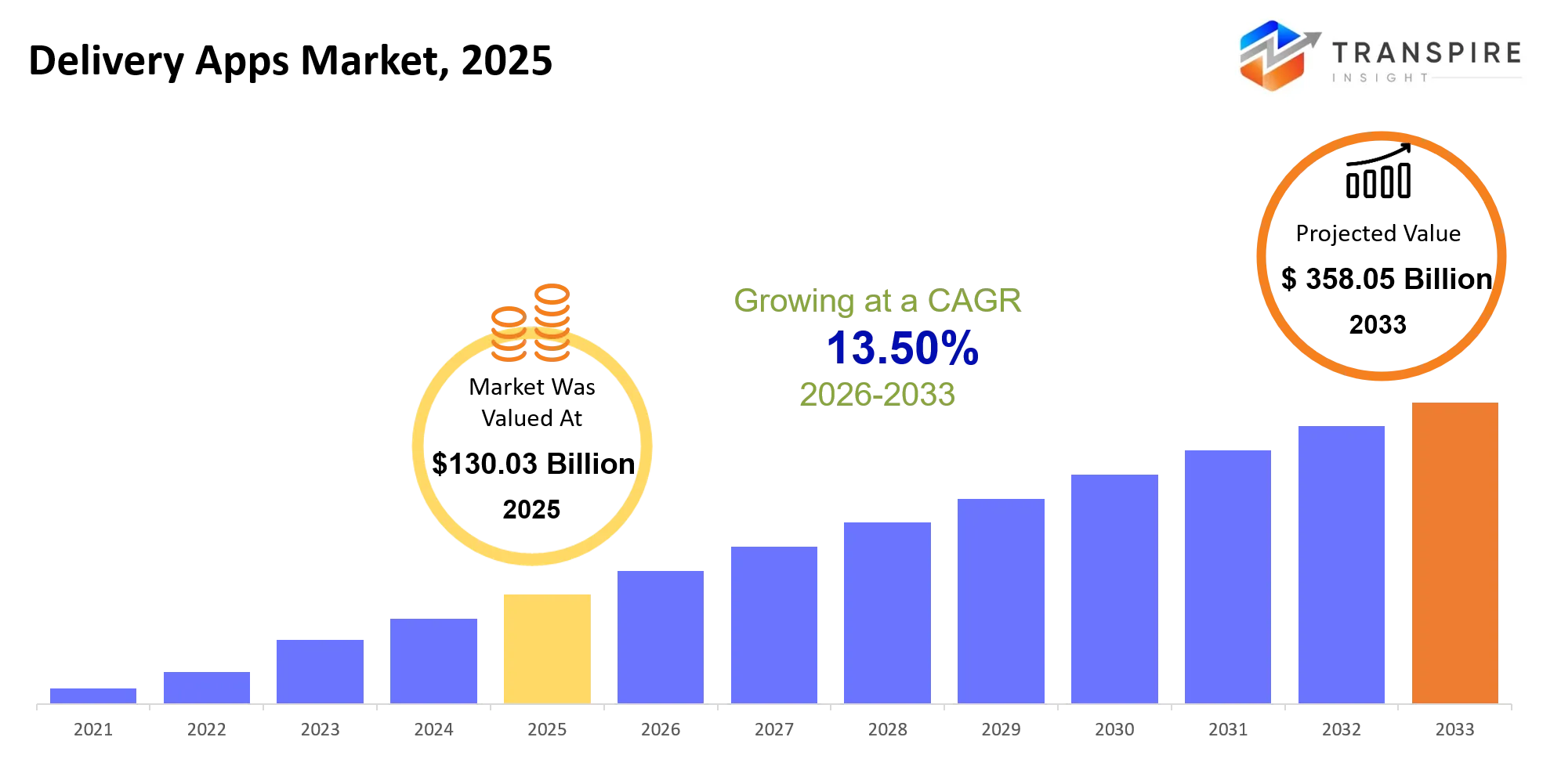
- Global Market Value (2025): USD 130.03 Billion.
- Expected Market Value (2026): USD 147.55 Billion.
- Estimated Market Value (2033): USD 358.05 Billion.
- Forecast CAGR (2026–2033): 13.50%
- Leading Region in 2025: North America
- Second-largest Region: Europe
- Fastest Growing Region: Asia Pacific
Introduction
The market of applications for delivery comprises digital commerce software, as well as systems for logistics, which make a connection between the end-user and a local business, restaurant, retailer, or delivery person. These applications perform a number of functions such as searching for products in real-time, making secure payments, processing orders, and tracking deliveries via GPS. Initially, delivery apps were used for prepared food only and now it has grown to include quick commerce, which includes all kinds of essentials, groceries, and retail goods. Quick commerce means an extremely fast on-demand delivery model in which goods, groceries, and basic necessities are delivered within 10-30 minutes. Delivery applications ensure a great level of convenience and availability of transactions any minute of the day and night, whether it is food, groceries, or some things that are needed without personal visits. The use of the global positioning system (GPS) enables people to track their orders in real time. Digital payments make the operation of money transfers extremely quick as well. There are a lot of different suppliers providing goods and services through delivery apps, so they all help their clients to engage more. These applications have extended the outreach of businesses, as these companies can now operate remotely, and their logistics complexity has reduced due to outsourcing the process of delivery. What is more, the usage of analytics allows companies to understand what the clients tend to buy most frequently, obtain the results of research about the peak times, and thus receive many other important information for business improvement.
For instance:-North America's market for delivery apps is thriving due to the habits that came after the pandemic and quick grocery expansion. This is why strategic investments have begun to focus on automated delivery strategies, drone deliveries, and supply chains that use AI technologies.
Market Highlights: -
- North America is anticipated to hold roughly 42% share of the Delivery Apps Market over the predicted timeframe.
- Europe is expected to grow at a rapid CAGR in the Delivery Apps Market by holding roughly27% of the share during the forecast period.
- Asia Pacific is anticipated to hold roughly15% share of the Delivery Apps Market over the predicted timeframe.
- By delivery type, the Food Delivery segment dominated the market and holds nearly 57% share in 2025 and is projected to grow at a substantial CAGR during the forecast period.
- By payment, the Digital Wallets segment dominated the market and holds nearly 54% share in 2025 and is projected to grow at a substantial CAGR during the forecast period.
- By application, the Retail segment dominated the market and holds nearly 32% share in 2025 and is projected to grow at a substantial CAGR during the forecast period.
- Open Network for Digital Commerce (ONDC): The ONDC is empowering Indian delivery applications under its interoperable digital trade program by allowing various buyers to shop through a common platform and using different apps, as well as connecting restaurants and partnering with logistics. In particular, ONDC’s food and beverage network is beneficial for the fasting of commission and better accessibility of the market since it allows independent restaurants to go digital and enhances the competition in the field of food delivery in India.
How is Technology Driving Growth in the Delivery Apps Market?
Through demand prediction, customized recommendations, and hyper-local stock-setting, artificial intelligence and predictive operations are shaping the food delivery apps market. AI algorithms enable the analysis of order behavior, climate conditions, and buying patterns to make the operational processes more efficient. Real-time GPS and smart routes dynamics improve delivery accuracy, shorten time-consuming trips, and help to assign drivers in more efficient ways. Comprehensive digital ecosystems, which include UPI, digital wallets and internet banking, make transactions easy. Cloud kitchens provide restaurants with tools for digitizing processes and lowering costs of real estate. In addition, cloud-based SaaS solutions offer small food companies scalable solutions with respect to ordering, delivery management, analytics, and customer engagement processes.
|
Report Metrics |
Details |
|
Market size value in 2025 |
USD 130.03 Billion |
|
Market size value in 2026 |
USD 147.55 Billion |
|
Revenue forecast in 2033 |
USD 358.05 Billion |
|
Growth rate |
CAGR of 13.50% from 2026 to 2033 |
|
Base year |
2025 |
|
Historical data |
2021 - 2024 |
|
Forecast period |
2026 - 2033 |
|
Report coverage |
Revenue forecast, competitive landscape, growth factors, and trends |
|
Regional scope |
United States; Canada; Mexico; United Kingdom; Germany; France; Italy; Spain; Denmark; Sweden; Norway; China; Japan; India; Australia; South Korea; Thailand; Brazil; Argentina; South Africa; Saudi Arabia; United Arab Emirates |
|
Key company profiled |
DoorDash, Uber Technologies, Delivery Hero, Just Eat Takeaway, Meituan, Swiggy, Zomato, Grab, Gojek, Deliveroo, Instacart, Amazon, Walmart, Alibaba, JD.com |
|
Customization scope |
Free report customization (country, regional & segment scope). Avail customized purchase options to meet your exact research needs. |
|
Report Segmentation |
By Delivery Type (Food Delivery, Grocery Delivery, Parcel Delivery, Medicine Delivery, Alcohol Delivery, Retail Delivery, Meal-kit Delivery, Others); By Platform Type (Marketplace Apps, Aggregator Apps, Direct-to-consumer Apps, On-demand Apps, Quick-commerce Apps, Subscription Apps, Fleet Platforms, Others); By Order Type (Scheduled, On-demand, Same-day, Instant, Next-day, Subscription-based, Bulk Orders, Others); By Customer Type (Individual Consumers, Businesses, Restaurants, Retailers, Grocery Stores, Pharmacies, E-commerce Merchants, Others); By Payment (Credit/Debit Cards, Digital Wallets, Cash, Bank Transfer, BNPL, UPI, Subscription, Others); By Delivery Mode (Motorcycles, Cars, Vans, Trucks, Bicycles, Autonomous Vehicles, Drones, Others); By Application (Food, Grocery, Retail, Healthcare, E-commerce, Restaurant, Corporate, Others) |
Market Drivers
The Delivery Apps Market experiences a rise due to the drastic penetration of smartphones and internet services which make it easy to place an order. Urbanization is contributing to an increase in dependence of customers on delivery services for meals, grocery items, and indispensable goods. Various online payment systems including e-wallets, UPI, credit cards, and direct payments simplify transactions for users. The introduction of quick-commerce was facilitated by dark stores and cloud kitchens. Additionally, the use of logistics and transportation technologies, GPS tracking systems, possibility of using artificial intelligence for demand forecasting, and automated parcel delivery is growing. Delivery apps allow businesses to extend their reach and cater to customers beyond their local vicinity or their physical locations. Online ordering platforms can minimize expenses as they increase revenues through better average basket sizes, impulsive purchases, and repeated purchases owing to increased convenience. Various advanced analytics allow valuable data about consumer preferences, busy ordering time, and purchasing habits, thus enabling businesses to improve stock and make necessary planning. Moreover, delivery-only concepts along with cloud kitchens minimize the obstacles to entering the market as there are much lower costs resulting from lack of physical stores and front-office personnel. Furthermore, different integrated marketing tools such as targeted advertisements, promotional campaigns or featured listings allow small and medium enterprises to accomplish their goal with the help of the efficient promotion and increase brand awareness.
For Instance: -
- The online food delivery sector in Russia is flourishing, with significant investment in infrastructure being seen, as noted in RWB Group (Wildberries) Among the prominent players, Yandex.Eda, Ozon, and SberMarket lead consolidation, applying innovative technologies and connecting with local state banking institutions to keep their quick-commerce going at high speed.
- In the UK delivery apps market, only a few companies like Uber Eats, Deliveroo, and Just Eat dominate. Demand for fast groceries has driven growth in this sector. Ongoing waves of consolidation in the sector are driven by such deals as DoorDash buying Deliveroo or the investments made by Prosus to buy Just Eat.
Restrain
There are various hurdles before the Delivery Apps Market such as the high delivery cost and labor cost along with exaggerated competitiveness due to many spending promotions and market commission rates leading to lower margins for the competitors. Regulations related to gig economy workers keep changing along with a constantly declining number of delivery persons thereby resulting in disruption of the provision of services whenever there is a negative situation in the delivery market.
|
Driver |
Relative Impact on Growth (%) |
Geographic Relevance |
Impact Timeline |
Demand Strength |
Growth Mechanism |
Key Beneficiaries |
Major Constraint |
|
Rapid adoption of quick commerce and hyperlocal delivery |
25% |
Asia-Pacific, North America, Europe |
Short-term |
High |
Accelerates instant ordering and repeat purchases |
Retailers, delivery platforms, logistics providers |
High fulfillment and last-mile costs |
|
Expansion of omnichannel retail and digital retailer integration |
22% |
North America, Europe, Asia-Pacific |
Medium-term |
High |
Connects stores, apps, inventory, and customers |
Retailers, app providers, technology vendors |
Complex system and inventory integration |
|
AI-driven personalization and delivery optimization |
19% |
North America, Asia-Pacific, Europe |
Medium-term |
High |
Improves recommendations, forecasting, and routing |
AI vendors, retailers, logistics providers |
Data quality and implementation costs |
|
Growth of mobile commerce and digital payments |
18% |
Asia-Pacific, North America, Europe |
Short-term |
High |
Simplifies mobile ordering, checkout, and transactions |
Retailers, payment providers, consumers |
Payment fees and cybersecurity risks |
|
Retailer digitization, open-commerce networks, and sustainable logistics |
16% |
Asia-Pacific, Europe, North America |
Long-term |
Medium |
Expands digital access and enables efficient fulfillment |
SMEs, retailers, logistics firms, technology providers |
Fragmented ecosystems and infrastructure gaps |
|
Total |
100% |
— |
— |
— |
— |
— |
— |
Analysis of Prices and Consumer Behaviour
The market for delivery apps is characterized by mobile apps (85.60% of the total food platform-to-consumer delivery revenue in 2025 mainly because of the convenience, access, and customized ordering that can be done through mobile phones). The share of aggregator platforms in the market is 60.95% in 2025, backed by the merchant network, logistics, and customer base. Around 49.15% of market revenue is attributed to digital wallets and UPI payment systems in 2025. The sales volume will be boosted by convenience, quick fulfillment, expansion of merchant base, and adoption of digital ordering. Grocery and convenience orders made up around 28.60% of market revenue in 2025. The buying habits of consumers demonstrate that 85.60% of revenue is obtained through mobile applications, demonstrating the tendency towards using smartphones and digital services. About 49.15% of market revenue comes from digital wallets and UPI payment systems.
|
Investment Factor |
Why It Matters to Investors |
Opportunity |
Investment Implication |
|
Quick-Commerce and On-Demand Expansion |
Why it is attractive: Expanding high-frequency delivery categories |
Grocery, convenience, pharmacy, and instant retail |
Medium-term investment in diversified delivery ecosystems |
|
AI-Driven Delivery Optimization |
Why it is attractive: AI improves operational efficiency and margins |
Predictive demand, dynamic routing, automated dispatch, personalization |
Long-term investment in logistics technology platforms |
|
Retailer and Merchant Digitization |
Why it is attractive: Digital merchants expand addressable delivery demand |
Retailer integration, merchant SaaS, inventory connectivity |
Medium-term opportunity in B2B delivery infrastructure |
|
Advertising and Subscription Monetization |
Why it is attractive: Multiple revenue streams strengthen platform economics |
Retail media, sponsored listings, memberships, loyalty programs |
Long-term opportunity for higher-margin recurring revenues |
|
Emerging-Market Geographic Expansion |
Why it is attractive: Urbanization supports expanding delivery ecosystems |
Asia-Pacific, Latin America, Middle East markets |
Medium-to-long-term expansion through localized platforms |
|
Autonomous and Sustainable Last-Mile Delivery |
Why it is attractive: Automation can reduce structural delivery costs |
Delivery robots, drones, electric fleets, smart fulfillment |
Long-term technology investment with execution risks |
Who are the Key Players in the Delivery Apps Market and how do they compete?
In order to become competitive in the international market of delivery apps, it is necessary to involve firms specializing in technology innovation, tailored solutions for customers, and creation of delivery networks internationally. It is necessary to compete not only in terms of prices but also with convenient ordering, digital payments, delivery tracking, AI recommendations, and integration with restaurants, retailers, and logistics providers. Such a strategy in competition contributes to constant platform evolution and allows for reaching customers better and more efficiently.
Creating intelligent delivery platforms, recommendation solutions based on AI, and logistics management, DoorDash increases its competitive advantage in the market. Creating platforms that will work fast in the restaurants, grocery, retail, and convenience segments, firms differentiate themselves from competitors. Uber Technologies builds its competitive advantage by providing comprehensive solutions in terms of food delivery, groceries, and local commerce by cooperating with merchants, couriers, and digital payments ecosystems.
Top Companies in the Delivery Apps Market
- DoorDash
- Uber Technologies
- Delivery Hero
- Just Eat Takeaway
- Meituan
- Swiggy
- Zomato
- Grab
- Gojek
- Deliveroo
- Instacart
- Amazon
- Walmart
- Alibaba
- JD.com
|
Company |
Est. Revenue Share Range |
Key Offerings |
Strategic Positioning |
Geographic Strength |
Technology Focus |
|
DoorDash |
9–13% |
Restaurant delivery, grocery delivery, DashPass, Drive, Wolt |
Platform ecosystem with diversified local commerce |
North America, Europe, Asia-Pacific |
AI routing, logistics optimization, personalization |
|
Meituan |
8–12% |
Food delivery, grocery delivery, instant retail, Keeta |
Technology-led local commerce ecosystem expansion |
Asia-Pacific, Middle East |
AI algorithms, autonomous delivery, intelligent dispatch |
|
Uber Technologies |
7–11% |
Uber Eats, grocery delivery, retail delivery, memberships |
Global multi-service platform leveraging network effects |
North America, Europe, Latin America |
AI matching, routing, marketplace optimization |
|
Delivery Hero |
6–10% |
Foodpanda, Talabat, Glovo, quick commerce |
Multi-brand regional platform and quick-commerce strategy |
Asia-Pacific, Europe, Middle East, Latin America |
AI dispatch, predictive analytics, cloud platforms |
|
Grab Holdings |
4–7% |
GrabFood, GrabMart, GrabUnlimited, merchant services |
Super-app ecosystem integrating mobility and delivery |
Southeast Asia |
AI logistics, mapping, digital payments |
|
iFood |
3–6% |
Food delivery, grocery, payments, logistics |
Regional scale strategy with merchant ecosystem integration |
Latin America, particularly Brazil |
AI logistics, predictive demand, digital payments |
|
Just Eat Takeaway |
3–5% |
Restaurant delivery, takeaway ordering, loyalty programs |
Restaurant marketplace and network-density specialization |
Europe, North America |
Data analytics, personalization, logistics technology |
|
Instacart |
2–4% |
Grocery delivery, retailer technology, advertising, fulfillment |
Retailer-integrated grocery delivery technology platform |
North America |
AI shopping, fulfillment automation, retail data |
|
Swiggy |
2–4% |
Food delivery, Instamart, Dineout, logistics |
Multi-category convenience platform with quick-commerce expansion |
Asia-Pacific, primarily India |
AI recommendations, demand forecasting, route optimization |
|
Rappi |
2–4% |
Food delivery, Rappi Turbo, groceries, payments |
Super-app strategy targeting high-frequency urban consumption |
Latin America |
AI personalization, logistics optimization, digital payments |
Market Segmentation
The Delivery Apps Market share is divided into seven categories: By delivery type, platform, order, customer, payment, delivery mode and application.
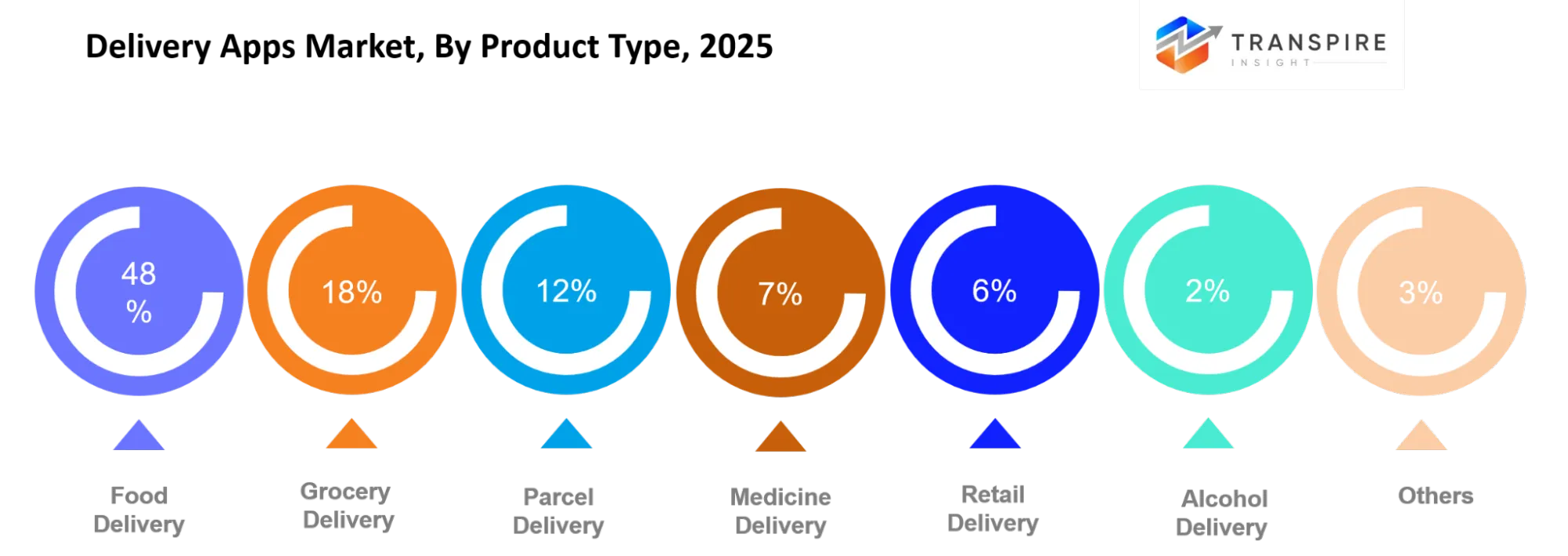
The Food Delivery dominated the market, accounting for nearly 57% in 2025 and is expected to rise at a significant CAGR during the forecast period.
The Delivery Apps Market is segmented by delivery type into Food Delivery, Grocery Delivery, Parcel Delivery, Medicine Delivery, Alcohol Delivery, Retail Delivery, Meal-kit Delivery, Others. Among these, the Food Delivery segment dominated the market, accounting for nearly 57% in 2025 and expected to increase at a significant CAGR during the forecast period. The Food Delivery category is the largest owing to increased mobile phone ownership, urbanization, online payment facilities, and customer preference towards convenient food delivery services. The growing involvement of restaurants in food deliveries, personalized service offerings, trackable orders, and effective last-mile deliveries have helped in making this market more successful.
The Digital Wallets dominated the market, accounting for nearly 54% in 2025, and is expected to rise at a significant CAGR during the forecast period.
The Delivery Apps Market is segmented by payment into Credit/Debit Cards, Digital Wallets, Cash, Bank Transfer, BNPL, UPI, Subscription, Others. Among these, the Digital Wallets segment dominated the market, accounting for nearly 54% in 2025 and expected to increase at a significant CAGR during the forecast period. The Digital Wallets category rules because of the rising trend in consumers opting for cashless transactions that are secure, faster, and more convenient. The rise in usage of smartphones, use of UPI, contactless payments, and in-app payment has helped this. Furthermore, digital wallets also help with promotions, loyalty benefits, and recurring payments.
The Retail dominated the market, accounting for nearly 32% in 2025 and is expected to rise at a significant CAGR during the forecast period.
The Delivery Apps Market is segmented by application into Food, Grocery, Retail, Healthcare, E-commerce, Restaurant, Corporate, Others. Among these, the Retail segment dominated the market, accounting for nearly 32% in 2025 and expected to increase at a significant CAGR during the forecast period. The Retail vertical holds the major share owing to the growing consumer demand for doorstep delivery of groceries, electronics, daily necessities, and household products. Growing e-commerce adoption, mobile phone adoption, online payments, personalized offers, and tracking of orders in real-time are fueling the growth of retail deliveries. Furthermore, rapid urbanization and quick-commerce services are boosting the demand in the Delivery Apps Market.
Regional Segment Analysis of the Delivery Apps Market:
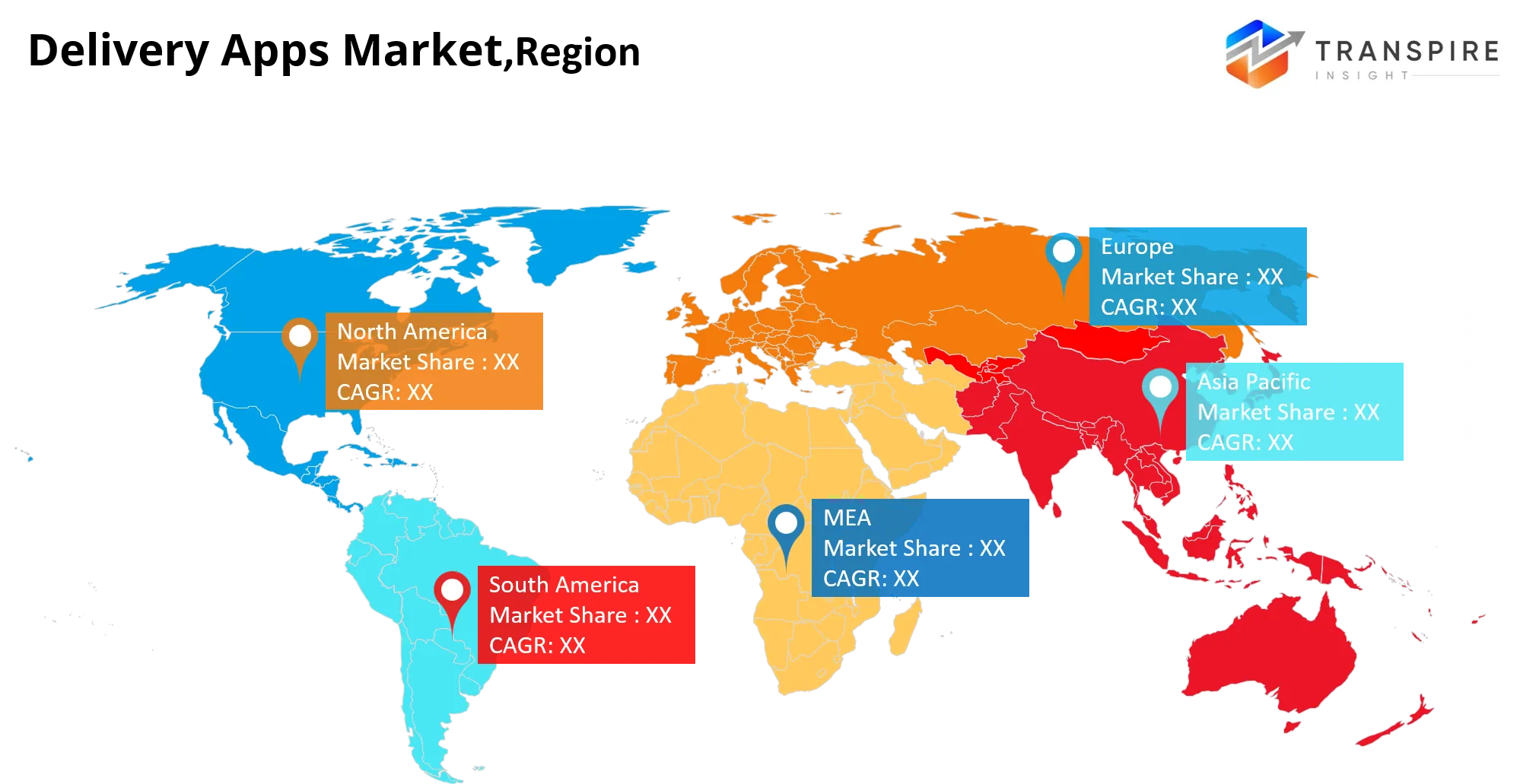
- North America (U.S., Canada, Mexico)
- Europe (Germany, France, U.K., Italy, Spain, Rest of Europe)
- Asia-Pacific (China, Japan, India, Rest of APAC)
- South America (Brazil and the Rest of South America)
- The Middle East and Africa (UAE, South Africa, Rest of MEA)
Asia Pacific is the fastest-growing region in the Delivery Apps Market during the period, holding roughly 42% share.
Asia Pacific is the fastest-growing region in the Delivery Apps Market during the forecast period, holding roughly 42% share during the forecast period. The Asia Pacific region is the fastest-growing one, driven by fast adoption of smartphones and internet usage, as well as the usage of digital payments. The factors driving the market include high urbanization, growth in the number of middle class people, rising demand for food and grocery delivery services, along with increased use of quick commerce networks.
North America is the fastest-growing region in the Delivery Apps Market during the period, holding roughly 27% share.
North America is expected to grow at a rapid CAGR in the Delivery Apps Market holding roughly 27% share during the forecast period. North America is experiencing robust growth in the Delivery Apps Market owing to the high penetration of smartphones, sophisticated digital payment systems, and the use of on-demand services by consumers. The rising demand for food, groceries, and retail delivery coupled with efficient logistics solutions, AI route optimization, and quick commerce applications keeps adding to the growth of the region's market.
Europe is expected to grow at a rapid CAGR in theDelivery Apps Market, holding roughly 15% of the share during the forecast period.
Europe is expected to grow at a rapid CAGR in the Delivery Apps Market holding roughly 15% share during the forecast period. Europe is projected to register a swift CAGR as a result of growing usage of smartphones and mobile payments as well as demand from consumers for easy access to food, grocery, and retail delivery services. The increase in e-commerce, urbanization, fast commerce, and sophisticated logistics infrastructure is driving the use of delivery apps even more, along with technology advancements in the region.
Strategies for Market Growth in Non-Leading Regions:
The development of delivery app services technology in underdeveloped areas would be useful to small or medium-sized restaurants, retailers and other businesses. Local business acquisition and delivery network setup would help decrease reliance on major aggregators and lower delivery and overall costs. Strategic partnership formation with regional restaurants, retailers, logistics and delivery distributors would facilitate the market penetration for delivery app service providers. To raise the level of competence in digital ordering, app management, delivery optimization, customer communication and platform integration, professional training and technical skills improvement would be necessary. Moreover, different financing and long-term service agreements would be needed to make delivery app services more affordable and popular among consumers. Collaborative initiatives with government and digital commerce and logistics projects, as well as the usage of digital selling approach, would increase access to delivery app services and contribute to sustainable market growth throughout the world in developing nations.
Future Market Trends for the Delivery Apps Market: -
- Expansion to Quick Commerce & Non-Grocery: Delivery apps have started venturing into non-food categories with delivery in 10-15 minutes such as fashion, electronics, and pharmaceuticals.
- Tier-II and Tier-III City Penetration: Major delivery companies have reached out operations in Tier II and even Tier III cities to meet growth in local demand.
- AI-Powered Hyper-Personalized Services: Applications use AI and machine learning principles to predict orders, offer local suggestions, and navigate logistics operations.
- Autonomous & Eco-Friendly Logistics: Investigations on the delivery process by means of robots and drones, coupled with sustainable green packaging are in progress.
Recent Development
- In January 2026: India's Department of Posts has successfully completed its maiden online delivery using the ONDC enabled platform as a Logistics Service Provider. With this new initiative, the last mile logistics capabilities in the Indian Delivery Apps Market have invigorated. The public sector is now able to add variety to the delivery options offered by digital sellers, thus facilitating more MSMEs to join in.
- In August 2026: Flipkart rolled out its ONDC-based food delivery pilot in Bengaluru with commissions for restaurants expected to be around 10%. This program contributes to the Indian Delivery Apps Market by giving restaurants one more way to take orders digitally while fostering competition in prices and platform options in the developing online food delivery landscape.
This study forecasts revenue at global, regional and country levels from 2020 to 2033. Transpire Insights has segmented the Delivery Apps Market based on the below-mentioned segments:
Delivery Apps Market, By Delivery Type
- Food Delivery
- Grocery Delivery
- Parcel Delivery
- Medicine Delivery
- Alcohol Delivery
- Retail Delivery
- Meal-kit Delivery
- Others
Delivery Apps Market, By Platform Type
- Marketplace Apps
- Aggregator Apps
- Direct-to-consumer Apps
- On-demand Apps
- Quick-commerce Apps
- Subscription Apps
- Fleet Platforms
- Others
Delivery Apps Market, By Order Type
- Scheduled
- On-demand
- Same-day
- Instant
- Next-day
- Subscription-based
- Bulk Orders
- Others
Delivery Apps Market, By Customer Type
- Individual Consumers
- Businesses
- Restaurants
- Retailers
- Grocery Stores
- Pharmacies
- E-commerce Merchants
- Others
Delivery Apps Market, By Payment
- Credit/Debit Cards
- Digital Wallets
- Cash
- Bank Transfer
- BNPL
- UPI
- Subscription
- Others
Delivery Apps Market, By Delivery Mode
- Motorcycles
- Cars
- Vans
- Trucks
- Bicycles
- Autonomous Vehicles
- Drones
- Others
Delivery Apps Market, By Application
- Food
- Grocery
- Retail
- Healthcare
- E-commerce
- Restaurant
- Corporate
- Others
Delivery Apps Market, By Regional Analysis
North America
- US
- Canada
- Mexico
Europe
- Germany
- UK
- France
- Italy
- Spain
- Russia
- Rest of Europe
Asia Pacific
- China
- Japan
- India
- South Korea
- Australia
- Rest of Asia Pacific
South America
- Brazil
- Argentina
- Rest of South America
Middle East & Africa
- UAE
- Saudi Arabia
- Qatar
- South Africa
- Rest of the Middle East & Africa
Frequently Asked Questions
Find quick answers to common questions.
The market is driven by smartphone adoption, digital payments, quick commerce, urbanization, AI-powered logistics, and increasing consumer demand for convenient, fast deliveries.
Food Delivery dominates, accounting for nearly 57% in 2025, supported by rising online food ordering, smartphone usage, digital payments, and consumer preference for doorstep delivery.
AI enables demand forecasting, personalized recommendations, intelligent order allocation, dynamic route optimization, and predictive logistics, improving delivery efficiency and customer experience.
Digital Wallets lead with nearly 54% share in 2025, driven by convenient, secure, fast, and increasingly integrated cashless payment solutions.
Key trends include quick commerce, expansion into non-grocery categories, Tier-II and Tier-III penetration, AI-powered personalization, autonomous delivery, drones, and sustainable logistics.
- DoorDash
- Uber Technologies
- Delivery Hero
- Just Eat Takeaway
- Meituan
- Swiggy
- Zomato
- Grab
- Gojek
- Deliveroo
- Instacart
- Amazon
- Walmart
- Alibaba
- JD.com
About the Authors

Mayur Shinde
I am Mayur Shinde, a Senior Research Analyst at Transpire Insight, specializing in the Automotive & Transportation and Information & Communication Technology (ICT) Industry. My work focuses on analyzing emerging market trends, technological advancements, competitive landscapes, and industry developments to deliver accurate, data-driven insights. I am passionate about transforming complex market information into clear, actionable content that helps businesses, professionals, and decision-makers stay informed and make confident strategic decisions.

Chakradhar Khansole
Chakradhar serves as the Research Director at Transpire Insight, bringing over 8 years of experience in technology, innovation, and strategic market intelligence. He specializes in transforming complex market data into actionable business insights that enable organizations to make informed, growth-oriented decisions. Recognized for his strategic vision and analytical expertise, Chakradhar leads high-impact research initiatives, delivering comprehensive market assessments, competitive intelligence, and forward-looking industry analysis.
Recently Published Reports
-
Apr 2026
3D Optical Profiler Market
3D Optical Profiler Market Size, Share & Analysis Report By Type (Desktop 3D Optical Profiler, and Portable 3D Optical Profiler), By Technology (Confocal Technology, and White Light Interference), By End-Use Industry (Manufacturing, Research Institutions, Automotive, Aerospace and Defense, Medical Devices, and Other), and Geography (North America, Europe, Asia-Pacific, Middle East and Africa, South and Central America), 2021 - 2031
-
Apr 2026
Depth Sensor Market
Depth Sensor Market Size, Share & Analysis Report By Type (Infrared Depth Sensors, Time-of-Flight (ToF) Sensors, Stereo Vision Sensors, Structured Light Sensors, Ultrasonic Depth Sensors), By Application (Automotive, Robotics, Gaming, Consumer Electronics, Industrial Automation, Healthcare, Security & Surveillance, Others), By End Users (Automotive Manufacturers, Consumer Electronics Companies, Healthcare Providers, Industrial Companies, Security Agencies, Gaming Companies, Robotics Companies, Others), and Geography (North America, Europe, Asia-Pacific, Middle East and Africa, South and Central America), 2021 – 2031
-
Apr 2026
Digital Manufacturing Market
Digital Manufacturing Market Size, Share & Analysis Report By Component (Hardware, Software, and Services), By Technology (Robotics, 3D Printing, Internet of Things (IoT), and Others), By Application (Automotive and Transportation, Aerospace and Defense, Consumer Electronics, Industrial Machinery, and Others), By Process Type (Computer-Based Designing, Computer-Based Simulation, Computer 3D Visualization, Analytics, and Others), and Geography (North America, Europe, Asia-Pacific, Middle East and Africa, South and Central America), 2021 – 2031
-
Apr 2026
Digital Visa Services Market
Digital Visa Services Market Size, Share & Analysis Report By Type (Individual Travelers, Group Travelers), By Application (Tourism, Business Travel, Others), and Geography (North America, Europe, Asia-Pacific, Middle East and Africa, South and Central America), 2021 – 2031