

Dehydrated Garlic Market Summary:
As per Transpire Insight Analysis, the Dehydrated Garlic Market size is estimated at USD 2.96 Billion in 2025 and is anticipated to reach USD 3.92 Billion by 2033, growing at a CAGR of 3.55% from 2026 to 2033. The growth is due to increased demand for processed foods and convenience foods, an increase in applications in food processing, and the requirement for products with extended shelf life.
The dehydrated garlic market is really important for the food industry. It gives people easy-to-use products that can be stored for a long time. These products are used for things like seasonings. Ready-to-eat meals. Dehydrated garlic is also used in bakeries. To make meat products taste better. Food companies like dehydrated garlic because it helps them make food that always tastes the same. It is also easier to store. Helps them make food more efficiently.
People are eating processed food and going to fast food places more often. This means that the demand for dehydrated garlic is getting stronger. More people are also buying food from other countries. A lot of people now want to buy premium and organic dehydrated garlic. This is making companies try to make products. People like food that's easy to make and has simple ingredients. This is why dehydrated garlic is being used more in restaurants and food factories. Food companies want products that can be stored for a time and do not go bad easily. They also want to reduce waste and have ingredients that they can always get. This is why dehydrated garlic is becoming more popular. It is popular in both markets and in markets that sell food to other countries. The dehydrated garlic market is really important. It will keep growing as people want more convenient food options.
Dehydrated Garlic Market Size & Forecast:
- Market Size 2025: USD 2.96 Billion
- Expected Market Value (2033): USD 3.92 Billion
- Forecast CAGR (2026–2033): 3.55%
- Leading Region in 2025: Asia Pacific
- Fastest Growing Region: North America
- Key Company Profiles: Olam Food Ingredients, McCormick & Company, Sensient Technologies, Jain Farm Fresh Foods, V.T. Foods, Garlico Industries, BC Foods, Silva International, Kanegrade, Döhler, Frontier Co-op, Natural Dehydrated Vegetables, Van Drunen Farms, Symrise, Qingdao Deesheng Foods.

Key Market Insights:
There is continuous development as producers focus on ingredient consistency, increased shelf-life and improved efficiency in the production process. The increase in innovation in the production process as well as increased production of better quality products increases competition in both domestic and foreign markets.
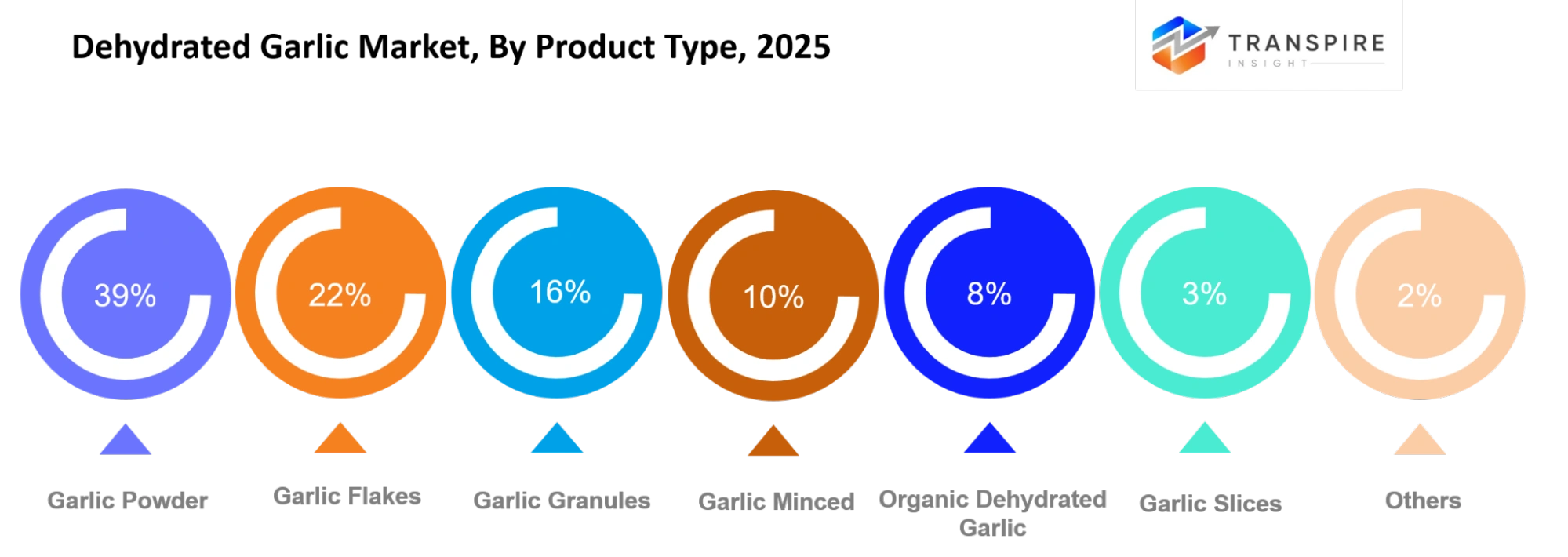
- Garlic powder forms 39% of the product segment because of its wide application in seasoning, sauce, snack, and processed food formulation due to its easy mixing nature and long shelf-life.
- Organic dehydrated garlic is the fastest-growing segment of dehydrated garlic, and it will grow at a CAGR of 15.6%. This growth is driven by increasing consumer preference for natural or clean-label food ingredients.
- Garlic flakes constitute 22% of the segment, as food processors have come up with more efficient drying technology, which helps in preserving the aroma, texture, and nutritive value of the garlic flakes for food service applications.
- Garlic granules make up 16% of the segment and have become popular with spice processors due to their uniform particle size and improved production efficiency.
- Garlic minced makes up 10% of the segment, due to increasing demand from the ready-to-cook meal manufacturers for convenient ingredients.
- Garlic slices constitute 3% of the segment and have found specific applications in gourmet food products.
- Other dehydrated garlic products make up 2% of the segment and find specific industrial applications.
- The key players have been making significant investments in modern drying systems, automated manufacturing lines, and export-oriented production facilities.
What are the Key Drivers, Restraints, and Opportunities in the Dehydrated Garlic Market?
Drivers
There is an increasing demand in the market as food processors make use of dehydrated garlic to increase their production efficiencies without compromising on the taste and quality of the products. One of the key reasons behind this is the quick expansion of the market for processed foods, ready-to-eat foods, seasonings, and the foodservice industry. The adoption of dehydrated garlic has become popular among manufacturers due to the longer shelf life, reduced storage costs, decreased wastage of raw materials, and year-round availability of the ingredients.
Restraints
The market is faced with challenges due to changes in the amounts of garlic harvests and their prices as a result of weather damage to crops, changes in cultivation practices, and other factors which may influence the supply and price of fresh garlic. Due to high dependence on agriculture, producers of dehydrated garlic face volatile procurement prices.
Opportunities
The increasing demand for premium dehydrated and organic dehydrated garlic presents a great chance for the companies. More customers begin to pay attention to the quality of their food, which makes it necessary for processors to implement new dehydration technologies, tracing systems, and organic certification processes. The companies that develop their product lines with added value exports-oriented products can benefit from this trend greatly.
What Has the Impact of Artificial Intelligence Been on the Dehydrated Garlic Market?
AI is progressively refining the way dehydrated garlic is manufactured, examined, and delivered within the food sector. Companies are using intelligent surveillance systems to ensure that the conditions for drying are optimised by monitoring the temperature, humidity, and moisture. As a result, the quality becomes more uniform, there is less energy used, and fewer losses in the process of manufacture.
Not only manufacturing but also other stages are becoming more efficient thanks to AI. Predictive analytics is employed to conduct demand forecasting with regard to past sales, seasonal consumption patterns, and exports. In this way, it is possible to plan the inventory and the supply of raw materials in an optimal way, which helps avoid having excess products or their shortage. Computer vision can be used for quality control as well. The application of the technology on a wider scale faces obstacles for several small and medium-sized processors because of the expensive implementation of AI technology, the integration of AI into the already existing production system, and the necessity for skilled specialists who will control all the processes that are based on artificial intelligence. In March 2025, Buhler Group implemented more extensive utilisation of its artificial intelligence-based optical sorting and digital quality inspection technologies in the production of vegetables and dried foods. These AI-based sorting solutions assist processors of dehydrated garlic to accurately identify discoloured products, foreign objects, and any quality issues, minimising waste, lowering operational costs, and ensuring product uniformity.
Key Market Trends
There is a gradual change happening in the dehydrated garlic market due to the concerns of food manufacturers regarding ingredient quality, manufacturing process efficiency, and changing consumer trends. The changes are happening in areas like advances in manufacturing technology, development of products with a clean label, and export-oriented manufacturing.
- Organic dehydrated garlic, as well as garlic that does not have any preservatives, is being preferred by food manufacturers because of the growing preference for clean-label food ingredients among consumers.
- With the help of modern drying processes such as freeze drying and vacuum drying, conventional drying processes are being phased out to enhance the taste, product quality, and shelf life.
- Processors are adopting automation techniques in their operations, which helps them to achieve consistency in their manufacturing processes and reduces waste.
- Due to increasing demands from food processing companies abroad, export-oriented processors are enhancing their manufacturing capacities and logistics chains.
- Increasing demands are coming from the ready-to-eat meals and convenience foods segment.
Dehydrated Garlic Market Segmentation
By Product Type
Garlic Powder is the leader in the market, accounting for 39% of the total market share as it is one of the most versatile, long-lasting products that find extensive applications in the preparation of seasonings, processed foods, sauces, and snacks. Garlic Flakes have a market share of 22%, Garlic Granules have 16%, while Garlic Minced has a market share of 10%. These types of garlic are widely used in commercial kitchens and processing facilities for the convenience and consistent flavour offered by them. The fastest-growing market segment is Organic Dehydrated Garlic with a market share of 8%, growing at a Compound Annual Growth Rate of 15.6%. Garlic Slices and Others account for 3% and 2% market share, respectively.
By Application
Food Processing continues to dominate the application segment owing to the extensive use of dried garlic in food processing applications like packaging, sauces, soups, frozen products, and seasoning blends. The Seasoning segment is experiencing growth owing to the emergence of customised spice products for different end users. Ready to Eat Meal is another growing demand owing to the increasing preference of consumers towards convenience food products. Bakery and Meat products use dehydrated garlic in order to provide a consistent flavour and prolong the shelf life of their products.
By End User
The category of Food Manufacturers is the leading end user as they need to have reliable ingredient quality, uniform flavour, and constant availability of supplies for mass manufacturing. The use of dehydrated garlic among restaurants has increased to enhance the efficiency of their kitchens and save on preparation time, while retail consumers are using more shelf-stable ingredients for cooking at home. Spices Manufacturers make use of dehydrated garlic in formulating their seasonings, while Nutraceuticals Manufacturers include garlic ingredients in health foods. Increasing export demands have also led to the significance of Exporters.
By Distribution Channel
Direct Sales have been favoured by bulk industrial customers in favour of purchasing contracts. Wholesalers and Export Channels have played a crucial part in developing our company’s international market reach, while Supermarkets & Hypermarkets will keep serving our retail customers through widespread availability of products. Speciality Stores target the markets with premium and organic product lines, and Online Retail has been gaining popularity with the growing tendency of purchasing food ingredients via the Internet.
By Processing Method
Air Drying still prevails in industrial production since it provides a balanced ratio of quality and cost effectiveness. Freeze Drying is getting more popular in high-end product manufacturing, since it retains flavour, aroma, and food characteristics much better. Vacuum Drying is becoming a more preferred method in high-quality food production where more effective moisture retention is needed, whereas Spray Drying provides an opportunity to make garlic powder for seasoning producers. Solar Drying and other alternatives are slowly gaining popularity among companies producing their products using efficient manufacturing technologies.
What are the Key Use Cases Driving the Dehydrated Garlic Market?
The largest usage of dehydrated garlic occurs in the food processing industry, in which Garlic Powder, one of the product segments, is extensively used as an ingredient in seasoning mixes, sauces, soups, frozen products, and packaged food products. The longer shelf life, flavour consistency, and easy storage characteristics of the ingredient make it an ideal choice for food manufacturers.
Usage of the ingredient is growing in the category of ready-to-eat food products, bakery products, meat products, snack foods, and restaurants where food manufacturers prefer reduced preparation times, efficient stock management, and improved quality of the food products.
Increased usage of dehydrated garlic in nutraceuticals and premium food products sectors is observed due to rising awareness about clean-label food products and value-added food products among manufacturers, which is expected to provide significant growth opportunities to manufacturers of dehydrated garlic. Organic dehydrated garlic, the fastest-growing segment, has huge potential in the domestic market
|
Report Metrics |
Details |
|
Market size value in 2025 |
USD 2.96 Billion |
|
Market size value in 2026 |
USD 3.07 Billion |
|
Revenue forecast in 2033 |
USD 3.92 Billion |
|
Growth rate |
CAGR of 3.55% from 2026 to 2033 |
|
Base year |
2025 |
|
Historical data |
2021 - 2024 |
|
Forecast period |
2026 - 2033 |
|
Report coverage |
Revenue forecast, competitive landscape, growth factors, and trends |
|
Regional scope |
United States; Canada; Mexico; United Kingdom; Germany; France; Italy; Spain; Denmark; Sweden; Norway; China; Japan; India; Australia; South Korea; Thailand; Brazil; Argentina; South Africa; Saudi Arabia; United Arab Emirates |
|
Key company profiled |
Olam Food Ingredients, McCormick & Company, Sensient Technologies, Jain Farm Fresh Foods, V.T. Foods, Garlico Industries, BC Foods, Silva International, Kanegrade, Döhler, Frontier Co-op, Natural Dehydrated Vegetables, Van Drunen Farms, Symrise, Qingdao Deesheng Foods. |
|
Customization scope |
Free report customization (country, regional & segment scope). Avail customized purchase options to meet your exact research needs. |
|
Report Segmentation |
By Product Type (Garlic Powder, Garlic Flakes, Garlic Granules, Garlic Minced, Garlic Slices, Organic Dehydrated Garlic, Roasted Garlic Powder, Others); By Application (Food Processing, Seasonings, Ready-to-Eat Meals, Bakery Products, Meat Products, Snacks, Nutraceuticals, Others); By End User (Food Manufacturers, Restaurants, Retail Consumers, Spice Companies, Nutraceutical Companies, Exporters, Others); By Distribution Channel (Direct Sales, Supermarkets & Hypermarkets, Specialty Stores, Online Retail, Wholesalers, Export Channels, Others); By Processing Method (Air Drying, Freeze Drying, Vacuum Drying, Spray Drying, Solar Drying, Others). |
Which Regions are Driving the Dehydrated Garlic Market Growth?
North America
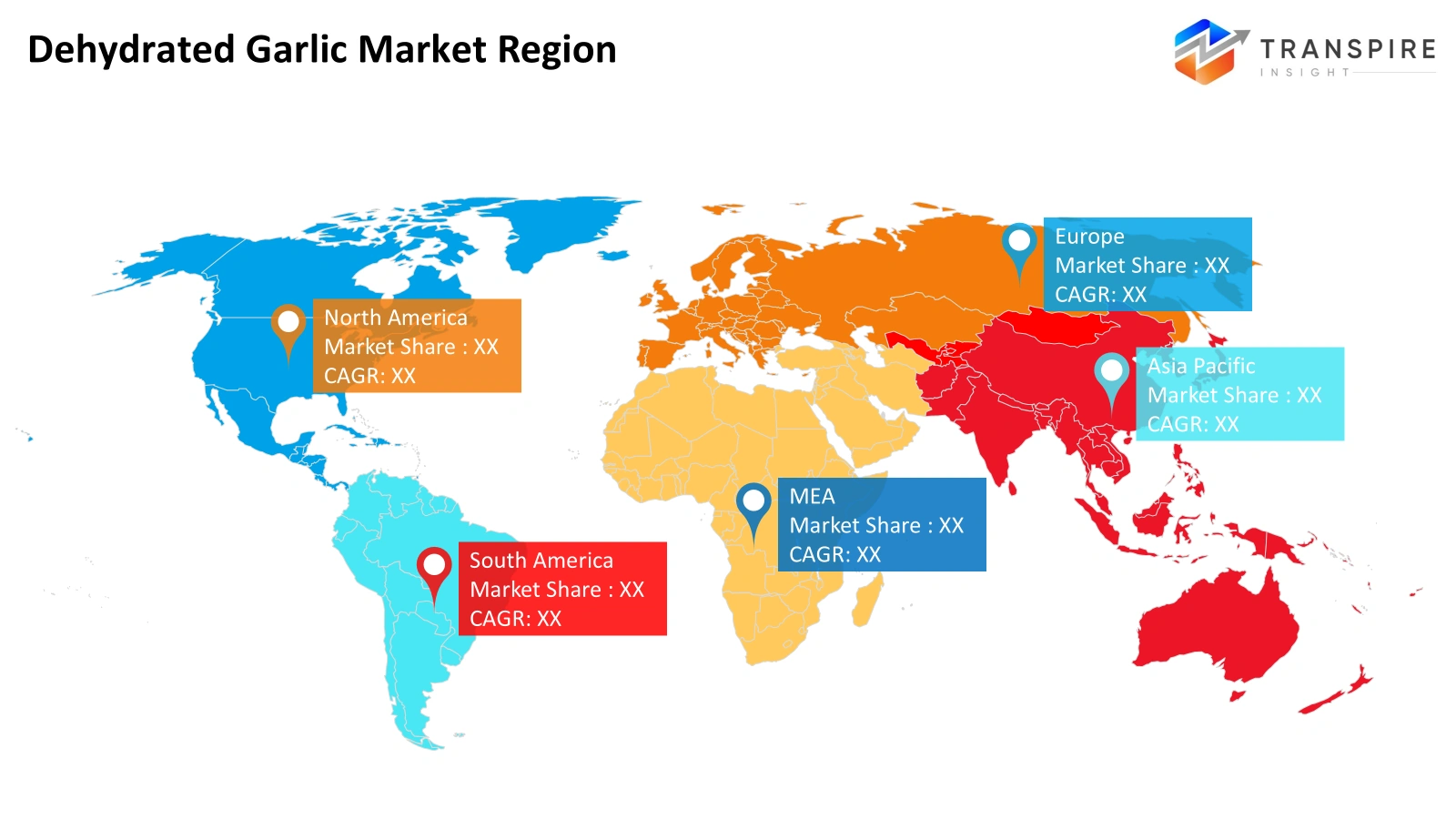
North America, which has a 24% market share, is the fastest-growing region, and the compound annual growth rate during the forecast period will be estimated to be 16.4%. Growth in demand for convenience foods, ready-to-eat meals, and superior seasonings has increased the usage of dehydrated garlic in the food manufacturing and foodservice sectors. Investment in automation and increasing popularity of organic food ingredients will provide new growth opportunities. All these factors will help solidify the position of North America as the fastest-growing region.
Europe
Europe, which accounts for 24% of the worldwide market, exhibits steady growth owing to its strong emphasis on food quality, traceability, and high-end products. As against Asia Pacific, the value-added and specialized dehydrated garlic is extensively used in Europe. The stringent regulations on food safety and rising trends of consumption of clean label and organic food ingredients compel companies to adopt technology.In June 2025, Garlic Solutions (Netherlands) introduced a 100% recyclable pouch packaging for peeled garlic cloves, which increases shelf-life and reduces the use of plastic by 73%. This development underscores the European focus on sustainable value-added garlic products.
Asia Pacific
The Asia Pacific region holds a leading position in the market for dehydrated garlic, with a market share of 44%, which is attributed to its large-scale cultivation of garlic and its highly developed food manufacturing sector. Nations like China and India supply plenty of material inputs in the region; thus, manufacturers in the Asia Pacific region enjoy the benefit of a competitive cost structure as well as steady availability of products.
Who are the Key Players in the Dehydrated Garlic Market and how do they Compete?
The competition within the market for dehydrated garlic depends on product quality, efficiency of processing, pricing methods, and exports. The differentiation of firms is done through investment in technology of dehydration, safety of products, and expansion into new export markets. It has become one of the main ways to build relations with customers in the food processing industry because of quality, custom format, and supply reliability.
Jiyan Food Ingredients, Garlico Industries Ltd., V.T. Foods Pvt. Ltd., and Jain Farm Fresh Foods Ltd. are some of the major competitors who compete through providing a wide range of products, including garlic powder, flakes, granules, and others in dehydrated form. Many companies give attention to the process of automation, certification of products, and customisation of packing in order to meet the demands of food processors, seasoning producers, and export clients. Some other important participants that are growing through export partnerships, capacity expansions, and development of high-end and organic products include Henan Sunny Foodstuff Co., Ltd., Natural Dehydrated Vegetables Pvt. Ltd., Silva International, Inc., and Oceanic Foods Limited. Through the improvement of traceability, sustainability of their processing systems, and focusing on growth markets internationally, these firms have been successfully able to grow their market reach in response to changing market conditions and consumer demands.
Dehydrated Garlic Marketcompanies
- Olam Food Ingredients
- McCormick & Company
- Sensient Technologies
- Jain Farm Fresh Foods
- V.T. Foods
- Garlico Industries
- BC Foods
- Silva International
- Kanegrade
- Döhler
- Frontier Co-op
- Natural Dehydrated Vegetables
- Van Drunen Farms
- Symrise
- Qingdao Deesheng Foods
Recent Development News
In March 2026, Jain Farm Fresh Foods Ltd. increased its capacity to process dehydrated vegetables by modernising its manufacturing units to enhance efficiency in production and cater to increasing exports of dehydrated garlic and other dehydrated vegetable products. This move is expected to improve the company's supply capacities in the market.
Source: https://www.jainfarmfresh.com/
In September 2025, Silva International, Inc. launched new sustainably sourced dehydrated vegetable and herb ingredients, including garlic-derived products, to cater to the increasing demand for such ingredients among food producers. The move helped the company solidify its position in the premium food ingredients category.
Source: https://silva-intl.com/
What Strategic Insights Define the Future of the Dehydrated Garlic Market?
The market for dehydrated garlic is forecasted to develop because food producers will become more focused on the issues of consistency, efficiency, and high-quality ingredients. Growing demand for organic and minimally processed food items will lead to further implementation of advanced dehydration technologies and high-level quality assurance processes. Yet one more potential risk is associated with dependence of the industry on fluctuations of garlic harvest and corresponding supply problems and increased production expenses. On the other hand, growing opportunities to expand export markets and increase investment into the production of value-added and organic products will create substantial growth opportunities for manufacturers. Those producers who pay attention to increasing supply chain flexibility, diverse sources of raw materials, energy-saving processing technologies, and high-quality certification of their products will benefit from the developing market environment.
Key Segmentations are:
By Product Type
- Garlic Powder
- Garlic Flakes
- Garlic Granules
- Garlic Minced
- Garlic Slices
- Organic Dehydrated Garlic
- Roasted Garlic Powder
By Application
- Food Processing
- Seasonings
- Ready-to-Eat Meals
- Bakery Products
- Meat Products
- Snacks
- Nutraceuticals
By End User
- Food Manufacturers
- Restaurants
- Retail Consumers
- Spice Companies
- Nutraceutical Companies
- Exporters
By Distribution Channel
- Direct Sales
- Supermarkets & Hypermarkets
- Speciality Stores
- Online Retail
- Wholesalers
- Export Channels
By Processing Method
- Air Drying
- Freeze Drying
- Vacuum Drying
- Spray Drying
- Solar Drying
Regional Outlook
North America
- United States
- Canada
- Mexico
Europe
- Germany
- United Kingdom
- France
- Spain
- Italy
- Rest of Europe
Asia Pacific
- Japan
- China
- Australia & New Zealand
- South Korea
- India
- Rest of Asia Pacific
South America
- Brazil
- Argentina
- Rest of South America
Middle East & Africa
- Saudi Arabia
- United Arab Emirates
- South Africa
- Rest of the Middle East & Africa
Frequently Asked Questions
Find quick answers to common questions.
The dehydrated garlic market size was valued at USD 2.96 Billion in 2025 and is poised to reach USD 3.92 Billion by 2033, expanding at a 3.55% CAGR.
Key segments for the dehydrated garlic market are By Product Type (Garlic Powder, Garlic Flakes, Garlic Granules, Garlic Minced, Garlic Slices, Organic Dehydrated Garlic, Roasted Garlic Powder, Others); By Application (Food Processing, Seasonings, Ready-to-Eat Meals, Bakery Products, Meat Products, Snacks, Nutraceuticals, Others); By End User (Food Manufacturers, Restaurants, Retail Consumers, Spice Companies, Nutraceutical Companies, Exporters, Others); By Distribution Channel (Direct Sales, Supermarkets & Hypermarkets, Specialty Stores, Online Retail, Wholesalers, Export Channels, Others); By Processing Method (Air Drying, Freeze Drying, Vacuum Drying, Spray Drying, Solar Drying, Others).
Growth is primarily driven by an increase in demand for convenient and shelf-stable food ingredients, an increase in consumption of prepared foods, growth in use in foodservice applications, trade in spices, and an increase in consumer preference for natural flavouring agents.
The market is led by major manufacturers including Olam Food Ingredients, McCormick & Company, Sensient Technologies, Jain Farm Fresh Foods, V.T. Foods, Garlico Industries, BC Foods, Silva International, Kanegrade, Döhler, Frontier Co-op, Natural Dehydrated Vegetables, Van Drunen Farms, Symrise, Qingdao Deesheng Foods.
The Asia-Pacific region accounts for 44% of the dehydrated garlic market due to the presence of huge volumes of garlic cultivation in countries like China and India, cheap processing costs, efficient export facilities, and increasing demand from the food industry sector.
The business opportunities include growing demand for convenience foods, increased use of dehydrated garlic in sauces and seasoning and pre-cooked foods, export potential, increasing private label foods, and developments in sustainable processing and packaging technologies.
- Olam Food Ingredients
- McCormick & Company
- Sensient Technologies
- Jain Farm Fresh Foods
- V.T. Foods
- Garlico Industries
- BC Foods
- Silva International
- Kanegrade
- Döhler
- Frontier Co-op
- Natural Dehydrated Vegetables
- Van Drunen Farms
- Symrise
- Qingdao Deesheng Foods
About the Authors

Chetan Dhatrak
I’m Chetan Dhatrak, a Senior Research Analyst at Transpire Insight, specializing in the Consumer Goods, Foods and Beverages industry. I focus on analyzing market trends, consumer behavior, competitive landscapes, and industry developments to deliver accurate, data-driven insights. My research at Transpire Insight is built on credible sources and in-depth analysis, helping businesses and readers better understand market dynamics, emerging opportunities, and evolving consumer preferences. I’m committed to creating reliable, well-researched content that supports informed decision-making and reflects the latest developments in the consumer goods and food & beverage sectors.

Chakradhar Khansole
Chakradhar serves as the Research Director at Transpire Insight, bringing over 8 years of experience in technology, innovation, and strategic market intelligence. He specializes in transforming complex market data into actionable business insights that enable organizations to make informed, growth-oriented decisions. Recognized for his strategic vision and analytical expertise, Chakradhar leads high-impact research initiatives, delivering comprehensive market assessments, competitive intelligence, and forward-looking industry analysis.
Recently Published Reports
-
Apr 2026
Baby Infant Formula Market
Baby Infant Formula Market Size, Share & Analysis Report By ype (Infant Milk, Follow On Milk, Specialty Baby Milk, Growing-Up Milk), By Ingredient (Carbohydrate, Fat, Protein, Minerals, Vitamins, and Others), By Product Form (Powder, Liquid, and Ready-to-feed), By Distribution Channels (Supermarket/Hypermarket, Specialty Store, Pharmacies, Online Retail, and Others), and Geography (North America, Europe, Asia-Pacific, Middle East and Africa, South and Central America), 2021 - 2031
-
Apr 2026
Edible Insects for Animal Feed Market
Edible Insects for Animal Feed Market Size, Share & Analysis Report By Type (Insect Powder, Insect Meal, Insect Bar, Insect Paste, Insect Oil, and Others), By Insect Type (Beetles, Cricket, Caterpillar, Hymenoptera, Orthoptera, Tree Bugs, and Others), By Application (Livestock, Pet Food, and Aquaculture), By Livestock Type (Poultry, Swine, and Others), and Geography (North America, Europe, Asia-Pacific, Middle East and Africa, South and Central America), 2021 - 2031
-
Apr 2026
Food Industry Disinfection and Bacterial Control Market
Food Industry Disinfection and Bacterial Control Market Size, Share & Analysis Report By Type (Chemical Disinfectants, Physical Disinfectants, and Biocides and Antimicrobials), By Application (Food Processing Equipment Surface Disinfection, Food Preparation Areas Surface Disinfection, Storage Areas Surface Disinfection, Anti-microbial Coatings Food Preservation, and Preservative Solutions Food Preservation), By End User (Meat and Poultry Processing, Dairy Processing, Seafood Processing, Bakery and Confectionery, Restaurants and Commercial Kitchens, and Food Service Providers), By Sales Channel (Online, Offline), and Geography (North America, Europe, Asia-Pacific, Middle East and Africa, South and Central America), 2021 - 2031
-
May 2026
Freeze Dried Food Market
Freeze Dried Food Market Size, Share & Analysis Report By Product Type (Fruits, Vegetables, Freeze-Dried Dairy Products, Freeze-Dried Meat and Seafood, Freeze-Dried Pet Food, and Prepared Meal), By Nature (Organic, and Conventional), By Form (Powdered, Granules, and Diced), By End Use (Breakfast Cereals, Dairy Products, Bakery & Confectionery, Nutritional Bars & Supplements, Powdered Beverages, Snacks, and Retail (Household)), and Geography (North America, Europe, Asia-Pacific, Middle East and Africa, South and Central America), 2021 - 2031