Meta Description:
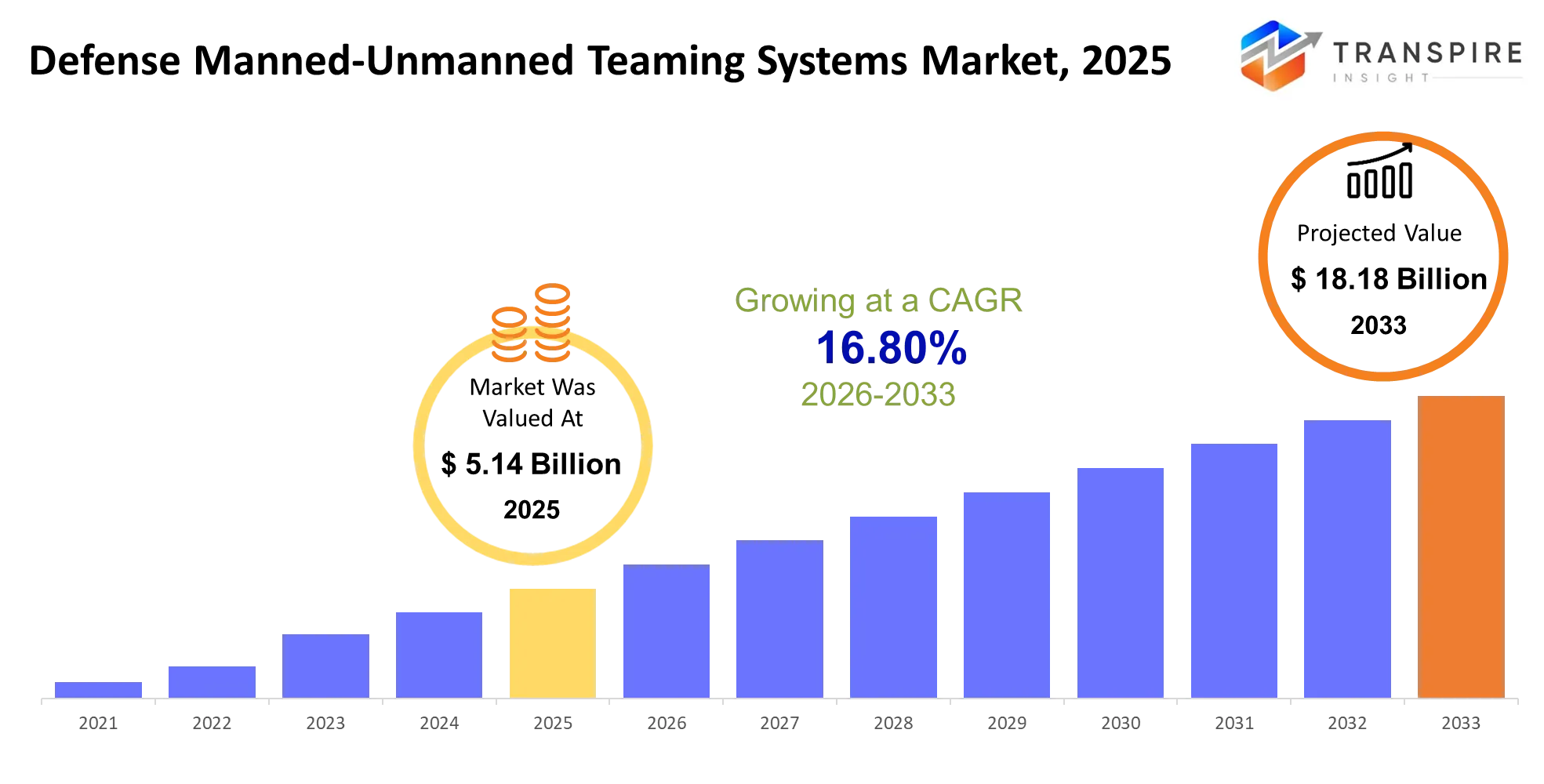
According to Transpire Insights analysis, the Defense Manned-Unmanned Teaming Systems Market size is expected to expand significantly between 2026 and 2033, with a compound annual growth rate (CAGR) of 16.80% from USD 5.14 Billion in 2025 to USD 18.18 Billion by 2033.
Defense Manned-Unmanned Teaming Systems Market Summary:
According to Transpire Insights, a detailed research report on the market reflects that the airborne platform application segment dominates the Defense Manned-Unmanned Teaming Systems Market, accounting for approximately 45–50% of the total market share globally. Lockheed Martin Corporation leads the market with approximately USD 75.0 billion in annual revenue and an estimated 12–16% global market share, making it a leading contributor to global defense manned-unmanned teaming market development, innovation, advanced autonomous teaming technologies, expanding system integration capabilities, and growth dynamics.
Market Snapshot
- Global Market Value (2025): USD 5.14 Billion.
- Expected Market Value (2026): USD 6.13 Billion.
- Estimated Market Value (2033): USD 18.18 Billion.
- Forecast CAGR (2026–2033): 16.80%
- Leading Region in 2025: North America
- Second-largest Region: Europe
- Fastest Growing Region: Asia Pacific
Introduction
Manned-unmanned teaming is all about the use of manned (human-controlled) military technologies (such as helicopters, aircrafts, terrestrial tanks, etc.) and unmanned technologies (such as drones, ground unscrewed assets and naval vessels) acting in sync and in collaboration. Various unmanned assets are directed by human groups or collect the needed information from them so that comprehensive situational awareness can be achieved, overall effectiveness can be increased, and risks can be minimized while being on the battlefield. The market of Manned-Unmanned Teaming (MUM-T) Systems brings many benefits for the operations of modern military forces. Low Human Risk allows for unmanned systems to accomplish missions in risky conditions while exposing minimal amounts of people to danger. Force Multiplication means that the actions of one pilot or commander can control the work of several unscrewed machines, thus allowing for increases in the number of missions performed without a proportional increase of staff. Enhanced awareness increases the level of situational awareness thanks to the deployment of unmanned scouts which cover the sensors to a greater extent while providing real-time intelligence. Cost efficiency makes it possible to use modular unmanned machines for reconnaissance and electronic warfare operations. Finally, the use of cognitive relief based on AI eases routine navigation and targeting processes and simplifies the work of operators during challenging missions.
For instance:-North America leads the market in defense manned-unmanned teaming systems, with funding for defense modernization in the U.S. and JADC2 investments that support artificial intelligence technology integration, development of cooperative combat aircraft, and safe and secure communication.
Market Highlights: -
- North America is anticipated to hold roughly 38% share of the Defense Manned-Unmanned Teaming Systems Market over the predicted timeframe.
- Europe is expected to grow at a rapid CAGR in the Defense Manned-Unmanned Teaming Systems Market by holding roughly25% of the share during the forecast period.
- Asia Pacific is anticipated to hold roughly20% share of the Defense Manned-Unmanned Teaming Systems Market over the predicted timeframe.
- By platform, the Manned Aircraft segment dominated the market and holds nearly 71% share in 2025 and is projected to grow at a substantial CAGR during the forecast period.
- By mission, the ISR segment dominated the market and holds nearly 44% share in 2025 and is projected to grow at a substantial CAGR during the forecast period.
- By application, the Army segment dominated the market and holds nearly 40% share in 2025 and is projected to grow at a substantial CAGR during the forecast period.
- India is enhancing the Defense Manned-Unmanned Teaming (MUM-T) Systems Market through the ₹39,000 crore RPSA projects which emphasizes development of indigenous unmanned combat-aircraft systems. The government supports programs such as iDEX and ADITI which enable defense innovations, artificial intelligence, unmanned systems, and private sector participation for fast-tracking of MUM-T technology development and strengthening of India’s domestic defense technology industry.
How is Technology Driving Growth in the Defense Manned-Unmanned Teaming Systems Market?
The Manned-Unmanned Teaming (MUM-T) Systems Market within the defense sphere is evolving due to emerging technologies that make services more automated, connected, and relevant to the mission. Artificial Intelligence and Machine Learning allow for making independent decisions, recognizing targets, and reducing workload. Innovative Communication Networks, such as 5G and satellite internet, allow for secure data transfer with low latency and reliable communication in today’s challenging operational conditions. Sensor Fusion and Autonomy combine data from a number of sensors to develop situational awareness and facilitate unmanned operations in environments where GNSS is unavailable. Additionally, Cybersecurity and Predictive Maintenance technologies ensure real-time threat identification, data protection, and monitoring of the machinery condition. In combination, such technologies significantly improve interoperability, resilience, efficiency, and readiness to carry out various missions in defense MUM-T applications.
|
Report Metrics |
Details |
|
Market size value in 2025 |
USD 5.14 Billion |
|
Market size value in 2026 |
USD 6.13 Billion |
|
Revenue forecast in 2033 |
USD 18.18 Billion |
|
Growth rate |
CAGR of 16.80% from 2026 to 2033 |
|
Base year |
2025 |
|
Historical data |
2021 - 2024 |
|
Forecast period |
2026 - 2033 |
|
Report coverage |
Revenue forecast, competitive landscape, growth factors, and trends |
|
Regional scope |
United States; Canada; Mexico; United Kingdom; Germany; France; Italy; Spain; Denmark; Sweden; Norway; China; Japan; India; Australia; South Korea; Thailand; Brazil; Argentina; South Africa; Saudi Arabia; United Arab Emirates |
|
Key company profiled |
Lockheed Martin, Northrop Grumman, Boeing, RTX, General Dynamics, BAE Systems, Saab, Airbus Defence and Space, Leonardo, Thales, L3Harris Technologies, Rheinmetall, Elbit Systems, Israel Aerospace Industries, Anduril Industries |
|
Customization scope |
Free report customization (country, regional & segment scope). Avail customized purchase options to meet your exact research needs. |
|
Report Segmentation |
By Platform (Manned Aircraft, Unmanned Aircraft, Ground Vehicles, Naval Platforms, Helicopters, Combat Vehicles, Support Vehicles, Others); By Unmanned System (UAVs, UGVs, USVs, UUVs, Loitering Systems, Drones, Autonomous Vehicles, Others); By Mission (ISR, Combat, Surveillance, Reconnaissance, Logistics, Electronic Warfare, Target Acquisition, Others); By Autonomy (Human-controlled, Human-assisted, Semi-autonomous, Autonomous, AI-enabled, Swarm-enabled, Remote, Others); By Application (Air Force, Army, Navy, Marine Corps, Special Forces, Border Security, Homeland Defense, Others); By Technology (AI, Machine Learning, Sensor Fusion, Communications, Navigation, Data Links, Robotics, Others); By Range (Short-range, Medium-range, Long-range, Tactical, Operational, Strategic, Ultra-long-range, Others) |
Market Drivers
The expansion of Defense Manned-Unmanned Teaming (MUM-T) Systems Markets is attributed to innovations in AI, machine learning, and automation that allow rapid evaluation of threats and effective decision-making as well as quick allocation of tasks. MUM-T offers tremendous advantages in terms of cost efficiencies since human operators can manage more than one platform with the least possible interaction with the personnel during complex missions. Implementation of JADC2 and other network-based defense strategies have opened up new opportunities for development of interoperable weapons. Finally, cooperation between humans and machines leads to better efficiency, shortening of communication time, and less burden for an operator minimizing the chances of human mistakes. The market for the Defense Manned-Unmanned Teaming (MUM-T) systems is witnessing robust growth largely due to the operational and strategic advantages of the systems. Unmanned systems reduce the risk of operations which can be carried out in dense and hostile environments with less exposure to personnel. The cost-effective force multiplier will prompt manned systems to work with cost-effective and unmanned systems to get sensor usage and mission capabilities, improved surveillance and monitoring will be enabled by unmanned systems which provide endurance and monitoring in difficult environments. AI mission management takes the cognitive burden off the staff by automating operations such as navigation, tracking, and cueing targets. In addition, distributed networked operations help enhance resilience and expand operations in the defense sector.
For Instance: - The defense sector of South Africa is investing in both unmanned aerial vehicles and manned-unmanned team systems. Due to budgetary constraints of its national defense, it depends on local companies such as Milkor and Denel when looking for growth options including maritime surveillance, border-over-sea patrolling, and low-cost alternatives for old equipment.
The Russian market of human-unmanned teaming (MUM-T) in the worldwide military sector benefits from the active investments into domestic uncrewed systems, applied AI, and safe communications focusing on home-grown military robotics technology and independent drone eco-systems owing to the constant modernization of military tactics.
Restrain
The Defense Manned-Unmanned Teaming (MUM-T) Systems Market has to deal with challenges that arise from high costs of cyber-hardening, long procurement processes, and complicated integration needs. Pilots' tasks may exert mental pressure that can add to workload in challenging operations. The costs of development increase even further due to severe testing and safety certification, which is mainly the case for small-sized companies. Furthermore, the advancement of new electronic war technology poses an additional set of challenges, including jamming, spoofing, and cyber offenses, which necessitate continuous investments into cybersecurity updates and lifecycle improvements that can hinder large-scale adoption of MUM-T Systems.
|
Driver |
Relative Impact on Growth (%) |
Geographic Relevance |
Impact Timeline |
Demand Strength |
Growth Mechanism |
Key Beneficiaries |
Major Constraint |
|
Driver 1: AI and Autonomous Teaming |
26% |
North America, Europe, Asia-Pacific |
Short-term |
High |
AI enables autonomous coordination and faster mission decisions. |
AI vendors, defense primes, military end-users |
Certification and autonomous-system reliability challenges |
|
Driver 2: Defense Modernization and JADC2 |
23% |
North America, Europe, Indo-Pacific |
Long-term |
High |
Networked architectures connect manned and unmanned platforms. |
Defense integrators, communications vendors, armed forces |
Complex interoperability and procurement requirements |
|
Driver 3: Rising Demand for ISR and Situational Awareness |
20% |
North America, Europe, Asia-Pacific |
Short-term |
High |
Unmanned sensors extend persistent intelligence coverage. |
Sensor manufacturers, ISR providers, defense forces |
Electronic warfare and contested-spectrum environments |
|
Driver 4: Collaborative Combat Aircraft and Force Multiplication |
17% |
North America, Europe, Asia-Pacific |
Medium-term |
High |
Collaborative aircraft expand combat capacity with fewer personnel. |
Aircraft manufacturers, autonomy firms, air forces |
High development costs and lengthy testing cycles |
|
Driver 5: Secure Communications and Multi-Domain Interoperability |
14% |
North America, Europe, Asia-Pacific |
Medium-term |
High |
Resilient links enable coordinated operations across domains. |
Communications vendors, data-link providers, defense integrators |
Jamming, spoofing, cybersecurity, and connectivity limitations |
Analysis of Prices and Consumer Behaviour
The airborne technology contributes to the majority of the defense manned-unmanned teaming systems market (45.25% of the total market, as the technology includes manned-unmanned principles of using the crewed aircraft in missions of intelligence, surveillance and reconnaissance and combat). It is presumed that the price of the upcoming advanced high-performance manned-unmanned teaming systems will be bigger than that of conventional technologies because of the use of innovative AI technology, autonomous devices, secure communication and sensor integration technologies. Airborne platforms bring in almost 45.25% of defense manned-unmanned teaming systems market revenue. The key reason for market growth is the application diversity of these technologies in ISR, combat actions, electronic warfare, and logistics. ISR application market segment is estimated to be responsible for nearly 45.69% of the total market revenue. An analysis of purchasing behavior of defense companies has shown that interoperability of the MUM-T technology, autonomy of decisions, and reliability of the system are the main aspects taken into account when choosing a MUM-T solution. The possibility to sign long-term contracts and use procurement procedures is also regarded as an important advantage of the technology since it allows armies to ensure the supply of a stable system.
|
Investment Factor |
Why It Matters to Investors |
Opportunity |
Investment Implication |
|
Collaborative Combat Aircraft & Autonomous Platforms |
Why invest: scalable autonomous platforms expand defense capability |
CCA, loyal-wingman aircraft, autonomous UAVs, and attritable systems offer scalable force-multiplication opportunities. |
Short–Medium Term: Prioritize platform developers, autonomy suppliers, and subsystem manufacturers with production-ready technologies. |
|
AI-Based Mission Autonomy & Human-Machine Teaming |
Why invest: software increases mission capability across platforms |
AI mission management, autonomous decision support, sensor fusion, and human-machine interfaces can be deployed across multiple unmanned platforms. |
Medium–Long Term: Software, AI, autonomy algorithms, and reusable mission systems can provide scalable technology exposure. |
|
Secure Communications & Interoperability |
Why invest: connected forces require resilient digital infrastructure |
Tactical data links, secure communications, C2 systems, open architectures, and cross-platform interoperability address a critical MUM-T requirement. |
Short–Medium Term: Invest in communications, networking, C2, cybersecurity, and standards-compliant integration capabilities. |
|
Multi-Domain Expansion |
Why invest: teaming applications extend beyond combat aviation |
MUM-T applications can expand across air, land, maritime, ISR, logistics, electronic warfare, and autonomous support missions. |
Medium–Long Term: Diversified suppliers serving multiple domains can reduce dependence on one platform category. |
|
Regional Defense Modernization |
Why invest: modernization programs create sustained procurement demand |
North America, Europe, and Asia-Pacific are developing autonomous systems, collaborative aircraft, digital C2, and indigenous defense capabilities. |
Short–Long Term: Regional partnerships, localization, technology transfer, and domestic manufacturing can create expansion pathways. |
|
Specialized Components & Software Ecosystem |
Why invest: open architectures broaden supplier participation |
Sensors, navigation, autonomy software, robotics, datalinks, cybersecurity, mission systems, and payloads offer entry opportunities beyond prime contractors. |
Long Term: Specialized suppliers can scale through multiple defense platforms and strategic partnerships rather than owning complete aircraft systems. |
Who are the Key Players in the Defense Manned-Unmanned Teaming Systems Market and how do they compete?
The competitive environment of the international market of defense systems that include both manned and unmanned platforms is determined by companies that are engaged in the development of autonomous technologies, interoperability, mission-specific solutions, and advanced defense platforms on a global scale. The companies compete not only by their products but also by their capabilities in terms of autonomous operation, artificial intelligence decision-making systems, remote indication, sensor fusion, and compatibility with existing defense mechanisms. The companies improve their technology and achieve desired effectiveness of their missions.
Lockheed Martin improves its position in the market through the development of autonomous teaming solutions and advanced unmanned technologies. The company develops a range of effective unmanned and manned systems whose technology and operational performance distinguish them from the products of their competitors. Northrop Grumman improves its position thanks to the integrated solutions that it offers and the technologies that allow working with modern systems of command and control and warfare.
Top Companies in the Defense Manned-Unmanned Teaming Systems Market
- Lockheed Martin
- Northrop Grumman
- Boeing
- RTX
- General Dynamics
- BAE Systems
- Saab
- Airbus Defence and Space
- Leonardo
- Thales
- L3Harris Technologies
- Rheinmetall
- Elbit Systems
- Israel Aerospace Industries
- Anduril Industries
|
Company |
Est. Revenue Share Range |
Key Offerings |
Strategic Positioning |
Geographic Strength |
Technology Focus |
|
Lockheed Martin Corporation |
8–12% |
F-35, CCA technologies, autonomous systems, sensor fusion |
Integrated defense-platform and autonomy leadership |
North America, Europe, Asia-Pacific |
AI, autonomy, sensor fusion, open architectures |
|
The Boeing Company |
7–11% |
MQ-28 Ghost Bat, MQ-25 Stingray, F/A-18 teaming |
CCA-led platform ecosystem and global expansion |
North America, Australia, Europe |
Autonomous teaming, AI, open architecture, mission systems |
|
Northrop Grumman Corporation |
6–10% |
MQ-4C Triton, autonomous systems, DA/RC |
Distributed autonomy and multi-domain integration |
North America, Europe, Asia-Pacific |
Distributed autonomy, JADC2, C2, machine teaming |
|
RTX Corporation |
5–8% |
Collaborative Mission Autonomy, tactical communications, sensors |
Mission-autonomy and network-centric systems integration |
North America, Europe, Middle East |
Mission autonomy, navigation, communications, AI |
|
Airbus SE |
4–7% |
FCAS, Remote Carriers, Eurodrone, HTeaming |
European sovereign MUM-T ecosystem development |
Europe, Middle East, Asia-Pacific |
Autonomous teaming, AI, secure connectivity, C2 |
|
Leonardo S.p.A. |
3–6% |
Uncrewed systems, sensors, Eurofighter integration, LBA Systems |
Multi-domain systems and European teaming specialization |
Europe, Middle East, Asia-Pacific |
Sensors, mission systems, autonomy, swarming |
|
Saab AB |
3–5% |
Gripen teaming, autonomous systems, UAS and C2 |
Agile combat-system and interoperability strategy |
Europe, North America, Asia-Pacific |
AI, autonomy, sensors, secure communications |
|
Elbit Systems Ltd. |
2–5% |
Torch-X RAS, E-LynX UxS, autonomous platforms, MUM-T solutions |
Vertically integrated tactical autonomy specialist |
Israel, Europe, Asia-Pacific, Middle East |
AI, robotics, SDR, swarm autonomy, sensor fusion |
|
Rheinmetall AG |
2–4% |
Autonomous ground systems, robotics, Rheinmetall Mission Master |
Land-domain robotics and integrated battlefield systems |
Europe, NATO markets, Australia |
Robotics, autonomy, AI, C2, unmanned vehicles |
|
Kratos Defense & Security Solutions, Inc. |
1–4% |
XQ-58A Valkyrie, tactical UAS, autonomous combat aircraft |
Affordable attritable aircraft and CCA specialization |
North America, Europe, Asia-Pacific |
Autonomous flight, AI, attritable systems, CCA |
Market Segmentation
The Defense Manned-Unmanned Teaming Systems Market share is divided into seven categories: By platform, unmanned system, mission, autonomy, application, technology and range.
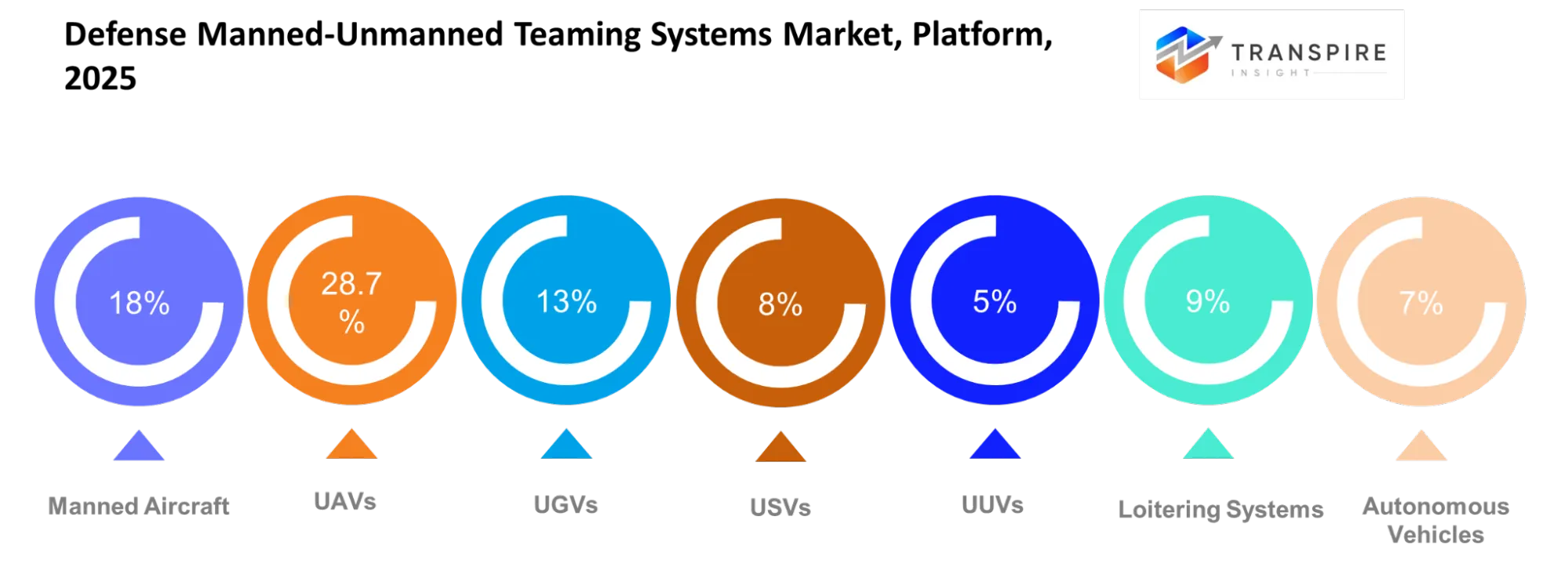
The Manned Aircraft dominated the market, accounting for nearly 71% in 2025 and is expected to rise at a significant CAGR during the forecast period.
The Defense Manned-Unmanned Teaming Systems Market is segmented by platform into Manned Aircraft, Unmanned Aircraft, Ground Vehicles, Naval Platforms, Helicopters, Combat Vehicles, Support Vehicles, Others. Among these, the Manned Aircraft segment dominated the market, accounting for nearly 71% in 2025 and expected to increase at a significant CAGR during the forecast period. With their capability to perform established operations, established dependability, high utilization in defense programs, and large reliance on human-operated vehicles, the Manned Aircraft sector accounted for the biggest share of the market. They offer improved situational awareness, increased mission adaptability, and compatibility with current defense systems. Their already existing supply chains help boost the market turnover and contribute to a consistent demand.
The ISR dominated the market, accounting for nearly 44% in 2025, and is expected to rise at a significant CAGR during the forecast period.
The Defense Manned-Unmanned Teaming Systems Market is segmented by mission into ISR, Combat, Surveillance, Reconnaissance, Logistics, Electronic Warfare, Target Acquisition, Others. Among these, the ISR segment dominated the market, accounting for nearly 44% in 2025 and expected to increase at a significant CAGR during the forecast period. The ISR segment had a significant share in the market owing to the rising demand for real-time Intelligence, Surveillance, and Reconnaissance capabilities among various modern defense operations. Certain benefits of these ISR solutions include enhanced situational awareness, target identification, threat monitoring, and mission planning capabilities offered by ISR systems. The adoption of advanced systems like network-centric warfare, intelligent sensors, autonomous weapons, and long-duration intelligence solutions acts as a boon to the ISR market.
The Army dominated the market, accounting for nearly 40% in 2025 and is expected to rise at a significant CAGR during the forecast period.
The Defense Manned-Unmanned Teaming Systems Market is segmented by application into Air Force, Army, Navy, Marine Corps, Special Forces, Border Security, Homeland Defense, Others. Among these, the Army segment dominated the market, accounting for nearly 40% in 2025 and expected to increase at a significant CAGR during the forecast period. The army sector led the market due to the growing use of unmanned systems for reconnaissance, surveillance, intelligence, and tactical operations. The ground forces make more use of autonomous systems in order to improve situational awareness, expand the ability to conduct operations as well as reduce the number of people involved. The increase in funds allocated for modernization, AI systems, and network-centric warfare further enhances the army's demand and growth.
Regional Segment Analysis of the Defense Manned-Unmanned Teaming Systems Market:
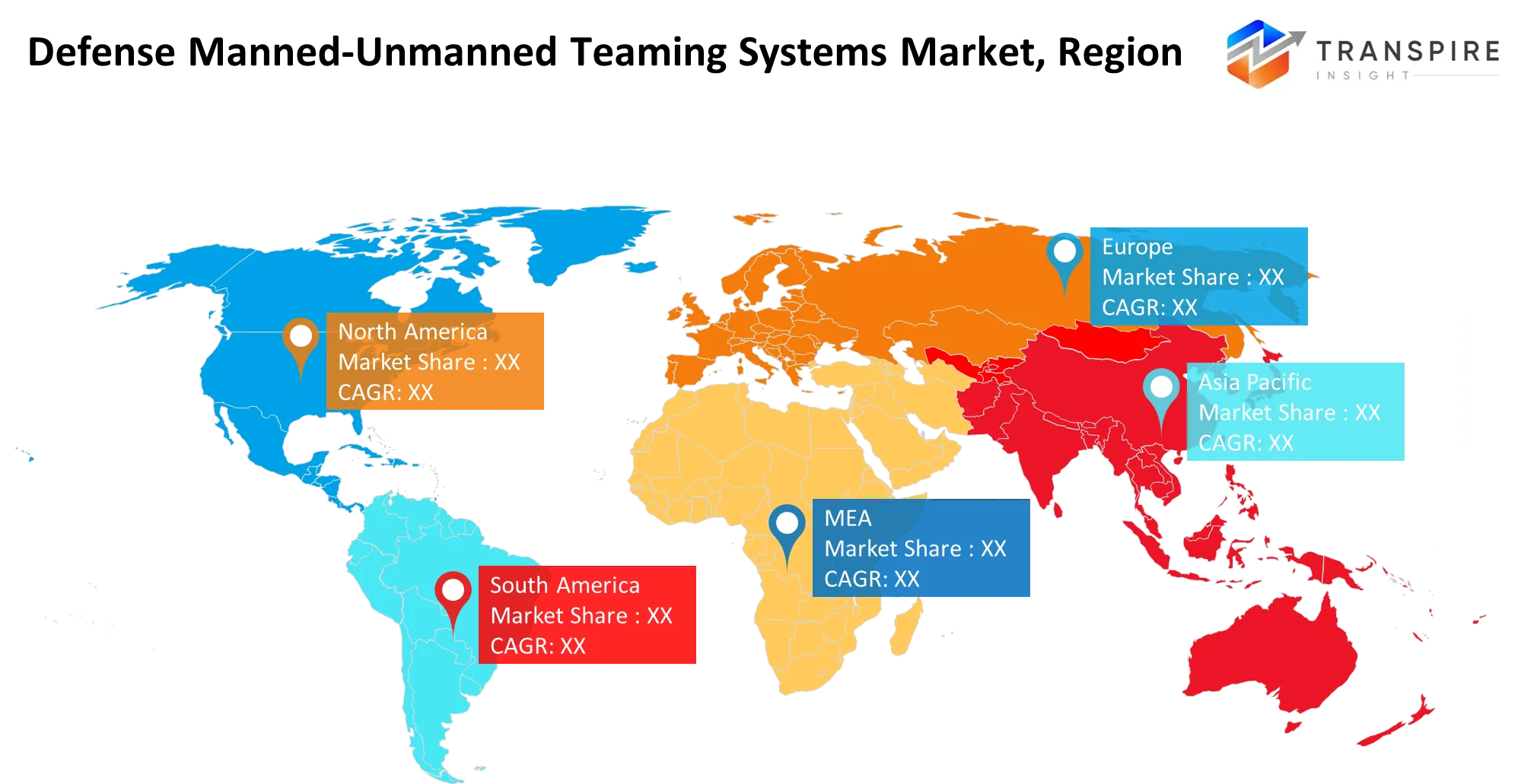
- North America (U.S., Canada, Mexico)
- Europe (Germany, France, U.K., Italy, Spain, Rest of Europe)
- Asia-Pacific (China, Japan, India, Rest of APAC)
- South America (Brazil and the Rest of South America)
- The Middle East and Africa (UAE, South Africa, Rest of MEA)
North America is the fastest-growing region in the Defense Manned-Unmanned Teaming Systems Market during the period, holding roughly 38% share.
North America is expected to grow at a rapid CAGR in the Defense Manned-Unmanned Teaming Systems Market holding roughly 38% share during the forecast period. The strong position of North America is due to significant modernization programs in defense, growing investments in self-driving systems, and quick assimilation of manned-unmanned teaming technologies in a wide area. North America has some advanced aerospace capabilities, renowned defense companies, and artificial intelligence capabilities, as well as comprehensive military test programs in various sectors. The demand for collaborative combat aircraft and network-centric operations continues to promote the expansion of the market.
Europe is expected to grow at a rapid CAGR in theDefense Manned-Unmanned Teaming Systems Market, holding roughly 25% of the share during the forecast period.
Europe is expected to grow at a rapid CAGR in the Defense Manned-Unmanned Teaming Systems Market holding roughly 25% share during the forecast period. Europe’s market growth is driven by the rise of defense modernization, increased funding toward autonomous systems, and the demand for sophisticated surveillance setup. The initiatives for defense built into the region, along with the collaborations across borders, and the introduction of military systems using AI technology have promoted MUM-T development. The investments in terms of interoperability, expertise in the field of communication, as well as the upcoming unmanned systems add fuel to the growth of the market.
Asia Pacific is the fastest-growing region in the Defense Manned-Unmanned Teaming Systems Market during the period, holding roughly 20% share.
Asia Pacific is the fastest-growing region in the Defense Manned-Unmanned Teaming Systems Market during the forecast period, holding roughly 20% share during the forecast period. The market growth in Asia Pacific is attributed to the increase in defense modernization, investment in autonomous systems, and growing use of Manned-Unmanned Teaming (MUM-T) technologies. Countries in this region are advancing their unmanned capabilities for the purposes of reconnaissance, surveillance, and combat support. Technology advancements in the fields of artificial intelligence, secure communication, and local defense manufacturing help boost the MUM-T development and consequent market expansion.
Strategies for Market Growth in Non-Leading Regions:
It is the realization of the potential of non-leading regions through efficient and scalable technologies of manned-unmanned teaming that will contribute to the success of small and medium defense tech companies. Because of such technology, local development and incorporation of various types of manned and unmanned systems as well as the establishment of integration centers will help to achieve the goal of reducing reliance on foreign imports and lower investment costs. It is possible to obtain greater market share if partnerships with local players in the field of defense (including companies producing defense products and military organizations) are established. In order to boost knowledge about the proprietary technology of manned-unmanned teaming, special programs on training and qualification improvement must be developed in such areas as autonomous teaming technologies, AI-enabled mission systems, encrypted communication technologies, system interoperability, and sensor fusion. Promising financing schemes such as sovereign-backed projects and long-term contracts will also contribute to greater affordability and availability of manned-unmanned teaming systems. Establishment of collaborative ventures with government structures, both in defense and aerospace industries, and introduction of more sophisticated procurement strategies will help to make manned-unmanned teaming technologies widely available in developing
Future Market Trends for the Defense Manned-Unmanned Teaming Systems Market: -
1.AI-Based Technology: Transitioning from conventional remote piloting to swarm interoperability as well as Collaborative Combat Aircraft (CCA) integration in edge computing.
- Reliable Communication Systems: Emphasizing on low-latency, anti-jamming, and secure cloud to edge network systems from terrestrial and maritime domains.
- Strategy for Cheap System: Involving the usage of advanced manned platforms with low-cost and high-volume robotic systems to offer the tactical advantage.
- Cybersecurity Integration: Developing partnerships with trusted IT specialists for the protection of robotic systems against jamming as well as cyber issues.
- Equipment and ISR Emphasis: Noting the highest advancement in the technology of intelligence, surveillance, and reconnaissance systems.
Recent Development
- In January 2026: The U.S. Marine Corps chose Northrop Grumman along with Kratos for a project that developed the Collaborative Combat Aircraft (CCA) that is based on the XQ-58 Valkyrie model. This project takes forward the Defense Manned-Unmanned Teaming (MUM-T) with independent operations, crewed-uncrewed working together, the integration of sensors and joint fighting capacity for countering offensives in high-risk operations.
- In February 2026: Popular consultancy firm Frost & Sullivan pointed out that the spread of technologies like Human-Machine Integration and Manned-Unmanned Teaming (MUM-T) is accelerating in multimode military missions. Some of the components of successful deployment include the use of artificial intelligence and machine learning, secure communications systems, modular system architectures, and cooperation between man and machine.
This study forecasts revenue at global, regional and country levels from 2020 to 2033. Transpire Insights has segmented the Defense Manned-Unmanned Teaming Systems Market based on the below-mentioned segments:
Defense Manned-Unmanned Teaming Systems Market, By Platform
- Manned Aircraft
- Unmanned Aircraft
- Ground Vehicles
- Naval Platforms
- Helicopters
- Combat Vehicles
- Support Vehicles
- Others
Defense Manned-Unmanned Teaming Systems Market, By Unmanned System
- UAVs
- UGVs
- USVs
- UUVs
- Loitering Systems
- Drones
- Autonomous Vehicles
- Others
Defense Manned-Unmanned Teaming Systems Market, By Mission
- ISR
- Combat
- Surveillance
- Reconnaissance
- Logistics
- Electronic Warfare
- Target Acquisition
- Others
Defense Manned-Unmanned Teaming Systems Market, By Autonomy
- Human-controlled
- Human-assisted
- Semi-autonomous
- Autonomous
- AI-enabled
- Swarm-enabled
- Remote
- Others
Defense Manned-Unmanned Teaming Systems Market, By Application
- Air Force
- Army
- Navy
- Marine Corps
- Special Forces
- Border Security
- Homeland Defense
- Others
Defense Manned-Unmanned Teaming Systems Market, Technology
- AI
- Machine Learning
- Sensor Fusion
- Communications
- Navigation
- Data Links
- Robotics
- Others
Defense Manned-Unmanned Teaming Systems Market, Range
- Short-range
- Medium-range
- Long-range
- Tactical
- Operational
- Strategic
- Ultra-long-range
- Others
Defense Manned-Unmanned Teaming Systems Market, By Regional Analysis
- North America
- US
- Canada
- Mexico
- Europe
- Germany
- UK
- France
- Italy
- Spain
- Russia
- Rest of Europe
- Asia Pacific
- China
- Japan
- India
- South Korea
- Australia
- Rest of Asia Pacific
- South America
- Brazil
- Argentina
- Rest of South America
- Middle East & Africa
- UAE
- Saudi Arabia
- Qatar
- South Africa
- Rest of the Middle East & Africa
Frequently Asked Questions
Find quick answers to common questions.
It covers technologies enabling manned and unmanned platforms to coordinate, improving situational awareness, mission effectiveness, operational reach, and personnel safety.
AI, autonomous systems, machine learning, secure communications, sensor fusion, defense modernization, and network-centric warfare are key growth drivers.
Manned Aircraft dominates by platform, while ISR leads by mission and Army leads by application in the reported market.
North America leads due to defense modernization, autonomous technology investments, advanced aerospace capabilities, and strong military technology development.
AI, machine learning, sensor fusion, secure communications, navigation, data links, and robotics are transforming MUM-T capabilities and interoperability.
- Lockheed Martin
- Northrop Grumman
- Boeing
- RTX
- General Dynamics
- BAE Systems
- Saab
- Airbus Defence and Space
- Leonardo
- Thales
- L3Harris Technologies
- Rheinmetall
- Elbit Systems
- Israel Aerospace Industries
- Anduril Industries
About the Authors

Tejashri Dhatrak
I am Tejashri Dhatrak, a Senior Research Analyst at Transpire Insight, specializing in the Aerospace and Defence sector. My work focuses on analyzing industry trends, defence technologies, market developments, and emerging innovations that shape the global aerospace and security landscape. At Transpire Insight, I research complex topics, evaluate credible sources, and transform technical insights into accurate, well-structured, and easy-to-understand content for industry professionals and decision-makers. My goal is to provide reliable, research-backed information that helps readers stay informed about defence capabilities, aerospace advancements, strategic developments, and the evolving dynamics of the global defence ecosystem.

Chakradhar Khansole
Chakradhar serves as the Research Director at Transpire Insight, bringing over 8 years of experience in technology, innovation, and strategic market intelligence. He specializes in transforming complex market data into actionable business insights that enable organizations to make informed, growth-oriented decisions. Recognized for his strategic vision and analytical expertise, Chakradhar leads high-impact research initiatives, delivering comprehensive market assessments, competitive intelligence, and forward-looking industry analysis.
Recently Published Reports
-
Apr 2026
Aerospace Fluoropolymers Market
Aerospace Fluoropolymers Market Size, Share & Analysis Report By Type (PTFE, FEP, PFA, ETFE, and Others), By Application (Electrical Insulation, Seals & Gaskets, Coatings, and Others), By End User (Commercial Aviation, Military Aviation, General Aviation, and Others), and Geography (North America, Europe, Asia-Pacific, Middle East and Africa, South and Central America), 2021 - 2031
-
Apr 2026
Airborne SATCOM System Market
Airborne SATCOM System Market Size, Share & Analysis Report By Type (SATCOM Terminals, Transceivers, Airborne Radio, Modems and Routers, SATCOM Radomes, and Other), By Application (Government and Defense and Commercial), and Geography (North America, Europe, Asia-Pacific, Middle East and Africa, South and Central America), 2021 – 2031
-
Apr 2026
Ship Leasing Market
Ship Leasing Market Size, Share & Analysis Report By Vessel Type (Container Ships, Bulk Carriers, Tankers, and Specialized Vessels), By Lease Duration (Short-Term Lease (Less than 1 year), Medium-Term Lease (1-5 years), and Long-Term Lease (More than 5 years)), By Lease Type (Bareboat Charter, Time Charter, Financial Lease, and Others), By End-User Industry (Oil and Gas, Manufacturing and Industrial, Automotive, Agriculture and Food, Retail and Consumer Goods, and Others), and Geography (North America, Europe, Asia-Pacific, Middle East and Africa, South and Central America), 2021 – 2031
-
Apr 2026
Thread Rolling Dies Market
Thread Rolling Dies Market Size, Share & Analysis Report By Type (Flat Thread Rolling Dies, Circular (Cylindrical) Dies, Tangential Thread Rolling Dies, Planetary Thread Rolling Dies, and Other Types), By Material Type (High-Speed Steel (HSS), Carbide, Tool Steel, Alloy Steel, and Other Specialized Alloys), By Distribution Channel (Direct Sales, Distributors and Dealers, and Online Platforms), By Application (Automotive Industry, Aerospace and Defense, Construction and Infrastructure, Industrial Machinery, Electronics and Electrical Components, Medical Devices, and Fastener Production), and Geography (North America, Europe, Asia-Pacific, Middle East and Africa, South and Central America), 2021 – 2031
Our Clients