

Data Annotation Tools Market Summary:
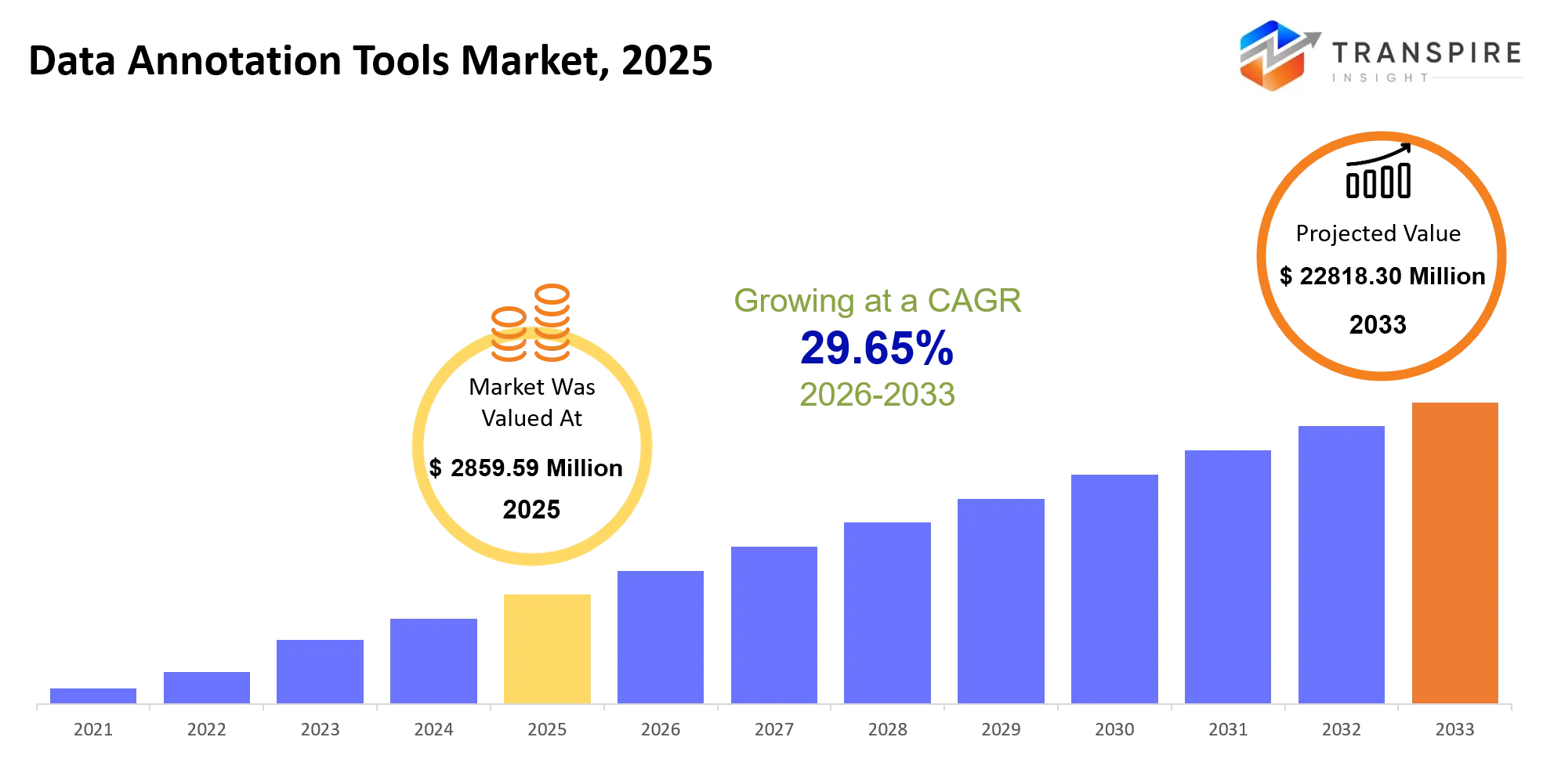
As per the Transpire Insight Analysis, The Data Annotation Tools Market size is estimated at USD 2859.59 million in 2025 and is anticipated to reach USD 22818.30 million by 2033, growing at a CAGR of 29.65% from 2026 to 2033.
The data annotation tools market is moving from lower-level to automation-driven, AI-enabled data operations that organize datasets for models to learn, test, and govern. In the past 3-5 years, annotation tools have shifted from image tagging to extensive video, text, audio, 3D, sensor, and GIS workflows; automated pre-labelling and human review have streamlined repetitive and boring tasks. A design shift, according to experts, is towards hybrid annotation; models produce labels that are then proofed and verified by expert Annotators rather than solely relying on the crew to build labels. Real-world igniters include the broad deployment of generative AI, autonomous vehicles, robotics, and computer vision that has increased both data volume and annotation workloads. And additional regulation have ratcheted up the value of traceability processes; the EU AI Act enhances transparency and mandates detailed documentation for training data, and annotation tools at the early stage improve data quality, auditability, and iteration.
Data Annotation Tools Market Size & Forecast:
- Market Size 2025: USD 2859.59 Million
- Expected Market Value (2033): USD 22818.30 Million
- Forecast CAGR (2026–2033): 29.65%
- Leading Region in 2025: North America
- Fastest Growing Region: Asia Pacific
- Key Company Profiles: Scale AI, Appen, TELUS International, Labelbox, SuperAnnotate, Encord, Sama, iMerit, CloudFactory, Label Studio, V7, Dataloop, Hive, CVAT, Amazon Web Service
Key Data Annotation Tools Market Insights:
The market is moving from labour-intensive labelling to AI-assisted, human-validated data operations, and multimodal and physical-AI workloads are gaining significance. The ability to directly annotate workflows with domain knowledge, traceability, and the capability to connect with model evaluation and deployment is becoming a key part of competitive advantage.
- Scale AI, Appen and TELUS International are upgrading image annotation by 42%, reducing manual effort with model-assisted pre-labelling and active-learning loops.
- Video annotation at 18% is becoming more popular in enterprise use, with Labelbox, SuperAnnotate and Encord introducing tools that incorporate the timeline aspect of annotation for ADAS, robotics and retail analytics.
- At 14%, text annotation is changing with generative AI, with Hive, V7, and Dataloop introducing LLM-based span suggestion and RLHF preference labelling.
- The audio technology and speech workflows are being transitioned to semi-automated diarization and transcription using Sama, iMerit, and CloudFactory for contact-centre and healthcare applications.
- Encord, CVAT and Label Studio are launching LiDAR and point-cloud editors for autonomous driving and industrial robotics, respectively, and are driving the growth of 3D annotation at 7%.
- Niche players are joining in on sensor data (5%) and geospatial data (3%) to combine multimodal data for agriculture, infrastructure and defence mapping.
- In terms of components, tools and platforms lead the way, with AWS, Label Studio and Dataloop vying with APIs, managed services and integration with MLOps stacks.
- The technologies of computer vision, NLP, and deep learning are still central, and generative AI and robotics are becoming a differentiator for pre-labelling and synthetic data.
- Autonomous vehicles and healthcare lead the way, followed by retail, security, manufacturing, and IT & telecom, in terms of application of annotation, which will be used as part of ongoing model retraining.
What are the Key Drivers, Restraints, and Opportunities in the Data Annotation Tools Market?
Driver:
Generative AI and multimodal model development are pushing annotation beyond simple image labelling. Foundation models, robotics, autonomous systems, and AI evaluation require accurately labelled text, video, audio, 3D, and sensor datasets. As data complexity rises, organisations are adopting integrated annotation platforms that combine labelling, quality control, and workflow management. This shift expands software adoption while creating recurring revenue opportunities through managed services, automation, and specialized data operations.
Restraint:
Annotation quality remains difficult to standardise across languages, domains, and high-risk applications. The structural issue is that automated labels can reproduce model errors, miss subtle context, or encode inconsistent instructions, forcing human review, quality checks, and specialist supervision. This raises labour, governance, integration, and validation costs and can slow deployment.
Opportunity:
AI-assisted and synthetic-data workflows can reduce repetitive labelling while expanding coverage of rare scenarios. AWS Clean Rooms supports privacy-enhancing synthetic datasets for ML training, demonstrating how organizations can create usable training data without exposing original records. Combined with active learning, confidence scoring, and human-in-the-loop review, these capabilities can open new adoption across healthcare, automotive, robotics, financial services, and regulated enterprise AI. Providers can also monetize higher-value quality assurance, domain expertise, and compliance workflows as customers shift from one-off projects to governed, repeatable data operations.
What Has the Impact of Artificial Intelligence Been on the Data Annotation Tools Market?
AI-enhanced annotation tools are transforming annotation platforms from task-management systems into adaptive data-generation ecosystems. ML models can pre-annotate images, videos, and streaming sensor data; computer vision can detect object boundaries and metadata annotations, which humans can then verify; NLP models can sort documents, auto-identify entities, and suggest sentence labels to cut down on repetitive work; active-learning workflows can focus human effort on high-value data points; predictive quality controls can identify potential errors, predict potentially contentious data sets, and raise alarms in the case of potential dataset contamination; and generative AI can create synthetic data to augment human efforts at scenario expansions or rare-event collections. In terms of operations, it reduces annotation time, increases throughput, and supports continuous quality monitoring. Human experts and ground truth validation are still needed in a number of ways: identifying accuracy gaps, addressing ambiguity in specialised domains, ensuring compatible integration with existing data inflow, and the costs of validating labels generated by AI. Human-in-the-loop is the direction of growth for annotation markets.
In September 2026, SuperAnnotate secured a $36 million Series B funding round. This financial backing was led by Socium Ventures with participation from major AI infrastructure leaders, including NVIDIA and Databricks Ventures.
https://techcrunch.com/2024/11/18/superannotate-helps-companies-manage-their-ai-data-sets/
Key Data Annotation Tools Market Trends:
The shift from manual labelling to AI-aided, multimodal, and governance-ready workflows in the field of annotation. Buyers appreciate tools that link the labelling, quality control, synthetic data, evaluation, and audit trails together, rather than individual annotation features.
- Manual processes are being replaced by pre-labelling, and humans are dealing with exceptions and challenging cases.
- AI for physical projects is moving from image to video, 3D, sensor, and multimodal datasets.
- The transition from volume-based production to domain expertise is underway, with annotation teams focusing on healthcare, robotics, and regulated AI.
- Active learning is the process of shifting the focus of annotation to uncertainty-based sampling, thereby decreasing the number of low-value examples.
- Synthetic data is emerging as an alternative to real-world data when privacy, scarcity, or safety restrictions preclude real-world data collection.
- Quality control is evolving to become continuous and targeted review based on model disagreement and confidence signals.
- Enterprise buyers are looking to combine labels, workforce management, evaluation, and governance into a single platform.
- There is growing emphasis on regulatory oversight of processes, documentation, and controlled human oversight of training data.
- The focus of buyer evaluation is shifting from annotation speed to accuracy, consistency, and model performance.
- As AI spreads to regions, regulations, and industry-specific jargon, multilingual and specialist annotation is becoming increasingly significant. This gives an advantage to vendors who are able to link labelling to evaluation and feedback.
Data Annotation Tools Market Segmentation
By Component:
Tools form the core operational layer for creating, managing, and validating labelled datasets, while Services support specialized annotation requirements. Platforms are gaining importance by connecting labelling with data management and model workflows. APIs enable integration with existing AI pipelines, while Managed Services, Consulting, and Integration address enterprise implementation and governance needs. Others capture emerging workflow capabilities, allowing organisations to combine annotation with quality assurance, evaluation, and deployment processes.
By Annotation Type:
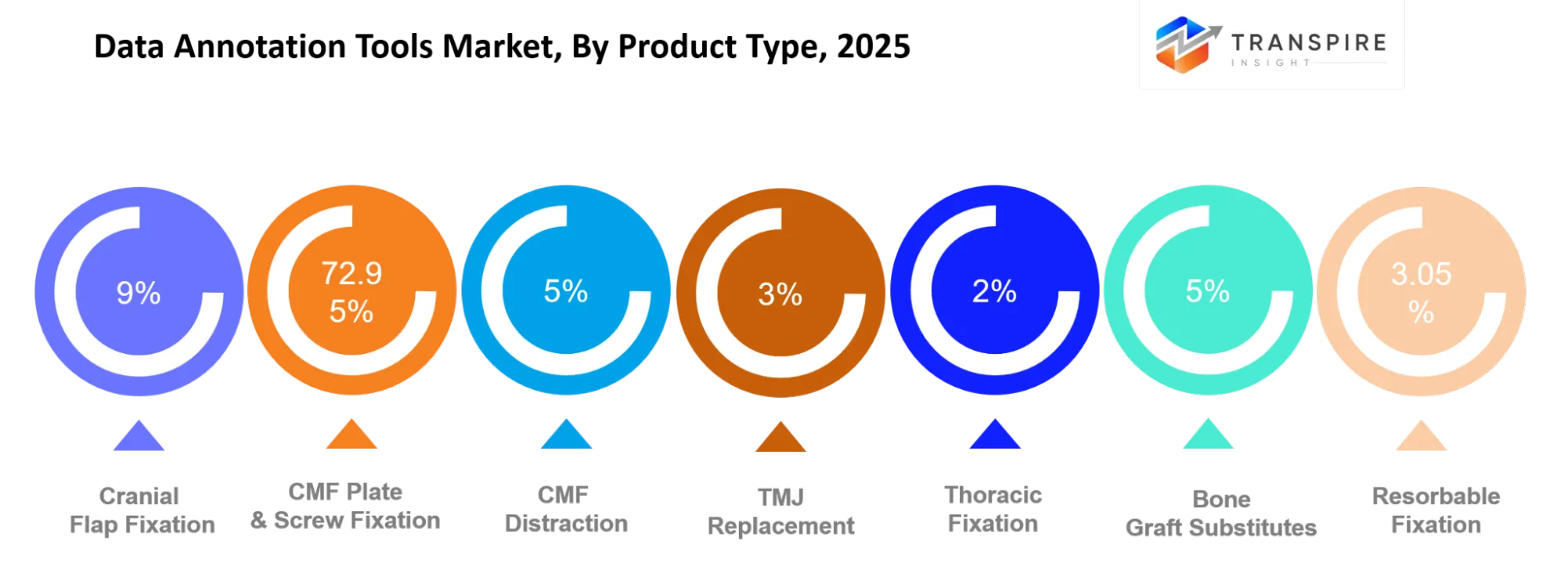
Image leads at 42%, supported by computer vision, inspection, object recognition, and visual quality-control workloads across industries. Video accounts for 18%, reflecting growing use in autonomous systems, surveillance, and behavioural analytics, while Text holds 14%, driven by document processing, NLP, and generative AI training. Audio represents 8%, followed by 3D at 7%, Sensor Data at 5%, Geospatial at 3%, and Others at 3%. This mix highlights the market’s shift toward multimodal annotation, where organisations combine image, video, language, spatial, and sensor datasets to improve AI model accuracy, contextual understanding, and deployment performance.
By Technology:
Machine Learning, Computer Vision, NLP, Speech Recognition, Deep Learning, Generative AI, Robotics, and Others increasingly operate together across annotation workflows. Machine learning and computer vision automate pre-labelling, while NLP and speech technologies support text and audio processing. Generative AI is expanding synthetic-data and evaluation capabilities, while robotics increases requirements for spatial datasets. 3D Annotation records a 26.1% CAGR, supported by robotics and spatial AI adoption.
By Application:
Autonomous Vehicles and Healthcare represent important use cases, requiring high-quality datasets for perception, diagnosis, classification, and model evaluation. Retail applies annotation to product recognition, customer analytics, and visual intelligence, while Security uses labelled video and image data for detection systems. Agriculture applies computer vision to crop and field monitoring, while Manufacturing, IT & Telecom, and Others use annotation for inspection, automation, document processing, and continuous AI model improvement.
By Annotation Approach:
Manual annotation remains important where datasets require contextual judgment, specialist knowledge, or complex labeling. Semi-supervised and Automated approaches are gaining adoption by using machine-generated labels to reduce repetitive work before human validation. Outsourced and Crowdsourced models provide flexible workforce capacity, while In-house approaches offer greater control over sensitive datasets. Hybrid workflows increasingly combine these methods, helping enterprises balance annotation speed, accuracy, governance, and operational costs.
By Enterprise Size:
Large Enterprises anchor spending because they manage extensive AI programs requiring scalable annotation infrastructure, security, and governance. SMEs and Startups are adopting cloud-based tools that reduce upfront technology requirements and provide flexible access to annotation capabilities. Government organisations require controlled and traceable datasets for public-sector AI applications, while Research Institutes, Technology Companies, and Academic Institutions generate specialised projects involving scientific, experimental, multilingual, and emerging AI datasets.
By End User:
Automotive and Healthcare generate substantial annotation requirements through autonomous driving, medical imaging, and clinical AI applications. Retail uses labelled data for visual search, personalisation, and inventory intelligence, while BFSI applies annotation to documents, customer interactions, and risk workflows. Manufacturing and Media increasingly use multimodal datasets for automation and content intelligence. Government and Others emphasise security, traceability, domain-specific accuracy, and controlled data handling as AI adoption expands.
What are the Key Use Cases Driving the Data Annotation Tools Market?
Image annotation dominates, accounting for 42% of segment revenue, due to the segment's broad adoption of computer vision. Annotation for inspection, object recognition, medical imaging, retail situational awareness, and road-condition detection exists across all industries, using bounding boxes, polygons, classification, and segmentation to enable use cases.
Marketplaces and managed services extend core use cases into video, text, audio, 3D, and sensor data, as AI systems become multimodal. Automotive and robotics combine camera, lidar, and sensor annotations, while healthcare and BFSI extend text and document annotation to information extraction, classification, and data-model validation.
Emerging use cases center on human-feedback datasets for generative AI, safety testing, synthetic-data validation, and training physical-AI. These workflows drive demand for scenario-specific datasets, expert review, and traceability and coverage annotations, where crowdsourcing cannot fill the gap.
|
Report Metrics |
Details |
|
Market size value in 2025 |
USD 2859.59 Million |
|
Market size value in 2026 |
USD 3706.60 Million |
|
Revenue forecast in 2033 |
USD 22818.30 Million |
|
Growth rate |
CAGR of 29.65% from 2026 to 2033 |
|
Base year |
2025 |
|
Historical data |
2021 - 2024 |
|
Forecast period |
2026 - 2033 |
|
Report coverage |
Revenue forecast, competitive landscape, growth factors, and trends |
|
Regional scope |
United States; Canada; Mexico; United Kingdom; Germany; France; Italy; Spain; Denmark; Sweden; Norway; China; Japan; India; Australia; South Korea; Thailand; Brazil; Argentina; South Africa; Saudi Arabia; United Arab Emirates |
|
Key companies profiled |
Scale AI, Appen, TELUS International, Labelbox, SuperAnnotate, Encord, Sama, iMerit, CloudFactory, Label Studio, V7, Dataloop, Hive, CVAT, Amazon Web Services. |
|
Customization scope |
Free report customization (country, regional & segment scope). Available customised purchase options to meet your exact research needs. |
|
Report Segmentation |
By Component (Tools, Services, Platforms, APIs, Managed Services, Consulting, Integration, Others); By Annotation Type (Image, Video, Text, Audio, 3D, Sensor Data, Geospatial, Others); By Technology (Machine Learning, Computer Vision, NLP, Speech Recognition, Deep Learning, Generative AI, Robotics, Others); By Application (Autonomous Vehicles, Healthcare, Retail, Security, Agriculture, Manufacturing, IT & Telecom, Others); By Annotation Approach (Manual, Semi-supervised, Automated, Outsourced, Crowdsourced, In-house, Hybrid, Others); By Enterprise Size (Large Enterprises, SMEs, Startups, Government, Research Institutes, Technology Companies, Academic Institutions, Others); By End User (Automotive, Healthcare, Retail, BFSI, Manufacturing, Media, Government, Others) |
Which Regions are Driving the Data Annotation Tools Market Growth?
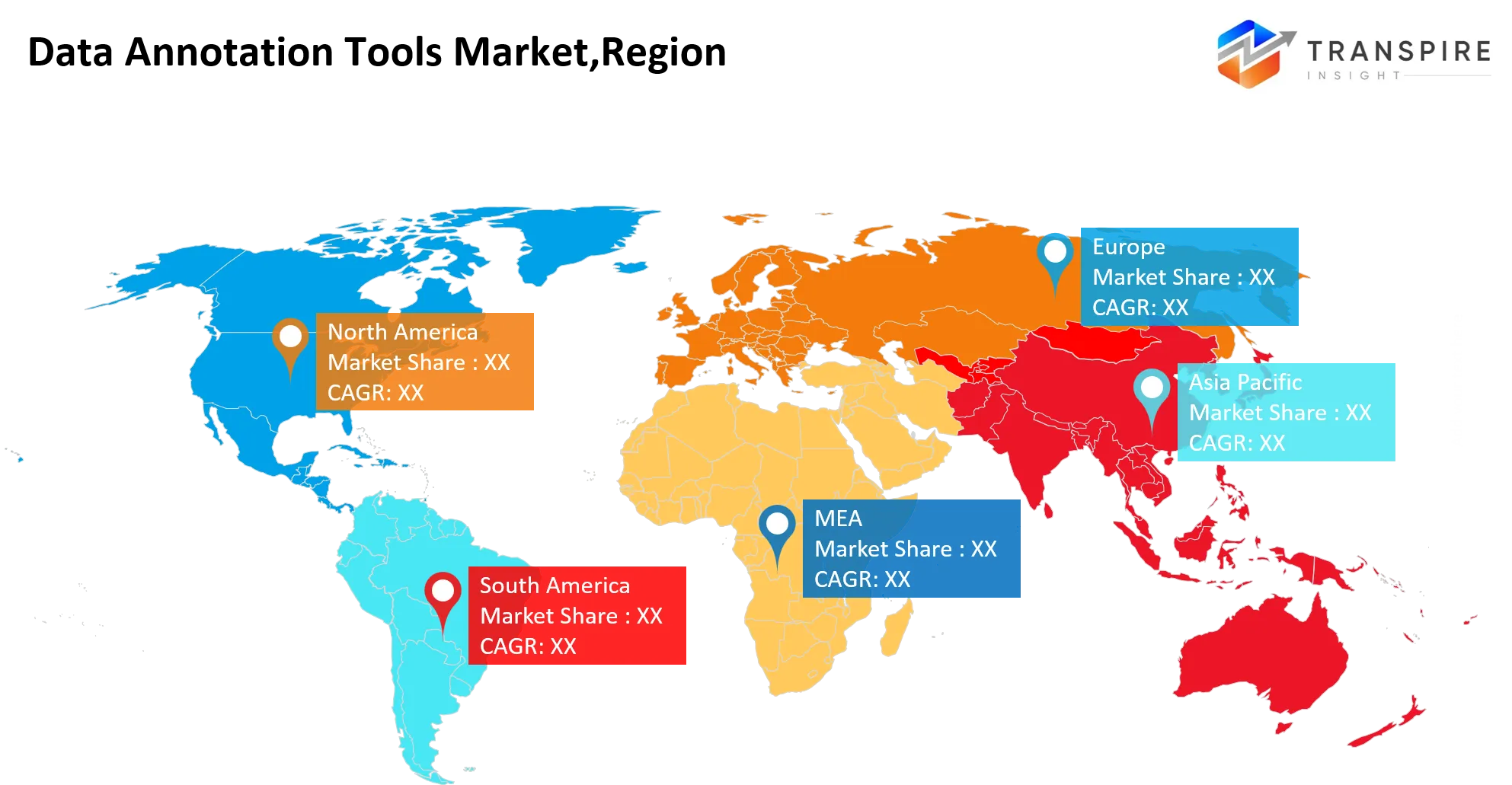
North America at 43% takes the lead, as the bulk of the AI model developers, autonomous vehicle programs, and large cloud providers who need constant, high-quality labelled data are based here. North America's ecosystem of high-end infrastructure, robust venture funding, and early enterprise AI adoption creates a cycle that feeds on itself – demand for more advanced annotation platforms. Increased regulation on how data can be used across several industries, and mature outsourcing partners, help solidify that lead – a virtuous circle that results in better models requiring more annotation spend.
In February 2026, Labelbox acquired the agentic sales automation startup Upcraft. This integration incorporates Upcraft's AI agent technology into Labelbox's infrastructure to automate workflows and rapidly scale outreach within its network of over 1 million domain experts.
Europe at 27% maintains consistent growth, with mature automotive, industrial manufacturing, and health sectors benefiting from high-accuracy, high-compliance annotation with deep industry knowledge. However, growth is more modest than in North America, limited by market-specific rules and GDPR. These regulations underpin demand for quality-oriented on-premise or sovereign-cloud annotation processes instead of simply scale, thus requiring heavier investment in regtech tools and long-term growth.
In January 2026, Amazon Web Services (AWS) launched the AWS European Sovereign Cloud. This specialized infrastructure initiative is backed by an initial independent region in Germany.
Asia Pacific is 22% of the market and growing at a 25.4% CAGR; the fastest-growing market, as AI systems programmes across India, China, Japan and SE Asia are ramping up quickly in parallel as the labour force becomes more cost-competitive. One recent trend has been an increase in local AI capacity and a higher proportion of annotation work being diverted to the region. Going forward, the opportunity is to develop locally adapted, compliant platforms for domestic as well as international enterprises looking for scale and speed.
In May 2026, Google Cloud announced expanded collaborations with Enterprise Singapore, Indonesia's Komdigi, Vietnam's NIC, and Ho Chi Minh City's SIHUB to launch an AI startup innovation corridor.
Who are the Key Players in the Data Annotation Tools Market, and how do they compete?
Market competition is heating up at the pure-play annotation tool level, as service providers and hyperscalers combine platform, specialist domain knowledge, and large-scale delivery for market access. Established players such as Scale AI, Appen, and TELUS International differentiate on scale, domain depth, and end-to-end data operations with human-in-the-loop review for autonomous vehicles, NLP, and enterprise AI. Meanwhile, newer category entrants specialise in niche modalities or verticals, emphasising innovation and developer-friendly annotation tools with model-assisted labelling, active learning, and open platform APIs, such as Labelbox, Super Annotate, and Encord. Finally, companies like Sama, iMerit, and Cloud Factory focus on cost-effective, socially responsible outsourcing of large-scale annotation operations with dedicated teams for healthcare, enterprise content moderation, and tough computer vision tasks. Niche and open-source strategies are pursued by Label Studio, V7, Dataloop, Hive, and CVAT, offering flexible, adaptable platforms that can be integrated into custom research pipelines; Microsoft's ecosystem lock-in strategy dominates the cloud-based annotation platform space by tightly integrating annotation into its broader AI and cloud services, making it easier for big enterprise customers to adopt through cloud and platform procurement and integration.
Key Players are:
- Scale AI
- Appen
- TELUS International
- Labelbox
- SuperAnnotate
- Encord
- Sama
- iMerit
- CloudFactory
- Label Studio
- V7
- Dataloop
- Hive
- CVAT
- Amazon Web Services
Recent Development News
- In March 2026, Universal Robots partnered with Scale AI to launch the UR AI Trainer imitation learning system at GTC 2026. This collaboration captures synchronised motion, force, and visual data on industrial hardware to bridge the lab-to-factory gap for robotics foundation model training.
- In April 2026, Quhuo partnered with Wons to establish joint AI data-service operations across China, Vietnam, Germany, and the U.S. The partnership combines Wons’ annotation standards and quality systems with Quhuo’s workforce capabilities to scale data collection, annotation, cleaning, and quality inspection across image, audio, text, and point-cloud datasets.
- In March 2026, Centific launched Data Canvas, an annotation operating system designed for physical AI, robotics, embodied AI, and autonomous systems. The product adds multi-sensor data fusion and reasoning-traceable labelling, expanding annotation capabilities for complex multimodal AI training workflows.
What Strategic Insights Define the Future of the Data Annotation Tools Market?
The market is moving in the direction of AI-native data operations, in which annotation, evaluation, synthetic-data generation, quality control, and model feedback are all contained in one continuous process. The unseen risk is that automation can mirror the scale of false labels just as easily as true ones, making expert validation and dataset governance increasingly strategic rather than a "nice-to-have." Regulatory pressures around compliance - including the EU's forthcoming AI Act, which will impose transparency and documentation requirements on AI systems - only increase accountability. An additional opportunity in physical AI in robotics, autonomous vehicles, LiDAR, sensor fusion, and human-behaviour datasets requires domain-specific annotation that differs from the image- and text-labelling used in AI-native data. Encord's 2026 investment in an AI-native data infrastructure and TELUS Digital's foray into physical-AI data services showcase this emerging direction. Provider strategy should shift toward multimodal orchestration, domain-specific validation, provenance, and reusable, AI-assisted workflows, rather than novel entrants simply adding annotation staff capacity.
Key Segmentations are:
By Component
- Tools
- Services
- Platforms
- APIs
- Managed Services
- Consulting
- Integration
- Others
By Annotation Type
- Image
- Video
- Text
- Audio
- 3D
- Sensor Data
- Geospatial
- Others
By Technology
- Machine Learning
- Computer Vision
- NLP
- Speech Recognition
- Deep Learning
- Generative AI
- Robotics
- Others
By Application
- Autonomous Vehicles
- Healthcare
- Retail
- Security
- Agriculture
- Manufacturing
- IT & Telecom
- Others
By Annotation Approach
- Manual
- Semi-supervised
- Automated
- Outsourced
- Crowdsourced
- In-house
- Hybrid
- Others
By Enterprise Size
- Large Enterprises
- SMEs
- Startups
- Government
- Research Institutes
- Technology Companies
- Academic Institutions
- Others
By End User - Automotive
- Healthcare
- Retail
- BFSI
- Manufacturing
- Media
- Government
- Others
Frequently Asked Questions
Find quick answers to common questions.
The data annotation tools market size was valued at USD 2859.59 million in 2025 and is poised to reach USD 22818.30 million by 2033, expanding at a 29.65% CAGR.
Key segments for the data annotation tools market are By Component (Tools, Services, Platforms, APIs, Managed Services, Consulting, Integration, Others); By Annotation Type (Image, Video, Text, Audio, 3D, Sensor Data, Geospatial, Others); By Technology (Machine Learning, Computer Vision, NLP, Speech Recognition, Deep Learning, Generative AI, Robotics, Others); By Application (Autonomous Vehicles, Healthcare, Retail, Security, Agriculture, Manufacturing, IT & Telecom, Others); By Annotation Approach (Manual, Semi-supervised, Automated, Outsourced, Crowdsourced, In-house, Hybrid, Others); By Enterprise Size (Large Enterprises, SMEs, Startups, Government, Research Institutes, Technology Companies, Academic Institutions, Others); By End User (Automotive, Healthcare, Retail, BFSI, Manufacturing, Media, Government, Others).
Growth is primarily driven by the expansion of generative AI, multimodal AI models, autonomous vehicles, robotics, computer vision, and the need for high-quality labeled datasets for model training and evaluation.
The data annotation tools market is led by major manufacturers, including Scale AI, Appen, TELUS International, Labelbox, SuperAnnotate, Encord, Sama, iMerit, CloudFactory, Label Studio, V7, Dataloop, Hive, CVAT, and Amazon Web Services.
North America holds a 43% share, supported by advanced AI ecosystems, cloud infrastructure, leading AI developers, autonomous technology, robotics, and strong enterprise adoption of generative AI and computer vision.
Commercial Opportunities include AI-assisted annotation, multimodal data labelling, synthetic data generation, physical AI and robotics datasets, domain-specific annotation, and integrated data-quality and model-evaluation services.
About the Authors

Mayur Shinde
I am Mayur Shinde, a Senior Research Analyst at Transpire Insight, specializing in the Automotive & Transportation and Information & Communication Technology (ICT) Industry. My work focuses on analyzing emerging market trends, technological advancements, competitive landscapes, and industry developments to deliver accurate, data-driven insights. I am passionate about transforming complex market information into clear, actionable content that helps businesses, professionals, and decision-makers stay informed and make confident strategic decisions.

Chakradhar Khansole
Chakradhar serves as the Research Director at Transpire Insight, bringing over 8 years of experience in technology, innovation, and strategic market intelligence. He specializes in transforming complex market data into actionable business insights that enable organizations to make informed, growth-oriented decisions. Recognized for his strategic vision and analytical expertise, Chakradhar leads high-impact research initiatives, delivering comprehensive market assessments, competitive intelligence, and forward-looking industry analysis.
Recently Published Reports
-
Apr 2026
3D Optical Profiler Market
3D Optical Profiler Market Size, Share & Analysis Report By Type (Desktop 3D Optical Profiler, and Portable 3D Optical Profiler), By Technology (Confocal Technology, and White Light Interference), By End-Use Industry (Manufacturing, Research Institutions, Automotive, Aerospace and Defense, Medical Devices, and Other), and Geography (North America, Europe, Asia-Pacific, Middle East and Africa, South and Central America), 2021 - 2031
-
Apr 2026
Depth Sensor Market
Depth Sensor Market Size, Share & Analysis Report By Type (Infrared Depth Sensors, Time-of-Flight (ToF) Sensors, Stereo Vision Sensors, Structured Light Sensors, Ultrasonic Depth Sensors), By Application (Automotive, Robotics, Gaming, Consumer Electronics, Industrial Automation, Healthcare, Security & Surveillance, Others), By End Users (Automotive Manufacturers, Consumer Electronics Companies, Healthcare Providers, Industrial Companies, Security Agencies, Gaming Companies, Robotics Companies, Others), and Geography (North America, Europe, Asia-Pacific, Middle East and Africa, South and Central America), 2021 – 2031
-
Apr 2026
Digital Manufacturing Market
Digital Manufacturing Market Size, Share & Analysis Report By Component (Hardware, Software, and Services), By Technology (Robotics, 3D Printing, Internet of Things (IoT), and Others), By Application (Automotive and Transportation, Aerospace and Defense, Consumer Electronics, Industrial Machinery, and Others), By Process Type (Computer-Based Designing, Computer-Based Simulation, Computer 3D Visualization, Analytics, and Others), and Geography (North America, Europe, Asia-Pacific, Middle East and Africa, South and Central America), 2021 – 2031
-
Apr 2026
Digital Visa Services Market
Digital Visa Services Market Size, Share & Analysis Report By Type (Individual Travelers, Group Travelers), By Application (Tourism, Business Travel, Others), and Geography (North America, Europe, Asia-Pacific, Middle East and Africa, South and Central America), 2021 – 2031