

Daily Fantasy Sports Market Summary:
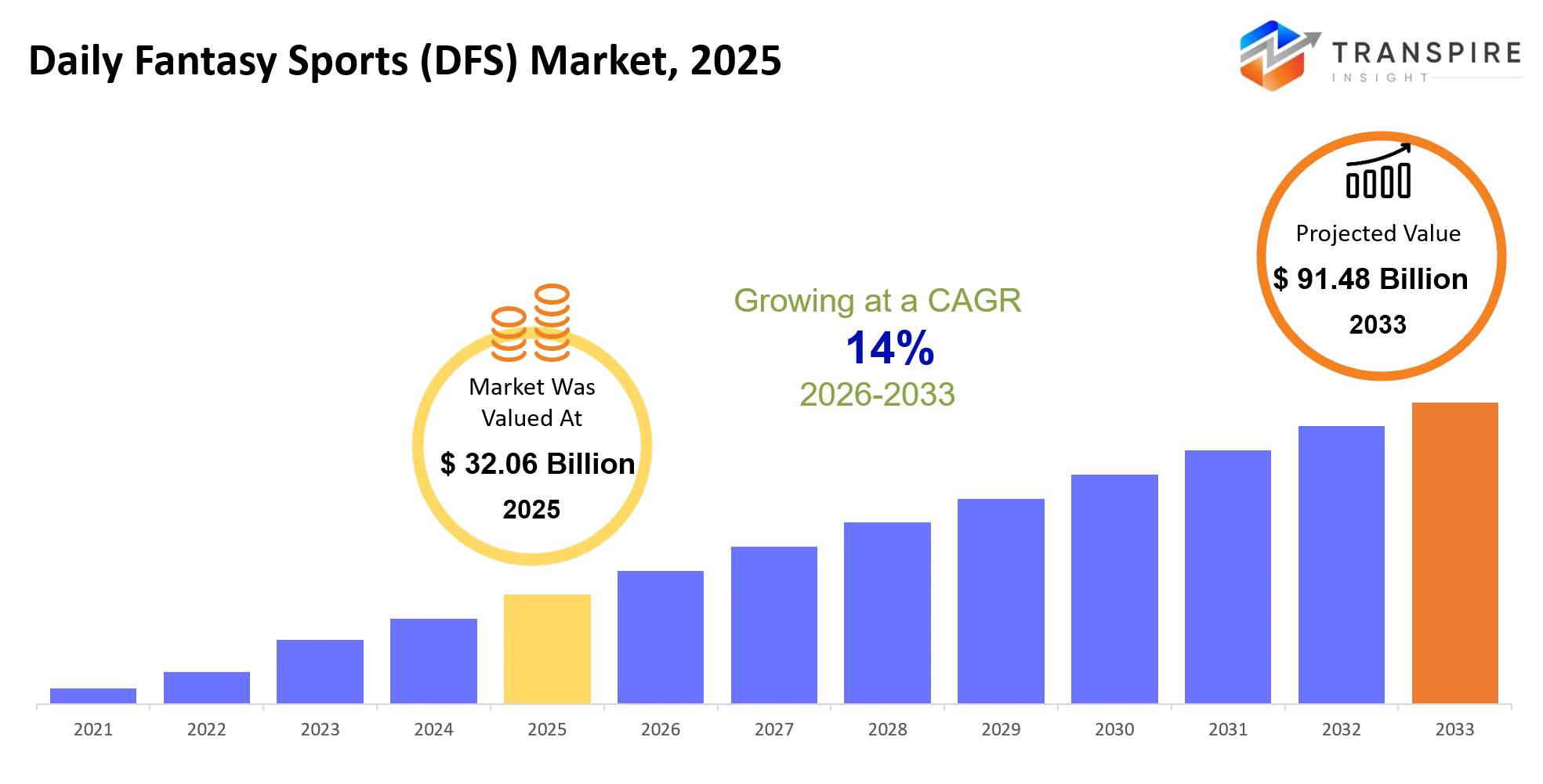
As per the Transpire Insight Analysis, The Daily Fantasy Sports (DFS) Market size is estimated at USD 32.06 billion in 2025 and is anticipated to reach USD 91.48 billion by 2033, growing at a CAGR of 14% from 2026 to 2033.
The DFS Market enables participants to draft virtual teams, enter time-limited contests, and then earn prizes based on the live performances of players or teams. Revenue can come from entry fees, advertising, subscriptions, sponsorships, and data services. In the past 3-5 years, the DFS market has shifted away from desktop participants to service an increasing number of mobile-first players, who settle contests faster, receive recommendations based on past activity, and compete head-to-head with friends. Structurally, the shift has been toward the combination of live data, automated scoring and predictive analytics within a continuous engagement model. A major real-world catalyst has been the proliferation of legal online sports betting and fantasy sports programs across a small number of states, which has led to questions around contest structure, age vetting and consumer protection. Growth follows a well-defined commercial path: entry via easy mobile onboarding, rebuilding loyalty with in-game stats and diversifying formats for monetisation, but the state-by-state regulatory patchwork creates hurdles for platform access and running costs.
Daily Fantasy Sports (DFS) Market Size & Forecast:
- Market Size 2025: USD 32.06 Billion
- Expected Market Value (2033): USD 91.48 Billion
- Forecast CAGR (2026–2033): 14%
- Leading Region in 2025: North America
- Fastest Growing Region: Asia-Pacific
- Key Company Profiles: DraftKings, FanDuel, Dream Sports, Yahoo Fantasy Sports, ESPN Fantasy Sports, Sleeper, Underdog Fantasy, PrizePicks, CBS Sports Fantasy, MPL, My11Circle, FanFight, RealFevr, SuperDraft, PlayUp.
Key Daily Fantasy Sports (DFS) Market Insights:
In the DFS market, the focus is now on a mobile-first, data-driven form of competition that values personalised experiences and contests over the prize money. The platforms that will scale sustainably will be influenced by regional differences in regulation and sports preferences.
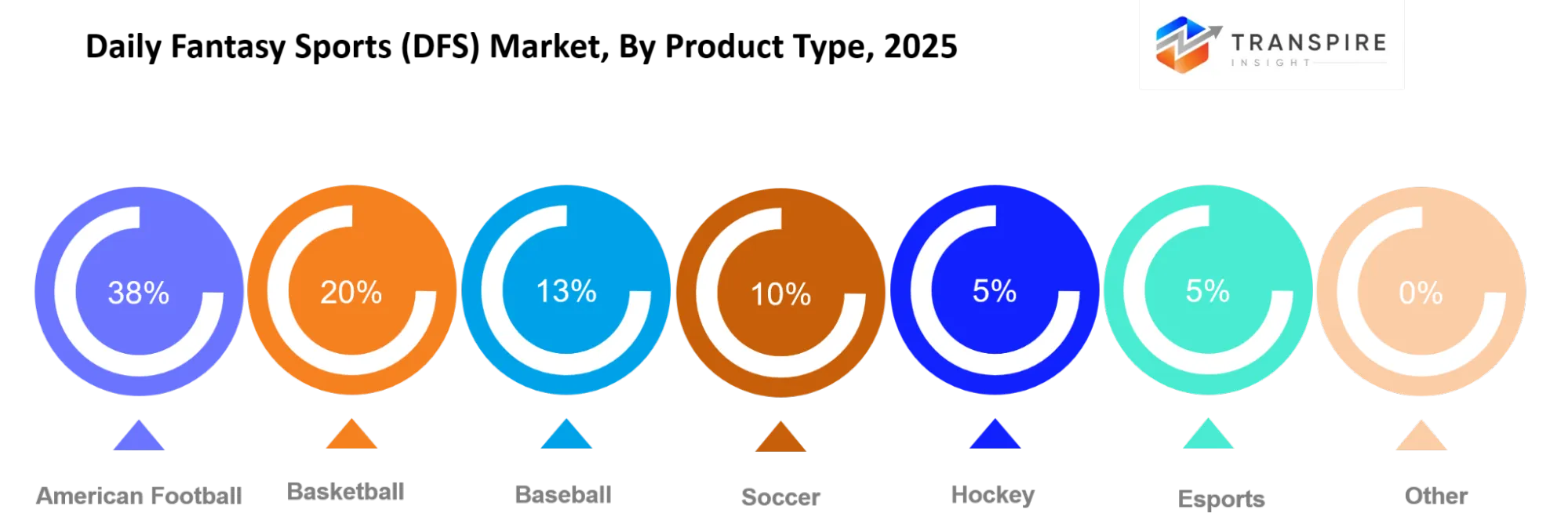
- American football is the top sport at 38.00%, followed by DraftKings and FanDuel, which offer big tournaments and six-figure NFL jackpots.
- Esports is expanding at a 14.64% CAGR, while Sleeper and Underdog appeal to younger audiences with streamlined drafts, in-chat leagues, and pick 'em games.
- Platform usage is dominated by mobile apps, while FanDuel's Picks platform makes it easy to choose between 3-6 athletes for “more” and “less.”
- The game is built on the salary-cap format, but DraftKings offers high-stakes tournaments, and FanDuel focuses on easy-to-play cash games.
- Pick’em is evolving into a lower-friction format, with alternate player lines, multipliers, and quicker settlement.
- Entry fees remain the main revenue stream, with operators introducing advertising, subscriptions, and data partnerships to reduce reliance on contest volume.
- North America accounts for 46.00% of demand, while DraftKings and FanDuel rely on state-level licensing and cross-sell sportsbook ecosystems to hold on to market share.
- Asia-Pacific is growing at a 17.90% CAGR, and Dream Sports is making Dream11 an AI-first, prize-free sports-engagement platform due to India's regulatory change in 2025.
- Media reach and fantasy content are being leveraged by Yahoo, ESPN, and CBS Sports to turn their audiences into regular mobile fans, while MPL, My11Circle, and FanFight are emphasizing regional, cricket-centric engagement.
What are the Key Drivers, Restraints, and Opportunities in the Daily Fantasy Sports (DFS) Market?
Driver:
Mobile accessibility and short-duration contests are central growth drivers. Improved smartphone performance, digital payments, and live player statistics have reduced the effort required to join contests. The expansion of real-time sports coverage also gives users more opportunities to participate beyond traditional season-long fantasy leagues. As platforms personalise onboarding and offer free-entry options alongside paid contests, they can convert occasional sports followers into repeat users. DraftKings’ 2026 strategy to unify its sports and entertainment products reflects the commercial value of simplified access and cross-platform engagement.
Restraint:
Fragmented regulation remains a structural barrier. Differences in state laws, licensing requirements, permitted contest formats, age verification, and prize structures force operators to maintain jurisdiction-specific systems. Illinois’ 2026 licensing provisions illustrate how compliance obligations can affect market access and operating costs.
Opportunity:
AI-assisted lineup tools, transparent contest recommendations, and social competitions offer room for product differentiation. Operators can invest in explainable player projections, personalised practice contests, and safer participation controls. In North America, these features can improve retention, while partnerships with sports-data providers and esports organisers can open additional audiences. Commercial success will depend on balancing personalisation with data accuracy, responsible engagement, and local legal requirements.
|
Driver |
Relative Impact on Growth (%) |
Geographic Relevance |
Impact Timeline |
Demand Strength |
Growth Mechanism |
Key Beneficiaries |
Major Constraint |
|
Driver 1: Rising Mobile Sports Engagement and Real-Time Fan Participation |
25% |
North America, Europe, Asia-Pacific |
Short-term |
High |
Mobile apps enable frequent, real-time fantasy participation |
DFS platforms, sports leagues, advertisers, mobile technology providers |
User acquisition costs and intense platform competition |
|
Driver 2: AI, Predictive Analytics and Personalized Fantasy Recommendations |
22% |
North America, Europe, Asia-Pacific |
Medium-term |
High |
AI improves player projections, personalization, and contest engagement |
DFS operators, AI vendors, data providers, advanced users |
High technology investment and data-quality requirements |
|
Driver 3: Expansion of Regulated DFS Ecosystems and Product Innovation |
20% |
United States, Canada, United Kingdom, Australia |
Medium-term |
High |
Regulatory clarity enables operators to launch differentiated contests |
DFS operators, regulators, payment providers, sports organizations |
Fragmented regulations across jurisdictions and formats |
|
Driver 4: Growth of Live Sports Content, Esports and Emerging Fantasy Categories |
18% |
Asia-Pacific, North America, Europe |
Short-term |
High |
More sports properties expand contest frequency and addressable users |
DFS platforms, sports rights holders, esports operators, media companies |
Uneven popularity and data availability across sports |
|
Driver 5: Strategic Investment, Partnerships and Integrated Sports Entertainment Ecosystems |
15% |
North America, Europe, Asia-Pacific |
Long-term |
Medium |
Partnerships expand distribution, monetization, and cross-platform engagement |
DFS operators, sports teams, broadcasters, technology providers |
Regulatory risk and rising customer acquisition expenditure |
What Has the Impact of Artificial Intelligence Been on the Daily Fantasy Sports (DFS) Market?
AI is improving the way DFS providers utilise sports data to create games and monitor user activity. Machine-learning models can pull in historical player data, opponent quality, injuries, minutes, conditions, recent form, and other variables to estimate potential fantasy points, which helps users compare players, find value plays, and evaluate a different lineup before entering.
Algorithms can be used to calculate scores when plays are confirmed, identify irregular account activity and suspicious competition, or assist customer support teams in queuing disputes. Recommendation engines can surface relevant contests based on their sport, experience and consumer behaviour to reduce friction on searches and improve retention. The field is moving toward broader AI. For example, in March 2026, DraftKings disclosed intentions to deploy AI across the site, not just in a single game, to increase efficiency and operational leverage. But AI predictions will be vulnerable to late injuries, unpredictable subs, incomplete data, and sporting chaos, and require investment in solid live feeds and transparent models. So AI's best use today is in decision support and operations rather than lineup wins.
In September 2026, DraftKings expanded its strategic deployment of machine learning by launching Gamalyze American Football, a football-themed self-assessment tool developed in partnership with Mindway AI.
Key Daily Fantasy Sports (DFS) Market Trends:
The DFS sector is moving away from the "stand-alone" contest entry to more connected, data-driven experiences that bring real-time analytics, personalisation and social interaction together. Maintaining users efficiently and having open rules and responsible participation is becoming a vital part of competitive advantage.
- Contest participation has shifted from a desktop to a mobile application.
- In-game, live contests are growing in popularity as real-time scoring and instant settlements continue to develop.
- Engagement tools are increasingly becoming personalised and based on AI forecasts.
- Partnerships with the official leagues are expanding and improving the integrity and quality of the contests.
- Esports and cricket are becoming more popular among young and international fans.
- Operators are being driven towards licensing, taxation, and geo-compliance systems by regulatory formalisation.
- Social and community elements (private leagues, chat, shared contests) are helping to increase retention.
- Responsible-gaming features, betting caps and behavioural tracking are getting competitive.
- The user friction is being lowered with payment innovation, faster withdrawals, and digital wallets.
- Revenue diversification via advertising, subscriptions, sponsorships, and data services.
Daily Fantasy Sports (DFS) Market Segmentation
Sport Type:
American football is the most dominant sport type at 38.00% participation, based on well-established professional leagues, depth of player statistics, and player TV viewer exposure on weekly games. Other sport types are as follows: 20.00% Basketball, 13.00% Baseball, 10.00% Soccer, 9.00% Cricket, 5.00% Hockey, 3.00% Esports, and 2.00% in others. Esports is the fastest-growing sport type, with 14.64% compound growth per annum, and is a remote activity where digital fans are familiar with frequent matches. Broader international coverage could accelerate participation diversification outside North American sports.
Platform:
Mobile applications dominate because they support live contest entry, push notifications, biometric authentication, and convenient payments. Web-based platforms remain valuable for users conducting detailed player research and managing multiple lineups, while desktop and tablet interfaces support more complex analysis. Social platforms and super apps improve contest discovery through integrated communities, whereas connected TV offers complementary engagement during live matches. Future growth will depend on embedding DFS features into streaming, social, and digital entertainment ecosystems.
Competition Format:
Salary-cap contests remain important because they combine player-selection strategy with accessible entry mechanics and scalable prize pools. Snake drafts appeal to users who prefer interactive team selection, while Pick'em and points-per-dollar formats simplify participation. Head-to-head contests encourage direct competition, whereas tournaments and guaranteed prize pools attract users seeking larger events. Operators can strengthen retention by offering different formats for varying experience levels, balancing competitive excitement with transparent rules and responsible participation.
Revenue Model:
Entry fees provide a central monetisation channel for paid contests, while advertising, subscriptions, sponsorships, in-app purchases, data services, partnerships, and other sources broaden revenue opportunities. Advertising monetises audience reach, sponsorships connect brands with sports communities, and subscriptions can provide recurring income from premium tools. Data services create opportunities to commercialise statistical insights where permitted. Over time, diversified revenue models may reduce dependence on contest volume, particularly where regulatory restrictions limit paid-entry activities.
User Type:
Amateur and casual players contribute participation volume because accessible interfaces and straightforward contests lower entry barriers. Serious and professional players typically seek detailed projections, advanced statistics, and lineup optimisation tools, while high-frequency users value speed and efficient contest management. Social players are drawn to private leagues and friend-based competition, whereas esports players engage with digitally native tournaments. Future growth will depend on converting occasional participants into retained users through guided onboarding, relevant recommendations, community features, and responsible-play safeguards.
What are the Key Use Cases Driving the Daily Fantasy Sports (DFS) Market?
The core use case is mobile contest participation around American football, which represents 38.00% of the sport-type market. Fans create lineups, monitor live scores, and enter weekly or daily contests, converting sports viewership into recurring digital engagement.
Expanding applications include basketball, baseball, soccer, and cricket contests, where real-time data, live leaderboards, and short-format games support higher participation frequency. Operators also use DFS to strengthen advertising, sponsorship, and subscription monetization across sports-media ecosystems.globenewswire+1
Emerging use cases include esports DFS, which is growing at 14.64% CAGR, AI-personalized contest recommendations, social private leagues, and responsible-gaming analytics. These applications link DFS with streaming, gaming, and data-service industries, creating new engagement and revenue pathways.
|
Report Metrics |
Details |
|
Market size value in 2025 |
USD 32.06 Billion |
|
Market size value in 2026 |
USD 36.55 Billion |
|
Revenue forecast in 2033 |
USD 91.48 Billion |
|
Growth rate |
CAGR of 14% from 2026 to 2033 |
|
Base year |
2025 |
|
Historical data |
2021 - 2024 |
|
Forecast period |
2026 - 2033 |
|
Report coverage |
Revenue forecast, competitive landscape, growth factors, and trends |
|
Regional scope |
United States; Canada; Mexico; United Kingdom; Germany; France; Italy; Spain; Denmark; Sweden; Norway; China; Japan; India; Australia; South Korea; Thailand; Brazil; Argentina; South Africa; Saudi Arabia; United Arab Emirates |
|
Key companies profiled |
DraftKings, FanDuel, Dream Sports, Yahoo Fantasy Sports, ESPN Fantasy Sports, Sleeper, Underdog Fantasy, PrizePicks, CBS Sports Fantasy, MPL, My11Circle, FanFight, RealFevr, SuperDraft, PlayUp. |
|
Customization scope |
Free report customization (country, regional & segment scope). Available customized purchase options to meet your exact research needs. |
|
Report Segmentation |
Sport Type (American Football, Basketball, Baseball, Cricket, Soccer, Hockey, Esports, Others); Platform (Mobile Applications, Web-Based Platforms, Desktop, Tablet, Social Platforms, Super Apps, Connected TV, Others); Competition Format (Salary Cap, Snake Draft, Pick'em, Points-Per-Dollar, Head-to-Head, Tournaments, Guaranteed Prize Pools, Others); Revenue Model (Entry Fees, Advertising, Subscriptions, Sponsorships, In-App Purchases, Data Services, Partnerships, Others); User Type (Amateur Players, Casual Players, Serious Players, Professional Players, High-Frequency Players, Social Players, Esports Players, Others) |
Which Regions are Driving the Daily Fantasy Sports (DFS) Market Growth?
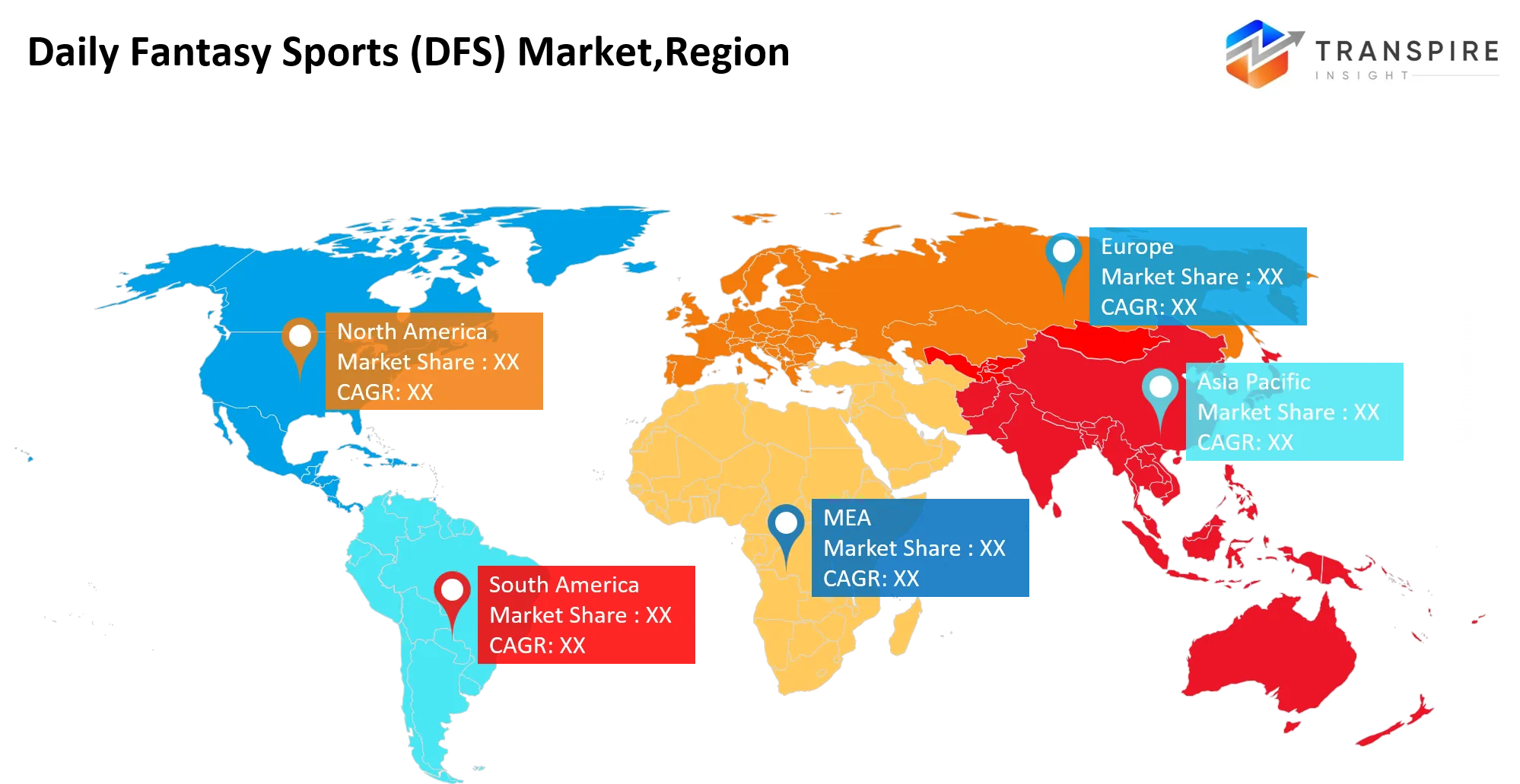
North America accounts for the largest share at 46.00% of the overall DFS market owing to the existing sports fan community, large disposable income, and a regular schedule of professional leagues. The United States has the strongest ecosystem with state licensing, mature payment infrastructure, and large sports media consumption. DraftKings and FanDuel have the benefits of brand presence, deep contest liquidity, and cross-selling opportunities into adjacent betting and media products, which results in a self-reinforcing feedback loop whereby user activity drives bigger prize pools and better user retention.
In April 2026, FanDuel announced a strategic partnership to become the first Official Betting Operator of Formula 1 in the United States. This agreement embeds real-time odds and contextual insights directly into F1’s official app and digital content, expanding user reach and boosting user acquisition during high-profile race weekends.
Europe at 22.00% will continue to grow at a steadier and more regulation-based rate than North America due to the continued growing acceptance of online gaming, healthy football and basketball cultures, and the growing availability of online payment methods. Europe will not be as reliant on a single sport and will have a more even spread across football-heavy content and country-specific regulations, supported by entrenched media brands, mature internet penetration and a steadier move to clearer regulation.
In October 2026, Lottomatica and CIRSA approved a cross-border merger plan to unite their complementary European operations. This strategic transaction combines Lottomatica’s online gaming, sports betting, and retail networks in Italy with CIRSA’s robust casino, digital gambling, and gaming hall footprint across Spain.
https://sigma.world/news/lottomatica-cirsa-merger-plan/
Asia-Pacific, with a market share of 20.00%, is currently the fastest-growing region, growing at a compound annual growth rate of 17.90%, driven by expanding mobile/smartphone adoption, large segments of young, digital consumers, and growing discretionary spend and income levels. Current legislative shifts have completely transformed market potential; in Dream11's case in particular, the focus has shifted from pay-to-play contests toward AI-enabled sports content, live scores, and community and social. Expect product opportunities to lie in building locally compliant, mobile-first product experiences that focus on cricket, esports, and localised payments/e-commerce, rather than mimicking U.S. based pay-to-play entry fee models.
In March 2026, Dream Cricket (a mobile-focused subsidiary of Dream Sports) partnered with Winners Alliance—the commercial entity representing international athletes through the World Cricketers' Association.
Who are the Key Players in the Daily Fantasy Sports (DFS) Market, and how do they compete?
Growth is driven by brand loyalty, contest types, data accuracy, mobile play, and CPI. Operators find differentiation through sport-specific communities, analytics, social features, and contest formats. Regulatory constraints increasingly determine which monetization types and geographies are commercially viable.
DraftKings combines daily fantasy sports with the wider digital sports ecosystem, investing in artificial intelligence and connected applications to deliver efficiency and engagement. Fan Duel leverages its sports entertainment platform and brand presence, while Yahoo Fantasy Sports and ESPN Fantasy Sports benefit from shared content distribution, existing leagues, and discovery through their existing sports audiences. Dream Sports, My11Circle, MPL and Fan Fight traditionally focused on mobile-first fantasy participation in India, but the India 2025 online gaming legislation substantially shifts the sustainability of paid-entry formats. Sleeper emphasises social competition, whereas Underdog Fantasy and Prize Picks facilitate expertise-driven, simple player-proposition contests, subject to regulation. Super Draft and PlayUp focus on other contest formats, while CBS Sports Fantasy and Real Fevr serve established fantasy and football-specific audiences, respectively. Across the portfolio, sustainable growth increasingly comes from product compliance, retention-optimised marketing, high-quality data and revenue diversification rather than new-player acquisition.
Key Players are:
- DraftKings
- FanDuel
- Dream Sports
- Yahoo Fantasy Sports
- ESPN Fantasy Sports
- Sleeper
- Underdog Fantasy
- PrizePicks
- CBS Sports Fantasy
- MPL
- My11Circle
- FanFight
- RealFevr
- SuperDraft
- PlayUp
Recent Development News
In July 2026, IG Group agreed to acquire Underdog, a US-based daily fantasy sports and prediction markets operator, in a transaction valued at up to $1.3 billion. The deal supports IG Group's expansion into the US market and strengthens its position in digital sports entertainment and event-based prediction products.
https://www.iggroup.com/investor-relations/press-releases/2026/acquisition-of-underdog
In February 2026, Atlas World Sports launched AtlasDFS, a new daily fantasy sports platform featuring real-time odds, AI-driven insights, and player-stat-based Pick'em contests. The launch expands its sports analytics ecosystem and gives users an integrated platform for researching player performance and building fantasy entries, with plans to add more sports throughout 2026.
In April 2026, PrizePicks established a landmark, multi-year partnership with the National Basketball Association (NBA) to become an Official Daily Fantasy Sports Partner. This commercial agreement grants the provider comprehensive rights to integrate official NBA intellectual property, league assets, and active team marks directly into its mobile platform and marketing initiatives.
https://www.prizepicks.com/press-news/prizepicks-named-an-official-daily-fantasy-partner-of-the-nba
What Strategic Insights Define the Future of the Daily Fantasy Sports (DFS) Market?
The future of DFS is to move to a compliant, mobile-first 'engagement' model rather than unrestrained paid contest proliferation. Operators employing AI in terms of personalised play, live information feeds, and simpler formats to appeal to casual play rather than the larger prize pools will have a better chance of capturing users than operators with a focus on high engagement through locked-in higher prizes. The looming risk of reclassification is significant. Platforms that rely solely on entry fees may well be reigned in suddenly, as was the case with Dream11 in India, where it moved away from paid contests altogether. The opportunity is to monetize engagement without risk of illegality. This can be done via subscription, advertising, data monetisation, sponsorship, and social contests. The Asia-Pacific region is high-growth (17.90% CAGR) and has high mobility and dynamic regulation, creating the conditions for the flat template model of engagement.
Key Segmentations are:
Sport Type
- American Football
- Basketball
- Baseball
- Cricket
- Soccer
- Hockey
- Esports
- Others
Platform
- Mobile Applications
- Web-Based Platforms
- Desktop
- Tablet
- Social Platforms
- Super Apps
- Connected TV
- Others
Competition Format
- Salary Cap
- Snake Draft
- Pick'em
- Points-Per-Dollar
- Head-to-Head
- Tournaments
- Guaranteed Prize Pools
- Others
Revenue Model
- Entry Fees
- Advertising
- Subscriptions
- Sponsorships
- In-App Purchases
- Data Services
- Partnerships
- Others
User Type
- Amateur Players
- Casual Players
- Serious Players
- Professional Players
- High-Frequency Players
- Social Players
- Esports Players
- Others
Frequently Asked Questions
Find quick answers to common questions.
The daily fantasy sports (DFS) market size was valued at USD 32.06 billion in 2025 and is poised to reach USD 91.48 billion by 2033, expanding at a 14% CAGR.
Key segments for the daily fantasy sports (DFS) market are Sport Type (American Football, Basketball, Baseball, Cricket, Soccer, Hockey, Esports, Others); Platform (Mobile Applications, Web-Based Platforms, Desktop, Tablet, Social Platforms, Super Apps, Connected TV, Others); Competition Format (Salary Cap, Snake Draft, Pick'em, Points-Per-Dollar, Head-to-Head, Tournaments, Guaranteed Prize Pools, Others); Revenue Model (Entry Fees, Advertising, Subscriptions, Sponsorships, In-App Purchases, Data Services, Partnerships, Others); User Type (Amateur Players, Casual Players, Serious Players, Professional Players, High-Frequency Players, Social Players, Esports Players, Others)
Growth is primarily driven by mobile-first platforms, real-time sports data, AI-powered player analytics, flexible contest formats, digital payments, and personalised user experiences.
Growth is primarily driven by mobile-first platforms, real-time sports data, AI-powered player analytics, flexible contest formats, digital payments, and personalised user experiences.
The daily fantasy sports (DFS) market is led by major manufacturers, including DraftKings, FanDuel, Dream Sports, Yahoo Fantasy Sports, ESPN Fantasy Sports, Sleeper, Underdog Fantasy, PrizePicks, CBS Sports Fantasy, MPL, My11Circle, FanFight, RealFevr, SuperDraft, and PlayUp.
North America dominates with a 46.00% share, supported by established professional sports leagues, strong fan engagement, advanced digital infrastructure, extensive sports data, and established DFS platforms.
- DraftKings
- FanDuel
- Dream Sports
- Yahoo Fantasy Sports
- ESPN Fantasy Sports
- Sleeper
- Underdog Fantasy
- PrizePicks
- CBS Sports Fantasy
- MPL
- My11Circle
- FanFight
- RealFevr
- SuperDraft
- PlayUp
About the Authors

Mayur Shinde
I am Mayur Shinde, a Senior Research Analyst at Transpire Insight, specializing in the Automotive & Transportation and Information & Communication Technology (ICT) Industry. My work focuses on analyzing emerging market trends, technological advancements, competitive landscapes, and industry developments to deliver accurate, data-driven insights. I am passionate about transforming complex market information into clear, actionable content that helps businesses, professionals, and decision-makers stay informed and make confident strategic decisions.

Chakradhar Khansole
Chakradhar serves as the Research Director at Transpire Insight, bringing over 8 years of experience in technology, innovation, and strategic market intelligence. He specializes in transforming complex market data into actionable business insights that enable organizations to make informed, growth-oriented decisions. Recognized for his strategic vision and analytical expertise, Chakradhar leads high-impact research initiatives, delivering comprehensive market assessments, competitive intelligence, and forward-looking industry analysis.
Recently Published Reports
-
Apr 2026
3D Optical Profiler Market
3D Optical Profiler Market Size, Share & Analysis Report By Type (Desktop 3D Optical Profiler, and Portable 3D Optical Profiler), By Technology (Confocal Technology, and White Light Interference), By End-Use Industry (Manufacturing, Research Institutions, Automotive, Aerospace and Defense, Medical Devices, and Other), and Geography (North America, Europe, Asia-Pacific, Middle East and Africa, South and Central America), 2021 - 2031
-
Apr 2026
Depth Sensor Market
Depth Sensor Market Size, Share & Analysis Report By Type (Infrared Depth Sensors, Time-of-Flight (ToF) Sensors, Stereo Vision Sensors, Structured Light Sensors, Ultrasonic Depth Sensors), By Application (Automotive, Robotics, Gaming, Consumer Electronics, Industrial Automation, Healthcare, Security & Surveillance, Others), By End Users (Automotive Manufacturers, Consumer Electronics Companies, Healthcare Providers, Industrial Companies, Security Agencies, Gaming Companies, Robotics Companies, Others), and Geography (North America, Europe, Asia-Pacific, Middle East and Africa, South and Central America), 2021 – 2031
-
Apr 2026
Digital Manufacturing Market
Digital Manufacturing Market Size, Share & Analysis Report By Component (Hardware, Software, and Services), By Technology (Robotics, 3D Printing, Internet of Things (IoT), and Others), By Application (Automotive and Transportation, Aerospace and Defense, Consumer Electronics, Industrial Machinery, and Others), By Process Type (Computer-Based Designing, Computer-Based Simulation, Computer 3D Visualization, Analytics, and Others), and Geography (North America, Europe, Asia-Pacific, Middle East and Africa, South and Central America), 2021 – 2031
-
Apr 2026
Digital Visa Services Market
Digital Visa Services Market Size, Share & Analysis Report By Type (Individual Travelers, Group Travelers), By Application (Tourism, Business Travel, Others), and Geography (North America, Europe, Asia-Pacific, Middle East and Africa, South and Central America), 2021 – 2031