

Courier, Express, & Parcel (CEP) Market Summary:
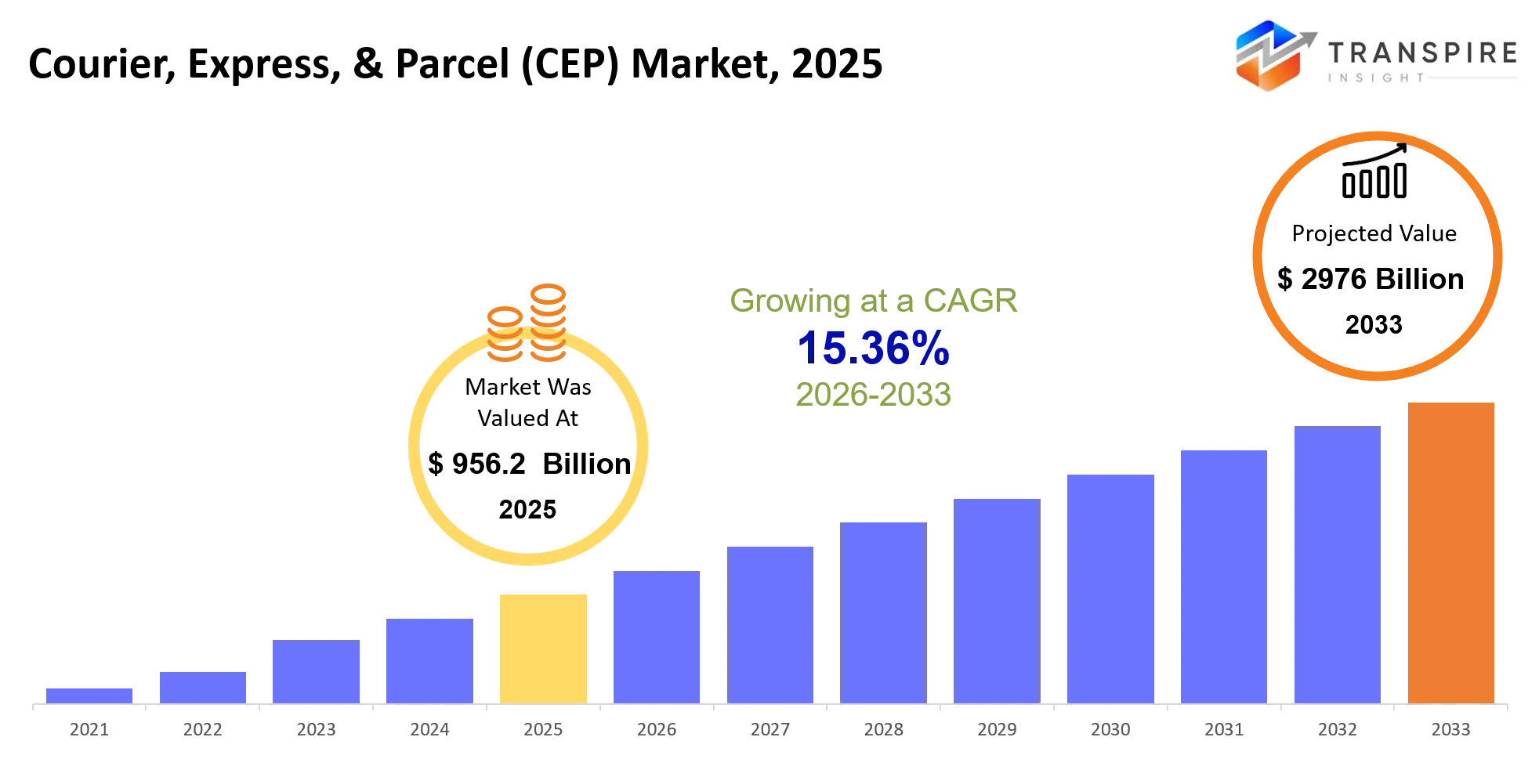
As per Transpire Insight Analysis, the Courier, Express, & Parcel (CEP) Market size is estimated at USD 956.2 billion in 2025 and is anticipated to reach USD 2976 billion by 2033, growing at a CAGR of 15.36% from 2026 to 2033.
The courier, express, and parcel (CEP) market supports move purchases, business shipments, documents and urgent items within and between countries. In the next three to five years, parcel companies have stopped just focusing on delivering more packages. Now they are working on making deliveries by giving better updates on where packages are and saving money. More people are buying things online, selling across borders and using direct-to-consumer models. This has made it more important to have shipping networks that can change and adapt. At the same time, machines that sort packages, digital tools that track shipments and computer systems that plan delivery routes are changing the way packages are handled and sent. Customers want their packages to arrive on time and want ways to return items. Because of this companies are spending more on the part of the delivery process and new technology. Higher costs for workers, fuel and more complicated deliveries are still hurting profits. Because of this, companies are now looking at making their networks work better, offering services and finding ways to grow without causing problems.
Courier, Express, & Parcel (CEP) Market Size & Forecast:
- Market Size 2025: USD 956.2 Billion
- Expected Market Value (2033): USD 2976Billion
- Forecast CAGR (2026–2033): 15.36%
- Leading Region in 2025: Asia-Pacific
- Fastest Growing Region: Asia-Pacific
- Key Company Profiles: DHL Group; FedEx Corporation; United Parcel Service; USPS; SF Holding; JD Logistics; Japan Post Holdings; Yamato Holdings; Aramex; DTDC; Blue Dart Express; Delhivery; Royal Mail; Singapore Post; Kerry Logistics
Key Market Insights:
The market is evolving into one where both low-cost package transportation and efficient deliveries are being considered. Traditional shipping remains at the core of the shipment numbers, with automation, international trade, and alternative methods shaping future investments.
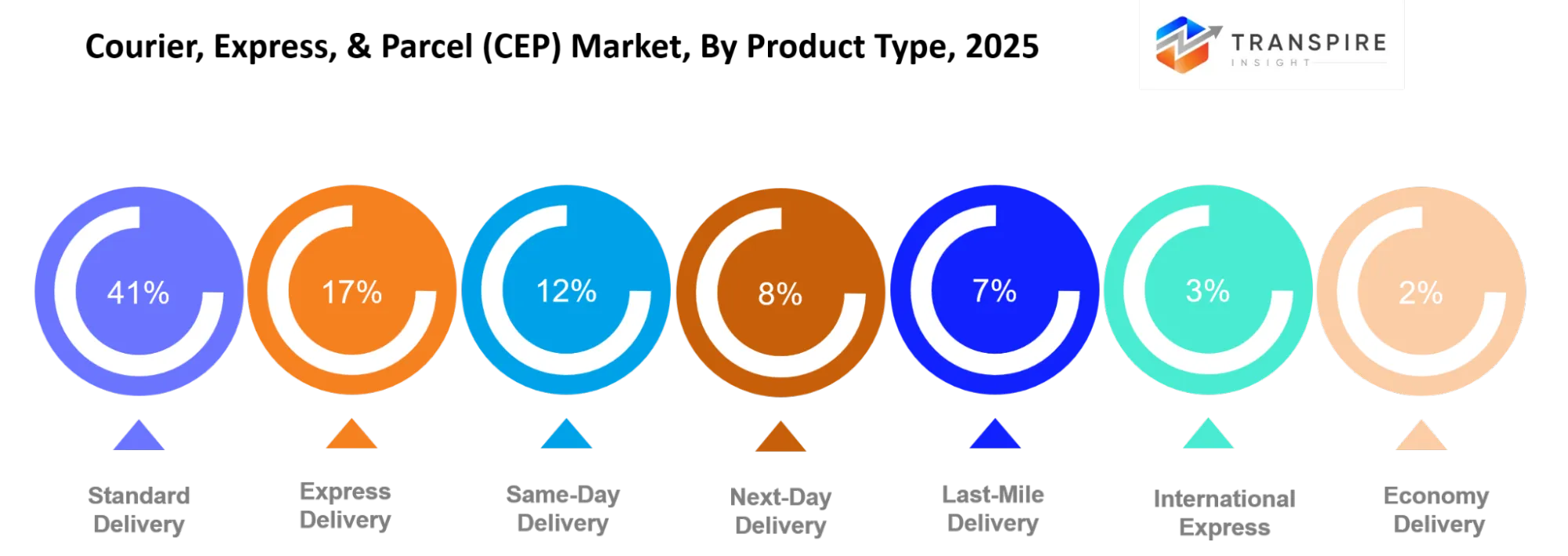
- Standard delivery holds 42.20% of the market share. It includes shipments via e-commerce and business deliveries. DHL Group is working on automating parcel handling.
- Express delivery accounts for 20.00% of the market share because businesses require reliable and timely deliveries. FedEx and UPS compete via integration and tracking systems.
- Same-day delivery constitutes 13.00% of the market share. It is one of the fastest-growing services. FedEx rolled out SameDay Local service in March 2026 for quicker local deliveries.
- Next-day delivery accounts for 9.00% of the market share. Retailers are bringing products closer to consumers to speed up deliveries.
- Last-mile delivery constitutes 7.00% of the market share. Optimised routes and parcel lockers are used to lower delivery expenses and missed deliveries.
- Economy delivery makes up 2.80% of the market share. It includes consolidated deliveries and flexible delivery schedule options.
What are the Key Drivers, Restraints, and Opportunities in the Courier, Express, & Parcel (CEP) Market?
Drivers
The rise in the number of online transactions, expansion of shipments to other countries and B2C operations is causing an increase in the number of parcels in transport domestically and internationally. Although merchants offer services to their customers not only locally but worldwide as well, there is a need for delivery, tracking, returns, and customs clearance services for such customers. This offers an opportunity for the CEP companies to earn by getting money for parcel processing, premium services, and logistics services.
Restraints
The last mile charges, fluctuating fuel costs, labour issues and failures of delivery might cause losses for the company. These factors remain relevant since the packages have to be delivered to distant geographic areas, while the customers may require cheap or even free shipping and returns.
Opportunities
Cross-border e-commerce presents opportunities for firms to reduce the complexities of customs clearance processes as well as ensure shipment tracking is done openly and effectively. With the expenditure on delivery by way of electric vans and delivery consolidations, costs will be controlled. Firms that deliver through cost-effective shipping and premium shipments will fulfill customer demands.
What Has the Impact of Artificial Intelligence Been on the Courier, Express, & Parcel (CEP) Market?
The use of artificial intelligence technology will facilitate shipment planning, customer relations, and better delivery in courier, express, and parcel (CEP) businesses. Machine learning algorithms can be trained to use past parcel volumes, weather, traffic, and delivery records for demand prediction and choosing the most suitable routes. The described features will enable operators to plan the allocation of vehicles, schedules of personnel and potential delays beforehand.AI technology will help with the automation of sorting, address validation, forecasted parcel volume, and exceptions management. Predictive solutions can determine parcels that might arrive later than initially planned and inform customers via customer service. Also, chatbots and automated solutions will be able to answer some common queries regarding tracking, changes in deliveries and returns. Still, implementing AI technologies requires investments in software, databases, employee training and the integration of logistics processes. Problems such as inaccurate addresses, inconsistency in data collection and unforeseen events can affect the predictions of machines. CEP services will, thus, benefit the most from the combination of AI and operational experience.
Instance
In May 2026, DHL Express launched an AI-driven item description system for international shipping. The technology uses computer vision to assess photos of shipments and automatically create item descriptions that comply with customs regulations. This initiative has improved the accuracy of shipment information and minimized the chances of customs-related delays and hassles, providing an example of how AI can be applied in the CEP business environment.
Key Market Trends:
Trends in the CEP industry towards connectivity, adaptability, and technology-based delivery networks. The capability to find the right balance between customer convenience, fast delivery, sustainability, and cost becomes essential in order to gain competitive advantage.
- Parcels will become increasingly less manually handled, as more sorting, scanning and conveyor equipment becomes automated to help handle increased volumes of work.
- Narrower time slots, same-day services and various collection points are introduced by providers in response to the desire of their clients to be in charge of when and where parcels can be received.
- Growth of international transportation. E-commerce platforms serve more customers from overseas markets, and carriers have to enhance their customs, international delivery and tracking systems.
- AI integration into the process. Operations planning, routing optimisation, and automated customer support services are becoming increasingly important for cutting costs from unnecessary delays.
- Development of parcel lockers. Outdoor delivery and return locations are becoming popular because they can prevent additional delivery attempts and provide client convenience.
Courier, Express, & Parcel (CEP) Market Segmentation
By Service
The standard delivery constitutes 42.20% of the total service segment, then comes express delivery with 20.00%, followed by same-day delivery with 13.00%, next-day delivery with 9.00%, last-mile delivery with 7.00%, international express with 5.00%, economy delivery with 2.80%, and specialised delivery with 1.00%. The service of standard delivery is supplemented with many e-commerce orders and deliveries, whereas the express service deals with time-sensitive shipments.. The same-day delivery service is recognised as the fastest-growing service in the given market profile, owing to an interest in speedy fulfilment periods. Next-day and last-mile services are still significant in terms of delivering shipments from fulfilment centres to customers, while the international express service caters to cross-border shipping.
By Business Model
the B2C shipping is related to e-commerce and home delivery, where the vendors grocery delivery use CEP services to fulfil the orders of individual customers. The B2B services cater to the needs of manufacturers, wholesalers, distributors, and office shipments that require scheduled and urgent shipments. C2C delivery enables shipments between individuals and includes resale orders and personal parcels. The B2B2C model is for businesses, logistics, and end consumers, whereas D2C shipping is used by brands to ship directly to their consumers. The marketplace delivery facilitates delivery for orders made from online platforms, whereas subscription delivery helps with recurring shipments.
By Destination
domestic deliveries take advantage of well-established network facilities for deliveries of parcels inside the country. International and cross-border deliveries help promote international e-commerce and trade activities but are accompanied by customs documentation. Intra-city delivery is intended to meet the needs of retail, food and urgent deliveries, whereas inter-city and regional deliveries link up business centres. Urban deliveries may be facilitated by the concentration of demand but hampered by the problem of traffic congestion and other access problems. Rural deliveries need a wider coverage area and careful route planning.
By Mode of Transport
road transport is still important in the delivery of goods on a local level, regionally, and in the last-mile delivery due to its flexibility. Air transport is used for urgent and international shipments where time of delivery is of utmost importance, while rail transport may offer an alternative for some appropriate long-distance routes. Sea transport is important for slow and consolidated shipments where cost is more important than time. Motorcycles and bicycles may be useful in congested urban areas and for small shipments. Drone transport provides a possible option in selected places.
By end user
e-commerce and retail firms need the provision of safe delivery of parcels, tracking of goods in transit and management of returned parcels. Manufacturing and automobile firms have a need for transportation of spare parts and other related items in their processes. The health sector requires the secure transportation of drugs, medical tools and any other temperature-sensitive products. In the financial sector, the use of couriers is used for transport of important documents. For the food and beverages industry, the mode of transport could be fast or refrigerated depending on the type of product.
By Delivery Type
Door to door delivery is convenient as parcels are delivered right at home to customers. Those unable to deliver parcels to their home can choose pickup stations and parcel lockers, but click and collect is a combination of purchasing online and physically visiting the shop. In curbside delivery you pick your parcel near the store or somewhere else. Store door deliveries will assist local shops to deliver their orders, but warehouse door deliveries will connect distribution centers with customers. Hub to hub delivery will involve transportation between two logistics centers.
What are the Key Use Cases Driving the Courier, Express, & Parcel (CEP) Market?
Parcel delivery is a use case in the CEP industry. Retailers, marketplace retailers, and direct-to-consumer brands rely on such services to transport their everyday items to customers from fulfilment centres. Express and next-day delivery services are applied to transport important business documents, parts replacement, and other important shipments. Expanded use cases include cross-border e-commerce, store-to-door delivery, returns management, and scheduled deliveries for retail and manufacturing companies. In the health care industry, there is a need for transportation of pharmaceuticals and medical devices. Examples of developing use cases include AI-driven delivery planning, automated returns management, parcel lockers, and selected drone deliveries.
|
Report Metrics |
Details |
|
Market size value in 2025 |
USD 956.2 Billion |
|
Market size value in 2026 |
USD 1094.4 Billion |
|
Revenue forecast in 2033 |
USD 2976 Billion |
|
Growth rate |
CAGR of 15.36%from 2026 to 2033 |
|
Base year |
2025 |
|
Historical data |
2021 - 2024 |
|
Forecast period |
2026 - 2033 |
|
Report coverage |
Revenue forecast, competitive landscape, growth factors, and trends |
|
Regional scope |
United States; Canada; Mexico; United Kingdom; Germany; France; Italy; Spain; Denmark; Sweden; Norway; China; Japan; India; Australia; South Korea; Thailand; Brazil; Argentina; South Africa; Saudi Arabia; United Arab Emirates |
|
Key company profiled |
DHL Group; FedEx Corporation; United Parcel Service; USPS; SF Holding; JD Logistics; Japan Post Holdings; Yamato Holdings; Aramex; DTDC; Blue Dart Express; Delhivery; Royal Mail; Singapore Post; Kerry Logistics |
|
Customization scope |
Free report customization (country, regional & segment scope). Avail customized purchase options to meet your exact research needs. |
|
Report Segmentation |
Service (Standard Delivery, Express Delivery, Same-Day Delivery, Next-Day Delivery, Last-Mile Delivery, International Express, Economy Delivery, Specialized Delivery); Business Model (B2C, B2B, C2C, B2B2C, D2C, Marketplace Delivery, Subscription Delivery, On-Demand Delivery); Destination (Domestic, International, Cross-Border, Intra-City, Inter-City, Rural, Urban, Regional); Mode of Transport (Road, Air, Rail, Sea, Motorcycle, Bicycle, Drone, Multimodal); End User (E-Commerce, Retail, Manufacturing, Healthcare, Financial Services, Automotive, Food & Beverage, Individuals); Delivery Type (Door-to-Door, Pickup Point, Locker, Click-and-Collect, Curbside, Store-to-Door, Warehouse-to-Door, Hub-to-Hub) |
Which Regions are Driving the Courier, Express, & Parcel (CEP) Market Growth?
North America
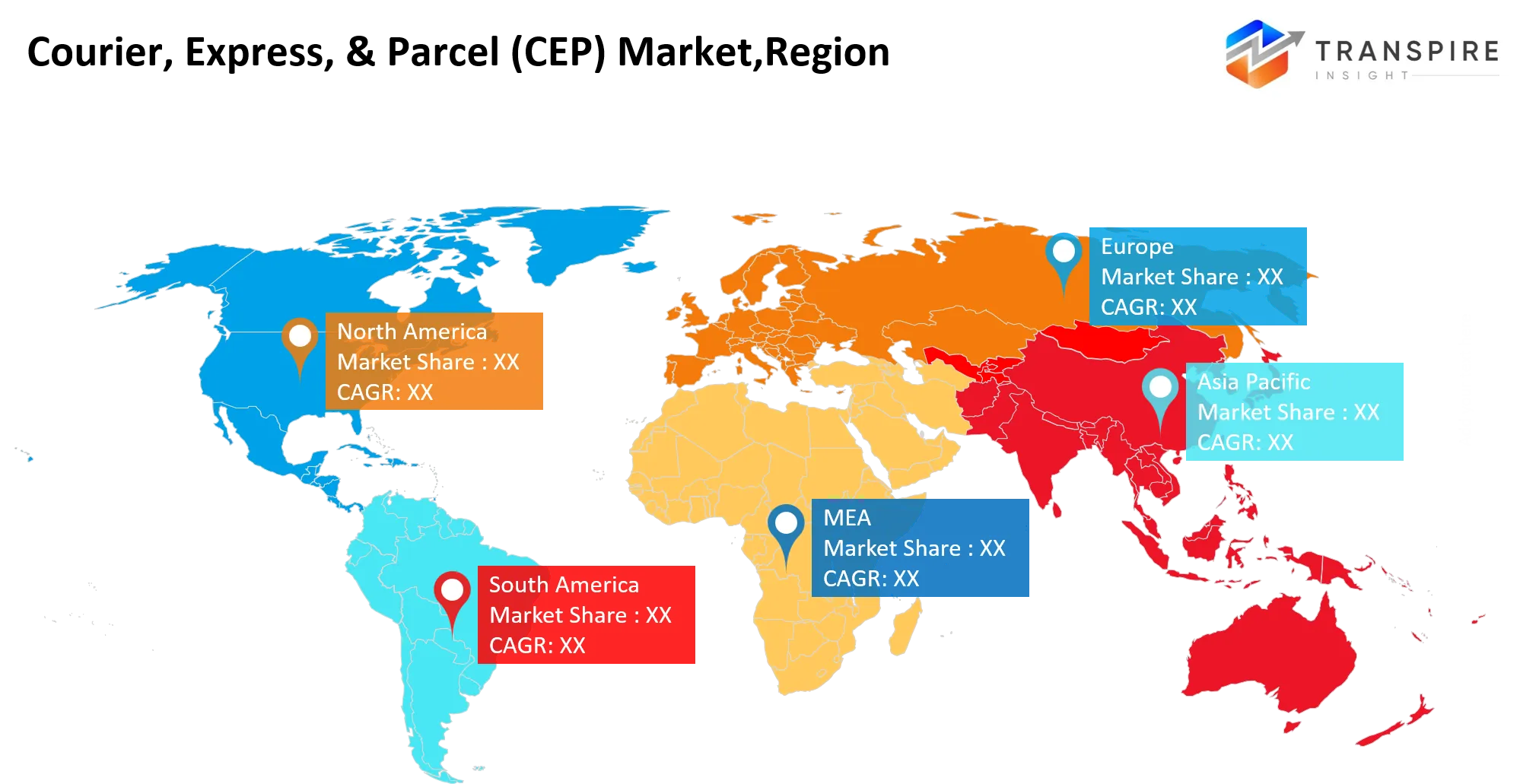
North America holds 27.00% of the market due to mature parcel networks, well-established express carriers, state-of-the-art fulfilment operations, and extensive online shopping. In terms of its market, there is demand for delivery at set times, returns, and shipping solutions for large retailers and businesses. Established distribution centres and investments in technology aid in managing high shipment volumes and provide visibility. In contrast to Asia-Pacific, the competitiveness of the region is associated with network productivity, premium solutions, and cost-effectiveness on both domestic and international routes that are already developed.
In October 2025, DHL Express upgraded its capacities in the U.S. DHL Express decided to invest USD 90 million in the Greater New York City area to increase capacities of its logistics centres, update materials handling equipment, and improve dispatching activities. This measure helps to cope with the growth of parcel volumes and rising demand for express delivery services.
Europe
Europe accounts for 21.00% of the market share. It is defined by trade relationships between countries, road connectivity, and shipment requirements across the border lines. Shipments between countries neighboring each other offer an opportunity for companies that can provide transport, customs clearance where needed, and tracking facilities. Sustainability projects and urban delivery restrictions promote investments in eco-friendly technologies, hubs of collection, and other strategies that will make the process of transportation more effective. The opportunities for the future of the region are associated with cross-border e-commerce, sustainable deliveries, and returns for merchant companies that operate in several European countries.
In February 2026, GLS increased its out-of-home collection network in Europe. In the course of 24 months, its network of parcel shops and lockers was doubled from 70,000 units to 130,000.
https://gls-group.eu/GROUP/en/GLS-doubles-European-OOH-network/
Asia-Pacific
Asia-Pacific constitutes 40.30% of the total CEP market share, as per the data provided, owing to the region’s large base of e-commerce, manufacturing operations, and domestic parcel networks. Mobile shopping, online marketplaces, and the rise in the number of online merchants result in a need for reliable delivery services in key cities and rising commercial centres. Investments made in automated sorting centres, logistics, and transport infrastructure are aiding companies to optimise their parcel handling and capacity. This region is also considered to be the fastest-growing, with a projected CAGR of 16.10%.
In May 2026, Asendia and Singapore Post established a strategic partnership in cross-border e-commerce. The two companies disclosed their intention to partner in order to enhance delivery performance, gain market entry, and deliver scalable solutions for parcel shipping in the Asia-Pacific region, including Singapore.
Who are the Key Players in the Courier, Express, & Parcel (CEP) Market and how do they compete?
The competitiveness in the CEP industry is based on such elements as dependability, scope of operations, delivery time, price and technology. This competition in the industry occurs among integrated giants, regional carriers, and last-mile carriers. DHL Express focuses on international time-definite delivery and customs brokerage, while FedEx and UPS compete with broad transportation networks, business solutions and shipment tracking services. The DHL Group combines international express service with e-commerce, freight and contract logistics services. The company's strategy involves investing in automation, regional facilities and specialised services. The UPS Corporation competes through its parcel network, business shipping solutions and logistics for commercial clients. The key priorities of the company's strategy include increased efficiency and support of complicated shipping requirements. For all the above-mentioned companies, expansion is becoming more and more reliant on combining reliable core delivery services with automation and technology.
Courier, Express, & Parcel (CEP) Market companies
- DHL Group
- FedEx Corporation
- United Parcel Service (UPS)
- United States Postal Service (USPS)
- SF Holding
- JD Logistics
- Japan Post Holdings
- Yamato Holdings
- Aramex
- DTDC
- Blue Dart Express
- Delhivery
- Royal Mail
- Singapore Post
- Kerry Logistics
Recent Development News
In March 2026, FedEx introduced a local delivery service that provides a two-hour delivery window or end-of-day delivery through OneRail. The introduction reinforces its service offering to businesses that need fast delivery solutions but do not have a delivery network of their own.
In February 2025, DHL eCommerce agreed to acquire a minority interest in AJEX, a Saudi parcel logistics company. This helps DHL expand in the Saudi e-commerce parcel market.
What Strategic Insights Define the Future of the Courier, Express, & Parcel (CEP) Market?
The world CEP market is moving towards a business-model approach based on service, where reliability, visibility, and flexibility in delivery will become equally valued attributes to fast delivery. There will still be scope for commercial success in standard delivery, but the potential for enhancing customer experience and efficiency will come through same-day delivery, automation, and artificial intelligence in planning. What risks this implies is that ever-increasing demands to be faster and cheaper might lead to the disproportionate increase of the last mile cost beyond revenue growth, particularly, in low shipment density and peaks in time of demand. Businesses moving towards premium delivery without controlling the delivery economics are at risk of losing profitability. A new potential lies in the combination of cross-border e-commerce with speciality logistics like delivery of health care products and tech-powered returns. Their competitive advantages will be precision tracking, fast customs clearance and simple returns collection. The key to the strategy here would be automation at high volumes, predictive analytics for routing and capacity planning and selective offering of fast deliveries if unit economics allows that.
Service
- Standard Delivery
- Express Delivery
- Same-Day Delivery
- Next-Day Delivery
- Last-Mile Delivery
- International Express
- Economy Delivery
- Specialized Delivery
Business Model
- B2C
- B2B
- C2C
- B2B2C
- D2C
- Marketplace Delivery
- Subscription Delivery
- On-Demand Delivery
Destination
- Domestic
- International
- Cross-Border
- Intra-City
- Inter-City
- Rural
- Urban
- Regional
Mode of Transport
- Road
- Air
- Rail
- Sea
- Motorcycle
- Bicycle
- Drone
- Multimodal
End User
- E-Commerce
- Retail
- Manufacturing
- Healthcare
- Financial Services
- Automotive
- Food & Beverage
- Individuals
Delivery Type
- Door-to-Door
- Pickup Point
- Locker
- Click-and-Collect
- Curbside
- Store-to-Door
- Warehouse-to-Door
- Hub-to-Hub
Frequently Asked Questions
Find quick answers to common questions.
The courier, express, & parcel (CEP) market size was valued at USD 956.2 Billion in 2025 and is poised to reach USD 2976 Billion by 2033, expanding at a 15.36% CAGR.
Key segments for the courier, express, & parcel (CEP) market are Service (Standard Delivery, Express Delivery, Same-Day Delivery, Next-Day Delivery, Last-Mile Delivery, International Express, Economy Delivery, Specialized Delivery); Business Model (B2C, B2B, C2C, B2B2C, D2C, Marketplace Delivery, Subscription Delivery, On-Demand Delivery); Destination (Domestic, International, Cross-Border, Intra-City, Inter-City, Rural, Urban, Regional); Mode of Transport (Road, Air, Rail, Sea, Motorcycle, Bicycle, Drone, Multimodal); End User (E-Commerce, Retail, Manufacturing, Healthcare, Financial Services, Automotive, Food & Beverage, Individuals); Delivery Type (Door-to-Door, Pickup Point, Locker, Click-and-Collect, Curbside, Store-to-Door, Warehouse-to-Door, Hub-to-Hub)
Growth is primarily driven by increased cross-border trade, increasing need for speedy deliveries, development of online retail sites, and improvements in automated sorting and logistics systems.
The market is led by major manufacturers including DHL Group; FedEx Corporation; United Parcel Service; USPS; SF Holding; JD Logistics; Japan Post Holdings; Yamato Holdings; Aramex; DTDC; Blue Dart Express; Delhivery; Royal Mail; Singapore Post; Kerry Logistics
The Asia-Pacific region leads the world CEP industry with its 40.30% share owing to the fast growth of e-commerce and cross-border trade, development of the logistics network, and high demand for timely delivery in China, India, and South-eastern Asia.
Opportunities for business within the CEP industry include growth in international e-commerce deliveries, use of AI technology in logistics and routing, creating sustainable last-mile delivery options, and rising demand for same-day and next-day delivery services.
- DHL Group
- FedEx Corporation
- United Parcel Service (UPS)
- United States Postal Service (USPS)
- SF Holding
- JD Logistics
- Japan Post Holdings
- Yamato Holdings
- Aramex
- DTDC
- Blue Dart Express
- Delhivery
- Royal Mail
- Singapore Post
- Kerry Logistics
About the Authors

Kartik bhong
I am Kartik Bhong, a Senior Research Analyst at Transpire Insight, specializing in the Packaging, Manufacturing, and Construction industry. My work focuses on analyzing market trends, emerging technologies, industry regulations, and competitive landscapes to deliver accurate, data-driven insights. I am passionate about transforming complex industry information into clear, practical content that helps businesses, professionals, and decision-makers stay informed and make confident strategic decisions. Through continuous research and a strong commitment to accuracy, I strive to create reliable, well-researched content that reflects the latest developments across these dynamic industries and supports the vision of Transpire Insight in delivering valuable market intelligence.

Chakradhar Khansole
Chakradhar serves as the Research Director at Transpire Insight, bringing over 8 years of experience in technology, innovation, and strategic market intelligence. He specializes in transforming complex market data into actionable business insights that enable organizations to make informed, growth-oriented decisions. Recognized for his strategic vision and analytical expertise, Chakradhar leads high-impact research initiatives, delivering comprehensive market assessments, competitive intelligence, and forward-looking industry analysis.
Recently Published Reports
-
Apr 2026
Handling and Lifting Equipment Market
Handling and Lifting Equipment Market Size, Share & Analysis Report By Product (Cranes and Hoists, Forklifts, Conveyor Systems, Aerial Work Platforms, Others), By Application (E-Commerce, Automotive and Railway, Food and Beverages, Aviation, Others), and Geography (North America, Europe, Asia-Pacific, Middle East and Africa, South and Central America), 2021 - 2031
-
Apr 2026
HVAC Equipment Market
HVAC Equipment Market Size, Share & Analysis Report By Heating Equipment Type (Boilers and Furnaces, Heat Pumps, and Unitary Heaters), By Ventilation Equipment (Air Handling Units, Humidifiers and Dehumidifiers, Air Filters, and Fan Coiling Units), By Air Conditioning Equipment (Unitary Air Conditioners, Room Air Conditioners, Packaged Terminal Air Conditioners, and Chillers), By End User (Commercial, Residential, Industrial, and others), and Geography (North America, Europe, Asia-Pacific, Middle East and Africa, South and Central America), 2021 – 2031
-
Apr 2026
Refrigeration Valves Market
Refrigeration Valves Market Size, Share & Analysis Report By Type (Solenoid Valves, Expansion Valves, Check Valves, Service Valves, Others), By Application (Commercial Refrigeration, Industrial Refrigeration, Transport Refrigeration, Residential Refrigeration, Air Conditioning Systems), By End User (Food and Beverage Industry, Pharmaceutical Industry, HVAC Industry, Chemical Industry, Others), and Geography (North America, Europe, Asia-Pacific, Middle East and Africa, South and Central America), 2021 – 2031
-
Apr 2026
E-Commerce Packaging Materials Market
E-Commerce Packaging Materials Market By Material Type (Corrugated Boxes, Paper & Paperboard, Foam & Cushioning Materials, Plastic Packaging, Flexible Packaging, Protective Packaging, Others), By Product(Primary Packaging, Secondary Packaging, Tertiary Packaging), By Packaging Function (Protective Packaging, Branding & Presentation Packaging, Transit & Logistic Packaging, Sustainable Packaging, Tamper Evidence Packaging), By End-User (Retail & Consumer Goods, Electronic Appliances, Food & Beverages, Healthcare & Pharmaceutical, Fashion & Apparel, Home & Furnishing, Others); By Industry Analysis, Size, Share, Growth, Trends, and Forecasts 2021-2033