
Cosmetic Perfumery Glass Bottle Packaging Market Summary:
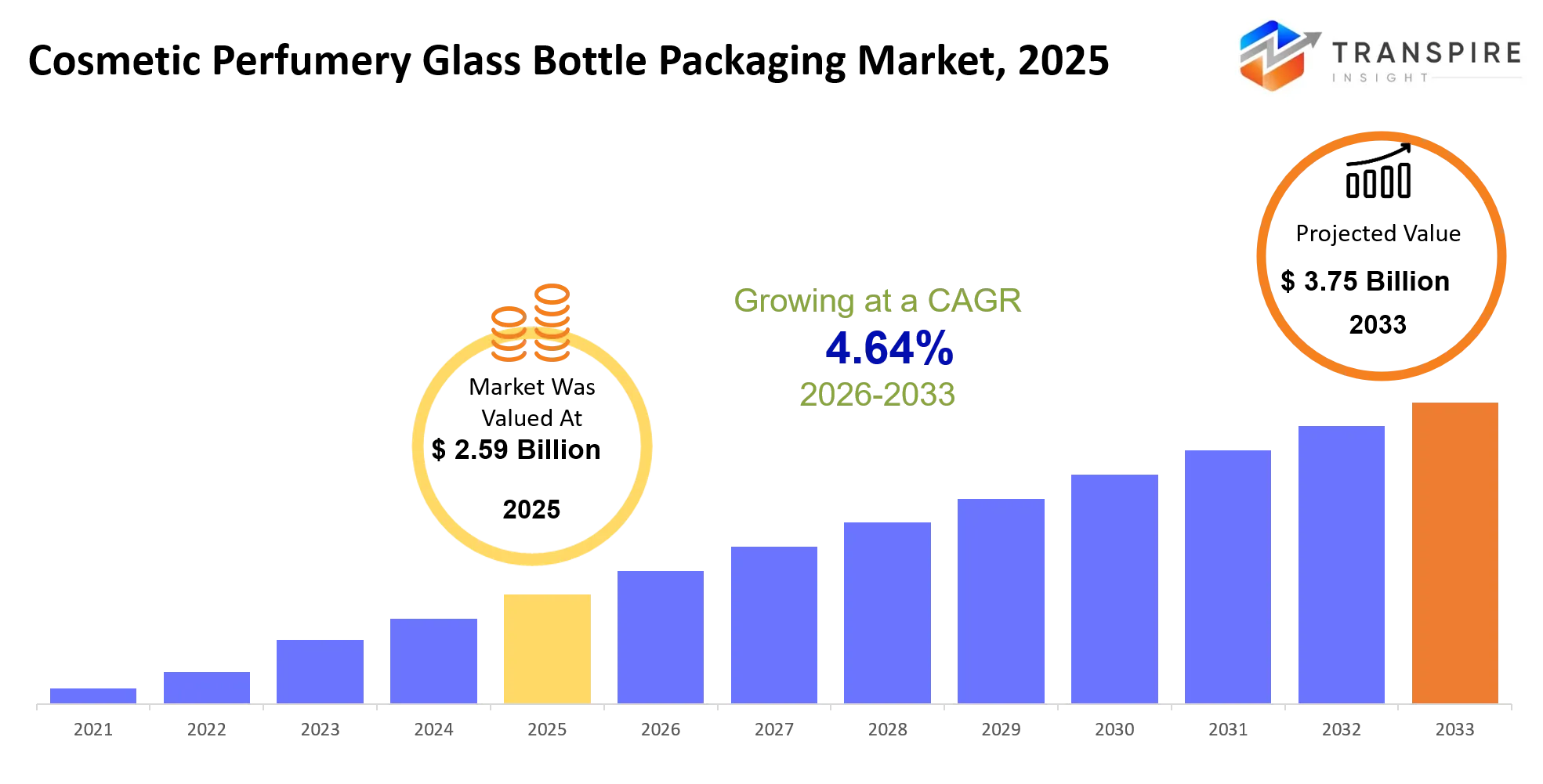
As per the Transpire Insight Analysis, The Cosmetic Perfumery Glass Bottle Packaging Market size is estimated at USD 2.59 billion in 2025 and is anticipated to reach USD 3.75 billion by 2033, growing at a CAGR of 4.64% from 2026 to 2033.
The cosmetic perfume glass bottle packaging market supplies primary containers, for example, bottles, jars, and dispensing-supported shapes that protect the formulation and elevate the look of fragrance and beauty items to in-store consumers. In the past three to five years, the shift has been changing from ugly, single-use decorative bottles to lighter-weight, refill-ready bottles with PCR glass buildouts, while the structural shift is being accelerated by the PPWR of Europe's packaging waste regulation, which became live in August 2026 and is driving higher lifecycle, recyclability, and documentation standards for packaging that must enter the EU market. A tangible real-world driver has been the necessity for luxury brands to improve on-pack emissions without sacrificing the wow factor; suppliers are now refashioning bottle shoulders, bases, and necks and making on-demand pumps to use less material and refill using higher-value engineering, decoration, closure compatibility, and circular-packaging services instead of volume.
Cosmetic Perfumery Glass Bottle Packaging Market Size & Forecast:
- Market Size 2025: USD 2.59 Billion
- Expected Market Value (2033): USD 3.75 Billion
- Forecast CAGR (2026–2033): 4.64%
- Leading Region in 2025: Europe
- Fastest Growing Region: Asia Pacific
- Key Company Profiles: Verescence, Pochet du Courval, Gerresheimer, Saverglass, Vitro, Stoelzle Glass, HEINZ-GLAS, SGD Pharma, Bormioli Luigi, Zignago Vetro, Vidrala, O-I Glass, Estal, Piramal Glass, Şişecam.
Key Cosmetic Perfumery Glass Bottle Packaging Market Insights:
The market is changing from one-way, decorative perfume bottles to more sustainable, refillable, and lower-carbon glass bottles. Suppliers with design flexibility and recyclable material documentation are starting to have more prestige beauty programs.
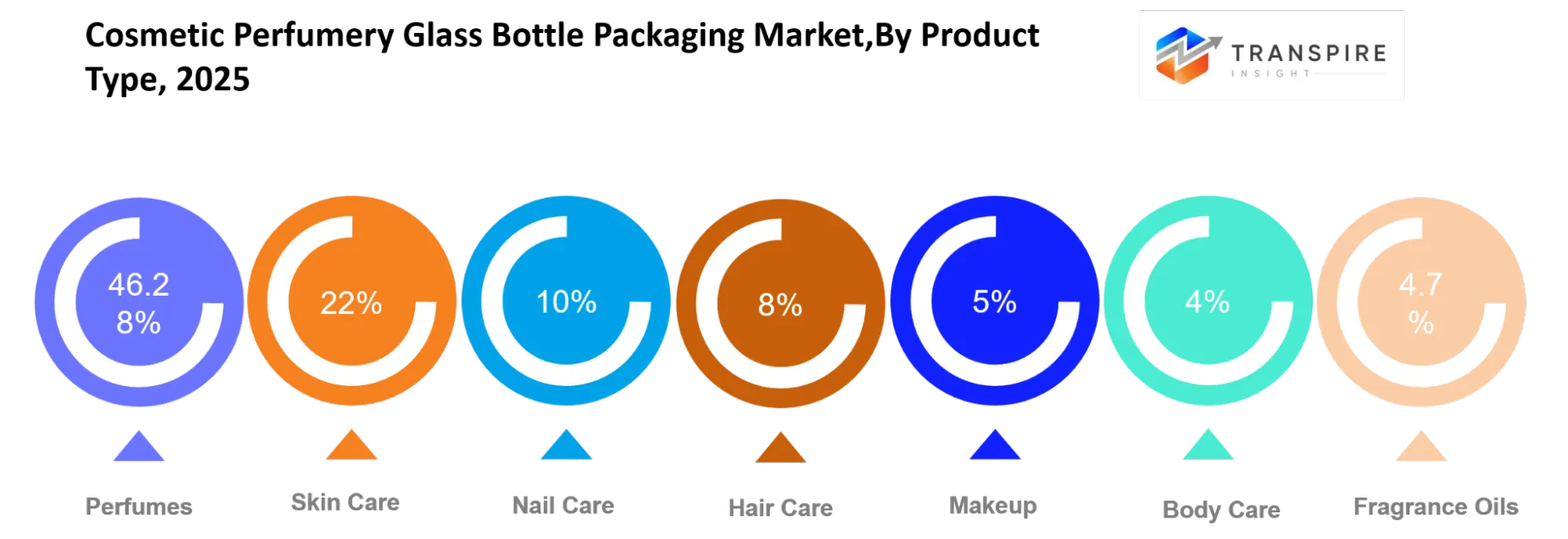
- Perfumes account for 46.28% of the market, while Verresence is growing screw-neck refillable bottles as consumers keep high-quality outer packs and buy refills.
- Skin care accounts for 22%, and Gerresheimer's Gx product families help to ensure customised glass for pumps and droppers, with active-serum formats preferring controlled dispensing.
- Nail care represents 10% and is growing at 6.05% CAGR; compact treatment bottles are getting precise applicators and high-quality colour finishes.
- Hair care contributes 8% while lighter glass formats target concentrated oils and scalp serums as consumers move away from bulk packs to high-value hair care.
- Makeup is 5%; Pochet is a blend of material and surface-effect experience, with tactile, recognisable prestige packs.
- Body care makes up 4%, and the reusable jars and long-lasting dispensers enable repeat use of body care over the disposable seasonal versions.
- Fragrance oils comprise 2%, and roller and dropper formats are becoming popular for controlled-use, portable wellness products.
- Other products make up 2.72%, while QR-linked glass packaging is helping with niche product authentication and digital storytelling.
- Verresence reported 92% PCR-glass bottle production, and will be using up to 80% electricity in a hybrid furnace, with premium packaging and lower-carbon production.
What are the Key Drivers, Restraints, and Opportunities in the Cosmetic Perfumery Glass Bottle Packaging Market?
Driver:
Premium fragrance launches and the conversion of beauty packaging into a visible sustainability claim are driving demand for engineered glass formats. The trigger is the convergence of luxury-brand differentiation with packaging-waste regulation and consumer scrutiny of disposable components. Glass gives brands a weighty, high-end feel, chemical stability, and a recyclable material story; when combined with embossing, frosting, colour gradients, or digital decoration, it turns the pack into a brand asset. Refillable bottles further increase adoption because a durable outer bottle can be sold at a premium while refills create repeat-purchase revenue. Advances such as narrow-neck press-and-blow forming also allow lower bottle weight without sacrificing strength, reducing freight and material intensity.
Restraint:
High furnace energy requirements and the engineering complexity of premium glass remain structural constraints. Glass must withstand forming, decoration, transport, and repeated handling while maintaining precise aesthetics, and recycled cullet quality can vary by collection stream. These requirements raise qualification, tooling and production costs, particularly for customized luxury bottles with low or medium volumes.
Opportunity:
The strongest future opportunity lies in circular premium packaging that combines mono-material or easily separable refill systems, PCR-rich flint glass, and lower-carbon manufacturing. These designs help fragrance and cosmetics brands retain a luxury appearance while reducing material complexity, waste, and regulatory exposure. Verescence illustrates this transition through its Prium Eco-Flex project at Mers-les-Bains: the hybrid oxy-gas-electric furnace is designed to replace up to 80% of fossil-fuel energy with electricity while maintaining the quality required for prestige bottles. It will also use waste-gas heat recovery to improve energy efficiency. Together with PCR-glass programs, such investments make lower-impact luxury packaging commercially scalable rather than limited to niche eco-ranges.
What Impact Has Artificial Intelligence Had on the Cosmetic Perfumery Glass Bottle Packaging Market?
Another application for AI in glass bottle manufacturing is the improvement of the process itself. Improvements in machine vision, process control, and predictive maintenance are helping manufacturers to identify cracks, chips, wall thickness variations, mould marks, and defects in decoration image quality (before the bottle gets to secondary packaging or filling). This is particularly important when decorating perfume bottles, as minor visual defects can lead to rejection even if the bottle is functional.
Machine-learning models are used to identify the cause of repeats and establish correlations between such defects and phenomena such as mould deterioration, oven temperature, gob weight, and mould forming pressure, so technicians can tune the line to reduce scrap. All this produces a higher proportion of bottles meeting a standard, less energy use for heating and cleaning, and more homogeneous premium aesthetics. The main implementation limitation is the cost of integration. Many plants still operate on aged furnaces, inspection units, and manufacturing execution systems designed to run independently of real-time data sharing, while the need for wide datasets of correctly labelled defects can be demanding, and unusual bottle shapes, dark coatings, and novel decoration styles require retraining of models.
In September 2026, Bucher Emhart Glass introduced SmartInspectAI, an advanced AI-driven glass container inspection system designed to identify unique material flaws. This deployment drastically lowered false reject rates and significantly improved inspection accuracy by using deep learning to isolate true structural defects from normal cosmetic variations in glass.
https://www.seedops.co/activities/bucher-industries-ag/s-bucher-emhart-glass-will-demonstrate-how-ai-is-opening-up-new-possibilities-in-glass-container-inspection-at-glasstec-in-d-sseldorf-2133492
Key Cosmetic Perfumery Glass Bottle Packaging Market Trends:
The market is moving away from “beautiful but disposable” packs, and towards those that offer both high-quality shelf appeal and tangible material and carbon benefits. Suppliers are competing on manufacturability, refill compatibility, lower-emission production, digital brand interaction, and not just by bottle weight.
- Heavy decorative bottles are being lightweighted with enhanced forming, reduced material and transport emissions, and without loss of luxury cues.
- The use of recycled cullet at scale is bringing PCR glass to the mainstream of premium ranges.
- Where brands require practical refill and recycling routes, screw-neck and removable-pump formats are taking over the place of permanently crimped designs.
- Bottle decoration is moving away from traditional screen printing to embossing, etching, digital printing and tactile finishes to create more differentiation.
- Refill systems are transforming bottle design from a disposable container to a branded asset that can be purchased again.
- EU PPWR compliance is forcing brands to document packaging composition, redesign more complicated parts, and prepare for recyclability requirements.
- Investments in hybrid and electric furnaces are shifting the decarbonisation from marketing to production infrastructure.
- QR, NFC and AR-enabled formats are bringing the real-life fragrance packs closer to authentication, product storytelling and consumer engagement.
Cosmetic Perfumery Glass Bottle Packaging Market Segmentation
By Product Type:
Perfumes hold the leading position with 46.28% of the market because fragrance brands rely heavily on bottle form, clarity, weight, and decoration to signal identity before consumers test the scent. Skin care accounts for 22%, supported by demand for serum, oil and premium cream containers that protect formulations and elevate clinical-luxury positioning. Nail care represents 10% and is identified as a faster-moving niche with a 6.05% CAGR, as brands adopt differentiated brush, dropper and compact bottle formats for treatments, gels and premium colour products. Hair care holds 8%, while makeup contributes 5%; both segments increasingly favour glass for concentrated, prestige and refill-led product lines rather than high-volume commodity formats. Body care accounts for 4%, fragrance oils for 2%, and other applications for 2.72%, leaving room for home fragrance, wellness and specialist beauty products.
By Capacity:
0–50 ml bottles are widely used for samples, discovery sets, travel fragrances and compact personal-care products, supporting trial-oriented purchasing and portability. Travel-size and sample-size formats are also becoming important for premium brands seeking additional consumer touchpoints without changing the core product formula. The 50–150 ml range remains suited to mainstream perfumes and skin-care products, balancing shelf presence with practical usage. Above-150 ml and large-format bottles serve statement fragrances, hospitality and professional applications, while refillable capacities increasingly connect packaging size with repeat-purchase and reuse models.
By Color:
Flint and clear glass remain important where brands want consumers to see the fragrance or formulation and associate transparency with product purity. Amber glass is particularly relevant for formulations requiring greater protection from light, strengthening its role in selected skin-care and treatment applications. Frosted and special-colored bottles provide greater scope for premium differentiation through tactile surfaces, opaque finishes and distinctive visual identities. Green and blue glass support colour-led branding and product recognition, particularly where companies seek a strong shelf signature. The shift toward customised colouration is also increasing the importance of flexible glass-decoration capabilities.
By Closure:
Spray systems remain central to perfume bottles because they provide controlled application and consistent dosing, making them closely aligned with fragrance consumption habits. Screw caps are gaining strategic relevance in refillable and reusable packaging because they allow easier opening, replacement, and product replenishment. Pumps and droppers serve skin-care and treatment formulations where measured dispensing is important, while stoppers maintain a premium positioning for selected fragrance formats. Roll-on systems support portable products, and crimp closures remain established in conventional fragrance packaging. Closure innovation is increasingly focused on compatibility, leak prevention, refillability, and simplified component structures.
By Application:
Fragrance remains the principal use area because glass combines formulation protection with the visual and tactile characteristics required for premium perfume presentation. Skin Care follows as brands use glass for serums, oils and treatment products, where material compatibility and premium positioning influence packaging selection. Hair Care, Makeup, Nail Care and Personal Care expand the addressable application base through specialised bottles for oils, treatments and liquid formulations. Professional Care adds demand from salons and service environments. The broader application mix reduces reliance on traditional perfume launches and creates opportunities for customised shapes, capacities and dispensing systems.
By Distribution:
Online channels are becoming increasingly important for emerging beauty brands because they enable direct-to-consumer launches without extensive physical retail infrastructure. Specialty Stores and Beauty Stores remain important for premium products where consumers evaluate bottle design, decoration and brand presentation before purchase. Department Stores and Brand Stores continue supporting luxury fragrance through controlled merchandising and experiential retail environments. Hypermarkets provide broader access for mass-market personal-care products, while Salons create targeted distribution for professional applications. The channel mix is therefore moving toward an omnichannel model in which packaging must perform consistently across physical shelves, digital imagery and direct-to-consumer fulfilment.
By End User:
Personal Care represents the broadest application base, covering everyday fragrance, skin care, hair care and other beauty products. Professional/Salon users require practical dispensing formats and durable packaging suited to repeated service usage, while Institutional and Hospitality customers favor standardized bottles that support consistent presentation across locations. Retail buyers prioritize shelf differentiation and efficient handling, creating demand for scalable packaging platforms. Luxury Brands increasingly emphasize bespoke shapes, premium decoration, PCR glass, and refillability, whereas Mass Brands generally prioritize standardized designs, manufacturing efficiency, and customization through finishes. This creates distinct packaging strategies across price tiers.
What are the Key Use Cases Driving the Cosmetic Perfumery Glass Bottle Packaging Market?
Perfumes are the core use case, consistent with the segment’s 46.28% share, because glass protects fragrance formulas while providing a premium surface for shaping, colour and decoration. Refillable and travel formats are extending this role into repeat purchases and on-the-go use.
Expanding applications include skin care, hair care, makeup, body care and nail care, where glass supports premium positioning and can provide formulation compatibility or light protection. This broadens glass packaging beyond traditional fragrance flacons.
Emerging uses include hospitality fragrance programs, discovery packs, sample-size formats and refill systems. These applications increase consumer interaction with the primary container and create opportunities for packaging suppliers to combine glass engineering with dispensing, customization and reuse features.
|
Report Metrics |
Details |
|
Market size value in 2025 |
USD 2.59 Billion |
|
Market size value in 2026 |
USD 2.73 Billion |
|
Revenue forecast in 2033 |
USD 3.75 Billion |
|
Growth rate |
CAGR of 4.64% from 2026 to 2033 |
|
Base year |
2025 |
|
Historical data |
2021 - 2024 |
|
Forecast period |
2026 - 2033 |
|
Report coverage |
Revenue forecast, competitive landscape, growth factors, and trends |
|
Regional scope |
United States; Canada; Mexico; United Kingdom; Germany; France; Italy; Spain; Denmark; Sweden; Norway; China; Japan; India; Australia; South Korea; Thailand; Brazil; Argentina; South Africa; Saudi Arabia; United Arab Emirates |
|
Key companies profiled |
Verescence, Pochet du Courval, Gerresheimer, Saverglass, Vitro, Stoelzle Glass, HEINZ-GLAS, SGD Pharma, Bormioli Luigi, Zignago Vetro, Vidrala, O-I Glass, Estal, Piramal Glass, Şişecam. |
|
Customization scope |
Free report customisation (country, regional & segment scope). Available customised purchase options to meet your exact research needs. |
|
Report Segmentation |
By Product Type (Perfumes, Skin Care, Nail Care, Hair Care, Makeup, Body Care, Fragrance Oils, Others); By Capacity (0–50 ml, 50–150 ml, Above 150 ml, Travel-size, Sample-size, Refillable, Large-format, Others); By Color (Flint, Amber, Frosted, Special-colored, Clear, Green, Blue, Others); By Closure (Screw Cap, Pump, Dropper, Spray, Stopper, Roll-on, Crimp, Others); By Application (Fragrance, Skin Care, Hair Care, Makeup, Nail Care, Personal Care, Professional Care, Others); By Distribution (Online, Specialty Stores, Hypermarkets, Department Stores, Beauty Stores, Brand Stores, Salons, Others); By End User (Personal Care, Professional/Salon, Institutional, Hospitality, Retail, Luxury Brands, Mass Brands, Others). |
Which Regions are Driving the Cosmetic Perfumery Glass Bottle Packaging Market Growth?
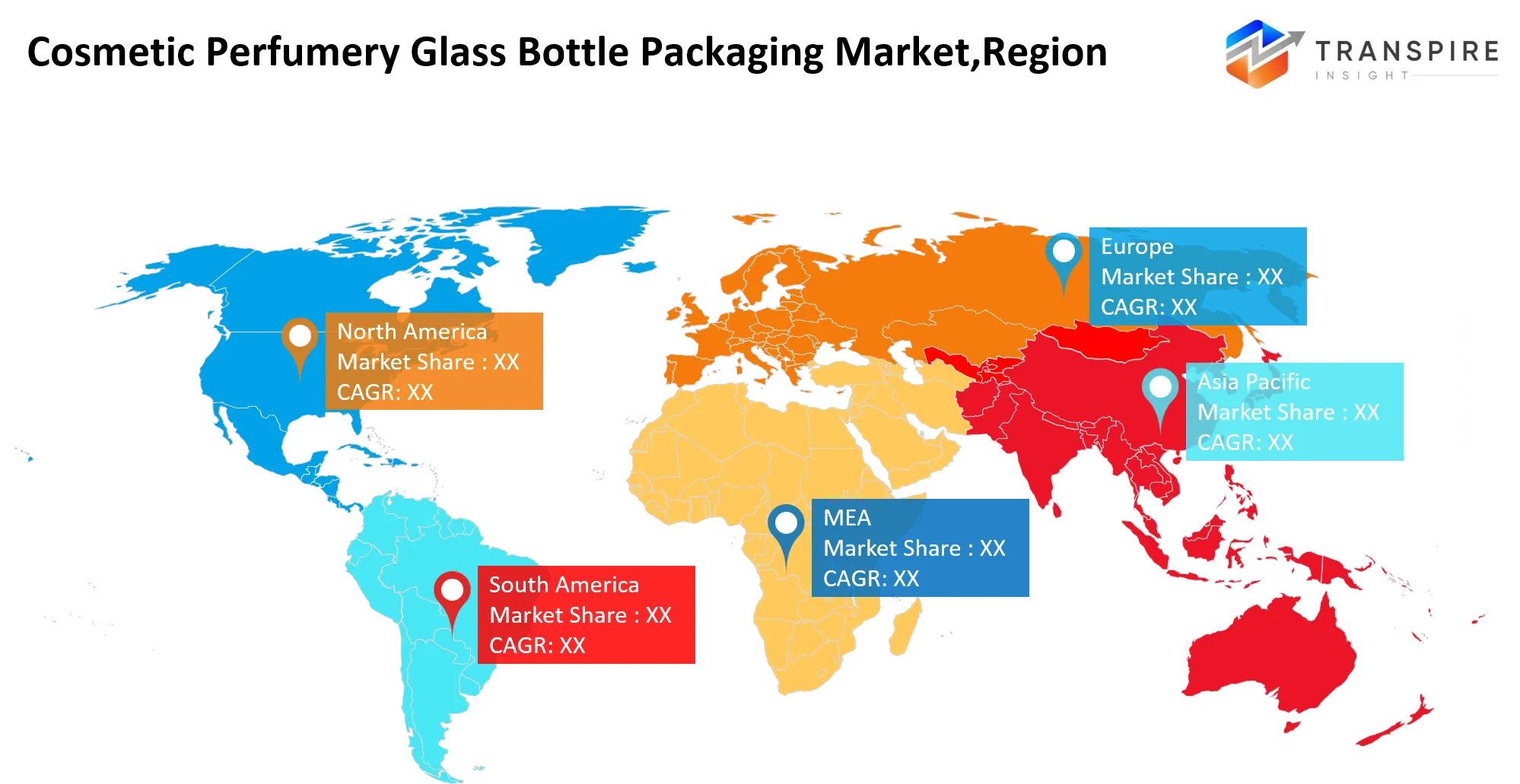
Europe has a significant share of 32.56%, reflecting its strong, luxury fragrance ecosystem centred in France, Italy, Spain and Germany. France alone has had EUR 23.3 billion worth of cosmetics exports, which is supporting solid demand for technically advanced, decorated and high-value glass bottles. Europe's strength also lies in its developed mould-making, decoration, recycling and filling infrastructure. Investment in recyclable-by-design innovations, minimal packaging and material traceability is being driven by the PPWR, which comes into effect in August 2026.
In September 2026, Aptar Beauty and BVLGARI partnered to launch the Le Gemme Tygar Travel Spray featuring the patented Nomad Refill system. This luxury 10 ml travel spray utilises a custom refillable glass vial enclosed in a premium anodised aluminium case, connecting directly to a full-size fragrance bottle.
North America makes up 29% of the market and is being encouraged more by the launch of prestige brands, the rise of independent beauty brands, and omnichannel retail strategies than by Europe's regulation-led approach. Its dependable demand foundation is a big mark by way of auxiliary fragrance houses and specialist beauty outlets and an emerging refill economy driving durable glass outer packaging. Regional investments in automation boost North America; Saverglass is reported to have invested in automated glass moulding lines in the US in 2025 to present high end cosmetic packaging. However, diffuse recycling techniques mean extraction of PCR glass has been less reliable than European frontrunners.
In September 2026, the newly formed indie prestige fragrance brand Lore, co-founded by beauty executives from Rhode, Youth to the People, and Milk Makeup, launched its highly anticipated product line online and in Sephora U.S.
https://re-sources.co/what-the-latest-indie-launches-tell-us-about-the-beauty-market/
Asia Pacific accounts for 25% and is the most rapidly expanding at a CAGR of 5.48%. Latin America accounts for 7%, and the Middle East & Africa accounts for 6.44%. Expansion has been significant given the growing middle class in China, India, South Korea, and South Asian markets that want their first experience with premium perfumes, skincare, and beauty brands defined by their local needs. Regional players have scaled up exporting capacity, and social-commerce launches are favouring smaller, eye-catching bottles in the 100ml to 150ml range. The opportunity is in localising mould design, decoration and refill formats versus importing European-designed premium packaging that goes unmodified.
In August 2026, MESSE ESANG partnered with international cosmetic bodies to announce the launch of BeautySum India 2026, a new B2B exhibition focusing heavily on localized packaging coordination, OEM/ODM manufacturing, and cross-border trade between South Korea and India.
Who are the Key Players in the Cosmetic Perfumery Glass Bottle Packaging Market, and how do they compete?
Competition within the industry is based on premium design execution, furnace decarbonisation, PCR-glass capability, decoration quality, and supply without bottle variation. Verresence distinguishes itself with its PCR-glass, refill-ready formats, and investments in hybrid furnaces and recyclates in 2026 to reach 80%/20% electricity/biogas. Pochet du Courval also offers luxury co-development and high-effect surfaces, whereas Gerresheimer and Verresence have combined their custom and standard glass portfolios with crystal-finish capabilities to meet fragrance, skin-care, and body-care needs.
Saverglass' key selling points are premium moulding, decoration, and automated production, while HEINZ-GLAS and Stoelzle Glass are operating in a high-volume European prestige-bottle speciality, allowing high quality to meet technical precision and co-development. Conversely, Bormioli Luigi, SGD Pharma, and Zignago Vetro mix their manufacturing depth with decoration and vast glass processing to win MNC customers. Vitro, O-I Glass, Vidrala, and Şişecam strengthen their positioning using scale, furnace networks, and regional supply advantages, and Estal has grown via sustainable luxury offers. Piramal Glass has expanded into India and exports through affordability, cost-competitive capacity, and a tailored beauty-packaging offer.
Key Players are:
- Verescence
- Pochet du Courval
- Gerresheimer
- Saverglass
- Vitro\
- Stoelzle Glass
- HEINZ-GLAS
- SGD Pharma
- Bormioli Luigi
- Zignago Vetro
- Vidrala
- O-I Glass
- Estal
- Piramal Glass
- Şişecam
Recent Development News
In January 2026, launched its Artisan Series Gradient Glass Cosmetic Packaging Set designed specifically for high-end skincare brands. Featuring thick-walled premium glass and customizable metal closures across a suite of six specialised capacities, this product rollout provides cosmetic manufacturers with an elevated, luxury-tier shelf appearance for premium anti-ageing serums and moisturisers.
https://www.penghuangbottle.com/news/gradient-glass-cosmetic-set-2026spring-85403506.html
In September 2026, Aptar Beauty launched its Nomad Refill fragrance packaging innovation in partnership with BVLGARI’s Le Gemme Tygar travel spray. This luxury-tier solution pairs an ornate outer casing with a replaceable, high-clarity 10 ml glass vial, combining sustainable circular design with premium high-end aesthetics.
In February 2026, Verescence produced the glass bottle for Emporio Armani’s Power of You Eau de Parfum using 20% post-consumer recycled glass. The jewel-like flacon combines lateral fluting with rose-gold decoration, demonstrating how recycled glass can be integrated into premium fragrance packaging without reducing visual differentiation.
What Strategic Insights Define the Future of the Cosmetic Perfumery Glass Bottle Packaging Market?
The industry is quickly moving towards premium circularity-post-consumer recycled glass, lightweighting, and refillability will all become 'must-have' aspects of the design rather than simply sustainability options. The major competitive shift will be from bottle aesthetics to designing for fit-for-purpose packaging. A potential latent risk of this shift towards more recycled content is that inconsistency in complex colour, decoration, and premium finishes could become a challenge, with costly qualification cycles and high manufacturing costs. A potential emerging opportunity is the development of refillable systems, combining standardised glass body bases with refillable fragrance or cosmetic caps, thus maintaining brand aesthetics while significantly reducing raw material consumption. This will require a focus on modular bottle platforms, high-precision filling technology, and visual quality inspection. In this new arena, partnering with beauty brands in the early development stage will become strategically significant, as regulatory requirements, carbon reduction, and customer experience will need to be addressed within a similar design framework.
Key Segmentations are:
By Product Type
- Perfumes
- Skin Care
- Nail Care
- Hair Care
- Makeup
- Body Care
- Fragrance Oils
- Others
By Capacity
- 0–50 ml
- 50–150 ml
- Above 150 ml
- Travel-size
- Sample-size
- Refillable
- Large-format
- Others
By Colour
- Flint
- Amber
- Frosted
- Special-colored
- Clear
- Green
- Blue
- Others
By Closure
- Screw Cap
- Pump
- Dropper
- Spray
- Stopper
- Roll-on
- Crimp
- Others
By Application
- Fragrance
- Skin Care
- Hair Care
- Makeup
- Nail Care
- Personal Care
- Professional Care
- Others
By Distribution
- Online
- Specialty Stores
- Hypermarkets
- Department Stores
- Beauty Stores
- Brand Stores
- Salons
- Others
By End User
- Personal Care
- Professional/Salon
- Institutional
- Hospitality
- Retail
- Luxury Brands
- Mass Brands
- Others
Frequently Asked Questions
Find quick answers to common questions.
The cosmetic perfumery glass bottle packaging market size was valued at USD 2.59 billion in 2025 and is poised to reach USD 3.75 billion by 2033, expanding at a 4.64% CAGR.
Key segments for the cosmetic perfumery glass bottle packaging market are By Product Type (Perfumes, Skin Care, Nail Care, Hair Care, Makeup, Body Care, Fragrance Oils, Others); By Capacity (0–50 ml, 50–150 ml, Above 150 ml, Travel-size, Sample-size, Refillable, Large-format, Others); By Color (Flint, Amber, Frosted, Special-colored, Clear, Green, Blue, Others); By Closure (Screw Cap, Pump, Dropper, Spray, Stopper, Roll-on, Crimp, Others); By Application (Fragrance, Skin Care, Hair Care, Makeup, Nail Care, Personal Care, Professional Care, Others); By Distribution (Online, Specialty Stores, Hypermarkets, Department Stores, Beauty Stores, Brand Stores, Salons, Others); By End User (Personal Care, Professional/Salon, Institutional, Hospitality, Retail, Luxury Brands, Mass Brands, Others).
Growth is primarily driven by the adoption of lightweight and PCR glass, expansion of refillable packaging, premium fragrance launches, demand for customized bottle designs, and tighter packaging sustainability requirements.
The cosmetic perfumery glass bottle packaging market is led by major manufacturers, including Verresence, Pochet du Courval, Gerresheimer, Saverglass, Vitro, Stoelzle Glass, HEINZ-GLAS, SGD Pharma, Bormioli Luigi, Zignago Vetro, Vidrala, O-I Glass, Estal, Piramal Glass, and Şişecam.
Europe holds 32.56% of the market, supported by its luxury fragrance ecosystem, specialist glass manufacturing base, advanced decoration capabilities, and regulatory push toward recyclable, recycled-content, lightweight, and refillable packaging.
- Verescence
- Pochet du Courval
- Gerresheimer
- Saverglass
- Vitro\
- Stoelzle Glass
- HEINZ-GLAS
- SGD Pharma
- Bormioli Luigi
- Zignago Vetro
- Vidrala
- O-I Glass
- Estal
- Piramal Glass
- Şişecam
About the Authors

Kartik bhong
I am Kartik Bhong, a Senior Research Analyst at Transpire Insight, specializing in the Packaging, Manufacturing, and Construction industry. My work focuses on analyzing market trends, emerging technologies, industry regulations, and competitive landscapes to deliver accurate, data-driven insights. I am passionate about transforming complex industry information into clear, practical content that helps businesses, professionals, and decision-makers stay informed and make confident strategic decisions. Through continuous research and a strong commitment to accuracy, I strive to create reliable, well-researched content that reflects the latest developments across these dynamic industries and supports the vision of Transpire Insight in delivering valuable market intelligence.

Chakradhar Khansole
Chakradhar serves as the Research Director at Transpire Insight, bringing over 8 years of experience in technology, innovation, and strategic market intelligence. He specializes in transforming complex market data into actionable business insights that enable organizations to make informed, growth-oriented decisions. Recognized for his strategic vision and analytical expertise, Chakradhar leads high-impact research initiatives, delivering comprehensive market assessments, competitive intelligence, and forward-looking industry analysis.
Recently Published Reports
-
Apr 2026
Pharmaceutical Cold Chain Packaging Market
Pharmaceutical Cold Chain Packaging Market By Material (Plastic,(Polyethylene (PE), Polypropylene (PP), Polyethylene Terephthalate (PET), Expanded Polystyrene (EPS), Polyurethane (PU),Others), Paper, Metal, Others), By Product (Small Boxes, Pallets, Large Sized Pallet Containers, Others), By End Use (Biopharmaceutical Companies, Clinical Research Organizations, Hospitals, Research Institutes, Logistics and Distribution Companies, Others)”, By Industry Analysis, Size, Share, Growth, Trends, and Forecasts 2026-2033
-
Apr 2026
Active & Intelligent Packaging Market
Active & Intelligent Packaging Market By Type (Active Packaging, Smart Packaging), By Material (Polymer-Based, Paper & Board-Based, Metal-Based, Glass-Based), By Technology (Time-Temperature Indicators, Freshness Indicators, RFID, Antimicrobial Packaging, Modified Atmosphere Packaging), By Application (Food & Beverages, Pharmaceutical, Cosmetics & Personal Care, Electronics & Consumer Goods, Others), By Industry Analysis, Size, Share, Growth, Trends, and Forecasts 2026-2033
-
Apr 2026
Biodegradable Cut Flower Packaging Market
Biodegradable Cut Flower Packaging Market By Material Type (Paper & Paperboard, Biodegradable Plastics, Natural Fibers, Molded Pulp, Others), By Product Type (Sleeves, Wraps, Boxes & Cartons, Bags & Pouches, Inserts & Holders), By Application (Roses, Carnations, Tulips, Chrysanthemums, Mixed Flowers, Others) and By Distribution Channel (Direct Sales, Distributors & Wholesalers, Online Channels), By Industry Analysis, Size, Share, Growth, Trends, and Forecasts 2026-2033
-
May 2026
Pharmaceutical Packaging Market
Pharmaceutical Packaging Market By Material Type (Plastic, Glass, Metal, Paper & Paperboard, Others), By Packaging Type (Bottles, Blister Packs, Vials, Ampoules, Pouches & Sachets, Others) and By End User (Hospitals & Clinics, Retail Pharmacies, Online Pharmacies, Pharmaceutical Manufacturers), By Industry Analysis, Size, Share, Growth, Trends, and Forecasts 2026-2033