

Copper Pipes and Tubes Market Summary:
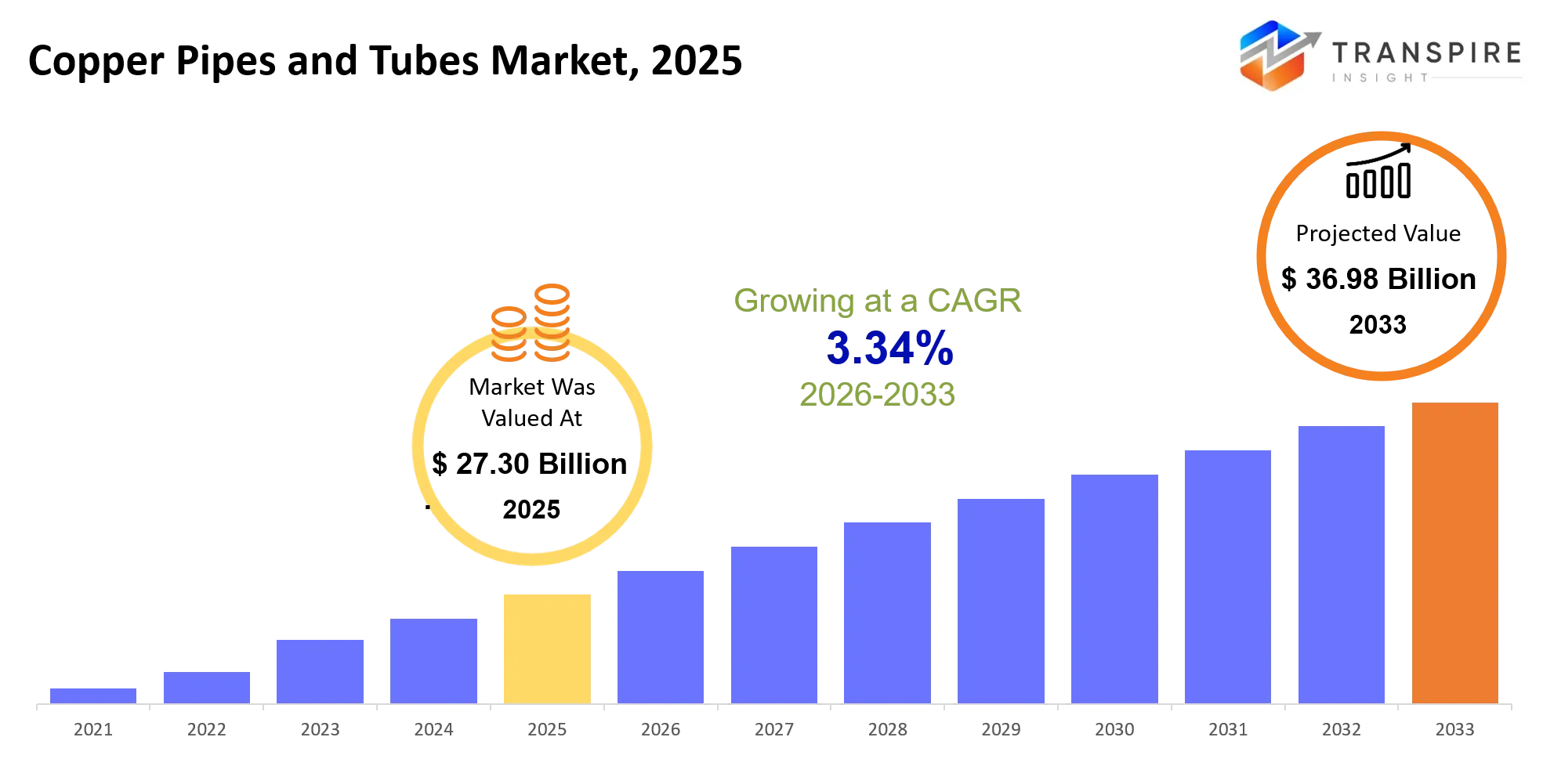
As per the Transpire Insight Analysis, The Copper Pipes and Tubes Market size is estimated at USD 27.30 billion in 2025 and is anticipated to reach USD 36.98 billion by 2033, growing at a CAGR of 3.84% from 2026 to 2033.
The worldwide market for copper pipes and tubes is the necessary flow paths and heat-transfer surfaces for use in air conditioners, refrigeration systems, plumbing, heat exchangers, medical-gas lines, and other industrial equipment. In the last three to five years, development has trended away from standard large-diameter tubes toward internally grooved, small-diameter, high-strength, high-heat-transfer tubes to reduce the refrigerant charge and equipment size. This structural shift is also driven by more demanding refrigerant regulations around the world-namely Europe's 2026 ban on servicing equipment that uses high-GWP fluorinated gases-combined with the impact that heat-pump technology, small-scale cooling, and other tech advances are having on the equipment specifications. The growth is, therefore, a straightforward cause-and-effect situation: efficiency and refrigerant specifications attract equipment developers to thermally more-efficient copper forms, with new cooling capacity driving the demand for more copper tube. Forward-looking product launches for 2026 confirm this pattern, and the needs of next-generation HVAC&R systems-and therefore copper tube- are being targeted by manufacturers.
Copper Pipes and Tubes Market Size & Forecast:
- Market Size 2025: USD 27.30 Billion
- Expected Market Value (2033): USD 36.98 Billion
- Forecast CAGR (2026–2033): 3.34%
- Leading Region in 2025: Asia-Pacific
- Fastest Growing Region: Middle East & Africa
- Key Company Profiles: Mueller Industries, Wieland, KME Group, Furukawa Electric, Mitsubishi Materials, KMCT, Golden Dragon Precise Copper Tube Group, Hailiang Group, Mehta Tubes, Cambridge-Lee Industries, Cerro Flow Products, Cupori, Lawton Tubes, Luvata, Shanghai Metal Corporation.
Key Copper Pipes and Tubes Market Insights:
The market is shifting from traditional plumbing volumes to engineered thermal-management requirements across HVACRs, heat pumps, cold chains and digital infrastructure. The competitive advantage is moving towards high-efficiency tube geometry, supply chain localisation, recycled copper, and defect-free OEM delivery.
- Hailiang and Golden Dragon are building up the Asia Pacific share, with inverter-AC manufacturers using thinner, internally enhanced tubing.
- 22.00% Europe share: Wieland is investing USD 27 million in high-performance tube capacity for HVAC, data centre cooling and defence applications.
- Mueller Streamline's USD 7.5 million investment in the Arkansas market reinforces quicker distribution and packaging of HVAC replacement demand, with a 20.00% share.
- 6.00% Latin America share: nearshoring is moving the procurement of tubes closer to appliance and automotive assembly, and not towards long-haul imports.
- 4.50% Middle East & Africa share: Contractors in the Middle East and Africa are calling for reliable HVAC tubing in high ambient temperature projects and district-cooling systems.
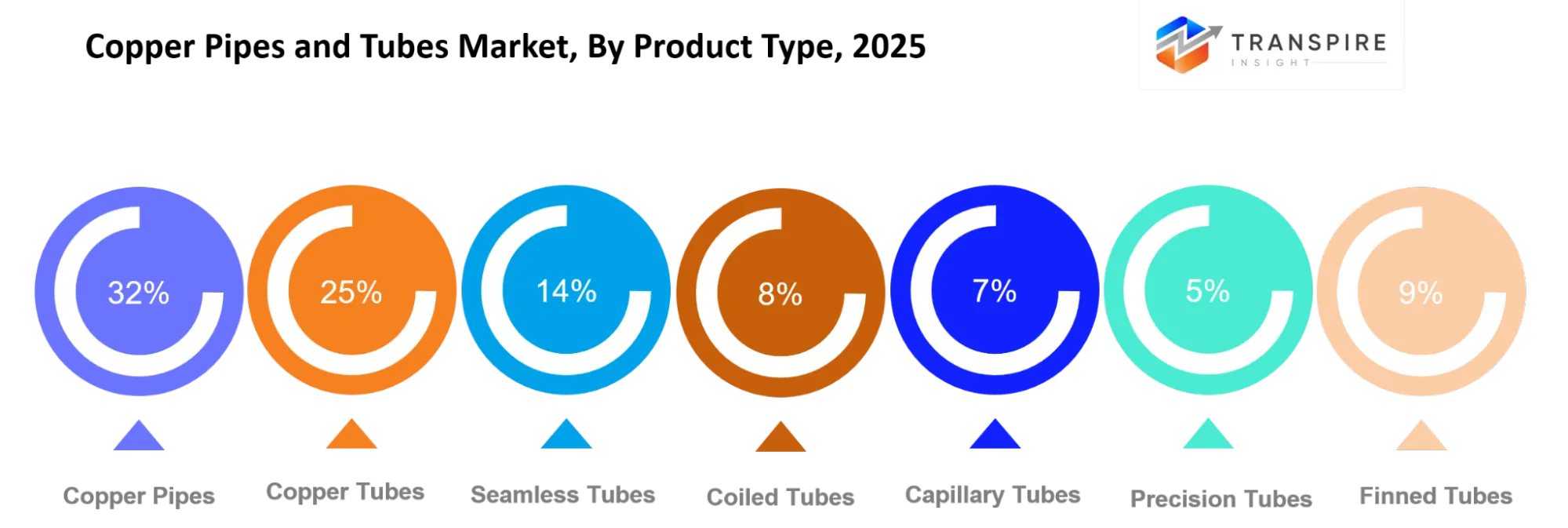
- 32.00% copper pipes: Installers appreciate long-life, recyclable pipes in high-quality plumbing and institutional retrofits.
- Compact coil designs that yield a higher heat transfer per unit of copper are being preferred by OEMs, with 25.00% copper tubes being the preferred option.
- Low-GWP refrigerant redesign drives up demand for pressure-resistant, weld-free lines and 14.00% seamless tubes.
- 8.00% coiled tubes: prefabricated coils minimise joints, brazing time and installation errors in limited retrofit applications.
What are the Key Drivers, Restraints, and Opportunities in the Copper Pipes and Tubes Market?
Driver:
HVACR replacement and heat-pump redesign are driving value growth. The trigger is the transition toward lower-GWP refrigerants, combined with appliance-efficiency incentives and building retrofits. New refrigerants and compact inverter systems require cleaner internal surfaces, tighter dimensional tolerances, and higher-pressure capability. This increases sales of seamless, micro-grooved, and precision-drawn tube rather than only raising metal volume. In China, efficient-appliance incentives introduced a rise in copper-tube orders by nearly 20% year on year, illustrating how policy can move tube-mill utilisation quickly.
Restraint:
Copper remains exposed to a structural installed-cost disadvantage against PEX, polypropylene, and aluminium micro-channel heat exchangers. Copper price volatility affects working capital and contract margins, while plastic systems reduce installation time and dependence on skilled brazers. The issue persists because lower-cost substitutes are already embedded in residential plumbing standards and entry-level HVAC designs; copper must justify its premium through durability, recyclability, thermal performance, or compliance reliability.
Opportunity:
The next value pool is lightweight, high-performance tubing using advanced alloys, microgrooves, recycled feedstock, and digitally controlled production. Halcor’s 2026 TALOS XR launch demonstrates this direction, while Hindalco’s ramp-up of copper-tube and inner-grooved-tube capacity shows investment in downstream value addition. Regional opportunities are strongest where heat pumps, compact refrigeration, and data-centre cooling are scaling. This shifts value toward inventory management.
What Has the Impact of Artificial Intelligence Been on the Copper Pipes and Tubes Market?
Artificial intelligence is currently improving copper tube manufacturing mostly by improving machine vision, process controls, and predictive maintenance. Vision can be used to evaluate tube surface quality for scratches, pinholes, inclusions, ovality, seam quality, and dimensional tolerances at line speed, so defect coils can be separated before being sold to HVAC or refrigeration OEMs. Artificial intelligence models can take furnace temperature, drawing force, lubricant quality, eddy-current, and wall-thickness data and make recommendations for annealing and drawing, reducing scrap and helping to ensure consistent operating conditions for thin-wall or micro-groove tube.
Predictive maintenance is the other big application. Algorithms can identify abnormal vibration, motor-load fluctuations, or die wear on drawing lines or coilers so that maintenance can be scheduled before a line fails and impacts supply, which is critical for OEM contracts with aggressive delivery goals. AI-enabled inspection lines are receiving particular attention from China's tube producers. The biggest challenge is how expensive these systems are to implement. Many older mills have disparate systems, varying sensor configurations, and limited historic quality data; AI can identify anomalies but cannot make up for weak sampling, faulty sensors, or lax process controls, so metallurgical expertise and lab tests are still needed.
In July 2026, Continuous Properzi advanced its development of a predictive maintenance program specifically designed for Continuous Casting and Rolling (CCR) plants producing copper and aluminum rods.
https://wiretech.com/2026/07/predictive-maintenance-in-continuous-casting-and-rolling-ccr-plants/
Key Copper Pipes and Tubes Market Trends:
Demand for copper tubes is becoming more specification-driven as the value of reliability per kg becomes more important due to refrigerant reform, electrified heating, and compact equipment designs. The competitive emphasis is on precision forming, certified quality, recycled content, and OEM co-development.
- With the greater demand for low-GWP refrigerants, there is an increase in the need for pressure-capable seamless and precision-drawn tubing in new AC and heat-pump circuits.
- OEMs are moving away from simpler bore designs to micro-grooved inner surfaces to gain greater heat transfer from a smaller footprint for coils.
- Smaller diameter tubes are being accepted in the heat exchangers of air conditioners; 60% of targeted systems had ICA-supported programs.
- Capillary and precision-tube use is growing as a result of the need for narrow, tightly controlled bores for refrigerant metering in inverter-driven refrigeration.
- With the rise of AI vision inspection, tube makers are looking to decrease surface defect escape rates and safeguard high-value HVAC OEM relationships.
- In applications such as high-pressure refrigeration, medical gas, and heat pumps, where weld-free reliability is important, seamless formats are preferred.
- The supply of recycled copper continues to be a competitive lever for fabricators who are looking for reduced material-risk exposure and improved circularity credentials.
- District cooling systems in the Gulf markets are driving growth in the demand for corrosion-resistant, large-scale thermal transfer systems.
Copper Pipes and Tubes Market Segmentation
Product Type:
Copper tubes are highest at 32.00%, driven by potable-water plumbing, building services, and rigid distribution networks where corrosion resistance and extended service life are key. Copper tubes are 25.00% of the market with applications in HVAC coils, refrigeration line sets, automotive heat circuits, and smaller heat exchangers. Seamless tubes are 14.00% of the market due to temperature/pressure-sensitive refrigeration, medical gas, and industrial applications where the lack of a longitudinal seam provides added reliability. Coiled tubes are 8.00% of the market due to ease and speed of installation in retrofit and confined construction situations. Capillary tubes are 7.00% due to pressure-sensitive refrigeration control applications. Precision tubes are 5.00% of the market due to engineered/effective heat transfer, among others.
Grade:
Pure copper remains the central volume category for plumbing and general heat-transfer duties, while oxygen-free and high-purity copper serve demanding electrical, vacuum, and contamination-sensitive applications. Deoxidised and phosphorus-deoxidised grades remain important for brazing and HVACR production because they support reliable fabrication. Alloyed copper is gaining relevance where strength and corrosion resistance matter, while recycled copper benefits buyers seeking lower-carbon sourcing and circularity. Grade selection is increasingly tied to performance, compliance, process compatibility, and material-traceability requirements across applications.
Application:
HVAC leads with 38.60%, reflecting copper’s role in refrigerant circulation, coil fabrication, and efficient heat transfer. Refrigeration and heat-exchanger applications are expected to expand at a 6.90% CAGR, supported by cold-chain investment, lower-GWP refrigerant redesign, and industrial cooling requirements. Plumbing remains important, while electrical, industrial machinery, automotive, medical gas systems, and heat exchangers diversify consumption. Application growth increasingly favours specialised tubing geometries, cleaner surfaces, tighter tolerances, and materials engineered for specific operating pressures, temperatures, and installation conditions today.
End User:
Residential construction supports plumbing installations and room-air-conditioner demand, while commercial users adopt VRF systems, chilled-water networks, and building retrofit projects. Industrial users require durable tubing for process equipment, heat exchangers, and machinery, whereas automotive manufacturers increasingly integrate copper into thermal-management systems. Construction remains linked to pipelines, while power-generation and healthcare applications emphasise reliability and traceability. Refrigeration users add specialized demand as cold-chain infrastructure expands. End-user procurement is increasingly shaped by efficiency, certification, lifecycle performance, and supply security.
Manufacturing Process:
Extrusion establishes the initial tube form, drawing delivers dimensional accuracy, and annealing restores ductility for forming and installation. Coiling improves logistics and field productivity, particularly for long-length HVAC applications. Casting and rolling remain important for preparing suitable feedstock and controlling material properties before tube conversion, while welding serves selected lower-cost configurations. Producers are increasingly integrating inline inspection, automated process controls, and digital monitoring across these stages. This improves consistency, reduces scrap, tightens tolerances, and supports traceable manufacturing.
Distribution Channel:
Direct sales and OEM supply dominate customised, high-volume contracts where specifications, certification, and delivery reliability influence supplier selection. Distributors and wholesalers provide inventory depth for contractors, maintenance providers, and smaller manufacturers, while dealers serve fragmented construction and replacement demand. Fabricators add value through cutting, bending, joining, and assembly services, reducing installation effort. Online sales remain useful for standardised products and smaller orders. Channel strategies increasingly combine digital ordering, warehouses, technical support, and replenishment to improve customer responsiveness.
What are the Key Use Cases Driving the Copper Pipes and Tubes Market?
The main use case is HVAC and refrigeration, at 38.60%. This is due to the refrigerant flow and heat transfer efficiencies of copper tubes for evaporators and condensers, chillers, and heat pumps. Small diameter internally grooved tubes support the continued design of smaller coils while also reducing refrigerant charges.
Expansion of applications is taking place in plumbing, industrial machinery, automotive thermal management, medical gas systems, electrical equipment, and heat exchangers. Refrigeration and heat-exchanger applications have a CAGR of 6.90% on the back of equipment redesigns and adoption of refrigerants with a lower GWP.
New use cases include those for data centres and liquid cooling systems that connect to cold plates, coolant distribution units, and heat exchangers used for overall facility cooling systems.
|
Report Metrics |
Details |
|
Market size value in 2025 |
USD 27.30 Billion |
|
Market size value in 2026 |
USD 28.40 Billion |
|
Revenue forecast in 2033 |
USD 36.98 Billion |
|
Growth rate |
CAGR of 3.84% from 2026 to 2033 |
|
Base year |
2025 |
|
Historical data |
2021 - 2024 |
|
Forecast period |
2026 - 2033 |
|
Report coverage |
Revenue forecast, competitive landscape, growth factors, and trends |
|
Regional scope |
United States; Canada; Mexico; United Kingdom; Germany; France; Italy; Spain; Denmark; Sweden; Norway; China; Japan; India; Australia; South Korea; Thailand; Brazil; Argentina; South Africa; Saudi Arabia; United Arab Emirates |
|
Key companies profiled |
Mueller Industries, Wieland, KME Group, Furukawa Electric, Mitsubishi Materials, KMCT, Golden Dragon Precise Copper Tube Group, Hailiang Group, Mehta Tubes, Cambridge-Lee Industries, Cerro Flow Products, Cupori, Lawton Tubes, Luvata, Shanghai Metal Corporation. |
|
Customization scope |
Free report customisation (country, regional & segment scope). Available customised purchase options to meet your exact research needs. |
|
Report Segmentation |
Product Type (Copper Pipes, Copper Tubes, Seamless Tubes, Welded Tubes, Capillary Tubes, Coiled Tubes, Precision Tubes, Finned Tubes); Grade (Pure Copper, Oxygen-Free Copper, Deoxidized Copper, Phosphorus-Deoxidized Copper, Alloyed Copper, Recycled Copper, High-Purity Copper); Application (HVAC, Plumbing, Refrigeration, Electrical, Industrial Machinery, Automotive, Medical Gas Systems, Heat Exchangers); End User (Residential, Commercial, Industrial, Automotive, Construction, Power Generation, Healthcare, Refrigeration); Manufacturing Process (Extrusion, Drawing, Casting, Rolling, Welding, Annealing, Coiling); Distribution Channel (Direct Sales, Distributors, Dealers, Wholesalers, Online Sales, OEM Supply, Fabricators). |
Which Regions are Driving the Copper Pipes and Tubes Market Growth?
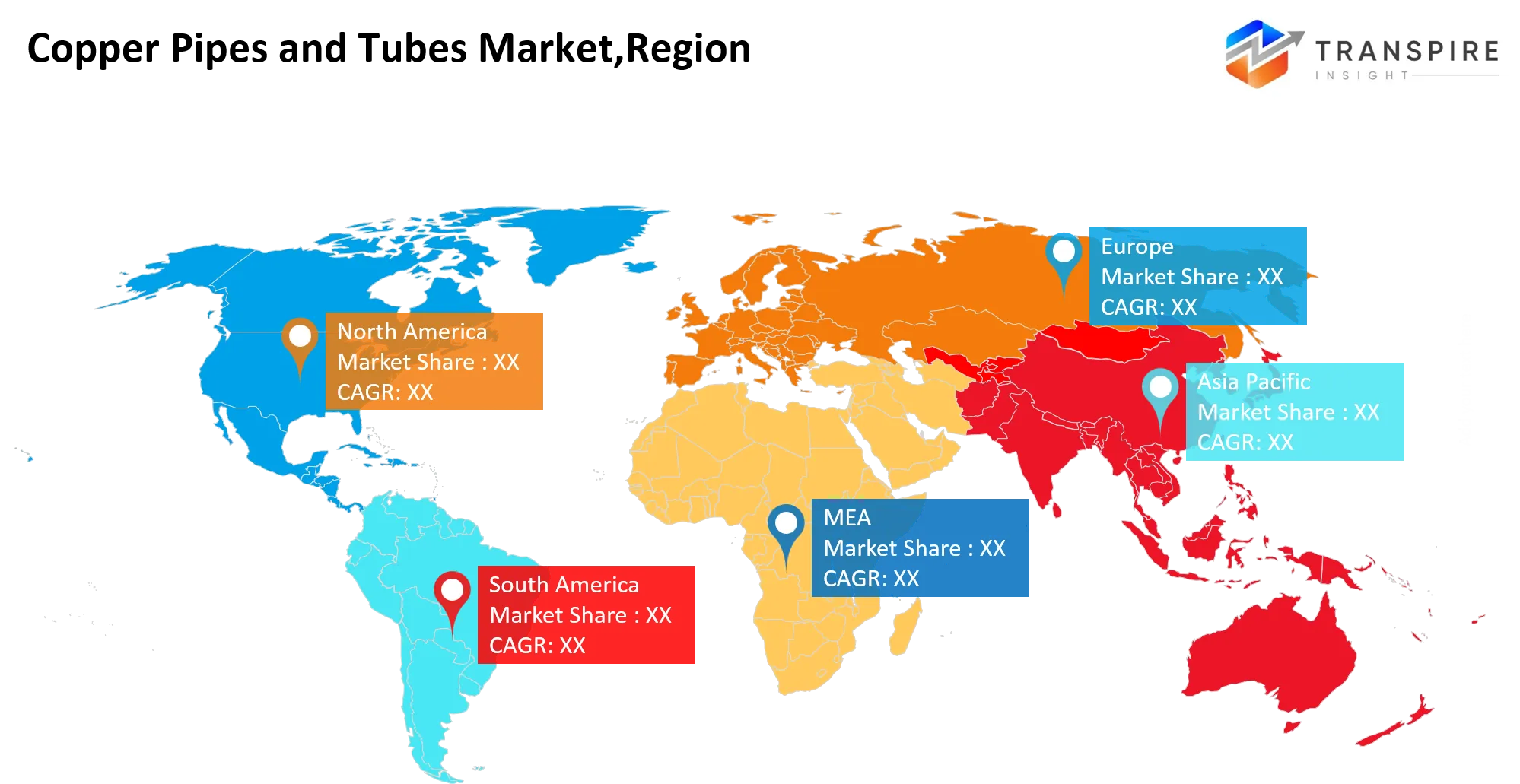
Asia Pacific leads the world with a 47.50% share due to the convergence of the world's most comprehensive clusters in air-conditioner, refrigerator, electronics, and construction manufacturing in the region. China maintains its strong foothold in regional demand, with 6.9% growth in air-conditioner assembly activity. India is also scaling up its industrial-tube capacity under the Make in India program, with 1 plant now running while another three plants are under construction. This ecosystem enables a quick supply chain for copper feedstock, machinery, component manufacturers, installers and export-centric HVACR OEMs.
In July 2026, Daikin Industries approved the establishment of its new dedicated subsidiary, Daikin Research and Development India Private Limited. As part of this expansion, the company is building a major R&D centre in Haryana, India.
https://www.daikin.com/press/2026/20260626
Europe is at 22.00% and has a higher demand structure of regulatory pressure compared with Asia Pacific. The F-gas regulation in Europe is pushing for lower warming potential refrigerants, which is encouraging small, efficient heat-transfer principles such as dedicated tubing and the right heat exchange designs. European heat-pump sales showed a recovery in 2025, helping substitution and replacement efforts. Technical standards, environmental regulation, and HVAC engineering pressures provide stability for suppliers of value-added services.
In June 2026, A-Gas and Solstice Advanced Materials signed a strategic framework agreement to accelerate the transition to low warming potential (GWP) alternatives as European fluorinated gas quotas tighten.
Who are the Key Players in the Copper Pipes and Tubes Market, and how do they compete?
Competition within the industry appears spread out between integrated fabricators, regional tube specialists, and distributor-led suppliers. Producers compete on copper quality, dimensional control, heat transfer design, delivery, and proximity to customers rather than simply on the quoted price of metal. Mueller uses its Piping Systems, Industrial Metals, and Climate business units to serve wholesalers, OEMs, and the refrigeration channel. The company's topline growth was driven by higher pricing of copper tubes and new capacity we acquired.
Wieland employs engineered high-performance tube, finned products, heat exchangers, and U.S. capacity builds for data centres and HVAC cooling applications. KME Group, Furukawa Electric, Mitsubishi Materials, Cupori, Lawton Tubes, Luvata and KMCT leverage strengths in grades and a European/Asian manufacturing footprint and products for refrigeration, plumbing, and industrial markets. Golden Dragon Precise Copper Tube Group and Hailiang Group operate at scale, export with low-cost production of ACR tubes into Asia, address flexible regional sourcing needs with Mehta Tubes and Shanghai Metal Corporation, or expand North American distribution channels with Cambridge-Lee Industries and Cerro Flow Products. Copper future differentiation will come from improved recycled-copper processing, seamless precision tubes, traceable quality systems, and low-GWP heat pumps.
Key Players are:
- Mueller Industries
- Wieland
- KME Group
- Furukawa Electric
- Mitsubishi Materials
- KMCT
- Golden Dragon Precise Copper Tube Group
- Hailiang Group
- Mehta Tubes
- Cambridge-Lee Industries
- Cerro Flow Products
- Cupori
- Lawton Tubes
- Luvata
- Shanghai Metal Corporation
Recent Development News
- In July 2026, Hindalco Industries expanded its downstream copper-tube operations as its Copper Tubes and Inner Grooved Tubes facility became fully operational and began scaling production. The development strengthens Hindalco’s ability to supply value-added copper tube products for HVAC and related applications while broadening its downstream copper manufacturing capacity.
- In April 2026, Luvata consolidated its operational divisions by merging its specialised product facilities into a unified entity called the Materials & Solutions Business Unit. This structural alignment integrates interconnected manufacturing networks across Europe, North America, and Asia to optimise technical material workflows and highly specialised copper pipelines.
http://luvata.com/articles/luvata-introduces-materials-solutions-business-unit/
What Strategic Insights Define the Future of the Copper Pipes and Tubes Market?
The industry is upgrading to higher-value, engineered copper systems driven by heat-pump, inverter-HVAC, and cold-chain expansion and data-centre cooling. These applications demand dense, pressure-rated, and heat-efficient tubing. Substitution risk, driven by aluminium heat exchangers and polymer plumbing, can lower copper content when manufacturers seek quick payback or ease of installation. Copper's price volatility significantly impacts margins and purchasing decisions for contractors. Mueller has announced higher selling prices for higher-value products despite lower unit volumes for its core copper/brass products. An attractive niche is premium tube optimised for low-GWP refrigerants, liquid cooling, and district-cooling networks for GCC infrastructure and North American data centres. Providers should maintain access to scrap, automate inspection and traceability, and, in close collaboration, develop coil geometries optimised for HVAC OEMs. The goal is to emphasise proven efficiency, leak risk mitigation, and lifecycle benefits, not just copper content.
Key Segmentations are:
- Product Type
- Copper Pipes
- Copper Tubes
- Seamless Tubes
- Welded Tubes
- Capillary Tubes
- Coiled Tubes
- Precision Tubes
- Finned Tubes
Grade
- Pure Copper
- Oxygen-Free Copper
- Deoxidised Copper
- Phosphorus-Deoxidized Copper
- Alloyed Copper
- Recycled Copper
- High-Purity Copper
Application
- HVAC
- Plumbing
- Refrigeration
- Electrical
- Industrial Machinery
- Automotive
- Medical Gas Systems
- Heat Exchangers
End User
- Residential
- Commercial
- Industrial
- Automotive
- Construction
- Power Generation
- Healthcare
- Refrigeration
Manufacturing Process
- Extrusion
- Drawing
- Casting
- Rolling
- Welding
- Annealing
- Coiling
Distribution Channel
- Direct Sales
- Distributors
- Dealers
- Wholesalers
- Online Sales
- OEM Supply
- Fabricators
Frequently Asked Questions
Find quick answers to common questions.
The copper pipes and tubes market size was valued at USD 27.30 billion in 2025 and is poised to reach USD 36.98 billion by 2033, expanding at a 3.84% CAGR.
Key segments for the copper pipes and tubes market are Product Type (Copper Pipes, Copper Tubes, Seamless Tubes, Welded Tubes, Capillary Tubes, Coiled Tubes, Precision Tubes, Finned Tubes); Grade (Pure Copper, Oxygen-Free Copper, Deoxidized Copper, Phosphorus-Deoxidized Copper, Alloyed Copper, Recycled Copper, High-Purity Copper); Application (HVAC, Plumbing, Refrigeration, Electrical, Industrial Machinery, Automotive, Medical Gas Systems, Heat Exchangers); End User (Residential, Commercial, Industrial, Automotive, Construction, Power Generation, Healthcare, Refrigeration); Manufacturing Process (Extrusion, Drawing, Casting, Rolling, Welding, Annealing, Coiling); Distribution Channel (Direct Sales, Distributors, Dealers, Wholesalers, Online Sales, OEM Supply, Fabricators).
Growth is primarily driven by HVAC and refrigeration system redesign, heat-pump deployment, lower-GWP refrigerant regulations, data-centre cooling, cold-chain expansion, and demand for higher-efficiency heat-transfer tubing.
The copper pipes and tubes market is led by major manufacturers, including Mueller Industries, Wieland, KME Group, Furukawa Electric, Mitsubishi Materials, KMCT, Golden Dragon Precise Copper Tube Group, Hailiang Group, Mehta Tubes, Cambridge-Lee Industries, Cerro Flow Products, Cupori, Lawton Tubes, Luvata, and Shanghai Metal Corporation.
Asia Pacific holds 47.50% of the market, supported by concentrated HVAC manufacturing, copper-processing capacity, construction activity, electronics production, and extensive supplier networks across China, India, Japan, and Southeast Asia.
Opportunities include thin-wall and internally grooved tubes, data-centre liquid cooling, heat-pump systems, recycled-copper products, and localised high-traceability supply for HVACR and infrastructure projects.
- Mueller Industries
- Wieland
- KME Group
- Furukawa Electric
- Mitsubishi Materials
- KMCT
- Golden Dragon Precise Copper Tube Group
- Hailiang Group
- Mehta Tubes
- Cambridge-Lee Industries
- Cerro Flow Products
- Cupori
- Lawton Tubes
- Luvata
- Shanghai Metal Corporation
About the Authors

Pankaj Ghogare Patil
I am Pankaj Ghogare Patil, a Senior Research Analyst at Transpire Insight, specializing in the Pharmaceutical, Chemicals & Materials, Healthcare IT, and Biotechnology industry. My expertise lies in conducting comprehensive market research, analyzing industry trends, evaluating competitive landscapes, and translating complex data into actionable insights. At Transpire Insight, I closely follow emerging technologies, regulatory developments, and market innovations to create accurate, well-researched, and informative content that helps businesses and professionals make informed decisions. I am committed to producing credible, evidence-based articles that reflect industry best practices while making technical topics accessible and valuable for a broad audience.

Chakradhar Khansole
Chakradhar serves as the Research Director at Transpire Insight, bringing over 8 years of experience in technology, innovation, and strategic market intelligence. He specializes in transforming complex market data into actionable business insights that enable organizations to make informed, growth-oriented decisions. Recognized for his strategic vision and analytical expertise, Chakradhar leads high-impact research initiatives, delivering comprehensive market assessments, competitive intelligence, and forward-looking industry analysis.
Recently Published Reports
-
May 2026
Healthcare Polymer Packaging Market
Healthcare Polymer Packaging Market Size, Share & Analysis Report By Packaging Type (Syringes, IV Bottles and Pouches, Clamshells, Blisters, Bottles & Jars, Containers, Tubes, IV Parental Packaging, Others), By Type (Regulated, Non-regulated), By Polymer Type (LDPE (Low-Density Polyethylene), HDPE (High-Density Polyethylene), Homo-polymer (Homo), Random Copolymer (Random), Block Copolymer (Block), PET, Polystyrene, Polyvinyl Chloride, Polyamide/EVOH, Others), and Geography (North America, Europe, Asia-Pacific, Middle East and Africa, South and Central America), 2021 - 2031
-
Apr 2026
Hydrophilic Tape (Waterstop) Market
Hydrophilic Tape (Waterstop) Market Size, Share & Analysis Report By Type (Bentonite-Based Hydrophilic Tape, Rubber-Based Hydrophilic Tape), By Application (Residential Buildings, Commercial Buildings, Infrastructure Projects), and Geography (North America, Europe, Asia-Pacific, Middle East and Africa, South and Central America), 2021 - 2031
-
Apr 2026
Metalens Market
Metalens Market Size, Share & Analysis Report By Type (Visible Light Metalens, and Infrared Metalens), By Application (Consumer Electronics, Automotive Electronics, Industrial, Medical, and Others), and Geography (North America, Europe, Asia-Pacific, Middle East and Africa, South and Central America), 2021 - 2031
-
Apr 2026
PBT Resin Market
PBT Resin Market Size, Share & Analysis Report By Type (Reinforced PBT Resin, Unreinforced PBT Resin), By Processing Method (Injection Molding, Extrusion, Blow Molding, Others), By End-User (Automotive, Electrical & Electronics, Consumer Appliances, Industrial Machinery, Medical Devices, Packaging, Others), and Geography (North America, Europe, Asia-Pacific, Middle East and Africa, South and Central America), 2021 - 2031