

Contract Lifecycle Management Software Market Summery:
According to Transpire Insights, a detailed research report on the market reflects that the enterprise contract management application segment dominates the Contract Lifecycle Management Software Market, accounting for approximately 64% of the total share worldwide. DocuSign leads the market with approximately (around USD 3.1 billion) in annual revenue and an estimated 18–22% market influence/share, making it a leading contributor to market development, innovation, manufacturing expansion, and industry growth.
Market Snapshot Contract Lifecycle Management Software Market
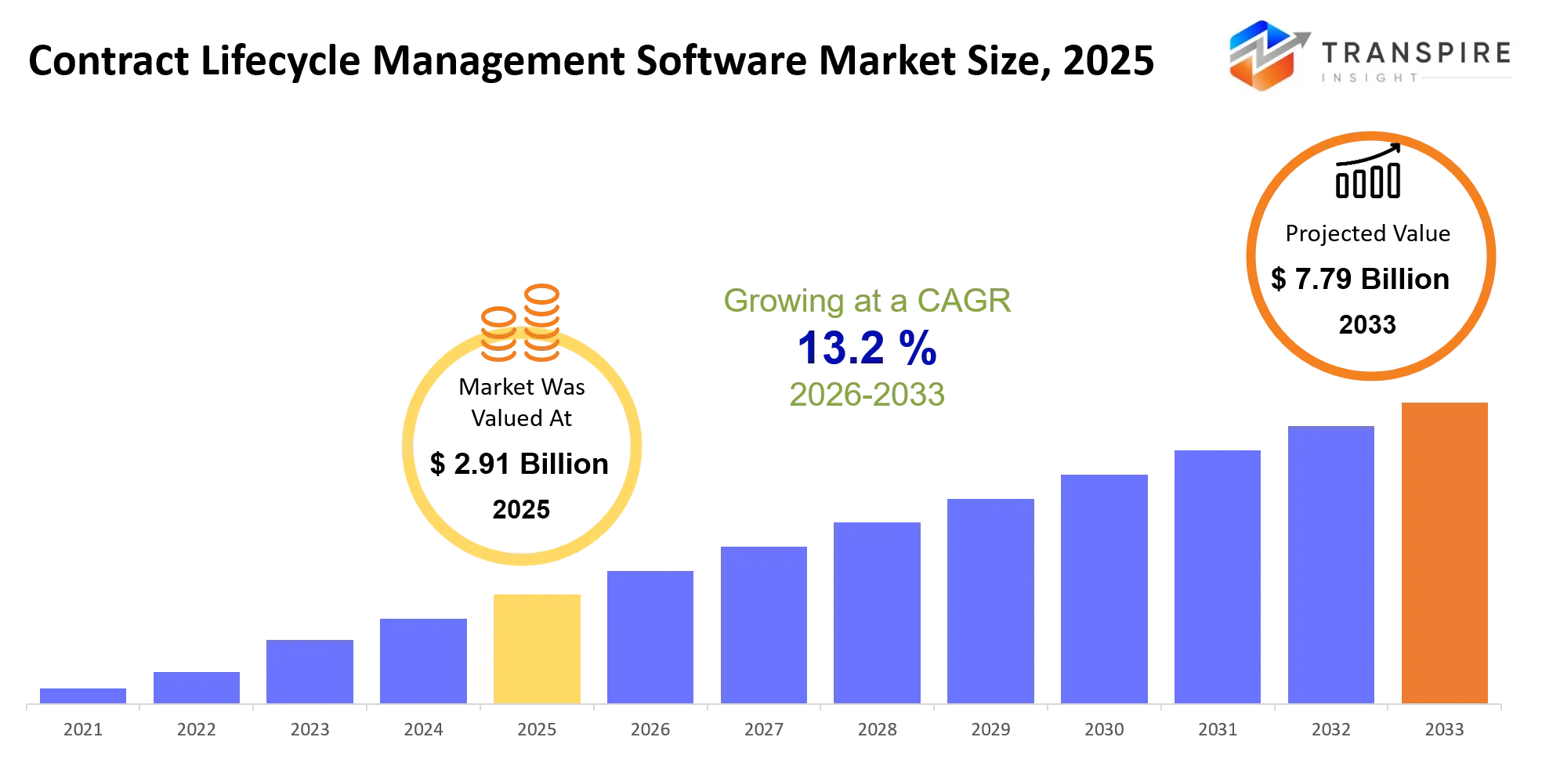
- Market Value (2025): USD 2.91Billion
- Expected Market Value (2026): USD 3.30 Billion
- Estimated Market Value (2033): USD 7.79 Billion
- Forecast CAGR (2026–2033): 13.2%
- Leading Region in 2025: Asia Pacific
- Second-largest Region: Europe
- Fastest Growing Region: North America
Introduction
Modern enterprise software technologies and digital contract management solutions that facilitate contract creation, negotiation, approval, execution, storage, compliance, obligation tracking, renewal management, and performance monitoring comprise the market for contract lifecycle management software. AI-powered contract intelligence, automated contract drafting, digital contract repositories, workflow automation, electronic signatures, contract analytics, obligation management, risk monitoring, and next-generation contract management technologies are examples of CLM software solutions that address the changing needs of legal departments, procurement teams, sales organizations, finance departments, compliance teams, and enterprise operations.
- AI-powered contract review systems, intelligent contract drafting platforms, automated approval workflows, centralized contract repositories, contract analytics solutions, obligation management technologies, digital signature integrations, and enterprise contract intelligence platforms are examples of product innovations that improve functionality and performance. Contract Lifecycle Management Software innovation improves contract visibility, review accuracy, workflow efficiency, compliance monitoring, risk identification, negotiation speed, and long-term contract performance through the use of artificial intelligence, machine learning, natural language processing, cloud computing, automated workflows, advanced analytics, and enterprise integration technologies. Improved contract management performance, reduced administrative costs, enhanced legal productivity, greater process transparency, and consistent contract governance across interconnected business operations are all made possible by product innovation. Data security standards, privacy regulations, legal compliance requirements, information governance policies, cybersecurity standards, quality management systems, and industry-specific compliance criteria are all adhered to.
- The need for contract lifecycle management software is being driven by a number of factors, including the growing complexity and volume of commercial agreements, rising demand for contract automation, increasing regulatory and compliance requirements, rapid adoption of cloud-based enterprise software, growing use of artificial intelligence and generative AI, increasing focus on contract risk management, and ongoing developments in contract analytics, intelligent document processing, digital signatures, workflow automation, obligation tracking, enterprise integrations, and AI-powered contract intelligence.
Market Highlights:
- Asia Pacific is expected to grow at a rapid CAGR in the Contract Lifecycle Management Software Market by holding nearly 42% of the share during the forecast period.
- North America is the fastest-growing region in the Contract Lifecycle Management Software Market during the period, holding around 31% share.
- Europe is anticipated to hold approximately 24% share of the Contract Lifecycle Management Software Market over the predicted timeframe.
- By Deployment, the Cloud-based segment dominated the market and holds nearly 48.3% share in 2025 and is projected to grow at a substantial CAGR during the forecast period.
- By Component, the Contract Authoring segment dominated the market and holds almost 46.6% share in 2025 and is projected to grow at a substantial CAGR during the forecast period.
- By Enterprise Size, the Large Enterprises segment dominated the market and holds approximately 61.8% share in 2025 and is projected to grow at a substantial CAGR during the forecast period.
- By End User, the BFSI segment dominated the market and holds roughly 36.4% share in 2025 and is projected to grow at a substantial CAGR during the forecast period.
- By Application, the Procurement Contracts segment dominated the market and holds around 41.2% share in 2025 and is projected to grow at a substantial CAGR during the forecast period.
- Growing Adoption of Contract Lifecycle Management Software, AI-Powered Contract Intelligence, and Automated Contract Management Technologies: Legal departments, procurement teams, sales organizations, finance functions, compliance teams, BFSI institutions, healthcare organizations, IT and telecommunications companies, manufacturing enterprises, government agencies, retail organizations, and CLM software providers across Asia Pacific, North America, and Europe are increasing investments in cloud-based, on-premise, hybrid, and SaaS contract lifecycle management platforms, contract authoring, centralized contract repositories, workflow automation, analytics and reporting, e-signature integration, AI-powered contract intelligence, procurement contracts, sales contracts, legal contracts, vendor management, and compliance management solutions to improve contract visibility, accelerate contract creation and approval, automate workflows, reduce contractual risks, strengthen regulatory compliance, optimize vendor relationships, enhance operational efficiency, and support the transition toward intelligent, secure, scalable, and cost-effective contract lifecycle management.
How is the Contract Lifecycle Management Software Market Growing Due to Technology?
The market for contract lifecycle management software is growing as a result of ongoing developments in artificial intelligence, machine learning, natural language processing, generative AI, cloud computing, intelligent document processing, contract analytics, automated workflows, and enterprise integration technologies. Superior contract intelligence, optimized workflow efficiency, improved review accuracy, enhanced compliance visibility, automated obligation tracking, risk identification, contract search capabilities, and long-term contract performance are provided by contemporary solutions such as AI-powered contract review, intelligent contract drafting, automated redlining, centralized contract repositories, contract analytics, digital signature integration, and cloud-based CLM platforms. Innovations in generative AI, natural language understanding, AI-based clause analysis, predictive contract analytics, automated workflow engineering, intelligent document extraction, enterprise data integration, cloud-native architecture, advanced cybersecurity, digital identity technologies, and smart contract management allow organizations to create contract processes that are more consistent, scalable, secure, and efficient while still meeting strict international data protection requirements, information security standards, regulatory obligations, legal governance requirements, and industry-specific compliance frameworks. Icertis, for example, is advancing AI-native contract intelligence through its Vera platform and expanded collaboration with Microsoft to integrate contract intelligence with enterprise AI infrastructure. In addition to improving contract management efficiency, data visibility, compliance, risk management, workflow automation, scalability, and innovation across the Contract Lifecycle Management Software Market, these technological advancements are promoting broader adoption across legal, procurement, sales, finance, operations, BFSI, IT and telecommunications, manufacturing, healthcare, government, retail, and other contract-intensive industries.
Market Drivers
The Contract Lifecycle Management Software Market is being driven by the growing demand for automated, secure, scalable, and intelligent contract management solutions and the increasing adoption of advanced contract intelligence technologies by legal departments, procurement organizations, sales teams, finance departments, compliance functions, government agencies, healthcare organizations, manufacturing companies, and enterprise software providers. The increasing use of AI-powered contract review, automated contract drafting, intelligent redlining, contract repositories, cloud-based CLM software, contract analytics, obligation management, workflow automation, digital signatures, and advanced contract management technologies is driving up demand for solutions that improve contract visibility, optimize approval processes, reduce administrative workloads, enhance regulatory compliance, identify contractual risks, accelerate negotiations, and support enterprise-wide contract governance while addressing the growing need for efficient and cost-effective contract management. These advancements are encouraging organizations to make investments in next-generation AI technologies, innovative CLM platforms, enterprise integrations, and expanded contract intelligence capabilities. Companies in the worldwide Contract Lifecycle Management Software Market are expanding their product portfolios, improving contract automation capabilities, increasing research and development investments, strengthening AI functionality, and creating new growth opportunities.
- For example, Icertis continues to advance contract lifecycle management innovation through AI-native contract intelligence, automated contract review, intelligent drafting, agent-driven redlining, obligation management, contract search, portfolio intelligence, and enterprise AI integration. Its 2026 developments demonstrate the industry's movement toward AI-driven contract intelligence that transforms contracts from static documents into actionable business information.
Restrain
The primary challenges facing the Contract Lifecycle Management Software Market are high implementation and integration costs, complex enterprise deployment requirements, data migration challenges, cybersecurity concerns, and strict regulations related to data privacy, information security, legal compliance, and contractual governance. The use of advanced AI-powered contract intelligence, enterprise workflow automation, intelligent document processing, cloud infrastructure, analytics platforms, integration technologies, cybersecurity systems, and continuous research and development initiatives can increase technology and operational costs.
Analysis of Prices and Consumer Behaviour
The Contract Lifecycle Management Software Market is experiencing increasing demand for cost-effective, scalable, secure, and high-performance contract management software as legal departments, procurement organizations, sales teams, finance departments, compliance functions, and other enterprise users increasingly prioritize workflow automation, contract visibility, operational efficiency, and risk management. Pricing is influenced by factors such as software licensing models, subscription structures, number of users, number of contracts managed, deployment model, AI functionality, customization requirements, integration complexity, implementation services, data migration requirements, storage requirements, cybersecurity infrastructure, customer support, and technology investments. Organizations are increasingly evaluating CLM software based on total cost of ownership, contract review efficiency, workflow automation, risk reduction, compliance performance, integration capabilities, scalability, data security, and long-term operational value rather than initial acquisition costs. Consumer behaviour is also shifting toward AI-powered contract review, automated drafting, cloud-based contract repositories, intelligent search, automated approval workflows, contract analytics, obligation tracking, digital signature integrations, and advanced contract intelligence platforms that improve contract visibility, reduce manual workloads, accelerate negotiations, enhance compliance, and streamline enterprise processes. As organizations increasingly demand reliable, flexible, secure, and technologically advanced contract lifecycle management solutions, companies are focusing on competitive subscription pricing, modular CLM platforms, customized implementation services, AI-powered contract intelligence, cloud deployment, enterprise integration, and advanced automation capabilities to address evolving customer requirements and strengthen their position in the Contract Lifecycle Management Software Market.
Top Companies in the Contract Lifecycle Management Software Market
- Icertis
- DocuSign
- Ironclad
- Agiloft
- Conga
- SAP
- Oracle
- Coupa Software
- SirionLabs
- ContractPodAi
- Evisort
- LinkSquares
- JAGGAER
- IBM
- Wolters Kluwer
Market Segmentation
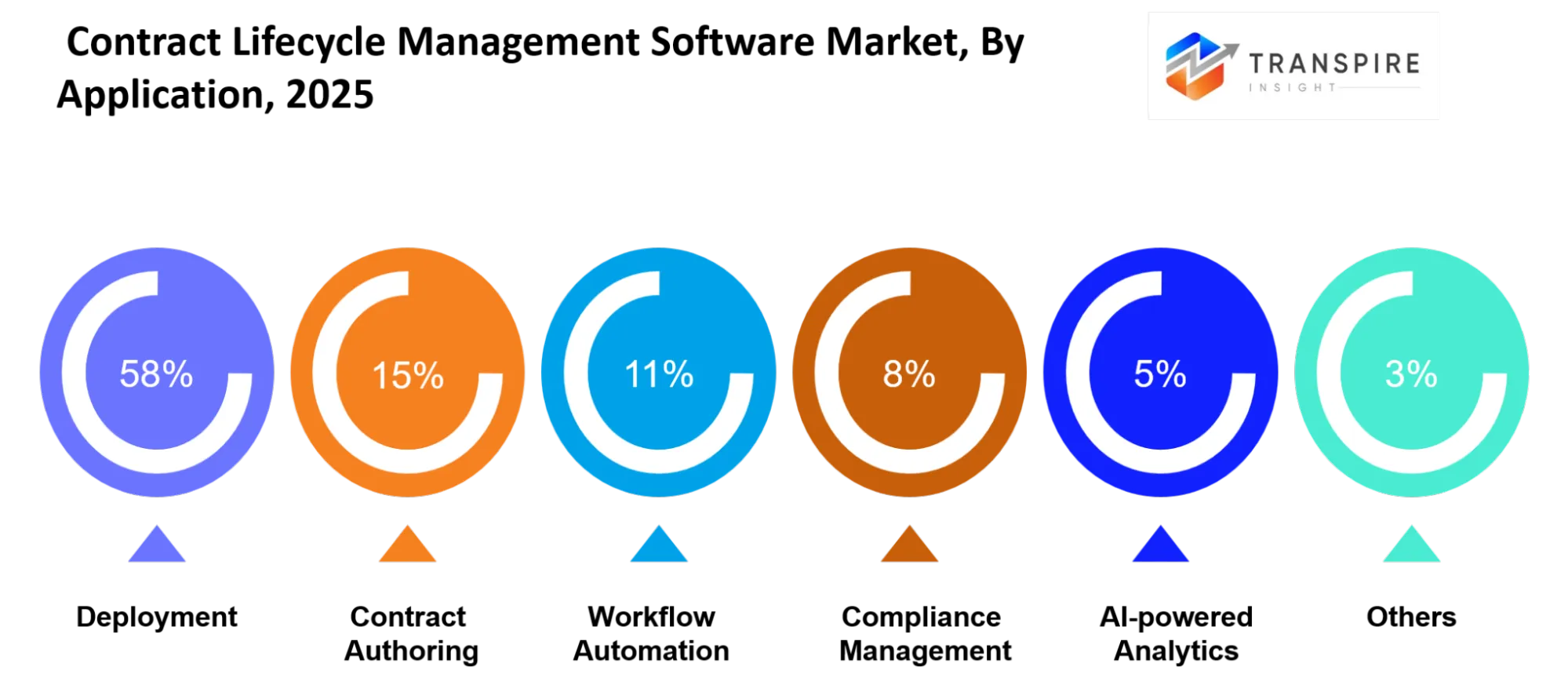
The Contract Lifecycle Management Software Market share is divided into five categories: Deployment, Component, Enterprise Size, End User, Application.
The Cloud-based dominated the market, accounting for nearly 47.3% in 2025, and is expected to rise at a significant CAGR during the forecast period.
The Contract Lifecycle Management Software Marketis segmented. By Deployment Cloud-based, On-premise, Hybrid, SaaS, Others Among these the Cloud-based dominated the market, accounting for nearly 47.3% in 2025 and expected to increase at a significant CAGR during the forecast period.due to scalable deployment, lower infrastructure costs, remote accessibility, rapid implementation, automatic updates, seamless integrations, enhanced collaboration, flexible subscription models, and growing enterprise digital transformation initiatives.
The Contract Authoring segmentheld the greatest share of approximately 49.1% in 2025 and is expected to increase at a substantial CAGR over the forecast period.
The Contract Lifecycle Management Software Market is segmentedBy Component Contract Authoring, Contract Repository, Workflow Automation, Analytics & Reporting, E-signature Integration, Others Among these, the Polypropylene (PP) segment held the greatest share of approximately 49.1% in 2025 and is expected to increase at a substantial CAGR over the forecast period.due to automated drafting, standardized templates, faster contract creation, reduced errors, improved collaboration, streamlined workflows, AI-powered recommendations, clause librarie, and enhanced compliance across enterprise contracting processe.
The Large Enterprises segmentheld the greatest share of approximately 45.4%in 2025 and is expected to increase at a high CAGR over the forecast period.
The Contract Lifecycle Management Software Market is segmented By Enterprise Size Large Enterprises, SMEs, Others Among these the Large Enterprises segment held the greatest share of approximately 44.9% in 2025 and is expected to increase at a considerable CAGR over the projected period.due to high contract volumes, complex workflows, stringent compliance requirements, greater technology budgets, extensive legal operations, integration needs, and strong demand for centralized contract management and automation.
Regional Segment Analysis of the Contract Lifecycle Management Software Market
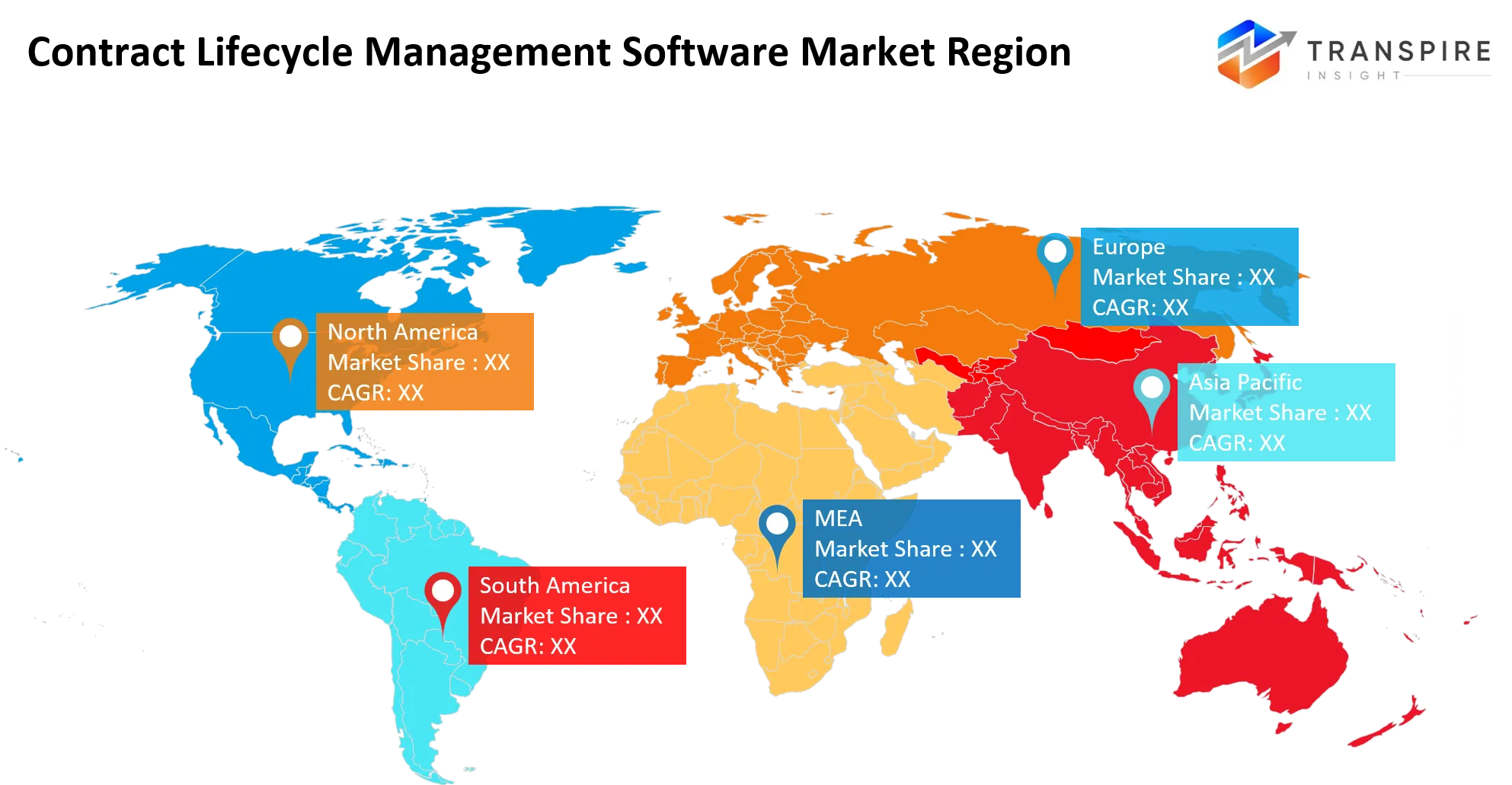
- North America (U.S., Canada, Mexico)
- Europe (Germany, France, U.K., Italy, Spain, Rest of Europe)
- Asia-Pacific (China, Japan, India, Rest of APAC)
- South America (Brazil and the Rest of South America)
- The Middle East and Africa (UAE, South Africa, Rest of MEA)
North America is expected to maintain a leading position in the Contract Lifecycle Management Software Market by holding nearly 42% of the share during the forecast period.
Over the forecast period, the market for contract lifecycle management software is anticipated to expand rapidly in North America. It makes up about 42% of the market. The region dominates this market due to a number of factors, including strong adoption of enterprise software, increasing contract complexity, growing investments in legal technology, rising demand for contract automation, increasing adoption of artificial intelligence, established cloud infrastructure, and the presence of major CLM software providers in the United States and Canada. The need is driven by advancements in AI-powered contract review, automated contract drafting, intelligent redlining, centralized contract repositories, contract analytics, obligation management, digital signature integration, workflow automation, and enterprise contract intelligence. Growing investments by financial institutions, technology companies, healthcare organizations, manufacturing companies, government organizations, retail enterprises, and professional services firms are expanding deployment across legal, procurement, sales, finance, compliance, and operations functions. The region's strong focus on cybersecurity, data governance, regulatory compliance, enterprise digital transformation, and AI adoption further supports regional market growth.
Europe is anticipated to hold approximately 25% share of the Contract Lifecycle Management Software Market over the predicted timeframe.
Over the course of the projected period, Europe is expected to hold a 25% market share for the Contract Lifecycle Management Software Market. The region's growth is primarily driven by strong investments in digital transformation, increasing regulatory requirements, expanding enterprise automation activities, and growing adoption of advanced contract management technologies across legal departments, procurement organizations, financial institutions, healthcare companies, manufacturing organizations, retail businesses, and government agencies. Germany, France, the UK, Italy, and Spain are among the countries that are prioritizing cloud-based CLM platforms, AI-powered contract review, automated workflows, contract analytics, digital signatures, obligation management, enterprise contract repositories, and advanced contract intelligence technologies. Partnerships involving CLM software providers, enterprise technology companies, legal departments, procurement organizations, financial institutions, government agencies, research institutions, and technology providers are accelerating the development, deployment, and adoption of advanced contract lifecycle management solutions in order to promote long-term market growth throughout Europe.
Asia Pacific is anticipated to hold approximately 31% share of the Contract Lifecycle Management Software Market over the predicted timeframe.
Asia Pacific is anticipated to hold around 31% of the worldwide market for Contract Lifecycle Management Software throughout the forecast period. A rapidly expanding digital economy, increasing enterprise software adoption, growing investments in cloud infrastructure, expanding procurement digitization, increasing contract complexity, and rising awareness of automated contract management are all likely to contribute to the region's sustained rise. Growing investments in financial services, IT and telecommunications, manufacturing, healthcare, consumer goods, retail, government, and professional services, increased demand for cloud-based CLM platforms, AI-powered contract intelligence, contract analytics, automated workflows, and digital contract repositories, and continuous advancements in artificial intelligence, natural language processing, enterprise automation, cybersecurity, and cloud computing are all contributing to the market's expansion. Additionally, efforts to improve contract visibility, reduce administrative workloads, optimize procurement processes, strengthen compliance, enhance legal productivity, and develop intelligent contract management technologies are driving innovation, technology adoption, and commercialization across Asia Pacific. The region's expanding CLM market is also supported by increasing digital transformation initiatives and rising adoption of cloud-based contract management solutions.
Strategies for Market Growth in Non-Leading Regions
By creating scalable and affordable contract lifecycle management infrastructure utilizing advanced cloud-based CLM platforms, AI-powered contract intelligence, automated contract workflows, centralized contract repositories, contract analytics, obligation management, digital signature integrations, and integrated enterprise contract management platforms, non-leading regions can promote growth. Through the development of local CLM capabilities, innovative contract intelligence solutions, and value-added contract management implementation and support services, this would enhance regional digital ecosystems and reduce dependency on fragmented contract management processes. Commercialization and market penetration will be accelerated by strategic partnerships with CLM software providers, enterprise software companies, legal departments, procurement organizations, financial institutions, healthcare organizations, manufacturing companies, government agencies, technology integrators, academic institutions, and cloud service providers. To increase contract management performance and operational efficiency, investments in workforce training, R&D, artificial intelligence, cloud infrastructure, cybersecurity, data governance, enterprise integration, automation technologies, and compliance with data protection and information security standards are required. Government support for digital transformation initiatives, cloud adoption programs, AI development, regulatory modernization, cybersecurity infrastructure, and enterprise software investments can all increase technology adoption, attract investment, and accelerate the long-term growth of the Contract Lifecycle Management Software Market in emerging economies.
Recent Development
- In May 13, 2026, Icertis expanded its strategic partnership with Microsoft to advance AI-native contract intelligence and agentic automation. The multi-year agreement is designed to embed Icertis Vera into Microsoft's AI stack, including Microsoft 365 Copilot, Microsoft Fabric, and Microsoft Copilot Studio, supporting greater automation and contract intelligence across enterprise contracting workflows.
- In June 2026: Icertis: Introduced a next-generation contracting experience powered by Vera, including AI-driven contract intelligence, conversational contract interaction, agent-driven drafting, automated redlining, and AI-powered playbooks designed to accelerate negotiations, improve contract compliance, and reduce contract risk.
Future Market Trends for the Contract Lifecycle Management Software Market:
- Growing Adoption of Contract Lifecycle Management Software and AI-Powered Contract Intelligence Solutions: As organizations place a higher priority on contract visibility, risk management, compliance, workflow efficiency, automation, and cost optimization, providers are expanding their CLM software portfolios, which include AI-powered contract review, automated drafting, intelligent redlining, contract repositories, contract analytics, obligation management, cloud-based CLM platforms, digital signatures, and advanced contract intelligence solutions.
- Growing Need for Advanced Contract Lifecycle Management Solutions: To improve contract performance, enhance legal and procurement productivity, optimize approval workflows, strengthen compliance, reduce contractual risks, and support legal, procurement, sales, finance, operations, BFSI, IT and telecom, manufacturing, healthcare, government, retail, and other applications, organizations are progressively adopting AI-powered contract review, intelligent contract drafting, automated workflows, contract analytics, cloud-based repositories, obligation tracking, digital signature technologies, and comprehensive contract lifecycle management platforms. AI is increasingly shifting CLM from document administration toward proactive contract intelligence and decision support.
- In order to improve contract quality, management performance, operational reliability, cybersecurity, regulatory compliance, data visibility, and support next-generation enterprise ecosystems, businesses are investing in advanced AI technologies, generative AI, intelligent contract review systems, automated drafting technologies, cloud-based CLM platforms, contract analytics, digital workflow technologies, enterprise integration systems, intelligent document processing, predictive contract analytics, automated obligation management, advanced cybersecurity solutions, and agentic contract management technologies.
Market Segment
This study forecasts revenue at global, regional, and country levels from 2020 to 2033. Transpire Insights has segmented the Contract Lifecycle Management Software Market based on the below-mentioned segments.
Contract Lifecycle Management Software Market, By Deployment
- Cloud-based
- On-premise
- Hybrid
- SaaS
- Others
Contract Lifecycle Management Software Market, By Component
- Contract Authoring
- Contract Repository
- Workflow Automation
- Analytics & Reporting
- E-signature Integration
- Others
Contract Lifecycle Management Software Market, By Enterprise Size
- Large Enterprises
- SMEs
- Others
Contract Lifecycle Management Software Market, By End User
- BFSI
- Healthcare
- IT & Telecom
- Manufacturing
- Government
- Retail
- Others
Contract Lifecycle Management Software Market, By Application
- Procurement Contracts
- Sales Contracts
- Legal Contracts
- Vendor Management
- Compliance Management
- Others
Contract Lifecycle Management Software Market, By Regional Analysis
North America
- US
- Canada
- Mexico
- US
- Canada
Europe
- Germany
- UK
- France
- Italy
- Spain
- Rest of Europe
Asia Pacific
- China
- Japan
- India
- South Korea
- Australia
- Rest of Asia Pacific
South America
- Brazil
- Argentina
- Rest of South America
Middle East & Africa
- UAE
- Saudi Arabia
- Qatar
- South Africa
- Rest of the Middle East & Africa
Frequently Asked Questions
Find quick answers to common questions.
The Contract Lifecycle Management Software Market is primarily driven by increasing contract volumes, growing regulatory complexity, rising demand for contract automation, expanding enterprise digital transformation, and increasing adoption of AI-powered contract intelligence. Organizations are deploying CLM software to automate contract creation, streamline approvals, improve compliance, reduce contractual risks, and enhance operational efficiency
The Cloud-based segment dominates the Contract Lifecycle Management Software Market, accounting for nearly 47.3% of the market in 2025. Its leadership is attributed to scalable deployment, lower infrastructure costs, remote accessibility, rapid implementation, automatic updates, seamless enterprise integrations, flexible subscription models, and growing adoption of cloud-based digital transformation solutions
Contract Authoring is a leading component because it enables automated contract drafting, standardized templates, clause libraries, AI-powered recommendations, faster document creation, reduced errors, improved collaboration, and streamlined approval workflows. These capabilities help legal, procurement, sales, and compliance teams improve contract efficiency and accelerate negotiations.
Asia Pacific is expected to witness rapid growth in the Contract Lifecycle Management Software Market, holding nearly 42% share during the forecast period. Increasing enterprise software adoption, cloud infrastructure investments, procurement digitization, AI adoption, expanding contract complexity, and growing demand for automated contract management are supporting regional market expansion
Major future trends include growing adoption of AI-powered contract intelligence, generative AI, automated contract drafting, intelligent contract review, agentic contract management, predictive contract analytics, cloud-based CLM platforms, automated obligation management, advanced workflow automation, and integrated enterprise contract ecosystems. These technologies are expected to improve contract visibility, compliance, risk management, and operational efficiency.
- Icertis
- DocuSign
- Ironclad
- Agiloft
- Conga
- SAP
- Oracle
- Coupa Software
- SirionLabs
- ContractPodAi
- Evisort
- LinkSquares
- JAGGAER
- IBM
- Wolters Kluwer
About the Authors

Mayur Shinde
I am Mayur Shinde, a Senior Research Analyst at Transpire Insight, specializing in the Automotive & Transportation and Information & Communication Technology (ICT) Industry. My work focuses on analyzing emerging market trends, technological advancements, competitive landscapes, and industry developments to deliver accurate, data-driven insights. I am passionate about transforming complex market information into clear, actionable content that helps businesses, professionals, and decision-makers stay informed and make confident strategic decisions.

Chakradhar Khansole
Chakradhar serves as the Research Director at Transpire Insight, bringing over 8 years of experience in technology, innovation, and strategic market intelligence. He specializes in transforming complex market data into actionable business insights that enable organizations to make informed, growth-oriented decisions. Recognized for his strategic vision and analytical expertise, Chakradhar leads high-impact research initiatives, delivering comprehensive market assessments, competitive intelligence, and forward-looking industry analysis.
Recently Published Reports
-
Apr 2026
3D Optical Profiler Market
3D Optical Profiler Market Size, Share & Analysis Report By Type (Desktop 3D Optical Profiler, and Portable 3D Optical Profiler), By Technology (Confocal Technology, and White Light Interference), By End-Use Industry (Manufacturing, Research Institutions, Automotive, Aerospace and Defense, Medical Devices, and Other), and Geography (North America, Europe, Asia-Pacific, Middle East and Africa, South and Central America), 2021 - 2031
-
Apr 2026
Depth Sensor Market
Depth Sensor Market Size, Share & Analysis Report By Type (Infrared Depth Sensors, Time-of-Flight (ToF) Sensors, Stereo Vision Sensors, Structured Light Sensors, Ultrasonic Depth Sensors), By Application (Automotive, Robotics, Gaming, Consumer Electronics, Industrial Automation, Healthcare, Security & Surveillance, Others), By End Users (Automotive Manufacturers, Consumer Electronics Companies, Healthcare Providers, Industrial Companies, Security Agencies, Gaming Companies, Robotics Companies, Others), and Geography (North America, Europe, Asia-Pacific, Middle East and Africa, South and Central America), 2021 – 2031
-
Apr 2026
Digital Manufacturing Market
Digital Manufacturing Market Size, Share & Analysis Report By Component (Hardware, Software, and Services), By Technology (Robotics, 3D Printing, Internet of Things (IoT), and Others), By Application (Automotive and Transportation, Aerospace and Defense, Consumer Electronics, Industrial Machinery, and Others), By Process Type (Computer-Based Designing, Computer-Based Simulation, Computer 3D Visualization, Analytics, and Others), and Geography (North America, Europe, Asia-Pacific, Middle East and Africa, South and Central America), 2021 – 2031
-
Apr 2026
Digital Visa Services Market
Digital Visa Services Market Size, Share & Analysis Report By Type (Individual Travelers, Group Travelers), By Application (Tourism, Business Travel, Others), and Geography (North America, Europe, Asia-Pacific, Middle East and Africa, South and Central America), 2021 – 2031