

Computer Numerical Controls (CNC) Market Summary:
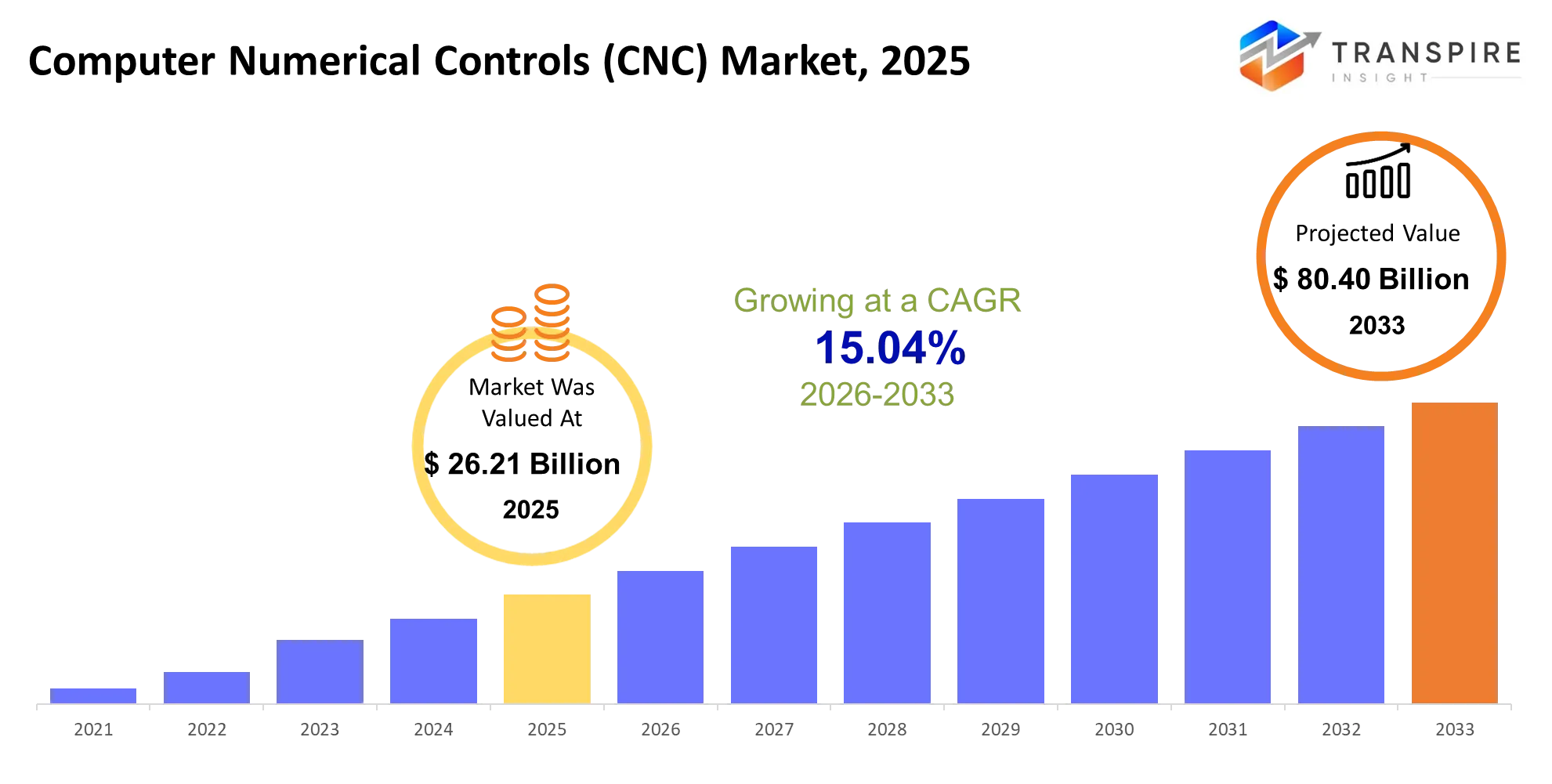
As per the Transpire Insight, The Computer Numerical Controls (CNC) Market size is estimated at USD 26.21 billion in 2025 and is anticipated to reach USD 80.40 billion by 2033, growing at a CAGR of 15.04% from 2026 to 2033.
CNC systems translate part designs into precise, repeatable motions of machines for cutting, drilling, milling, and finishing-and allow manufacturers to produce sophisticated parts every time, with less manual involvement. Over the last three to five years, the market has shifted from individual programmable equipment to integrated, multi-axis cells that use sensors, robotics, simulation, and shop-floor software. This direction impacts buying decisions, as plants now look at uptime, throughput, and process data in addition to machine accuracy. The push is driven by the goal to manufacture lightweight, complex aerospace and EV parts while overcoming skilled-operator shortages; in 2026, manufacturing technology orders in the US by first-half value hit an all-time high, reflecting renewed capital and automation investment. Digital twins and adaptive controls shorten prove-out, scrap, and tool wear, enabling buyers to justify higher-value CNC platforms based on lower cost-per-part and higher throughput; automation also supports traceability.
Computer Numerical Controls (CNC) Market Size & Forecast:
- Market Size 2025: USD 26.21 Billion
- Expected Market Value (2033): USD 80.40 Billion
- Forecast CAGR (2026–2033): 15.04%
- Leading Region in 2025: Asia Pacific
- Fastest Growing Region: Middle East and Africa
- Key Company Profiles: FANUC, Siemens, Mitsubishi Electric, Haas Automation, DMG MORI, Mazak, Okuma, Makino, Hurco, Yamazaki Mazak, Bosch Rexroth, Fagor Automation, Heidenhain, Syntec, Doosan Machine Tools.
Key Computer Numerical Controls (CNC) Market Insights:
The CNC market is heading towards intelligent, multi-axis, and highly automated machining, and with it, the competition over and above machine capacity is increasingly being waged on production efficiency. New products have been developed recently which show the trend towards integrated machining, with AI-controlled machines and flexible production lines that require less setup time and higher precision.
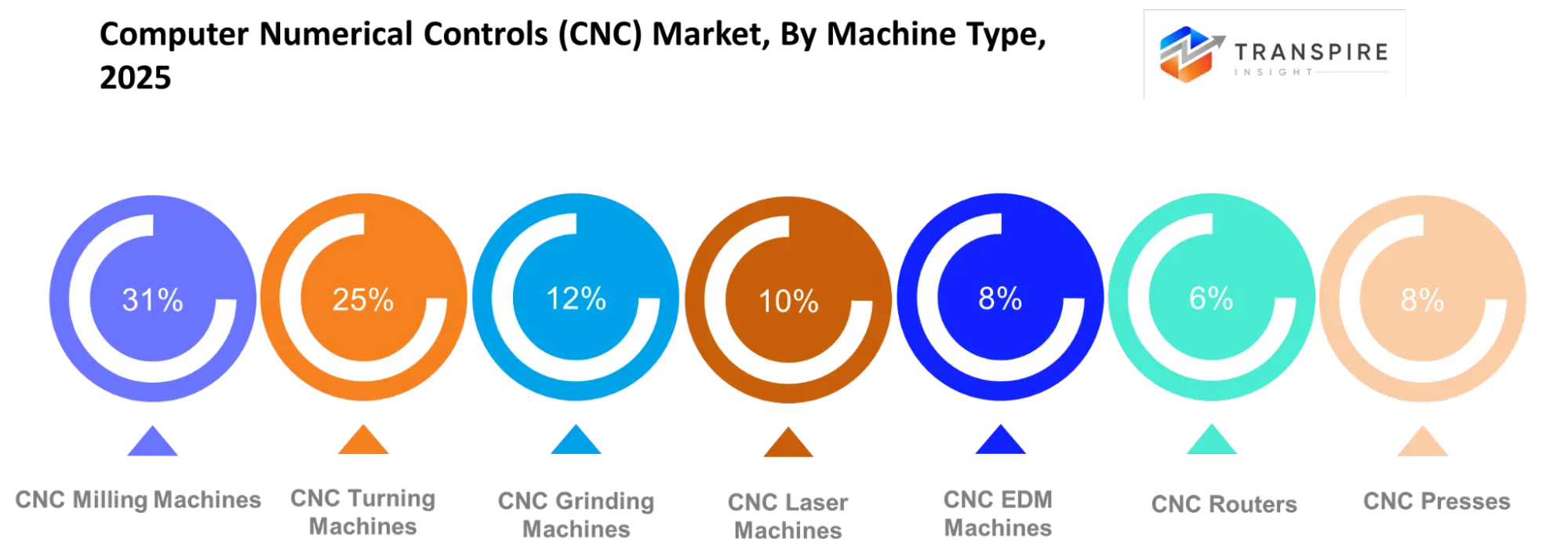
- CNC Milling Machines have a 31.0% share, with FANUC introducing AI technology into the servo tuning and cloud-connected diagnostics to minimise downtime.
- CNC turning machines make up 25.0%, and DMG MORI is rolling out mill-turned platforms and collision prevention through digital twinning.
- CNC grinding machines account for 12.0% of the market, with Okuma's focus on thermally stable machine structures for high-precision finishing.
- The integration of fibre lasers is the focus of Mazak's 10.0% share of CNC laser machines in EV battery, motor, and sheet-metal processing.
- 8.0% is CNC EDM machines, while Makino is building a niche with high-accuracy die-sinking and wire EDM machines for tooling.
- The CNC routers category represents 6.0%, and Hurco is working on easy-to-use control software for SMEs and job shops.
- CNC presses hold a 4.5% share, and Bosch Rexroth is moving toward energy-efficient forming with its servo-hydraulic and motion-control technology.
- 5-axis machines are growing at an 8.6% CAGR; Siemens is embedding kinematic simulation and virtual commissioning in SINUMERIK ONE.
- Asia Pacific holds the largest share at 48.71%, while Heidenhain Automation, Fagor Automation, and Syntec are battling it out with localised controls, retrofit support, and positioning for price-performance.
What are the Key Drivers, Restraints, and Opportunities in the Computer Numerical Controls (CNC) Market?
Driver:
The leading driver is the replacement of fixed-function machines with multi-axis, multi-tasking platforms that reduce setups, improve accuracy, and enable lights-out production. The trigger is demand from aerospace structures, medical implants, semiconductor equipment, and EV drivetrains for complex geometries that cannot be economically produced through repeated clamping. This supports revenue growth because buyers are moving up the value chain from basic 3-axis equipment to 5-axis and mill-turn systems with premium controls, automation, and service contracts.
Restraint:
High acquisition, tooling, installation, and programming costs make advanced machines difficult for smaller workshops to finance, while legacy-system integration, inconsistent data, and shortages of CNC programmers extend deployment. These structural costs delay replacement even when productivity gains are clear.
Opportunity:
Subscription-based digital services and retrofit analytics can unlock growth without requiring every customer to buy a new machine. Low-cost vibration, temperature, and spindle-current sensors, connected through edge gateways, can bring predictive maintenance to smaller shops; AI-guided CAM and adaptive toolpaths can then shorten cycle times on complex parts. Asia-Pacific’s manufacturing expansion, supported by government-backed semiconductor, EV, and aerospace programs, adds further regional upside.
Driver Impact Analysis – Computer Numerical Controls (CNC) Market
|
Driver |
Relative Impact on Growth (%) |
Geographic Relevance |
Impact Timeline |
Demand Strength |
Growth Mechanism |
Key Beneficiaries |
Major Constraint |
|
Rising Demand for High-Precision and Complex Component Manufacturing |
24% |
North America, Europe, Asia Pacific |
Long-term (≥4 years) |
High |
Enables micron-level accuracy and complex multi-axis machining operations |
Aerospace, automotive, medical device and CNC manufacturers |
High equipment costs and stringent technical requirements |
|
Increasing Industrial Automation and Smart Factory Adoption |
23% |
Asia Pacific, North America, Europe |
Short-term (≤2 years) |
High |
Automates machining operations, improves throughput and reduces labor dependency |
CNC manufacturers, robotics integrators and industrial manufacturers |
High initial investment and skilled workforce shortages |
|
Integration of AI, Industrial IoT and Industry 4.0 Technologies |
19% |
North America, Europe, Japan, South Korea |
Medium-term (2–4 years) |
High |
Enables predictive maintenance, real-time monitoring and optimized machining processes |
CNC control vendors, software providers and smart factories |
Cybersecurity risks and legacy system integration challenges |
|
Expansion of Manufacturing Investments and Reshoring Initiatives |
18% |
North America, India, China, Germany |
Medium-term (2–4 years) |
High |
Expands domestic production capacity, stimulating CNC equipment procurement |
Machine tool manufacturers, industrial automation suppliers and MSMEs |
Capital expenditure uncertainty and trade policy fluctuations |
|
Growing Demand from Electric Vehicles, Electronics and Aerospace Industries |
16% |
Asia Pacific, North America, Europe |
Long-term (≥4 years) |
High |
Increases demand for precision-machined components and specialised CNC equipment |
EV manufacturers, semiconductor equipment suppliers and aerospace OEMs |
End-user investment cycles and technological transition risks |
|
Total |
100% |
What Has the Impact of Artificial Intelligence Been on the Computer Numerical Controls (CNC) Market?
Artificial intelligence AI is taking CNC from essentially fixed programming to process control based on data. Machine-learning AI models can interpret spindle load, vibration, temperature, sound, and tool-wear data to detect anomalies before a machine fails. Adaptive control can change feed rates and cutting parameters for a workpiece or tool load to better control surface finish, minimize cycle time, and prevent breakage. AI-designed computer-aided manufacturing AI-CAM can recommend toolpaths, predict machining time, and automate quoting, easing programming in complex parts. Digital twins can simulate machine performance and audit NC programs before even making a physical cut. In March 2026, Mitsubishi Electric announced that its edge digital-twin system halved machining errors during machining trials. Tools of all types stand to increase uptime, first-pass yield, energy efficiency, and machine utilization.
The frustrating part of all this is that, like all new manufacturing tech, it requires high-quality, clean machine data; reliable sensors; and integration across legacy controllers, equipment, and software. The ROI can be compromised by the high cost of implementation and security issues, and by the risk of false alarms, especially for smaller job shops without dedicated automation specialists.
In August 2026, CloudNC released its AI-powered CAM Assist software solution as an add-on for GibbsCAM users. This launch expands the availability of autonomous toolpath generation and machining strategy optimisation to a wider user base, heavily reducing the complex manual programming burden and standardising manufacturing efficiency for shop floors.
Key Computer Numerical Controls (CNC) Market Trends:
The trend in CNC purchasing is changing from expanding machine capacity to intelligent and connected production systems. Manufacturers want more efficient equipment that delivers precision, automation, and operational visibility to boost productivity throughout the manufacturing process.
- Controls are changing from executing G-code to adaptive controls that adapt feeds and speeds during cutting.
- The continuous reduction in the number of setups for aerospace, medical and EV parts, among others, is driving the adoption of the 5-axis.
- Predictive maintenance is shifting from high-end retrofit to standard-issue embedded functions.
- Collisions are being checked, processes simulated and virtual commissioning is taking place before any metal is cut thanks to digital twins.
- New hybrid additive-subtractive systems decrease material waste in high-value titanium and other parts.
- Reshoring and localisation of supply chains are attracting investment towards flexible domestic machine capacity.
- The use of robotics in the CNC cells is growing rapidly, and lights-out production is growing outside the big boys.
- Energy-efficient drives, regenerative systems and optimised toolpaths are required by sustainability and are being promoted.
- With the introduction of data interoperability standards, it is now more feasible to bring analytics and retrofit kits across vendors.
- Machine-tool competition is moving from hardware specs to software, services and digital ecosystems.
Computer Numerical Controls (CNC) Market Segmentation
Machine Type:
Milling machines are the most widely used machine type at 31.0% share, with the ability to make intricate surfaces, pockets, and precision housings, making them suitable for most applications in a wide range of industries. Turning machines have a 25.0% share, to meet shaft, fastener, and rotational requirements. Grinding machines account for 12.0%, to meet tight tolerances and surface requirements. Laser machines account for 10.0%, EDM machines 8.0%, routers 6.0%, presses 4.5%, and all other machine types 3.5%. These machines are able to meet the majority of non-contact, hard-material and sheet-forming requirements. The remaining machines are able to meet more specialised requirements such as for wood, prototypes and one-off production. Manufacturing demand will fluctuate according to industrial investment and the availability of quality labour.
Axis Type:
5-axis CNC machines are the fastest-growing configuration, registering an 8.6% CAGR, as manufacturers increasingly require complex machining with fewer setups and tighter dimensional accuracy. Two-axis and three-axis machines remain widely used for conventional turning, drilling, and milling operations because of their lower investment requirements. Four-axis systems support indexed machining, while six-axis and multi-axis configurations handle intricate geometries and specialised components. Dual-axis machines serve dedicated production applications. Future adoption will favour flexible configurations that improve productivity, reduce repositioning and support complex component manufacturing.
Application:
Automotive, aerospace and defence, electronics, industrial machinery, medical devices, energy and consumer goods represent important CNC application areas. Automotive manufacturers use CNC equipment to produce transmission housings, engine components, EV motor parts and battery structures, prioritising production speed and repeatability. Aerospace and defence applications require high-precision machining of turbine components, structural parts and specialised alloys. Electronics production relies on accurate machining of enclosures and connectors, while medical-device manufacturers require consistent implant and instrument quality. Energy applications involve turbine, valve, and drilling components, creating opportunities for advanced machining capabilities.
Technology:
CNC machining, turning, milling, grinding, cutting, drilling, and electrical discharge machining (EDM) address different component geometries, material properties, and finishing requirements. Milling supports complex surfaces and precision housings, whereas turning remains important for cylindrical components and shafts. Grinding delivers fine surface finishes and dimensional accuracy, while laser cutting enables precise processing of sheet materials. EDM is particularly useful for intricate features in hard conductive materials. Manufacturers are increasingly combining multiple machining processes within integrated production environments to reduce workpiece transfers, improve consistency and shorten manufacturing lead times.
Enterprise Size:
Large enterprises generally invest in automated CNC production lines, connected machinery and multi-axis machining centres to manage high-volume manufacturing and complex production requirements. SMEs and mid-sized manufacturers prioritise equipment flexibility, manageable capital expenditure and shorter payback periods. Contract manufacturers and job shops require versatile machines that can accommodate changing customer specifications and short production runs. OEMs focus on process consistency, production scalability and supplier quality standards, while start-ups often favour compact equipment and outsourced machining before establishing internal capabilities. Flexible financing, operator training and accessible maintenance support will influence adoption across enterprise categories.
End User:
Automotive manufacturers, aerospace manufacturers, electronics manufacturers, machine builders, medical manufacturers, energy companies and metal fabricators represent the principal CNC end-user groups. Automotive producers use CNC systems to maintain consistent component quality across conventional and electric vehicle platforms, while aerospace manufacturers prioritise precision and traceability for critical parts. Electronics manufacturers require accurate machining for compact housings and equipment components. Machine builders depend on CNC technology for specialised machinery production, whereas medical manufacturers require repeatable processing of implants and surgical instruments. Energy companies and metal fabricators will increasingly adopt automated machining to improve equipment reliability, material utilisation, and production efficiency.
What are the Key Use Cases Driving the Computer Numerical Controls (CNC) Market?
The core use case is precision component production: CNC milling, the leading machine type at 31.0%, machines engine housings, transmission parts, structural brackets and complex aerospace components, while turning supports shafts and rotational parts.
In automotive and electronics, automated milling, drilling and laser cutting enable repeatable high-volume manufacture of EV motor parts, battery enclosures, connectors and thermal-management components. Aerospace, medical-device and energy producers use multi-axis machining, grinding and EDM for turbine parts, implants, tooling and hard-to-machine alloys where dimensional control is essential.
Emerging uses include digital-twin-validated production, robotic tending and customised low-volume components, helping job shops reduce setup time and waste. This improves consistency across short production runs and geometries.
|
Report Metrics |
Details |
|
Market size value in 2025 |
USD 26.21 Billion |
|
Market size value in 2026 |
USD 30.15 Billion |
|
Revenue forecast in 2033 |
USD 80.40 Billion |
|
Growth rate |
CAGR of 15.04% from 2026 to 2033 |
|
Base year |
2025 |
|
Historical data |
2021 - 2024 |
|
Forecast period |
2026 - 2033 |
|
Report coverage |
Revenue forecast, competitive landscape, growth factors, and trends |
|
Regional scope |
United States; Canada; Mexico; United Kingdom; Germany; France; Italy; Spain; Denmark; Sweden; Norway; China; Japan; India; Australia; South Korea; Thailand; Brazil; Argentina; South Africa; Saudi Arabia; United Arab Emirates |
|
Key company profiled |
FANUC, Siemens, Mitsubishi Electric, Haas Automation, DMG MORI, Mazak, Okuma, Makino, Hurco, Yamazaki Mazak, Bosch Rexroth, Fagor Automation, Heidenhain, Syntec, Doosan Machine Tools. |
|
Customization scope |
Free report customization (country, regional & segment scope). Avail customized purchase options to meet your exact research needs. |
|
Report Segmentation |
Machine Type (CNC Milling Machines, CNC Turning Machines, CNC Grinding Machines, CNC Laser Machines, CNC EDM Machines, CNC Routers, CNC Presses, Others)Axis Type (2-Axis, 3-Axis, 4-Axis, 5-Axis, 6-Axis, Multi-Axis, Dual-Axis, Others)Application (Automotive, Aerospace & Defense, Electronics, Industrial Machinery, Medical Devices, Energy, Consumer Goods, Others)Technology (CNC Machining, CNC Turning, CNC Milling, CNC Grinding, CNC Cutting, CNC Drilling, CNC EDM, Others)Enterprise Size (Large Enterprises, SMEs, Mid-Sized Manufacturers, Contract Manufacturers, OEMs, Job Shops, Startups, Others)End User (Automotive Manufacturers, Aerospace Manufacturers, Electronics Manufacturers, Machine Builders, Medical Manufacturers, Energy Companies, Metal Fabricators, Others). |
Which Regions are Driving the Computer Numerical Controls (CNC) Market Growth?
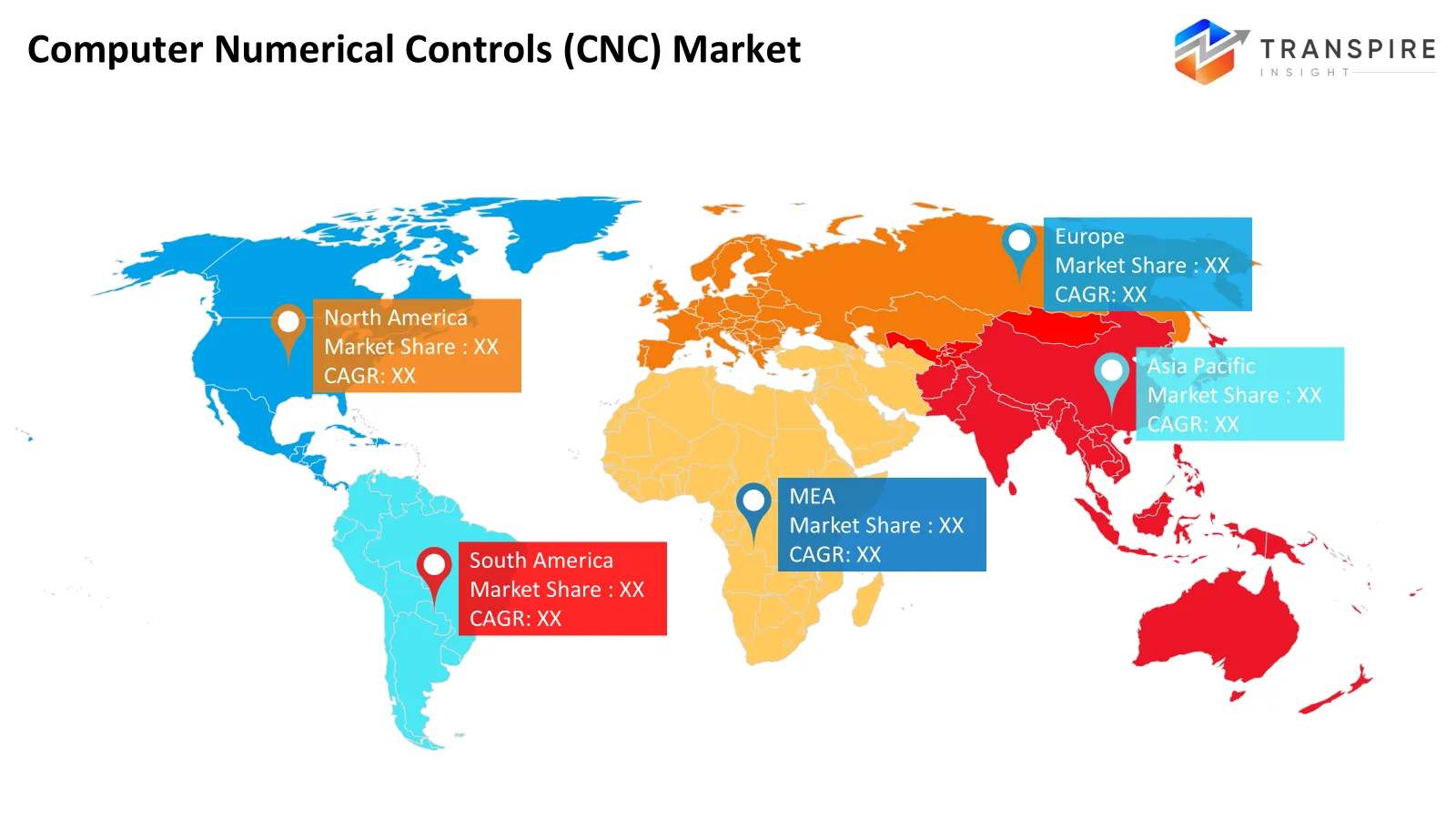
Asia Pacific dominates the CNC market at 48.71%. The high-volume manufacturing landscape for industries like automotive, electronics, machinery, and semiconductor manufacturing in some of the highly populated countries of China, Japan, South Korea, and India is complemented by strong arrays of suppliers within the ecosystem. Industrial policy support, the growth of the automation industry, and strong sets of machine-tool and parts suppliers help drive down access barriers for customers in Asia Pacific and accelerate implementation of integrated multi-axis manufacturing.
In October 2026, Okuma Corporation globally launched its newly engineered MU-250H, a highly compact 5-axis horizontal machining centre. This deployment integrates an advanced automated cell equipped with Okuma's own loader-type Auto Work Changer (AWC), drastically lowering procurement friction by squeezing full-scale multi-axis production capabilities onto a footprint that is 64% smaller than previous models.
https://kezuriba.net/en/articles/jimtof2026-report/
Europe accounts for 22.45% of the market and has the advantage of a long-standing engineering tradition, precision manufacturing, and strong automotive and aerospace industries. While the Asia Pacific market has the advantage of sheer manufacturing volume, markets in Europe remain historically linked to high-value engineering, bespoke machinery and advanced industrial automation. Countries such as Germany, Italy and Switzerland have well-established, world-leading machine-tool manufacturing sectors, a good supply of technical training, research institutes and industrial suppliers. Meanwhile, the EU Machinery Regulation is focusing attention on machine safety, digital compliance and industrial automation.
In October 2026, KUKA Group entered into a strategic sales and training partnership with DACH-region technology distributor KOMSA GmbH. This collaboration will scale the deployment of Autonomous Mobile Robots (AMRs) to small and medium-sized European enterprises, lowering integration barriers and helping them automate material handling and logistics amidst widespread labour shortages.
Middle East and Africa's 3.99% market share is projected to grow at a relatively higher CAGR of 6.9% during the forecast period. Industrial diversification and domestic manufacturing investments are driving regional growth. Saudi Arabia and the UAE are developing industrial infrastructure and encouraging local manufacture of finished components to reduce dependence on imports from high-volume component suppliers. The Saudi Arabia revised version of the Industrial Enablers and Incentives Guide, launched in April 2026, provides incentives in terms of finance, infrastructure, and workforce development for industrial investors, thereby presenting opportunities for suppliers of CNC equipment for metal fabrication, energy equipment, automotive components, and industrial machinery manufacturing.
In January 2026, Unimech Aerospace entered a joint venture partnership with YBA Kanoo to establish a new greenfield advanced manufacturing and remanufacturing facility in Dammam, Saudi Arabia. This action will deliver localized precision machining, API-certified repair services, and initial advanced CNC machining capabilities to serve the Middle East’s energy and industrial markets.
https://www.manufacturingtodayindia.com/unimech-enters-middle-east-manufacturing-joint-venture
Who are the Key Players in the Computer Numerical Controls (CNC) Market, and how do they compete?
Competition in the machine-tool and automation market centres on better controller reliability; more accurate machining; increased automation; open software; and lifecycle support. For standardised installations, price remains a key consideration.
FANUC's advantage lies in the integration of CNC, servo, and robotic products. Siemens' strengths are in the use of SINUMERIK controls, digital twins, and cybersecurity architecture. Mitsubishi Electric stands out for control and automation accuracy. Haas Automation is known for accessible machines and broad service coverage. DMG MORI emphasises process integration, 5-axis platforms, and turnkey cells. Mazak/Yamazaki Mazak combines multitasking machinery with a smooth control system. Okuma's edge is OSP controls and machine-tool integration. Makino's focus is high-accuracy aerospace, die-and-mould, and EDM applications. Hurco serves shop owners with conversational programming. Doosan Machine Tools offers productivity and value in turning-and-milling centres. Bosch Rexroth provides motion and automation control, but not a complete CNC machine product range. Heidenhain and Fagor Automation focus on controls, encoders, and feedback. Syntec aims at cost-effective control integration. Business growth for machine tool suppliers depends on solid local service, application engineering, software upgrades, and automation partners.
Key Players are:
- FANUC
- Siemens
- Mitsubishi Electric
- Haas Automation
- DMG MORI
- Mazak
- Okuma
- Makino
- Hurco
- Yamazaki Mazak
- Bosch Rexroth
- Fagor Automation
- Heidenhain
- Syntec
- Doosan Machine Tools
Computer Numerical Controls (CNC) Market — Enhanced Competitive Benchmarking
|
Company |
Est. Revenue Share Range |
Key Offerings |
Strategic Positioning |
Geographic Strength |
Technology Focus |
|
DMG MORI Co., Ltd. |
1.7–2.0% |
5-axis machining centres, CNC turning centres, multitasking machines, CELOS X |
Premium integrated machining solutions leader |
Europe, Asia Pacific, North America |
Digital twin, 5-axis automation, CELOS X |
|
TRUMPF Group |
1.7–2.0% |
CNC laser cutting machines, punching machines, laser-punching systems, TruMatic machines |
Technology-led sheet-metal processing specialist |
Europe, North America, Asia Pacific |
Smart laser processing, automated nesting, Industry 4.0 |
|
FANUC Corporation |
0.8–1.1% |
FANUC Series 0i, Series 30i/31i/32i, Power Motion i, CNC servo systems |
CNC controller and automation leader |
Asia Pacific, North America, Europe |
High-speed interpolation, AI compensation, digital twin |
|
Makino Milling Machine Co., Ltd. |
0.4–0.6% |
Horizontal machining centres, vertical machining centres, 5-axis centres, graphite machining systems |
High-precision aerospace and die-mould specialist |
Asia Pacific, North America, Europe |
High-speed machining, thermal stability, precision control |
|
Yamazaki Mazak Corporation |
0.4–0.6% |
MAZATROL CNC systems, INTEGREX multitasking machines, VARIAXIS 5-axis centres, QUICK TURN lathes |
Multitasking and advanced CNC machine innovator |
Asia Pacific, North America, Europe |
MAZATROL SmoothAi, multitasking, process automation |
|
Okuma Corporation |
0.4–0.6% |
OSP CNC controls, MULTUS multitasking machines, GENOS machining centres, LB turning centres |
Vertically integrated machine-control manufacturer |
Asia Pacific, North America, Europe |
Thermo-Friendly Concept, collision avoidance, servo optimisation |
|
JTEKT Corporation |
0.4–0.6% |
TOYODA horizontal machining centres, vertical machining centres, 5-axis centres, CNC grinding machines |
Precision grinding and automotive machining specialist |
Asia Pacific, North America, Europe |
Grinding accuracy, machine rigidity, automated machining |
|
Haas Automation, Inc. |
0.4–0.6% |
VF vertical machining centres, UMC universal machining centres, ST turning centres, Haas CNC Control |
Value-oriented CNC manufacturer for SMEs |
North America, Europe, Asia Pacific |
Integrated CNC control, accessible automation, simplified programming |
|
GF Machining Solutions |
0.4–0.6% |
MILL machining centres, CUT wire EDM, FORM EDM, LASER texturing systems |
High-precision EDM and advanced machining specialist |
Europe, Asia Pacific, North America |
Electrical discharge machining, laser texturing, precision automation |
|
AMADA Co., Ltd. |
0.4–0.6% |
CNC turret punch presses, ENSIS laser machines, CNC press brakes, EMK punching systems |
Integrated sheet-metal fabrication solutions provider |
Asia Pacific, Europe, North America |
Fiber-laser processing, intelligent controls, automated fabrication |
Recent Development News
- In September 2026, Siemens launched its Meet at the Machine initiative in collaboration with TRAK Machine Tools to integrate engineering software, automation hardware, and machine expertise into connected CNC manufacturing workflows. The initiative enables manufacturers to program, simulate, and validate production before machine delivery, potentially reducing production ramp-up time by up to 50%. https://press.siemens.com/global/en/pressrelease/siemens-launches-meet-machine-initiative-next-level-cnc-productivity
- In October 2026, Mitsubishi Electric developed an advanced machining system integrating humanoid robots with CNC machine tools through physical AI. The system automates machine setup, workpiece handling, cleaning, inspection, and troubleshooting, supporting reduced labour dependency and the transition towards fully autonomous manufacturing facilities. https://www.mitsubishielectric.com/en/pr/2026/1021_rd/
What Strategic Insights Define the Future of the Computer Numerical Controls (CNC) Market?
CNC will shift from equipment competition to integrated manufacturing ecosystems with smarter controllers, robots, simulation, and condition monitoring. Leading suppliers will succeed by integrating machining performance with production monitoring, agility, and lower cost of ownership. Hidden in this transition is a reliance on proprietary platforms for CNC software and controls that puts CNC manufacturers at risk of vendor lock-in, security threats, and costly integration for a diverse set of manufacturing assets. One opportunity is retrofit automation and AI-assisted programming for SME and emerging economies that can't afford to invest in a complete factory upgrade. EU regulations (CYBER RESILIENCE ACT, Machinery Regulation) will influence product design and compliance spending. CNC manufacturer strategies should focus on open control platforms, modular automation, industrial security, and a regionally based service network. One area where CNC suppliers can profit from productivity gains, instead of specifications, is forging long-term customer relationships.
Key Segmentations are:
Machine Type
- CNC Milling Machines
- CNC Turning Machines
- CNC Grinding Machines
- CNC Laser Machines
- CNC EDM Machines
- CNC Routers
- CNC Presses
- Others
Axis Type
- 2-Axis
- 3-Axis
- 4-Axis
- 5-Axis
- 6-Axis
- Multi-Axis
- Dual-Axis
- Others
Application
- Automotive
- Aerospace & Defense
- Electronics
- Industrial Machinery
- Medical Devices
- Energy
- Consumer Goods
- Others
Technology
- CNC Machining
- CNC Turning
- CNC Milling
- CNC Grinding
- CNC Cutting
- CNC Drilling
- CNC EDM
- Others
Enterprise Size
- Large Enterprises
- SMEs
- Mid-Sized Manufacturers
- Contract Manufacturers
- OEMs
- Job Shops
- Startups
- Others
End User
- Automotive Manufacturers
- Aerospace Manufacturers
- Electronics Manufacturers
- Machine Builders
- Medical Manufacturers
- Energy Companies
- Metal Fabricators
- Others
By Regional Analysis
North America
- US
- Canada
- Mexico
Europe
- Germany
- UK
- France
- Italy
- Spain
- Russia
- Rest of Europe
Asia Pacific
- China
- Japan
- India
- South Korea
- Australia
- Rest of Asia Pacific
South America
- Brazil
- Argentina
- Rest of South America
Middle East & Africa
- UAE
- Saudi Arabia
- Qatar
- South Africa
- Rest of the Middle East & Africa
Frequently Asked Questions
Find quick answers to common questions.
The computer numerical controls (CNC) market size was valued at USD 26.21 billion in 2025 and is poised to reach USD 80.40 billion by 2033, expanding at a 15.04% CAGR.
Key segments for the computer numerical controls (CNC) market are Machine Type (CNC Milling Machines, CNC Turning Machines, CNC Grinding Machines, CNC Laser Machines, CNC EDM Machines, CNC Routers, CNC Presses, Others)Axis Type (2-Axis, 3-Axis, 4-Axis, 5-Axis, 6-Axis, Multi-Axis, Dual-Axis, Others)Application (Automotive, Aerospace & Defense, Electronics, Industrial Machinery, Medical Devices, Energy, Consumer Goods, Others)Technology (CNC Machining, CNC Turning, CNC Milling, CNC Grinding, CNC Cutting, CNC Drilling, CNC EDM, Others)Enterprise Size (Large Enterprises, SMEs, Mid-Sized Manufacturers, Contract Manufacturers, OEMs, Job Shops, Startups, Others)End User (Automotive Manufacturers, Aerospace Manufacturers, Electronics Manufacturers, Machine Builders, Medical Manufacturers, Energy Companies, Metal Fabricators, Others).
Growth is primarily driven by increasing adoption of industrial automation, rising demand for precision-engineered components, expansion of electric vehicle and aerospace manufacturing, growing use of multi-axis machining systems, and integration of AI-enabled controls and predictive maintenance technologies.
The computer numerical controls (CNC) market is led by major manufacturers including FANUC, Siemens, Mitsubishi Electric, Haas Automation, DMG MORI, Mazak, Okuma, Makino, Hurco, Yamazaki Mazak, Bosch Rexroth, Fagor Automation, Heidenhain, Syntec, Doosan Machine Tools.
Asia Pacific dominates the computer numerical controls (CNC) market with a 48.71% share, supported by large-scale automotive and electronics manufacturing, strong machine-tool production capabilities, industrial automation investments, and expanding manufacturing infrastructure in China, Japan, South Korea, and India.
Key commercial opportunities include AI-enabled CNC automation, five-axis machining systems, digital-twin integration, robotic machine tending, predictive maintenance solutions, and retrofit automation for SMEs and emerging manufacturing markets.
- FANUC
- Siemens
- Mitsubishi Electric
- Haas Automation
- DMG MORI
- Mazak
- Okuma
- Makino
- Hurco
- Yamazaki Mazak
- Bosch Rexroth
- Fagor Automation
- Heidenhain
- Syntec
- Doosan Machine Tools
About the Authors

Mayur Shinde
I am Mayur Shinde, a Senior Research Analyst at Transpire Insight, specializing in the Automotive & Transportation and Information & Communication Technology (ICT) Industry. My work focuses on analyzing emerging market trends, technological advancements, competitive landscapes, and industry developments to deliver accurate, data-driven insights. I am passionate about transforming complex market information into clear, actionable content that helps businesses, professionals, and decision-makers stay informed and make confident strategic decisions.

Chakradhar Khansole
Chakradhar serves as the Research Director at Transpire Insight, bringing over 8 years of experience in technology, innovation, and strategic market intelligence. He specializes in transforming complex market data into actionable business insights that enable organizations to make informed, growth-oriented decisions. Recognized for his strategic vision and analytical expertise, Chakradhar leads high-impact research initiatives, delivering comprehensive market assessments, competitive intelligence, and forward-looking industry analysis.
Recently Published Reports
-
Apr 2026
3D Optical Profiler Market
3D Optical Profiler Market Size, Share & Analysis Report By Type (Desktop 3D Optical Profiler, and Portable 3D Optical Profiler), By Technology (Confocal Technology, and White Light Interference), By End-Use Industry (Manufacturing, Research Institutions, Automotive, Aerospace and Defense, Medical Devices, and Other), and Geography (North America, Europe, Asia-Pacific, Middle East and Africa, South and Central America), 2021 - 2031
-
Apr 2026
Depth Sensor Market
Depth Sensor Market Size, Share & Analysis Report By Type (Infrared Depth Sensors, Time-of-Flight (ToF) Sensors, Stereo Vision Sensors, Structured Light Sensors, Ultrasonic Depth Sensors), By Application (Automotive, Robotics, Gaming, Consumer Electronics, Industrial Automation, Healthcare, Security & Surveillance, Others), By End Users (Automotive Manufacturers, Consumer Electronics Companies, Healthcare Providers, Industrial Companies, Security Agencies, Gaming Companies, Robotics Companies, Others), and Geography (North America, Europe, Asia-Pacific, Middle East and Africa, South and Central America), 2021 – 2031
-
Apr 2026
Digital Manufacturing Market
Digital Manufacturing Market Size, Share & Analysis Report By Component (Hardware, Software, and Services), By Technology (Robotics, 3D Printing, Internet of Things (IoT), and Others), By Application (Automotive and Transportation, Aerospace and Defense, Consumer Electronics, Industrial Machinery, and Others), By Process Type (Computer-Based Designing, Computer-Based Simulation, Computer 3D Visualization, Analytics, and Others), and Geography (North America, Europe, Asia-Pacific, Middle East and Africa, South and Central America), 2021 – 2031
-
Apr 2026
Digital Visa Services Market
Digital Visa Services Market Size, Share & Analysis Report By Type (Individual Travelers, Group Travelers), By Application (Tourism, Business Travel, Others), and Geography (North America, Europe, Asia-Pacific, Middle East and Africa, South and Central America), 2021 – 2031