

Cold Forging Machine Market Summary:
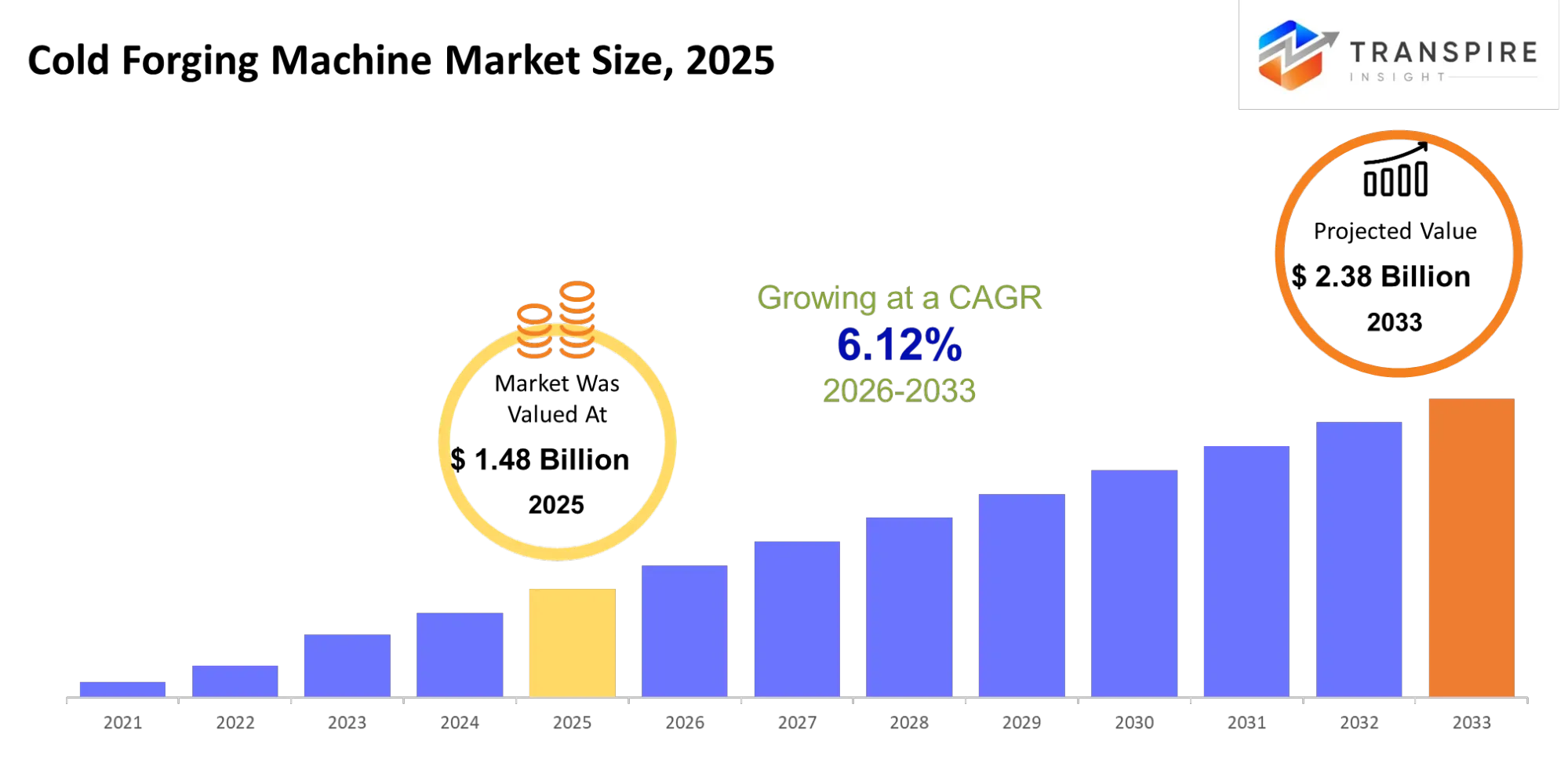
As per Transpire Insight Analysis, the Cold Forging Machine Market size is estimated at USD 1.48 billion in 2025 and is anticipated to reach USD 2.38 billion by 2033, growing at a CAGR of 6.12% from 2026 to 2033. Growth in the market can be attributed to factors such as the rise in demand for metal components that need precision, automation and manufacturing operations.
The cold forging machine market has evolved significantly over time. It is not about the old machines that shape metal anymore. Now it is a good way to make things with precision. This helps many industries, including those that make cars, aeroplanes, and medical devices.
In the past few years, the people who make things have been investing in automation and ways to monitor their work. They want to make sure the things they make are good and that they do not waste materials or spend much money. The cold forging machine market has seen a change from the old machines that use water to the new ones that use computers and can do many things at the same time. These new machines can make things more accurately and quickly. Because more people are making cars and investing in new factories, the old machines are being replaced with new ones. The people who make things want to work and make things that are exactly the right size. They also want to spend money on making things. So the demand for forging machines that work really well is getting stronger. This is a thing for the people who make these machines and the people who come up with new ideas for them. It means they will have a lot of work to do for a time. The cold forging machine market is going to keep growing. That is good for everyone involved in it.
Cold Forging Machine Market Size & Forecast:
- Market Size 2025: USD 1.48 Billion
- Expected Market Value (2033): USD 2.38 Billion
- Forecast CAGR (2026–2033): 6.12%
- Leading Region in 2025: Asia Pacific
- Fastest Growing Region: Europe
- Key Company Profiles: National Machinery, Hatebur, SACMA, Chun Zu Machinery, Sakamura Machine, Nedschroef, Hyodong Machine, Carlo Salvi, Komatsu Industries, AIDA Engineering, Jern Yao, GFM GmbH, Stamtec, Ajax-CECO, Schuler Group
Key Market Insights:
There has been a gradual shift in the market toward automation and precision forging methods in order to ensure high productivity, minimal wastage of materials, and quality parts. There have been continuous efforts to improve processes in smart manufacturing and digital process control, while ensuring energy efficiency.
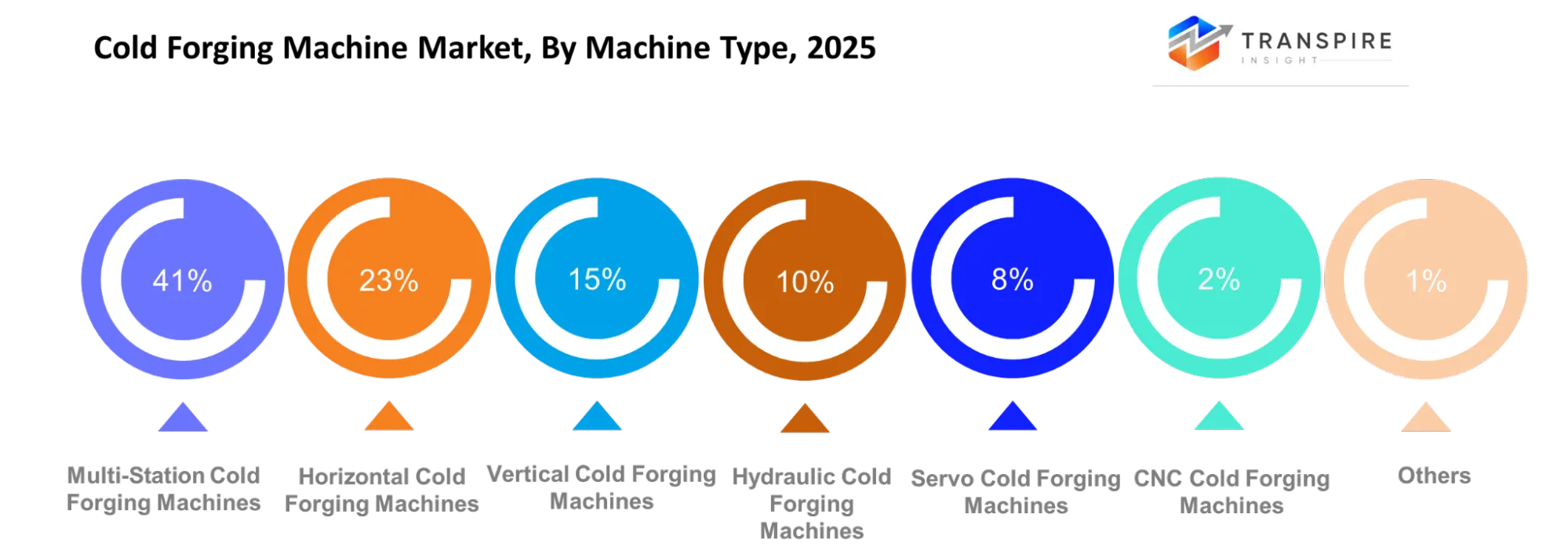
- Multi-Station Cold Forging Machines constitute 41% of the market due to the increasing demand for mass production and increased efficiency of operations.
- Servo Cold Forging Machines are forecasted to register a CAGR of 17.8%, attributed to the increasing popularity of energy-efficient machines with advanced motion control and production accuracy.
- Horizontal Cold Forging Machines constitute 23% of the market as a result of their common usage in the production of automotive fasteners, shafts, and metal parts.
- Vertical Cold Forging Machines have a 15% market share as a result of their preference in processing complex metal components under stable conditions.
- Equipment suppliers are increasing their capabilities in automation, digital monitoring, and predictive maintenance of machinery, allowing their clients to increase machine productivity.
- Hydraulic Cold Forging Machines are responsible for 10% of the market as they are still used in industries which require high forming forces for certain metal components.
- CNC Cold Forging Machines comprise 2% of the market, owing to their increasing popularity in applications where dimensional accuracy is highly valued.
- The Others segment is estimated to make up 1% of the market, catering to various customised industrial applications.
What are the Key Drivers, Restraints, and Opportunities in the Cold Forging Machine Market?
Drivers
The market is growing due to the increased focus of producers on precision production, material saving, and efficient metal-forming techniques. The key driver of growth is the growing adoption of automation in the automobile, aerospace, industrial fastener, and electrical equipment industries. Such development is being facilitated by growing investments in smart factories and advanced production techniques, which demand cold forging machines that can produce with the highest quality and minimal waste. As the efficiency of production increases and as the cost of operations falls, companies are making more investments in forging machinery.
Restraints
There are some difficulties associated with the considerable investment necessary for advanced cold forging technology deployment. Multi-station cold forging machines with the use of servo drives and AI technologies require huge sums for their purchase, installation, personnel training, and regular maintenance. These costs become especially important obstacles for small and medium-sized enterprises.
Opportunities
The opportunities that the market is currently enjoying are the increasing trend towards intelligent manufacturing. The ability to implement process control using AI allows producers to boost productivity and decrease downtime. Moreover, industrial investment growth in developing countries and rapid expansion of electric vehicle production create additional demand for precision forged parts.
What Has the Impact of Artificial Intelligence Been on the Cold Forging Machine Market?
Artificial intelligence has become increasingly significant for enhancing the performance and efficiency of cold forging processes. Companies are combining AI technology with machine sensors, vision systems, and production monitoring tools to enhance forging process parameters and keep product quality consistent. The system performs analysis of live data and changes machine parameters accordingly, saving materials and lowering the number of errors as well as increasing equipment effectiveness.
The implementation of AI is enabling improved capabilities of predictive maintenance through the continuous monitoring of machine condition for early detection of machine wear and potential breakdown of machinery. Quality inspection systems driven by AI are becoming increasingly useful in defect detection and measurements, performing better than traditional inspection methods in terms of reliability of the production process. The integration of AI-based production monitoring into advanced multi-station and servo cold forging machines, which involves the use of data analysis to optimise cycle times, is on the increase. The integration and deployment of AI solutions are expensive and require considerable investment.
Instance
In September 2025, the Schuler Group launched the Digital Suite, which provides forging manufacturers with artificial intelligence-based digital monitoring and predictive maintenance functionalities, enabling the optimisation of the performance of the presses and identifying potential problems with the machinery.
Key Market Trends:
The industry is moving towards intelligent and automated forging machinery with more emphasis being placed on enhancing production efficiency, product consistency, and flexibility. Digital manufacturing and precision engineering advancements are fueling the adoption of advanced cold forging technologies.
- Forging manufacturers have started replacing their traditional forging machines with servo-forge machines and multi-station machines to increase speed and accuracy in production processes.
- Industry solutions are being adopted with real-time machine monitoring and digital analysis becoming part and parcel of modern-day forging.
- There is growing importance being placed on energy-saving manufacturing, which is why there is a trend towards using machines that minimise energy usage without sacrificing production capacity.
- Automated quality inspections based on artificial intelligence technology have become popular, allowing for the speedy identification of defects and reduction of waste during production.
- Custom precision-forging machines are in demand due to the need for tight tolerance and complex geometry in parts used in automobile, aerospace, and medical device manufacturing.
- Predictive maintenance of equipment has been enhanced by equipment providers to minimise downtime of machines.
Cold Forging Machine Market Segmentation
By Machine Type
The increasing trend toward highly efficient forging machines is a key factor behind the rising popularity of such systems among customers. Multi-Station Cold Forging Machines currently occupy 41% of the market due to their capability of executing several forming processes in one cycle of work. Horizontal Cold Forging Machines occupy 23%, while Vertical Cold Forging Machines take 15% and cater to special production needs. Hydraulic Cold Forging Machines comprise 10%, while Servo Cold Forging Machines make up 8% and are expected to be the fastest-growing ones because of the increased investment in energy-efficient machinery. CNC Cold Forging Machines occupy 2% of the market, while the remaining 1% belongs to other machine types.
By Application
The automotive component segment continues to be the largest application sector, driven by steady requirements for precision forgings like gears, shafts, fasteners, and transmission components. Cold forging technology is being increasingly used by aerospace manufacturers to manufacture lightweight and strong components that conform to stringent quality specifications. There has been increasing demand for industrial fasteners and bearings owing to increased industrial operations across the globe. There is growing demand for electrical components, medical components, and construction hardware as industries require durable and accurately dimensioned metal components with minimum wastage.
By End Users
The automotive companies continue being the largest end users, as they are increasingly spending their capital in developing efficient manufacturing processes for making metallic components. Aerospace companies have been expanding the use of precision forging to improve performance efficiency and reduce metal usage. Cold forging machines are used by the industrial machinery manufacturers and fastener manufacturers to make the process of manufacturing more efficient. Increased demand has been observed from the medical devices manufacturers, as the application of the precision-engineered metallic components is rising in their products.
By Automation Levels
The market trend is moving away from manual and semi-automatic processes towards fully automatic systems of production. The popularity of fully automatic cold forging machines is increasing due to their efficiency in improving the speed of production and making the process independent of manual labour. AI-driven forging systems are becoming more significant due to their use for predictive maintenance, intelligent process optimisation, and quality inspection. Robotic forging cells ensure better flexibility in manufacturing by allowing uninterrupted production processes with minimal manual interference.
By Distribution Channels
Direct sales still remain the main means of distribution as the customers need customised machine settings, technical guidance, installations, and maintenance from the manufacturer’s side. The importance of industrial equipment distributors lies in the increase of market reach in various regions along with offering localised after-sales service. On the other hand, OEM suppliers enhance market reach via collaboration with manufacturing firms, whereas exporters assist the equipment manufacturer in penetrating new industrial markets. In this competitive scenario, companies have been enhancing their distribution channel network by integrating technical proficiency, customer support via digitisation, and speed.
What are the Key Use Cases Driving the Cold Forging Machine Market?
Cold forming machines involve the mass production of precision metal products used in the automotive industry by employing Multi-Station Cold Forging Machines for the production of fasteners, gears, shafts, bearings, and transmissions with high levels of accuracy and minimal wastage.
Other than automotive manufacturing processes, cold forging techniques are becoming popular in sectors like aerospace, heavy machinery, electronic components, medical, and construction hardware manufacturing. Companies are utilising these machines to manufacture strong, lightweight, and precise components while increasing their production process efficiencies.
Such developments are taking place due to the emergence of advanced concepts in smart manufacturing, electric vehicles, and automated manufacturing facilities. These technologies are being supported by new-age servo-driven and artificial intelligence-based forging technologies to enable efficient manufacturing processes.
|
Report Metrics |
Details |
|
Market size value in 2025 |
USD 1.48 Billion |
|
Market size value in 2026 |
USD 1.57 Billion |
|
Revenue forecast in 2033 |
USD 2.38 Billion |
|
Growth rate |
CAGR of 6.12% from 2026 to 2033 |
|
Base year |
2025 |
|
Historical data |
2021 - 2024 |
|
Forecast period |
2026 - 2033 |
|
Report coverage |
Revenue forecast, competitive landscape, growth factors, and trends |
|
Regional scope |
United States; Canada; Mexico; United Kingdom; Germany; France; Italy; Spain; Denmark; Sweden; Norway; China; Japan; India; Australia; South Korea; Thailand; Brazil; Argentina; South Africa; Saudi Arabia; United Arab Emirates |
|
Key company profiled |
National Machinery, Hatebur, SACMA, Chun Zu Machinery, Sakamura Machine, Nedschroef, Hyodong Machine, Carlo Salvi, Komatsu Industries, AIDA Engineering, Jern Yao, GFM GmbH, Stamtec, Ajax-CECO, Schuler Group |
|
Customization scope |
Free report customization (country, regional & segment scope). Avail customized purchase options to meet your exact research needs. |
|
Report Segmentation |
By Machine Type (Horizontal Cold Forging Machines, Vertical Cold Forging Machines, Multi-Station Cold Forging Machines, Servo Cold Forging Machines, Hydraulic Cold Forging Machines, CNC Cold Forging Machines, Transfer Forging Machines, Others); By Application (Automotive Components, Aerospace Parts, Industrial Fasteners, Bearings, Electrical Components, Medical Components, Construction Hardware, Others); By End User (Automotive Manufacturers, Aerospace Companies, Industrial Equipment Manufacturers, Fastener Producers, Medical Device Companies, Metal Fabricators, Others); By Automation Level (Manual, Semi-Automatic, Fully Automatic, AI-enabled Forging Systems, Robotic Forging Cells, Others); By Distribution Channel (Direct Sales, Industrial Equipment Distributors, OEM Suppliers, Exporters, Others) |
Which Regions are Driving the Cold Forging Machine Market Growth?
North America
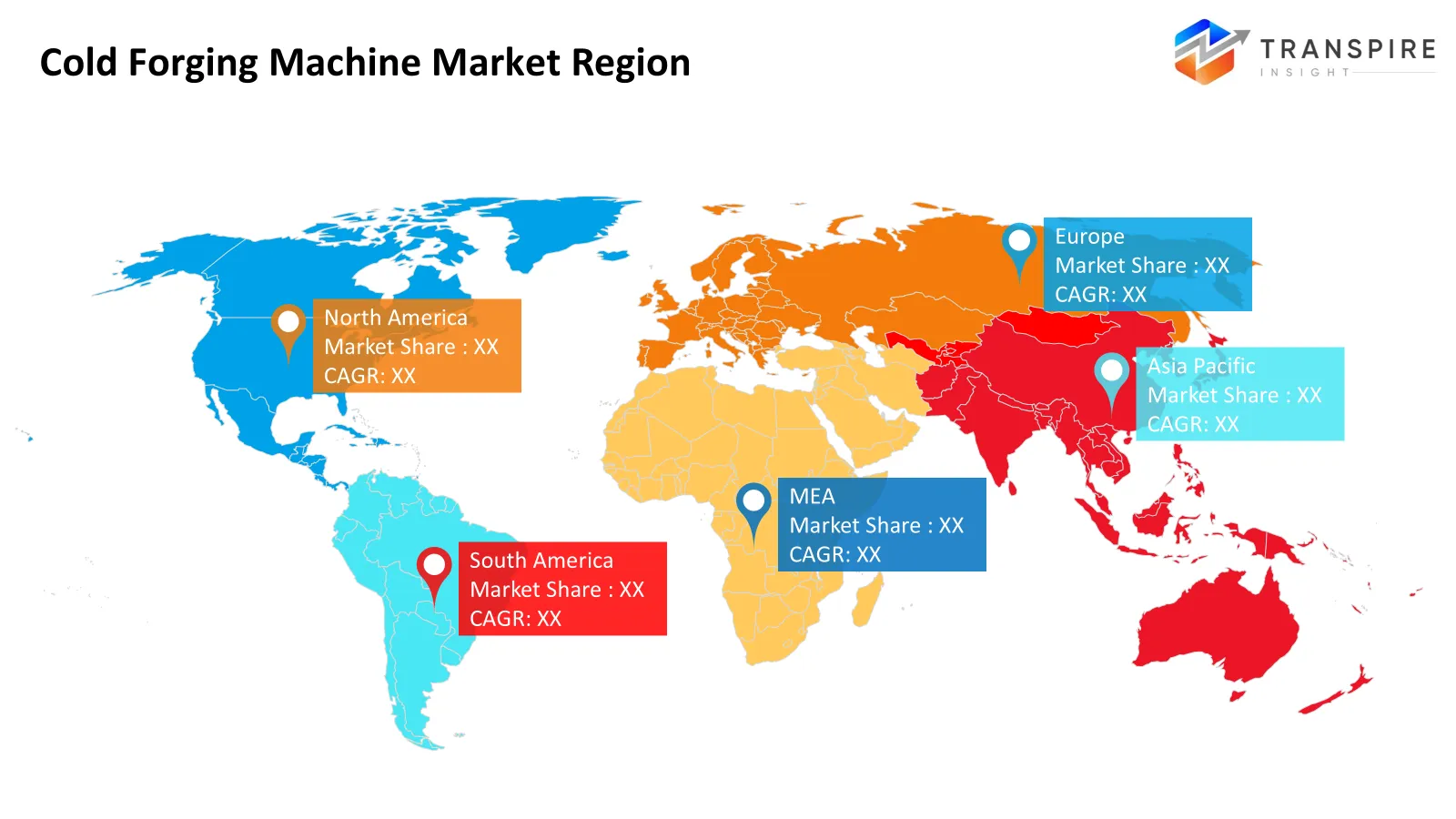
North America contributes to 21% of the share and sustains itself with stable growth owing to consistent investments in precision manufacturing, aerospace production, and industrial automation. North America is different from the Asia Pacific region in that it focuses more on technology, digital manufacturing systems, and high-value engineered components as opposed to mass production volumes. Research capabilities, workforce expertise, and adoption of Industry 4.0 technologies ensure the sustainability of the market in the long run. Modernisation of manufacturing units has spurred adoption of cold forging machines in the region. In July 2025, SMS group successfully put into operation an entirely automated forging line at Perryman Company located in Pennsylvania, USA. The system encompasses a high-speed forging press, a hydraulic radial forging machine and a digital control process, enhancing North America's precision forging capacities for the aerospace industry.
Europe
Europe holds a market share of 26% and is expected to witness the highest CAGR of 18.4%. Recent investments in sustainable manufacturing, energy-efficient production systems, and smart factory programs have boosted the adoption of cold forging equipment in the region. Growth in automotive electrification, precision engineering, and industrial automation presents opportunities for cold forging machinery manufacturers. Upgrading of production units with digitally connected and servo-driven forging equipment is likely to give a boost to the competitiveness of Europe in the coming years.In March 2025, Craemer Group (Germany) set up a new Nidec Arisa 800 tons servo press at its Attendorn plant, expanding precision metal forming production capacities for automotive and industrial components and improving production efficiency as part of Europe's strategy for moving towards smart and energy-efficient forging production.
Asia Pacific
Asia Pacific is dominating the cold forging machine market and holds a market share of 47%, owing to the region’s automotive manufacturing base, growing industrial manufacturing output, and presence of the metal processing industry in the region. Nations like China, Japan, South Korea, and India are constantly developing their manufacturing technology and automation capabilities, which generates demand for premium forging machines. Cost-effective manufacturing processes and suppliers, and growing production of electric vehicles and industrial machines in the region are some other factors that favour the dominance of the Asia Pacific.In July 2025, Nippon Steel noted the continuous growth of forging facilities within its Indian company SMI Amtek Crankshaft Pvt. Ltd., operating forging press lines of 4,000 and 5,000 tons capacity for precision crankshaft production, thus highlighting Asia Pacific's leading position in advanced forging production.
Who are the Key Players in the Cold Forging Machine Marketand how do they Compete?
The competition in the international market for cold forging machines revolves around technology innovation, increased production efficiency, customisation, and complete after-sales support. The competition is driven by manufacturers’ efforts to integrate more automation in cold forging processes as well as use advanced machine designs to satisfy the increasingly changing needs of the automotive, aerospace, and industrial manufacturers. The competition also arises from the expansion of distribution channels internationally, the development of technical services, and the creation of machines that are precise, fast in production, and cost-effective to operate.
The competitive strategy of the leading firms like National Machinery LLC, Sakamura Machine Co., Ltd., Hatebur Umformmaschinen AG, Nedschroef Machinery, and Chun Zu Machinery Industry Co., Ltd. is based on constant innovation and provision of customised solutions to manufacturers. They enjoy a competitive advantage through their ability to produce high-performing multi-station and servo-driven cold forging machines that can produce highly accurate and productive metal parts. Many firms incorporate smart manufacturing technologies in their products, including digital monitoring of machines and predictive maintenance.
Cold Forging Machine Market companies
- National Machinery
- Hatebu
- SACMA
- Chun Zu Machinery
- Sakamura Machine
- Nedschroef
- Hyodong Machine
- Carlo Salvi
- Komatsu Industries
- AIDA Engineering
- Jern Yao
- GFM GmbH
- Stamtec
- Ajax-CECO
- Schuler Group
Recent Development News
In May 2026, Hatebur launched its Oil Regeneration System (ORS), an initiative that is geared towards recycling and regeneration of about 90% of lubricating oils used during metal forming activities. The innovation assists in keeping down operation costs for the manufacturer while making the forging process more environmentally friendly.
In July 2025, National Machinery LLC purchased Drawing Technology Inc. (DTI) in order to grow its range of products related to precision metal forming, which includes wire processing to completed forged parts.
https://www.nationalmachinery.com
What Strategic Insights Define the Future of the Cold Forging Machine Market?
The cold forging machine market is shifting towards a high level of automation, digitalisation, and energy efficiency, where productivity and accuracy are expected to become the main factors of competition. The manufacturers will likely increase their investments in servo-driven forging machines, artificial intelligence technologies aimed at optimising processes, and predictive maintenance in order to increase productivity and decrease production costs. Another less obvious challenge is a shortage of specialists with the necessary skills required to use the advanced machines, thus hindering the development of technologies despite increasing demand from the industry. Moreover, the growth of investments in manufacturing in emerging markets and electric vehicle production opens up interesting opportunities for forging equipment manufacturers. In the current competitive environment, companies should focus on automation, digitalisation, a local service network, and continuous development of products to increase their competitiveness and grow sustainably.
Key Market Segmentation
By Machine Type
- Horizontal Cold Forging Machines
- Vertical Cold Forging Machines
- Multi-Station Cold Forging Machines
- Servo Cold Forging Machines
- Hydraulic Cold Forging Machines
- CNC Cold Forging Machines
- Transfer Forging Machines
By Application
- Automotive Components
- Aerospace Parts
- Industrial Fasteners
- Bearings
- Electrical Components
- Medical Components
- Construction Hardware
By End User
- Automotive Manufacturers
- Aerospace Companies
- Industrial Equipment Manufacturers
- Fastener Producers
- Medical Device Companies
- Metal Fabricators
By Automation Level
- Manual
- Semi-Automatic,
- Fully Automatic
- AI-enabled Forging Systems
- Robotic Forging Cells
By Distribution Channel
- Direct Sales
- Industrial Equipment Distributors
- OEM Suppliers
- Exporters
Regional Analysis
North America
- United States
- Canada
- Mexico
Europe
- Germany
- United Kingdom
- France
- Spain
- Italy
- Rest of Europe
Asia Pacific
- Japan
- China
- Australia & New Zealand
- South Korea
- India
- Rest of Asia Pacific
South America
- Brazil
- Argentina
- Rest of South America
Middle East & Africa
- Saudi Arabia
- United Arab Emirates
- South Africa
- Rest of the Middle East & Africa
Frequently Asked Questions
Find quick answers to common questions.
The global cold forging machine market size was valued at USD 1.48 Billion in 2025 and is poised to reach USD 2.38 Billion by 2033, expanding at a 6.12% CAGR.
Key segments for the global cold forging machine market are By Machine Type (Horizontal Cold Forging Machines, Vertical Cold Forging Machines, Multi-Station Cold Forging Machines, Servo Cold Forging Machines, Hydraulic Cold Forging Machines, CNC Cold Forging Machines, Transfer Forging Machines, Others); By Application (Automotive Components, Aerospace Parts, Industrial Fasteners, Bearings, Electrical Components, Medical Components, Construction Hardware, Others); By End User (Automotive Manufacturers, Aerospace Companies, Industrial Equipment Manufacturers, Fastener Producers, Medical Device Companies, Metal Fabricators, Others); By Automation Level (Manual, Semi-Automatic, Fully Automatic, AI-enabled Forging Systems, Robotic Forging Cells, Others); By Distribution Channel (Direct Sales, Industrial Equipment Distributors, OEM Suppliers, Exporters, Others).
Growth is primarily driven by an increase in demand from the automobile and aerospace sectors, an increase in the need for high-precision metallic parts, an increase in industrial automation, and increasing energy-efficient production techniques.
The global market is led by major manufacturers including National Machinery, Hatebur, SACMA, Chun Zu Machinery, Sakamura Machine, Nedschroef, Hyodong Machine, Carlo Salvi, Komatsu Industries, AIDA Engineering, Jern Yao, GFM GmbH, Stamtec, Ajax-CECO, and Schuler Group.
The Asia-Pacific region constitutes 47% of the worldwide cold forging machines industry owing to its solid automotive and industrial manufacturing infrastructure, low-cost manufacturing, growing electronics industry, and continual development of advanced forging technology.
These commercial possibilities may include increased demand for lightweight vehicle parts, increased use of electric vehicle production, development of precision engineering industries, increased automation in industry, and advanced cold forging technology in developing countries.
- National Machinery
- Hatebu
- SACMA
- Chun Zu Machinery
- Sakamura Machine
- Nedschroef
- Hyodong Machine
- Carlo Salvi
- Komatsu Industries
- AIDA Engineering
- Jern Yao
- GFM GmbH
- Stamtec
- Ajax-CECO
- Schuler Group
About the Authors

Kartik bhong
I am Kartik Bhong, a Senior Research Analyst at Transpire Insight, specializing in the Packaging, Manufacturing, and Construction industry. My work focuses on analyzing market trends, emerging technologies, industry regulations, and competitive landscapes to deliver accurate, data-driven insights. I am passionate about transforming complex industry information into clear, practical content that helps businesses, professionals, and decision-makers stay informed and make confident strategic decisions. Through continuous research and a strong commitment to accuracy, I strive to create reliable, well-researched content that reflects the latest developments across these dynamic industries and supports the vision of Transpire Insight in delivering valuable market intelligence.

Chakradhar Khansole
Chakradhar serves as the Research Director at Transpire Insight, bringing over 8 years of experience in technology, innovation, and strategic market intelligence. He specializes in transforming complex market data into actionable business insights that enable organizations to make informed, growth-oriented decisions. Recognized for his strategic vision and analytical expertise, Chakradhar leads high-impact research initiatives, delivering comprehensive market assessments, competitive intelligence, and forward-looking industry analysis.
Recently Published Reports
-
Apr 2026
Handling and Lifting Equipment Market
Handling and Lifting Equipment Market Size, Share & Analysis Report By Product (Cranes and Hoists, Forklifts, Conveyor Systems, Aerial Work Platforms, Others), By Application (E-Commerce, Automotive and Railway, Food and Beverages, Aviation, Others), and Geography (North America, Europe, Asia-Pacific, Middle East and Africa, South and Central America), 2021 - 2031
-
Apr 2026
HVAC Equipment Market
HVAC Equipment Market Size, Share & Analysis Report By Heating Equipment Type (Boilers and Furnaces, Heat Pumps, and Unitary Heaters), By Ventilation Equipment (Air Handling Units, Humidifiers and Dehumidifiers, Air Filters, and Fan Coiling Units), By Air Conditioning Equipment (Unitary Air Conditioners, Room Air Conditioners, Packaged Terminal Air Conditioners, and Chillers), By End User (Commercial, Residential, Industrial, and others), and Geography (North America, Europe, Asia-Pacific, Middle East and Africa, South and Central America), 2021 – 2031
-
Apr 2026
Refrigeration Valves Market
Refrigeration Valves Market Size, Share & Analysis Report By Type (Solenoid Valves, Expansion Valves, Check Valves, Service Valves, Others), By Application (Commercial Refrigeration, Industrial Refrigeration, Transport Refrigeration, Residential Refrigeration, Air Conditioning Systems), By End User (Food and Beverage Industry, Pharmaceutical Industry, HVAC Industry, Chemical Industry, Others), and Geography (North America, Europe, Asia-Pacific, Middle East and Africa, South and Central America), 2021 – 2031
-
Apr 2026
E-Commerce Packaging Materials Market
E-Commerce Packaging Materials Market By Material Type (Corrugated Boxes, Paper & Paperboard, Foam & Cushioning Materials, Plastic Packaging, Flexible Packaging, Protective Packaging, Others), By Product(Primary Packaging, Secondary Packaging, Tertiary Packaging), By Packaging Function (Protective Packaging, Branding & Presentation Packaging, Transit & Logistic Packaging, Sustainable Packaging, Tamper Evidence Packaging), By End-User (Retail & Consumer Goods, Electronic Appliances, Food & Beverages, Healthcare & Pharmaceutical, Fashion & Apparel, Home & Furnishing, Others); By Industry Analysis, Size, Share, Growth, Trends, and Forecasts 2021-2033