

Clinical EHR Market Summary:
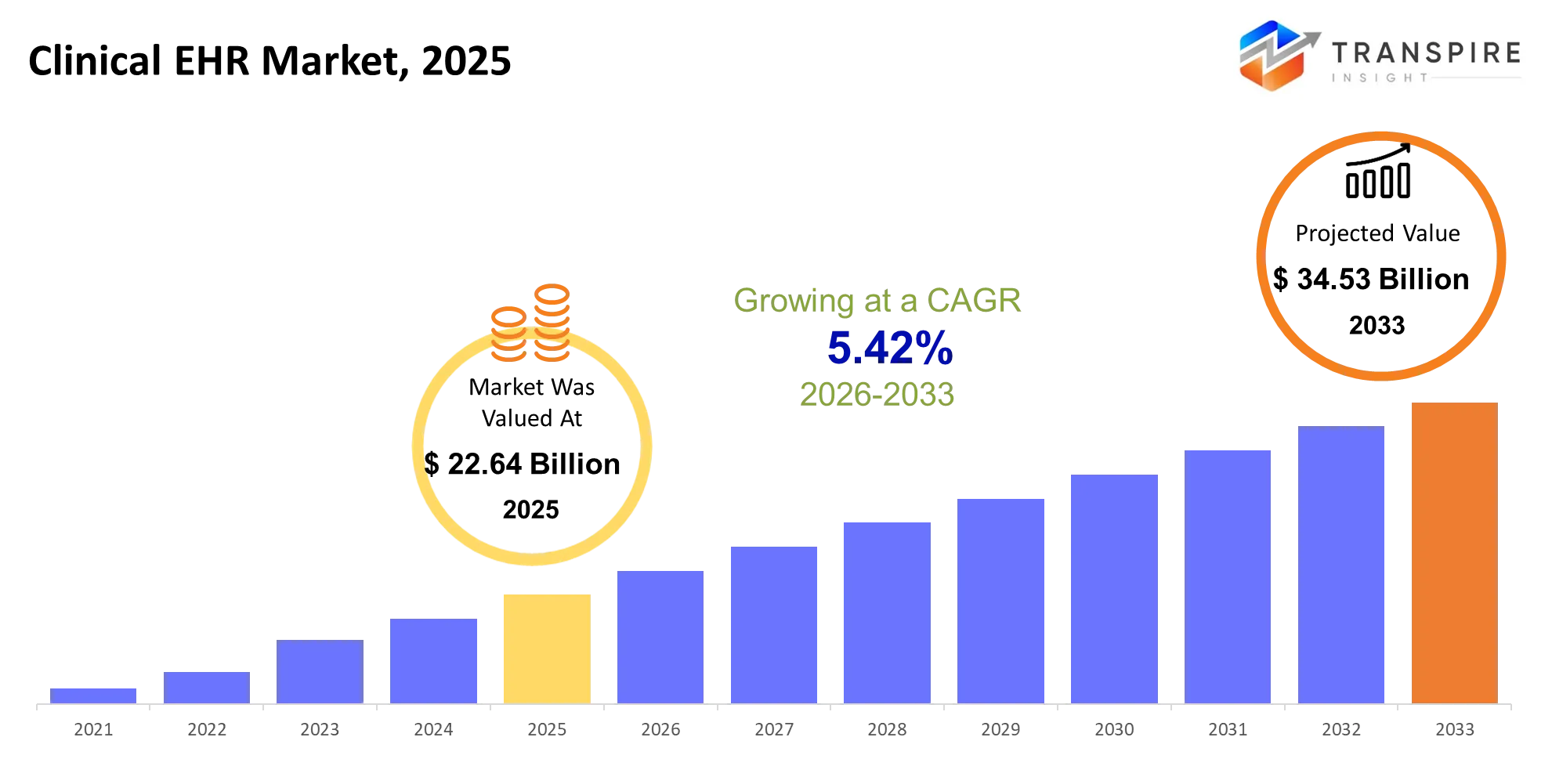
As per Transpire Insight, the Clinical EHR Market size is estimated at USD 22.64 billion in 2025 and is anticipated to reach USD 34.53 billion by 2033, growing at a CAGR of 5.42% from 2026 to 2033.
The clinical electronic health record market supports hospitals, clinics and other healthcare providers in keeping track of clinical history notes, prescriptions, test results and treatment plans using digital systems. I see that this system is a help for doctors and nurses who need quick access to information. In the past three to five years, the clinical electronic health record market has moved from simple electronic recordkeeping to connected cloud‑enabled platforms. These new platforms now include analytics and artificial intelligence. I notice that the change is driven by the need to do more with data. One major structural change is the growing emphasis on interoperability. Interoperability lets authorised healthcare professionals share information across different care settings. The pressure on healthcare organisations to cut paperwork and improve documentation accuracy. Coordinating treatment more efficiently is a practical trigger. These needs encourage providers to replace systems with platforms that link clinical workflows, billing, patient engagement and decision support. Cloud deployment also makes advanced software easier for healthcare facilities that cannot support large on‑site infrastructure. As a result, demand is shaped more by improvements in workflow efficiency, data accessibility and continuity of care than by digitisation alone.
Clinical EHR Market Size & Forecast:
- Market Size 2025: USD 22.64 Billion
- Expected Market Value (2033): USD 34.53 Billion
- Forecast CAGR (2026–2033): 5.42%
- Leading Region in 2025: North America
- Fastest Growing Region: Asia Pacific
- Key Company Profiles: Epic Systems, Oracle Health, MEDITECH, Veradigm, eClinicalWorks, athenahealth, NextGen Healthcare, Allscripts, Greenway Health, Altera Digital Health, CPSI, AdvancedMD, Tebra, InterSystems, DrChrono
Key Market Insights:
The market is moving towards integration of platforms that include clinical data and operations along with decision-making.
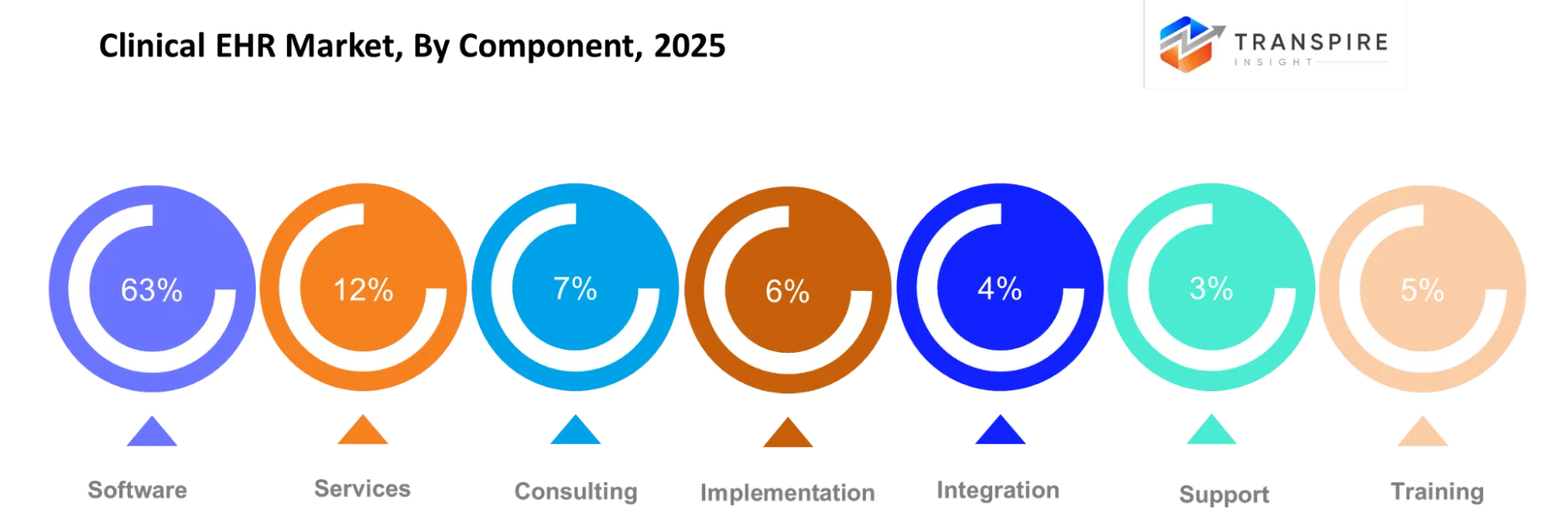
- Software comprises 63.0% of the market and clearly indicates the dependency of healthcare providers on electronic clinical records and workflow applications.
- Deployment of cloud EHR is the fastest-growing segment, and its growth rate is 9.8% because of the desire for flexibility from the providers.
- Services constitute 12.0% of the market and help in implementing, configuring, maintaining, and managing the system.
- Consulting represents 7.0% of the market and indicates the need for workflow analysis, technology selection, and compliance and digitalisation.
- Implementation forms 6.0% of the market and signifies the need for help with data and onboarding of staff.
- Integration comprises 4.5% of the market and indicates the need for integration of the EHR platform with laboratory, pharmacy, billing, and diagnostics.
What are the Key Drivers, Restraints, and Opportunities in the Clinical EHR Market?
Drivers:
Market expansion is There is a consolidation of disparate record-keeping systems into electronic health record systems that can offer a universal overview of a patient's history. This is being aided by greater capabilities and standards for sharing digital health information. With the collection of information from hospitals, laboratories, and outpatient centers, harmonised records can reduce duplication and present licensing, subscription, deployment, and integration opportunities.
Restraints:
High expenses often pose a challenge, particularly for smaller hospitals and standalone practices. High costs related to data migration, security, system integration, education/training and process redesign can hinder the implementation process. This remains relevant even today because physicians must keep practising medicine while implementing a new system and retiring the old one. Legacy system interoperability inefficiency also can cause high costs and longer times to implement a solution.
Opportunities:
Market Opportunities EHR software that is cloud-based may allow companies to penetrate the market of smaller clinical locations due to a more scalable subscription service and save money on costly infrastructure and human resources. AI documentation, prediction and process automation create room for opportunities. Companies developing software that promotes safe data exchange, automation and low-cost solutions will promote faster adoption in neglected health care environments.
|
Driver |
Relative Impact on Growth |
Geographic Relevance |
Impact Timeline |
Demand Strength |
Growth Mechanism |
Key Beneficiaries |
Major Constraint |
|
Rising adoption of digital health records |
Highest |
North America, Asia-Pacific, Europe |
Short-term (≤2 years) |
High |
Replaces paper records with centralized digital patient information |
EHR vendors, hospitals, clinics, healthcare IT providers |
High implementation costs and staff training requirements |
|
Government regulations and interoperability initiatives |
High |
North America, Europe, Asia-Pacific |
Short-term (≤2 years) |
High |
Encourages compliant recordkeeping and secure cross-provider data exchange |
EHR developers, healthcare networks, integration service providers |
Complex regulations and inconsistent interoperability standards |
|
Growing demand for cloud-based EHR solutions |
High |
Asia-Pacific, North America, Europe |
Medium-term (2–4 years) |
High |
Reduces infrastructure burdens and enables scalable remote access |
Cloud providers, SaaS vendors, small clinics, hospitals |
Cybersecurity risks and concerns over sensitive patient data |
|
Integration of artificial intelligence and clinical automation |
Medium |
North America, Europe, Asia-Pacific |
Medium-term (2–4 years) |
High |
Automates documentation, supports clinical decisions, improves workflow efficiency |
AI developers, EHR vendors, clinicians, healthcare providers |
Data quality limitations and clinical validation requirements |
|
Rising healthcare expenditure and demand for coordinated care |
Medium |
Asia-Pacific, North America, Middle East |
Long-term (≥4 years) |
High |
Supports care coordination, longitudinal records, and operational efficiency |
Hospitals, healthcare groups, EHR vendors, patients |
Budget constraints and uneven digital infrastructure |
|
Driver |
Relative Impact on Growth |
Geographic Relevance |
Impact Timeline |
Demand Strength |
Growth Mechanism |
Key Beneficiaries |
Major Constraint |
What Has the Impact of Artificial Intelligence Been on the Clinical EHR Market?
Artificial intelligence is revolutionising clinical EHR systems by helping healthcare professionals in the process of managing the documentation process, accessing patients' data, and discovering clinical information. AI-powered transcription will be able to transcribe clinician-patient interactions into drafts, which would reduce the need for manual entry. The NLP technology will help in organising unstructured clinical information, whereas intelligent search will help health care providers access the patients' data more effectively. Predictive analytics could use historical and current clinical data in order to detect the risks, gaps in care, and monitor patients. With proper use, the feature will allow the care teams to pay more attention to follow-ups and planning. AI-powered workflows will be able to help in coding, appointment scheduling, and clinical decision-making, which will provide the possibility to decrease the time that was spent on routine administrative processes. Challenges in AI adoption include issues of costs, data quality, interoperability, security, and information accuracy. It is crucial for clinical professionals to review all the information generated with the help of AI before applying it for patient treatment.
Instance:
In March 2025, Oracle Health announced that its Clinical AI Agent had helped decrease doctors' time spent on clinical documentation by nearly 30%. The AI-driven solution assists doctors in clinical documentation through voice and screen interaction and is available in over 30 medical disciplines. This example shows how AI integration into EHR systems can help in reducing administrative burdens and improving clinical workflow efficiency.
Key Market Trends:
Clinical EHRs have been developing from the mere electronic storage of data to systems that are clinical workflow-oriented and support communication among health care professionals.
- Health care organisations are shifting from stand-alone record-keeping software to all-inclusive software that includes clinical documentation, prescribing, scheduling, and billing.
- Cloud technology has become increasingly popular since health care organisations want to find an easy way to upgrade their software, as well as to maintain the infrastructure and have remote access to it.
- AI-supported documentation is being developed from research into software that helps to draft documents and minimise typing.
- The need for interoperability encourages vendors to improve the exchange of data between hospitals, clinics, laboratories, and other participants of the health care industry.
- Patient engagement is not limited to portals anymore but includes such aspects as digital communication, access to patients' records and follow-ups.
- Clinical analytics is developing from simple reporting to the identification of gaps in care, population monitoring, and decision-making.
Clinical EHR Market Segmentation
By component:
Software has the largest market share of 63.0%, as it plays an important role in recording patient details, clinical documentation, prescription management, and other treatment details. Services have a share of 12.0%, whereas consulting holds 7.0% of market share, signifying the significance of planning for the implementation process and technical assistance. Implementation holds 6.0%, integration accounts for 4.5%, support has 3.5%, whereas training and maintenance have 2.0%. Growth opportunities in future would depend upon making things simple to deploy, integrate, and for healthcare employees to use technology effectively.
By deployment:
The cloud-based EHR market segment is growing at the fastest rate, with a CAGR of 9.8%. Cost-effective access, simple single-source application updates and less reliance on localised infrastructure are driving adopters to the cloud. On-premises solutions are still being adopted where there are requirements around infrastructure, control or data access, or where existing systems will still be used together with cloud services in a hybrid environment. SaaS, managed hosting, private and public cloud solutions are all viable cloud deployment options with different approaches to infrastructure, access and security. Adoption of this type of deployment will depend on affordability, compliance, performance and IT capabilities in the healthcare organisation.
By application:
Documentation is still very much clinical and primary due to the very reason for the existence of records being consultations, treatment planning and ongoing care. Even more so than documenting patient data, EHRs enable patient management, electronic prescription, ordering and decision support, continuing the clinicians’ daily routine work. Coordination of care ensures exchange of information among authorised users, whereas telehealth connects digital record keeping with patient consultation in a real-life environment. Analytics allows care organisations to measure their performance against patient demographics.
By end-user:
Inpatient hospitals require advanced solutions able to handle several departments and specialities, complicated treatment plans and a large amount of data. Outpatient and physician practices mostly require easy interfaces, scheduling, documentation and prescription. Ambulatory and specialist clinics seek integration with their clinical and administrative workflow. Diagnostic centres could benefit from links between test results and patient records. Academic centres might need documentation and interfaces for teaching and research in addition to multidisciplinary patient treatment. The product differentiation will be based on each user’s needs
By patient type:
General medicine has standard case notes and standard order entry; oncology and cardiology have comprehensive longitudinal case notes along with incorporation of specialised treatments; paediatrics has special case note requirements for age-specific patients; neurology and orthopaedics can have rigid structure for case notes, imaging, and follow-up; and in the ER itself, accessibility and usability are crucial. So now, there are certain speciality-specific features which can help in clinical data capture and navigation without creating any kind of fragmentation. For the future, what is needed is flexible templates and tools which are speciality specific yet make clinical care more usable for the specialists and their patients.
By enterprise size:
Large hospitals and hospital networks usually need scalable platforms for multiple locations, many levels of access, and single-point reporting. While mid-size hospitals might need efficiency and integration, they may not like having a custom solution for themselves. Small clinics may prefer low-cost solutions that are easy to use and do not need much infrastructure. Health systems need consistency in data flow from all care settings, while governmental or academic institutions might have their own special requirements in procurement and reporting.
What are the Key Use Cases Driving the Clinical EHR Market?
The use cases of EHR software is clinical documentation and it is covered in the EHR market components category. The hospitals, clinics, and physicians' offices utilize the systems for tracking the patient’s medical history, consultation
ns, prescription of medicines, and access to the clinical data for the appropriate persons. Other uses are patient management, lab management, e-prescription, and clinical decision making support. They assist in linking the diagnostics and treatment procedures and minimizing the repetitive tasks in the hospitals, ambulatory centers, and specialty clinics. Some possible future uses could be generation of clinical notes by AI, patient monitoring predictions, and telehealth integration.
|
Report Metrics |
Details |
|
Market size value in 2025 |
USD 22.64 Billion |
|
Market size value in 2026 |
USD 23.86 Billion |
|
Revenue forecast in 2033 |
USD 34.53 Billion |
|
Growth rate |
CAGR of 5.42% from 2026 to 2033 |
|
Base year |
2025 |
|
Historical data |
2021 - 2024 |
|
Forecast period |
2026 - 2033 |
|
Report coverage |
Revenue forecast, competitive landscape, growth factors, and trends |
|
Regional scope |
United States; Canada; Mexico; United Kingdom; Germany; France; Italy; Spain; Denmark; Sweden; Norway; China; Japan; India; Australia; South Korea; Thailand; Brazil; Argentina; South Africa; Saudi Arabia; United Arab Emirates |
|
Key company profiled |
Epic Systems, Oracle Health, MEDITECH, Veradigm, eClinicalWorks, athenahealth, NextGen Healthcare, Allscripts, Greenway Health, Altera Digital Health, CPSI, AdvancedMD, Tebra, InterSystems, DrChrono |
|
Customization scope |
Free report customization (country, regional & segment scope). Avail customized purchase options to meet your exact research needs. |
|
Report Segmentation |
Component (Software, Services, Consulting, Implementation, Integration, Support, Training, Maintenance)Deployment (Cloud-Based, On-Premise, Hybrid, SaaS, Hosted, Private Cloud, Public Cloud, Others)Application (Clinical Documentation, Patient Management, E-Prescribing, Order Management, Clinical Decision Support, Care Coordination, Telehealth, Analytics)End User (Hospitals, Clinics, Ambulatory Centers, Specialty Centers, Physician Practices, Diagnostic Centers, Academic Medical Centers, Others)Patient Type (General Medicine, Oncology, Cardiology, Pediatrics, Neurology, Orthopedics, Emergency Care, Others)Enterprise Size (Large Hospitals, Mid-Sized Hospitals, Small Clinics, Hospital Networks, Integrated Health Systems, Government Facilities, Academic Centers, Others) |
Which Regions are Driving the Clinical EHR Market Growth?
North America:
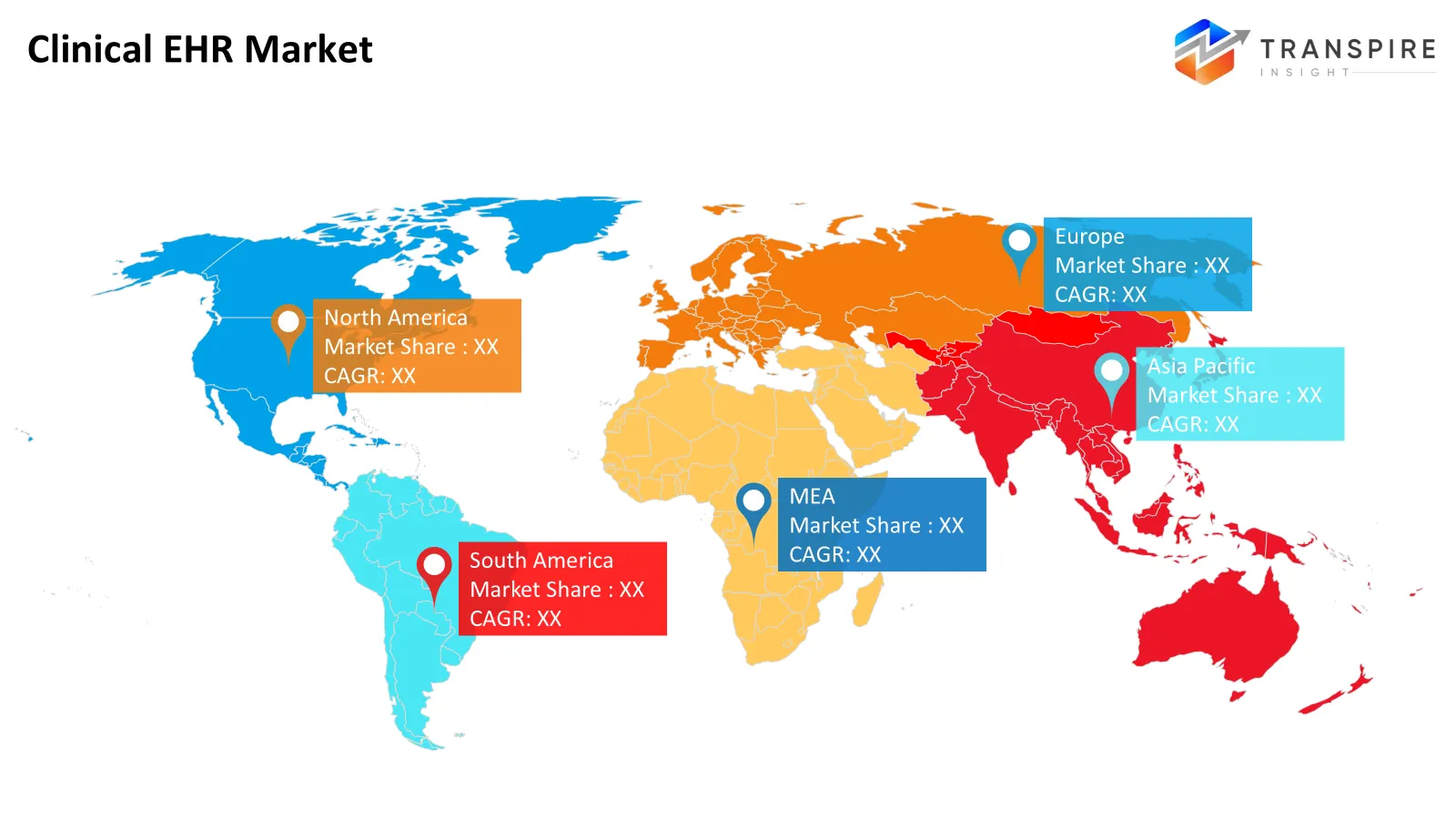
The North American market is currently dominant in terms of the clinical EHR market worldwide and holds a share of 39.10%, which can be explained by the developed healthcare IT infrastructure and high levels of electronic patient records. There continues to be investment in integration platforms that help improve clinical documentation, data exchange, and overall operations in healthcare facilities within this region. Market growth is driven by regulatory requirements, interoperability initiatives, and technology vendors' developments. In the future, adoption will depend on the integration of AI and data security improvements, as well as clinician workflow optimisation.
In August 2025, Oracle Health launched its next-generation AI-enabled EHR solution for ambulatory healthcare providers in the United States. The new solution leverages AI-powered intelligence and voice interaction to assist clinicians with accessing patient data, streamlining clinical processes, and cutting down administrative work.
https://www.oracle.com/health/ellison-bell-health-ai-ehrs/
Europe:
Europe constitutes 28.0%. It is driven by healthcare digitalisation programs, developed hospital networks, and initiatives aimed at enhancing information exchange between different care settings. Data protection is one of the factors that influence market development in Europe because appropriate measures have to be taken while dealing with confidential patient information. In this regard, there is a need for evaluation of digital solutions that can help in treatment coordination, clinical documentation, and healthcare administration.
In January 2025, University Hospitals Plymouth NHS Trust and Torbay and South Devon NHS Foundation Trust signed agreements with Epic Systems for the deployment of an electronic patient record (EPR) system. The project is meant to help establish a more integrated system of patient records in Devon and improve information exchange among healthcare professionals.
Asia Pacific:
Asia Pacific constitutes 24.0% of the market share and is expected to grow at the fastest rate, with a CAGR of 6.31%. Opportunities can be created for EHR vendors through the rising healthcare infrastructure, rising investment in technology services, and development of hospitals in this region. Cloud solutions can be beneficial for small hospitals and healthcare organisations looking for options other than building infrastructure within their premises.
In April 2025,EMC Healthcare in Indonesia decided to upgrade its EMR system with AI-powered functionalities from InterSystems. The new features are expected to include AI-enabled clinical documentation, suggestions for follow-up action to be reviewed by clinicians, and AI-assisted coding.
https://www.healthcareitnews.com/news/asia/transitioning-paper-based-ai-powered-emr-system
Who are the Key Players in the Clinical EHR Market and how do they compete?
Competitiveness in the clinical EHR industry concerns platform capabilities, interoperability, deployment flexibility, implementation support, and ability to simplify administration. The main competitors in this field are Epic Systems, Oracle Health, MEDITECH, athenahealth, and eClinicalWorks. Competitiveness depends on customer size, the company's technological infrastructure, and needs and priorities in the implementation. Epic Systems implements solutions for integrated healthcare settings and connections between clinical workflows in hospitals and health systems. General platform solutions of Epic can be interesting for those who need consistent integration within departments and facilities. Oracle Health works with cloud infrastructure and artificial intelligence integration to simplify documentation and ensure the fast availability of necessary clinical data. MEDITECH offers solutions for hospitals with enterprise clinical systems, such as Expanse and continuous modernisation for its customers. Vendors in the clinical EHR industry can increase their competitiveness with innovative products, partnerships, speciality-specific solutions, and integration with existing healthcare applications.
Clinical EHR Market Companies
- Epic Systems
- Oracle Health
- MEDITECH
- Veradigm
- eClinicalWorks
- athenahealth
- NextGen Healthcare
- Allscripts
- Greenway Health
- Altera Digital Health
- CPSI
- AdvancedMD
- Tebra
- InterSystems
- DrChrono
|
Company |
Est. Revenue Share Range |
Key Offerings |
Strategic Positioning |
Geographic Strength |
Technology Focus |
|
Epic Systems |
Estimated 15–25% |
Epic EHR, MyChart, Care Everywhere, Community Connect |
Market leader with integrated health-system ecosystem |
North America, selected international markets |
Interoperability, AI-assisted workflows, unified records |
|
Oracle Health |
Estimated 10–20% |
Oracle Health EHR, Millennium, patient administration, clinical suite |
Enterprise platform competing for large hospital contracts |
North America, Middle East, selected international markets |
Cloud infrastructure, generative AI, clinical automation |
|
MEDITECH |
Estimated 5–12% |
Expanse, Expanse Oncology, Traverse Exchange, MaaS |
Scalable hospital EHR with cost-conscious deployment options |
North America, Asia Pacific, selected international markets |
Cloud-native architecture, ambient AI, clinical decision support |
|
Dedalus |
Estimated 4–10% |
ORBIS, clinical information systems, EHR solutions, interoperability platforms |
Broad clinical portfolio tailored to national healthcare systems |
Europe, Latin America, selected Middle Eastern markets |
FHIR interoperability, integrated clinical workflows |
|
InterSystems |
Estimated 3–8% |
TrakCare, IntelliCare, HealthShare, IRIS for Health |
Interoperable enterprise EHR and healthcare data specialist |
Europe, Asia Pacific, Middle East |
Unified patient records, APIs, healthcare data integration |
|
TruBridge |
Estimated 2–6% |
TruBridge EHR, acute care clinical systems, patient accounting, revenue cycle solutions |
Community hospital specialist with integrated operational tools |
North America |
Workflow integration, clinical documentation, revenue cycle automation |
|
Altera Digital Health |
Estimated 2–6% |
Sunrise, Paragon, TouchWorks, dbMotion |
Diverse hospital and ambulatory systems serving established installations |
North America, selected international markets |
Clinical integration, interoperability, workflow modernization |
Recent Development News
- In March 2025, Microsoft launched Dragon Copilot, an AI assistant offering speech-to-text transcription and ambient listening features to assist clinicians in drafting reports, finding information, and automating repetitive clinical tasks. The launch marked an enhancement in Microsoft’s role in healthcare through AI. https://news.microsoft.com/source/2025/03/03/microsoft-dragon-copilot-provides-the-healthcare-industrys-first-unified-voice-ai-assistant-that-enables-clinicians-to-streamline-clinical-documentation-surface-information-and-automate-task/
- In June 2026, Elsevier purchased Wellsheet, a healthcare technology company that sorts out EHR data for clinical information. Elsevier’s purchase intends to utilise Wellsheet’s capabilities for managing patient data with Elsevier’s AI evidence tools through ClinicalKey. https://www-prod.elsevier.com/about/press-releases/elsevier-acquires-wellsheet-to-close-the-gap-between-patient-data-and-clinical-evidence-at-the-point-of-care
What Strategic Insights Define the Future of the Clinical EHR Market?
The market for clinical EHR systems is shifting towards connected systems that have the capability to integrate clinical documentation, management, analytics, and AI-driven processes. Future competition in this market would depend more on how effective the system can be in reducing the workload of healthcare professionals, providing relevant information, and being integrated easily in existing processes. One of the risks involved is increasing fragmentation of patient data recorded via non-integrated platforms which will decrease the effect of automation. Besides that, cybersecurity and inaccuracies that may be involved in the documentation through the help of AI may also create distrust if proper security measures are not taken. The future opportunity includes inexpensive cloud EHR systems for small and growing health care organizations in Asia Pacific. Along with being compatible and good data governance, vendor companies should pay attention to clinician engagement and easy integration with existing systems.
Key Segmentations are:
Component
- Software
- Services
- Consulting
- Implementation
- Integration
- Support
- Training
- Maintenance
Deployment
- Cloud-Based
- On-Premise
- Hybrid
- SaaS
- Hosted
- Private Cloud
- Public Cloud
- Others
Application
- Clinical Documentation
- Patient Management
- E-Prescribing
- Order Management
- Clinical Decision Support
- Care Coordination
- Telehealth
- Analytics
End User
- Hospitals
- Clinics
- Ambulatory Centers
- Specialty Centers
- Physician Practices
- Diagnostic Centers
- Academic Medical Centers
- Others
Patient Type
- General Medicine
- Oncology
- Cardiology
- Pediatrics
- Neurology
- Orthopedics
- Emergency Care
- Others
Enterprise Size
- Large Hospitals
- Mid-Sized Hospitals
- Small Clinics
- Hospital Networks
- Integrated Health Systems
- Government Facilities
- Academic Centers
- Others
By Regional Analysis
North America
- US
- Canada
- Mexico
Europe
- Germany
- UK
- France
- Italy
- Spain
- Russia
- Rest of Europe
Asia Pacific
- China
- Japan
- India
- South Korea
- Australia
- Rest of Asia Pacific
South America
- Brazil
- Argentina
- Rest of South America
Middle East & Africa
- UAE
- Saudi Arabia
- Qatar
- South Africa
- Rest of the Middle East & Africa
Frequently Asked Questions
Find quick answers to common questions.
The clinical EHR market size was valued at USD 22.64 billion in 2025 and is poised to reach USD 34.53 billion by 2033, expanding at a 5.42% CAGR.
Key segments for the clinical EHR market are Component (Software, Services, Consulting, Implementation, Integration, Support, Training, Maintenance)Deployment (Cloud-Based, On-Premise, Hybrid, SaaS, Hosted, Private Cloud, Public Cloud, Others)Application (Clinical Documentation, Patient Management, E-Prescribing, Order Management, Clinical Decision Support, Care Coordination, Telehealth, Analytics)End User (Hospitals, Clinics, Ambulatory Centers, Specialty Centers, Physician Practices, Diagnostic Centers, Academic Medical Centers, Others)Patient Type (General Medicine, Oncology, Cardiology, Pediatrics, Neurology, Orthopedics, Emergency Care, Others)Enterprise Size (Large Hospitals, Mid-Sized Hospitals, Small Clinics, Hospital Networks, Integrated Health Systems, Government Facilities, Academic Centers, Others).
Growth is primarily driven by increasing healthcare digitisation, rising demand for efficient patient data management, government initiatives supporting EHR adoption, growing telehealth services, and the integration of AI and cloud-based technologies.
The market is led by major manufacturers including Epic Systems, Oracle Health, MEDITECH, Veradigm, eClinicalWorks, athenahealth, NextGen Healthcare, Allscripts, Greenway Health, Altera Digital Health, CPSI, AdvancedMD, Tebra, InterSystems, and DrChrono.
North America has a 39.10% share of the market for clinical EHR, due to its highly developed healthcare infrastructure, wide implementation of digital health technologies, favourable government policies, and stringent regulatory requirements. Increased demand for effective patient data management and AI-driven healthcare solutions further adds to the market strength of the region.
The international market of clinical electronic health record systems provides various opportunities for business expansion in the form of incorporation of AI capabilities, cloud-based EHR systems, telemedicine connection, interoperability systems, and increased demand for customised healthcare software.
- Epic Systems
- Oracle Health
- MEDITECH
- Veradigm
- eClinicalWorks
- athenahealth
- NextGen Healthcare
- Allscripts
- Greenway Health
- Altera Digital Health
- CPSI
- AdvancedMD
- Tebra
- InterSystems
- DrChrono
About the Authors

Pankaj Ghogare Patil
I am Pankaj Ghogare Patil, a Senior Research Analyst at Transpire Insight, specializing in the Pharmaceutical, Chemicals & Materials, Healthcare IT, and Biotechnology industry. My expertise lies in conducting comprehensive market research, analyzing industry trends, evaluating competitive landscapes, and translating complex data into actionable insights. At Transpire Insight, I closely follow emerging technologies, regulatory developments, and market innovations to create accurate, well-researched, and informative content that helps businesses and professionals make informed decisions. I am committed to producing credible, evidence-based articles that reflect industry best practices while making technical topics accessible and valuable for a broad audience.

Chakradhar Khansole
Chakradhar serves as the Research Director at Transpire Insight, bringing over 8 years of experience in technology, innovation, and strategic market intelligence. He specializes in transforming complex market data into actionable business insights that enable organizations to make informed, growth-oriented decisions. Recognized for his strategic vision and analytical expertise, Chakradhar leads high-impact research initiatives, delivering comprehensive market assessments, competitive intelligence, and forward-looking industry analysis.
Recently Published Reports
-
Apr 2026
AI in Diabetic Retinopathy Market
AI in Diabetic Retinopathy Market Size, Share & Analysis Report By Type (Screening AI Systems, Diagnostic AI Systems, and Predictive AI Models), By Application Segment (Hospitals, Ophthalmology Clinics, Diagnostic Centers, and Research and Development), and Geography (North America, Europe, Asia-Pacific, Middle East and Africa, South and Central America), 2021 - 2031
-
Apr 2026
Psychometric Tests Market
Psychometric Tests Market Size, Share & Analysis Report By Type (Personality Tests, Ability/Aptitude Tests, Skill/Knowledge Tests, and Others), By Application (Talent Acquisition and Talent Management), and Geography (North America, Europe, Asia-Pacific, Middle East and Africa, South and Central America), 2021 – 2031
-
Apr 2026
Rare Biological Sample Collection Market
Rare Biological Sample Collection Market Size, Share & Analysis Report By Type (Isolation Kits & Reagent, Blood Collection Tubes, and Others), By Application (Oncology, Transcriptomics, Pharmacogenomics, and Others), and Geography (North America, Europe, Asia-Pacific, Middle East and Africa, South and Central America), 2021 – 2031
-
Jul 2026
Diabetic Retinopathy Market
Diabetic Retinopathy Market Size, Share & Analysis Report By Type (Proliferative Diabetic Retinopathy, and Diabetic Macular Edema (DME)), By Treatment Type (Anti VEGF Drug, Steroid Implants, Laser Surgeries, and Vitrectomy), and Geography (North America, Europe, Asia-Pacific, Middle East and Africa, South and Central America), 2021 – 2031
Our Clients







