

Market Summary
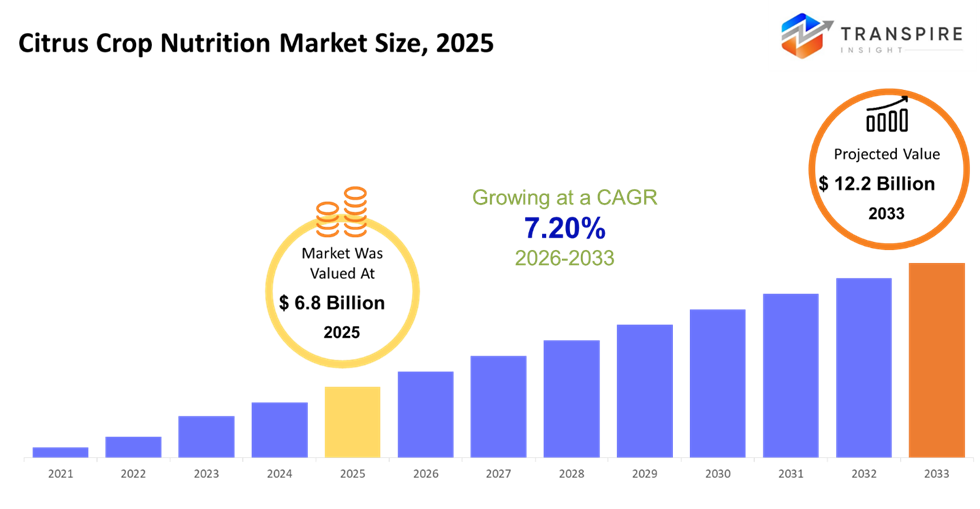
The global Citrus Crop Nutrition market size was valued at USD 6.8 billion in 2025 and is projected to reach USD 12.2 billion by 2033, growing at a CAGR of 7.20% from 2026 to 2033 The citrus crops nutrition market is registering constant CAGR value because the consumption of citrus around the world is increasing, and optimization of yields is gaining momentum. Depletion and gaps in micronutrients in soil contribute to the adoption of well-balanced nutrition solutions. Technological developments related to fertigation and foliar applications also promote this growth.
Market Size & Forecast
- 2025 Market Size: USD 6.8 Billion
- 2033 Projected Market Size: USD 12.2 Billion
- CAGR (2026-2033): 7.20%
- North America: Largest Market in 2026
- Asia Pacific: Fastest Growing Market
To learn more about this report,  Download Free Sample Report
Key Market Trends Analysis
- North America illustrates high acceptance of precision citrus nutrition due to commercial-scale groves and regulatory requirements being met. High-end fertigation systems and micronutrient foliar applications have gained popularity as orchards emphasize improved yields, product quality, and efficiency over diverse climatological conditions.
- United States leads the way in innovation in growing citrus fruit through its technologically advanced citrus fruit growing practices. There is also a significant level of education concerning deficiencies in nutrients. Growers opt for tailored solutions involving macronutrients and micronutrients.
- The Asia Pacific region is identified as the foremost in terms of its speedy growth due to the rise in the number of citrus crops in China and India. Increased mechanization of farmlands and an awareness of nutrient imbalance accelerate the demand for foliar and fertigation methodologies in farmlands.
- Macronutrients lead the market being demanded as a result of the indispensability of nitrogen, phosphorus, and potassium for the growth of the citrus trees as well as the fruit production. All the cited reasons promote the consistent demand of the Macronutrients.
- Foliar nutrition is increasing in popularity on account of its speedy nutrient uptake and corrective effects. It finds application at critical phases of growth, particularly where nutritional content or pH factors limit nutritional uptake in the soil
So, the citrus crop nutrition market is centered on ensuring that the essential nutrients are provided for adequate citrus crops like oranges, lemons, limes, and citrus mandarins. These nutritional solutions consist of macronutrients and micronutrients that are offered through diverse application techniques. This market is very significant in maintaining citrus productivity in response to increased demands for food. Rising soil deterioration, increased agricultural practices, and nutrient deficiencies have increased the demand for optimal fertilization practices. Farmers are moving away from the conventional fertilization method and focusing on integrated nutrient management practices, including soil, foliar, and fertigation nutrient applications.
Technological advancements in the areas of formulation sciences, agriculture, and irrigation technology are further fueling the expansion. Nutrient optimization capabilities are being supported by governments and agricultural bodies in order to enhance the immunity system and exportability of crops. As commercial citrus fruit cultivation has received prominence, the requirement for nutritional solutions has been forecasted as extremely imperative.
Citrus Crop Nutrition Market Segmentation
By Type
- Macronutrients (Nitrogen, Phosphorus, Potassium)
Macronutrients provide the building blocks of citrus crop nutrition and initiate and promote essential activities of plant growth, root emergence, and fruit production. Nitrogen promotes vegetative growth and phosphorus supports root & flower development, while potassium improves fruit quality & stress resistance.
- Micronutrients (zinc, boron, iron)
Micronutrients require less quantity; however, they play a major role in flower formation and fruiting. Zinc deficiency, boron deficiency, and iron deficiency may result in severe loss of production and quality of the fruit. Despite being needed in trace amounts, micronutrients are essential for proper metabolism and biochemical processes in plants. Through the precise application of micronutrients, there would be no possibility of "hidden hunger" in citrus yields, hence improved productivity and uniformity in the resultant fruits.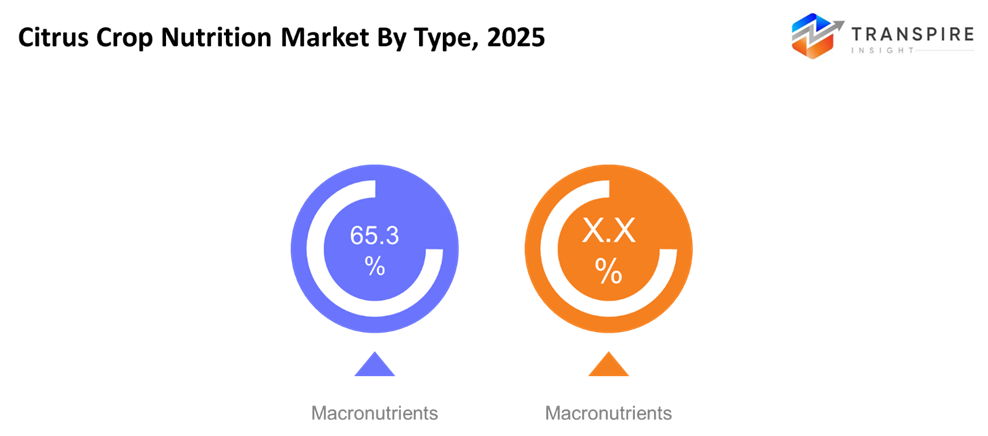
To learn more about this report, Download Free Sample Report
By Component
- Foliar Nutrition
Leaf feeding is preferred due to its quick correction of deficiency disorders and high efficiency. It enables accurate dosing during sensitive periods of growth and avoids the wastage of nutrients as experienced in other methods.
- Fertigation
Fertigation ensures efficiency in the use of nutrients as it combines nutritional and irrigation processes. Its increasing acceptance is informed by the need to conserve water resources and improve efficiency in the agricultural field, particularly in citrus plantations.
- Soil Application
Application to soil remains the basic practice for long-term nutrient supply in soil fertility management. It allows sustained orchard nutrition-especially macronutrients-and is widely adopted due to cost-effectiveness and simplicity.
- Others
This also covers the novel methods of treatment, like treatment of seeds, injections into trunks, and various mixes of nutrition, catering to particular environmental or specific pest pressures.
Regional Insights
North America is an established citrus nutritional market, led in Tier 1 capacity by the USA, which has sophisticated agricultural technology and high nutritional intelligence. Canada is in Tier 2, as citrus fruit is not cultivated in considerable quantity, and Mexico is also significant given its cheap production and export-based nutritional practices. Europe indicates stable demand, with citrus production being established by Tier 1 countries like Spain and Italy. France, Germany, and the United Kingdom follow as Tier 2 countries, with regulatory-driven use or optimization towards nutrients.
Asia Pacific leads the growth pace, and China and India are classified as Tier 1 markets because of their extensive citrus area and increasing productivity projects, while Australia and Japan are technologically advanced Tier 2 markets focusing on fertigation and quality improvement. South America is driven by Brazil, a Tier 1 producer enabled by large-format commercial orchards. At the same time, countries such as Argentina are considered Tier 2 markets, where there is moderate diffusion of advanced nutritional practices. Middle East & Africa's main exporter-focused markets are South Africa (Tier 1) and Saudi Arabia and UAE Tier 2 markets, adopting Fertigation and Foliar Nutrition to overcome water and soil-related adversities.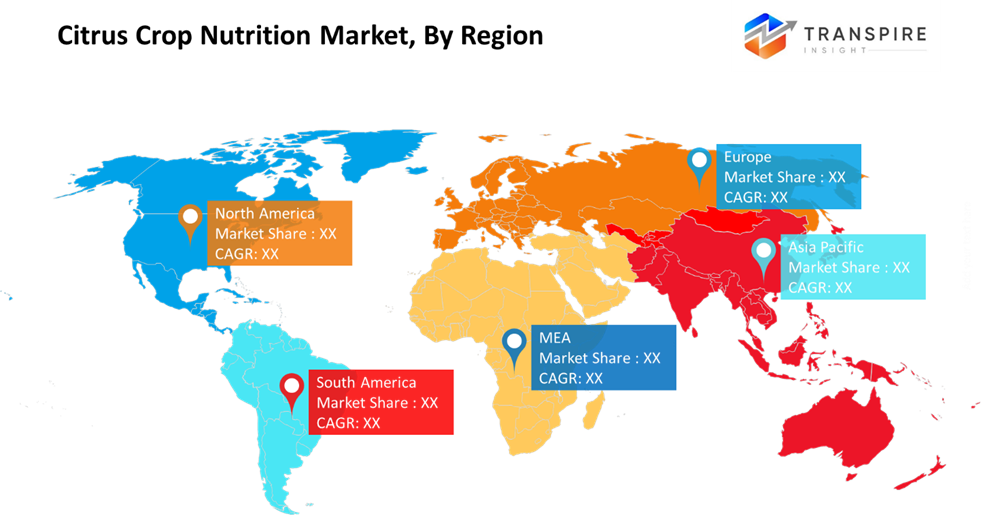
To learn more about this report, Download Free Sample Report
Recent Development News
- December 2025, Mountain Valley MD Holdings Inc. shared results of Agrarius agricultural product trials and key findings regarding the Company’s current citrus crop field trials being conducted in Brazil and the cow pasture grass field trials being conducted in Colombia. These field trials are aimed at facilitating the adoption of the Company’s customer product offerings and the Company’s efforts to develop the Agrarius agricultural plant signaling technology.
- In December 2023, Yara today unveiled its new brand of biostimulants, YaraAmplix, at the Biostimulant World Congress in Milan, Italy.To address the plea by farmers to find a way to enhance crop resilience and efficiency in the use of nutrients.
|
Report Metrics |
Details |
|
Market size value in 2025 |
USD 6.8 Billion |
|
Market size value in 2026 |
USD 7.5 Billion |
|
Revenue forecast in 2033 |
USD 12.2 Billion |
|
Growth rate |
CAGR of 7.20% from 2026 to 2033 |
|
Base year |
2025 |
|
Historical data |
2021 – 2024 |
|
Forecast period |
2026 – 2033 |
|
Report coverage |
Revenue forecast, competitive landscape, growth factors, and trends |
|
Regional scope |
North America; Europe; Asia Pacific; Latin America; Middle East & Africa |
|
Country scope |
United States; Canada; Mexico; United Kingdom; Germany; France; Italy; Spain; Denmark; Sweden; Norway; China; Japan; India; Australia; South Korea; Thailand; Brazil; Argentina; South Africa; Saudi Arabia; United Arab Emirates |
|
Key company profiled |
Yara International, Nutrien Ltd., The Mosaic Company, ICL Group, Haifa Group, EuroChem Group, SQM (Sociedad Química y Minera de Chile), Valagro S.p.A., Coromandel International, Compass Minerals, BASF SE K+S Group, Compo Expert GmbH, Helena Agri-Enterprises, Wilbur-Ellis Company |
|
Customization scope |
Free report customization (country, regional & segment scope). Avail customized purchase options to meet your exact research needs. |
|
Report Segmentation |
By Type (Macronutrients (Nitrogen, Phosphorus, Potassium) and micronutrients (Zinc, Boron, Iron)), By Application (Foliar nutrition, Fertigation, Soil application and others) |
Key Citrus Crop Nutrition Company Insights
Nutrien Ltd is one of the largest fertilizer and crop nutrient companies in the global market with robust product lines in macronutrients and micronutrients that are highly essential in citrus crops. The company boasts one of the largest distribution bases in the world with more than 2,000 retail outlets. Nutrien provides an integrated product offering in terms of crop nutrients and agronomic guidance. It also provides specialty blends based on soil and crop needs with digital solutions for crop nutrient management. Nutrien’s competitive advantage in the market is founded on economies of scale in supply, research investments, and the ability to integrate fertilizer solutions with crop protectants and digital solutions..
Key Citrus Crop Nutrition Companies:
- Yara International
- Nutrien Ltd.
- The Mosaic Company
- ICL Group
- Haifa Group
- EuroChem Group
- SQM (Sociedad Química y Minera de Chile)
- Valagro S.p.A.
- Coromandel International
- Compass Minerals
- BASF SE
- K+S Group
- Compo Expert GmbH
- Helena Agri-Enterprises
- Wilbur-Ellis Company
Global Citrus Crop Nutrition Market Report Segmentation
By Type
- Macronutrients (Nitrogen, Phosphorus, Potassium)
- Micronutrients (Zinc, Boron, Iron)
By Component
- Foliar Nutrition
- Fertigation
- Soil application
Regional Outlook
- North America
- United States
- Canada
- Mexico
- Europe
- Germany
- United Kingdom
- France
- Spain
- Italy
- Rest of Europe
- Asia Pacific
- Japan
- China
- Australia & New Zealand
- South Korea
- India
- Rest of Asia Pacific
- South America
- Brazil
- Argentina
- Rest of South America
- Middle East & Africa
- Saudi Arabia
- United Arab Emirates
- South Africa
- Rest of the Middle East & Africa
Frequently Asked Questions
Find quick answers to common questions.
The approximate Citrus Crop Nutrition Market size for the market will be USD 12.2 billion in 2033.
Key segments for the Citrus Crop Nutrition Market are By Type (Macronutrients (Nitrogen, Phosphorus, Potassium) and micronutrients (Zinc, Boron, Iron)), By Application (Foliar nutrition, Fertigation, Soil application and others).
Major Citrus Crop Nutrition Market players are Yara International, Nutrien Ltd., The Mosaic Company, ICL Group, Haifa Group.
The North America region is leading the Citrus Crop Nutrition Market.
The CAGR of the Citrus Crop Nutrition Market is 7.20%.
- Yara International
- Nutrien Ltd.
- The Mosaic Company
- ICL Group
- Haifa Group
- EuroChem Group
- SQM (Sociedad Química y Minera de Chile)
- Valagro S.p.A.
- Coromandel International
- Compass Minerals
- BASF SE
- K+S Group
- Compo Expert GmbH
- Helena Agri-Enterprises
- Wilbur-Ellis Company
Recently Published Reports
-
Dec 2024
Baby Infant Formula Market
Baby Infant Formula Market Size, Share & Analysis Report By ype (Infant Milk, Follow On Milk, Specialty Baby Milk, Growing-Up Milk), By Ingredient (Carbohydrate, Fat, Protein, Minerals, Vitamins, and Others), By Product Form (Powder, Liquid, and Ready-to-feed), By Distribution Channels (Supermarket/Hypermarket, Specialty Store, Pharmacies, Online Retail, and Others), and Geography (North America, Europe, Asia-Pacific, Middle East and Africa, South and Central America), 2021 - 2031
-
Jan 2025
Edible Insects for Animal Feed Market
Edible Insects for Animal Feed Market Size, Share & Analysis Report By Type (Insect Powder, Insect Meal, Insect Bar, Insect Paste, Insect Oil, and Others), By Insect Type (Beetles, Cricket, Caterpillar, Hymenoptera, Orthoptera, Tree Bugs, and Others), By Application (Livestock, Pet Food, and Aquaculture), By Livestock Type (Poultry, Swine, and Others), and Geography (North America, Europe, Asia-Pacific, Middle East and Africa, South and Central America), 2021 - 2031
-
Jan 2025
Food Industry Disinfection and Bacterial Control Market
Food Industry Disinfection and Bacterial Control Market Size, Share & Analysis Report By Type (Chemical Disinfectants, Physical Disinfectants, and Biocides and Antimicrobials), By Application (Food Processing Equipment Surface Disinfection, Food Preparation Areas Surface Disinfection, Storage Areas Surface Disinfection, Anti-microbial Coatings Food Preservation, and Preservative Solutions Food Preservation), By End User (Meat and Poultry Processing, Dairy Processing, Seafood Processing, Bakery and Confectionery, Restaurants and Commercial Kitchens, and Food Service Providers), By Sales Channel (Online, Offline), and Geography (North America, Europe, Asia-Pacific, Middle East and Africa, South and Central America), 2021 - 2031
-
Jan 2025
Freeze Dried Food Market
Freeze Dried Food Market Size, Share & Analysis Report By Product Type (Fruits, Vegetables, Freeze-Dried Dairy Products, Freeze-Dried Meat and Seafood, Freeze-Dried Pet Food, and Prepared Meal), By Nature (Organic, and Conventional), By Form (Powdered, Granules, and Diced), By End Use (Breakfast Cereals, Dairy Products, Bakery & Confectionery, Nutritional Bars & Supplements, Powdered Beverages, Snacks, and Retail (Household)), and Geography (North America, Europe, Asia-Pacific, Middle East and Africa, South and Central America), 2021 - 2031