

Centrifugal Blowers Market Summary:
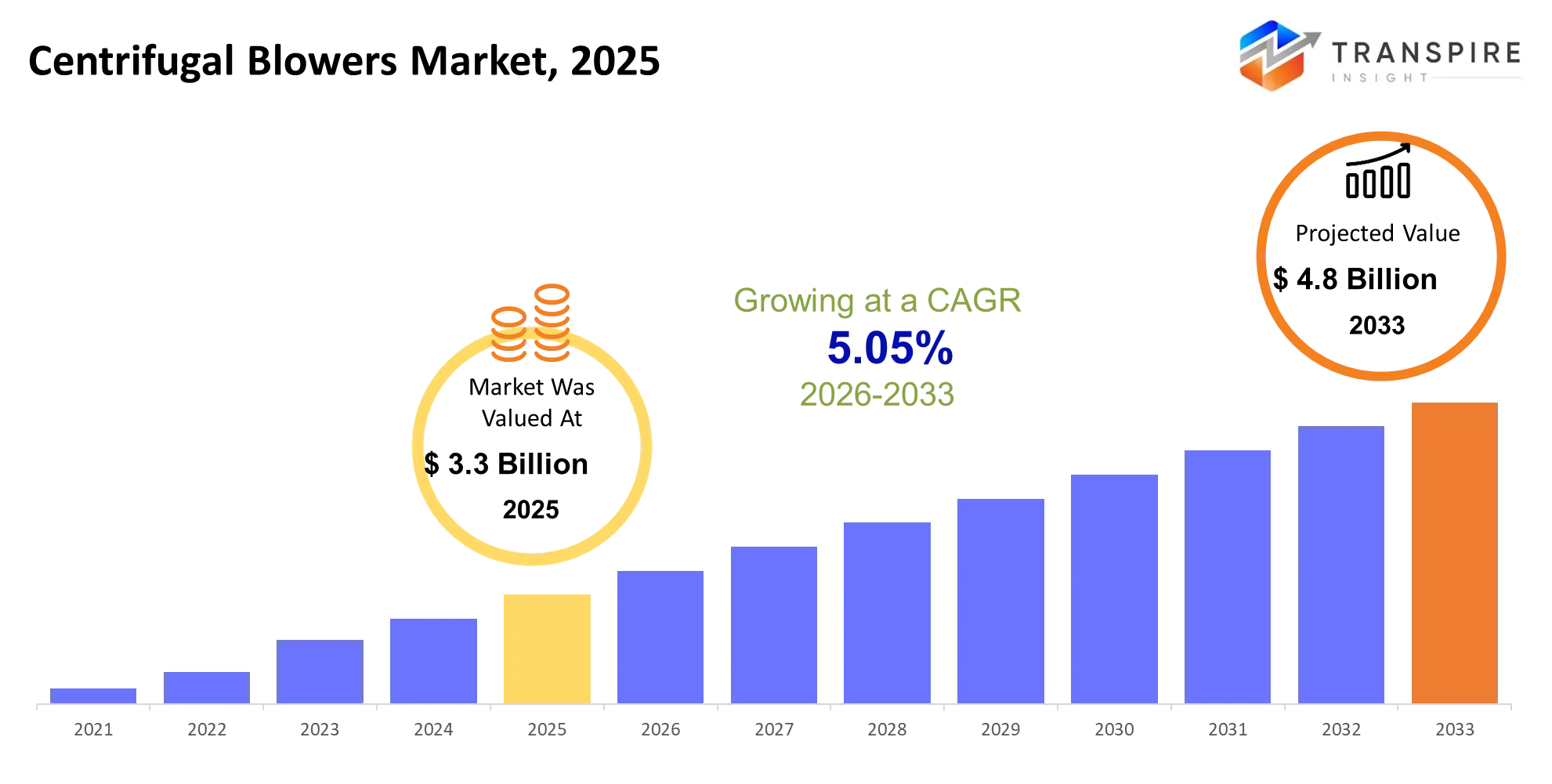
As per the Transpire Insight, The Centrifugal Blowers Market size is estimated at USD 3.3 billion in 2025 and is anticipated to reach USD 4.8 billion by 2033, growing at a CAGR of 5.05% from 2026 to 2033.
The worldwide industry for centrifugal blowers supports the transfer of air and gases in laboratories, commercial structures, wastewater treatment plants, and processing lines. Over the past three to five years, buyers have placed a higher priority on power usage, dependable equipment, and potentially even more accurate control of airflow than on simple upgrades of current units. A major trend is underway, shifting from fixed-speed, traditional blowers to new variable-speed drives, electronically commutated motors, and digitally monitored systems. This trend is driven by tightening requirements for power efficiency and the need for low operating costs in highly energy- intensive sectors. The growing needs for this transition include data-centre cooling equipment growth, wastewater system upgrades, and a general push for industrial decarbonization, all of which depend on reliable airflow. With the rising costs of power and risk of downtime, buyers are investing more time analysing total lifecycle costs over purchase price alone.
Centrifugal Blowers Market Size & Forecast:
- Market Size 2025: USD 3.3 Billion
- Expected Market Value (2033): USD 4.8 Billion
- Forecast CAGR (2026–2033): 5.05%
- Leading Region in 2025: Asia-Pacific
- Fastest Growing Region: Middle East/Africa
- Key Company Profiles: Howden, Atlas Copco, Ingersoll Rand, Gardner Denver, Continental Blower, Air Control Industries, Kaeser Kompressoren, Tuthill Corporation, Aerzen, Busch Vacuum Solutions, Spencer Turbine, FPZ, Elmo Rietschle, Cincinnati Fan, Elektror.
Key Centrifugal Blowers Market Insights:
The market is shifting from delivering basic airflow to energy optimisation, predictive maintenance, and application-specific engineering. To be competitive, lifecycle savings must be proven while implementing blowers in digitally managed industrial systems.
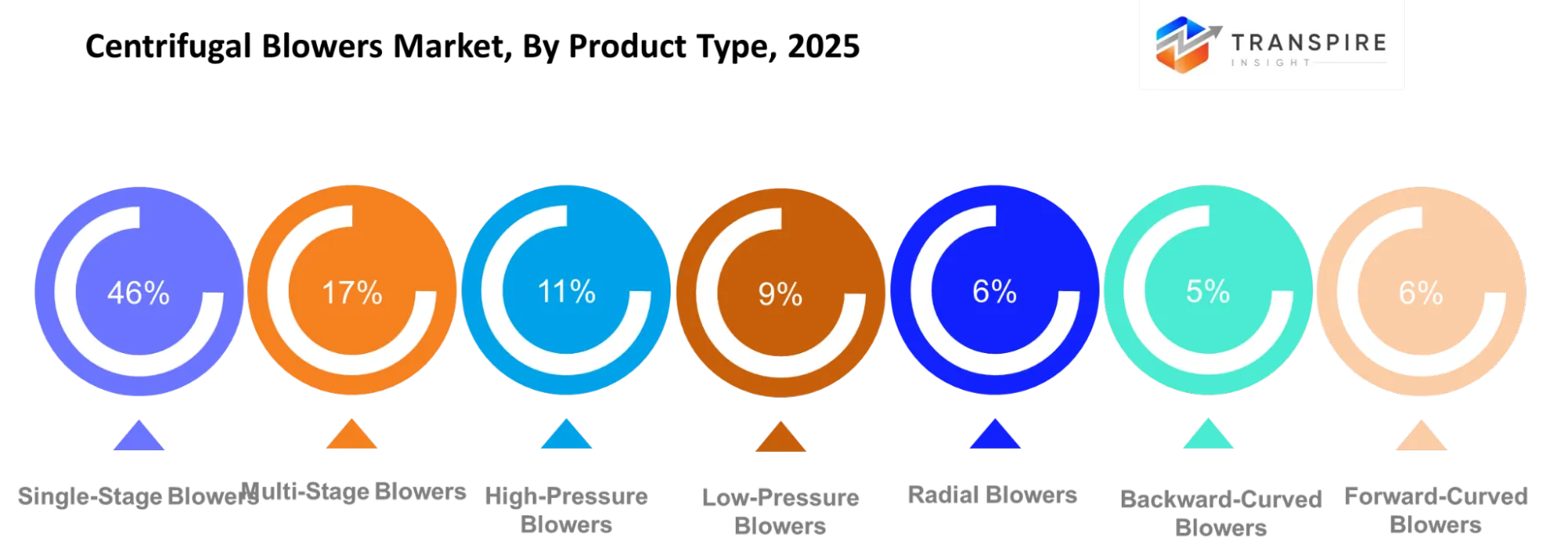
- Single-stage blowers accounted for 46.20% of the market, and Howden's Turblex platform combines multi-blower control, eliminating the requirement for a separate master control panel in wastewater aeration.
- EC/VFD blowers are the fastest-growing product direction at 7.90% CAGR, while Atlas Copco and Aerzen are pushing VFD integration and IoT-based monitoring to optimise part-load performance.
- Multi-stage blowers make up 17.00%, and established suppliers are moving them to higher-pressure chemical, combustion and process-gas applications instead of directly from the turbo blower.
- High-pressure blowers account for 11.00%, and Howden is expanding its variable-speed centrifugal technology to hydrogen production and waste-heat-recovery applications.
- Low-pressure blowers account for 9.00%, and HVAC-focused companies like Elektror and Cincinnati Fan are focused on modular, retrofit-friendly ventilation packages.
- Radial blowers make up 6.00%, and niche manufacturers are offering ruggedised blowers for industrial and material handling applications where dust is present.
- Backwards-curved blowers represent 5.00%, and newer designs have achieved 76-80% adiabatic efficiency compared to 70-74% for older designs due to aerodynamic improvements.
- Forward-curved blowers have a 3.00% share; suppliers are focused on compact commercial HVAC use where the need for low noise and ease of installation is higher.
- Competing with regenerative blowers are oil-free, low-maintenance designs from FPZ, Elmo Rietschle and Busch for aeration, vacuum and pneumatic conveying, respectively, accounting for 2.80% of the market.
What are the Key Drivers, Restraints, and Opportunities in the Centrifugal Blowers Market?
Driver:
Energy-cost pressure and tighter efficiency requirements are accelerating investment in advanced blower systems. The European Union’s Ecodesign Regulation (EU) began applying in July 2026, introducing updated efficiency, part-load performance, and repairability requirements for covered industrial fans, including centrifugal designs. This regulatory shift encourages manufacturers and facility operators to assess existing equipment, upgrade inefficient installations, and adopt variable-speed control. The resulting demand supports new equipment sales, retrofit contracts, and maintenance services.
Restraint:
High upfront investment remains a barrier, particularly for small and medium-sized facilities. Replacing blowers can require ductwork modifications, electrical upgrades, process shutdowns, and specialist commissioning. These costs persist because equipment must match site-specific pressure, airflow, temperature, and gas-handling requirements. Buyers may consequently postpone replacement even when modern systems promise lower operating expenses.
Opportunity:
Energy-efficient EC-motor and variable-frequency-drive blowers offer manufacturers an attractive growth avenue. Integrating sensors, automated controls, and remote monitoring can improve airflow management while identifying performance deterioration earlier. For example, wastewater treatment plants in rapidly industrialising Asian economies can modernise aeration systems to reduce electricity consumption without replacing entire treatment facilities. Suppliers offering modular retrofits, service agreements, and measurable efficiency improvements can capture additional revenue while building longer-term customer relationships.
Driver Impact Analysis — Centrifugal Blowers Market
|
Driver |
Relative Impact on Growth (%) |
Geographic Relevance |
Impact Timeline |
Demand Strength |
Growth Mechanism |
Key Beneficiaries |
Major Constraint |
|
Rising demand for energy-efficient industrial air-moving systems |
28% |
North America, Europe, Asia Pacific |
Short-term (≤2 years) |
High |
Reduces electricity consumption through optimised impellers and variable-speed drives. |
Blower manufacturers, motor suppliers, industrial facility operators. |
High upfront costs can delay efficiency-focused equipment replacement. |
|
Expansion of wastewater treatment and environmental infrastructure |
23% |
Asia Pacific, North America, Middle East |
Medium-term (2–4 years) |
High |
Supports wastewater aeration, biological treatment, and pollution-control operations. |
Blower manufacturers, water utilities, environmental engineering contractors. |
Infrastructure funding gaps can postpone treatment plant projects. |
|
Industrialization and manufacturing capacity expansion |
21% |
Asia Pacific, Middle East, Latin America |
Medium-term (2–4 years) |
High |
Expands process-air requirements across cement, chemicals, metals, and manufacturing. |
Industrial equipment manufacturers, OEMs, plant operators. |
Economic uncertainty can constrain industrial capital expenditure. |
|
Growth in HVAC, commercial construction, and data centre infrastructure |
16% |
North America, Asia Pacific, Europe |
Short-term (≤2 years) |
High |
Increases demand for ventilation, cooling, and equipment heat management. |
HVAC suppliers, blower OEMs, construction contractors, data centre operators. |
Construction delays and cooling-system design alternatives limit adoption. |
|
Smart blower technologies and industrial automation adoption |
12% |
North America, Europe, Asia Pacific |
Long-term (≥4 years) |
Medium |
Enables predictive maintenance, automated airflow control, and operational optimisation. |
Smart equipment vendors, automation integrators, aftermarket service providers. |
Integration complexity and sensor retrofitting increase implementation costs. |
|
Total |
100% |
— |
— |
— |
— |
— |
— |
What Has the Impact of Artificial Intelligence Been on the Centrifugal Blowers Market?
AI is evolving centrifugal blowers from simple mechanical devices into generic plant equipment. Wastewater treatment plants use machine-learning algorithms to automatically modulate blower speed based on influent load, DO measurements, and pressure, aligning aeration with biological demand rather than relying on the most conservative instrument settings. The manufacturing and heating, ventilation and air conditioning (HVAC) industries use AI to control airflow based on humidity, occupancy, filter status and process load, reducing unnecessary work.
Predictive capabilities are equally important. IoT sensors monitor vibration, bearing temperature, current, and pressure pulsation to detect early signs of impeller fouling, imbalance, or bearing deterioration, and to schedule maintenance downtime before machinery fails, saving on repair bills and capital replacement costs. Digital twins further enhance operations by simulating airflow and energy use, allowing engineers to predict the effects of control changes before implementing them on-site. While many facilities still rely on equipment of varying ages, inconsistent data formats, limited connectivity, and sketchy maintenance histories, the accuracy of AI depends on precise sensors and clean data, and retrofitting instrumentation and software can be cost-prohibitive for small facilities.
In September 2026, SOP Group, a leading blower manufacturer, officially launched its month-long industrial customer campaign. Designed directly for operators handling heavy mechanical systems, the promotion provided advanced, energy-efficient centrifugal blowers, roots blowers, and custom ventilation packages to facilities struggling with high upfront infrastructure expenses.
Key Centrifugal Blowers Market Trends:
The market is moving away from equipment-based purchasing to lifecycle performance, intelligent control and service-based reliability. New regulations and utility management are incentivising companies to stand out based on measurable efficiency and operating-cost reductions.
- With the realisation of the benefits of matching airflow to actual process requirements, fixed-speed systems are being compared to variable-speed systems.
- In appropriate applications, conventional motor designs are being replaced by EC-motor designs, which enable more precise control and lower energy consumption.
- Basic alarms are being transformed into condition monitoring, enabling maintenance crews to detect deteriorating mechanical conditions at an earlier stage.
- Lifecycle costs are now more important than the purchase price in equipment replacement decisions, and energy consumption and ease of maintenance are more important.
- The importance of compliance documentation, part-load performance and repairability is increasing with the upcoming Industrial fan efficiency rules from July 2026.
- Wastewater operators are focusing on optimising aeration as blower electricity use has a direct impact on treatment operating budgets.
- Digital monitoring is driving suppliers to include remote diagnostics, maintenance contracts, and performance reporting as an added service to equipment sales.
- Modular retrofit solutions become relevant when facilities need efficiency upgrades but don't have the budget for a complete system overhaul or extended downtime.
Centrifugal Blowers Market Segmentation
Product Type:
Single-stage blowers hold a 46.20% market share thanks to the crossover of airflow, compact installation, and efficiency that applies to wastewater handling, HVAC, and industrial processes. Growth in this segment becomes more and more compelling, as operations replace ageing multi-stage equipment with high-velocity, variable frequency drive-compatible solutions – a move that favours all suppliers with an efficient and service-friendly single-stage product platform. Multi-stage blowers make up 17.00% of the market and remain relevant when a higher pressure rise is specified. High-pressure blowers comprise 11.00% of the market; low-pressure blowers 9.00%; radial blowers 6.00%; backwards-curved blowers 5.00%; forward-curved blowers 3.00%; and regenerative blowers 2.80%. EC/VFD driven (variable output) blower sales are the fastest-growing segment, with a 7.90% compound annual growth rate for the forecast period.
Drive Type:
Direct-drive systems appeal to buyers because they eliminate transmission components, reduce mechanical losses, and simplify maintenance, while belt-drive systems offer flexibility in speed adjustment and component replacement. Electric motors remain the primary power source across industrial installations. Variable-frequency drives (VFDs) enable operators to adjust motor speed according to airflow requirements, reducing unnecessary electricity consumption during partial-load operation. Electronically commutated (EC) motors support precise control in suitable applications, while hydraulic and pneumatic drives serve specialised environments requiring particular control or operating characteristics.
Application:
HVAC and industrial ventilation remain important applications, supporting air circulation, temperature management, and indoor air quality across commercial buildings and manufacturing facilities. Wastewater treatment plants use centrifugal blowers to supply oxygen for biological treatment, making energy efficiency and reliable operation essential. Chemical processing requires equipment compatible with operating conditions and gas characteristics, while power generation depends on dependable process airflow. Food processing, mining, and automotive manufacturing create additional opportunities through drying, cooling, combustion support, and material-handling operations.
Pressure Type:
Low-pressure blowers support ventilation, cooling, and wastewater aeration, where continuous airflow and operating efficiency influence purchasing decisions. Medium-pressure systems serve applications requiring greater resistance handling across ducts and industrial processes. High-pressure and ultra-high-pressure configurations address specialised duties where process requirements demand increased pressure capability and carefully engineered equipment. Vacuum applications require suitable pressure differentials, while exhaust systems remove heat, fumes, or contaminated air. Combustion applications depend on controlled air delivery to support stable operation, making correct pressure selection, system compatibility, and reliability important purchasing considerations.
End User:
Industrial and manufacturing facilities prioritise dependable airflow, production continuity, and electricity-cost management because blower performance directly affects operating expenses. Commercial buildings focus on ventilation quality, occupant comfort, and efficient HVAC operation. Power plants require reliable air delivery for auxiliary processes, while chemical plants need equipment suited to demanding operating conditions. Automotive manufacturers use blowers for ventilation, cooling, and selected production processes. Agricultural facilities apply airflow systems in storage, drying, and environmental control. Across these end users, maintenance support and lifecycle efficiency increasingly influence equipment selection.
Sales Channel:
Direct sales enable manufacturers to assess operating conditions, recommend suitable configurations, and manage complex industrial installations. Original equipment manufacturer (OEM) partnerships integrate blowers into larger machinery and engineered systems, while distributors and dealers extend regional market access and provide local product support. System integrators coordinate blowers with motors, sensors, controls, ductwork, and automation platforms, helping customers obtain complete operating solutions. Online sales are more suitable for standardised equipment and replacement components than complex engineered projects. Aftermarket channels generate recurring revenue through spare parts, repairs, maintenance contracts, and efficiency-focused retrofits.
What are the Key Use Cases Driving the Centrifugal Blowers Market?
The primary use case is industrial air movement, where single-stage blowers, representing 46.20% of the market, support ventilation, cooling, and process-air delivery across manufacturing facilities and commercial buildings. Their practical design makes them suitable for installations requiring dependable airflow without unnecessary system complexity.
Expanding applications include wastewater treatment, chemical processing, food production, mining, and power generation. Wastewater plants use blowers for biological aeration, while chemical and food-processing facilities depend on controlled airflow for process stability, drying, and material handling. Variable-speed systems help these users respond to changing operating loads.
Emerging applications include energy-optimised data-centre cooling, sensor-based maintenance, and automated industrial ventilation. These uses create opportunities for suppliers combining efficient blowers with intelligent controls and retrofit services.
|
Report Metrics |
Details |
|
Market size value in 2025 |
USD 3.3 Billion |
|
Market size value in 2026 |
USD 3.4 Billion |
|
Revenue forecast in 2033 |
USD 4.8 Billion |
|
Growth rate |
CAGR of 5.05% from 2026 to 2033 |
|
Base year |
2025 |
|
Historical data |
2021 - 2024 |
|
Forecast period |
2026 - 2033 |
|
Report coverage |
Revenue forecast, competitive landscape, growth factors, and trends |
|
Regional scope |
United States; Canada; Mexico; United Kingdom; Germany; France; Italy; Spain; Denmark; Sweden; Norway; China; Japan; India; Australia; South Korea; Thailand; Brazil; Argentina; South Africa; Saudi Arabia; United Arab Emirates |
|
Key companies profiled |
Howden, Atlas Copco, Ingersoll Rand, Gardner Denver, Continental Blower, Air Control Industries, Kaeser Kompressoren, Tuthill Corporation, Aerzen, Busch Vacuum Solutions, Spencer Turbine, FPZ, Elmo Rietschle, Cincinnati Fan, Elektror |
|
Customization scope |
Free report customization (country, regional & segment scope). Available customized purchase options to meet your exact research needs. |
|
Report Segmentation |
Product Type (Single-Stage Blowers, Multi-Stage Blowers, High-Pressure Blowers, Low-Pressure Blowers, Radial Blowers, Backward-Curved Blowers, Forward-Curved Blowers, Regenerative Blowers); Drive Type (Direct Drive, Belt Drive, Electric Motor, Variable Frequency Drive, EC Motor, Hydraulic Drive, Pneumatic Drive); Application (HVAC, Industrial Ventilation, Wastewater Treatment, Chemical Processing, Power Generation, Food Processing, Mining, Automotive); Pressure Type (Low Pressure, Medium Pressure, High Pressure, Ultra-High Pressure, Vacuum, Exhaust, Combustion); End User (Industrial, Commercial, Residential, Automotive, Power Plants, Manufacturing, Chemical Plants, Agriculture); Sales Channel (Direct Sales, Distributors, Dealers, OEMs, System Integrators, Online Sales, Aftermarket). |
Which Regions are Driving the Centrifugal Blowers Market Growth?
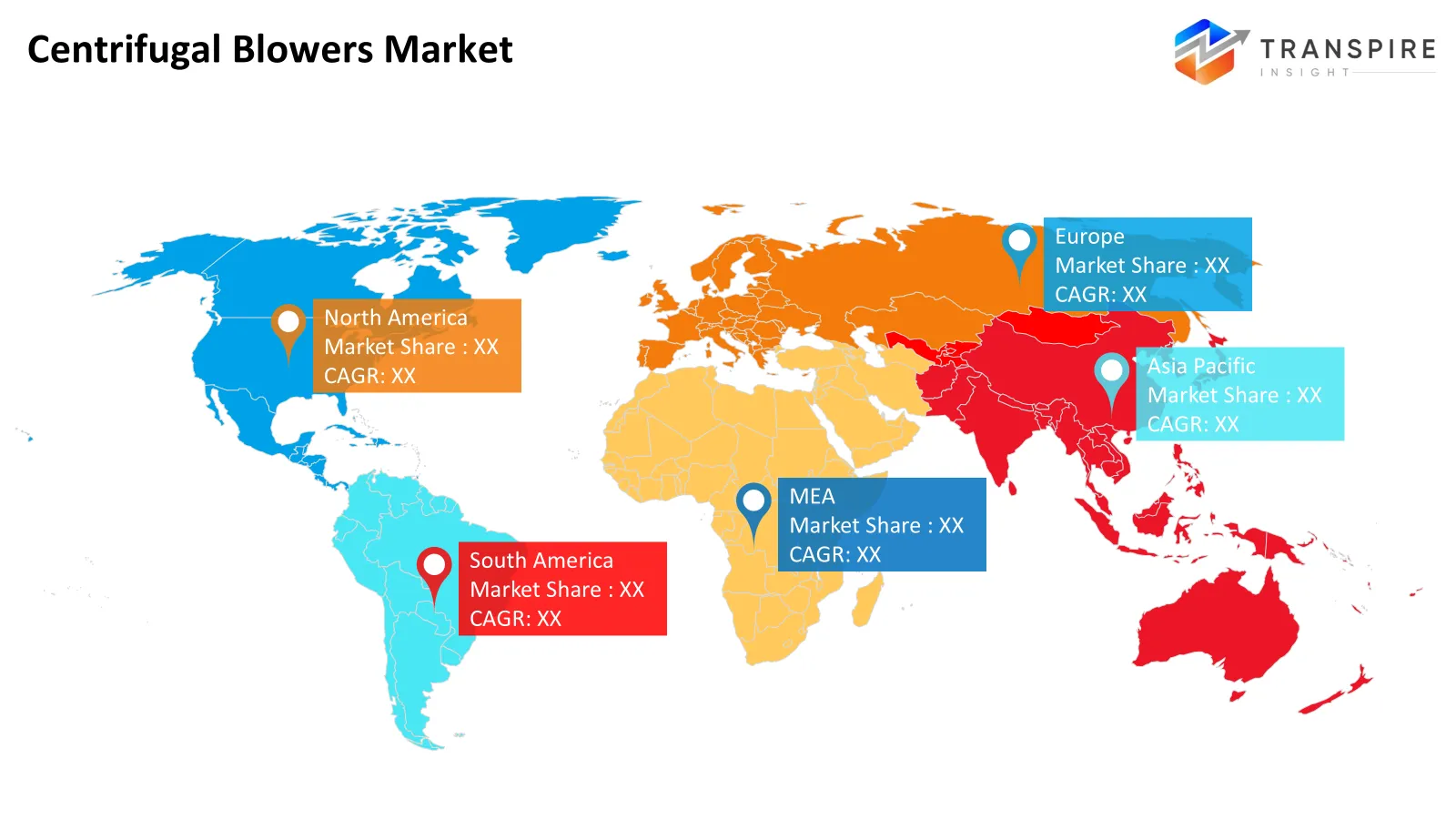
The Asia Pacific is the largest volume market with a 39.80% share of the overall market. Concomitant industrialisation, urban water infrastructure demand and manufacturing growth in China, India and Southeast Asia continue to underpin this region's fundamentals. The Asia Pacific region is also supported by a large base of wastewater treatment, chemical, power and general manufacturing projects which will require both new blowers and efficiency retrofits. Continued policy interest in reductions in industrial emissions coupled with rising energy productivity is providing support for growing demand for variable frequency drive-controlled, high-efficiency equipment, making Asia the largest volume market but also a proving ground for optimised smart blower deployments.
In April 2026, Sprintex showcased its high-speed blower technologies at the AsiaWater 2026 expo, targeting the rapid municipal and industrial wastewater infrastructure expansion across the region. This action introduced advanced, oil-free aeration solutions designed specifically to address the stringent energy productivity demands highlighted above.
https://sprintex.com.au/media/asiawater-2026-sprintex-high-speed-blowers-cut-aeration-costs-30-50/
Europe accounts for 27.00%, Latin America is at 5.00%, and the Middle East and Africa are at 4.20%. Europe is not so much construction-led as it is transformation-led, since regulation for motors and variable-speed drives, wastewater discharge, and carbon reduction drive operators to upgrade existing plants. This spurs demand for good-quality, approved equipment and long-term service contracts. North America is equally stable, driven by the shale-related process plants, power plant upgrades, and infrastructure investments, although its industry is more contract-based than regulation-led.
In March 2026, Schneider Electric launched its next-generation Altivar HVAC Drive family, including the ATH200 and ATH600 models. These variable-speed drives are specifically engineered to deliver energy savings of more than 30%, streamline smart-building integration, and provide advanced cybersecurity features.
Middle East/Africa shows the strongest growth, with a 6.70% CAGR on a smaller revenue base of 4.20%. This has been fueled by recent investments in desalination and municipal water treatment, petrochemical capacity expansion, and new industrial parks that are creating new demand for dependable aeration, ventilation, and process-air equipment and services. On the one hand, performance-based blower services could help replace dated fixed-speed equipment, starting with high-speed, oil-free, digitally monitored blowers. Combining this with water security and industrial diversification policies, Middle East/Africa could develop as a market for performance-based blower services in addition to typical equipment sales.
In March 2026, Energy Recovery launched its advanced PX Q650 energy recovery device, a fluid-handling innovation designed specifically for the extreme scale and operating pressures of modern mega-desalination facilities. This technology reduces desalination energy consumption by up to 60%, drastically cutting lifecycle costs and emissions as regional utilities shift toward high-efficiency reverse osmosis infrastructure.
Who are the Key Players in the Centrifugal Blowers Market, and how do they compete?
Competition is moving beyond blower specifications to total ownership cost, digital service, and application-specific engineering. Large diversified groups are leveraging platforms and service networks, while specialists are defending territory with custom airflow, quick delivery, and sector expertise. Howden is differentiating with an innovation and decarbonization portfolio that includes Turblex aeration, integrated multiblower controls, and variable speed for hydrogen, waste-heat recovery, and wastewater projects. Its growth plan ties equipment to lifecycle service.
Atlas Copco and Ingersoll Rand/Gardner Denver are competing with broad industrial offerings, high-efficiency compressor–blower ecosystems, and extensive distributor coverage to appeal to customers seeking standardized, scalable solutions. Aerzen is targeting process-critical, oil-free applications with its blower expertise, magnetic-bearing compressor technology, and automation. Kaeser Kompressoren is executing a system-integration plan that offers blower and compressed air specialties alongside energy surveys, while Busch Vacuum Solutions and Elmo Rietschle target vacuum/low pressure applications. Air Control Industries, Continental Blower, Tuthill, Spencer Turbine, Cincinnati Fan, and FPZ are applying application tailoring, aftermarket delivery, and regional customer proximity instead of scale.
Key Players are:
- Howden
- Atlas Copco
- Ingersoll Rand
- Gardner Denver
- Continental Blower
- Air Control Industries
- Kaeser Kompressoren
- Tuthill Corporation
- Aerzen
- Busch Vacuum Solutions
- Spencer Turbine
- FPZ
- Elmo Rietschle
- Cincinnati Fan
- Elektror
Centrifugal Blowers Market — Enhanced Competitive Benchmarking:
|
Company |
Est. Revenue Share Range |
Key Offerings |
Strategic Positioning |
Geographic Strength |
Technology Focus |
|
Atlas Copco AB |
Estimated 4–7% |
ZM multistage blowers, ZB turbo blowers, ZHA centrifugal blowers |
scale with energy-efficient integrated blower packages |
Europe, Asia Pacific, North America |
High-efficiency impellers, variable-speed drives, digital monitoring |
|
Howden Group |
Estimated 3–6% |
Industrial centrifugal blowers, process-air systems, high-pressure fans |
Engineered solutions for demanding industrial processes |
Europe, North America, Asia Pacific |
Custom aerodynamic designs, process optimization, condition monitoring |
|
AERZEN Maschinenfabrik GmbH |
Estimated 3–5% |
Aerzen Turbo, multistage turbo blowers, industrial air systems |
Specialist in reliable, application-specific industrial air technology |
Europe, Asia Pacific, North America |
High-speed turbo technology, air bearings, energy-efficient control |
|
KAESER KOMPRESSOREN SE |
Estimated 2–4% |
Pillar-free turbo blower solutions, industrial air systems, blower packages |
Lifecycle-cost differentiation through efficiency and service |
Europe, North America, Asia Pacific |
Integrated controls, efficient air delivery, variable-speed operation |
|
Piller Blowers & Compressors GmbH |
Estimated 1–3% |
Turbo blowers, centrifugal compressors, engineered gas-handling systems |
Premium engineering for specialized industrial applications |
Europe, Asia Pacific, Middle East |
High-speed impellers, customized aerodynamics, process reliability |
|
Continental Blower LLC |
Estimated 1–3% |
Multistage centrifugal blowers, exhausters, single-stage centrifugal units |
Application-focused specialist balancing performance and capital cost |
North America, Europe, Asia Pacific |
Multistage impellers, inlet guide vanes, compact blower configurations |
|
Boldrocchi Group |
Estimated 1–3% |
Industrial centrifugal fans, process blowers, customized air-handling systems |
Custom-engineered equipment for complex industrial installations |
Europe, Middle East, Asia Pacific |
Aerodynamic optimization, heavy-duty construction, tailored airflow |
|
Sulzer Ltd. |
Estimated 1–3% |
Industrial gas-handling equipment, process machinery, engineered rotating equipment |
Process-industry specialization with project-based engineering capabilities |
Europe, Asia Pacific, North America |
Rotating-equipment engineering, process integration, reliability optimization |
|
Ingersoll Rand Inc. |
Estimated 2–4% |
Industrial blower systems, centrifugal air equipment, compressed-air solutions |
Broad industrial distribution and aftermarket service differentiation |
North America, Europe, Asia Pacific |
Energy-efficient air systems, control integration, predictive maintenance |
|
EBARA Corporation |
Estimated 1–3% |
Industrial centrifugal blowers, air-handling equipment, engineered turbomachinery |
Industrial engineering strength serving infrastructure and process customers |
Asia Pacific, Europe, North America |
High-speed rotating machinery, aerodynamic efficiency, equipment reliability |
Recent Development News
- In June 2026, Kirloskar Pneumatic Company Limited launched the Tezcatlipoca A800, a two-stage centrifugal air compressor designed to deliver 600–980 CFM of Class 0 oil-free air. The launch expands the availability of domestically engineered centrifugal compression technology for pharmaceuticals, food processing, automotive manufacturing, and other industrial applications, with a focus on energy efficiency and lower lifecycle costs. https://www.indianchemicalnews.com/general/kirloskar-pneumatic-launches-indias-first-compact-centrifugal-compressor-for-600980-cfm-range-30975
- In February 2026, Garrett Motion introduced its oil-free centrifugal compressor technology for HVAC systems at AHR Expo 2026, announcing a product roadmap covering cooling capacities from 7 to 500 tons. The development targets commercial buildings, data centres, and battery energy storage facilities, with potential energy savings exceeding 10% in real-world trials compared with existing solutions, supporting demand for efficient air and cooling technologies. https://www.globenewswire.com/news-release/2026/02/02/3230244/0/en/Garrett-Motion-introduces-breakthrough-oil-free-centrifugal-compressor-technology-for-HVAC-systems-at-AHR-Expo-2026-in-Las-Vegas.html
- In September 2026, industrial air-movement machinery producer SOP Group launched a comprehensive commercial initiative structured to reduce capital expenditure barriers for manufacturing, wastewater, and HVAC operators. https://www.sopblowers.com/news/blower-manufacturer-sop-group-launches-september-2026-cost-saving-promotion-for-industrial-clients/
What Strategic Insights Define the Future of the Centrifugal Blowers Market?
The centrifugal blowers market has been moving toward a performance-based competitive environment where vendors can be evaluated not just on buy price but on proven energy savings, equipment availability and emissions reduction. This transition can slow due to fragmented data and services at ageing industrial sites with incompatible sensors and missing maintenance history, limiting AI-driven asset optimisation and potential efficiency gains. On the other hand, a readiness to adopt blower-as-a-service with an integrated VFD or EC blower with remote diagnostics and guaranteed efficiency savings is a new opportunity that is especially attractive in the 39.80% of the Asia Pacific market and other fast-growing regions such as the Middle East and Africa that are expected to grow at 6.70% CAGR. From a strategy standpoint, manufacturers should develop an offering that includes retrofit-ready designs, open data protocols, and outcome-based service agreements to monetise efficiency needs.
Key Segmentations are:
Product Type
- Single-Stage Blowers
- Multi-Stage Blowers
- High-Pressure Blowers
- Low-Pressure Blowers
- Radial Blowers
- Backward-Curved Blowers
- Forward-Curved Blowers
- Regenerative Blowers
Drive Type
- Direct Drive
- Belt Drive
- Electric Motor
- Variable Frequency Drive
- EC Motor
- Hydraulic Drive
- Pneumatic Drive
Application
- HVAC
- Industrial Ventilation
- Wastewater Treatment
- Chemical Processing
- Power Generation
- Food Processing
- Mining
- Automotive
Pressure Type
- Low Pressure
- Medium Pressure
- High Pressure
- Ultra-High Pressure
- Vacuum
- Exhaust
- Combustion
End User
- Industrial
- Commercial
- Residential
- Automotive
- Power Plants
- Manufacturing
- Chemical Plants
- Agriculture
Sales Channel
- Direct Sales
- Distributors
- Dealers
- OEMs
- System Integrators
- Online Sales
- Aftermarket
By Regional Analysis
North America
- US
- Canada
- Mexico
Europe
- Germany
- UK
- France
- Italy
- Spain
- Russia
- Rest of Europe
Asia Pacific
- China
- Japan
- India
- South Korea
- Australia
- Rest of Asia Pacific
South America
- Brazil
- Argentina
- Rest of South America
Middle East & Africa
- UAE
- Saudi Arabia
- Qatar
- South Africa
- Rest of the Middle East & Africa
Frequently Asked Questions
Find quick answers to common questions.
The centrifugal blowers market was valued at USD 3.3 billion in 2025 and is expected to reach USD 4.8 billion by 2033, growing at a 5.05% CAGR.
Key segments for the centrifugal blowers market are Product Type (Single-Stage Blowers, Multi-Stage Blowers, High-Pressure Blowers, Low-Pressure Blowers, Radial Blowers, Backward-Curved Blowers, Forward-Curved Blowers, Regenerative Blowers); Drive Type (Direct Drive, Belt Drive, Electric Motor, Variable Frequency Drive, EC Motor, Hydraulic Drive, Pneumatic Drive); Application (HVAC, Industrial Ventilation, Wastewater Treatment, Chemical Processing, Power Generation, Food Processing, Mining, Automotive); Pressure Type (Low Pressure, Medium Pressure, High Pressure, Ultra-High Pressure, Vacuum, Exhaust, Combustion); End User (Industrial, Commercial, Residential, Automotive, Power Plants, Manufacturing, Chemical Plants, Agriculture); Sales Channel (Direct Sales, Distributors, Dealers, OEMs, System Integrators, Online Sales, Aftermarket).
Growth is primarily driven by industrial automation, energy-efficiency requirements, wastewater treatment infrastructure, HVAC expansion, variable-speed technologies, and demand for reliable, low-maintenance airflow systems.
The centrifugal blowers market is led by major manufacturers, including (Include company players list).
Asia Pacific accounts for 39.80% of the market, supported by manufacturing expansion, urbanisation, industrial infrastructure investment, wastewater treatment projects, and growing adoption of energy-efficient blower systems.
Key opportunities include EC/VFD blower retrofits, AI-enabled predictive maintenance, blower-as-a-service models, energy-efficiency upgrades, and industrial wastewater infrastructure modernisation.
- Howden
- Atlas Copco
- Ingersoll Rand
- Gardner Denver
- Continental Blower
- Air Control Industries
- Kaeser Kompressoren
- Tuthill Corporation
- Aerzen
- Busch Vacuum Solutions
- Spencer Turbine
- FPZ
- Elmo Rietschle
- Cincinnati Fan
- Elektror
About the Authors

Avinash Kumar
I’m Avinash Kumar, a Senior Research Analyst at Transpire Insight, with expertise in the Electronics and Semiconductor and Energy & Power industry. My work focuses on analyzing emerging technologies, market trends, industry developments, and innovation across these sectors. I specialize in transforming complex technical and market insights into clear, research-backed content that helps professionals, businesses, and decision-makers stay informed. Through continuous industry research and data-driven analysis, I strive to deliver accurate, reliable, and practical perspectives on the latest advancements shaping the semiconductor and energy landscape.

Chakradhar Khansole
Chakradhar serves as the Research Director at Transpire Insight, bringing over 8 years of experience in technology, innovation, and strategic market intelligence. He specializes in transforming complex market data into actionable business insights that enable organizations to make informed, growth-oriented decisions. Recognized for his strategic vision and analytical expertise, Chakradhar leads high-impact research initiatives, delivering comprehensive market assessments, competitive intelligence, and forward-looking industry analysis.
Recently Published Reports
-
Apr 2026
Active Power Filter Market
Active Power Filter Market Size, Share & Analysis Report By Type (Shunt Active Power Filters, Series Active Power Filter, Hybrid Active Power Filter), By Application (Harmonics Mitigation, Reactive Power Compensation, Voltage Regulation, Power Factor Correction), By Phase (Single Phase, Three Phase), By End-User Industry (Manufacturing, Healthcare, Commercial, Automotive, Oil and Gas, Others), and Geography (North America, Europe, Asia-Pacific, Middle East and Africa, South and Central America), 2021 - 2031
-
Apr 2026
Electrical Transformer Market
Electrical Transformer Market Size, Share & Analysis Report By Core (Closed, Shell, and Berry), By Insulation (Gas, Oil, Solid, Air, and Other), By Phase (Single, and Three), By Rating (100 MVA to 500 MVA, 501 MVA to 800 MVA, and 801 MVA to 1200 MVA), and Geography (North America, Europe, Asia-Pacific, Middle East and Africa, South and Central America), 2021 – 2031
-
Apr 2026
Hydraulic Piston Pumps Market
Hydraulic Piston Pumps Market Size, Share & Analysis Report By Type (Axial Piston Pumps, Radial Piston Pumps), By Operating Pressure (Low Pressure, Medium Pressure, High Pressure), By Application (Construction, Mining, Agriculture, Automotive, Oil & Gas, Industrial Machinery, Others), By End-User (OEMs, Aftermarket), and Geography (North America, Europe, Asia-Pacific, Middle East and Africa, South and Central America), 2021 – 2031
-
Apr 2026
Laboratory Gas Generators Market
Laboratory Gas Generators Market Size, Share & Analysis Report By Product (Nitrogen Gas Generator, Hydrogen Gas Generator, Zero Air Gas Generator, Purge Gas Generator, TOC Gas Generators, Others), By Application (Gas Chromatography, Liquid Chromatography-mass Spectrometry (LC-MS), Gas Analyzers, Others), By End-user (Life Science, Chemical & Petrochemical, Food & Beverage, Others), and Geography (North America, Europe, Asia-Pacific, Middle East and Africa, South and Central America), 2021 – 2031