
Cement Board Market Summery:
According to Transpire Insights, The research report on Cement Board Market published by Transpire Insights shows that the Cement Board Market is mainly represented by a residential construction application segment which covers about 69% of total market share. James Hardie Industries is said to be the leading player in the market with an annual revenue of around USD 3.9 billion with a market share of 18%-22%. It has played a large role in the development of the market thanks to the introduction of advanced technology of fiber cement manufacture and various innovations in cement board manufacturing process.
Market Snapshot
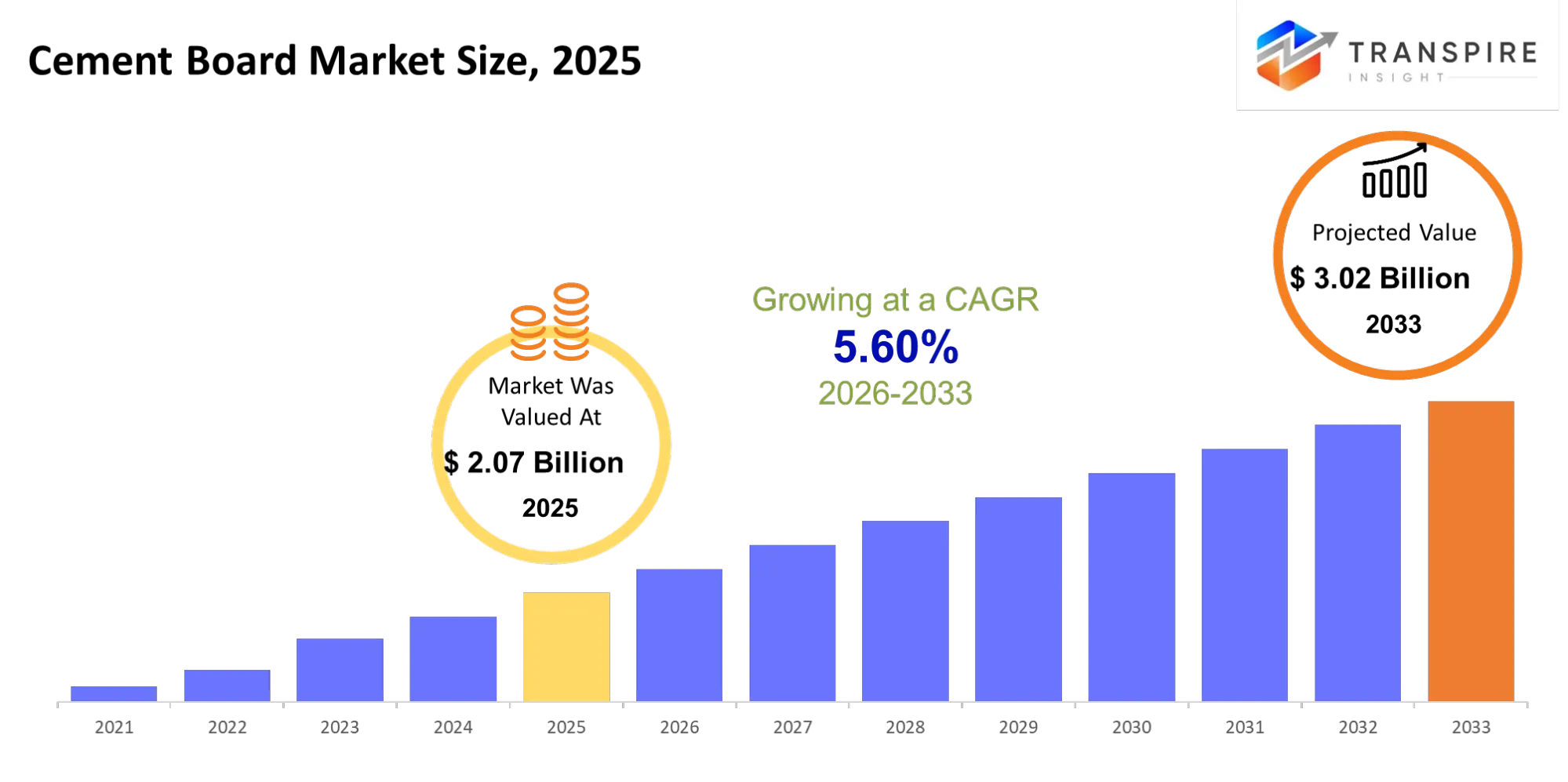
- Market Value (2025): USD 2.07 Billion.
- Expected Market Value (2026): USD 2.19 Billion.
- Estimated Market Value (2033): USD 3.02 Billion.
- Forecast CAGR (2026–2033): 5.60%.
- Leading Region in 2025: Asia-Pacific.
- Second-largest Region: Europe.
- Fastest Growing Region: North America.
Introduction
Cement Board is a high-performance building material manufactured from Portland cement, silica sand, cellulose fibers, and other reinforcing additives through advanced autoclaving and compression technologies. It offers exceptional fire resistance, moisture resistance, durability, dimensional stability, impact strength, and termite resistance, making it an ideal choice for interior and exterior wall cladding, partitions, ceilings, flooring, facades, and roofing applications. The Cement Board Market is primarily driven by rapid urbanization, increasing residential and commercial construction activities, growing investments in infrastructure development, rising demand for sustainable and energy-efficient building materials, and stricter building safety regulations across developed and emerging economies.
- For Instance:North America, Market Outlook: North America is expected to remain one of the dominant regions in the Cement Board Market, projected to surpass USD 7.4 billion during the forecast period due to increasing renovation activities, high adoption of fiber cement products, and stringent fire safety regulations.
- Japan, Sustainable Construction Initiatives: Cement board manufacturers are increasingly investing in low-carbon cement technologies, recycled raw materials, digital manufacturing systems, and energy-efficient production processes to reduce carbon emissions, improve product performance, and comply with green building standards such as LEED and BREEAM.
Market Highlights
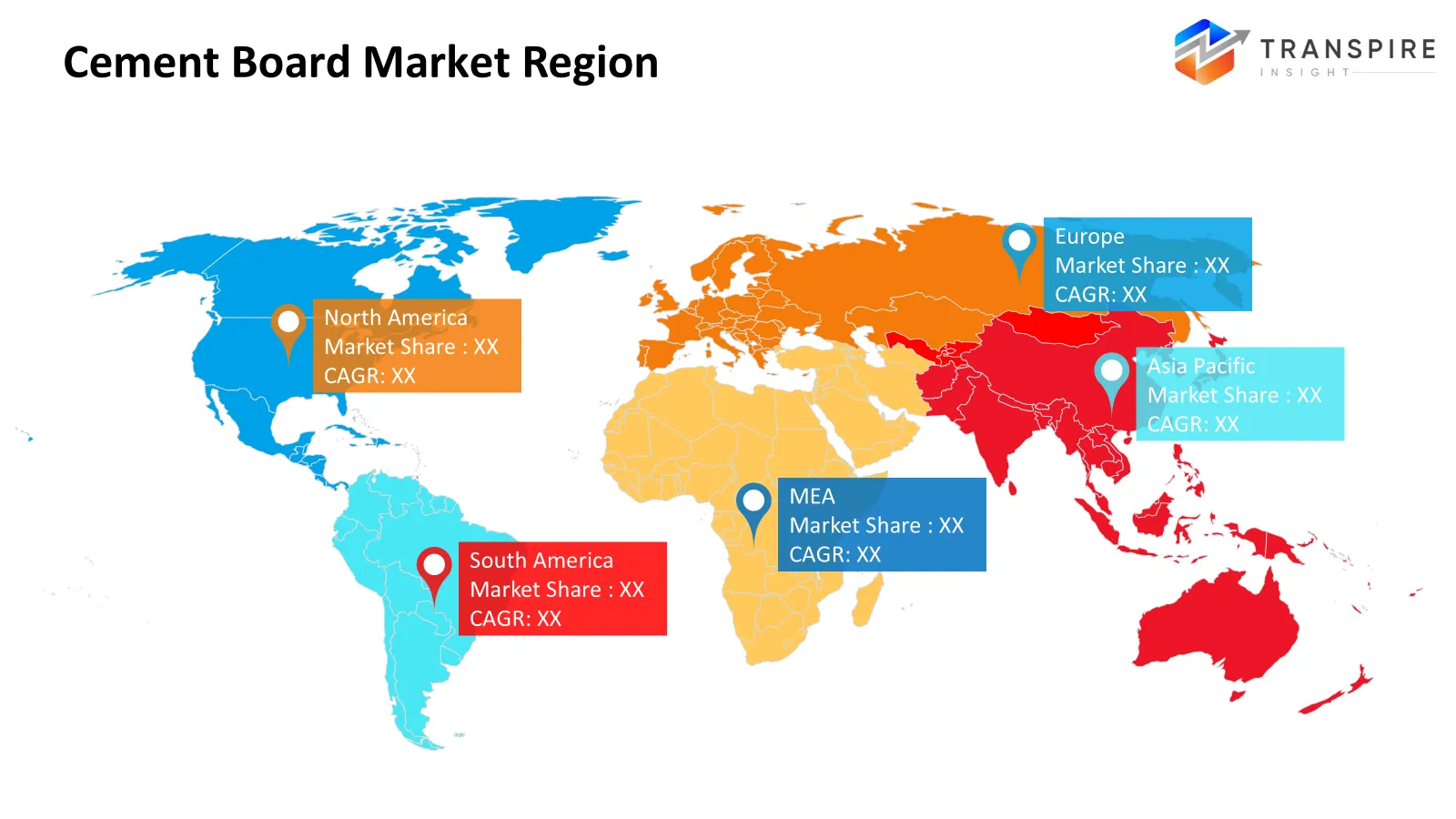
- Asia Pacific is expected to grow at a rapid CAGR in the Cement Board Market, holding approximately 41% of the market share during the forecast period.
- North America remains one of the fastest-growing regional markets, accounting for approximately 28% of the market share during the forecast period.
- Europe is anticipated to hold approximately 24% of the Cement Board Market over the forecast timeframe, supported by sustainable construction initiatives and renovation projects.
- By Product Type, the Fiber Cement Board segment dominated the market, holding approximately 58% share in 2025 and is projected to grow at a substantial CAGR during the forecast period.
- By Application, the Residential Construction segment dominated the market, accounting for approximately 69% share in 2025 and is projected to witness significant growth throughout the forecast period.
- By End User, the Building & Construction Companies segment dominated the market with approximately 61% share in 2025 and is expected to maintain its leadership during the forecast period.
- Government Infrastructure & Green Building Programs: Governments worldwide continue to support sustainable infrastructure, affordable housing, and energy-efficient construction through green building regulations, smart city initiatives, and investments in resilient infrastructure, significantly accelerating Cement Board market growth.
How is Technology Driving Growth in the Cement Board Market?
The Cement Board Market is experiencing robust growth owing to continuous technological advancements in construction material manufacturing. Modern production technologies, including autoclaved curing systems, automated fiber dispersion, precision pressing equipment, robotic manufacturing lines, AI-enabled quality inspection, and digital process monitoring, have significantly improved product consistency, strength, durability, and manufacturing efficiency. Furthermore, innovations in lightweight cement board formulations, recycled fiber reinforcement, moisture-resistant coatings, and low-carbon cement technologies enable manufacturers to produce environmentally sustainable building materials while meeting increasingly stringent international building standards. Advanced manufacturing automation and smart factory technologies also improve productivity, reduce waste generation, lower production costs, and enhance overall product quality, supporting the continued expansion of the Cement Board Market.
Market Drivers
Rapid Urbanization, Infrastructure Development & Sustainable Construction, Rapid urbanization, expanding residential housing projects, commercial infrastructure development, and increasing investments in industrial construction continue to drive strong demand for cement boards worldwide. The growing emphasis on green buildings, fire-resistant construction materials, energy-efficient buildings, and durable prefabricated construction systems further accelerates market growth. Additionally, increasing adoption of modular construction techniques, government investments in affordable housing, and rising renovation and remodeling activities create substantial opportunities for cement board manufacturers globally.
- For instance: India, under initiatives such as the Pradhan Mantri Awas Yojana (PMAY), Smart Cities Mission, and large-scale infrastructure development programs, the government continues to encourage the adoption of durable, sustainable, and cost-effective building materials, significantly supporting the demand for cement boards.
Restrain
The primary restraint affecting the Cement Board Market is the volatility in cement, cellulose fiber, silica, and energy prices, which directly impacts manufacturing costs and profit margins. In addition, competition from alternative construction materials such as gypsum boards, calcium silicate boards, metal panels, and engineered wood products
Analysis of Prices and Consumer Behaviour
The Residential & Commercial Construction sector dominates the Cement Board Market, contributing approximately 71% of total market revenue due to increasing demand for durable, fire-resistant, moisture-resistant, and low-maintenance construction materials. Premium-grade fiber cement boards are generally priced approximately 18–25% higher than conventional gypsum boards because of their superior strength, weather resistance, longer service life, and enhanced safety performance. Residential construction accounts for nearly 46% of total cement board consumption, driven by increasing urban housing developments, smart city projects, and sustainable construction practices. Approximately 74% of total market demand originates from the building and construction industry. Consumer preferences indicate that nearly 69% of buyers prioritize long-term durability, fire protection, moisture resistance, environmental sustainability, and low maintenance costs, while growing investments in green infrastructure and energy-efficient buildings continue to support the long-term expansion of the Cement Board Market.
Top Companies in the Cement Board Market
- James Hardie Industries
- Etex Group
- Nichiha Corporation
- Saint-Gobain
- SCG Building Materials
- Everest Industries
- USG Corporation
- Shera Public Company
- Soben Board
- Ramco Industries
- Hume Cemboard
- Allura USA
- Cembrit
- Knauf
- BGC Fibre Cement
Market Segmentation
The Cement Board Market share is divided into five categories: Product Type, Application, End User, Packaging Type, and Distribution Channel.
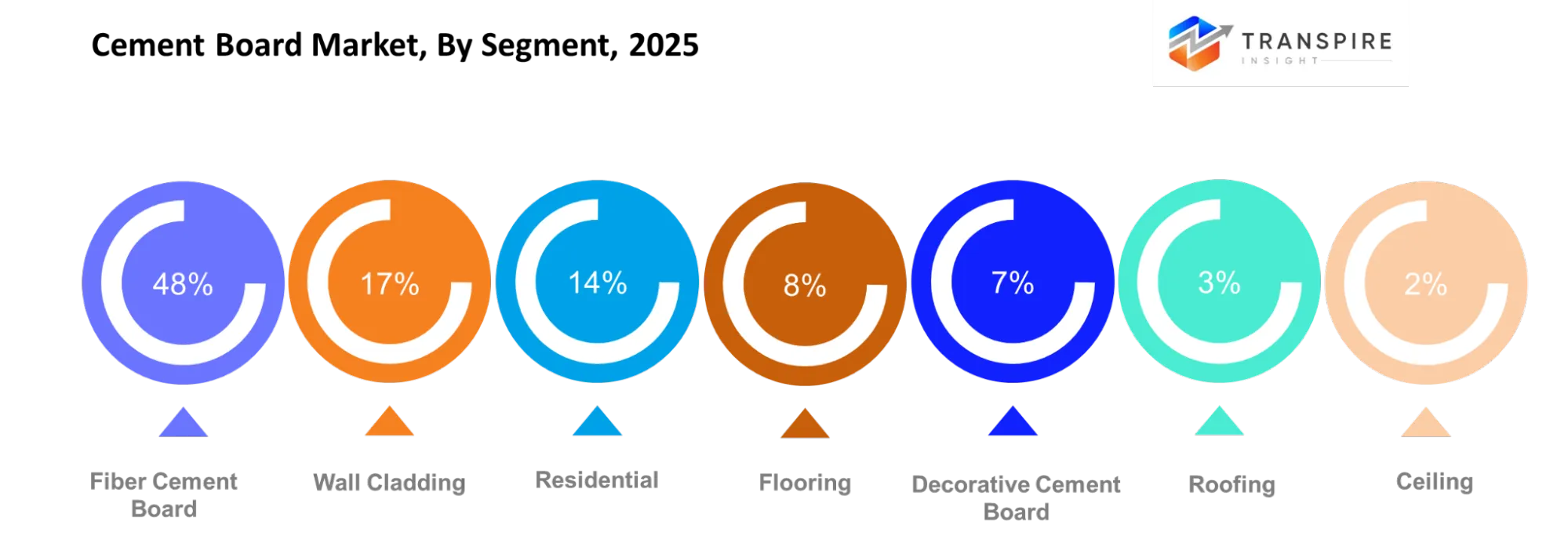
The Fiber Cement Board Segment Dominated the Market, Accounting for Approximately 58% in 2025, and is Expected to Grow at a Significant CAGR During the Forecast Period
The Cement Board Market is segmented by product type into Fiber Cement Board, Standard Cement Board, High-Density Cement Board, Medium-Density Cement Board, Low-Density Cement Board, Exterior Cement Board, Interior Cement Board, Decorative Cement Board, and Others. Among these, the Fiber Cement Board segment dominated the market, accounting for approximately 58% in 2025 and is expected to witness a significant CAGR throughout the forecast period. The segment maintains its leadership due to its superior fire resistance, moisture resistance, impact strength, dimensional stability, durability, termite resistance, and long service life. Increasing adoption in residential housing, commercial buildings, prefabricated construction, and sustainable infrastructure projects continues to strengthen demand. Furthermore, the growing preference for environmentally friendly building materials and compliance with stringent building safety standards further support the expansion of the Fiber Cement Board segment globally.
The Residential Construction Segment Held the Largest Share of Approximately 69% in 2025 and is Expected to Grow at a Substantial CAGR During the Forecast Period
The Cement Board Market is segmented by application into Residential Construction, Commercial Construction, Industrial Construction, Exterior Cladding, Interior Partitions, Ceilings, Flooring Systems, Roofing Applications, and Others. Among these, the Residential Construction segment accounted for approximately 69% of the market in 2025 and is projected to expand at a substantial CAGR during the forecast period. Rising urbanization, increasing affordable housing developments, government-supported housing projects, and growing consumer demand for durable, low-maintenance, fire-resistant, and moisture-resistant construction materials continue to drive market growth. In addition, the increasing adoption of prefabricated construction technologies and green building practices significantly contributes to the long-term expansion of this segment.
The Building & Construction Companies Segment Held the Largest Share of Approximately 61% in 2025 and is Expected to Grow at a High CAGR During the Forecast Period
The Cement Board Market is segmented by end user into Building & Construction Companies, Infrastructure Developers, Residential Builders, Commercial Contractors, Industrial Construction Companies, Interior Design & Renovation Firms, Prefabricated Building Manufacturers, and Others. Among these, the Building & Construction Companies segment dominated the market with approximately 61% share in 2025 and is expected to witness considerable growth throughout the forecast period. Increasing investments in residential, commercial, and industrial infrastructure, rapid urban expansion, government infrastructure spending, and the widespread adoption of modern construction materials continue to drive demand. Furthermore, increasing focus on sustainable construction, energy-efficient buildings, and high-performance building envelopes further strengthens market growth.
Regional Segment Analysis of the Cement Board Market
- North America (U.S., Canada, Mexico)
- Europe (Germany, France, U.K., Italy, Spain, Rest of Europe)
- Asia-Pacific (China, Japan, India, South Korea, Rest of APAC)
- South America (Brazil, Argentina, Rest of South America)
- Middle East & Africa (UAE, Saudi Arabia, South Africa, Rest of MEA)
Asia Pacific is Expected to Grow at the Fastest CAGR in the Cement Board Market by Holding Approximately 41% Market Share During the Forecast Period
Asia Pacific continues to dominate the Cement Board Market owing to rapid urbanization, expanding population, increasing residential construction activities, smart city initiatives, and significant infrastructure investments across China, India, Southeast Asia, and other emerging economies. Government support for affordable housing, commercial real estate development, and sustainable building practices further accelerates market demand. Additionally, the region's growing adoption of prefabricated construction technologies, energy-efficient buildings, and green infrastructure projects significantly strengthens the market outlook.
North America Holds Approximately 28% Market Share in the Cement Board Market During the Forecast Period
North America remains one of the leading markets due to increasing residential remodeling activities, strong commercial construction, and strict fire safety and building regulations. Growing investments in energy-efficient buildings, sustainable construction materials, and disaster-resistant infrastructure continue to support market expansion. Furthermore, rising demand for fiber cement siding, exterior cladding systems, and high-performance building materials contributes significantly to regional growth.
Europe is Anticipated to Hold Approximately 24% Share of the Cement Board Market During the Forecast Period
Europe maintains strong market growth due to increasing renovation activities, stringent environmental regulations, widespread adoption of green building certifications, and government initiatives promoting sustainable construction materials. Growing investments in low-carbon construction technologies, circular economy practices, and energy-efficient buildings continue to encourage the adoption of cement boards across residential, commercial, and public infrastructure projects.
Strategies for Market Growth in Non-Leading Regions
Emerging economies can accelerate Cement Board Market growth by investing in advanced manufacturing facilities, localized production units, and sustainable construction material technologies. Strengthening domestic supply chains, encouraging public-private partnerships, expanding affordable housing programs, and supporting infrastructure modernization will significantly improve market penetration. Governments can further stimulate demand by introducing incentives for green buildings, promoting prefabricated construction, and encouraging the adoption of fire-resistant and energy-efficient building materials. Digital construction technologies, Building Information Modeling (BIM), and smart manufacturing solutions will further improve operational efficiency and long-term competitiveness.
Future Market Trends for the Cement Board Market
1. Sustainable & Low-Carbon Cement Board Manufacturing
Manufacturers are increasingly investing in low-carbon cement production, recycled raw materials, carbon capture technologies, and environmentally sustainable manufacturing processes to comply with carbon reduction targets and green building standards.
2. Rapid Growth of Prefabricated & Modular Construction
The increasing adoption of modular construction, off-site manufacturing, and prefabricated building systems is significantly boosting demand for lightweight, durable, moisture-resistant, and easy-to-install cement boards across residential and commercial projects.
3. Smart Manufacturing & Product Innovation
Leading manufacturers are implementing AI-driven production systems, robotic automation, digital quality control, advanced autoclaving technologies, and high-performance fiber reinforcement to improve product quality, manufacturing efficiency, and operational sustainability while meeting evolving construction industry requirements.
Recent Developments
- In May 2026: James Hardie Industries announced further expansion of its fiber cement manufacturing capabilities through investments in advanced production technologies and sustainable manufacturing initiatives to meet the growing demand for high-performance cement board products used in residential and commercial construction.
- In December 2025 – Capacity Expansion: Etex Group expanded its fiber cement production capacity by investing in modern manufacturing facilities and energy-efficient production technologies. The investment strengthens supply capabilities, enhances operational efficiency, and supports increasing demand for sustainable cement board solutions across infrastructure and building construction projects.
Market Segment
This study forecasts revenue at global, regional, and country levels from 2020 to 2033. Transpire Insights has segmented the Cement Board Market based on the below-mentioned segments:
Cement Board Market, By Product
- Fiber Cement Board
- Wood Wool Cement Board
- Cement Bonded Particle Board
- Calcium Silicate Board
- Magnesium Oxide Board
- Composite Cement Board
- Decorative Cement Board
- Others
Cement Board Market, By Thickness
- Below 6 mm
- 6–10 mm
- 10–15 mm
- 15–20 mm
- 20–25 mm
- Above 25 mm
- Custom Thickness
- Others
Cement Board Market, By End User
- Wall Cladding
- Flooring
- Roofing
- Ceiling
- Partition Walls
- Facades
- Exterior Siding
- Others
Cement Board Market, By application
- Residential
- Commercial
- Industrial
- Infrastructure
- Institutional
- Hospitality
- Healthcare
- Others
Cement Board Market, By Distribution Channel
- Direct Sales
- Building Material Distributors
- Specialty Stores
- Online Sales
- OEM Supply
- Wholesalers
- Contractors
- Others
Cement Board Market, By Regional Analysis
North America
- United States
- Canada
- Mexico
Europe
- Germany
- United Kingdom
- France
- Spain
- Italy
- Rest of Europe
Asia Pacific
- Japan
- China
- Australia & New Zealand
- South Korea
- India
- Rest of Asia Pacific
South America
- Brazil
- Argentina
- Rest of South America
Middle East & Africa
- Saudi Arabia
- United Arab Emirates
- South Africa
- Rest of the Middle East & Africa
Frequently Asked Questions
Find quick answers to common questions.
Rising urbanization, increasing residential and commercial construction activities, growing demand for fire-resistant and moisture-resistant building materials, expanding infrastructure development, and technological advancements in fiber cement manufacturing are driving the growth of the Cement Board Market.
Asia Pacific dominates the Cement Board Market due to rapid urbanization, large-scale infrastructure investments, increasing affordable housing projects, expanding commercial construction, and strong government support for sustainable building materials.
Cement boards are widely used because they offer excellent fire resistance, moisture resistance, durability, dimensional stability, termite resistance, impact strength, and low maintenance, making them ideal for residential, commercial, and industrial construction applications.
The Residential Construction segment leads the Cement Board Market, driven by increasing housing developments, urban infrastructure projects, rising renovation activities, and growing demand for durable and sustainable building materials.
Major companies operating in the Cement Board Market include James Hardie Industries plc, Etex Group, Nichiha Corporation, Saint-Gobain, SCG Building Materials, Everest Industries Limited, Shera Public Company Limited, Soben Board, Visaka Industries Limited, and Hume Cemboard Industries Sdn. Bhd.
- James Hardie Industries
- Etex Group
- Nichiha Corporation
- Saint-Gobain
- SCG Building Materials
- Everest Industries
- USG Corporation
- Shera Public Company
- Soben Board
- Ramco Industries
- Hume Cemboard
- Allura USA
- Cembrit
- Knauf
- BGC Fibre Cement
About the Authors

Pankaj Ghogare Patil
I am Pankaj Ghogare Patil, a Senior Research Analyst at Transpire Insight, specializing in the Pharmaceutical, Chemicals & Materials, Healthcare IT, and Biotechnology industry. My expertise lies in conducting comprehensive market research, analyzing industry trends, evaluating competitive landscapes, and translating complex data into actionable insights. At Transpire Insight, I closely follow emerging technologies, regulatory developments, and market innovations to create accurate, well-researched, and informative content that helps businesses and professionals make informed decisions. I am committed to producing credible, evidence-based articles that reflect industry best practices while making technical topics accessible and valuable for a broad audience.

Chakradhar Khansole
Chakradhar serves as the Research Director at Transpire Insight, bringing over 8 years of experience in technology, innovation, and strategic market intelligence. He specializes in transforming complex market data into actionable business insights that enable organizations to make informed, growth-oriented decisions. Recognized for his strategic vision and analytical expertise, Chakradhar leads high-impact research initiatives, delivering comprehensive market assessments, competitive intelligence, and forward-looking industry analysis.
Recently Published Reports
-
May 2026
Healthcare Polymer Packaging Market
Healthcare Polymer Packaging Market Size, Share & Analysis Report By Packaging Type (Syringes, IV Bottles and Pouches, Clamshells, Blisters, Bottles & Jars, Containers, Tubes, IV Parental Packaging, Others), By Type (Regulated, Non-regulated), By Polymer Type (LDPE (Low-Density Polyethylene), HDPE (High-Density Polyethylene), Homo-polymer (Homo), Random Copolymer (Random), Block Copolymer (Block), PET, Polystyrene, Polyvinyl Chloride, Polyamide/EVOH, Others), and Geography (North America, Europe, Asia-Pacific, Middle East and Africa, South and Central America), 2021 - 2031
-
Apr 2026
Hydrophilic Tape (Waterstop) Market
Hydrophilic Tape (Waterstop) Market Size, Share & Analysis Report By Type (Bentonite-Based Hydrophilic Tape, Rubber-Based Hydrophilic Tape), By Application (Residential Buildings, Commercial Buildings, Infrastructure Projects), and Geography (North America, Europe, Asia-Pacific, Middle East and Africa, South and Central America), 2021 - 2031
-
Apr 2026
Metalens Market
Metalens Market Size, Share & Analysis Report By Type (Visible Light Metalens, and Infrared Metalens), By Application (Consumer Electronics, Automotive Electronics, Industrial, Medical, and Others), and Geography (North America, Europe, Asia-Pacific, Middle East and Africa, South and Central America), 2021 - 2031
-
Apr 2026
PBT Resin Market
PBT Resin Market Size, Share & Analysis Report By Type (Reinforced PBT Resin, Unreinforced PBT Resin), By Processing Method (Injection Molding, Extrusion, Blow Molding, Others), By End-User (Automotive, Electrical & Electronics, Consumer Appliances, Industrial Machinery, Medical Devices, Packaging, Others), and Geography (North America, Europe, Asia-Pacific, Middle East and Africa, South and Central America), 2021 - 2031