
Car Wash Market Summary:
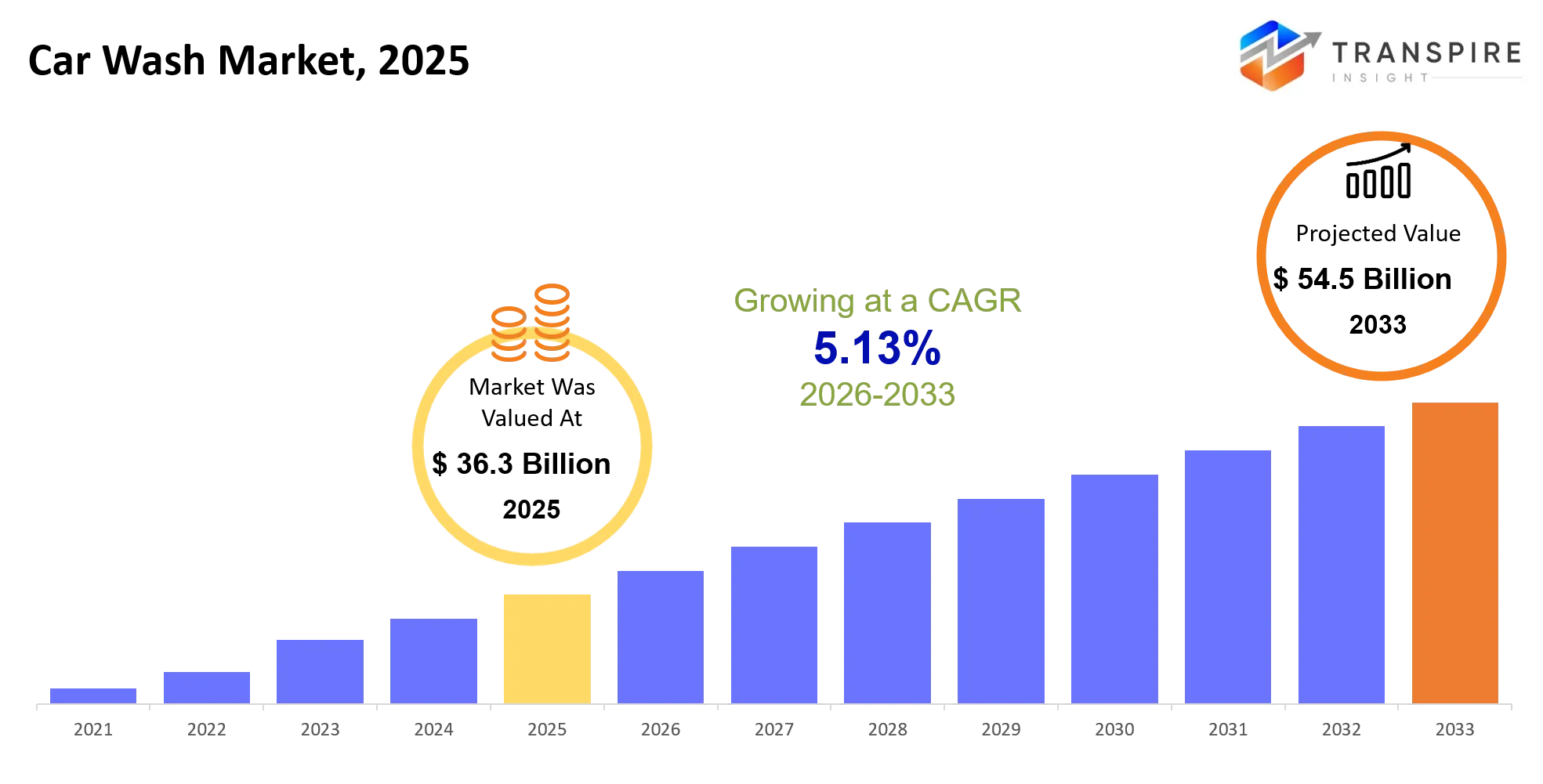
As per the Transpire Insight Analysis, TheCar Wash Market size is estimated at USD 36.3 billion in 2025 and is anticipated to reach USD 54.5 billion by 2033, growing at a CAGR of 5.13% from 2026 to 2033.
Thecar wash market provides exterior and interior cleaning of vehicles on a regular basis at established wash centres, automated tunnels, self-serve locations, mobile operators, and wash/club programs. Over the past three to five years, the industry has shifted from transactional washing to basic membership/club and app-based self-serve models, along with automated sites minimising labour. A fundamental structural change has been accelerated by water regulations and customer demands for faster, gentler operation: accepting only water-recycling or touchless automation. For example, new-style conveyor and in-bay auto systems in California are becoming recyclable as a regulatory requirement, which opens up a market for closed-loop mobile systems. This is beginning to have an effect on economics, whereby operators make stagnant or sporadic visits into recurring revenues and reduce costs on water, labour, and downtime. The rise of autonomous on-demand high-capacity touchless and mobile hand car wash options is also supporting growth as commercial fleets, ride-hail drivers and urban consumers flock for easy, regularly scheduled cleaning.
Car Wash Market Size & Forecast:
- Market Size 2025: USD 36.3 Billion
- Expected Market Value (2033): USD 54.5 Billion
- Forecast CAGR (2026–2033): 5.13%
- Leading Region in 2025: North America
- Fastest Growing Region: Asia Pacific
- Key Company Profiles: Mister Car Wash, ICWG, Driven Brands, Zips Car Wash, Autobell Car Wash, Quick Quack Car Wash, Tommy's Express, Splash Car Wash, Hoffman Car Wash, WashTec, Kärcher, Istobal, Sonny's Enterprises, Belanger, Ryko Solutions.
Key Car Wash Market Insights:
The market is shifting toward predictable subscription income, automated service delivery, and measurable resource efficiency. Competitive advantage increasingly depends on combining convenient customer experiences with reliable equipment, efficient water use, and scalable operations.
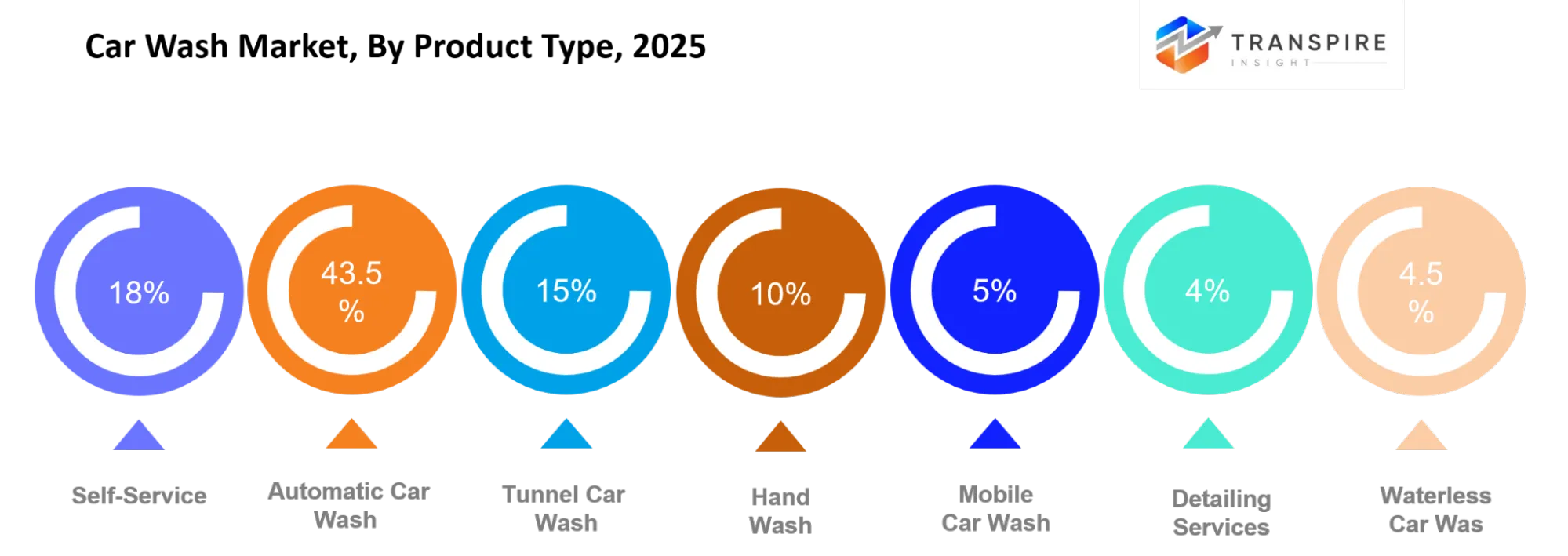
- Automatic car wash accounted for 43.50% of the market, with Mister Car Wash increasing to 548 locations in 2025 with 16 greenfield sites and 5 acquisitions to further strengthen express-tunnel scale.
- Mobile and subscription car wash is expanding at an 11.20% CAGR, while Zips Car Wash is investing in mobile apps, loyalty initiatives and unlimited wash plans to boost retention.
- Self-service is 18.00% of service demand, with operators incorporating card, QR code and app activation to minimise the need for cash and enhance unattended-site uptime.
- Tunnel car wash 15.00%: ICWG is on the path of acquisition-led growth and continues to standardise operations and implement water-saving technologies.
- Hand wash holds on to 10.00%, and ceramic coatings, paint-protection film, and interior hygiene packages are helping premium detailing providers stand out.
- Mobile car wash accounts for 5.00%, while app-based car wash providers are trying to appeal to residential communities, offices, and fleet depots where it is convenient to wash cars on the go, rather than at a traditional car wash.
- Waterless car wash is still a 2.00% niche, although it is becoming more important due to the EPA and EU water rules.
- The introduction of touchless and robotic systems is progressing as AI-driven sensors adjust pressure, chemicals, and drying based on the condition of the vehicle.
- Competition is changing hands: Driven Brands left the car washing business, and Mister Car Wash went private to focus on long-term memberships and network investments.
What are the Key Drivers, Restraints, and Opportunities in theCar Wash Market?
Driver:
Automation and subscription adoption are strengthening growth across the car wash market. License-plate recognition, mobile apps, and contactless payments simplify repeat visits, while unlimited-wash memberships turn occasional customers into recurring revenue. Rising labour costs and consumer preference for faster service have accelerated this shift. By automating tunnel operations and integrating digital membership systems, operators can process more vehicles with less reliance on additional staff, improving operational efficiency, customer retention and revenue consistency across locations.
Restraint:
High capital intensity remains a barrier. Modern tunnel systems, water-reclamation units, sensors, and digital platforms require significant upfront investment, while water-use and wastewater rules raise compliance costs. This persists because small independent operators often lack financing and suitable urban land, limiting their ability to compete with automated chains.
Opportunity:
Water-efficient systems, mobile services and fleet contracts offer practical routes to expansion. Operators can install filtration and water-reclamation systems to reduce freshwater dependence, particularly in drought-prone urban markets. Mobile washing can serve residential complexes and offices without requiring customers to travel to a fixed facility. Partnerships with rental agencies, dealerships and ride-hailing fleets can secure repeat service volumes. Combining digital bookings, prepaid packages and route optimisation can improve technician utilisation and reduce unnecessary travel. In emerging cities, compact automatic bays near fuel stations and retail centres offer another investment opportunity, provided operators validate traffic, water access and local compliance costs before committing capital.
Driver Impact Analysis –Car Wash Market
|
Driver |
Relative Impact on Growth (%) |
Geographic Relevance |
Impact Timeline |
Demand Strength |
Growth Mechanism |
Key Beneficiaries |
Major Constraint |
|
Rising vehicle ownership and preference for professional car care |
28% |
Asia-Pacific, North America |
Medium-term (2–4 years) |
High |
Expands the addressable vehicle-cleaning customer base |
Car wash operators, equipment manufacturers, cleaning-product suppliers |
Uneven vehicle ownership and discretionary consumer spending |
|
Expansion of subscription-based memberships and recurring wash programs |
24% |
North America, Europe, Australia |
Short-term (≤2 years) |
High |
Increases repeat visits and stabilizes monthly operator revenue |
Multi-site operators, franchisees, payment technology vendors |
Membership saturation, customer churn, and price competition |
|
Automation, express tunnels, and digital customer experiences |
20% |
North America, Europe, East Asia |
Medium-term (2–4 years) |
High |
Boosts vehicle throughput while reducing service time |
Equipment manufacturers, automated wash operators, software providers |
High installation costs and ongoing equipment maintenance |
|
Fleet expansion and growing commercial vehicle cleaning requirements |
16% |
Asia-Pacific, North America, Middle East |
Medium-term (2–4 years) |
High |
Generates frequent wash demand through fleet service contracts |
Fleet operators, logistics companies, commercial wash providers |
Fleet budget constraints and pressure on contract pricing |
|
Water recycling, sustainability requirements, and resource-efficient washing |
12% |
Europe, North America, water-stressed Asian markets |
Long-term (≥4 years) |
Medium |
Encourages compliant facilities and lowers freshwater consumption |
Water-treatment vendors, eco-focused operators, wash equipment manufacturers |
High retrofit costs and inconsistent local enforcement |
|
Total |
100% |
— |
— |
— |
— |
— |
— |
What Has the Impact of Artificial Intelligence Been on theCar Wash Market?
AI is allowing the entire car wash operation to evolve from a traditional fixed, manual process into a data-based service. Using computer vision and sensors, it detects the size of the vehicle, dirt level and condition of the surface and dynamically makes adjustments to the flow rate, chemical feed, brush or jet movement and drying cycle accordingly. This results in increased machine consistency in touchless and automatic washes and a lower consumption of water and chemicals.
In addition, AI supports predictive features. Connected equipment can anticipate component wear, schedule maintenance before failures occur, and adjust staffing or wash schedules according to demand trends. Customer touchpoints can leverage purchase history and vehicle condition to propose packages, renew memberships, and bolster customer loyalty. From an operational standpoint, they boost throughput, decrease labour needs, and ease the administration of multi-location chains by means of centralised tracking. However, they're limited by the prices of implementation; retrofitting vintage wash equipment with AI cameras and sensors, cloud-based tools, and dependable connectivity can be costly. Cameras and sensors could produce inaccurate outcomes when vehicle shapes are weird, there's excessive mud, or conditions are poor.
In June 2026, NXT Wash launched Ask NXT, a conversational AI-powered business intelligence capability for car wash operators. This allows operators to securely connect their operational datasets to AI assistants and retrieve clear, actionable insights using natural language instead of manually sorting through spreadsheets or dashboards.
Key Car Wash Market Trends:
The market is shifting from single cleaning transactions to connected, resource-efficient and recurring-revenue operations. Customer retention, water management, and service delivery are becoming key factors in gaining a competitive edge.
- As operators seek to minimise the risk of vehicle damage, reduce vehicle downtime, and minimise manual tasks, touchless and friction-free systems are taking the place of more manual operations.
- The unlimited-wash model is turning one-time customers into recurring customers and helping to solidify the operator's cash flow.
- Entry, payment, and loyalty tracking are becoming contactless thanks to mobile apps, QR access, and license-plate recognition.
- Water recycling, low-flow nozzles, and biodegradable chemicals are no longer luxuries but competitive requirements.
- Strict water scarcity laws are driving operators to closed-loop systems and waterless cleaning.
- AI-powered vehicle scanning is allowing for personalised wash cycles depending on how dirty the vehicle is, its shape, and the surface condition.
- Fleet, ride-hailing and rental companies are driving the demand for scheduled, high-volume and mobile cleaning.
- As operators look for ways to reduce costs and improve their ESG positioning, solar-powered sites and energy-efficient equipment are becoming more prevalent.
- Funded chains are rapidly consolidating by buying smaller independent locations to scale up digital platforms and automation.
Car Wash Market Segmentation
Service Type:
Automatic car wash leads with 43.50% market share thanks to its efficiency, cost-effectiveness, and scalability. It's mostly favored for consistently delivering a speedy job, requiring very little operator assistance. The growth model focuses on high volume, full automation, and membership. Self-service accounts for 18.00%, targeted at lower-income customers that value convenience. Tunnel car wash accounts for 15.00%, suited to use in high-traffic urban areas for its express high-volume formats and physical constraints. Hand wash is 10.00%, appealing to premium customers. Mobile car wash comprises 5.00% of the market share, growing fastest on account of its convenience, justified by the 11.20% CAGR of mobile and subscription car washes. Detailing service is 4.00%, full-service 2.50%, and waterless car wash 2.00%, the latter three aided by the trend towards premiumization and water conservation.
Vehicle Type:
Passenger cars drive routine car wash demand, while SUVs require larger bays and more powerful cleaning systems. Electric vehicles create opportunities for touchless, low-water washing as owners prioritise paint protection and resource efficiency. Light and heavy commercial vehicles generate demand for specialised cleaning, while fleet vehicles support scheduled contracts. Motorcycles require compact washing solutions, and rental and ride-hailing vehicles need frequent cleaning to maintain presentation, hygiene, and operational readiness across busy urban markets.
Mode:
Conveyor systems support high-volume tunnel operations, enabling operators to process vehicles quickly during peak periods. In-bay automatic and roll-over systems suit compact locations with limited space. Touchless washing appeals to customers concerned about surface contact, while friction systems provide physical cleaning for stubborn dirt. Robotic systems offer opportunities to improve consistency and reduce repetitive labour, whereas manual washing remains relevant for specialised cleaning and premium detailing. Technology selection depends on throughput, investment costs and customer expectations.
Payment Type:
Subscriptions, memberships, mobile payments and prepaid packages are reshaping customer transactions by encouraging repeat visits and simplifying billing. Unlimited-wash plans provide operators with recurring revenue and useful customer-behaviour data for targeted promotions. Credit and debit cards remain important at unattended facilities because they enable quick, cashless transactions. Mobile wallets further reduce payment friction, while prepaid packages attract customers seeking spending control. Integrating payment platforms with licence-plate recognition can streamline access and improve membership management.
End User:
Individual consumers provide a broad base of demand through routine vehicle cleaning and seasonal maintenance. Fleet operators, rental companies and corporate fleets generate predictable volumes through scheduled washing agreements. Government fleets require regular cleaning to maintain vehicle presentation and operational standards. Dealerships use washing services to prepare vehicles for display, delivery and resale, while taxi and ride-hailing operators prioritise frequent cleaning to maintain passenger confidence. These commercial customers favour reliable turnaround times, negotiated pricing and service consistency.
Business Model:
Franchise chains and company-owned centres can standardise equipment, procurement, pricing and customer experience across multiple locations. Independent operators retain flexibility in local pricing and service customisation but may face greater purchasing and technology constraints. Automated facilities improve throughput and reduce reliance on manual labour, while mobile operators reach customers at homes and workplaces. Membership-based and subscription-based models strengthen customer retention through recurring payments. Long-term competitiveness depends on balancing expansion costs, location quality, service reliability, and recurring revenue potential.
What are the Key Use Cases Driving theCar Wash Market?
The core use case is frequent exterior cleaning for passenger-car owners, particularly through automatic and tunnel formats that account for the largest service-type share. Urban commuters increasingly use app-enabled, membership-based washes for quick, repeatable maintenance.
Expanding applications include fleet and ride-hailing cleaning, where operators need scheduled, high-volume service to maintain vehicle presentation, hygiene, and resale value. Dealerships and rental companies also use automated washes to prepare vehicles for sale or rental quickly.
Emerging use cases focus on EV care, waterless cleaning in drought-affected regions, and AI-guided detailing for premium vehicles. Mobile subscription services are also extending car wash access to residential complexes, offices, and fleet depots.
|
Report Metrics |
Details |
|
Market size value in 2025 |
USD 36.3 Billion |
|
Market size value in 2026 |
USD 38.4 Billion |
|
Revenue forecast in 2033 |
USD 54.5 Billion |
|
Growth rate |
CAGR of 5.13% from 2026 to 2033 |
|
Base year |
2025 |
|
Historical data |
2021 - 2024 |
|
Forecast period |
2026 - 2033 |
|
Report coverage |
Revenue forecast, competitive landscape, growth factors, and trends |
|
Regional scope |
United States; Canada; Mexico; United Kingdom; Germany; France; Italy; Spain; Denmark; Sweden; Norway; China; Japan; India; Australia; South Korea; Thailand; Brazil; Argentina; South Africa; Saudi Arabia; United Arab Emirates |
|
Key companies profiled |
Mister Car Wash, ICWG, Driven Brands, Zips Car Wash, Autobell Car Wash, Quick Quack Car Wash, Tommy's Express, Splash Car Wash, Hoffman Car Wash, WashTec, Kärcher, Istobal, Sonny's Enterprises, Belanger, Ryko Solutions. |
|
Customization scope |
Free report customization (country, regional & segment scope). Available customised purchase options to meet your exact research needs. |
|
Report Segmentation |
Service Type (Self-Service, Automatic Car Wash, Tunnel Car Wash, Hand Wash, Mobile Car Wash, Detailing Services, Waterless Car Wash, Full-Service Wash); Vehicle Type (Passenger Cars, SUVs, Light Commercial Vehicles, Heavy Commercial Vehicles, Motorcycles, Electric Vehicles, Fleet Vehicles); Mode (Conveyor, In-Bay Automatic, Roll-Over, Touchless, Friction, Manual, Robotic); Payment Type (Cash, Credit Card, Debit Card, Mobile Payment, Subscription, Membership, Prepaid); End User (Individual Consumers, Fleet Operators, Rental Companies, Corporate Fleets, Government Fleets, Dealerships, Taxi/Ride-Hailing Operators); Business Model (Independent Operators, Franchise Chains, Company-Owned Centers, Mobile Operators, Membership-Based, Subscription-Based, Automated Facilities) |
Which Regions are Driving theCar Wash Market Growth?
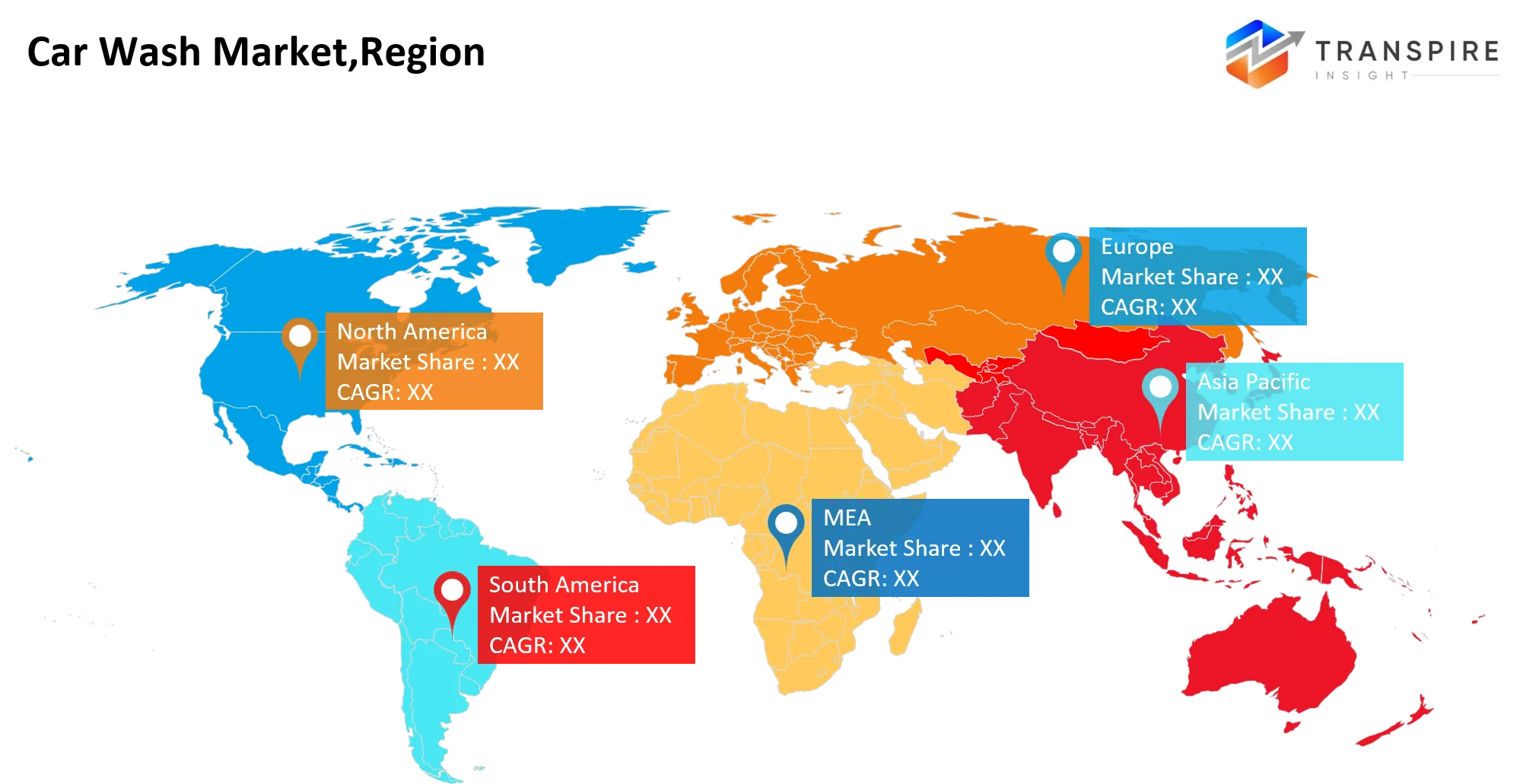
North America has the largest share of 42.30%, driven by the mature express-tunnel network, high car ownership, and widespread penetration of unlimited memberships. The majority of consumers' willingness to pay for convenience has made a recurring revenue model a key operating model for subscription-based express tunnel offerings. The region also has mature payment infrastructure, extensive road networks, and a large number of franchise and corporate operators that are financially capable of automation.
In October 2026, El Car Wash acquired four Sparkle Express Car Wash locations in Illinois. This action expanded the brand's footprint into the Midwest and served as the foundational launchpad for its plans to scale up to 50 locations across the Chicago metropolitan area.
Europe accounts for 27.00% of the market and focuses on sustainability rather than site density. Environmental regulations and wastewater disposal protocols, combined with a consumer-driven shift to environmentally friendly cleaning solutions, are creating opportunities for water-reclamation systems, biodegradable chemicals and energy-efficient equipment. Growth in Europe is more predictable and regulated than in North America, with long-term demand coming from Germany, the United Kingdom and the Nordic countries, which all have mature equipment suppliers.
In March 2026, Werner & Mertz Professional became the first cleaning products manufacturer to achieve the Cradle to Cradle Certified® Full Scope Gold (Standard 4.0) rating for its formulations. This milestone sets a new benchmark for circular-economy, biodegradable cleaning chemicals across European commercial markets.
https://www.intercleanshow.com/exhibitor-news
Asia Pacific accounts for 22.00% and is the fastest-growing region, with a CAGR of 8.90%, driven by vehicle ownership, urbanisation, and middle-class incomes. China, new automated tunnels, mobile washing and digital payments are turning a historically manual market into a more organised category. Larger opportunities are available in India, Southeast Asia and China where compact in-bay systems, water-efficient innovations and fleet cleaning for ride-hailing and logistics can scale quickly.
In September 2026, Jetwash launched its fully automated touchless car wash system in the Philippines, featuring a 360-degree cleaning process controlled entirely by a computer that finishes a cycle in six and a half minutes. This product launch brings highly accessible, scratch-free automation and rapid water-wax processing to the expanding Southeast Asian automotive care sector, shifting the market further away from manual labour.
Who are the Key Players in theCar Wash Market, and how do they compete?
The future of competition extends beyond geography to include factors such as membership economics, automation capabilities, and capital discipline. Operator consolidation is occurring to create more buying power and scale around technology; equipment manufacturers are vying for relevance on the basis of water efficiency, reliability, and integration. Recent exits and ownership transitions highlight that borrowing for growth can be risky as costs related to labour, interest, and regulatory compliance rise.
In the mid-market space, Mister Car Wash leverages a scalable, innovative approach that combines greenfield buildouts with annual memberships and digital interaction, while its 548 locations prioritize route density and recurring revenue streams. ICWG focuses on international acquisition, operational uniformity, and water-efficient technology; in the markets, Zips Car Wash leverages express tunnels, mobile apps, cashless loyalty, and subscriptions, yet its recapitalization reveals the importance of prudent leverage for expansion. Equipment companies such as Wash Tec, Kärcher, Istobal, Sonny's Enterprises, Belanger, and Ryko Solutions compete via automation, touchless capability, water recycling, and smart diagnostics, but differentiate themselves by enabling operators to minimise labour, water, and downtime; growth is shifting toward dealer channels, integrations, and service-based business models.
Key Players are:
- Mister Car Wash
- ICWG
- Driven Brands
- Zips Car Wash
- Autobell Car Wash
- Quick Quack Car Wash
- Tommy's Express
- Splash Car Wash
- Hoffman Car Wash
- WashTec
- Kärcher
- Istobal
- Sonny's Enterprises
- Belanger
- Ryko Solutions
Car Wash Market — Enhanced Competitive Benchmarking
|
Company |
Est. Revenue Share Range |
Key Offerings |
Strategic Positioning |
Geographic Strength |
Technology Focus |
|
Mister Car Wash |
Estimated 1.5–3.0% |
Express exterior washes, interior cleaning, Unlimited Wash Club |
Scale leadership through membership-led express washing |
North America, particularly the United States |
Subscription analytics and automated conveyor systems |
|
Driven Brands (Take 5 Car Wash and IMO) |
Estimated 0.5–1.5% |
Express washes, tunnel washes, international car wash services |
Multi-brand expansion across value and convenience segments |
North America, Europe |
Automated tunnels and centralized operating systems |
|
ZIPS Car Wash |
Estimated 0.5–1.5% |
Express washes, unlimited memberships, multi-tier wash packages |
Value-oriented pricing with a large multi-state network |
United States, particularly the Southeast and Midwest |
Membership platforms and high-throughput wash automation |
|
Quick Quack Car Wash |
Estimated 0.5–1.2% |
Express exterior washes, unlimited plans, premium wash packages |
Membership-driven growth and consistent customer experience |
United States, especially the West and Southwest |
Automated tunnels, digital memberships, and customer analytics |
|
Tommy’s Express Car Wash |
Estimated 0.3–1.0% |
Express tunnel washes, franchise operations, site development support |
Franchise-led scaling with standardized wash designs |
North America, with international franchise reach |
Proprietary tunnel design and automated wash controls |
|
Club Car Wash |
Estimated 0.3–0.9% |
Express exterior washes, monthly memberships, premium wash packages |
Regional consolidation through acquisitions and new locations |
United States, particularly the Midwest and South |
High-volume tunnels and recurring membership systems |
|
Autobell Car Wash |
Estimated 0.2–0.7% |
Full-service washes, interior cleaning, express exterior washes |
Service differentiation through labor-assisted cleaning |
United States, especially the Southeast |
Automated exterior washing and integrated service workflows |
|
Hoffman Car Wash |
Estimated 0.1–0.5% |
Full-service washes, express washes, unlimited wash plans |
Regional brand loyalty and diversified service formats |
Northeastern United States |
Tunnel automation and membership management |
|
Splash Car Wash |
Estimated 0.1–0.5% |
Express washes, full-service washing, unlimited memberships |
Regional network expansion and premium service offerings |
Northeastern United States |
Automated wash systems and subscription-based customer retention |
|
Super Star Car Wash |
Estimated 0.2–0.7% |
Express exterior washes, unlimited memberships, multi-level wash packages |
High-growth regional expansion in sunbelt markets |
United States, especially the Southwest |
High-throughput tunnels and digital membership sales |
Recent Development News
In February 2026, Leonard Green & Partners announced a definitive agreement to take Mister Car Wash private. This transaction valued the largest conveyor car wash platform in the United States at an enterprise value of approximately 3.1billion(7.00 per share. The acquisition highlights a major transition toward private equity-led institutional consolidation in the maturing express exterior wash sector.
In May 2026, National Carwash Solutions launched Armour All Professional Furious Wet Tire Shine for commercial car wash operations in partnership with Energiser Holdings. The product expands premium finishing options for tunnel operators and helps facilities differentiate wash packages through a high-gloss tire-care treatment.
https://ncswash.com/armor-all-professional-wet-tire-shine-launch/
In June 2026, Bubble Down Car Wash secured a $200 million growth capital commitment from BTG Pactual Strategic Capital. The funding is intended to support new-site development, acquisitions, and investment in technology and operating infrastructure, strengthening the company's expansion plans across Florida and the southeastern United States.
https://finance.yahoo.com/small-business/articles/bubble-down-car-wash-secures-110000263.html
What Strategic Insights Define the Future of theCar Wash Market?
The industry is moving toward integrated service platforms that include automated washing, digital memberships, resource utilisation management, and fleet contracts. Operators should focus on site profit rather than expansion, as high equipment prices and fluctuating vehicle traffic may lower margins despite higher volumes. Heavy discounting could drive up membership numbers but leave revenue per wash level while causing delays at peak periods. Water availability and wastewater compliance present additional challenges for facilities in drought regions or high-water-cost areas. An opening exists for the leveraging of water-reclamation technology with automated booking and predictive maintenance to monitor water usage and avoid downtime. Expansion potential exists in the Asia Pacific region, where there is a trend to co-locate organised facilities with vehicle ownership and digital payment schemes. Businesses should analyse demand before the launch of new sites, measure net customer retention and water use per vehicle, and scale up only after unit economics are validated.
Key Segmentations are:
Service Type
- Self-Service
- Automatic Car Wash
- Tunnel Car Wash
- Hand Wash
- Mobile Car Wash
- Detailing Services
- Waterless Car Wash
- Full-Service Wash
Vehicle Type
- Passenger Cars
- SUVs
- Light Commercial Vehicles
- Heavy Commercial Vehicles
- Motorcycles
- Electric Vehicles
- Fleet Vehicles
Mode
- Conveyor
- In-Bay Automatic
- Roll-Over
- Touchless
- Friction
- Manual
- Robotic
Payment Type
- Cash
- Credit Card
- Debit Card
- Mobile Payment
- Subscription
- Membership
- Prepaid
End User
- Individual Consumers
- Fleet Operators
- Rental Companies
- Corporate Fleets
- Government Fleets
- Dealerships
- Taxi/Ride-Hailing Operators
Business Model
- Independent Operators
- Franchise Chains
- Company-Owned Centres
- Mobile Operators
- Membership-Based
- Subscription-Based
- Automated Facilities
Frequently Asked Questions
Find quick answers to common questions.
The car wash market size was valued at USD 36.3 billion in 2025 and is poised to reach USD 54.5 billion by 2033, expanding at a 5.13% CAGR.
Key segments for the Keyword are Service Type (Self-Service, Automatic Car Wash, Tunnel Car Wash, Hand Wash, Mobile Car Wash, Detailing Services, Waterless Car Wash, Full-Service Wash); Vehicle Type (Passenger Cars, SUVs, Light Commercial Vehicles, Heavy Commercial Vehicles, Motorcycles, Electric Vehicles, Fleet Vehicles); Mode (Conveyor, In-Bay Automatic, Roll-Over, Touchless, Friction, Manual, Robotic); Payment Type (Cash, Credit Card, Debit Card, Mobile Payment, Subscription, Membership, Prepaid); End User (Individual Consumers, Fleet Operators, Rental Companies, Corporate Fleets, Government Fleets, Dealerships, Taxi/Ride-Hailing Operators); Business Model (Independent Operators, Franchise Chains, Company-Owned Centers, Mobile Operators, Membership-Based, Subscription-Based, Automated Facilities).
Growth is primarily driven by automation, subscription-based wash memberships, rising vehicle ownership, increasing labour costs, contactless payment systems, demand for convenient cleaning services, and investments in water-recycling technologies.
The car wash market is led by major manufacturers, including Mister Car Wash, ICWG, Driven Brands, Zips Car Wash, Autobell Car Wash, Quick Quack Car Wash, Tommy's Express, Splash Car Wash, Hoffman Car Wash, WashTec, Kärcher, Istobal, Sonny's Enterprises, Belanger, and Ryko Solutions
North America dominates the car wash market with a 42.30% share, supported by high vehicle ownership, established express-wash networks, subscription-based memberships, advanced automation, and strong investment in digital payment systems.
Opportunities include AI-enabled automation, water-recycling systems, mobile washing services, subscription-based memberships, fleet-cleaning contracts, and expansion into rapidly urbanising Asia Pacific markets.
- Mister Car Wash
- ICWG
- Driven Brands
- Zips Car Wash
- Autobell Car Wash
- Quick Quack Car Wash
- Tommy's Express
- Splash Car Wash
- Hoffman Car Wash
- WashTec
- Kärcher
- Istobal
- Sonny's Enterprises
- Belanger
- Ryko Solutions
About the Authors

Mayur Shinde
I am Mayur Shinde, a Senior Research Analyst at Transpire Insight, specializing in the Automotive & Transportation and Information & Communication Technology (ICT) Industry. My work focuses on analyzing emerging market trends, technological advancements, competitive landscapes, and industry developments to deliver accurate, data-driven insights. I am passionate about transforming complex market information into clear, actionable content that helps businesses, professionals, and decision-makers stay informed and make confident strategic decisions.

Chakradhar Khansole
Chakradhar serves as the Research Director at Transpire Insight, bringing over 8 years of experience in technology, innovation, and strategic market intelligence. He specializes in transforming complex market data into actionable business insights that enable organizations to make informed, growth-oriented decisions. Recognized for his strategic vision and analytical expertise, Chakradhar leads high-impact research initiatives, delivering comprehensive market assessments, competitive intelligence, and forward-looking industry analysis.
Recently Published Reports
-
Apr 2026
ATV & UTV Market
ATV & UTV Market Size, Share & Analysis Report By Type (ATV, and UTV), By Variants (Less Than 400 CC, 400 CC To 800 CC, and More Than 800 CC), and Geography (North America, Europe, Asia-Pacific, Middle East and Africa, South and Central America), 2021 - 2031
-
Apr 2026
Automotive Central Gateway Module Market
Automotive Central Gateway Module Market Size, Share & Analysis Report By Type (Ethernet Central Gateway Module, CAN Central Gateway Module, LIN Central Gateway Module, and FlexRay), By Application (Powertrain Control, Body Control, Infotainment System, Advanced Driver Assistance Systems (ADAS), and Others), By End User (Passenger Vehicles, and Commercial Vehicles), and Geography (North America, Europe, Asia-Pacific, Middle East and Africa, South and Central America), 2021 - 2031
-
Apr 2026
Automotive Engine Oil Filter Market
Automotive Engine Oil Filter Market Size, Share & Analysis Report By Filter Type (Fuel Filter, Engine Oil Filter, Hydraulic Oil Filter, and Others), By Filter Media (Cellulose, Synthetic, and Micro), By Sales Channel (OEMs, and Aftermarket), By Vehicle Type (Passenger Cars, Light Commercial Vehicles, Heavy Duty Trucks, Buses and Coaches, and Off-road Vehicles), and Geography (North America, Europe, Asia-Pacific, Middle East and Africa, South and Central America), 2021 - 2031
-
Apr 2026
Automotive Parts Aluminium Die Casting Market
Automotive Parts Aluminium Die Casting Market Size, Share & Analysis Report By Production Process (Pressure Die Casting, Vacuum Die Casting, Squeeze Die Casting, Gravity Die Casting), By Application (Body Parts, Engine Parts, Transmission Parts, Battery And Related Components, Other Application Types), and Geography (North America, Europe, Asia-Pacific, Middle East and Africa, South and Central America), 2021 - 2031
Our Clients