

Butterfly Valve Market Summary:
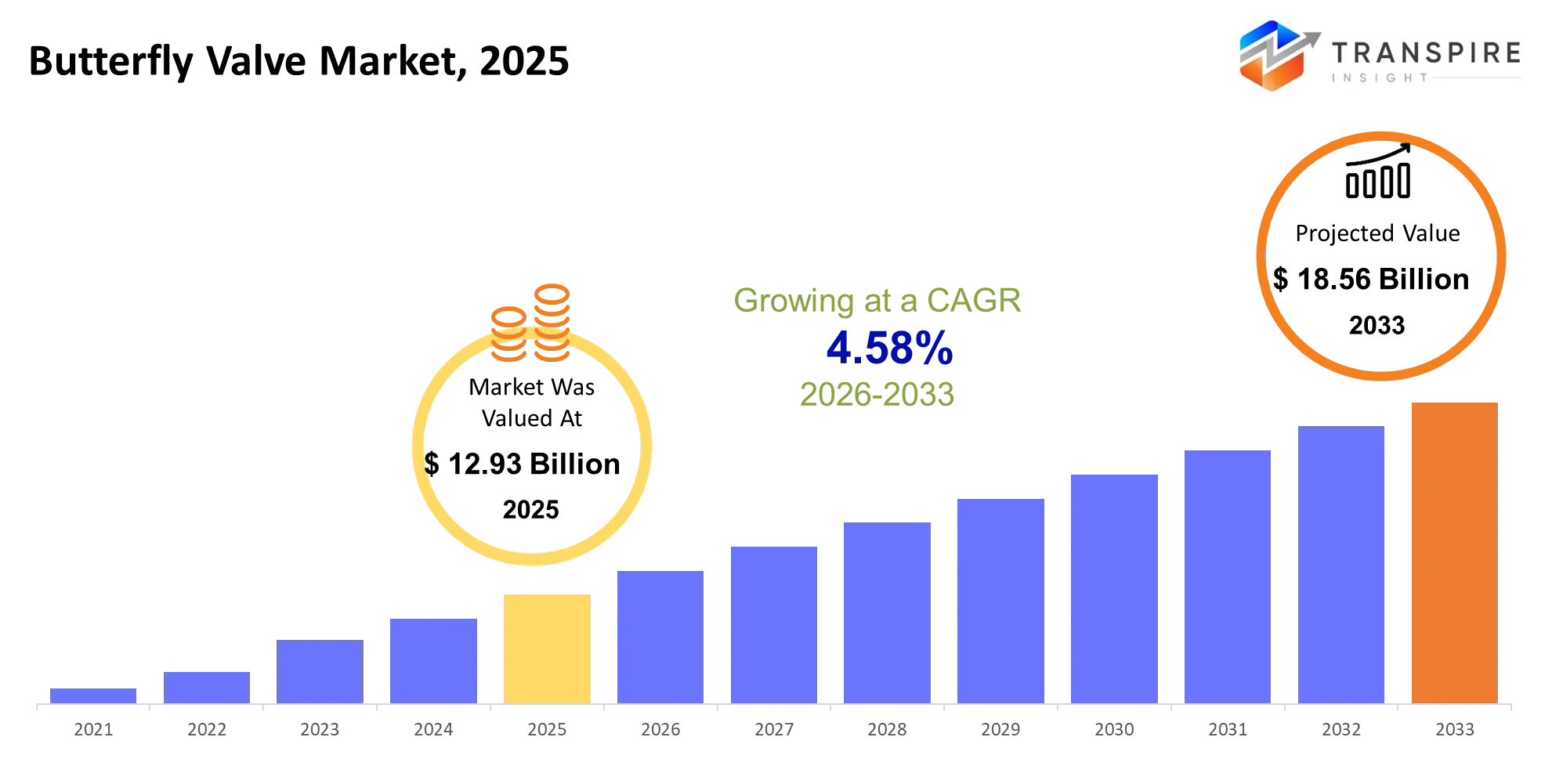
As per the Transpire Insight, the Butterfly Valve Market size is estimated at USD 12.93 billion in 2025 and is anticipated to reach USD 18.56 billion by 2033, growing at a CAGR of 4.58% from 2026 to 2033.
The butterfly valve market supplies compact flow-control devices used for isolating, controlling, and redirecting fluids and gases throughout a facility, pipeline, or treatment plant. In the last 3-5 years, purchasing criteria have transitioned from mechanical devices to automation-capable, enhanced sealing, and digitally monitored operation. Replacement valves and new installations are being created by city water system upgrades, industrial developments, and projects related to energy transition. There is a structural change underway as electric actuation and connected monitoring become more relevant for operators desiring remote operation and fewer maintenance outages. Water utilities in particular are impacted by ageing network assets, more demanding service levels, and the need to monitor leakage more effectively. LNG plants, hydrogen projects, and chemical manufacturers require secure isolation in tough process conditions. These investments will demand more procurement of specialised valves, actuators, and maintenance services, laying the foundation for industry growth.
Butterfly Valve Market Size & Forecast:
- Market Size 2025: USD 12.93 Billion
- Expected Market Value (2033): USD 18.56 Billion
- Forecast CAGR (2026–2033): 4.58%
- Leading Region in 2025: Asia Pacific
- Fastest Growing Region: North America
- Key Company Profiles: Alfa Laval, Curtiss-Wright, Flowserve, Emerson, Pentair, Weir Group, AVK, Crane, Schlumberger, Velan, KSB, Honeywell, Bray International, DeZURIK, Valmet.
Key Butterfly Valve Market Insights:
The traditional valve supply is changing to engineered solutions that incorporate actuation, sealing reliability, and lifecycle services. Matching the valve design to the operating conditions is becoming increasingly critical to market differentiation, with the need to keep installation and maintenance costs under control.
- Asia Pacific accounts for 44.8% of revenue share, as the Chinese and Indian manufacturers are cranking up automated production and exporting valve clusters.
- North America represents 21.5% of demand, with shale-gas contractors turning to high-performance valves for high-cycle, abrasive applications.
- Europe accounts for 19.0%, with German and Nordic suppliers making strides in low-emission sealing, traceable materials, and digital valve diagnostics.
- The region of Latin America has an 8.0% share and is growing at a 5.0% CAGR, driven by Brazilian offshore production and Chilean mining automation.
- The Middle East and Africa account for 6.7% of the market, while desalination and petrochemical activities are responsible for higher demand for alloy and corrosion-resistant valves.
- With an estimated 13% share, Emerson is expanding its smart-actuator and plant-analytics integration in the water and process industries.
- Around 11%, Flowserve is distinguishing itself with engineered severe-service valves and lifecycle services for energy customers.
- For Schlumberger's Cameron business, which accounts for about 10%, the emphasis is on project integration in the oilfield, which puts valves in a full flow-equipment package.
- The electric actuation is becoming a critical feature for buyers, moving from manual control to predictive assets that will be remotely monitored.
What are the Key Drivers, Restraints, and Opportunities in the Butterfly Valve Market?
Driver:
Municipal water-system rehabilitation, industrial automation, and energy infrastructure investment are strengthening butterfly valve procurement. Ageing pipelines and treatment facilities require replacement valves, while new LNG terminals, chemical plants, and power projects need dependable isolation equipment. The practical trigger is infrastructure modernization combined with stricter operating-reliability expectations. This encourages adoption of resilient-seated, high-performance, and actuated valves, generating revenue through equipment sales, actuator integration, and maintenance contracts.
Restraint:
Price competition and raw-material volatility continue to limit margin expansion. Stainless steel, ductile iron, elastomers, and imported castings remain exposed to commodity cycles, tariffs, and supply-chain disruption, particularly for standard ductile-iron water valves. The constraint persists because many buyers still treat basic butterfly valves as interchangeable commodities rather than lifecycle-performance assets.
Opportunity:
Digital actuation, predictive maintenance, and water infrastructure investment offer attractive expansion pathways. Electric actuators with position feedback can support remote operation, while connected diagnostics help utilities identify abnormal valve behaviour before failures interrupt service. India and Southeast Asia provide opportunities through industrial development and municipal water investments. Hydrogen, desalination and carbon-capture infrastructure may also create demand for specialized, corrosion-resistant and tightly sealed butterfly valves.
Driver Impact Analysis – Butterfly Valve Market
|
Driver |
Relative Impact on Growth (%) |
Geographic Relevance |
Impact Timeline |
Demand Strength |
Growth Mechanism |
Key Beneficiaries |
Major Constraint |
|
Expansion of water and wastewater infrastructure |
28% |
Asia-Pacific, North America, Middle East |
Medium-term (2–4 years) |
High |
Municipal pipelines, treatment plants, and distribution networks increase valve procurement. |
Municipal utilities, valve manufacturers, water infrastructure contractors. |
Delayed public infrastructure funding and project approvals. |
|
Oil and gas pipeline, refinery, and petrochemical investments |
25% |
Middle East, North America, Asia-Pacific |
Medium-term (2–4 years) |
High |
Pipeline expansion and refinery modernization increase demand for isolation valves. |
Oilfield equipment suppliers, valve manufacturers, EPC contractors. |
Oil price volatility and postponement of capital-intensive projects. |
|
Industrialization and chemical processing expansion |
19% |
Asia-Pacific, Europe, North America |
Medium-term (2–4 years) |
High |
Process plant expansion drives demand for corrosion-resistant, high-performance valves. |
Chemical producers, industrial valve suppliers, engineering contractors. |
High material costs and stringent application-specific requirements. |
|
Industrial automation and smart valve adoption |
16% |
North America, Europe, Japan, Asia-Pacific |
Long-term (≥4 years) |
High |
Automated actuators enable remote operation, precise flow control, and predictive maintenance. |
Smart valve manufacturers, automation vendors, industrial operators. |
Integration complexity and high initial automation costs. |
|
Power generation, renewable energy, and energy-efficiency investments |
12% |
Asia-Pacific, Europe, North America, Middle East |
Long-term (≥4 years) |
Medium |
Power plant upgrades and renewable projects increase specialised valve installations. |
Power utilities, valve suppliers, renewable energy EPC contractors. |
Project uncertainty and competing infrastructure priorities. |
|
Total |
100% |
— |
— |
— |
— |
— |
— |
What Has the Impact of Artificial Intelligence Been on the Butterfly Valve Market?
Artificial intelligence does not threaten to replace existing butterfly valves; rather, intelligent monitoring, predictive maintenance, and process optimization are having an impact on butterfly valve operation. For automated industrial water treatment and other industrial processes, artificial intelligence-enabled systems can analyse data from actuator position, torque, vibration, pressure, and flow to detect aberrant patterns of operation, enabling them to more quickly detect issues such as sticking discs, seal failures, actuator failures, or pressure fluctuations that are not within expected ranges.
Predictive analytics can also allow maintenance teams to plan inspections based on the condition of equipment, rather than on a schedule. In process plants, an artificial intelligence-based control system can optimise the position of valves together with pumps and other equipment, improving the stability of flow and allowing energy consumption to be reduced. Digital valve positioners and industrial communication networks are a must-have for those applications. The main problem is integration. Older manually actuated valves don't have sensors or digital interfaces, and require instrumentation, appropriate control systems, and trained personnel to upgrade them. Inaccurate sensor output or a lack of historical data could potentially lead to unreliable predictions. As such, the use of artificial intelligence is more viable in upgraded plants rather than installations with small budgets.
In October 2026, E Tech Group and SORBA.ai formed a strategic partnership to deploy modular, industrial artificial intelligence models and advanced process controls directly into automated control environments.
https://valvemagazine.com/news/new-partnership-between-ai-automation-companies/
Key Butterfly Valve Market Trends:
Beyond low-cost mechanical isolation, the market is shifting to reliability and controllability per application. The building of new infrastructure, digital monitoring, and tighter requirements for materials are changing purchasing.
- Electric and pneumatic actuation is becoming the standard for remote operation, and manual valves are giving way.
- Electric actuation is gaining ground over other modes of actuation, with the help of smart positioners and plant-wide digital infrastructures.
- In certain high-pressure, high-temperature, high temperature and cryogenic applications, triple-offset valves are taking the place of gate, globe and ball valves.
- Water companies are transforming from emergency repair to planned replacement of their deteriorating network, preferring to replace resilient-seated and lined valves that can last for decades.
- Buyers are now considering total cost of ownership (TCO), comprising downtime, leakage, energy loss, and maintenance costs, not just the price of the purchased product.
- Sensors, actuators, diagnostics, and software are being packaged into high-end smart valves by valve manufacturers.
- Valves with metal-seated moving parts, fire-safe, and traceable are being demanded by LNG, refining, chemical, and hydrogen projects, etc.
- Manufacturers are compelled to source locally and make their supply chains more resilient due to tariffs and fluctuations in steel, casting, and elastomer prices.
- The service model of predictive maintenance is shifting from selling spare parts to contracts for condition monitoring and valve-as-a-service.
Butterfly Valve Market Segmentation
Function:
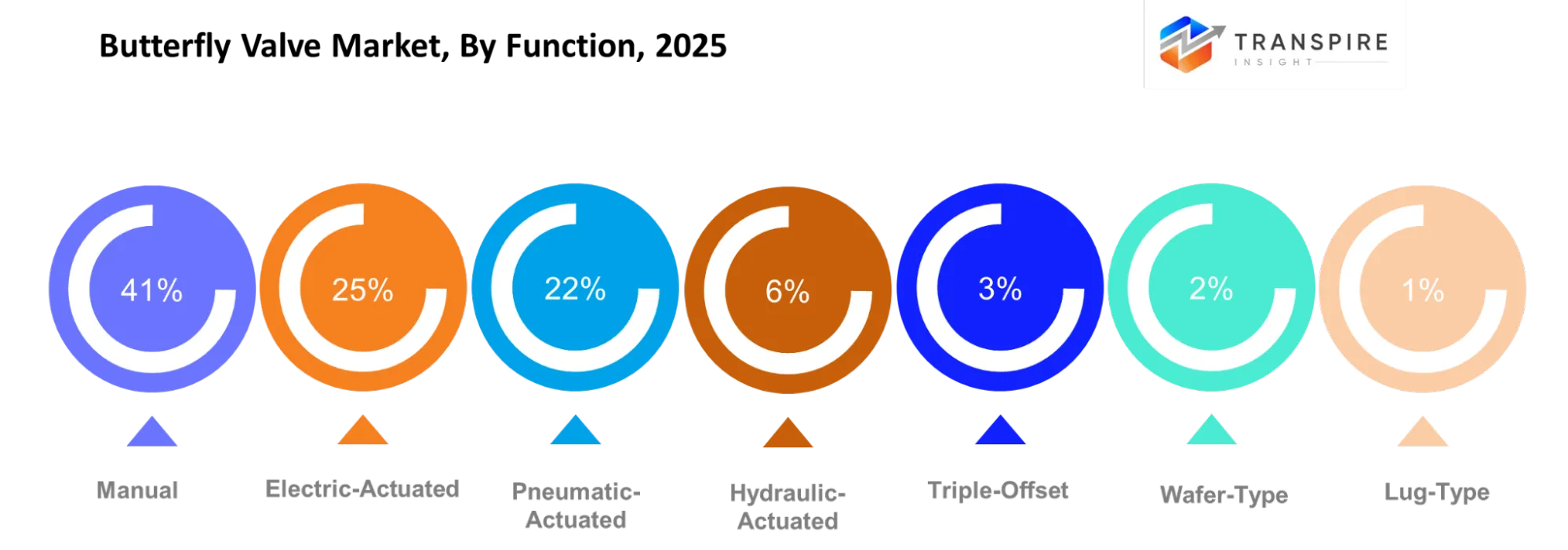
The distribution of flow with respect to actuation is 41.2% for manual valves; these are included due to their low cost, ease of installation, and because they are suitable for normal isolation applications. Electric-operated valves will have a 5.0% CAGR, since electric actuators can be operated remotely and are suitable for plant automation systems; the distribution of types is 25.0% for electric, 22.0% for pneumatic, and 6.0% for hydraulic. The distribution of types between these is 3.0% in the triple offset category, 1.8% in the wafer category, and 1.0% in the lug category. These total 100%, but include both the actuation types as well as the categories.
End Use:
Water and wastewater is the fastest-growing application at 7.25%, driven by infrastructure renewal, leakage reduction, and treatment-system modernization. Oil and gas remains the largest revenue contributor, accounting for 34.60%, supported by pipeline operations, refining, and energy infrastructure. Power generation and chemical processing require reliable isolation under demanding operating conditions. Food and beverage and pharmaceutical facilities increasingly prioritize hygienic construction, cleanability, and material compatibility. Automation adoption across these industries is encouraging investment in actuated valves, improving operational control and supporting more consistent process performance.
Valve Type:
Triple-offset valves are expanding at 3.0% as LNG, refining, and power projects increasingly specify metal-to-metal sealing for severe-service conditions. Wafer-type valves grow at 1.8%, supported by compact construction, lower installation costs, and space-efficient integration into water and HVAC networks. Lug-type valves expand at 1.0%, benefiting from dead-end service capabilities and maintenance flexibility. These designs address different installation constraints, allowing buyers to balance sealing performance, accessibility, operating conditions, and lifecycle costs when selecting valve configurations for infrastructure and industrial applications.
Material:
Cast iron and ductile iron remain important for municipal water distribution and general-purpose installations because of their established manufacturing base and cost-effective performance. Stainless steel, alloy steel, and lined valves are gaining relevance in corrosive chemical processing, pharmaceutical production, and offshore applications where material compatibility directly influences service life. Carbon steel continues to support oil and gas infrastructure through its strength and industrial suitability. Meanwhile, plastics and aluminium address lightweight, corrosion-sensitive, and specialized installations. Material selection increasingly reflects operating temperature, pressure, fluid composition, maintenance requirements, and total ownership costs.
Size:
Below-6-inch and 6–12-inch valves serve numerous water distribution, HVAC, and process-control applications, where compact dimensions simplify installation and replacement. The 13–24-inch and 25–48-inch categories support larger industrial pipelines, treatment facilities, and power-generation systems. Valves measuring 49–72 inches and above 72 inches address high-capacity transmission networks and large infrastructure projects. Custom configurations are becoming increasingly relevant in severe-service applications and brownfield retrofits, where existing pipeline dimensions, operating pressures, and installation constraints require tailored engineering. Manufacturers capable of supplying application-specific large-diameter solutions can strengthen project participation and service differentiation.
Application:
Isolation remains the foundational butterfly valve use case, particularly in water networks, industrial pipelines, and utility systems requiring dependable flow interruption. Flow regulation and throttling are gaining relevance as actuated valves become integrated into automated plant operations. Pressure control, HVAC, and process-control applications benefit from compact designs and compatibility with monitoring systems. Emergency shutoff requirements further support specialised valve configurations in energy and chemical facilities. As industrial operators prioritise process reliability, equipment coordination, and reduced downtime, butterfly valves are increasingly selected as components within integrated flow-management systems rather than standalone mechanical devices.
What are the Key Use Cases Driving the Butterfly Valve Market?
The core use case is large-volume isolation in water and wastewater networks, where resilient-seated and lined butterfly valves provide fast shutoff, low pressure loss, and compact installation across treatment plants, pumping stations, and transmission mains. This aligns with the segment’s 7.25% growth and its rising role in leakage-reduction programmes.
Expanding applications include automated flow regulation and throttling in chemical, power, oil-and-gas, and HVAC systems. Electric and pneumatic actuation enables remote positioning, emergency shutoff, and integration with plant control systems, supporting the 5.0% growth in electric-actuated products.
Emerging use cases centre on severe-service and energy-transition infrastructure. Triple-offset valves are being specified for LNG, refining, cryogenic, and high-pressure service, while hydrogen and carbon-capture projects require leak-tight, material-certified valve packages.
|
Report Metrics |
Details |
|
Market size value in 2025 |
USD 12.93 Billion |
|
Market size value in 2026 |
USD 13.52 Billion |
|
Revenue forecast in 2033 |
USD 18.56 Billion |
|
Growth rate |
CAGR of 4.58% from 2026 to 2033 |
|
Base year |
2025 |
|
Historical data |
2021 - 2024 |
|
Forecast period |
2026 - 2033 |
|
Report coverage |
Revenue forecast, competitive landscape, growth factors, and trends |
|
Regional scope |
United States; Canada; Mexico; United Kingdom; Germany; France; Italy; Spain; Denmark; Sweden; Norway; China; Japan; India; Australia; South Korea; Thailand; Brazil; Argentina; South Africa; Saudi Arabia; United Arab Emirates |
|
Key companies profiled |
Alfa Laval, Curtiss-Wright, Flowserve, Emerson, Pentair, Weir Group, AVK, Crane, Schlumberger, Velan, KSB, Honeywell, Bray International, DeZURIK, Valmet. |
|
Customization scope |
Free report customization (country, regional & segment scope). Available customized purchase options to meet your exact research needs. |
|
Report Segmentation |
Function (Manual, Electric-Actuated, Pneumatic-Actuated, Hydraulic-Actuated, Triple-Offset, Wafer-Type, Lug-Type); End Use (Water & Wastewater, Oil & Gas, Power Generation, Chemical, Food & Beverage, Pharmaceutical, Other); Valve Type (Concentric, Double-Offset, Triple-Offset, High-Performance, Resilient-Seated, Metal-Seated, Lined); Material (Cast Iron, Ductile Iron, Carbon Steel, Stainless Steel, Aluminum, Alloy Steel, Plastic); Size (Below 6 Inch, 6–12 Inch, 13–24 Inch, 25–48 Inch, 49–72 Inch, Above 72 Inch, Custom); Application (Isolation, Flow Regulation, Throttling, Pressure Control, HVAC, Process Control, Emergency Shutoff) |
Which Regions are Driving the Butterfly Valve Market Growth?
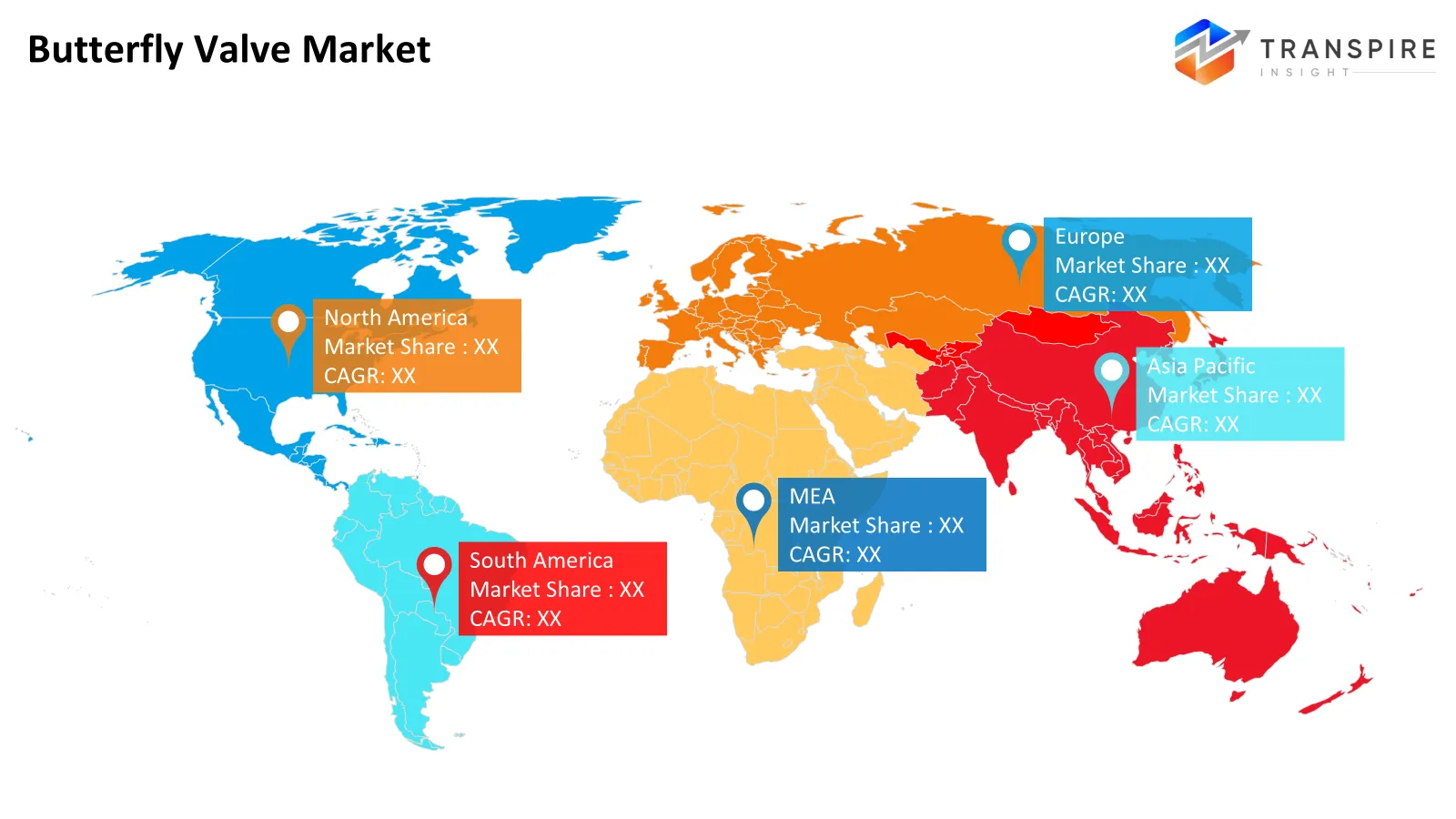
Asia Pacific has a leading share of 44.8% due to its large-scale manufacturing, rapid industrialisation, and large public infrastructure projects. China remains the world's leading manufacturer and consumer of valves, while India is working to upgrade its refineries and chemical parks and increase power capacity and water infrastructure in cities. The market has a large number of suppliers, reduced cost of component sourcing, and rising local demand from water treatment plants, oil and gas projects, industrial parks, and other infrastructure projects. Policy-backed investments and automation of factories are driving the replacement of manual valves with electric and pneumatic valves.
In July 2026, Duncan Engineering Limited secured a formal contract award from Bharat Petroleum Corporation Limited (BPCL) to supply advanced industrial valve systems for the ongoing Bina Petchem and Refinery Expansion Project in Madhya Pradesh, India.
North America, accounting for a 21.5% share of the total, and Europe (19.0%) are mature but robust markets fueled by replacement demand instead of capacity expansion. North America also profits from some shale gas-related activity, pipeline integrity programs, and water-infrastructure upgrades. Europe's markets, on the other hand, are more stable, driven by a combination of industrial decarbonization, strict leak- and emission-regulation targets, and water-and-district-energy network upgrades. Both show an increasing need for certified, high-performance, and digitally monitored valves, thus lending even more power to the aftermarket for established suppliers.
In June 2026, flow control manufacturer Flowserve Corporation closed the all-cash acquisition of Trillium Flow Technologies’ Valves Division for $490 million. This move directly strengthens the company's position as a leading high-specification flow control provider, expanding its specialized valve, actuation, and digital aftermarket capabilities across nuclear power, traditional generation, and critical infrastructure sectors.
Latin America remains the fastest-growing area at 5.0% CAGR but constitutes only 8.0% of demand. The revival of investments in Brazilian offshore oil, Chilean mining, and Argentine and Colombian refining has created demand for robustly isolated and throttling valves. Meanwhile, industrial automation is encouraging utilities and process plants to replace manual valves with electronically actuated, remotely controlled valves. Opportunities in the future include water infrastructure, mining water management, and energy projects requiring corrosion-resistant, serviceable valve packages.
In July 2026, Valmet completed the acquisition of Severn Group, an industrial valve manufacturer specialising in severe service applications. This transaction directly addresses the growing demand for specialized flow control by integrating Severn Group's high-end severe service valve portfolio into Valmet's Flow Control business line.
Who are the Key Players in the Butterfly Valve Market, and how do they compete?
Industry competition includes flow-control product portfolios worldwide, application-specific engineering capabilities, and regional distribution networks. Buyers in the industry consider pressure ratings, sealing performance, certification, actuator matching, and aftermarket service offerings, rather than simply price.
Cost competition is important for standard water-service valves, but most industrial installations in demanding applications require a focus on reliability, customization, and life-cycle-service orientation. Flowserve competes by leveraging its engineered solutions, automation, and broad service lineup. Its 2026 acquisition of Trillium's valve division broadened its power-and-nuclear product portfolio. Emerson emphasizes process automation and control-system integration. Bray International markets butterfly-valve styles and actuation solutions. AVK emphasizes water infrastructure, highly resilient seated products, and regional distribution networks. Flowserve Corporation pursues a niche-engineering approach to severe-service valves, material expertise, and lifecycle services for oil and gas, power, and chemical plant operators. Flowserve's growth plan combines engineered-to-order services with aftermarket service agreements for delivering service. Like many competitors-such as AVK, Bray International, DeZURIK, Velan, KSB, Crane, Weir, Pentair, Alfa Laval, Curtiss-Wright, Honeywell, and Valmet-Flowserve's competitors have differentiated market positioning: AVK focusing on municipal water systems, Bray on actuated valves, DeZURIK on wastewater management, Velan on high-pressure services, and KSB on pumps-plus-valves sales; they are differentiated by application expertise, distribution footprint, and certified product offerings, rather than extensive size.
Key Players are:
- Alfa Laval
- Curtiss-Wright
- Flowserve
- Emerson
- Pentair
- Weir Group
- AVK
- Crane
- Schlumberger
- Velan
- KSB
- Honeywell
- Bray International
- DeZURIK
- Valmet
Butterfly Valve Market — Enhanced Competitive Benchmarking
|
Company |
Est. Revenue Share Range |
Key Offerings |
Strategic Positioning |
Geographic Strength |
Technology Focus |
|
Emerson Electric Co. |
Estimated 2–4% |
Keystone resilient-seated, high-performance, triple-offset butterfly valves |
Broad portfolio; integrated automation and process-control solutions |
North America, Europe, Asia Pacific |
High-performance sealing; automated actuation; digital valve diagnostics |
|
Flowserve Corporation |
Estimated 2–4% |
Valtek, Durco, Worcester butterfly valves; severe-service designs |
Engineered flow-control solutions for demanding industrial applications |
North America, Europe, Middle East |
Severe-service engineering; corrosion-resistant materials; actuator integration |
|
AVK Holding A/S |
Estimated 1.5–3% |
Resilient-seated butterfly valves; water-network isolation valves |
Water infrastructure specialization; strong utility and municipal relationships |
Europe, Asia Pacific, Middle East |
Rubber-lined sealing; corrosion protection; water-network reliability |
|
Alfa Laval AB |
Estimated 1–2.5% |
LKB butterfly valves; hygienic and sanitary butterfly valves |
Premium hygienic flow control for process industries |
Europe, Asia Pacific, North America |
Hygienic design; cleanability; stainless-steel construction |
|
Bray International, Inc. |
Estimated 1–2.5% |
Series 20/30 butterfly valves; high-performance and triple-offset designs |
Specialist butterfly-valve manufacturer; integrated valve-actuator-control packages |
North America, Europe, Asia Pacific |
Resilient seating; disc and seat engineering; modular actuation |
|
Crane Company |
Estimated 1–2% |
Centerline butterfly valves; high-performance industrial butterfly valves |
Diversified valve supplier serving industrial and infrastructure applications |
North America, Europe, Asia Pacific |
High-performance sealing; engineered valve materials; industrial reliability |
|
KSB SE & Co. KGaA |
Estimated 1–2% |
BOAX butterfly valves; water and industrial butterfly valve solutions |
Pump-and-valve portfolio integration; application-focused engineering |
Europe, Asia Pacific, Middle East |
Hydraulic efficiency; corrosion-resistant designs; actuator compatibility |
|
Valmet Oyj |
Estimated 0.5–1.5% |
Neles butterfly valves; automated process-control valve solutions |
Process-industry specialisation; control-valve and automation integration |
Europe, North America, Asia Pacific |
Precision flow control; smart positioners; process automation |
|
L&T Valves Limited |
Estimated 0.5–1.5% |
Industrial butterfly valves; high-performance and engineered valve designs |
Project-driven engineering; competitive manufacturing and EPC relationships |
Asia Pacific, Middle East, Africa |
Pressure-rated designs; industrial metallurgy; customised engineering |
|
DeZURIK, Inc. |
Estimated 0.5–1.5% |
AWWA butterfly valves; eccentric and high-performance butterfly valves |
Speciality water, wastewater, and slurry applications |
North America, Europe, Asia Pacific |
Eccentric-disc designs; abrasion resistance; specialised sealing |
Recent Development News
- In June 2026, Velan delivered a series of 42-inch Class 900 triple-offset butterfly valves for a major LNG development project in Texas, USA. The delivery highlights growing demand for large-diameter, high-pressure valve solutions in LNG infrastructure and reinforces the importance of specialized engineering capabilities. https://ca.marketscreener.com/news/velan-news-june-2026-ce7f5cd2df8bf221
- In October 2026, NIBCO Inc. expanded its large-diameter ductile iron butterfly valve portfolio with the introduction of a moulded-in liner for its LD-2000 Series. This engineering update improves the performance and seating integrity of large-diameter valves used in heavy-duty flow control, mitigating line media leak risks and boosting operational reliability. https://www.industrialvalvenews.com/category/products/
- In January 2026, AVK Industrial Solutions acquired PetrolValves’ triple-offset valve manufacturing facility in Piacenza, Italy, including its workforce of 42 employees. The acquisition strengthens AVK’s production capabilities and expands its high-performance butterfly valve portfolio for industrial and energy applications. https://www.avkvalves.eu/en/news/avk-news/acquisition-of-petrolvalves-manufacturing-site
What Strategic Insights Define the Future of the Butterfly Valve Market?
The market is moving toward specifications-driven growth as end users become willing to pay more for performance (i.e., certified sealing, automation-ready, condition-monitoring) than the lowest unit price. Electric-actuated valves, a growth segment at 5.0%, will be the primary enabler, as many utilities and process plants seek to reduce manual control. A strategic risk is commoditization at the bottom of the market. Ductile-iron and standard wafer valves are susceptible to race-to-the-bottom price comparisons, tariff fluctuations, and unpredictable casting and steel costs, which can squeeze margins even as the premium market expands. A new growth area is in the severe-service and energy-transition infrastructure. Triple-offset, metal-seated, hydrogen-capable valves could tap into the premium market of LNG, refining, desalination, carbon-capture, and green-hydrogen projects. One strategic move is for manufacturers to deploy regional production, bundled with smart-valve offerings, predictive maintenance services, and application-specific certifications. That creates lifecycle revenue from valve sales that can help shield the business from the volatility of commodity-price cycles.
Key Segmentations are:
Function
- Manual
- Electric-Actuated
- Pneumatic-Actuated
- Hydraulic-Actuated
- Triple-Offset
- Wafer-Type
- Lug-Type
End Use
- Water & Wastewater
- Oil & Gas
- Power Generation
- Chemical
- Food & Beverage
- Pharmaceutical
- Other
Valve Type
- Concentric
- Double-Offset
- Triple-Offset
- High-Performance
- Resilient-Seated
- Metal-Seated
- Lined
Material
- Cast Iron
- Ductile Iron
- Carbon Steel
- Stainless Steel
- Aluminum
- Alloy Steel
- Plastic
Size
- Below 6 Inch
- 6–12 Inch
- 13–24 Inch
- 25–48 Inch
- 49–72 Inch
- Above 72 Inch
- Custom
Application
- Isolation
- Flow Regulation
- Throttling
- Pressure Control
- HVAC
- Process Control
- Emergency Shutoff
By Regional Analysis
North America
- US
- Canada
- Mexico
Europe
- Germany
- UK
- France
- Italy
- Spain
- Russia
- Rest of Europe
Asia Pacific
- China
- Japan
- India
- South Korea
- Australia
- Rest of Asia Pacific
South America
- Brazil
- Argentina
- Rest of South America
Middle East & Africa
- UAE
- Saudi Arabia
- Qatar
- South Africa
- Rest of the Middle East & Africa
Frequently Asked Questions
Find quick answers to common questions.
The butterfly valve market size was valued at USD 12.93 billion in 2025 and is poised to reach USD 18.56 billion by 2033, expanding at a 4.58% CAGR.
Key segments for the butterfly valve market are Function (Manual, Electric-Actuated, Pneumatic-Actuated, Hydraulic-Actuated, Triple-Offset, Wafer-Type, Lug-Type); End Use (Water & Wastewater, Oil & Gas, Power Generation, Chemical, Food & Beverage, Pharmaceutical, Other); Valve Type (Concentric, Double-Offset, Triple-Offset, High-Performance, Resilient-Seated, Metal-Seated, Lined); Material (Cast Iron, Ductile Iron, Carbon Steel, Stainless Steel, Aluminum, Alloy Steel, Plastic); Size (Below 6 Inch, 6–12 Inch, 13–24 Inch, 25–48 Inch, 49–72 Inch, Above 72 Inch, Custom); Application (Isolation, Flow Regulation, Throttling, Pressure Control, HVAC, Process Control, Emergency Shutoff).
Growth is primarily driven by expanding water and wastewater infrastructure, rising oil and gas investments, increasing demand for efficient flow-control systems, industrial automation, and the modernization of ageing pipelines and processing facilities. Growing adoption of compact, lightweight, and corrosion-resistant valves across power generation, chemical processing, and HVAC applications further supports market expansion.
The butterfly valve market is led by major manufacturers including Alfa Laval, Curtiss-Wright, Flowserve, Emerson, Pentair, Weir Group, AVK, Crane, Schlumberger, Velan, KSB, Honeywell, Bray International, DeZURIK, Valmet.
Asia Pacific holds approximately 44.8% of the butterfly valve market, supported by rapid industrialization, expanding water and wastewater infrastructure, rising manufacturing activity, urbanization, and investments in oil and gas, power generation, and chemical processing across China, India, and Southeast Asia.
Opportunities include smart valve integration, industrial automation, infrastructure modernization, corrosion-resistant valve development, and expanding water treatment and energy projects in emerging economies.
- Alfa Laval
- Curtiss-Wright
- Flowserve
- Emerson
- Pentair
- Weir Group
- AVK
- Crane
- Schlumberger
- Velan
- KSB
- Honeywell
- Bray International
- DeZURIK
- Valmet
About the Authors

Avinash Kumar
I’m Avinash Kumar, a Senior Research Analyst at Transpire Insight, with expertise in the Electronics and Semiconductor and Energy & Power industry. My work focuses on analyzing emerging technologies, market trends, industry developments, and innovation across these sectors. I specialize in transforming complex technical and market insights into clear, research-backed content that helps professionals, businesses, and decision-makers stay informed. Through continuous industry research and data-driven analysis, I strive to deliver accurate, reliable, and practical perspectives on the latest advancements shaping the semiconductor and energy landscape.

Chakradhar Khansole
Chakradhar serves as the Research Director at Transpire Insight, bringing over 8 years of experience in technology, innovation, and strategic market intelligence. He specializes in transforming complex market data into actionable business insights that enable organizations to make informed, growth-oriented decisions. Recognized for his strategic vision and analytical expertise, Chakradhar leads high-impact research initiatives, delivering comprehensive market assessments, competitive intelligence, and forward-looking industry analysis.
Recently Published Reports
-
Apr 2026
Fiber Optic Faceplates Market
Fiber Optic Faceplates Market Size, Share & Analysis Report By Type (< 300 mm2, 300-350 mm2, and > 350 mm2, By Application (Night Vision, Holographic Imaging, Medical, and Others), and Geography (North America, Europe, Asia-Pacific, Middle East and Africa, South and Central America), 2021 - 2031
-
Apr 2026
High Temperature Superconductors Market
High Temperature Superconductors Market Size, Share & Analysis Report By Type (1G HTS, and 2G HTS), By Application (Power Cable, Fault Current Limiter, and Transformer), and Geography (North America, Europe, Asia-Pacific, Middle East and Africa, South and Central America), 2021 - 2031
-
Apr 2026
Industrial Plugs and Socket Market
Industrial Plugs and Socket Market Size, Share & Analysis Report By Type (Industrial Plugs, Industrial Sockets), By Current (Up to 32 A, 32 to 125 A, Above 125 A), By Protection (Dustproof and Splash Proof, Waterproof, Explosion Proof), By End User (Heavy Industries, Oil and Gas, Chemicals and Pharmaceuticals, Power Generation, Others), and Geography (North America, Europe, Asia-Pacific, Middle East and Africa, South and Central America), 2021 - 2031
-
Apr 2026
InGaAs Avalanche Photodiodes Market
InGaAs Avalanche Photodiodes Market Size, Share & Analysis Report By Type (1100 - 1700 nm, and 1000 - 1600 nm), By Application (Missile Warning System, Muzzle Flash Detection, Wafer Defect Inspection, Laser Rangefinders, and Others), and Geography (North America, Europe, Asia-Pacific, Middle East and Africa, South and Central America), 2021 - 2031