
Busbar Trunking Market Summary:
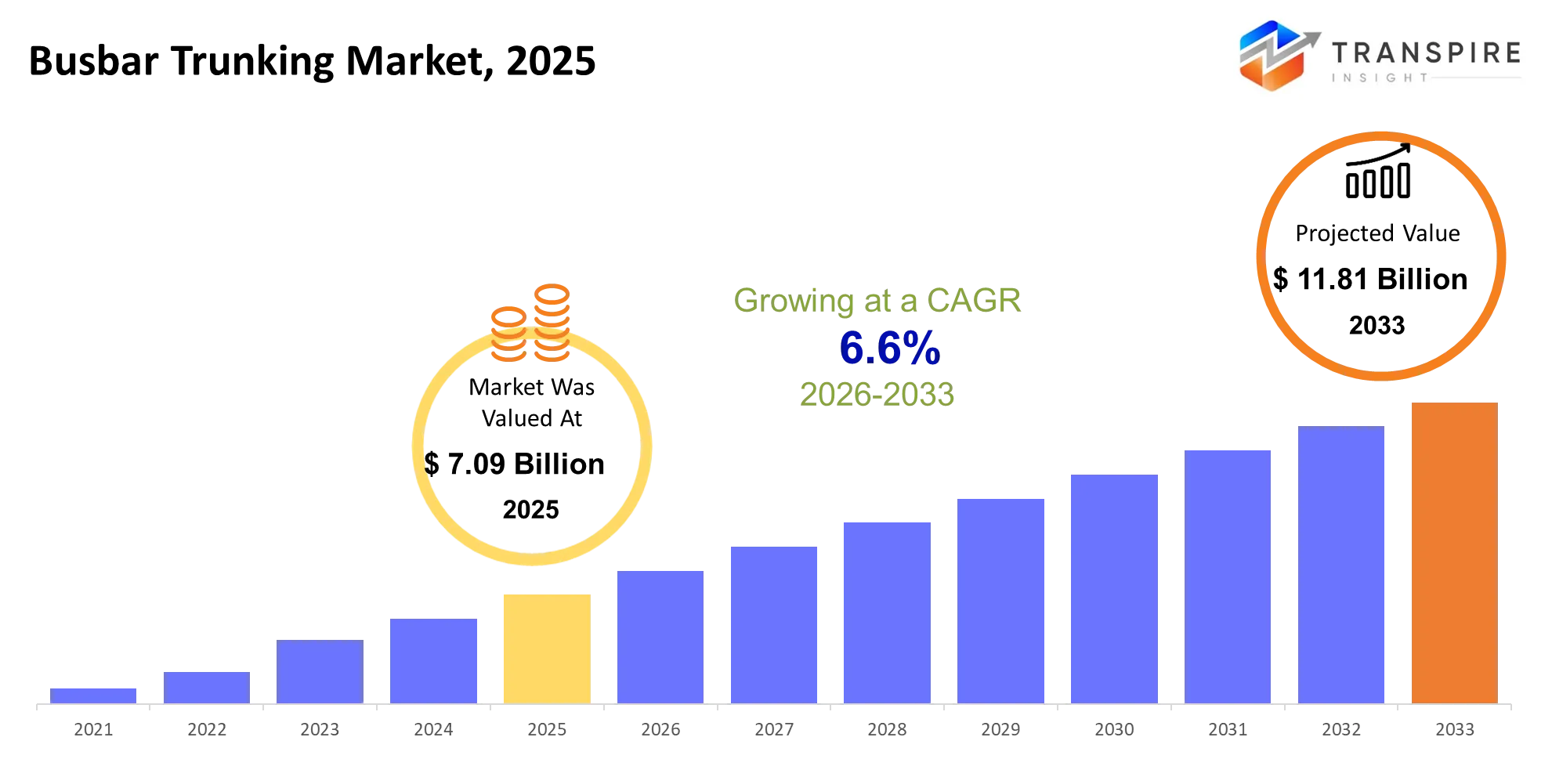
As per Transpire Insight, the Busbar Trunking Market size is estimated at USD 7.09 billion in 2025 and is anticipated to reach USD 11.81 billion by 2033, growing at a CAGR of 6.6% from 2026 to 2033.
The Busbar Trunking Market supports keeping electricity safe and moving smoothly inside buildings, factories, data centres, and big construction projects. In recent years, the Busbar Trunking Market has shifted away from old electrical wiring methods to newer, smaller modular busbar setups that can grow easily. The rapid build of high‑capacity data centres and the upgrade of factories have pushed this change faster. A key change in the Busbar Trunking Market is the use of monitoring tools and ready‑made power distribution units, which let operators handle shifting electricity needs. The fast rise of artificial‑intelligence sites has made the need for solid, high‑density power supply even stronger. When companies focus on installation, safe operation and good use of space, the Busbar Trunking Market shows that busbar trunking systems are a very practical choice compared with old cable‑based networks.
Busbar Trunking Market Size & Forecast:
- Market Size 2025: USD 7.09 Billion
- Expected Market Value (2033): USD 11.81 Billion
- Forecast CAGR (2026–2033): 6.6%
- Leading Region in 2025: Asia Pacific
- Fastest Growing Region: North America
- Key Company Profiles: Schneider Electric, Siemens, ABB, Legrand, Eaton, Vertiv, Larsen & Toubro, LS Cable & System, TMC Transformers, EAE, Pogliano, Godrej & Boyce, C&S Electric, Megabarre, Rittal
Key Market Insights
The industry is moving towards transformation into modular electricity distribution, driven by infrastructure development, industrialisation, and increased demand from data centres for power.
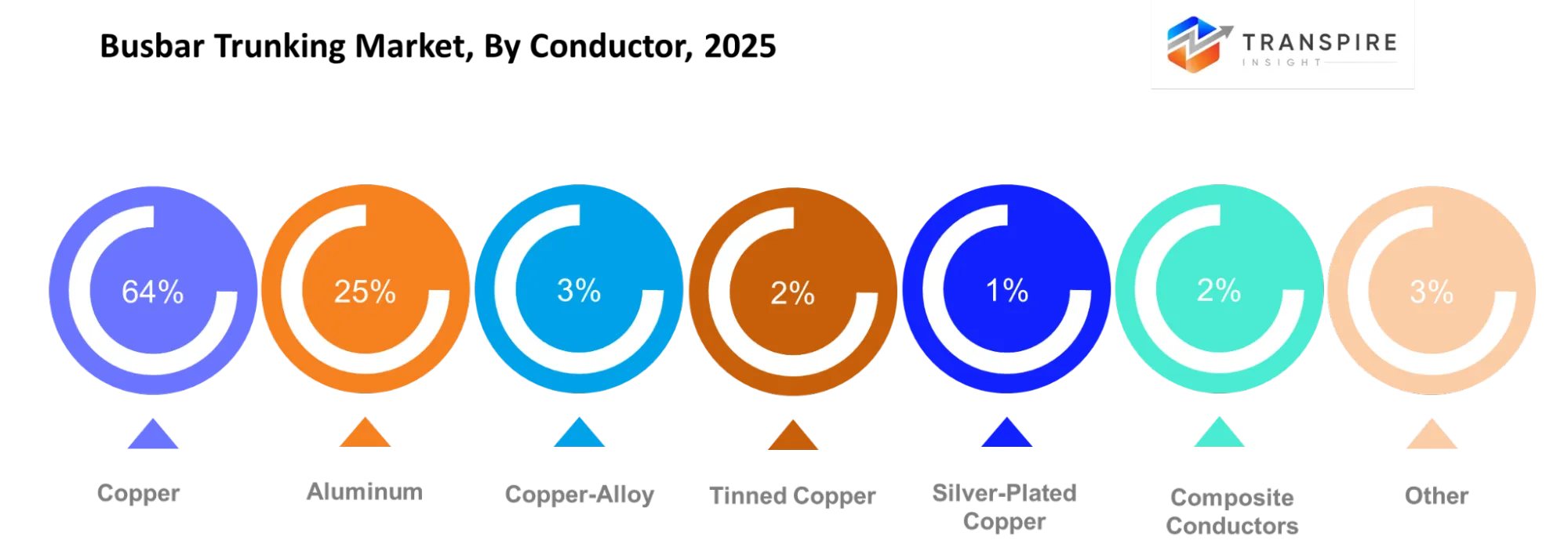
- Copper is the leading product in the conductor segment at a share of 64.06% due to its high conductivity and widespread usage in industry and commerce.
- Aluminium constitutes 25.0% of the conductor segment and is the fastest-growing segment, having a projected CAGR of 8.45%, as producers are looking at lighter and more cost-effective options.
- Copper alloy conductor makes up 3.5% of the conductor segment and has applications where mechanical and electrical properties matter.
- Tinned copper makes up 2.5% of the conductor segment and provides resistance to oxidation in harsh operating conditions.
- Silver-coated copper constitutes 1.5% of the conductor segment and is used in special electrical applications. Composite conductors have a share of 1.2%.
What are the Key Drivers, Restraints, and Opportunities in the Busbar Trunking Market?
Drivers:
The growing number of data centers, factories, and commercial sites has created a need for dependable electrical distribution systems. With the fast development of AI computing centers, the rack-level power consumption has grown. This has forced operators to use modular busbar trunking systems rather than traditional cables due to flexible connection options, easy system scaling, and optimal use of the space available.
Restraints:
High expenses associated with the installation of busbar trunking systems are the main obstacle that prevents manufacturers from further growth. These expenses include high prices caused by the necessity to hire certified engineers, buy specific equipment, and pay for installation services. Copper price fluctuations also cause troubles in procurement, which negatively affects the prices and profit margins of companies.
Opportunities:
The creation of data centres that are ready for AI, renewable energy facilities, and EV charging stations presents opportunities for companies in this industry. By creating high-capacity aluminium busbar systems, intelligent monitoring and prefabricated distribution assemblies, manufacturers will gain an advantage. The growth of data centre infrastructure in North America and industrial growth in Asia-Pacific represent opportunities for suppliers to establish themselves locally.
|
Driver |
Relative Impact on Growth (%) |
Geographic Relevance |
Impact Timeline |
Demand Strength |
Growth Mechanism (5–10 words) |
Key Beneficiaries (5–10 words) |
Major Constraint (5–10 words) |
|
Expansion of Data Centers and AI Infrastructure |
30% |
North America, Asia Pacific, Europe |
Short-term |
High |
Rising AI workloads increase demand for high-capacity power distribution. |
Busbar manufacturers, data center developers, electrical equipment suppliers. |
High installation costs and limited electrical infrastructure capacity. |
|
Increasing Industrial Electrification and Automation |
24% |
Asia Pacific, North America, Europe |
Medium-term |
High |
Industrial automation increases demand for reliable high-current distribution systems. |
Industrial manufacturers, busbar suppliers, automation solution providers. |
High initial investment and complex facility integration requirements. |
|
Growth in Commercial Construction and Urban Infrastructure |
18% |
Asia Pacific, Middle East & Africa, North America |
Medium-term |
High |
New buildings require compact and scalable electrical distribution infrastructure. |
Construction companies, electrical contractors, busbar manufacturers. |
Construction delays and fluctuations in infrastructure investment. |
|
Renewable Energy Integration and Grid Modernization |
16% |
Europe, Asia Pacific, North America |
Long-term |
High |
Renewable installations increase demand for efficient power distribution connections. |
Renewable developers, utility providers, electrical equipment manufacturers. |
Grid integration challenges and inconsistent renewable project investments. |
|
Demand for Energy-Efficient and Smart Power Distribution Systems |
12% |
Europe, North America, Asia Pacific |
Medium-term |
High |
Smart monitoring improves energy efficiency and operational reliability. |
Technology vendors, facility operators, smart busbar manufacturers. |
High technology costs and limited adoption in existing facilities. |
|
Total |
100% |
Global |
— |
— |
— |
— |
— |
What Has the Impact of Artificial Intelligence Been on the Busbar Trunking Market?
Artificial intelligence is affecting the growth of the Busbar Trunking Market in terms of advanced manufacturing procedures, electrical intelligence and applications in predictive maintenance. AI technologies can be incorporated into production to find manufacturing errors, minimise the usage of materials and control the quality of the assembly process. Also, intelligent monitoring systems can analyse the electrical load and fluctuations of the temperature in industrial plants and data centres to detect malfunctions. With the help of artificial intelligence, one can predict failures in equipment caused by abnormal heat distribution and connection breakdowns. It is also possible to assess the state of the equipment by analysing the load distribution. Therefore, such systems are valuable for predicting equipment malfunction and maintenance. In addition, operators can analyse the electricity distribution and estimate the requirements to expand capacity with the help of artificial intelligence. But AI incorporation is highly dependent on sensors and the quality of the data. Also, smaller manufacturers have certain difficulties with implementing artificial intelligence because of higher prices and a lack of technical knowledge.
Instance:
In March 2026, Vertiv launched an improved Vertiv PowerBar Track Double Stack Busway that is capable of meeting the higher power needs of AI-driven data centres. This busbar trunking system delivers high-capacity power distribution up to 2,500A, can easily scale in size, and offers real-time power monitoring by virtue of its built-in metering capability.
Key Market Trends:
The market is transitioning to intelligent, modular, and application-specific electrical distribution systems.
- Suppliers are now making use of modular busbar configurations, which will help customers increase the electrical distribution capacity without requiring any changes to be made to the existing infrastructure.
- Monitoring technology is becoming increasingly important as facility managers require better insight into electrical loads and performance of equipment.
- Suppliers are slowly looking at aluminium conductors to overcome issues related to cost, weight, and installation.
- Prefabricated electrical distribution assemblies are gaining importance as they will make the project easier and minimise the need for on-site installation activities.
- Suppliers are increasingly focusing on designing compact insulation solutions to maximise space and improve operational efficiency.
Busbar Trunking Market Segmentation
By Conductor:
Copper forms the leading market category, holding a 64.06% market share due to its excellent electrical conductivity, durability, and ability to handle power distribution efficiently. Aluminium comprises 25.0% of the market and has a forecasted CAGR of 8.45% since its light construction and cost efficiency make it a preferred choice among manufacturers and projects. The copper alloy conductor accounts for 3.5% and tinned copper 2.5% of the market segment. Silver-plated copper, composite conductor, and others hold 1.5%, 1.2%, and 2.24%.
By Insulation:
The air insulation can be considered where accessibility and ventilation of the systems is a priority. The sandwich insulation systems help in providing compact installation and efficient use of space. The epoxy insulation system and cast resin are ideal for systems that require electrical protection in tough operating conditions. PVC insulation systems and laminated systems offer further options.
By Power Rating:
Lower-power and lighting categories are often seen in very small commercial sites and building infrastructure. Medium-power categories are used for office complexes, commercial and business areas and industrial sites that require continuous electrical supply. High- and extra-high-power categories are used in applications that require high electricity consumption, such as heavy industry, manufacturing plants and large data centres. Feeder types provide electricity between large distribution areas. Lighting categories are for specialist lighting needs.
By End User:
Residential applies busbar trunking in buildings where installation of electrical power distribution is organised to optimise the available space. Commercial apartments, shopping malls, office buildings, hospitals and other commercial buildings need a highly reliable and versatile busbar system that can deliver multiple types of electrical loads. Industrial is an important market segment due to the need to support manufacturing processes, which require consistent and reliable power. The data centre segment is based on high-capacity power distribution, while infrastructure, utilities and transportation projects demand power due to modernization and development.
By Installation:
Most indoor systems are designed for applications in commercial structures, industrial plants and data centres where the electrical distribution equipment is located within the shelter of the building structure. Outdoor systems should be protected from exposure to the environment and operating conditions. Systems can be configured vertically or horizontally to match building layouts and distribution needs. Underground and overhead are for special installations, and modular is for future expansion.
By Application:
Power is the most common application. Busbar trunks are commonly used to distribute power as an efficient and tidy power transfer around various locations in a facility. Lighting distribution is used for industrial and commercial lighting, and data centres where high-power capacity flexible distribution is required for server banks. Manufacturing plants use it to distribute power to machinery and manufacturing equipment. Commercial, renewable energy, and EV charging applications are all potential applications of busbar trunking, as power demand continues to grow.
What are the Key Use Cases Driving the Busbar Trunking Market?
The use case of the Busbar Trunking Market is power distribution within industrial premises, office buildings, and factories. The copper system can be used for such projects due to its high conductivity and performance regardless of the load.Use cases include power distribution in data centres, hospitals, shopping malls, and other large infrastructure projects. Modular busbars enable the connection of extra devices, management of the electrical load, and maintenance of these systems. Some of the emerging applications include AI data centres, renewable energy sources, battery storage centres, and EV charging stations. Such projects need more flexible electrical power distribution solutions.
|
Report Metrics |
Details |
|
Market size value in 2025 |
USD 7.09 Billion |
|
Market size value in 2026 |
USD 7.56 Billion |
|
Revenue forecast in 2033 |
USD 11.81 Billion |
|
Growth rate |
CAGR of 6.6% from 2026 to 2033 |
|
Base year |
2025 |
|
Historical data |
2021 - 2024 |
|
Forecast period |
2026 - 2033 |
|
Report coverage |
Revenue forecast, competitive landscape, growth factors, and trends |
|
Regional scope |
United States; Canada; Mexico; United Kingdom; Germany; France; Italy; Spain; Denmark; Sweden; Norway; China; Japan; India; Australia; South Korea; Thailand; Brazil; Argentina; South Africa; Saudi Arabia; United Arab Emirates |
|
Key company profiled |
Schneider Electric, Siemens, ABB, Legrand, Eaton, Vertiv, Larsen & Toubro, LS Cable & System, TMC Transformers, EAE, Pogliano, Godrej & Boyce, C&S Electric, Megabarre, Rittal |
|
Customization scope |
Free report customization (country, regional & segment scope). Avail customized purchase options to meet your exact research needs. |
|
Report Segmentation |
Conductor (Copper, Aluminum, Copper-Alloy, Tinned Copper, Silver-Plated Copper, Composite Conductors, Other); Insulation (Air-Insulated, Sandwich-Insulated, Epoxy-Insulated, Cast Resin, PVC-Insulated, Laminated, Other); Power Rating (Low Power, Medium Power, High Power, Extra-High Power, Lighting, Distribution, Feeder); End Use (Residential, Commercial, Industrial, Data Centers, Infrastructure, Utilities, Transportation); Installation (Indoor, Outdoor, Vertical, Horizontal, Underground, Overhead, Modular); Application (Power Distribution, Lighting Distribution, Data Centers, Manufacturing Plants, Commercial Buildings, Renewable Energy, EV Infrastructure) |
Which Regions are Driving the Busbar Trunking Market Growth?
North America:
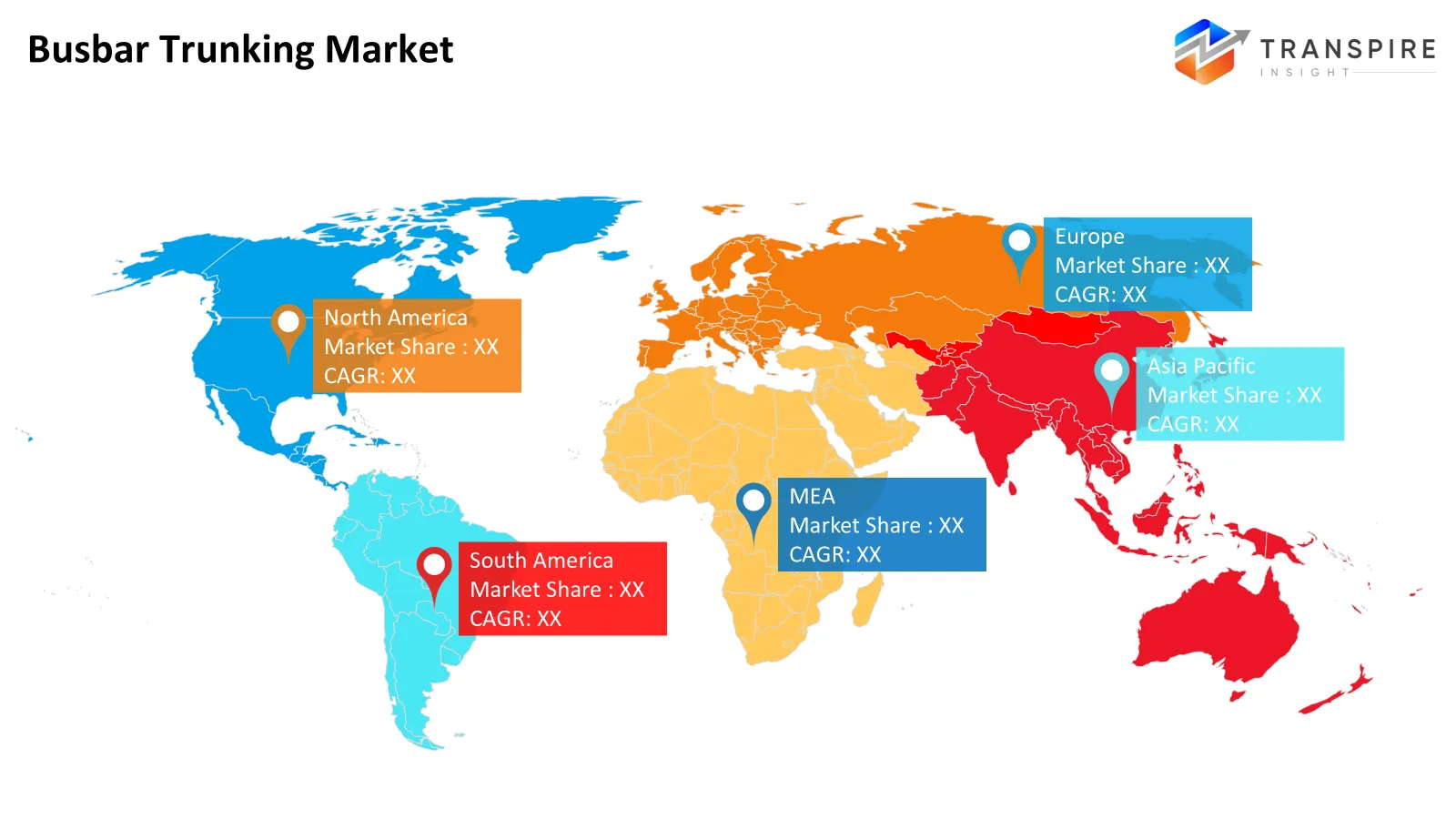
North America holds a 17.5% share of the market and is the fastest-growing regional market. The construction of hyperscale data centres, increased investment in AI infrastructure, and electricity needs are contributing to the use of busbar trunking systems with high capacity. Investments in computing facilities and electrification of industries are providing opportunities for companies that provide intelligent power distribution systems.
In November 2025, Schneider Electric launched plans to develop its North American headquarters, Winthrop Centre in Boston, with the use of energy-efficient and smart building technologies. This is due to the high need for efficient and intelligent electrical infrastructure and power distribution.
Europe:
Europe constitutes 21.0% due to a strong infrastructural setup, efforts towards energy efficiency, and improvement in commercial as well as industrial infrastructure. It also has strict electrical safety regulations and investments towards renewable energy projects. The European market is different from the Asia Pacific market as far as the Busbar Trunking Market is concerned because of the role that infrastructure modernisation, energy optimisation, and traditional electricity network replacement play.
In September 2025, Telenco launched the busbar trunking project for a hyperscale data centre in Spain in partnership with Mercury. They implemented EAE busbar systems. It shows the high implementation of reliable power distribution systems in European data centres.
https://www.telenco.com/en/news/busbars-datacenter-spain-neklandc
Asia Pacific:
Asia Pacific region has become the dominant part of the Busbar Trunking Market with a market share of 47.60%. The region owes its dominance to industrialisation, growth of industrial infrastructure, development in the construction sector, and development in the infrastructure sector. Countries such as China, India, Japan, and South Korea are putting in efforts towards modernising their electrical infrastructure and developing their industries.
In April 2026, TECO announced plans to create a plant for the manufacture of an armoured busway in Penang, Malaysia, which will be operated by its subsidiary TECOBAR.
https://www.teco.com.tw/en-us/press/news/20260429?tags=3510
Who are the Key Players in the Busbar Trunking Market and how do they compete?
The Busbar Trunking Industry has both traditional electrical equipment manufacturers and specialised industry vendors vying in terms of innovative products, manufacturing, price strategy, and distribution network. Schneider Electric, Siemens, ABB, Eaton, and Legrand target the supply of fully integrated electric distribution products for industrial, commercial and data centre applications. Schneider Electric uses its unique product offerings in the Canalis range and integration with energy management systems to differentiate itself, whereas Siemens targets engineering electric distribution systems for industrial & infrastructure applications. ABB differentiates itself with a wide-ranging electric distribution portfolio of applications. Eaton offers reliable power distribution products & systems suited for tough commercial and industrial applications. Legrand is growing its business by way of strategic acquisitions and developing specific data centre solutions, including its presence in Asian busbar manufacturing via Linkk Busway Systems. Vertiv is targeting high-density data centres with its innovative busbar systems. The regional manufacturers such as EAE Elektrik and C&S Electric use application-specific products and regional manufacturing & distribution networks to compete.
Busbar Trunking Market Companies
- Schneider Electric
- Siemens
- ABB
- Legrand
- Eaton
- Vertiv
- Larsen & Toubro
- LS Cable & System
- TMC Transformers
- EAE
- Pogliano
- Godrej & Boyce
- C&S Electric
- Megabarre
- Rittal
|
Company |
Est. Revenue Share Range |
Key Offerings |
Strategic Positioning |
Geographic Strength |
Technology Focus |
|
Schneider Electric |
11–13% |
Canalis busbar trunking, I-Line busway, tap-off units, power distribution accessories |
leadership through integrated electrical distribution solutions |
Europe, North America, Asia Pacific |
Modular busway, digital monitoring, energy-efficient distribution |
|
Siemens AG |
7–9% |
SIVACON 8PS BD2, LD, LI and LR busbar systems |
Premium positioning through engineering expertise and industrial integration |
Europe, Asia Pacific, North America |
Compact busbar architecture, high-current distribution, safety monitoring |
|
ABB Ltd. |
6–8% |
ABB busway systems, low-voltage busbar trunking, power distribution components |
Technology-led competition with broad electrification capabilities |
Europe, Asia Pacific, North America |
Modular distribution, thermal performance, electrical safety |
|
Eaton Corporation |
5–7% |
Pow-R-Way III, Pow-R-Way II, busway fittings, plug-in units |
Strong mission-critical and industrial power distribution positioning |
North America, Europe, Asia Pacific |
High-current busway, modular tap-off, fault protection |
|
Legrand SA |
4–6% |
Starline Track Busway, Zucchini busbar trunking, plug-in units |
Premium specialization in commercial buildings and data centres |
North America, Europe, Asia Pacific |
Track busway, flexible power access, modular distribution |
|
Vertiv Group |
2–4% |
PowerBar, overhead busway, data centre power distribution solutions |
Data-centre-focused differentiation and critical power specialization |
North America, Asia Pacific, Europe |
High-density power distribution, modular busway, intelligent monitoring |
|
EAE Elektrik |
2–4% |
E-Line KX, E-Line KO, E-Line MK, E-Line DL |
Product diversification with competitive project-based solutions |
Europe, Middle East & Africa, Asia Pacific |
Sandwich busbar technology, compact construction, modular connections |
|
LS Cable & System |
1–3% |
Busduct systems, low-voltage busway, power distribution busbars |
Regional manufacturing strength and industrial project specialization |
Asia Pacific, Middle East, North America |
Copper and aluminium conductors, insulation, high-capacity distribution |
|
C&S Electric |
1–3% |
Busbar trunking systems, sandwich busducts, feeder busducts |
Value-oriented competition supported by localized manufacturing |
Asia Pacific, Middle East & Africa |
Compact busducts, conductor insulation, modular power distribution |
|
Godrej & Boyce |
1–3% |
Busbar trunking systems, sandwich busducts, feeder and plug-in busducts |
Domestic manufacturing strength and customized project solutions |
Asia Pacific, Middle East & Africa |
Modular busduct design, high-current distribution, electrical protection |
Recent Development News
- In March 2026, Vertiv launched a new high-capacity double stack PowerBar Track busway solution that is optimised for AI-based and hyperscale data centres. The system can operate in configurations up to 2,000A according to UL 857 standards and up to 2,500A according to IEC 61439-6 standards, allowing flexible power distribution with improved space utilisation in high-density computing environments. https://investors.vertiv.com/news/news-details/2026/Vertiv-Announces-Scalable-High-Capacity-Double-Stack-Busway-System-that-Preserves-White-Space-for-Growing-AI-Data-Center-Demands/
- In June 2025, Legrand acquired Linkk Busway Systems, which is a Malaysian manufacturer of data centre power distribution systems. The company had more than 240 employees and had €45 million in annual revenues. This acquisition allowed Legrand to expand its busbar technology solutions and increase its share in the grey-space infrastructure of data centres. https://www.legrandgroup.com/sites/default/files/Documents_PDF_Legrand/Finance/2025/acquisition/Legrand-Press_Release_June_2025-1_1748891020.pdf
What Strategic Insights Define the Future of the Busbar Trunking Market?
The Busbar Trunking Market is expected to shift towards high capacity, modularity, and digitally monitored power distribution systems with the growing need for flexible power infrastructure in industrial installations and data centres. The companies that integrate advanced conductor technology and smart monitoring systems with pre-fabricated systems will have an edge over their competitors. Material reliance on copper, along with fluctuations in material prices, can pose risk factors and may impact production and project costs. One of the potential areas of growth includes the aluminium busbar trunking system due to its light weight and installation cost savings. The emergence of AI infrastructure, renewable energy infrastructure, and EV charging stations will present additional applications. It is recommended that companies focus on material diversification, localised production, product certifications, and partnerships.
Key Segmentations are:
Conductor
- Copper
- Aluminum
- Copper-Alloy
- Tinned Copper
- Silver-Plated Copper
- Composite Conductors
- Other
Insulation
- Air-Insulated
- Sandwich-Insulated
- Epoxy-Insulated
- Cast Resin
- PVC-Insulated
- Laminated
- Other
Power Rating
- Low Power
- Medium Power
- High Power
- Extra-High Power
- Lighting
- Distribution
- Feeder
End Use
- Residential
- Commercial
- Industrial
- Data Centers
- Infrastructure
- Utilities
- Transportation
Installation
- Indoor
- Outdoor
- Vertical
- Horizontal
- Underground
- Overhead
- Modular
Application
- Power Distribution
- Lighting Distribution
- Data Centers
- Manufacturing Plants
- Commercial Buildings
- Renewable Energy
- EV Infrastructure
By Regional Analysis
North America
- US
- Canada
- Mexico
Europe
- Germany
- UK
- France
- Italy
- Spain
- Russia
- Rest of Europe
Asia Pacific
- China
- Japan
- India
- South Korea
- Australia
- Rest of Asia Pacific
South America
- Brazil
- Argentina
- Rest of South America
Middle East & Africa
- UAE
- Saudi Arabia
- Qatar
- South Africa
- Rest of the Middle East & Africa
Frequently Asked Questions
Find quick answers to common questions.
The busbar trunking market size was valued at USD 7.09 billion in 2025 and is poised to reach USD 11.81 billion by 2033, expanding at a 6.6% CAGR.
Key segments for the busbar trunking market are Conductor (Copper, Aluminum, Copper-Alloy, Tinned Copper, Silver-Plated Copper, Composite Conductors, Other); Insulation (Air-Insulated, Sandwich-Insulated, Epoxy-Insulated, Cast Resin, PVC-Insulated, Laminated, Other); Power Rating (Low Power, Medium Power, High Power, Extra-High Power, Lighting, Distribution, Feeder); End Use (Residential, Commercial, Industrial, Data Centers, Infrastructure, Utilities, Transportation); Installation (Indoor, Outdoor, Vertical, Horizontal, Underground, Overhead, Modular); Application (Power Distribution, Lighting Distribution, Data Centers, Manufacturing Plants, Commercial Buildings, Renewable Energy, EV Infrastructure).
Growth is primarily driven by increasing demand for reliable and energy-efficient power distribution, rapid industrialisation, expanding data centre infrastructure, increasing commercial construction, urbanisation, and growing investments in electrical infrastructure modernisation.
The market is led by major manufacturers including Schneider Electric, Siemens, ABB, Legrand, Eaton, Vertiv, Larsen & Toubro, LS Cable & System, TMC Transformers, EAE, Pogliano, Godrej & Boyce, C&S Electric, Megabarre, Rittal.
Asia Pacific is the leader in the busbar trunking market with a market share of 47.60%, owing to the fast pace of industrialisation, development of commercial infrastructure, investments in data centres, and growth in demand for electricity.
Opportunities in the busbar trunking market are increased investments in data centre infrastructure, increased adoption of energy-efficient power distribution systems, development of smart buildings, increase in industrial automation, and upgrades of old electrical infrastructures.
- Schneider Electric
- Siemens
- ABB
- Legrand
- Eaton
- Vertiv
- Larsen & Toubro
- LS Cable & System
- TMC Transformers
- EAE
- Pogliano
- Godrej & Boyce
- C&S Electric
- Megabarre
- Rittal
About the Authors

Avinash Kumar
I’m Avinash Kumar, a Senior Research Analyst at Transpire Insight, with expertise in the Electronics and Semiconductor and Energy & Power industry. My work focuses on analyzing emerging technologies, market trends, industry developments, and innovation across these sectors. I specialize in transforming complex technical and market insights into clear, research-backed content that helps professionals, businesses, and decision-makers stay informed. Through continuous industry research and data-driven analysis, I strive to deliver accurate, reliable, and practical perspectives on the latest advancements shaping the semiconductor and energy landscape.

Chakradhar Khansole
Chakradhar serves as the Research Director at Transpire Insight, bringing over 8 years of experience in technology, innovation, and strategic market intelligence. He specializes in transforming complex market data into actionable business insights that enable organizations to make informed, growth-oriented decisions. Recognized for his strategic vision and analytical expertise, Chakradhar leads high-impact research initiatives, delivering comprehensive market assessments, competitive intelligence, and forward-looking industry analysis.
Recently Published Reports
-
Apr 2026
Active Power Filter Market
Active Power Filter Market Size, Share & Analysis Report By Type (Shunt Active Power Filters, Series Active Power Filter, Hybrid Active Power Filter), By Application (Harmonics Mitigation, Reactive Power Compensation, Voltage Regulation, Power Factor Correction), By Phase (Single Phase, Three Phase), By End-User Industry (Manufacturing, Healthcare, Commercial, Automotive, Oil and Gas, Others), and Geography (North America, Europe, Asia-Pacific, Middle East and Africa, South and Central America), 2021 - 2031
-
Apr 2026
Electrical Transformer Market
Electrical Transformer Market Size, Share & Analysis Report By Core (Closed, Shell, and Berry), By Insulation (Gas, Oil, Solid, Air, and Other), By Phase (Single, and Three), By Rating (100 MVA to 500 MVA, 501 MVA to 800 MVA, and 801 MVA to 1200 MVA), and Geography (North America, Europe, Asia-Pacific, Middle East and Africa, South and Central America), 2021 – 2031
-
Apr 2026
Hydraulic Piston Pumps Market
Hydraulic Piston Pumps Market Size, Share & Analysis Report By Type (Axial Piston Pumps, Radial Piston Pumps), By Operating Pressure (Low Pressure, Medium Pressure, High Pressure), By Application (Construction, Mining, Agriculture, Automotive, Oil & Gas, Industrial Machinery, Others), By End-User (OEMs, Aftermarket), and Geography (North America, Europe, Asia-Pacific, Middle East and Africa, South and Central America), 2021 – 2031
-
Apr 2026
Laboratory Gas Generators Market
Laboratory Gas Generators Market Size, Share & Analysis Report By Product (Nitrogen Gas Generator, Hydrogen Gas Generator, Zero Air Gas Generator, Purge Gas Generator, TOC Gas Generators, Others), By Application (Gas Chromatography, Liquid Chromatography-mass Spectrometry (LC-MS), Gas Analyzers, Others), By End-user (Life Science, Chemical & Petrochemical, Food & Beverage, Others), and Geography (North America, Europe, Asia-Pacific, Middle East and Africa, South and Central America), 2021 – 2031