

Bluetooth Low Energy Module Market Summary:
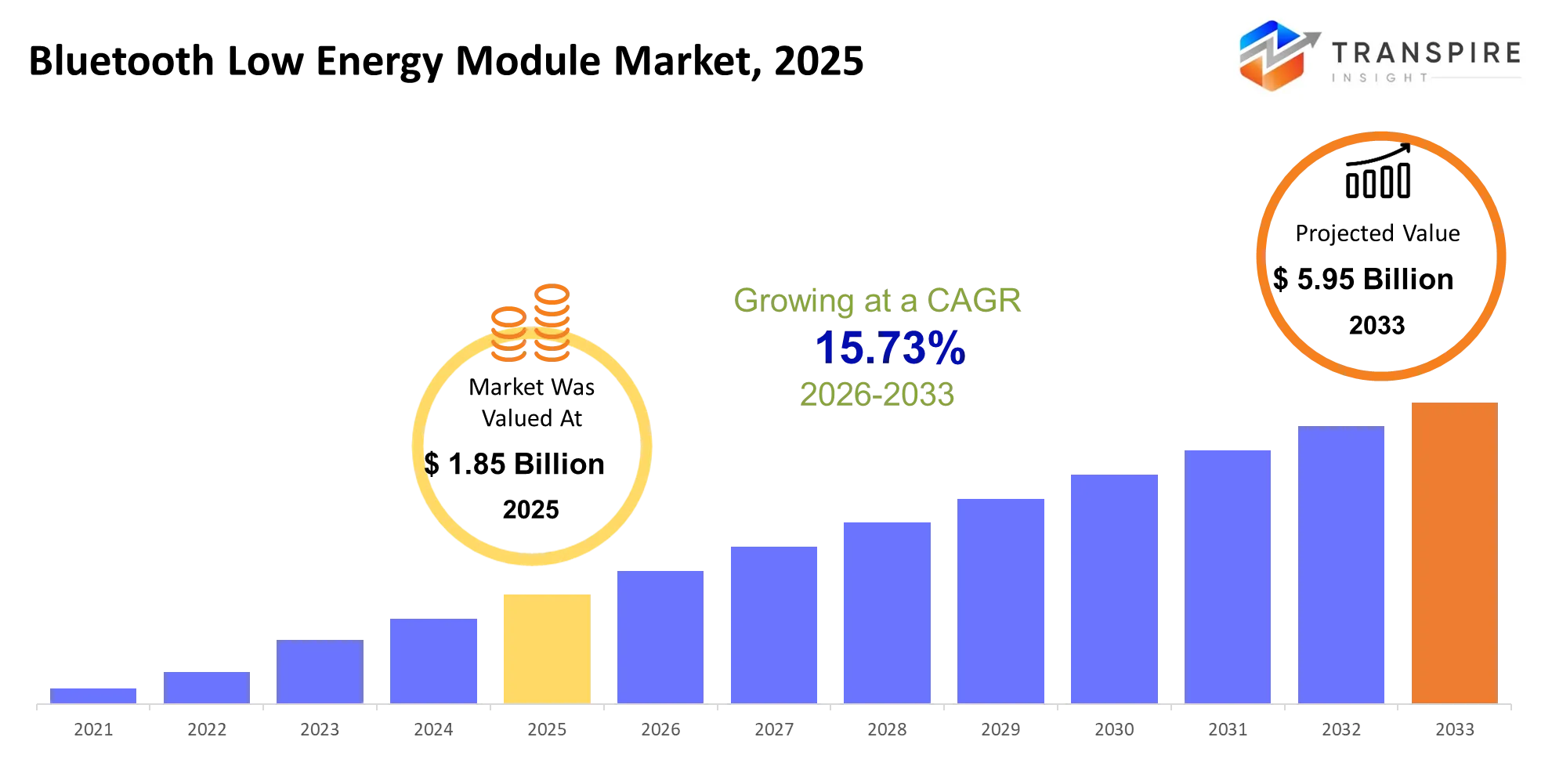
As per the Transpire Insight, The Bluetooth Low Energy Module Market size is estimated at USD 1.85 billion in 2025 and is anticipated to reach USD 5.95 billion by 2033, growing at a CAGR of 15.73% from 2026 to 2033.
The Bluetooth Low Energy (LE) module market is a key enabler of wireless connectivity to smart sensors, medical wearables, asset trackers, connected appliances and industrial equipment with no need for frequent battery replacement. In the past five years, module manufacturers have moved from simple wireless modules to small, multiprotocol, more secure, and more accurate-positioning modules with better energy efficiency. Interested in Bluetooth 6.0 Channel Sounding, the industry is placed on an increasing path of distance measurement accuracy for digital keys, tracking devices and access systems. Simultaneously, an increase in industrial IoT installations is changing traditional wired network monitoring structures with wireless, battery-powered networks to ease installation burden and create continued opportunity for connectivity and device management. Additionally, the GDPR in Europe, which demands breach notification, is guiding suppliers to improve the security and the lifecycle of their firmware, thus affecting module purchasing and choice.
Bluetooth Low Energy Module Market Size & Forecast:
- Market Size 2025: USD 1.85 Billion
- Expected Market Value (2033): USD 5.95 Billion
- Forecast CAGR (2026–2033): 15.73%
- Leading Region in 2025: Asia Pacific
- Fastest Growing Region: North America
- Key Company Profiles: Nordic Semiconductor, Silicon Labs, Qualcomm, Infineon Technologies, Texas Instruments, STMicroelectronics, NXP Semiconductors, Microchip Technology, Dialog Semiconductor, Murata, u-blox, Renesas Electronics, Panasonic Industry, Laird Connectivity, Ezurio.
Key Bluetooth Low Energy Module Market Insights:
The BLE module market is evolving from low-cost wireless connectivity to secure positioning, multiprotocol edge devices, and battery-friendly sensing platforms. Channel Sounding readiness, ultra-low power, and full software-and-certification ecosystems are competing criteria, not radio performance.
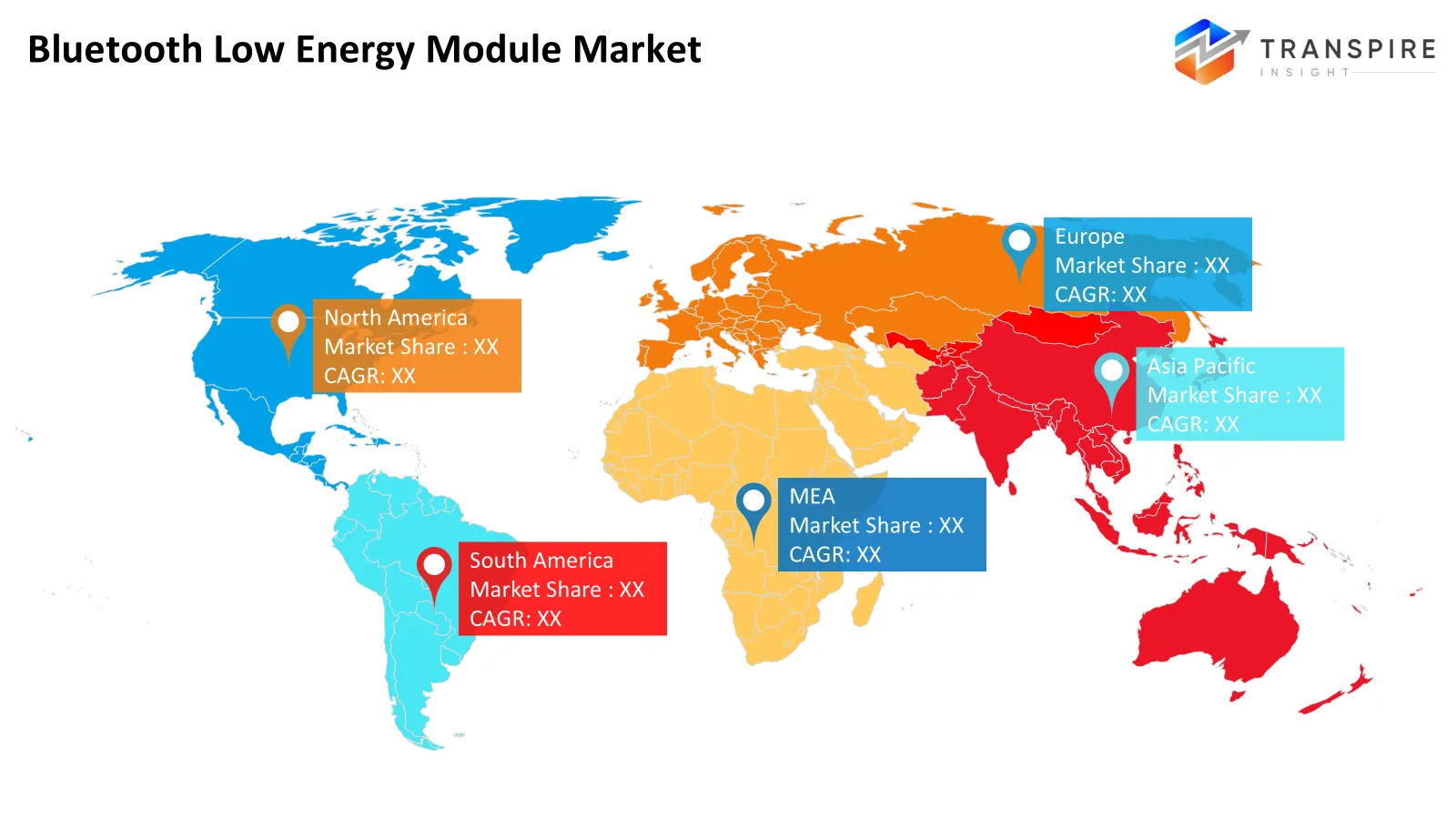
- Asia Pacific accounts for 48.0% share, driven by massive electronics, smartphone, wearable and IoT device production in China, Taiwan, South Korea, Vietnam and India.
- Healthcare IoT, industrial automation, and secure-access deployments are driving North America to account for 25.5% of the market and to expand at an 11.8% CAGR.
- In Europe, 19.0% are automotive, industrial, or smart-building buyers, and certified modules, security, and long product lifecycles are their top priorities.
- Latin America accounts for 4.2%, and demand is growing in the fields of retail automation, asset tracking, and connected metering projects.
- Middle East & Africa accounts for 3.3%, and early demand is emerging for smart city pilots and logistics digitalisation.
- Nordic Semiconductor's nRF54L Series was showcased at Embedded World 2026 with Android ranging tools, and is now capable of Bluetooth 6.0 Channel Sounding.
- Silicon Labs has integrated Bluetooth 6, Channel Sounding, hardware security, and a 14-15% reduction in the active-current consumption of its MCU compared to previous low-power models into its BG2B platform.
- Nordic's nRF54L15 is packaged in a pre-certified Nordic module, the PAN-B611 module family, from Panasonic, to minimise customer development risk.
- The DA14533 is an automotive-grade, AEC-Q100-qualified BLE SoC from Renesas, making BLE an application for vehicles.
- Consumers are increasingly turning to multiprotocol modules with BLE, Thread, Zigbee, and Matter support to streamline smart home and industrial designs.
What are the Key Drivers, Restraints, and Opportunities in the Bluetooth Low Energy Module Market?
Driver:
Industrial digitalisation and the growing adoption of battery-powered connected devices are accelerating BLE module deployment. Manufacturers increasingly require wireless sensors that monitor equipment conditions without expensive cabling or frequent maintenance. The introduction of Bluetooth 5.4 Periodic Advertising with Responses and Bluetooth 6.0 positioning capabilities has strengthened applications involving electronic shelf labels, asset tracking, and automated monitoring. These improvements support larger device installations, increase module procurement volumes, and create additional revenue opportunities through embedded connectivity solutions and engineering services.
Restraint:
Wireless interference, limited bandwidth, and security integration requirements continue to restrict deployment in demanding environments. Industrial facilities often contain metal structures, competing radio signals, and equipment that disrupt reliable communication. Manufacturers must also manage certification expenses, firmware maintenance, and interoperability testing. Europe's cybersecurity requirements add compliance responsibilities, particularly for suppliers serving multiple international markets. These structural challenges extend development cycles and increase product costs.
Opportunity:
The largest future opportunity lies in secure fine-ranging and edge-AI-enabled BLE systems. Bluetooth Channel Sounding, introduced in Core 6.0, enables sub-meter distance estimation using phase-based ranging and round-trip timing, creating demand for digital car keys, access control, child presence detection, and high-value asset tracking. Vendors that combine BLE modules with on-device anomaly detection, energy optimization, and privacy-preserving analytics can move beyond commodity radio sales into higher-value smart-sensing platforms, particularly in North America, Europe, and Asia-Pacific healthcare and industrial markets.
Driver Impact Analysis – Bluetooth Low Energy (BLE) Module Market
|
Driver |
Relative Impact on Growth (%) |
Geographic Relevance |
Impact Timeline |
Demand Strength |
Growth Mechanism |
Key Beneficiaries |
Major Constraint |
|
Expanding IoT Ecosystem and Connected Device Deployment |
30% |
Asia-Pacific, North America, Europe |
Short-term (≤2 years) |
High |
Expanding connected device installations accelerate BLE module integration. |
BLE manufacturers, IoT platform providers, electronics OEMs |
Interoperability challenges and fragmented device communication standards |
|
Rising Adoption of Wearables and Digital Healthcare Devices |
24% |
North America, Asia-Pacific, Europe |
Medium-term (2–4 years) |
High |
Continuous health monitoring increases low-power wireless connectivity requirements. |
Wearable manufacturers, medical device OEMs, semiconductor suppliers |
Battery limitations and stringent medical data security requirements |
|
Industrial IoT, Smart Manufacturing, and Asset Tracking Expansion |
19% |
Europe, North America, China, Japan |
Medium-term (2–4 years) |
High |
Industrial sensor networks increase demand for reliable connectivity. |
Industrial automation providers, module suppliers, logistics technology companies |
Harsh operating environments and complex legacy system integration |
|
Bluetooth LE Technological Advancements and Energy Efficiency Improvements |
15% |
North America, Europe, Asia-Pacific |
Long-term (≥4 years) |
High |
Channel sounding and enhanced connectivity enable advanced applications. |
Semiconductor developers, wireless module manufacturers, automotive electronics suppliers |
Certification expenses and compatibility with existing hardware |
|
Smart Buildings, Energy Management, and Connected Infrastructure Investments |
12% |
Europe, North America, Asia-Pacific, Middle East |
Medium-term (2–4 years) |
Medium |
Wireless building controls support scalable energy management deployments. |
Smart building integrators, lighting manufacturers, connectivity solution providers |
Installation costs and cybersecurity concerns delay widespread adoption |
|
Total |
100% |
— |
— |
— |
— |
— |
— |
What Has the Impact of Artificial Intelligence Been on the Bluetooth Low Energy Module Market?
AI also means BLE modules become more than just connectivity devices. For automation, AI models use BLE sensor data from gateways or edge controllers to control lighting, climate, machine configurations, and access controls without people needing to be involved. Predictive capabilities are another aspect of AI adoption that is already common in certain industries such as industrial maintenance and healthcare: BLE sensor-generated data on temperature, location, vibration and usage can reveal abnormal behaviour of machines, predict failure, or detect abnormal patient activity. In terms of operation, AI can make BLE networks smarter: learning usage patterns, then slowing down or speeding up scanning and advertising intervals, time between connection events, and even optimising routing of advertisements for minimal interference and power savings. AI also has the potential to give positioning a precision boost by fusing signal-strength, angle-of-arrival, direction-finding, and contextual data. These advances are not without challenge, though: the addition of AI means more processing, memory, firmware knowledge and testing, and potentially greater power consumption and cost than the low-cost BLE products selling well today using AI in the cloud or gateway.
In October 2026, Silicon Labs launched its new Simplicity AI SDK in public beta alongside its Simplicity Design Intelligence platform. This launch directly addresses the firmware complexity and integration challenges of edge-based AI by enabling AI coding assistants to autonomously configure, build, and debug complex Bluetooth Low Energy (BLE) sensor projects with native vendor context.
Key Bluetooth Low Energy Module Market Trends:
The Bluetooth Low Energy module has matured from a basic connectivity device to a smart wireless platform for secure positioning, automation, and distributed sensing. Most manufacturers are now focusing on security, battery life, and multiprotocol capabilities more than just basic wireless.
- With the introduction of Channel Sounding, Bluetooth Core 6.0 is taking BLE from “I think I'm close” to “I know exactly how far away I am.”
- AI-powered analytics are being integrated into device manufacturers' gateways and edge nodes to translate BLE sensor data into real-time operational decisions.
- The healthcare sector is moving from a standalone monitor to continuous remote patient monitoring, driving the demand for low-power medical-grade BLE modules.
- Industrial users are implementing BLE asset tags and condition-monitoring sensors to minimise downtime, inventory loss and manual tracking.
- The adoption of smart home is becoming more closely associated with Matter interoperability, which is driving vendors to invest in multi-protocol and easily certifiable modules.
- Automotive design is seeing BLE applications in digital keys, cabin controls, tire-pressure systems and proximity-based access.
- To meet the needs of wearables and medical devices with limited space, module suppliers are focusing on miniaturisation and system-in-package designs.
- Retail labels, building sensors, and logistics tags are slated for energy harvesting and batteryless concepts.
- Customers are looking for lifecycle support, security updates, and regulatory qualification, as well as the lowest module price.
- Wi-Fi HaLow, UWB, and cellular IoT are also competing with BLE, which is driving BLE vendors to focus on power efficiency, cost, and ecosystem compatibility.
Bluetooth Low Energy Module Market Segmentation
Module Type:
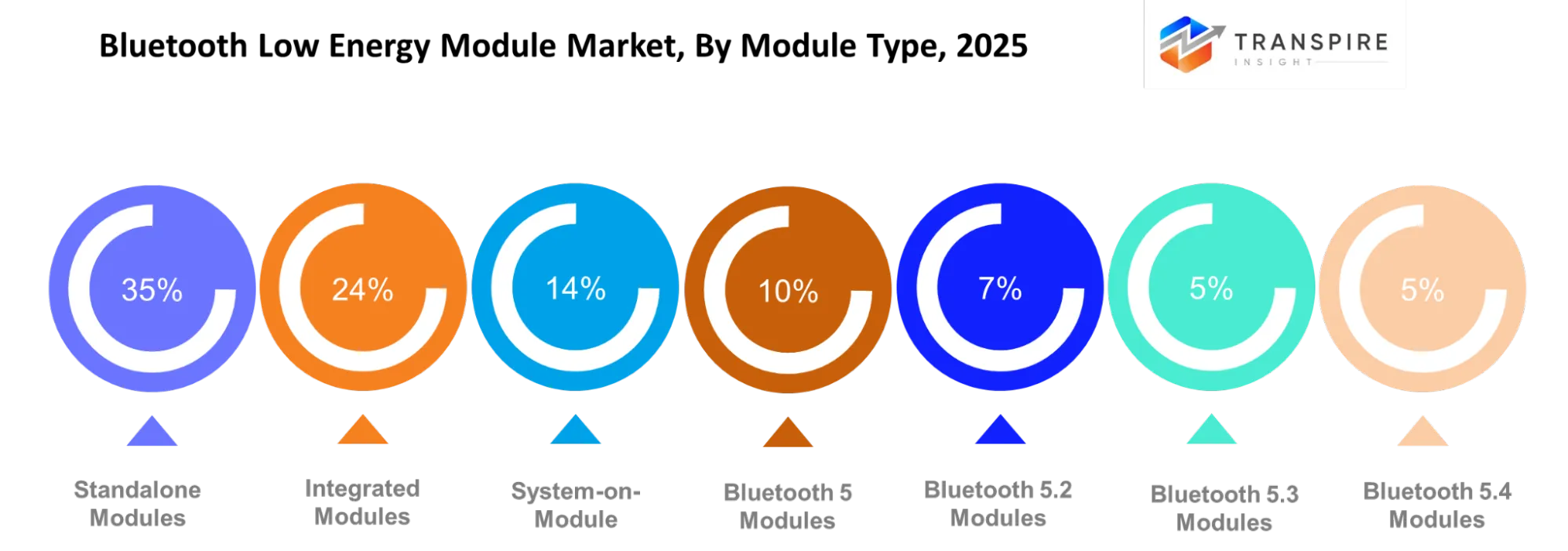
Standalone modules at 34.5%, leading the market with flexible design offerings for IoT, wearable, and smart-home applications. These modules are growing thanks to a higher degree of quick product customisation and easy firmware updates. Integrated modules at 24.0%, increasing market share as cost-effective, smaller designs combining radio, processing, and sensor functionalities become more attractive for OEMs. System-on-module solutions at 14.0% for more sophisticated industrial and medical platforms requiring higher processing power. Other modules at 11.0%, with 10.5% Bluetooth 5 modules, 7.0% Bluetooth 5.2 modules, 5.0% Bluetooth 5.3 modules, 3.0% Bluetooth 5.4 modules, and 2.0% other modules. The smallest market share is Bluetooth 5.4, but it is also the fastest-growing module with a CAGR of 18.6%, enabling better advertising and more reliable communication in industrial IoT applications.
Application:
IoT represents a major adoption area, supported by expanding connected infrastructure, remote monitoring, and wireless sensor networks. Wearables benefit from low-power connectivity that extends battery life, while smart homes increasingly integrate automated lighting, security, and environmental controls. Healthcare applications support continuous patient monitoring and connected medical equipment. Automotive manufacturers adopt BLE modules for digital keys and vehicle access systems. Industrial automation uses wireless sensors for predictive maintenance, while consumer electronics and other applications benefit from compact, secure connectivity solutions and integration.
Device Type:
Sensors represent a significant adoption category, supported by industrial monitoring, environmental sensing, and connected infrastructure. Trackers and beacons enable asset identification, proximity services, and location-based automation across commercial facilities. Smartphones maintain compatibility with connected accessories, while smart appliances increasingly incorporate wireless control and energy-management features. Medical devices benefit from continuous data transmission and remote monitoring capabilities. Automotive devices support digital keys and connected vehicle functions. Other specialised devices create opportunities for miniaturised modules offering reliable communication, security, and extended battery performance.
Communication Range:
Short-range connectivity maintains a strong position through smartphones, wearables, and personal electronic devices requiring efficient data exchange. Medium-range modules support smart buildings and commercial monitoring, while long-range configurations enable communication across warehouses and industrial facilities. Extended-range solutions address applications requiring wider coverage with limited infrastructure. Indoor deployments benefit from proximity sensing and asset tracking, whereas outdoor installations require stronger signal reliability. Mesh-based networks support distributed lighting and automation systems, creating opportunities for scalable connectivity across interconnected environments and facilities.
End User:
Consumer electronics represents a major adoption category, supported by wireless accessories, wearables, and connected household devices. Healthcare organisations increasingly deploy BLE-enabled medical equipment for remote patient monitoring and efficient clinical workflows. Automotive manufacturers integrate wireless modules into digital access and vehicle connectivity systems. Industrial users prioritise equipment monitoring and predictive maintenance, while retailers adopt electronic shelf labels and proximity-based services. Smart buildings benefit from automated energy management, and telecommunications providers support connected infrastructure, creating opportunities for specialised wireless connectivity solutions.
Deployment:
Embedded modules maintain a strong position because manufacturers integrate wireless connectivity directly into compact electronic products. External modules provide flexibility for equipment upgrades and specialised connectivity requirements. Gateway-based deployments enable communication between BLE devices and wider networks, while sensor-based installations support continuous environmental and equipment monitoring. Edge devices increasingly process information locally to reduce latency and network traffic. IoT platforms facilitate centralised device management, whereas wearable deployments prioritise compact designs and battery efficiency, supporting scalable, secure, and intelligent connected ecosystems.
What are the Key Use Cases Driving the Bluetooth Low Energy Module Market?
Standalone modules, holding 34.5% market share, support wireless sensors, asset trackers, and portable monitoring equipment. Their flexible integration enables manufacturers to introduce connected functionality without redesigning entire electronic systems, reducing development complexity.
Healthcare wearables transmit physiological readings to smartphones and monitoring platforms, while retailers use BLE-enabled electronic shelf labels for automated pricing. Industrial facilities deploy wireless vibration and temperature sensors to identify equipment deterioration and reduce unplanned downtime.
Emerging applications include secure digital keys, intelligent building access, and proximity-based automation. Bluetooth Channel Sounding improves distance-aware interactions, while edge analytics enables faster local decisions. These developments create opportunities for specialised modules supporting reliable positioning and low-power operation.
|
Report Metrics |
Details |
|
Market size value in 2025 |
USD 1.85 Billion |
|
Market size value in 2026 |
USD 2.14 Billion |
|
Revenue forecast in 2033 |
USD 5.95 Billion |
|
Growth rate |
CAGR of 15.73% from 2026 to 2033 |
|
Base year |
2025 |
|
Historical data |
2021 - 2024 |
|
Forecast period |
2026 - 2033 |
|
Report coverage |
Revenue forecast, competitive landscape, growth factors, and trends |
|
Regional scope |
United States; Canada; Mexico; United Kingdom; Germany; France; Italy; Spain; Denmark; Sweden; Norway; China; Japan; India; Australia; South Korea; Thailand; Brazil; Argentina; South Africa; Saudi Arabia; United Arab Emirates |
|
Key companies profiled |
Nordic Semiconductor, Silicon Labs, Qualcomm, Infineon Technologies, Texas Instruments, STMicroelectronics, NXP Semiconductors, Microchip Technology, Dialog Semiconductor, Murata, u-blox, Renesas Electronics, Panasonic Industry, Laird Connectivity, Ezurio. |
|
Customization scope |
Free report customization (country, regional & segment scope). Avail customized purchase options to meet your exact research needs. |
|
Report Segmentation |
Module Type (Standalone Modules, Integrated Modules, System-on-Module, Bluetooth 5 Modules, Bluetooth 5.2 Modules, Bluetooth 5.3 Modules, Bluetooth 5.4 Modules, Others)Application (IoT, Wearables, Smart Home, Healthcare, Automotive, Industrial Automation, Consumer Electronics, Others)Device Type (Smartphones, Sensors, Beacons, Trackers, Smart Appliances, Medical Devices, Automotive Devices, Others)Communication Range (Short Range, Medium Range, Long Range, Extended Range, Indoor, Outdoor, Mesh-Based, Others)End User (Consumer Electronics, Healthcare, Automotive, Industrial, Retail, Smart Buildings, Telecommunications, Others)Deployment (Embedded, External, Gateway-Based, Sensor-Based, Edge Devices, IoT Platforms, Wearable Devices, Others). |
Which Regions are Driving the Bluetooth Low Energy Module Market Growth?
Asia Pacific leads the pack with a 48.0% share, thanks to the region's high concentration of consumer electronics assembly, IoT device manufacturing, and contract manufacturing. The presence of multiple key players is just a "stone's throw away" from the component manufacturers, antenna manufacturers, and high-volume device OEMs (original equipment manufacturers). This delivers the benefit of reduced lead times and lower module costs, supported by government-assisted electronics manufacturing and rising demand for smart devices in the region. As a result, Asia Pacific remains the biggest region of consumption as well as the largest supply base for BLE-enabled products.
In March 2026, Hubble Network successfully demonstrated the first-ever direct-to-satellite connection using standard, off-the-shelf Bluetooth Low Energy (BLE) chips.
Europe accounts for 19.0% of revenue, representing a smaller regional market that is technically diversified. Industrial automation, connected medical devices, and energy-efficient building infrastructure are expected to increase the demand for products in Europe. The European Union's Cyber Resilience Act will compel manufacturers to improve security for wireless products, monitor product vulnerabilities, and maintain their firmware. Latin America accounts for 4.2% and the Middle East and Africa for 3.3%, driven by investments in smart infrastructure and industrial connectivity.
In February 2026, a consortium of European industrial manufacturers and technology providers launched the "Enhanced Cooperation for Cybersecurity" (ENFORCERS) initiative to deliver secure software supply chains, co-ordinated incident response, and lifecycle resilience under emerging EU cybersecurity frameworks.
https://en.wikipedia.org/wiki/European_Union
North America, with 25.5% of the market and the fastest growth, at an 11.8% CAGR, competes on the size of applications instead of volumetric sales. Applications for healthcare remote monitoring, industrial asset tracking, secure access control, and enterprise IOT platforms are provided by certified, secure, and long-life modules. The stability in North America can be attributed to a mature cloud and edge-computing environment, semiconductor design capability, and enterprise companies' investment for both safety and productivity in the workplace. Compared with the volume-led model in APAC, demand for modules with very high security, power management and software support is gradually increasing.
In October 2026, STMicroelectronics completed regulatory and carrier certifications for its advanced ST87M01 NB-IoT cellular modules across the United States and Canada.
https://newsroom.st.com/media-center/press-item.html/n4781.html
Who are the Key Players in the Bluetooth Low Energy Module Market, and how do they compete?
The Bluetooth Low Energy Module Market includes competition among certified communication solutions along with semiconductor technologies. The market players have competitive advantages based on power performance, development software, security, cost, and integration with applications. The competition is shifting towards one vendor with hardware and software, rather than just one wireless component.
Qualcomm's play is in a direct-to-premium-Audio niche, with its QCC-series SoCs and improved LE Audio quality, latency, and link margin for earbuds, hearing aids, and speakers. Texas Instruments is the broad consumer/industrial play with its CC26xx family. STMicroelectronics is the sensor+BLE integrated choice for wearables. Infineon and NXP are for connected automotive, industrial, and secure IoT. Renesas is entering automotive-grade BLE with the Q100-compliant DA14533. Murata, u-blox, Panasonic Industry, Laird Connectivity and Ezurio are all module specialists competing on pre-certified designs, size, type approval and customer accelerations. Nordic Semiconductor takes an innovation-led approach centred around its nRF54L and nRF54H platforms supporting Bluetooth 6.0, Channel Sounding, Bluetooth Mesh, Thread, Zigbee, Matter and Amazon Sidewalk. Its value prop is low power and multi-protocol support. The company is looking to build its position in healthcare wearables, industrial sensors, and Android-compatible ranging. Silicon Labs is the low-power platform with security at its core; the BG2B series features Bluetooth 6, Channel Sounding, hardware security and multiple peripherals for customers' system simplicity.
Key Players are:
- Nordic Semiconductor
- Silicon Labs
- Qualcomm
- Infineon Technologies
- Texas Instruments
- STMicroelectronics
- NXP Semiconductors
- Microchip Technology
- Dialogue Semiconductor
- Murata
- u-blox
- Renesas Electronics
- Panasonic Industry
- Laird Connectivity
- Ezurio
Bluetooth Low Energy Module Market — Enhanced Competitive Benchmarking
|
Company |
Est. Revenue Share Range |
Key Offerings |
Strategic Positioning |
Geographic Strength |
Technology Focus |
|
Murata Manufacturing |
Estimated 10–14% |
Type 2AB, Type 2EG, Type 2FR wireless modules |
High-volume integration leadership through compact, certified wireless modules |
Asia Pacific, North America, Europe |
Miniaturized RF modules, low-power connectivity, integrated antennas |
|
Nordic Semiconductor |
Estimated 9–13% |
nRF52840, nRF5340 and nRF54L-based module ecosystem |
Premium technology leadership through developer ecosystem and efficiency |
Europe, North America, Asia Pacific |
Ultra-low-power SoCs, Bluetooth LE, multiprotocol wireless connectivity |
|
u-blox |
Estimated 7–10% |
NINA-B4, NINA-B5, ANNA-B4 modules |
Industrial-grade differentiation through reliability and certification |
Europe, North America, Asia Pacific |
Secure BLE modules, industrial connectivity, compact architectures |
|
Silicon Labs |
Estimated 6–9% |
BGM220, BGM240, MGM240 module families |
Ecosystem-driven differentiation through secure multiprotocol IoT platforms |
North America, Europe, Asia Pacific |
Bluetooth LE, secure wireless stacks, energy optimization |
|
Infineon Technologies |
Estimated 5–8% |
AIROC CYW20820, CYW20835-based modules, partner modules |
Diversified connectivity strategy targeting industrial and consumer OEMs |
Asia Pacific, Europe, North America |
AIROC Bluetooth, low-power RF, embedded security |
|
STMicroelectronics |
Estimated 4–7% |
STM32WB5MMG, STM32WB-based wireless module solutions |
Embedded integration strategy leveraging established STM32 developer adoption |
Europe, Asia Pacific, North America |
Dual-core wireless MCUs, BLE stacks, hardware security |
|
Microchip Technology |
Estimated 4–6% |
RN4870, RN4871, WBZ451 module families |
Industrial specialization through long-lifecycle products and integration |
North America, Europe, Asia Pacific |
BLE 5 connectivity, embedded control, secure provisioning |
|
Ezurio |
Estimated 3–6% |
BL654, BL5340, BL54L wireless modules |
Certification-led specialization serving industrial and medical OEMs |
North America, Europe, Asia Pacific |
Certified BLE modules, antenna engineering, multiprotocol integration |
|
Panasonic Industry |
Estimated 3–5% |
PAN1780, PAN1781, PAN1782 wireless modules |
Compact module specialization backed by manufacturing expertise |
Europe, Asia Pacific, North America |
Low-power BLE modules, compact packaging, RF integration |
|
Renesas Electronics |
Estimated 2–5% |
DA14531 SmartBond TINY, DA1469x, DA14535MOD |
Value-oriented differentiation through low-power embedded wireless solutions |
Asia Pacific, North America, Europe |
SmartBond BLE, ultra-low-power design, integrated peripherals |
Recent Development News
- In July 2026, FDK Corporation announced the development of its ultra-compact HY0025 Bluetooth Low Energy module and began sample shipments to selected domestic customers. The Bluetooth 6-compatible module incorporates advanced distance measurement, long-range communication, and multi-protocol support, helping manufacturers develop compact, energy-efficient devices for healthcare, asset tracking, smart locks, and industrial IoT applications. https://www.fdk.com/whatsnew-e/release20260706-e.html
- In June 2026, Quectel Wireless Solutions introduced its FCM365X module, integrating Wi-Fi 6, Bluetooth Low Energy 5.4, Zigbee, and Thread connectivity. Built on NXP Semiconductors' RW612 wireless microcontroller, the module combines multiple wireless technologies in a single platform, simplifying hardware integration and supporting the development of connected smart-home products and industrial IoT devices. https://www.businesswire.com/news/home/20260624781458/en/Quectel-Introduces-NXP-based-FCM365X-Wi-Fi-6-Bluetooth-LE-5.4-Zigbee-and-Thread-Module-for-Smart-Home-and-Industrial-IoT-Solutions
- In April 2026, IndieSemiC partnered with Nordic Semiconductor to develop and commercialise certified wireless modules for connected-device applications. The collaboration combines IndieSemiC’s expertise in RF engineering, antenna design, testing, and certification with Nordic’s low-power wireless chipsets, helping accelerate the deployment of Bluetooth Low Energy and multiprotocol modules across wearables, healthcare equipment, smart-home devices, and industrial IoT systems. https://www.autocarpro.in/news/indiesemic-and-nordic-semiconductor-partner-to-develop-certified-wireless-modules-for-iot-applications-132192
What Strategic Insights Define the Future of the Bluetooth Low Energy Module Market?
The market is moving toward BLE modules as secure, location-aware edge nodes-not just a radio link. The big news in applications is Channel Sounding; it provides sub-meter range for digital keys, safety zones, asset tracking, and industrial HMI. But the real value will be in the extent to which phones, modules, and supporting software are interoperable.
A hidden risk is in certification and ecosystem fragmentation. Although many phones, modules, and software stacks support Channel Sounding, their support levels may slow its adoption. A further risk is in power budgets. Ranging, multiprotocol operation, and edge processing could end up destroying the battery-life benefits that make BLE worthwhile. The market opportunity is in pre-certified, multiprotocol BLE modules with integrated security and ranging support for health care, industrial safety, logistics, and intelligent buildings. Developers should focus on tools, Android interoperability, and reference designs to accelerate customer qualification cycles.
Key Segmentations are:
Module Type
- Standalone Modules
- Integrated Modules
- System-on-Module
- Bluetooth 5 Modules
- Bluetooth 5.2 Modules
- Bluetooth 5.3 Modules
- Bluetooth 5.4 Modules
- Others
Application
- IoT
- Wearables
- Smart Home
- Healthcare
- Automotive
- Industrial Automation
- Consumer Electronics
- Others
Device Type
- Smartphones
- Sensors
- Beacons
- Trackers
- Smart Appliances
- Medical Devices
- Automotive Devices
- Others
Communication Range
- Short Range
- Medium Range
- Long Range
- Extended Range
- Indoor
- Outdoor
- Mesh-Based
- Others
End User
- Consumer Electronics
- Healthcare
- Automotive
- Industrial
- Retail
- Smart Buildings
- Telecommunications
- Others
Deployment
- Embedded
- External
- Gateway-Based
- Sensor-Based
- Edge Devices
- IoT Platforms
- Wearable Devices
- Others
By Regional Analysis
North America
- US
- Canada
- Mexico
Europe
- Germany
- UK
- France
- Italy
- Spain
- Russia
- Rest of Europe
Asia Pacific
- China
- Japan
- India
- South Korea
- Australia
- Rest of Asia Pacific
South America
- Brazil
- Argentina
- Rest of South America
Middle East & Africa
- UAE
- Saudi Arabia
- Qatar
- South Africa
- Rest of the Middle East & Africa
Frequently Asked Questions
Find quick answers to common questions.
The Bluetooth Low Energy module market was valued at USD 1.85 billion in 2025 and is poised to reach USD 5.95 billion by 2033, growing at a 15.73% CAGR.
Key segments for the bluetooth low energy module market are Module Type (Standalone Modules, Integrated Modules, System-on-Module, Bluetooth 5 Modules, Bluetooth 5.2 Modules, Bluetooth 5.3 Modules, Bluetooth 5.4 Modules, Others)Application (IoT, Wearables, Smart Home, Healthcare, Automotive, Industrial Automation, Consumer Electronics, Others)Device Type (Smartphones, Sensors, Beacons, Trackers, Smart Appliances, Medical Devices, Automotive Devices, Others)Communication Range (Short Range, Medium Range, Long Range, Extended Range, Indoor, Outdoor, Mesh-Based, Others)End User (Consumer Electronics, Healthcare, Automotive, Industrial, Retail, Smart Buildings, Telecommunications, Others)Deployment (Embedded, External, Gateway-Based, Sensor-Based, Edge Devices, IoT Platforms, Wearable Devices, Others).
Growth is primarily driven by expanding IoT deployments, rising adoption of wearable devices, industrial automation, smart home connectivity, energy-efficient wireless communication, and advancements in Bluetooth 5.4 and 6.0 technologies.
The market is led by major manufacturers, including Nordic Semiconductor, Silicon Labs, Qualcomm, Infineon Technologies, Texas Instruments, STMicroelectronics, NXP Semiconductors, Microchip Technology, Dialogue Semiconductor, Murata, u-blox, Renesas Electronics, Panasonic Industry, Laird Connectivity, Ezurio.
Asia Pacific dominates the Bluetooth Low Energy Module Market with a 48.0% share, supported by strong semiconductor manufacturing capabilities, established electronics supply chains, expanding IoT adoption, cost-efficient production, and investments in smart manufacturing.
Key opportunities include Bluetooth 6.0-enabled precision tracking, AI-integrated wireless sensors, smart healthcare wearables, industrial IoT automation, secure digital keys, and multiprotocol connectivity solutions.
- Nordic Semiconductor
- Silicon Labs
- Qualcomm
- Infineon Technologies
- Texas Instruments
- STMicroelectronics
- NXP Semiconductors
- Microchip Technology
- Dialogue Semiconductor
- Murata
- u-blox
- Renesas Electronics
- Panasonic Industry
- Laird Connectivity
- Ezurio
About the Authors

Mayur Shinde
I am Mayur Shinde, a Senior Research Analyst at Transpire Insight, specializing in the Automotive & Transportation and Information & Communication Technology (ICT) Industry. My work focuses on analyzing emerging market trends, technological advancements, competitive landscapes, and industry developments to deliver accurate, data-driven insights. I am passionate about transforming complex market information into clear, actionable content that helps businesses, professionals, and decision-makers stay informed and make confident strategic decisions.

Chakradhar Khansole
Chakradhar serves as the Research Director at Transpire Insight, bringing over 8 years of experience in technology, innovation, and strategic market intelligence. He specializes in transforming complex market data into actionable business insights that enable organizations to make informed, growth-oriented decisions. Recognized for his strategic vision and analytical expertise, Chakradhar leads high-impact research initiatives, delivering comprehensive market assessments, competitive intelligence, and forward-looking industry analysis.
Recently Published Reports
-
Apr 2026
3D Optical Profiler Market
3D Optical Profiler Market Size, Share & Analysis Report By Type (Desktop 3D Optical Profiler, and Portable 3D Optical Profiler), By Technology (Confocal Technology, and White Light Interference), By End-Use Industry (Manufacturing, Research Institutions, Automotive, Aerospace and Defense, Medical Devices, and Other), and Geography (North America, Europe, Asia-Pacific, Middle East and Africa, South and Central America), 2021 - 2031
-
Apr 2026
Depth Sensor Market
Depth Sensor Market Size, Share & Analysis Report By Type (Infrared Depth Sensors, Time-of-Flight (ToF) Sensors, Stereo Vision Sensors, Structured Light Sensors, Ultrasonic Depth Sensors), By Application (Automotive, Robotics, Gaming, Consumer Electronics, Industrial Automation, Healthcare, Security & Surveillance, Others), By End Users (Automotive Manufacturers, Consumer Electronics Companies, Healthcare Providers, Industrial Companies, Security Agencies, Gaming Companies, Robotics Companies, Others), and Geography (North America, Europe, Asia-Pacific, Middle East and Africa, South and Central America), 2021 – 2031
-
Apr 2026
Digital Manufacturing Market
Digital Manufacturing Market Size, Share & Analysis Report By Component (Hardware, Software, and Services), By Technology (Robotics, 3D Printing, Internet of Things (IoT), and Others), By Application (Automotive and Transportation, Aerospace and Defense, Consumer Electronics, Industrial Machinery, and Others), By Process Type (Computer-Based Designing, Computer-Based Simulation, Computer 3D Visualization, Analytics, and Others), and Geography (North America, Europe, Asia-Pacific, Middle East and Africa, South and Central America), 2021 – 2031
-
Apr 2026
Digital Visa Services Market
Digital Visa Services Market Size, Share & Analysis Report By Type (Individual Travelers, Group Travelers), By Application (Tourism, Business Travel, Others), and Geography (North America, Europe, Asia-Pacific, Middle East and Africa, South and Central America), 2021 – 2031