Blood Pressure Monitoring Devices Market Summary:
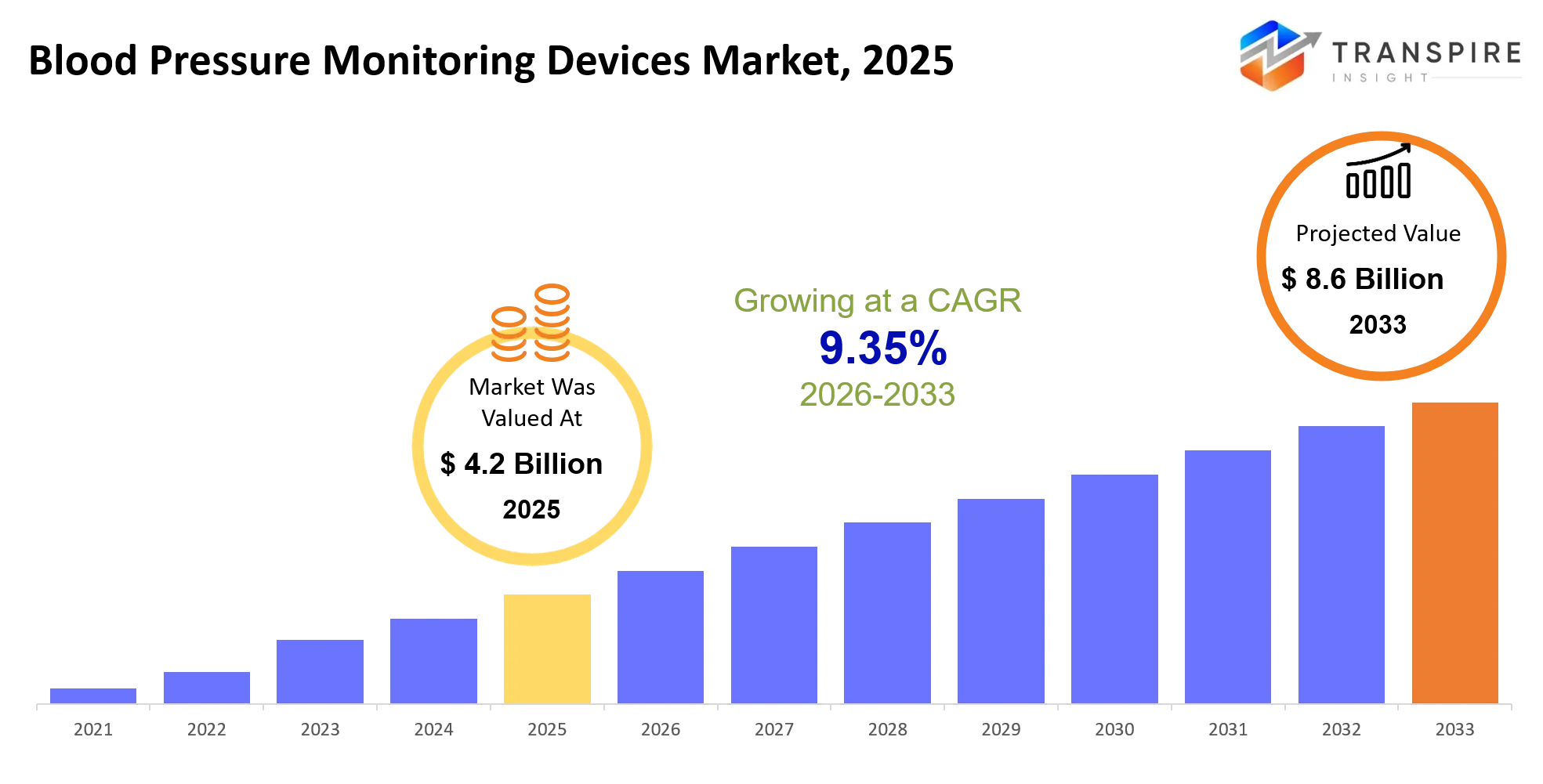
As per Transpire Insight Analysis, the Blood Pressure Monitoring Devices Market size is estimated at USD 4.2 billion in 2025 and is anticipated to reach USD 8.6 billion by 2033, growing at a CAGR of 9.35% from 2026 to 2033.
The blood pressure monitoring devices market is changing. Doctors and people are moving from checking blood pressure sometimes to checking it all the time and spotting heart problems earlier. Digital monitors are at the heart of this change because they give readings that are easy to use and let people keep track of their numbers at home. over three to five years, smartphone connectivity, remote patient monitoring, and wearable health technologies have helped take these devices out of hospitals and clinics. The major development in this case is that the connected monitoring devices are being integrated into health platforms such that the readings can be directly sent to the physicians. The introduction of hypertension alerts on the Apple Watch shows how regular gadgets are helping people become aware of their risks early, but all the findings need to be verified by a physician. Such innovations make the devices more appealing to users since they are more convenient and allow health care teams to monitor patients with hypertension.
Blood Pressure Monitoring Devices Market Size & Forecast:
- Market Size 2025: USD 4.2 Billion
- Expected Market Value (2033): USD 8.6 Billion
- Forecast CAGR (2026–2033): 9.35%
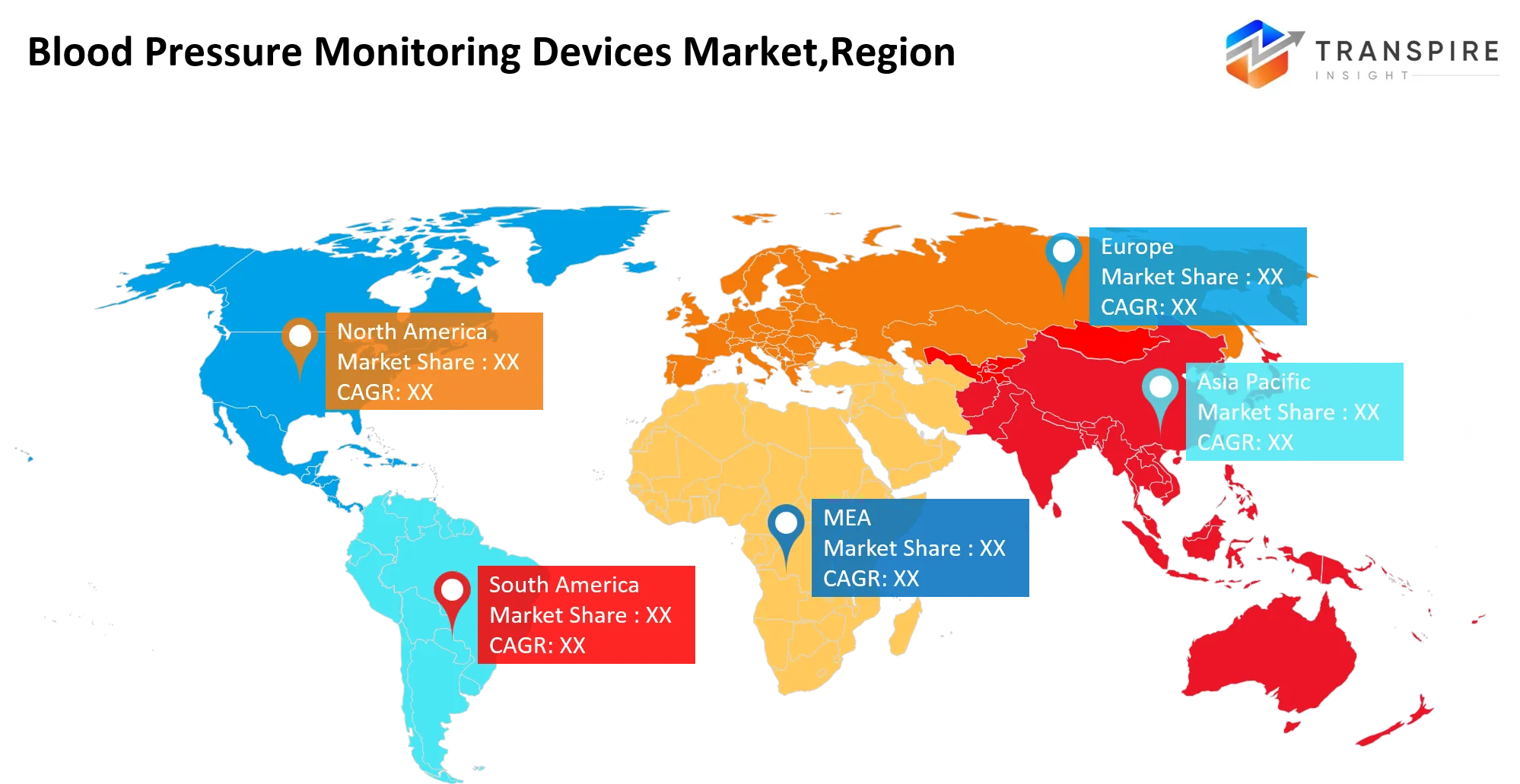
- Leading Region in 2025: North America
- Fastest Growing Region: Asia Pacific
- Key Company Profiles: Omron Healthcare, Koninklijke Philips, GE HealthCare, Hillrom, A&D Medical, Beurer, Microlife, Welch Allyn, Rossmax, SunTech Medical, Withings, Masimo, Nihon Kohden, Smiths Medical, American Diagnostic Corporation
Key Market Insights:
The market is moving towards convenient home monitoring, telemedicine, and early detection of risks regarding the cardiovascular health of patients.
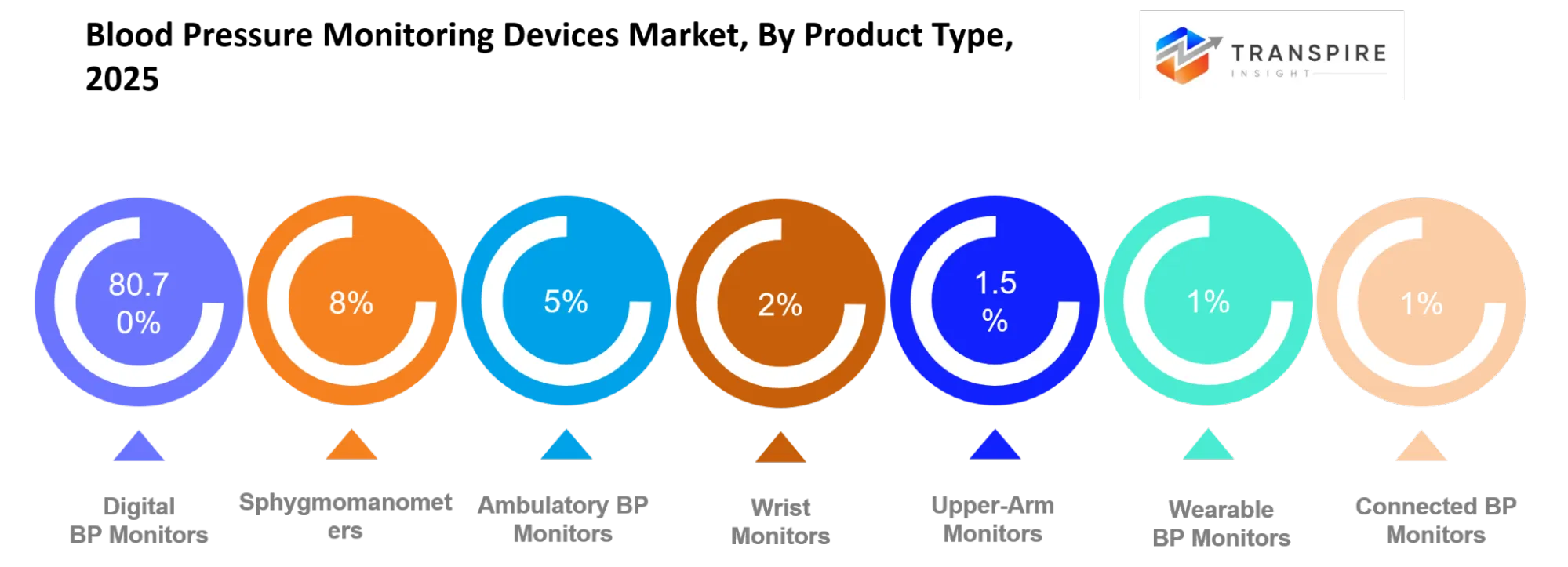
- Digital BP monitors hold 80.69% of the convenience of electronic measurement is crucial for the everyday monitoring process.
- Sphygmomanometers constitute 8.0% of the supplied segmentation as this type of device is still relevant in clinics that use conventional measuring devices.
- Ambulatory BP monitors make up 5.0% of the supplied segmentation, but the segment is expected to grow at a 10.2% CAGR according to the provided figures.
- Wrist monitors comprise 2.0%, providing an opportunity to produce small devices for people who prefer to use convenient-to-handle devices.
- Upper-arm monitors comprise 1.5%, offering another type of convenient monitoring with the use of arm cuffs.
- Wearable BP monitors constitute 1.0%, and research on wearable sensors and machine learning-based estimations is developing methods of continuous monitoring.
What are the Key Drivers, Restraints, and Opportunities in the Blood Pressure Monitoring Devices Market?
Drivers
Consistent control of hypertension is prompting the use of devices for measuring blood pressure at homes, clinics and healthcare facilities. The American Heart Association recommends the importance of home-based blood pressure monitoring in combination with follow-up at the clinical level. It aids adoption since repeat readings become helpful in taking medical actions based on them.
Restraints
Accuracy problems, improper placement of the cuff, inconsistency in measurements and the quality of the device can restrict users' confidence levels. They will continue because the readings obtained from them will be dependent on the technique followed, validated equipment and its interpretation. Wearables and connected devices may also face some affordability, connectivity and privacy issues.
Opportunities
The use of remote patient monitoring presents an opportunity for companies to blend connected monitors, application software and dashboards for the clinicians. Cellular-based solutions like the Withings BPM Pro 2 exemplify how devices may capture patient feedback and facilitate remote patient workflows. Companies will benefit from developing user-friendly devices, ensuring connectivity, and equipping healthcare providers with secure means of data sharing.
|
Driver |
Relative Impact on Growth (%) |
Geographic Relevance |
Impact Timeline |
Demand Strength |
Growth Mechanism |
Key Beneficiaries |
Major Constraint |
|
Rising prevalence of hypertension and cardiovascular diseases |
30% |
North America, Asia-Pacific, Europe |
Short-term |
High |
Increases routine blood pressure measurement and treatment monitoring |
Device manufacturers, hospitals, clinics, patients |
Limited awareness, affordability gaps, inconsistent monitoring practices |
|
Growing adoption of home healthcare and self-monitoring |
24% |
North America, Europe, Asia-Pacific |
Short-term |
High |
Encourages regular measurements outside hospitals and clinics |
Home-monitor manufacturers, pharmacies, telehealth providers |
Improper measurement techniques and poor patient adherence |
|
Technological advancements in digital and connected monitoring devices |
19% |
North America, Asia-Pacific, Europe |
Medium-term |
High |
Enables automated readings, connectivity, data storage, and tracking |
Smart device manufacturers, software vendors, healthcare providers |
Accuracy concerns, cybersecurity risks, and development costs |
|
Expansion of telehealth and remote patient monitoring services |
16% |
North America, Europe, Asia-Pacific |
Medium-term |
High |
Connects home readings with clinicians for timely treatment adjustments |
Remote-care providers, device manufacturers, digital health platforms |
Limited reimbursement, connectivity gaps, interoperability challenges |
|
Clinical validation and investment in advanced monitoring technologies |
11% |
North America, Europe, Asia-Pacific |
Long-term |
Medium |
Promotes validated devices and clinically reliable product innovation |
Medical device manufacturers, testing laboratories, healthcare institutions |
Costly validation, regulatory delays, uncertain cuffless-device accuracy |
|
Total |
100% |
Global |
— |
— |
— |
— |
— |
What Has the Impact of Artificial Intelligence Been on the Blood Pressure Monitoring Devices Market ?
The use of artificial intelligence is helping to move the application of blood pressure monitors beyond the task of registering readings and into the identification of trends that could require more clinical analysis. Through machine learning, it is possible to analyze physiological data, analyze multiple readings and identify trends that cannot be identified through single readings. This is especially important in the context of wearable sensors and other devices that are meant to monitor the cardiovascular system.Apple added hypertension alerts to their compatible Apple Watches. The function analyzes data collected by the optical heart sensor during 30 days to look for trends that might suggest the presence of hypertension.Through the use of AI, monitoring can also become more efficient through organizing readings and identifying trends, which is also useful in the context of remote patient management. However, there are limitations to such technologies. Wearable alerts are not a substitute for the use of the cuff method of measurement and cannot be used as a means of diagnosis. The American HeartAssociation does not recommend using cuffless devices to measure blood pressure due to imprecision.
Instance
In May 2025,OMRON Healthcare launched blood pressure monitors in the U.S. which utilize its IntelliSense AFib machine learning algorithm to detect atrial fibrillation while taking the patient’s blood pressure. The above information indicates the application of artificial intelligence in enhancing the cardiovascular screening process and the functionalities of home monitoring devices. The application of AI in the field provides an opportunity for device makers to design sophisticated devices for preventive care.
Key Market Trends:
Blood pressure measurement is shifting from sporadic readings towards connected and data-driven cardiovascular care.
- Integration with smartphones is transforming the way users record their readings, analyse their past results, and share this information with healthcare providers.
- Wearable sensor technology is transitioning towards continuous cardiovascular monitoring driven by research into machine learning-based blood pressure estimation.
- AI-powered screening is expanding the applications of consumer wearable devices, exemplified by Apple’s 2025 hypertension alert feature.
- Healthcare providers are putting more stress on contextual information about patients’ symptoms and medication adherence to enhance the value of remote monitoring data.
- The digital health ecosystem is enhancing the need for secure data transmission, interoperability, and clear reporting.
Blood Pressure Monitoring Devices Market Segmentation
By Device Type
The leading type of digital BP monitors is represented by 80.69% and is characterised by its ease of use, electronic display, and suitability for home-based measurements. Sphygmomanometers occupy 8.0% of the segment, as they are still relevant to healthcare facilities that use traditional measurement techniques. Ambulatory BP monitors represent 5.0% of the segment and have the highest CAGR at 10.2% per year according to the supplied forecast data. The capability to monitor patients' BP during daily activities makes the use of ambulatory BP monitors helpful in assessing BP readings outside the hospital or clinic environment. Wrist and upper-arm monitors represent 2.0% and 1.5% respectively. Wearable BP and connected BP monitors represent 1.0% of the market each.
By technology
oscillometric devices are essential in electronic devices since they facilitate automatic readings, whereas auscultatory devices are still essential in conventional clinical measurement. Automatic and semi-automatic devices cater to people with varying needs when it comes to convenience and control. Bluetooth and Wi-Fi devices aid in data transfer, whereas wearable devices are a new trend in development.
By end user
hospitals and clinics continue to play an essential role in professional assessment, diagnosis and follow-up. Home healthcare helps in repeated monitoring away from clinical settings whereas diagnostic centers and ambulatory centers use the devices for patient evaluation. Pharmacies, nursing homes and telehealth service providers provide alternative channels of adoption especially when it comes to monitoring alongside professional assistance.
By application
Hypertension monitoring continues to be one of the major use cases facilitated by the need for repeated measurements. Cardiovascular disease management depends on consistent blood pressure measurements. Pregnancy monitoring, diabetes management and preventive care constitute other use cases, whereas remote patient monitoring links the measurement with follow-up services. Clinical research is yet another use case where repeated and documented measurements may be required.
By connectivity
Bluetooth allows communication between the device and nearby smartphones and compatible software applications. However, Wi-Fi and cellular networks have the potential for data transmission by creating varied network configurations. Other possible methods of connecting or transferring data include NFC and USB. Cloud and smartphone-connected devices can be helpful in retaining historical records about measurements, which is contingent upon secure data management and compatibility of the health care systems.
By distribution channel
hospital pharmacies and medical stores are sources through which patients can get the devices in case they purchase their products from health care-related stores. On the other hand, retail pharmacies constitute another purchasing avenue for consumers. In addition, online retailers provide consumers with an opportunity to evaluate the product features and prices.
What are the Key Use Cases Driving the Blood Pressure Monitoring Devices Market?
Digital blood pressure monitors can facilitate regular at-home blood pressure readings as part of hypertension monitoring. Additional applications would include cardiovascular disease management, diabetes management, prenatal care, and prevention screenings. In hospitals and clinics, blood pressure is used to facilitate patient assessment; remote patient monitoring systems enable the integration of at-home blood pressure readings into the process. Future applications would be risk assessment based on wearable technology, monitoring programs using wearables and AI-based analysis of physiological signals. The new applications might help improve early diagnosis and make the monitoring process more convenient; however, newly developed wearable devices require proper validation from a clinical perspective.
|
Report Metrics |
Details |
|
Market size value in 2025 |
USD 4.2 Billion |
|
Market size value in 2026 |
USD 4.6 Billion |
|
Revenue forecast in 2033 |
USD 8.6 Billion |
|
Growth rate |
CAGR of 9.35% from 2026 to 2033 |
|
Base year |
2025 |
|
Historical data |
2021 - 2024 |
|
Forecast period |
2026 - 2033 |
|
Report coverage |
Revenue forecast, competitive landscape, growth factors, and trends |
|
Regional scope |
United States; Canada; Mexico; United Kingdom; Germany; France; Italy; Spain; Denmark; Sweden; Norway; China; Japan; India; Australia; South Korea; Thailand; Brazil; Argentina; South Africa; Saudi Arabia; United Arab Emirates |
|
Key company profiled |
Omron Healthcare, Koninklijke Philips, GE HealthCare, Hillrom, A&D Medical, Beurer, Microlife, Welch Allyn, Rossmax, SunTech Medical, Withings, Masimo, Nihon Kohden, Smiths Medical, American Diagnostic Corporation |
|
Customization scope |
Free report customization (country, regional & segment scope). Avail customized purchase options to meet your exact research needs. |
|
Report Segmentation |
Device Type (Digital BP Monitors, Sphygmomanometers, Ambulatory BP Monitors, Wrist Monitors, Upper-Arm Monitors, Wearable BP Monitors, Connected BP Monitors, Others)Technology (Oscillometric, Auscultatory, Automatic, Semi-Automatic, Bluetooth-Enabled, Wi-Fi-Enabled, Wearable Sensors, Others)End User (Hospitals & Clinics, Home Healthcare, Diagnostic Centers, Pharmacies, Ambulatory Centers, Nursing Homes, Telehealth Providers, Others)Application (Hypertension Monitoring, Cardiovascular Disease, Pregnancy Monitoring, Diabetes Management, Remote Patient Monitoring, Preventive Care, Clinical Research, Others)Connectivity (Bluetooth, Wi-Fi, Cellular, NFC, USB, Cloud-Based, Smartphone-Connected, Others)Distribution Channel (Hospital Pharmacies, Retail Pharmacies, Online Retailers, Medical Stores, Direct Sales, Distributors, E-commerce Marketplaces, Others) |
Which Regions are Driving the Blood Pressure Monitoring Devices Market Growth?
North America
North America holds the leading regional market, with a market share of 42.70%. This is due to the presence of a well-developed healthcare system and the availability of medical monitoring devices. Opportunities in this region are presented through the clinical focus on hypertension management and home monitoring. Also, connected healthcare solutions and remote patient monitoring programs provide opportunities for vendors with digital reporting capabilities. Product innovations and distribution channels of medical devices play a key role in maintaining its market position.
In May 2025, in the USA, OMRON Healthcare released home blood pressure monitors with AI-based atrial fibrillation (AFib) detection technology. The product uses a machine learning algorithm to identify heart rhythm abnormalities while measuring blood pressure. This innovation shows the potential of using advanced diagnostics and connected home healthcare solutions in North America.
Europe
Europe accounts for 23.72%. presence of a developed healthcare system and pharmacies, and the need for cardiovascular risk management. In comparison with North America, the commercial environment of this region is influenced by the healthcare system and medical device regulations in the region. Hospitals, outpatient clinics and home healthcare demand provide a diverse customer base.
In October 2025, Withings, a French company that develops connected health products, launched its BPM Vision blood pressure monitor. It can measure blood pressure and detect atrial fibrillation. The device also includes a high-definition colour screen that helps users conduct measurements. This launch demonstrates the region's growing interest in user-friendly cardiovascular monitoring devices and preventive healthcare solutions.
Asia-Pacific
The Asia-Pacific region holds a share of 22.33%, and it is the fastest-growing regional market, with a 12.22% CAGR. Growth in healthcare availability, increased availability of digital devices to consumers, and increasing preference for home-based monitoring provide an opportunity in several countries. The large population base and varied healthcare facilities in the region make it possible to cater to different pricing options.
In February 2026,Sky Labs, a South Korean manufacturer of medical technologies, launched CART ON, a ring-based blood pressure monitoring system intended for hospital wards. This system automatically measures and controls patients' blood pressure. Thus, it expands wearable monitoring technologies from consumer and outpatient applications to hospital setting. This innovation creates opportunities for wearable medical devices and patient monitoring in the hospitals of Asia-Pacific region.
Who are the Key Players in the Blood Pressure Monitoring Devices Market and how do they compete?
The competition in the market of blood pressure monitoring devices revolves around measurement accuracy, usability, clinical relevance, connectivity, and distribution reach. Traditional med-tech companies compete against digital health firms that are building their businesses around connected and wearable technologies. Each firm has different competitive strategies depending on whether they cater to hospitals, home users, or remote patient monitoring programs. OMRON Healthcare is focusing on home testing and expanded screening capabilities for other heart-related health issues. In May 2025, it launched its blood pressure monitors that have atrial fibrillation detection capabilities powered by artificial intelligence. It is setting itself apart from competitors by integrating yet another heart health screening feature into its product. Withings sets itself apart with its connected and remote monitoring capabilities. Withings' BPM Pro 2 integrates cellular connectivity along with patient feedback capabilities meant to help healthcare professionals, which is how the company is positioning itself in provider-led monitoring programs.
Blood Pressure Monitoring Devices Market companies
- Omron Healthcare
- Koninklijke Philips
- GE HealthCare
- Hillrom
- A&D Medical
- Beurer
- Microlife
- Welch Allyn
- Rossmax
- SunTech Medical
- Withings
- Masimo
- Nihon Kohden
- Smiths Medical
- American Diagnostic Corporation
|
Company |
Est. Revenue Share Range |
Key Offerings |
Strategic Positioning |
Geographic Strength |
Technology Focus |
|
OMRON Healthcare |
Estimated 12–20% |
Upper-arm monitors, wrist monitors, connected BP monitors, AFib-screening devices |
Consumer market leadership through trusted monitoring products |
Asia Pacific, North America, Europe |
Oscillometric sensing, AFib screening, Bluetooth connectivity |
|
A&D Company, Limited (A&D Medical) |
Estimated 5–10% |
Home BP monitors, TM-2440 ABPM, TM-2441 ABPM, automated office monitors |
Clinical accuracy combined with broad monitoring applications |
Asia Pacific, North America, Europe |
Oscillometric measurement, ambulatory monitoring, noise filtering |
|
Microlife Corporation |
Estimated 4–8% |
BP B3 AFIB, WatchBP systems, home monitors, professional office monitors |
Hypertension screening and specialized cardiovascular detection |
Europe, Asia Pacific, North America |
AFib detection, multiple-measurement averaging, central BP measurement |
|
Baxter International (Welch Allyn) |
Estimated 4–8% |
Connex Spot Monitor, ProBP devices, integrated vital-sign monitors |
Clinical workflow integration and hospital-focused distribution |
North America, Europe, Asia Pacific |
Automated BP measurement, vital-sign integration, clinical data connectivity |
|
Koninklijke Philips N.V. |
Estimated 3–7% |
IntelliVue patient monitors, bedside BP monitoring, portable patient monitors |
Hospital monitoring integration and premium clinical solutions |
North America, Europe, Asia Pacific |
Continuous non-invasive BP monitoring, patient data integration, clinical analytics |
|
Beurer GmbH |
Estimated 2–5% |
BM-series upper-arm monitors, wrist monitors, BM 95, connected BP devices |
Consumer wellness positioning with accessible digital devices |
Europe, Asia Pacific, North America |
Digital oscillometry, arrhythmia indicators, Bluetooth connectivity |
|
GE HealthCare |
Estimated 2–5% |
CARESCAPE patient monitors, bedside monitoring systems, integrated BP measurement |
Hospital-grade monitoring for complex clinical environments |
North America, Europe, Asia Pacific |
Non-invasive BP modules, multiparameter monitoring, clinical interoperability |
|
Withings |
Estimated 1–4% |
BPM Connect, BPM Vision, connected blood pressure monitoring devices |
Premium connected health with consumer-friendly design |
Europe, North America, Asia Pacific |
Wi-Fi synchronization, app-based tracking, integrated ECG in selected devices |
|
SunTech Medical |
Estimated 1–4% |
Tango M2, Oscar 2 ABPM, veterinary and clinical BP systems |
Specialized monitoring for stress testing and ambulatory diagnosis |
North America, Europe, Asia Pacific |
Motion-tolerant measurement, ambulatory monitoring, clinical BP algorithms |
|
iHealth Labs |
Estimated 1–3% |
iHealth Track, wireless BP monitors, smartphone-connected monitoring devices |
Affordable connected monitoring for home healthcare |
North America, Asia Pacific, Europe |
Bluetooth data transfer, mobile health applications, digital reading management |
Recent Development News
In October 2026, RunStar introduced the LoopGo Wireless Blood Pressure Monitor. RunStar released its LoopGo Wireless Blood Pressure Monitor with tubeless technology, a rotating colour screen, Bluetooth capabilities, and mobile application tracking. This marks an example of ongoing product development with simpler and more convenient home monitoring and record-keeping.
In September 2025, Apple released hypertension alerts for Apple Watch. Apple released a new feature which analyzes heart sensor readings of an Apple Watch over the period of 30 days in order to detect any pattern that may be linked to hypertension.
What Strategic Insights Define the Future of the Blood Pressure Monitoring Devices Market?
market future the producers can combine accuracy and user-friendliness and connectivity. Currently, the segmentation provided by the digital BP monitors dominates the market. There are many emerging markets for the ambulatory monitors, remote patient management, and wearable risk assessments. It would be wise for the producers to give priority to clinically proven tools with a user-friendly interface and safety measures instead of just the technology per se. Incorrect methods and various degrees of accuracy can cause confusion in the interpretation of the results received via notifications from wearables and algorithms. The first major risk associated with this trend is patients receiving notifications and estimates generated by algorithms as a diagnosis. The possible opportunity for manufacturers would involve cooperation with healthcare providers, pharmacies, and telehealth companies in connecting of tests at home and medical treatment, if necessary. For the producer to dominate in the market, he needs validation, interoperability, and affordability of connected health devices. Regional strategy must include product affordability and regulations in the region.
Device Type
- Digital BP Monitors
- Sphygmomanometers
- Ambulatory BP Monitors
- Wrist Monitors
- Upper-Arm Monitors
- Wearable BP Monitors
- Connected BP Monitors
- Others
Technology
- Oscillometric
- Auscultatory
- Automatic
- Semi-Automatic
- Bluetooth-Enabled
- Wi-Fi-Enabled
- Wearable Sensors
- Others
End User
- Hospitals & Clinics
- Home Healthcare
- Diagnostic Centers
- Pharmacies
- Ambulatory Centers
- Nursing Homes
- Telehealth Providers
- Others
Application
- Hypertension Monitoring
- Cardiovascular Disease
- Pregnancy Monitoring
- Diabetes Management
- Remote Patient Monitoring
- Preventive Care
- Clinical Research
- Others
Connectivity
- Bluetooth
- Wi-Fi
- Cellular
- NFC
- USB
- Cloud-Based
- Smartphone-Connected
- Others
Distribution Channel
- Hospital Pharmacies
- Retail Pharmacies
- Online Retailers
- Medical Stores
- Direct Sales
- Distributors
- E-commerce Marketplaces
- Others
Frequently Asked Questions
Find quick answers to common questions.
The blood pressure monitoring devices market size was valued at USD 4.2 Billion in 2025 and is poised to reach USD 8.6 Billion by 2033, expanding at a 9.35% CAGR
Key segments for the blood pressure monitoring devices market are Device Type (Digital BP Monitors, Sphygmomanometers, Ambulatory BP Monitors, Wrist Monitors, Upper-Arm Monitors, Wearable BP Monitors, Connected BP Monitors, Others)Technology (Oscillometric, Auscultatory, Automatic, Semi-Automatic, Bluetooth-Enabled, Wi-Fi-Enabled, Wearable Sensors, Others)End User (Hospitals & Clinics, Home Healthcare, Diagnostic Centers, Pharmacies, Ambulatory Centers, Nursing Homes, Telehealth Providers, Others)Application (Hypertension Monitoring, Cardiovascular Disease, Pregnancy Monitoring, Diabetes Management, Remote Patient Monitoring, Preventive Care, Clinical Research, Others)Connectivity (Bluetooth, Wi-Fi, Cellular, NFC, USB, Cloud-Based, Smartphone-Connected, Others)Distribution Channel (Hospital Pharmacies, Retail Pharmacies, Online Retailers, Medical Stores, Direct Sales, Distributors, E-commerce Marketplaces, Others)
Growth is primarily driven by increasing prevalence of hypertension and cardiovascular diseases, growing awareness of preventive healthcare, increasing demand for home-based monitoring, technological advancements in digital and wearable devices, and the expansion of telehealth and remote patient monitoring services
The market is led by major manufacturers including Omron Healthcare, Koninklijke Philips, GE HealthCare, Hillrom, A&D Medical, Beurer, Microlife, Welch Allyn, Rossmax, SunTech Medical, Withings, Masimo, Nihon Kohden, Smiths Medical, American Diagnostic Corporation
The North American accounts for a 42.70% share of the worldwide blood pressure monitoring devices market, owing to the prevalence of high blood pressure, rising awareness regarding cardiovascular diseases, well-developed healthcare system, increased use of digital monitoring devices, and growing demand for patient monitoring at home.
- Omron Healthcare
- Koninklijke Philips
- GE HealthCare
- Hillrom
- A&D Medical
- Beurer
- Microlife
- Welch Allyn
- Rossmax
- SunTech Medical
- Withings
- Masimo
- Nihon Kohden
- Smiths Medical
- American Diagnostic Corporation
About the Authors

Pankaj Ghogare Patil
I am Pankaj Ghogare Patil, a Senior Research Analyst at Transpire Insight, specializing in the Pharmaceutical, Chemicals & Materials, Healthcare IT, and Biotechnology industry. My expertise lies in conducting comprehensive market research, analyzing industry trends, evaluating competitive landscapes, and translating complex data into actionable insights. At Transpire Insight, I closely follow emerging technologies, regulatory developments, and market innovations to create accurate, well-researched, and informative content that helps businesses and professionals make informed decisions. I am committed to producing credible, evidence-based articles that reflect industry best practices while making technical topics accessible and valuable for a broad audience.

Chakradhar Khansole
Chakradhar serves as the Research Director at Transpire Insight, bringing over 8 years of experience in technology, innovation, and strategic market intelligence. He specializes in transforming complex market data into actionable business insights that enable organizations to make informed, growth-oriented decisions. Recognized for his strategic vision and analytical expertise, Chakradhar leads high-impact research initiatives, delivering comprehensive market assessments, competitive intelligence, and forward-looking industry analysis.
Recently Published Reports
-
Apr 2026
AI in Diabetic Retinopathy Market
AI in Diabetic Retinopathy Market Size, Share & Analysis Report By Type (Screening AI Systems, Diagnostic AI Systems, and Predictive AI Models), By Application Segment (Hospitals, Ophthalmology Clinics, Diagnostic Centers, and Research and Development), and Geography (North America, Europe, Asia-Pacific, Middle East and Africa, South and Central America), 2021 - 2031
-
Apr 2026
Psychometric Tests Market
Psychometric Tests Market Size, Share & Analysis Report By Type (Personality Tests, Ability/Aptitude Tests, Skill/Knowledge Tests, and Others), By Application (Talent Acquisition and Talent Management), and Geography (North America, Europe, Asia-Pacific, Middle East and Africa, South and Central America), 2021 – 2031
-
Apr 2026
Rare Biological Sample Collection Market
Rare Biological Sample Collection Market Size, Share & Analysis Report By Type (Isolation Kits & Reagent, Blood Collection Tubes, and Others), By Application (Oncology, Transcriptomics, Pharmacogenomics, and Others), and Geography (North America, Europe, Asia-Pacific, Middle East and Africa, South and Central America), 2021 – 2031
-
Jul 2026
Diabetic Retinopathy Market
Diabetic Retinopathy Market Size, Share & Analysis Report By Type (Proliferative Diabetic Retinopathy, and Diabetic Macular Edema (DME)), By Treatment Type (Anti VEGF Drug, Steroid Implants, Laser Surgeries, and Vitrectomy), and Geography (North America, Europe, Asia-Pacific, Middle East and Africa, South and Central America), 2021 – 2031
Our Clients