

Automated Liquid Handling System Market Summary:
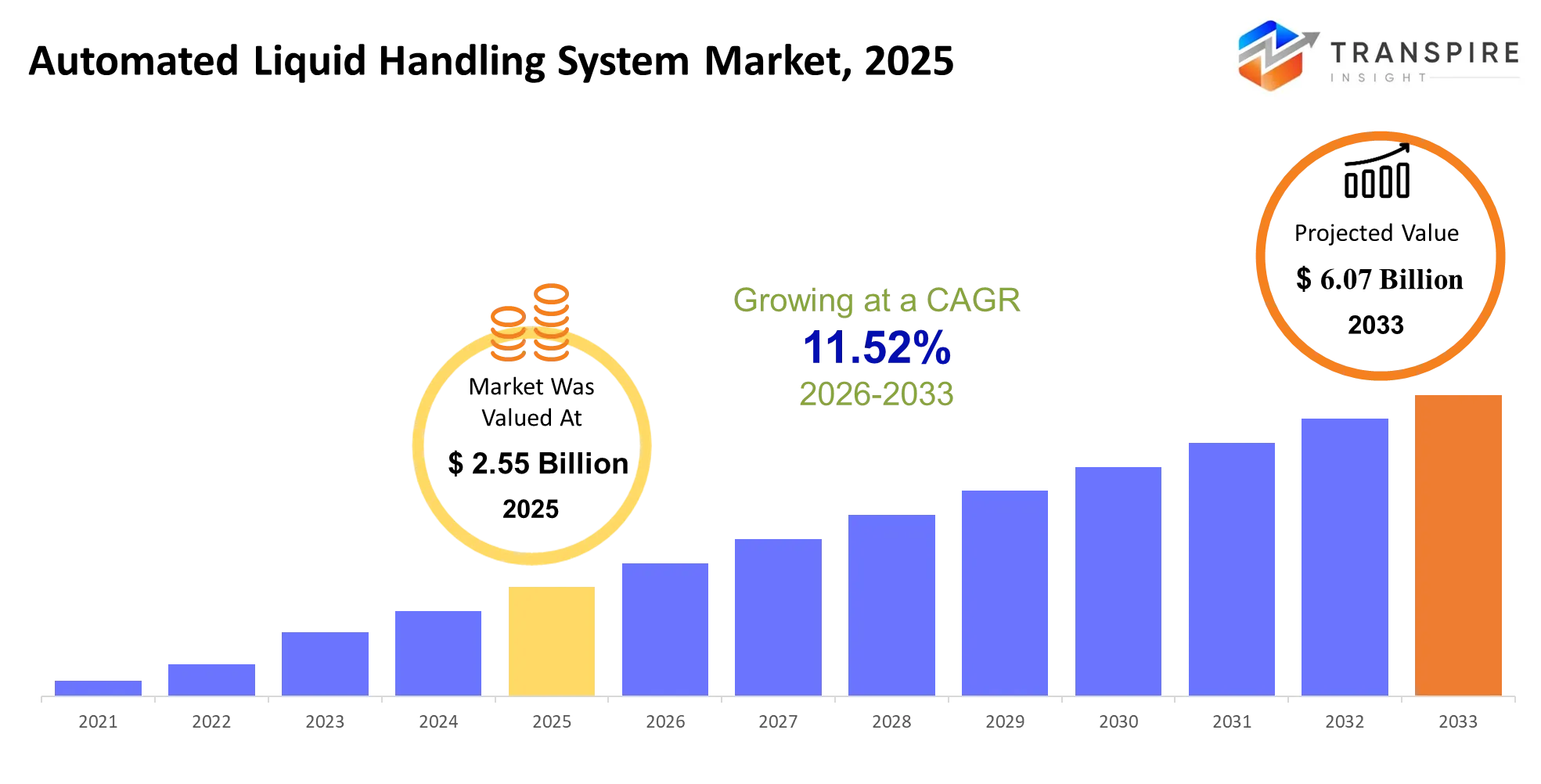
As per the Transpire Insight Analysis, The Automated Liquid Handling System Market size is estimated at USD 2.55 billion in 2025 and is anticipated to reach USD 6.07 billion by 2033, growing at a CAGR of 11.52% from 2026 to 2033.
The international automated liquid handling system market supports the operation of laboratories by enabling them to quickly, consistently, and accurately transfer, dispense, mix, and prepare liquid samples. Over the last three to five years, laboratories have moved from using dedicated pipetting stations toward connected platforms with digital workflows, integrated robotics, and automated sample tracking. This structural change has been driven by laboratory needs to complete larger numbers of experiments with consistent, reproducible conditions while leaving clear, traceable records. The rapid increase in usage of genomics testing, biologics development, and high-throughput screening has added significant bottlenecking for manual preparation, particularly when experiments require thousands of precise liquid transfers. Developments in miniaturized automation and software-driven workflows are also improving the accessibility of liquid handling for smaller research groups and teams. The need for quicker experiment rates to meet changing protocol timelines, along with less error-prone sample handling, is driving increasing focus on the ability to change protocols without the need to redesign physical laboratory space.
Automated Liquid Handling System Market Size & Forecast:
- Market Size 2025: USD 2.55 Billion
- Expected Market Value (2033): USD 6.07 Billion
- Forecast CAGR (2026–2033): 11.52%
- Leading Region in 2025: North America
- Fastest Growing Region: Asia Pacific
- Key Company Profiles: Hamilton Company, Tecan, Beckman Coulter, Agilent Technologies, PerkinElmer, Thermo Fisher Scientific, Eppendorf, QIAGEN, Danaher, Gilson, Analytik Jena, Hudson Robotics, Formulatrix, SPT Labtech, Andrew Alliance.
Key Automated Liquid Handling System Market Insights:
The market is moving from liquid transfer solutions to connected, application-specific laboratory automation solutions that emphasize data traceability, reproducibility, and flexibility. Instruments, software, and validated workflows are becoming key elements of competitive advantage, and their integration is becoming more important than ever without increasing operational complexity.
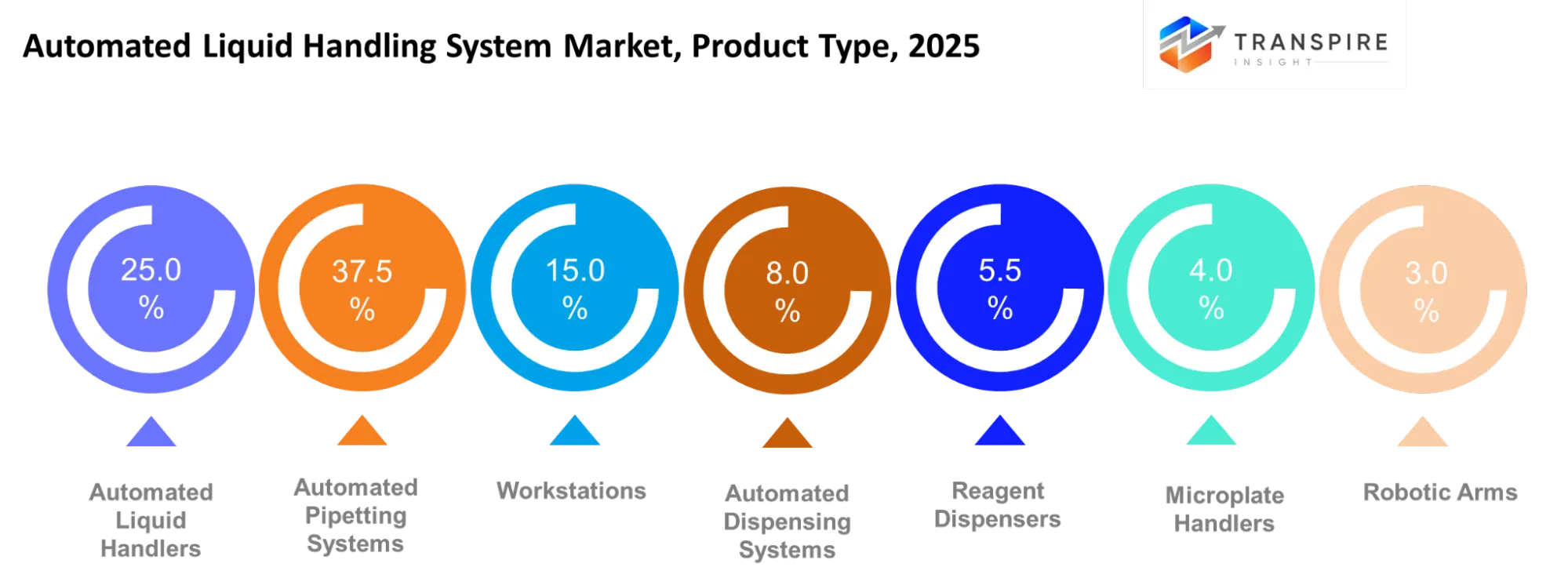
- Automated pipetting systems are the most important and widely used systems and make up 37.5% of the market.
- AI-powered liquid handling is expected to increase at a CAGR of 12.8%, fueling software-driven protocol optimization and flexible workflows.
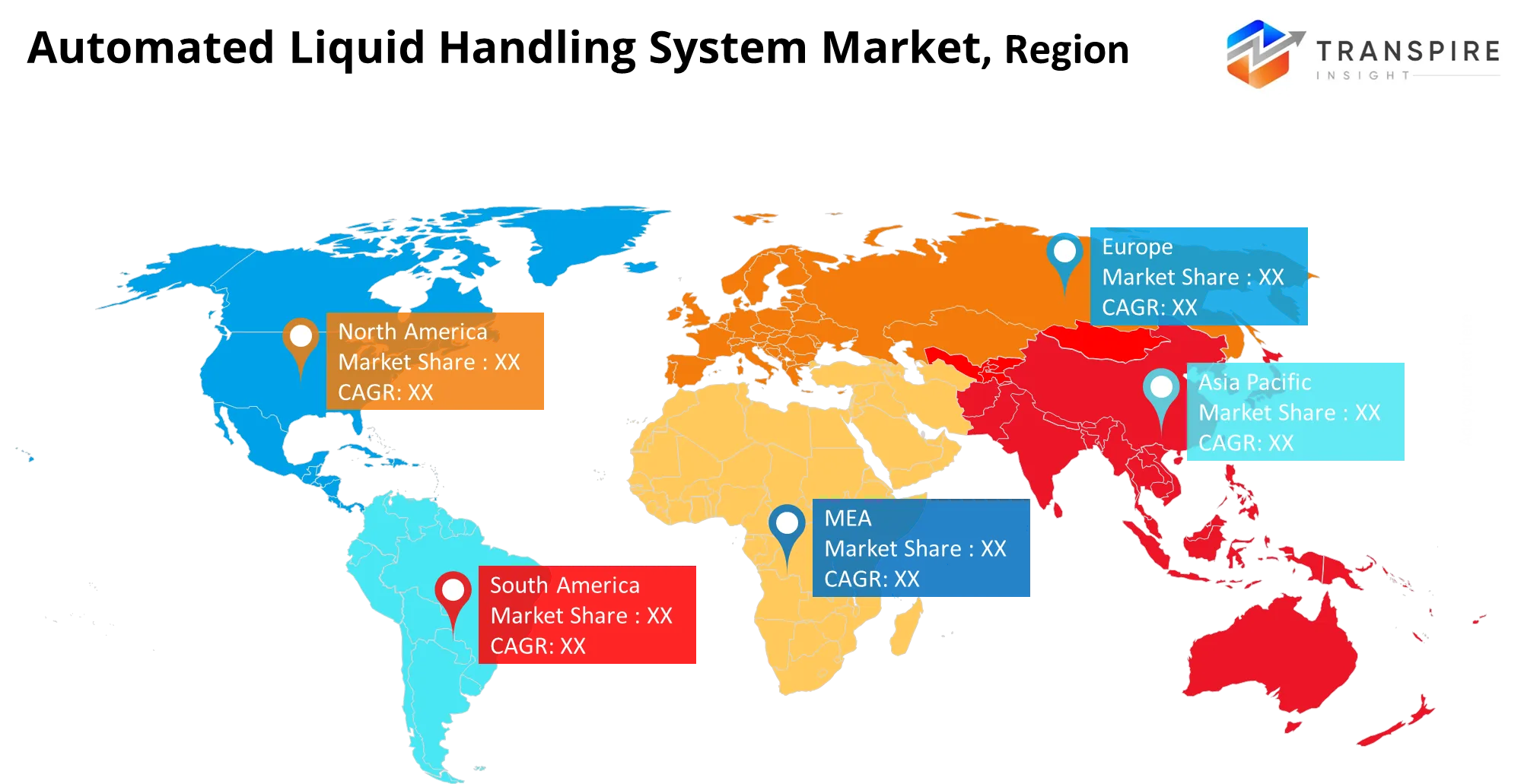
- North America is the largest region with 42.0%, benefiting from well-established pharmaceutical R&D infrastructure and significant investment in laboratory automation.
- Europe accounts for 29.0%, with well-developed research networks and laboratory practices emphasizing quality, influencing equipment purchases.
- Asia Pacific accounts for 21.5%, with biotechnology capacity and genomics infrastructure growing in the region's research hubs.
- Latin America represents 4.5%, creating scope for cost-conscious automation in diagnostics and university laboratories.
- The Middle East and Africa have 3.0%, which is an opportunity for specific targeting in centralised testing facilities or emerging research facilities.
- In 2026, SPT Labtech and Illumina made strides with the development of fireflyGO, which integrates liquid handling with targeted library preparation for oncology, and with more standardised genomics workflows.
- In 2026, Beckman Coulter Life Sciences joined forces with Automata, marking progress toward connected, AI-ready lab operations.
What are the Key Drivers, Restraints, and Opportunities in the Automated Liquid Handling System Market?
Driver:
The strongest growth driver is the need to standardize sample preparation across drug discovery, genomics, and molecular diagnostics. Complex assays require accurate transfers across multiple plates, making manual pipetting vulnerable to timing differences, operator fatigue, and inconsistent results. The expansion of next-generation sequencing and targeted oncology research has reinforced this need. Illumina and SPT Labtech introduced the fireflyGO automation platform for targeted oncology research, demonstrating how application-specific automation can simplify library preparation and improve workflow reproducibility. Such solutions support adoption by reducing hands-on work and helping laboratories process more samples with existing staff.
Restraint:
High initial investment remains a barrier, particularly for smaller laboratories. Equipment costs extend beyond the instrument to include validated consumables, software, maintenance, staff training, and integration with laboratory information management systems. Proprietary labware and protocol requirements can also limit flexibility, making upgrades difficult when research methods change.
Opportunity:
The next growth unlock is AI-enabled, application-specific automation systems that can optimise protocols, predict maintenance needs, and integrate with LIMS and cloud analytics. Asia-Pacific offers a strong regional opportunity as precision-medicine programmes and genomic-sequencing infrastructure expand, while partnerships such as Integrated DNA Technologies and Hamilton’s 2025 collaboration for automated NGS workflows show how vendors are packaging automation around specific scientific workflows rather than selling hardware alone.
Driver Impact Analysis: Automated Liquid Handling System Market
|
Driver |
Relative Impact on Growth (%) |
Geographic Relevance |
Impact Timeline |
Demand Strength |
Growth Mechanism |
Key Beneficiaries |
Major Constraint |
|
Rising pharmaceutical R&D and high-throughput drug screening |
28% |
North America, Europe, Asia Pacific |
Short-term (≤2 years) |
High |
Accelerates compound screening and increases experimental throughput. |
Pharmaceutical firms, biotech companies, liquid handler manufacturers. |
High capital expenditure limits smaller laboratory adoption. |
|
Expanding genomics, proteomics, and precision medicine research |
23% |
North America, Europe, Asia Pacific |
Medium-term (2–4 years) |
High |
Enables precise, reproducible preparation of complex biological samples. |
Genomics laboratories, sequencing companies, research institutes, equipment vendors. |
Protocol complexity and specialized consumables increase operating costs. |
|
Increasing laboratory automation and robotic workflow integration |
20% |
North America, Europe, Asia Pacific |
Medium-term (2–4 years) |
High |
Reduces manual pipetting, human error, and processing time. |
Automation vendors, pharmaceutical laboratories, contract research organizations. |
Integration challenges with legacy laboratory equipment and software. |
|
Growing clinical diagnostics and advanced therapy manufacturing |
17% |
North America, Europe, Asia Pacific |
Long-term (≥4 years) |
High |
Standardizes sample preparation and supports contamination-controlled workflows. |
Diagnostic laboratories, cell therapy manufacturers, biotechnology companies. |
Validation requirements and workflow-specific regulatory compliance. |
|
Advancements in AI-enabled liquid handling and sustainable miniaturization |
12% |
North America, Europe, Asia Pacific |
Long-term (≥4 years) |
Medium |
Optimizes dispensing accuracy while reducing reagent consumption and waste. |
Robotics developers, AI software vendors, instrument manufacturers, laboratories. |
Limited interoperability and high costs of advanced systems. |
|
Total |
100% |
— |
— |
— |
— |
— |
What Has the Impact of Artificial Intelligence Been on the Automated Liquid Handling System Market?
AI is transforming automated liquid handling from a programmed script to a smarter, adaptive lab system. For example, in practice, AI enables assay optimisation through dispensing volumes, liquid classes, plate layouts, and run sequence changes, and enables the system to perform dynamic scheduling between different instruments to eliminate idle time on multi-step workflows.
Prediction is just as important. Machine-learning algorithms can predict tip usage and warn of pipetting drift or failing instruments so they can be mitigated or maintenance scheduled prior to failure and consequential downtime, which preserves data integrity and reduces costs. IoT-enabled systems offer remote monitoring, letting labs track throughput, errors, and tip usage in real time. These capabilities operationally improve system utilisation, minimize waste, and enable audit-ready traceability and reduced cost per sample with connected software that links laboratory information systems and automates liquid handlers. The risk factor here is integration and validation, as features involve lifecycle management, cybersecurity, and evidence documentation under FDA and IMDRF guidance for AI-enabled medical-device functions. Until software advances are more widespread and affordable, many labs will use AI primarily to optimize efficiency.
In January 2026, Beckman Coulter Life Sciences (a Danaher company) formed a strategic partnership with robotics developer Automata. This collaboration integrates Beckman Coulter's liquid handling, genomic, and cell analysis technologies directly into Automata’s AI-ready Linq automation platform. https://www.ddw-online.com/beckman-coulter-partners-with-automata-on-lab-automation-40339-202602/
Key Automated Liquid Handling System Market Trends:
The market is shifting from equipment sales to intelligent and connected laboratory workflows, driven by software, data quality, and interoperability becoming more important in purchase decisions.
- Fixed automation is being replaced in the labs with modular platforms that can be reconfigured for new assays and throughput requirements.
- The focus of the buyer is changing from speed to data quality and workflow reliability, thanks to optimisation by AI.
- Predictive Maintenance is becoming a service-based business model, with service providers offering monitoring, support and software subscriptions.
- End-to-end automation is becoming the preferred operating model with integration to LIMS, ELNs, robotics and scheduling software.
- Acoustic droplet ejection and microfluidics are driving the use of ultra-low volume handling in single-cell and high-density screening applications.
- Automation is not confined to discovery research, as it is being called to clinical and translational laboratories by NGS, personalised medicine and molecular diagnostics.
- Low-code interfaces are rising to the occasion to compensate for the lack of laboratory personnel who are automation-savvy.
- Sustainability is changing the way that laboratories are designed, and the goal is to reduce energy consumption, use less plastic-tip waste, and make more efficient use of reagents.
- As connected laboratory systems grow, cybersecurity and data traceability are increasingly becoming procurement requirements.
Automated Liquid Handling System Market Segmentation
Product Type:
Automated pipetting systems are dominant, with a 37.5% market share, because they address a wide range of repeated tasks such as transfer, serial dilution, plate replication, and assay setup. Automated liquid handlers contribute 25.0% of this category because there is a strong requirement for flexible multi-channel dispensing, especially in drug discovery and genomics. Workstations make up 15.0% of the market, as we see more labs installing instruments on consolidated benches. Automated dispensing systems make up 8.0%, reagent dispensers 5.5%, microplate handlers 4.0%, robot arms 3.0%, and other systems 2.0%. AI-based, intelligent liquid handling is growing at a CAGR of 12.8%, with higher demand for scheduling algorithms, assay optimization, and predictive maintenance.
Automation Level:
Over the last few decades, fully automated and robotic systems have made significant inroads into laboratories seeking a 24/7, low-maintenance mode of working. Meanwhile, semi-automated platforms still have their place in settings that change protocols regularly or where budgets are tight. High-throughput setups are well suited to pharmaceutical screening and large diagnostic networks, while low-throughput, modular systems meet the needs of a growing number of biotech and academic labs. Integrated automation is gaining momentum, linking liquid handling with storage, scheduling, and analytics.
Application:
The most common application for these instruments is still the drug discovery segment at 34.2% demand in 2025. Other applications include Clinical diagnostics at 28.5% and genomics at 18.3%. Applications for high-throughput screening, lead optimization, and ADME-Tox studies require repeatable plate preparation and low-volume dispensing. Genomics is the fastest-growing segment with an 11.2% compound annual growth rate. Increased personalised medicine is driving increases in both the number and complexity of traceable samples, biobanking, and sample preparation segments.
End User:
Pharmaceutical companies and biotechnology firms dominate because they face the strongest throughput, reproducibility, and development-cycle pressures. CROs adopt automation to standardise client protocols and scale multi-project operations, while diagnostic laboratories and hospitals increasingly automate PCR, immunoassay, and molecular-testing workflows. Academic institutions and research institutes are also adopting compact systems as sequencing costs fall and testing volumes rise across translational research.
Type:
Benchtop and modular systems are expanding among mid-sized laboratories because they offer automation without major facility redesign. Floor-standing, integrated, and high-throughput platforms serve large pharmaceutical companies, CROs, and reference laboratories that require continuous operation across connected instruments. Compact and portable formats are emerging where space, budget, or decentralised testing constraints limit full-scale automation, particularly in regional diagnostic networks and applied-testing laboratories.
What are the Key Use Cases Driving the Automated Liquid Handling System Market?
The core use case is high-throughput assay preparation in pharmaceutical and biotechnology laboratories, where automated pipetting systems—37.5% of the product mix—perform plate replication, serial dilution, compound transfer, and screening workflows with consistent precision.
Expansion is strongest in genomics and clinical diagnostics. Automated systems now support NGS library preparation, PCR setup, sample normalisation, and molecular-testing workflows, helped by partnerships such as Integrated DNA Technologies and Hamilton’s 2025 automation collaboration.
Emerging use cases include AI-guided cell-culture workflows, biobank sample aliquoting, proteomic sample preparation, and decentralised diagnostic testing. AI-integrated liquid handling, growing at a 12.8% CAGR, is particularly relevant as laboratories seek autonomous optimisation and predictive maintenance.
|
Report Metrics |
Details |
|
Market size value in 2025 |
USD 2.55 Billion |
|
Market size value in 2026 |
USD 2.83 Billion |
|
Revenue forecast in 2033 |
USD 6.07 Billion |
|
Growth rate |
CAGR of 11.52% from 2026 to 2033 |
|
Base year |
2025 |
|
Historical data |
2021 - 2024 |
|
Forecast period |
2026 - 2033 |
|
Report coverage |
Revenue forecast, competitive landscape, growth factors, and trends |
|
Regional scope |
United States; Canada; Mexico; United Kingdom; Germany; France; Italy; Spain; Denmark; Sweden; Norway; China; Japan; India; Australia; South Korea; Thailand; Brazil; Argentina; South Africa; Saudi Arabia; United Arab Emirates |
|
Key companies profiled |
Hamilton Company, Tecan, Beckman Coulter, Agilent Technologies, PerkinElmer, Thermo Fisher Scientific, Eppendorf, QIAGEN, Danaher, Gilson, Analytik Jena, Hudson Robotics, Formulatrix, SPT Labtech, Andrew Alliance. |
|
Customization scope |
Free report customization (country, regional & segment scope). Available customized purchase options to meet your exact research needs. |
|
Report Segmentation |
Product Type (Automated Liquid Handlers, Automated Pipetting Systems, Workstations, Automated Dispensing Systems, Reagent Dispensers, Microplate Handlers, Robotic Arms, Others)Automation Level (Semi-Automated, Fully Automated, Robotic, Integrated, High-Throughput, Low-Throughput, Modular, Others)Application (Drug Discovery, Genomics, Proteomics, Clinical Diagnostics, Cell Biology, Biobanking, Sample Preparation, Others)End User (Pharmaceutical Companies, Biotechnology Companies, Hospitals, Diagnostic Laboratories, Academic Institutions, Research Institutes, CROs, Others)Type (Benchtop, Floor-Standing, Modular, Integrated, Compact, High-Throughput, Portable, Others)Technology (Robotics, Microfluidics, AI-Based Automation, Machine Vision, Barcode Integration, IoT-Enabled, Precision Pipetting, Others). |
Which Regions are Driving the Automated Liquid Handling System Market Growth?
North America accounts for a dominant share of 42.0%, driven by a robust infrastructure of pharmaceutical, biotech, contract research organisation (CRO), and clinical laboratories. This dominance is based on early adoption of high-throughput screening, genomics, and digital laboratory systems, where automation is a core operational competency that cannot be a supplementary value addition. Major research and development budgets, well-established regulatory environments, and an established vendor ecosystem drive the growth of demand for integrated robotic workstations.
In February 2026, Automata successfully closed a $45 million Series C funding round. This capital injection, which included a strategic investment partnership with Danaher Corporation, is intended to drive software-defined laboratory processes and expand next-generation capabilities. https://www.bionity.com/en/news/1187999/automata-raises-45-million-for-ai-enabled-laboratory-automation.html
Europe is at 29.0% and is an adoption model focused on quality and compliance. European regions focus more on reproducibility and data integrity, validated workflows, and sustainability, as opposed to the innovation-driven and throughput-driven demand of North America. Regional demand anchors in Germany and the UK are pharmaceutical manufacturing, academic research networks, and clinical laboratory accreditation requirements, and the region shows more standard-driven, replacement, and upgrade demand.
In July 2026, Evinova launched a strategic partnership with Merck KGaA (headquartered in Darmstadt, Germany) to integrate advanced operational benchmark data and digital capabilities into clinical development workflows. This collaboration aims to standardise clinical trial data structures and implement an AI-native operational data framework. https://www.businesswire.com/
Asia-Pacific led the way at 10.9% CAGR with a current share of 21.5%. China, Japan, India, South Korea and Southeast Asia have seen recent growth driven by increases in pharma manufacturing, genomics, clinical trial activity and government spend in life sciences. The region holds future potential for scalable and modular automation, such as emerging biotech companies, diagnostic networks and Contract Research Organisations that require additional laboratory capacity without the same cost of a fully integrated system.
In January 2026, AstraZeneca agreed to pay CSPC Pharmaceutical Group up to $18.5 billion for eight obesity and type 2 diabetes programmes. This pact unlocked exclusive rights outside Greater China for novel Chinese-developed molecules and AI-driven drug design platforms, highlighting how regional biotechs are shaping pipelines. https://lifesciencedaily.news/apac-biopharma-2026/
Who are the Key Players in the Automated Liquid Handling System Market, and how do they compete?
The Industry landscape price is one of several competitive factors: accuracy, throughput, software compatibility, service and total cost of ownership all play a role. Vendors like Hamilton and Tecan are highlighting configurable platforms: In addition to Hamilton's recent merger with Cerillo, the company offers a new 26 platform, which is a combination of laboratory automation and a compact plate reader. Tecan Veya represents predeveloped protocols and quick access with minimal setup.
Other competitive factors include connecting through a broad portfolio of products (Beckman and Danaher), using a wide range of emerging technologies like acoustic dispensing (Danaher), and establishing extensive distribution channels and integrated research workflows (Thermo Fisher Scientific). Agilent and PerkinElmer are focusing on the integration of analytical laboratories. And Gilson and Eppendorf are touting pipetting precision and ease of use, while QIAGEN is integrating automation and molecular testing. Analytik Jena and Hudson Robotics are developing automation for analytical workflows and robotics integration and customizing solutions, respectively. Formulatrix emphasizes precision automation, while SPT Labtech specialises in application-specific solutions for genomics and screening. Andrew Alliance (with Waters) is focusing on connected pipetting workflows.
Key Players are:
- Hamilton Company
- Tecan
- Beckman Coulter
- Agilent Technologies
- PerkinElmer
- Thermo Fisher Scientific
- Eppendorf
- QIAGEN
- Danaher
- Gilson
- Analytik Jena
- Hudson Robotics
- Formulatrix
- SPT Labtech
- Andrew Alliance
Automated Liquid Handling System Market — Enhanced Competitive Benchmarking
|
Company |
Est. Revenue Share Range |
Key Offerings |
Strategic Positioning |
Geographic Strength |
Technology Focus |
|
Hamilton Company |
Estimated 8–12% |
Microlab STAR, STAR V, VANTAGE, automated pipetting platforms |
Precision-led automation with strong workflow customization |
North America, Europe, Asia Pacific |
Air-displacement pipetting, liquid-class optimization, robotic integration |
|
Tecan Group |
Estimated 8–12% |
Fluent, Veya, Cavro liquid-handling components |
Flexible automation platforms for research and diagnostics |
Europe, North America, Asia Pacific |
Modular robotics, automated pipetting, workflow orchestration |
|
Beckman Coulter Life Sciences (Danaher) |
Estimated 7–11% |
Biomek i-Series, Biomek NGeniuS, automated workstations |
Integrated sample preparation and high-throughput automation |
North America, Europe, Asia Pacific |
Robotic pipetting, validated protocols, connected workflow software |
|
Thermo Fisher Scientific |
Estimated 6–10% |
KingFisher Flex, KingFisher Apex, automated sample preparation systems |
Broad life-science ecosystem and application-specific automation |
North America, Europe, Asia Pacific |
Magnetic-particle processing, automated purification, assay integration |
|
Agilent Technologies |
Estimated 5–8% |
Bravo, AssayMAP Bravo, Magnis NGS Prep System |
Application-focused automation for genomics and drug discovery |
North America, Europe, Asia Pacific |
Automated microplate handling, low-volume dispensing, NGS preparation |
|
Revvity |
Estimated 4–7% |
JANUS, Sciclone, automated liquid-handling workstations |
Integrated screening and assay-workflow automation |
North America, Europe, Asia Pacific |
Modular liquid handling, assay miniaturization, automated screening |
|
Eppendorf |
Estimated 3–6% |
epMotion 5070, epMotion 5073, epMotion 5075 |
User-friendly automation for molecular biology laboratories |
Europe, North America, Asia Pacific |
Electronic pipetting, automated sample preparation, protocol-driven control |
|
SPT Labtech |
Estimated 2–5% |
firefly, dragonfly discovery, mosquito |
Specialist automation for genomics and miniaturized assays |
Europe, North America, Asia Pacific |
Nanolitre dispensing, acoustic-free positive displacement, miniaturization |
|
Opentrons |
Estimated 1–4% |
OT-2, Flex, Python-based protocol automation |
Accessible, flexible robotics for research and smaller laboratories |
North America, Europe, Asia Pacific |
Open programming, modular pipetting, reproducible automated protocols |
|
FORMULATRIX |
Estimated 1–3% |
MANTIS, FLO i8, F.A.S.T. liquid-handling systems |
Compact dispensing solutions for specialized laboratory workflows |
North America, Europe, Asia Pacific |
Non-contact dispensing, low-volume liquid handling, automated assay setup |
Recent Development News
- In October 2026, Charles River Laboratories and Autolomous launched Apollo Orchestrate, a digital laboratory execution capability integrating laboratory workflows through Autolomous’ autoloMATE platform. The launch strengthens laboratory digitization, improves data traceability, and supports more efficient and standardized execution of regulated testing processes. https://charlesriverlaboratories.gcs-web.com/news-releases/news-release-details/charles-river-and-autolomous-partner-transform-laboratory
- In January 2026, Beckman Coulter Life Sciences partnered with Automata to integrate its liquid handling and genomic technologies with Automata’s AI-ready laboratory automation platform. The partnership supports modular, scalable laboratory workflows, enabling research organizations to improve experimental consistency, increase throughput, and prepare laboratories for AI-driven scientific discovery. https://www.beckman.com/news/partners-with-automata-to-accelerate-ai-ready-laboratory-automation
- In May 2026, Illumina and SPT Labtech introduced the fireflyGO automation platform for liquid handling and library preparation in targeted oncology research. Integrated with Illumina’s MiSeq i100 Series, the platform reduces manual processing steps, improves workflow consistency, and makes automated genomic research more accessible to laboratories. https://sapac.illumina.com/company/news-center/press-releases/2026/bc61a03c-575f-4947-81df-4e8f48663e60.html
What Strategic Insights Define the Future of the Automated Liquid Handling System Market?
The market is also moving toward modular, software-connected systems that seamlessly integrate precise liquid handling with plate movement, detection, and data capture. A vendor able to make it easier to configure and validate workflows may attract customers beyond speed freaks. A potential long-term pitfall is protocol lock-in: dependence on proprietary consumables, closed software, difficult data migration, and backward software compatibility can lead to lifetime cost and inhibit upgrades. Relying on AI-guided presets without validation risks disappointment when liquids' properties or assay conditions vary. A new research opportunity is compact automation for diagnostic labs and biotech teams with sequencing and molecular testing, producing preparation workload with fixed budgets and space. Instrument vendors, assay developers, and software firms must break down barriers to integration; open interfaces, application-ready protocols, cost of service, and proof of error reduction are good starting points. Precautionary factors include proven workflow, validation load, and consumable availability, not throughput.
Key Segmentations are:
Product Type
- Automated Liquid Handlers
- Automated Pipetting Systems
- Workstations
- Automated Dispensing Systems
- Reagent Dispensers
- Microplate Handlers
- Robotic Arms
- Others
Automation Level
- Semi-Automated
- Fully Automated
- Robotic, Integrated
- High-Throughput
- Low-Throughput
- Modular
- Others
Application
- Drug Discovery
- Genomics
- Proteomics
- Clinical Diagnostics
- Cell Biology
- Biobanking
- Sample Preparation
- Others
End User
- Pharmaceutical Companies
- Biotechnology Companies
- Hospitals
- Diagnostic Laboratories
- Academic Institutions
- Research Institutes
- CROs
- Others
Type
- Benchtop
- Floor-Standing
- Modular
- Integrated
- Compact
- High-Throughput
- Portable
- Others
Technology
- Robotics
- Microfluidics
- AI-Based Automation
- Machine Vision
- Barcode Integration
- IoT-Enabled
- Precision Pipetting
- Others
By Regional Analysis
North America
- US
- Canada
- Mexico
Europe
- Germany
- UK
- France
- Italy
- Spain
- Russia
- Rest of Europe
Asia Pacific
- China
- Japan
- India
- South Korea
- Australia
- Rest of Asia Pacific
South America
- Brazil
- Argentina
- Rest of South America
Middle East & Africa
- UAE
- Saudi Arabia
- Qatar
- South Africa
- Rest of the Middle East & Africa
Frequently Asked Questions
Find quick answers to common questions.
The automated liquid handling system market size was valued at USD 2.55 billion in 2025 and is poised to reach USD 6.07 billion by 2033, expanding at a 11.52% CAGR.
Key segments for the automated liquid handling system market are Product Type (Automated Liquid Handlers, Automated Pipetting Systems, Workstations, Automated Dispensing Systems, Reagent Dispensers, Microplate Handlers, Robotic Arms, Others)Automation Level (Semi-Automated, Fully Automated, Robotic, Integrated, High-Throughput, Low-Throughput, Modular, Others)Application (Drug Discovery, Genomics, Proteomics, Clinical Diagnostics, Cell Biology, Biobanking, Sample Preparation, Others)End User (Pharmaceutical Companies, Biotechnology Companies, Hospitals, Diagnostic Laboratories, Academic Institutions, Research Institutes, CROs, Others)Type (Benchtop, Floor-Standing, Modular, Integrated, Compact, High-Throughput, Portable, Others)Technology (Robotics, Microfluidics, AI-Based Automation, Machine Vision, Barcode Integration, IoT-Enabled, Precision Pipetting, Others).
Growth is primarily driven by the expansion of drug discovery and genomics research, the need for precise and reproducible sample preparation, rising adoption of high-throughput screening, and advances in robotics, AI-integrated automation, and connected laboratory workflows.
The automated liquid handling system market is led by major manufacturers including Hamilton Company, Tecan, Beckman Coulter, Agilent Technologies, PerkinElmer, Thermo Fisher Scientific, Eppendorf, QIAGEN, Danaher, Gilson, Analytik Jena, Hudson Robotics, Formulatrix, SPT Labtech, and Andrew Alliance.
North America holds 42.0% of the market, supported by advanced pharmaceutical R&D infrastructure, substantial biotechnology investment, established contract research organizations, and strong adoption of high-throughput laboratory automation
Key opportunities include AI-integrated liquid handling, modular automation for smaller laboratories, automated genomic and molecular diagnostic workflows, and interoperable platforms that reduce integration costs and improve laboratory efficiency.
- Hamilton Company
- Tecan
- Beckman Coulter
- Agilent Technologies
- PerkinElmer
- Thermo Fisher Scientific
- Eppendorf
- QIAGEN
- Danaher
- Gilson
- Analytik Jena
- Hudson Robotics
- Formulatrix
- SPT Labtech
- Andrew Alliance
About the Authors

Mayur Shinde
I am Mayur Shinde, a Senior Research Analyst at Transpire Insight, specializing in the Automotive & Transportation and Information & Communication Technology (ICT) Industry. My work focuses on analyzing emerging market trends, technological advancements, competitive landscapes, and industry developments to deliver accurate, data-driven insights. I am passionate about transforming complex market information into clear, actionable content that helps businesses, professionals, and decision-makers stay informed and make confident strategic decisions.

Chakradhar Khansole
Chakradhar serves as the Research Director at Transpire Insight, bringing over 8 years of experience in technology, innovation, and strategic market intelligence. He specializes in transforming complex market data into actionable business insights that enable organizations to make informed, growth-oriented decisions. Recognized for his strategic vision and analytical expertise, Chakradhar leads high-impact research initiatives, delivering comprehensive market assessments, competitive intelligence, and forward-looking industry analysis.
Recently Published Reports
-
Apr 2026
3D Optical Profiler Market
3D Optical Profiler Market Size, Share & Analysis Report By Type (Desktop 3D Optical Profiler, and Portable 3D Optical Profiler), By Technology (Confocal Technology, and White Light Interference), By End-Use Industry (Manufacturing, Research Institutions, Automotive, Aerospace and Defense, Medical Devices, and Other), and Geography (North America, Europe, Asia-Pacific, Middle East and Africa, South and Central America), 2021 - 2031
-
Apr 2026
Depth Sensor Market
Depth Sensor Market Size, Share & Analysis Report By Type (Infrared Depth Sensors, Time-of-Flight (ToF) Sensors, Stereo Vision Sensors, Structured Light Sensors, Ultrasonic Depth Sensors), By Application (Automotive, Robotics, Gaming, Consumer Electronics, Industrial Automation, Healthcare, Security & Surveillance, Others), By End Users (Automotive Manufacturers, Consumer Electronics Companies, Healthcare Providers, Industrial Companies, Security Agencies, Gaming Companies, Robotics Companies, Others), and Geography (North America, Europe, Asia-Pacific, Middle East and Africa, South and Central America), 2021 – 2031
-
Apr 2026
Digital Manufacturing Market
Digital Manufacturing Market Size, Share & Analysis Report By Component (Hardware, Software, and Services), By Technology (Robotics, 3D Printing, Internet of Things (IoT), and Others), By Application (Automotive and Transportation, Aerospace and Defense, Consumer Electronics, Industrial Machinery, and Others), By Process Type (Computer-Based Designing, Computer-Based Simulation, Computer 3D Visualization, Analytics, and Others), and Geography (North America, Europe, Asia-Pacific, Middle East and Africa, South and Central America), 2021 – 2031
-
Apr 2026
Digital Visa Services Market
Digital Visa Services Market Size, Share & Analysis Report By Type (Individual Travelers, Group Travelers), By Application (Tourism, Business Travel, Others), and Geography (North America, Europe, Asia-Pacific, Middle East and Africa, South and Central America), 2021 – 2031