
Asia Pacific Rubber Tired Gantry Crane Market Summary
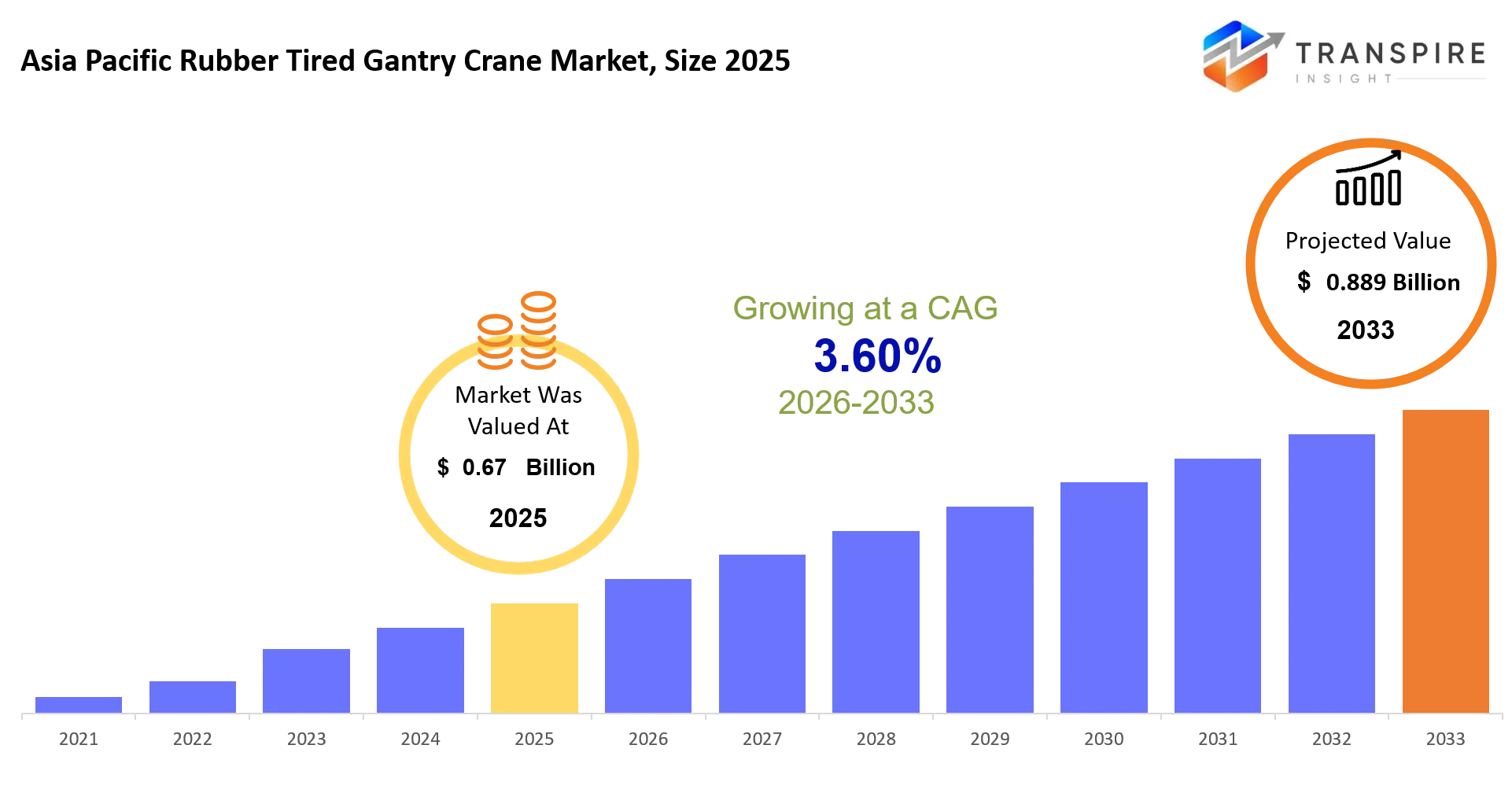
As per Transpire Insight Analysis, the Asia Pacific Rubber Tired Gantry Crane Market size is estimated at USD 0.67 Billion in 2025 and is anticipated to reach USD 0.889 Billion by 2033, growing at a CAGR of 3.60% from 2026 to 2033.
The Asia Pacific rubber tired gantry crane Market, in practice, helps keep container movement more smooth across ports inland freight terminals and logistics hubs. At the same time it lets operators cut down vessel turnaround time and boost yard output, though it sounds simpler than it is sometimes. These cranes are also starting to feel like a must have, because regional commerce keeps climbing and the whole system gets more pressure on cargo handling capacity, but without forcing everyone to redo the yard layout or major redesign work.
Over the past five years, there’s been this noticeable move away from standard diesel powered machines and more toward hybrid, then fully electric rubber tired gantry cranes. Port authorities are pushing this shift to reduce operating spend and meet tighter emissions targets, which is becoming harder to ignore. During the pandemic, supply chain hiccups basically revealed capacity pinch points on several shipping routes, and that pushed governments and terminal operators to speed up modernization steps, including automation investments.
So now procurement plans often lean toward energy saving equipment, plus remote operation abilities, and digital fleet management. In turn that usually creates better long term revenue prospects for manufacturers, while also supporting higher equipment utilization as more and more container terminals get expanded, and everyone is trying to squeeze better throughput out of existing spaces.
Asia Pacific Rubber Tired Gantry Crane Market Size & Forecast:
- Asia Pacific Rubber Tired Gantry Crane Market Size 2025: USD 0.67 Billion
- Expected Market Value 2033: USD 0.889 Billion
- Forecast CAGR: 3.60%
- Leading region in 2025: China
- Fastest Growing region: India
- Key Profile: Konecranes, Liebherr, ZPMC, Kalmar, SANY, Konecranes Noell, Mitsui E&S Machinery, Cargotec, TCM Corporation, Terex, Henan Mine Crane, Weihua Group, Anupam Industries, GH Cranes, Doosan Heavy Industries
Key Market Insights
- China pretty much dominated the Asia Pacific Rubber Tired Gantry Crane Market in 2025 with around 48% market share, and that’s tied to container terminal expansions that don’t really slow down, plus all these ongoing automation projects.
- India, meanwhile, should grow the quickest across the 2025–2033 window because new port corridors and logistics parks are getting built out, and that means procurement is picking up for equipment in a pretty consistent way.
- On the product side, Electric Rubber Tired Gantry Cranes took the lead with close to 56% share in 2025. Ports were prioritizing lower operating costs along with emissions compliance, so adoption moved faster than some other options.
- Hybrid Rubber Tired Gantry Cranes came in as the second-largest segment. This happened because many existing terminals are upgrading their diesel fleets, but they are not fully replacing infrastructure all at once, which keeps hybrid deployments relevant.
- Looking ahead, fully automated electric RTG cranes are set to show the fastest growth through 2033. Smart terminal investments, together with digital control integration, are basically pushing that curve up.
- For application share, container handling made up roughly 72% in 2025. This reflects sustained throughput growth across a bunch of regional maritime trade hubs, even when traffic patterns shift.
- As for where things expand fastest on application, automated container yard operations are expected to grow quickest through 2033. Terminal operators are deploying remote-controlled handling systems, often in phases, but the overall direction is clear.
- When end users are considered, seaport authorities held the biggest slice, about 67% share in 2025. This is supported by continued expansion of deep-water container terminals.
- Finally, inland logistics terminals and intermodal freight hubs should become the fastest-growing end-user category. That’s largely because multimodal transport networks are spreading across Asia Pacific, so more sites need yard-to-gate capability and reliable handling.
What are the Key Drivers, Restraints, and Opportunities in the Asia Pacific Rubber Tired Gantry Crane Market?
The primary force that seems to push market expansion along is large-scale port modernization, and it’s often backed by government infrastructure programs, plus more strict emissions policies. When electrification targets started showing up across many major ports, operators were encouraged, kind of indirectly, to swap out older diesel RTG fleets for electric and hybrid alternatives. On top of that, automated yard management systems helped the whole business case stay convincing because they reduce fuel expenses, improve crane utilization, and cut down container dwell time. With cargo moving quicker, terminal throughput climbs, so operators can earn more from what they already have in place, while also taking on larger shipping volumes.
Still, the biggest structural restraint is the high capital requirement for advanced RTG systems, and also for the electrical infrastructure that goes with them. Grid upgrades, charging facilities, automation software, and workforce training all need a serious amount of money up front. Smaller terminals usually can’t absorb that kind of spending quickly, even if they want to. From what Transpire Insight pulled from regional procurement announcements and launch schedules, supply chain concentration looks like the main execution risk. Specialized components are not always easy to source, and the delivery schedules tend to run long, which ends up delaying equipment deployment. That then slows the fleet replacement cycle, and it postpones when manufacturers can actually start seeing revenue.
The most powerful long term chance is in this odd combo, electrified RTG cranes together with AI enabled terminal management platforms, even if that sounds a bit futuristic. In India and Southeast Asia container ports are getting bigger, along with inland freight corridors and logistics parks where the digital backbone can be planned from day one. With remote operations, predictive maintenance, digital twins, and fleet optimization software, the whole setup should raise asset utilization while also pushing maintenance costs down a notch. And because it’s all integrated, you get steady recurring software and service revenue that goes beyond plain equipment sales.
What Has the Impact of Artificial Intelligence Been on the Asia Pacific Rubber Tired Gantry Crane Market?
Artificial intelligence and digital tech are, honestly, reshaping container handling work in a way that makes rubber tired gantry crane fleets feel more autonomous , more connected, and also faster. With AI based control logic, the systems keep watching crane position, container motions, and yard traffic all at once, then they tweak the lifting routine to cut down on idle time and wasted motion. At the same time, remote operation platforms make work safer for operators, while still letting supervisors monitor many cranes from a control center. And there is more: machine learning models look at vibration patterns, motor temperature, electrical load, and component wear, basically trying to foresee maintenance needs before a failure can interrupt terminal flow.
Because of that, the downtime surprises go down, equipment stays available longer, and those costly assets get a longer operational life. On top of that, digital fleet management dashboards help with container flow forecasting , so terminals can line up equipment with vessel schedules and cargo volumes with more precision. The end result is higher throughput, better energy efficiency, and lower operating costs for today’s ports. Still, AI rollouts run into real constraints. For instance, plugging modern software into older crane fleets takes a lot of money and turns into a complicated integration job. Plus data quality differs between terminals , so algorithm performance can drop in real world conditions. Connectivity holes in older facilities also limit steady data collection, which then slows wider adoption of this intelligent crane management approach across the regional cargo handling equipment industry.
Key Market Trends
- Since 2022, electric RTG procurement has accelerated , as major ports swap diesel-powered fleets for something more efficient so they can trim fuel costs and also meet tougher emissions rules.
- Remote crane operation has been spreading across top container terminals and it means fewer operators can oversee multiple cranes at once, yet the workplace safety situation gets better, which is kind of a win-win.
- AI-enabled predictive maintenance platforms now help reduce unexpected equipment failures , because they spot wear patterns before a critical component actually breaks down.
- China has continued spending on smart port development , running through 2025, which is pushing more automated yard handling systems and also intelligent scheduling software into everyday use.
- India’s port modernization push has created more procurement openings for hybrid and electric RTG gear, supporting expanding container throughput and keeping things moving.
- Manufacturers increasingly bundle cranes with digital service contracts , so they end up with recurring revenue from fleet monitoring diagnostics and lifecycle maintenance solutions.
- Battery-electric RTG technology has gained momentum as charging infrastructure keeps improving , and terminal operators start caring more about lower lifetime operating expenses.
- Strategic partnerships between automation software providers and crane manufacturers have also strengthened integrated terminal management capabilities since 2023 , making the whole setup more connected.
- Regional supply chains have diversified their component sourcing after pandemic disruptions, which helps reduce procurement risk while also encouraging more localized manufacturing investments.
Asia Pacific Rubber Tired Gantry Crane Market Segmentation
By Crane Type:
Electric RTG cranes kinda kept a leading spot , because port operators kept swapping out older diesel equipment for more energy efficient options, which in turn cut day to day operating expenses and still aligned with environmental targets. With lower electricity costs, less maintenance work , and the fact these cranes play well with automated terminal systems , investors felt steadier about putting money into them. Hybrid RTG Cranes also got a steady kind of acceptance, since many terminals upgraded what they already had, without going all the way and replacing entire infrastructure. Meanwhile Automated RTG Cranes started showing up more in the biggest, high-capacity ports where remote control and smart yard management helped move cargo in a smoother way and increased equipment utilization.
Single Girder RTG Cranes stayed in demand mainly at medium-capacity terminals, where cost control was still a big purchasing factor. Double Girder RTG Cranes were used for heavier-duty lifting tasks, the sort that really needs extra stability and higher lifting performance. Diesel RTG Cranes kept running in places where electrical infrastructure is still limited, but new buys slowed down a bit , because cleaner technologies became more commercially attractive. Other specialized crane configurations supported those niche cargo handling requirements across industrial zones and logistics sites.
By Power Source:
Electric Powered systems took the biggest share, mostly because the port modernization efforts were tilting toward cutting fuel use and bringing down lifecycle operating costs , you know, the whole long run thing. Grid-connected setups helped terminals keep running nonstop while also making it easier to meet tighter environmental rules . Hybrid Powered equipment stayed in the second position, not because people didn’t care, but because a lot of operators chose step by step fleet upgrades rather than doing a clean full replacement . Battery Powered solutions got more interest too , since charging technology kept getting better and energy storage performance felt more dependable over time.
Diesel Powered equipment still showed up strongly where the electrical infrastructure rolled out slower . The existing diesel fleets kept handling day to day tasks while replacement initiatives moved along across those next several years. Then, other power technologies filled in for specialized operating situations that needed more flexible energy options. Overall, investment plans increasingly leaned toward cleaner power systems that can sustain long-term operating efficiency, not just quick wins.
By Application:
Container Handling kind of shows up as the biggest application because container terminals really needed an efficient flow of huge cargo amounts with as few delays as possible, sorta continuously. As regional trade kept growing terminal operators started pushing yard productivity forward via modern crane technology and these digital operating systems too. At the same time Ports & Harbors also generated a lot of equipment demand , since expansion efforts kept boosting berth capacity plus container storage space. Logistics Parks and Intermodal Freight Yards further strengthened procurement activity, mainly because they help with an integrated freight movement between different transport modes.
Rail Terminals also went ahead with more equipment investments, especially as governments improved the multimodal transportation infrastructure across multiple economies. Industrial yards often lean on RTG solutions for moving heavy materials around inside manufacturing and processing sites. Then there are other specialized applications that back very specific cargo handling routines, where customized lifting capabilities give that extra operational value. Through all of it, technology upgrades continued to improve handling speed, operational accuracy, and equipment availability across basically every application segment. 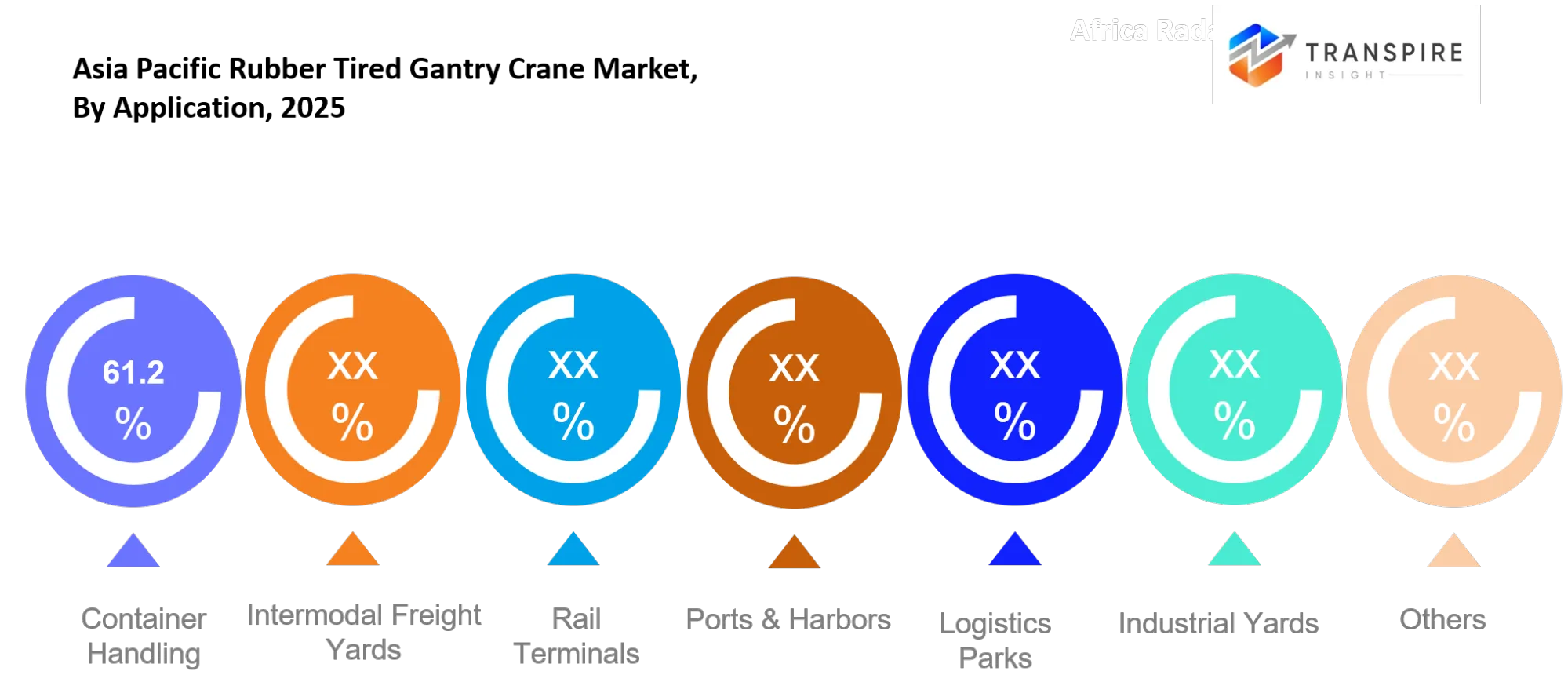
By End User:
Port Authorities actually accounted for the largest share , mostly because big infrastructure investments kept targeting terminal capacity expansions and that operational performance boost. Those modernization programs also somehow pushed more purchases of automated plus electric crane systems, cutting the day to day operating expenses while still enabling greater cargo throughput. Logistics Companies grew their equipment adoption too , since integrated supply chain networks sort of demanded swifter cargo transfers across distribution hubs. Shipping Companies in addition put money into more advanced terminal equipment to shave down vessel turnaround times and enhance overall service efficiency.
Rail Operators expanded procurement to reinforce intermodal freight connectivity between the ports and inland transportation corridors. Industrial Facilities ended up adopting RTG equipment for heavy material handling across manufacturing areas and storage locations. Meanwhile other end users created more room for sales via specialized lifting applications that called for flexible equipment configurations. And over the long run , investment plans continued backing the replacement of older fleets with newer technology solutions.
By Lifting Capacity:
The 40–60 Tons bracket showed up as the top segment, mainly because most container handling tasks needed that kind of balanced lifting power and also operational flexibility, kinda at the same time. The equipment in this range helped power the high-volume terminal routines while still keeping energy consumption efficient, plus holding operating costs at a dependable level. Once you moved past 60 Tons the hardware stayed relevant for heavy container movement and those tougher cargo situations, where extra lifting capability just mattered more. Heavy-Duty RTGs, for example, supported specialized terminals dealing with bulky loads and more complicated logistics requirements.
For units below 40 Tons, demand was still steady in smaller terminals and industrial facilities, where lighter cargo tasks were the usual rhythm of daily work. The other lifting capacity ranges, meanwhile, covered tailored operational needs across certain industrial segments and regional logistics projects. More infrastructure development and higher cargo volumes will keep pushing investment toward higher-capacity lifting solutions. Technology improvements will keep boosting operational efficiency, increasing reliability, and supporting long-term asset performance across every lifting capacity category.
What are the Key Use Cases Driving the Asia Pacific Rubber Tired Gantry Crane Market?
Container terminals still seem to be the main use case, since fast container movement kind of messes directly with port output and vessel turnaround, not in a small way. Port authorities and terminal operators tend to buy rubber tired gantry cranes as a way to raise yard capacity, lessen cargo bottlenecks , and manage rising trade quantities without just widening the terminal footprint, or at least not quickly.
You also see intermodal freight yards and logistics parks getting more attention, especially as regional governments push multimodal corridor upgrades. Rail operators and logistics companies are adopting these crane systems to make the cargo transfer between the rail side and road side a bit smoother, while industrial facilities lean on them to keep heavy materials moving efficiently over big storage lots.
There are early-stage chances too, like in smart inland freight hubs and automated dry ports where digital yard management gets paired with low emission cargo handling. Green port initiatives and carbon reduction rules will probably nudge investments toward electric, and sometimes remotely operated crane fleets, so new opportunities may appear as modern logistics infrastructure keeps expanding in developing economies.
|
Report Metrics |
Details |
|
Market size value in 2025 |
USD 0.67 Billion |
|
Market size value in 2026 |
USD 0.694 Billion |
|
Revenue forecast in 2033 |
USD 0.889 Billion |
|
Growth rate |
CAGR of 3.60% from 2026 to 2033 |
|
Base year |
2025 |
|
Historical data |
2021 - 2024 |
|
Forecast period |
2026 - 2033 |
|
Report coverage |
Revenue forecast, competitive landscape, growth factors, and trends |
|
Regional scope |
Asia Pacific (India, China, Japan, Australia, South Korea, Rest of Asia Pacific) |
|
Key company profiled |
Konecranes, Liebherr, ZPMC, Kalmar, SANY, Konecranes Noell, Mitsui E&S Machinery, Cargotec, TCM Corporation, Terex, Henan Mine Crane, Weihua Group, Anupam Industries, GH Cranes, Doosan Heavy Industries . |
|
Customization scope |
Free report customization (country, regional & segment scope). Avail customized purchase options to meet your exact research needs. |
|
Report Segmentation |
By Crane Type (Single Girder RTG Cranes, Double Girder RTG Cranes, Automated RTG Cranes, Hybrid RTG Cranes, Electric RTG Cranes, Diesel RTG Cranes, Others); By Power Source (Diesel Powered, Electric Powered, Hybrid Powered, Battery Powered, Others); By Application (Container Handling, Intermodal Freight Yards, Rail Terminals, Ports & Harbors, Logistics Parks, Industrial Yards, Others); By End User (Port Authorities, Logistics Companies, Shipping Companies, Rail Operators, Industrial Facilities, Others); By Lifting Capacity (Below 40 Tons, 40–60 Tons, Above 60 Tons, Heavy-Duty RTGs, Others) |
Which Regions are Driving the Asia Pacific Rubber Tired Gantry Crane Market Growth?
China is still basically the big regional market, with something like 48% of revenue in 2025. The national port modernization push, emissions reduction policies, and that ongoing investment in smarter terminal infrastructure have really helped equipment get deployed across the main container hubs. With a solid manufacturing base, domestic crane producers, automation providers, and already established component supply chains, production stays steady and delivery schedules tend to be faster. Plus, the constant upgrades at major coastal ports, along with growing trade capacity, should keep China in the lead for most of the forecast period.
Japan comes in second, largely because companies tend to make investment choices around long-term operational reliability, not quick capacity expansion. Funding for infrastructure is steadier, regulatory expectations are more predictable, and continuous maintenance programs back up the regular replacement of older crane fleets. Japan also has advanced engineering capability, and there is clear demand for high-performance automated gear, so equipment suppliers and technology providers can expect more dependable opportunities. All these structural factors make Japan a consistent revenue contributor, even if the growth pace feels slower compared with emerging markets.
India is anticipated to see the quickest growth over the forecast period, because large-scale port expansions, logistics corridor development, and freight modernization programs are already pushing equipment procurement faster and faster. At the same time, government steps that back multimodal transport, plus container terminal capacity, have essentially made companies more willing to invest in electric and automated cargo-handling approaches.
Also, as private involvement in port infrastructure and industrial logistics keeps rising, it’s quietly opening even more doors for advanced lifting equipment at both coastal and inland operations. All of this together should build solid momentum, and it will likely create a pretty attractive set of chances for manufacturers, technology suppliers, and long-term investors during 2026 to 2033.
Who are the Key Players in the Asia Pacific Rubber Tired Gantry Crane Market and How Do They Compete?
Competition is still sort of moderately consolidated, with this small group of international and regional manufacturers supplying most of the big container terminals. And it’s not that price is irrelevant, it’s just that the main things that actually decide who wins are technology know-how, how reliable the equipment stays, lifecycle operating costs, and even the after-sales support, more than anything else. The longer standing makers keep market share by pushing more digital solutions into the mix, while the regional suppliers tend to go after the advantage via localized manufacturing, quicker delivery, and customized equipment setups.
Konecranes kinda leans into automation, remote operation, and predictive maintenance features, with the idea that terminal output goes up and operating costs go down at the same time. Liebherr differentiates through energy-efficient electric crane systems, strong engineering quality, and customized solutions for difficult or complex container terminal layouts. Shanghai Zhenhua Heavy Industries, also known as ZPMC, has the benefit of broad manufacturing capacity, and they deliver integrated port equipment packages which tends to fit big infrastructure projects.
SANY keeps expanding regional production and, in general, tries to be more competitive with cost-controlled manufacturing plus smart equipment features. Mitsui E&S focuses on advanced automation technologies and intelligent terminal integration, so customers can improve cargo flow and operational efficiency without so much friction. Also, the ongoing push, for electric propulsion, digital fleet management, remote diagnostics, and long-term maintenance services, helps these companies lock in customer relationships and build recurring service revenue, which goes beyond the first equipment sale.
Company List
- Konecranes
- Liebherr
- ZPMC
- Kalmar
- SANY
- Konecranes Noell
- Mitsui E&S Machinery
- Cargotec
- TCM Corporation
- Terex
- Henan Mine Crane
- Weihua Group
- Anupam Industries
- GH Cranes
- Doosan Heavy Industries
Recent Development News
In March 2026, Konecranes secured its first European order for fully battery-powered Rubber-Tired Gantry (RTG) cranes from HHLA TK Estonia AS. The project will deploy two battery-electric RTGs at the Port of Muuga, demonstrating commercial adoption of zero-tailpipe-emission yard crane technology and accelerating the transition toward fully electric container terminals. Source https://investors.konecranes.com/
In June 2025, Konecranes launched the E-Hybrid Rubber-Tired Gantry (RTG) crane for the global market at TOC Europe 2025. The new electric-battery hybrid platform reduces infrastructure costs while improving operational resilience during grid interruptions, supporting wider adoption of low-emission container handling equipment.
Source https://investors.konecranes.com/
What Strategic Insights Define the Future of the Asia Pacific Rubber Tired Gantry Crane Market?
The Asia Pacific Rubber Tired Gantry Crane Market is likely to move toward more fully connected, lower emission cargo handling arrangements as ports start buying, not just standalone gear but really integrated terminal modernization programs. In a way this all gets pulled along by digital control platforms, electrification, and the grow ing of automated logistics infrastructure across both newer and more established maritime economies. There is also a less noticeable risk, but it’s real, coming from where the supply chain concentrates high-value parts like electrical components batteries, and automation systems. That can end up stretching delivery timelines, and pushing procurement costs upward, even if the money for the project is still there and ready.
At the same time there’s an opportunity that feels kind of “under the radar” , AI enabled digital twin platforms for inland freight terminals. This seems especially relevant in India and Southeast Asia, because new logistics corridors can let intelligent infrastructure be set up from the beginning, instead of retrofitting later which is often more costly and slower. Market players can do well by leaning into service based business models that blend equipment with predictive maintenance, software, and lifecycle support. That approach creates more recurring revenue, helps sustain relationships longer term, and also cuts down dependence on one time equipment sales.
Asia Pacific Rubber Tired Gantry Crane Market Report Segmentation
By Crane Type
- Single Girder RTG Cranes
- Double Girder RTG Cranes
- Automated RTG Cranes
- Hybrid RTG Cranes
- Electric RTG Cranes
- Diesel RTG Cranes
By Power Source
- Diesel Powered
- Electric Powered
- Hybrid Powered
- Battery Powered
By Application
- Container Handling
- Intermodal Freight Yards
- Rail Terminals
- Ports & Harbors
- Logistics Parks
- Industrial Yards
By End User
- Port Authorities
- Logistics Companies
- Shipping Companies
- Rail Operators
- Industrial Facilities
By Lifting Capacity
- Below 40 Tons
- 40–60 Tons
- Above 60 Tons
- Heavy-Duty RTGs
Frequently Asked Questions
Find quick answers to common questions.
The Expected Asia Pacific Rubber Tired Gantry Crane Market size for the Market will be USD 0.889 Billion in 2033.
Key Segments for the Asia Pacific Rubber Tired Gantry Crane Market are By Crane Type (Single Girder RTG Cranes, Double Girder RTG Cranes, Automated RTG Cranes, Hybrid RTG Cranes, Electric RTG Cranes, Diesel RTG Cranes, Others); By Power Source (Diesel Powered, Electric Powered, Hybrid Powered, Battery Powered, Others); By Application (Container Handling, Intermodal Freight Yards, Rail Terminals, Ports & Harbors, Logistics Parks, Industrial Yards, Others); By End User (Port Authorities, Logistics Companies, Shipping Companies, Rail Operators, Industrial Facilities, Others); By Lifting Capacity (Below 40 Tons, 40–60 Tons, Above 60 Tons, Heavy-Duty RTGs, Others).
Major Asia Pacific Rubber Tired Gantry Crane Market Players are Konecranes, Liebherr, ZPMC, Kalmar, SANY, Konecranes Noell, Mitsui E&S Machinery, Cargotec, TCM Corporation, Terex, Henan Mine Crane, Weihua Group, Anupam Industries, GH Cranes, Doosan Heavy Industries.
The Asia Pacific Rubber Tired Gantry Crane Market size is USD 0.67 Billion in 2025.
The Asia Pacific Rubber Tired Gantry Crane Market CAGR is 3.60% from 2026 to 2033.
- Konecranes
- Liebherr
- ZPMC
- Kalmar
- SANY
- Konecranes Noell
- Mitsui E&S Machinery
- Cargotec
- TCM Corporation
- Terex
- Henan Mine Crane
- Weihua Group
- Anupam Industries
- GH Cranes
- Doosan Heavy Industries
About the Authors

Mayur Shinde
I am Mayur Shinde, a Senior Research Analyst at Transpire Insight, specializing in the Automotive & Transportation and Information & Communication Technology (ICT) Industry. My work focuses on analyzing emerging market trends, technological advancements, competitive landscapes, and industry developments to deliver accurate, data-driven insights. I am passionate about transforming complex market information into clear, actionable content that helps businesses, professionals, and decision-makers stay informed and make confident strategic decisions.

Chakradhar Khansole
Chakradhar serves as the Research Director at Transpire Insight, bringing over 8 years of experience in technology, innovation, and strategic market intelligence. He specializes in transforming complex market data into actionable business insights that enable organizations to make informed, growth-oriented decisions. Recognized for his strategic vision and analytical expertise, Chakradhar leads high-impact research initiatives, delivering comprehensive market assessments, competitive intelligence, and forward-looking industry analysis.
Recently Published Reports
-
Apr 2026
ATV & UTV Market
ATV & UTV Market Size, Share & Analysis Report By Type (ATV, and UTV), By Variants (Less Than 400 CC, 400 CC To 800 CC, and More Than 800 CC), and Geography (North America, Europe, Asia-Pacific, Middle East and Africa, South and Central America), 2021 - 2031
-
Apr 2026
Automotive Central Gateway Module Market
Automotive Central Gateway Module Market Size, Share & Analysis Report By Type (Ethernet Central Gateway Module, CAN Central Gateway Module, LIN Central Gateway Module, and FlexRay), By Application (Powertrain Control, Body Control, Infotainment System, Advanced Driver Assistance Systems (ADAS), and Others), By End User (Passenger Vehicles, and Commercial Vehicles), and Geography (North America, Europe, Asia-Pacific, Middle East and Africa, South and Central America), 2021 - 2031
-
Apr 2026
Automotive Engine Oil Filter Market
Automotive Engine Oil Filter Market Size, Share & Analysis Report By Filter Type (Fuel Filter, Engine Oil Filter, Hydraulic Oil Filter, and Others), By Filter Media (Cellulose, Synthetic, and Micro), By Sales Channel (OEMs, and Aftermarket), By Vehicle Type (Passenger Cars, Light Commercial Vehicles, Heavy Duty Trucks, Buses and Coaches, and Off-road Vehicles), and Geography (North America, Europe, Asia-Pacific, Middle East and Africa, South and Central America), 2021 - 2031
-
Apr 2026
Automotive Parts Aluminium Die Casting Market
Automotive Parts Aluminium Die Casting Market Size, Share & Analysis Report By Production Process (Pressure Die Casting, Vacuum Die Casting, Squeeze Die Casting, Gravity Die Casting), By Application (Body Parts, Engine Parts, Transmission Parts, Battery And Related Components, Other Application Types), and Geography (North America, Europe, Asia-Pacific, Middle East and Africa, South and Central America), 2021 - 2031
Our Clients



