
Asia Pacific Road Haulage Market Size & Forecast:
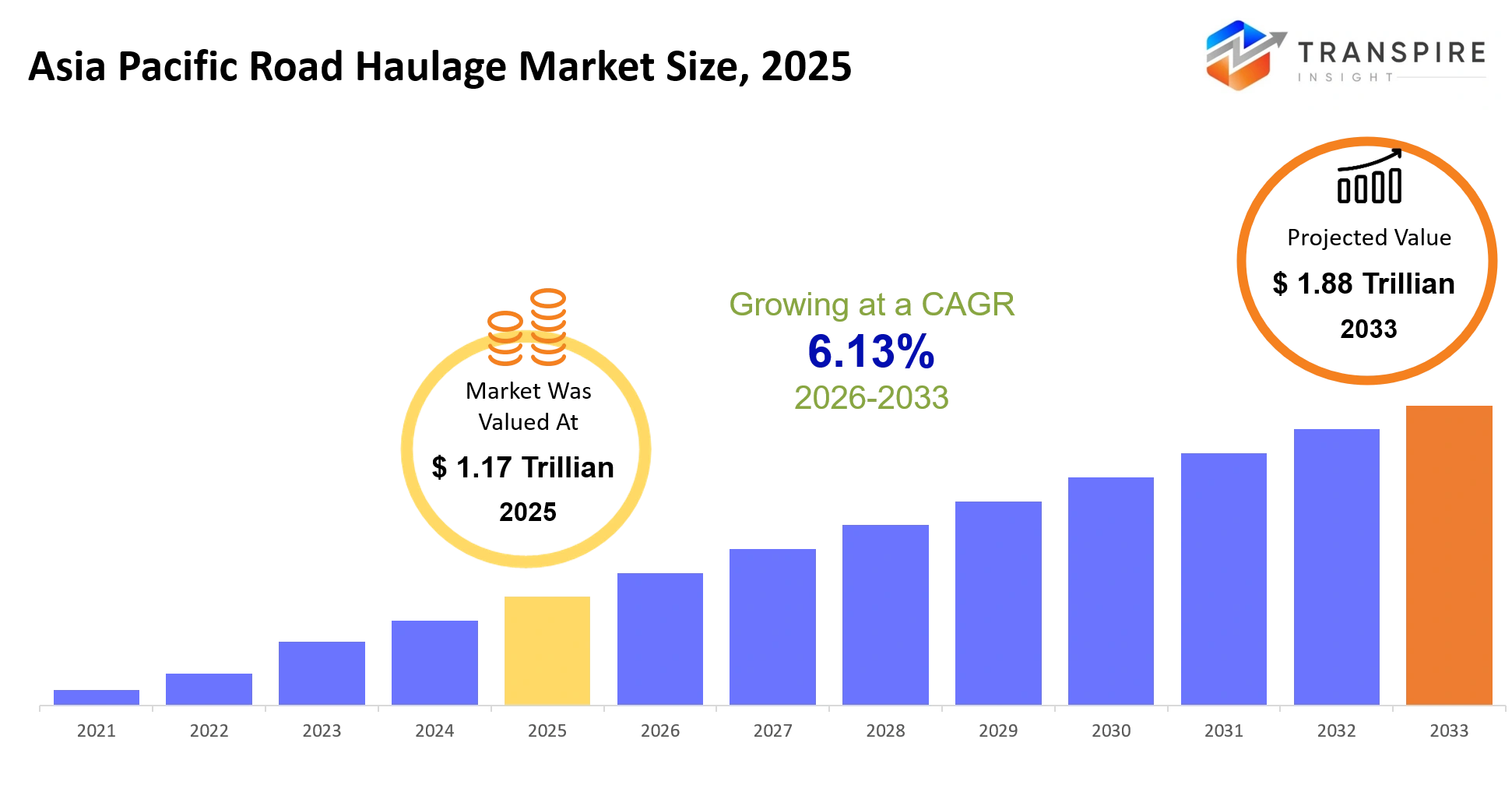
- Asia Pacific Road Haulage Market Size 2025: USD 1.17 Trillian
- Asia Pacific Road Haulage Market Size 2033: USD 1.88 Trillian
- Asia Pacific Road Haulage Market CAGR: 6.13%
- Asia Pacific Road Haulage Market Segments: By Vehicle Type (Heavy Trucks, Light Commercial Vehicles, Trailers, Tankers, Refrigerated Trucks, Others); By Service Type (Full Truck Load, Less Than Truck Load, Express Delivery, Dedicated Transport, Others); By End User (Retail, Manufacturing, Construction, Agriculture, Automotive, Others); By Distance (Short Haul, Medium Haul, Long Haul, Others).
To learn more about this report,  Download Free Sample Report
Asia Pacific Road Haulage Market Summary
The Asia Pacific Road Haulage Market was valued at USD 1.17 Trillian in 2025. It is forecast to reach USD 1.88 Trillian by 2033. That is a CAGR of 6.13% over the period.
The Asia Pacific Road Haulage Market is focused on the transportation of finished goods, raw materials, and time-sensitive consignments among the regional supply chain's port and industrial centers and distribution networks-the last-mile and intercity "artery" of each network. Over the past 3-5 years, the market has moved structurally away from isolated owner-operator networks toward digitally mediated fleet orchestration through centralized, platform-based systems and outsourced contract logistics services.
COVID-19 has proven to be a particularly powerful catalyst, through its exposure of supply chains to domestic and cross-border transit through lockdown induced supply bottlenecks and congestion at major ports. In response, consignees increasingly entered into long-term capacity arrangements and logistics providers committed to implementing real-time visibility, optimized routing, and in transit monitoring capabilities in their systems. The combination of structural digitization and crisis induced reliability issues has improved transit capacity utilization and increased carriers' incentive for network consolidation and has spurred a shift toward higher-value logistics coordination integration among the region's manufacturing and retail chains.
Key Market Insights
- Asia Pacific Road Haulage Market moving toward the platform-based fleet management, leading to the better route efficiency, load consolidation, and real-time freight visibility over the corridors.
- China captures major shares in the Asia Pacific Road Haulage Market at around 35-40% of the overall market in 2025 due to heavy industrial production and highly congested logistics infrastructure.
- The market exhibits high growth in India with strong momentum attributed to infrastructure development, coupled with fast formalization of the fragmented truck network.
- The long-haul trucking service dominates the Asia Pacific Road Haulage Market due to sustained intra-city movement of freight from industrial & export corridors of the region.
- Last-mile delivery accounts for the second largest share owing to the increasing retail sales across urban areas and rising e-commerce fulfillment orders.
- Contract logistics and digital freight platforms is the fastest growing segment up to 2030 on account of its rapid adoption of automation.
- Manufacturing is the leading application segment with a share of almost 45% as a result of its demand for transportation services of automobiles, electronic products and industrial products.
- E-commerce logistics is the fast-growing application segment, transforming delivery frequency and delivery expectation of city based freight movement.
- Manufacturing companies are the leading end-users on account of large volume time scheduled freight movement on a regional basis.
- Retail and E-commerce is the fast-growing end-user segment.
What are the Key Drivers, Restraints, and Opportunities in the Asia Pacific Road Haulage Market?
Growth in the Asia Pacific Road Haulage Market is fueled by rapid formalization of fragmented trucking ecosystems (via digital freight matching solutions and logistics digitisation mandate), improved highway infrastructure, and harmonised transport regulations implemented by governments of India, China and South Asia. These policy-driven shifts have facilitated faster transit times and improved asset utility, enabling freight companies to increase revenues by way of more trips per day per truck, higher load consolidation, and minimum fleet idleness-thereby driving profitability per truck.
The most critical barrier remains infrastructure bottlenecks and across-border regulatory fragmentation. While gains in transit speed are evident due to recent reforms, variations in tolling infrastructure, customs clearance systems and road quality will continue to constrain freight flow rates across the ASEAN countries-South Asia corridors. These systemic roadblocks cannot be ameliorated in the short term as they are contingent on capital investments and intra-region policy coordination.
An emerging trend is opportunity driven by Electrified and data-driven fleets, particularly China and India. Adoption of telematics, Electric freight vehicles and AI based dispatch systems will lead to transformative changes in freight cost dynamics. In India and China logistics players leveraging EV trucking corridors and battery swapping infrastructure, would likely witness diminished fuel dependence and stabilized longer-term margins with increasing scale
What Has the Impact of Artificial Intelligence Been on the Asia Pacific Road Haulage Market?
19 June 2020|Artificial Intelligence to Facilitate Operational Intelligence in APAC Road Haulage MarketArtificial intelligence (AI) is altering the Asia Pacific Road Haulage Market as it allows end-to-end operational intelligence that spans fleet scheduling, freight allocation, and route optimization. A greater number of logistics operators are installing AI based telematics solutions that permit automated vehicle and cargo tracking and monitoring driver behaviour and providing compliance reports for regulations. These solutions help minimize human intervention, enhance the accuracy of dispatched and cargo utilisation in high traffic transportation networks.
There are several applications in machine learning models that are widely adopted for predictive maintenance and analyse the risk of potential failures from the engine sensors, braking systems etc, so as to avoid equipment failure in order to maximize fleet availability for all operations. Other applications of AI include the utilisation of machine learning to optimize routes that analyse traffic, fuel data and the required time for delivery to further minimize the expenditure and improve the timeliness of long-haul vehicle deliveries.
Companies are realizing gains in efficiency and reducing costs as a result of effective load planning and minimizing return freight trips. Nonetheless, high expenses on integrations and poor data from the outdated systems still present significant barriers in this field. Most smaller operators do not have the necessary digital foundations required for AI technologies, thus limited to improve the accuracy and performance for distributed logistics in the developing Asia Pacific region.
Key Market Trends
- 2021–2025 Trucking sector saw a shift from owner–drivers to contract logistics, improving utilization across main APAC corridors.
- Digital Freight platforms grew extensively post 2020. This reduction in empty returns among organized fleet owners was close to 15–20% across China & India.
- Indian regulation on E-tolling & GPS tracking since 2022 added much required transparency in compliances & reduced transit time deviations.
- E-commerce boom during 2020–2025 escalated requirement for Time-definite deliveries, pushing for better routing and last-mile coordination between logistics providers.
- Electric Truck adoption began on a larger scale in 2023–26 on the short-haul urban freight routes for logistics providers in China.
- Integration of AI-based route optimization by major operators such as DHL SC and DB Schenker increased fuel efficiency and decreased truck idle time on the Asian networks.
- The COVID disruptions between 2020–2022 drove a need among manufacturers for more reliable and diverse transport partners, enhancing demand for Multi-Carrier logistics contracts across the region.
- The Intra-ASEAN cross border road freight improved post the 2023 trade facilitation agreements on reducing customs transit times.
- The fleet monitoring telematics adoption between 2022–25 increased delivery reliability.
- Mergers between smaller trucking firms and larger entities were more prevalent in the digitally integrated freight network for survival.
Asia Pacific Road Haulage Market Segmentation
By Vehicle Type :
Heavy trucks carry bulk freight over interstate routes and across industrial corridors transporting high-volume goods among industrial complexes. Light commercial vehicles are employed for urban deliveries and short-haul logistics while refrigerated trucks ensure constant temperature freight transport while tankers and trailers are essential for industrial materials and liquid distribution across the supply chains.
Vehicle diversification growth occurred post-2020 as freight volume demands underwent restructuring toward quick delivery and specialized cargo handling while heavy trucks continue to be critical for long-haul efficiency, light commercial vehicles have witnessed an exponential increase in growth driven by rising e-commerce logistics and the pressures of last mile delivery in metropolitan areas of Asia Pacific.
By Service Type :
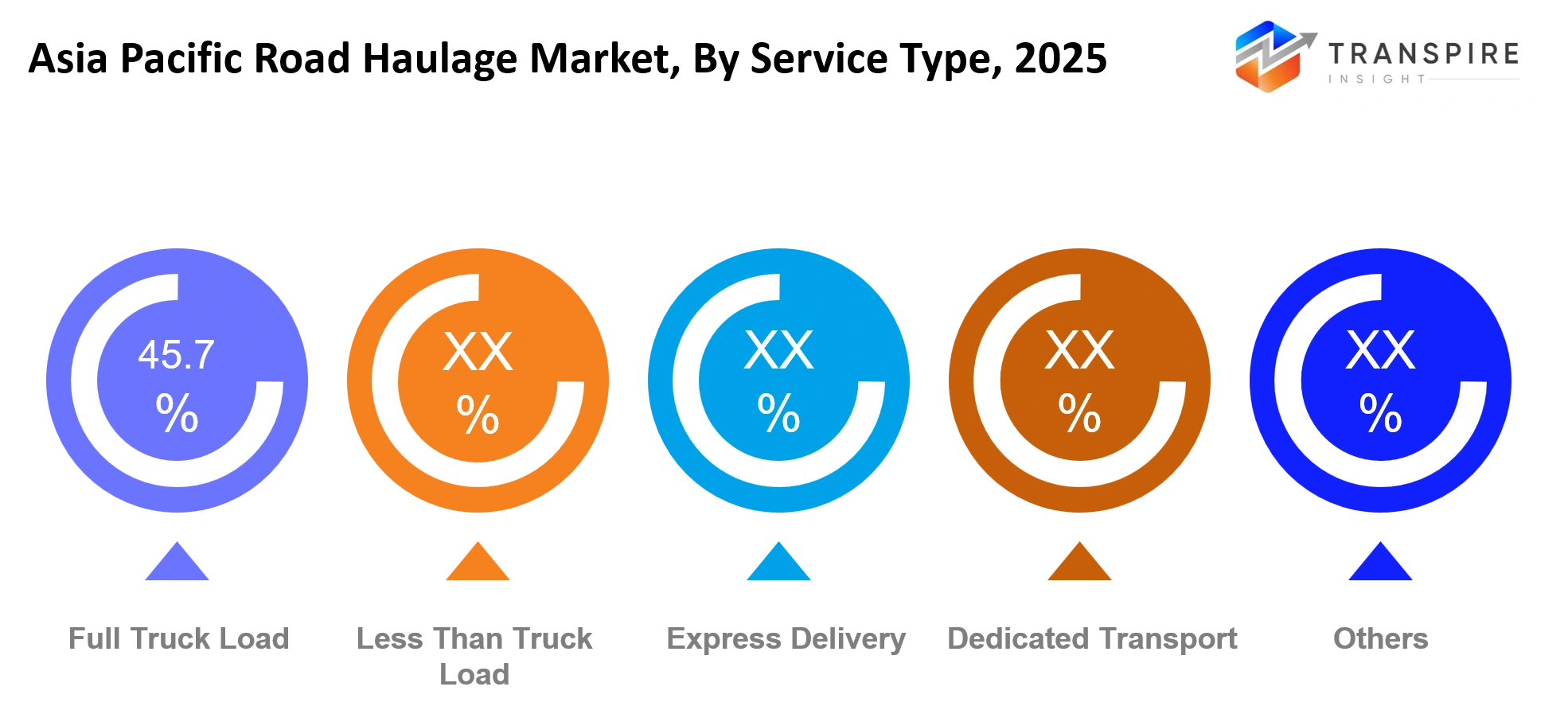
Full truck load services represent a large share of long-haul freight movements to facilitate economic delivery of bulk freight between industrial and export centers. Less than truck load services accommodate small and medium-sized shipments in a dispersed supply chain, whereas express delivery services focus on fast freight movements within and between urban/semi-urban regions.
Service configurations shifted post-2021, as supply chain disruptions amplified the need for dynamic capacity planning and flexible freight transportation solutions, Dedicated transportation contracts increased among large businesses demanding stable freight delivery availability, whereas express delivery services rose to prominence amid growing consumer demand for prompt last mile deliveries.
To learn more about this report, Download Free Sample Report
By End User :
Manufacturing continues to be one of the principal end users, with a steady freight flow of raw and finished goods among production clusters. Retail demand growth was supported by the rise of a structured logistics and distribution system to facilitate flow of consumer goods. Construction, as well as automotive sectors needed bulk transportation of components and equipment.
Post-2020 end-use demand evolved with the shift towards more dispersed manufacturing, driving growth of regional freight demands. Retail logistics expanded significantly with rapid growth of e-commerce, whereas the automotive industry moved toward shorter, frequent, smaller shipments, supporting flexibility across assembly networks against production variability.
By Distance :
Short haul enables rapid urban logistics and delivery services within cities; focused on efficiency and frequency of transit. Medium haul connects regional industrial zones, providing a trade-off between transit time and transport costs. Long haul covers transportation across inter-states and borders along extensive supply corridors.
Post-2020 distance-based logistics operations have transformed with the growing emphasis on faster delivery times and supply chain reliability. The short haul and medium haul segments recorded strong expansion with growth in urbanization and the retail sector, while the long haul sector remained a critical component connecting manufacturing clusters across economies of Asia Pacific.
What are the Key Use Cases Driving the Asia Pacific Road Haulage Market?
The leading use case in the Asia Pacific Road Haulage Market still involves manufacturing logistics. The production line of factories requires constant transit of goods-both raw materials and finished products-between manufacturing clusters, ports and transit areas. This leads to high usage due to its time-sensitive nature; production delays could affect output and commitments for exports in an industrial country.
Retail distribution and construction supply chains are growing use cases of road haulage especially for fast moving goods and building materials. The increasing demands from retailers requiring regular replenishment in various urban centers as well as cement, steel and heavy equipment required for projects by construction companies have contributed to an increase in road haulage usage.
Emerging use cases of cold chain logistics and cross-border e-commerce fulfillment are slowly emerging with rising quality standards for food and pharmaceuticals and cross-border shipment of small parcels due to growth in digital trade across ASEAN corridor and changes in customs facilitations respectively.
|
Report Metrics |
Details |
|
Market size value in 2025 |
USD 1.17 Trillian |
|
Market size value in 2026 |
USD 1.24 Trillian |
|
Revenue forecast in 2033 |
USD 1.88 Trillian |
|
Growth rate |
CAGR of 6.13% from 2026 to 2033 |
|
Base year |
2025 |
|
Historical data |
2021 - 2024 |
|
Forecast period |
2026 - 2033 |
|
Report coverage |
Revenue forecast, competitive landscape, growth factors, and trends |
|
Regional scope |
Asia Pacific (India, China, Japan, Australia, South Korea, Rest of Asia Pacific) |
|
Key company profiled |
DHL Supply Chain, DB Schenker, DSV, Kuehne+Nagel, Nippon Express, Toll Group, CJ Logistics, SF Holding, Kerry Logistics, Yusen Logistics, Hitachi Transport, CEVA Logistics, XPO, GXO, FedEx. |
|
Customization scope |
Free report customization (country, regional & segment scope). Avail customized purchase options to meet your exact research needs. |
|
Report Segmentation |
By Vehicle Type (Heavy Trucks, Light Commercial Vehicles, Trailers, Tankers, Refrigerated Trucks, Others); By Service Type (Full Truck Load, Less Than Truck Load, Express Delivery, Dedicated Transport, Others); By End User (Retail, Manufacturing, Construction, Agriculture, Automotive, Others); By Distance (Short Haul, Medium Haul, Long Haul, Others). |
Which Regions are Driving the Asia Pacific Road Haulage Market Growth?
China stands out as the leading country in the Asia Pacific Road Haulage market because of its robust manufacturing hub and tightly integrated logistics corridors. Its dense highway network, combined with consistent investment in interprovincial freight corridors, facilitates strong efficiency in cargo movement. National policies on promoting cluster development of manufacturing facilities in coastal zones and enhancing their proximity to ports further bolstered the demand for long haul trucking throughout export driven zones. Its sophisticated fleet infrastructure and mature tolling and digital freight management system also supports its premier position in the market.
The second largest region is Japan and South Korea because of its stable industrial output and standardized logistics operations. While this region does not experience growth in the similar volume driven sense as China's region, there is immense demand for delivery with more accuracy, stability and on-time performance than anything else. Strict enforcement of regulations and its high quality of road infrastructure ensures smooth operation with almost no disturbances in freight flow. Furthermore, the strong presence of long term contracts between the manufacturing companies and logistics operators in these countries, ensure sustained revenue contribution from these entities.
The two fastest growing regions in the Asia Pacific Road Haulage market are the Southeast Asian region and India. Both the regions have seen considerable developments in the infrastructure side due to the government led policies in construction of highways, investment in logistics parks and their interconnectivity. Recent trade facilitation policies by ASEAN has been critical in minimizing cross border delays for seamless cargo movement. These factors have presented favorable entry options for logistics providers looking to tap into scalable and cost effective opportunities in the developing freight market in the emerging centers of demand.
Who are the Key Players in the Asia Pacific Road Haulage Market and How Do They Compete?
The Asia Pacific Road Haulage market is moderately fragmented.Global logistics service providers are competing against regional trucking service providers. Competition has a greater focus on delivery accuracy, efficiency of service and digital freight visibility, more than simply price. Incumbent firms are investing further in developing integrated logistics services.Digital-first firms are innovating traditional models of dispatch and routing planning.DHL Supply ChainandDB Schenker,for instance, invest in technology-led logistics integration utilizing AI for routing and warehousing synchronization to enable more precise deliveries and minimize fleet idle times.
Kuehne+Nagel differentiates by prioritizing cross-border freight synchronization and contract logistics strengths, developing capabilities across Asian-Pacific trade corridors.Nippon Express Holdingscombines strong domestic coverage within Japan while investing in regional capacity through acquisition and enhanced multimodal transport services.Toll Groupcapitalizes on Australian and Southeast Asian strengths through specialization in heavy freight and infrastructure related logistics projects to service resource and industrial supply chains.
Company List
- DHL Supply Chain
- DB Schenker
- DSV
- Kuehne+Nagel
- Nippon Express
- Toll Group
- CJ Logistics
- SF Holding
- Kerry Logistics
- Yusen Logistics
- Hitachi Transport
- CEVA Logistics
- XPO
- GXO
- FedEx
Recent Development News
In June 2025, Nippon Express Holdings expanded its ASEAN road transport partnerships to strengthen multimodal logistics integration across Japan, Thailand, and Indonesia. The expansion improved automotive and electronics supply chain reliability through synchronized road and warehouse coordination. It also enhanced regional capacity for time-sensitive manufacturing shipments.
Source: https://www.nipponexpress.com/
In January 2025, DB Schenker expanded its Asia road logistics network through upgraded cross-border trucking corridors in Southeast Asia. The initiative improved freight visibility and reduced transit delays across Thailand, Malaysia, and Vietnam. This development strengthened regional connectivity for manufacturing and retail supply chains, supporting faster inland cargo movement linked to export hubs.
Source: https://www.dbschenker.com/
What Strategic Insights Define the Future of the Asia Pacific Road Haulage Market?
Within the Asia Pacific Road Haulage Market, a structural transformation to a truly digital and asset-light freight eco system is already occurring, whereby routing intelligence, cross-border consolidation and platform-driven capacity allocation will increasingly become the determining factors of competitive advantage over the next 5–7 years, supported by growing e-commerce and decentralizing manufacturing throughout Southeast Asia. The rise in time sensitive and adaptable Inland Logistics, replacing rigid route trucking solutions, will steadily grow over time.
An unseen threat of increased dependency on a handful of digital freight platforms could also emerge which could ultimately consolidate price-setting power and lower the bargaining leverage of smaller carriers, negatively impacting profit margins across the value chain.
A significant and visible emerging opportunity is that of green logistics corridors-particularly the planned freight electrification route network in India and a wide array of initiatives being implemented for low-emission highways in China-which will create first mover advantage for those investing in electrical and hybrid truck fleets.
Early adoption of multimodal visibility platforms and the ability to coordinate operations across road, rail and port segments to win long-term enterprise contracts will offer a significant opportunity for market players.
Asia Pacific Road Haulage Market Report Segmentation
By Vehicle Type
- Heavy Trucks
- Light Commercial Vehicles
- Trailers
- Tankers
- Refrigerated Trucks
By Service Type
- Full Truck Load
- Less Than Truck Load
- Express Delivery
- Dedicated Transport
By End User
- Retail
- Manufacturing
- Construction
- Agriculture
- Automotive
By Distance
- Short Haul
- Medium Haul
- Long Haul
Frequently Asked Questions
Find quick answers to common questions.
The Asia Pacific Road Haulage Market size is USD 1.88 Trillian in 2033.
Key segments for the Asia Pacific Road Haulage Market are By Vehicle Type (Heavy Trucks, Light Commercial Vehicles, Trailers, Tankers, Refrigerated Trucks, Others); By Service Type (Full Truck Load, Less Than Truck Load, Express Delivery, Dedicated Transport, Others); By End User (Retail, Manufacturing, Construction, Agriculture, Automotive, Others); By Distance (Short Haul, Medium Haul, Long Haul, Others).
Major Asia Pacific Road Haulage Market players are DHL Supply Chain, DB Schenker, DSV, Kuehne+Nagel, Nippon Express, Toll Group, CJ Logistics, SF Holding, Kerry Logistics, Yusen Logistics, Hitachi Transport, CEVA Logistics, XPO, GXO, FedEx.
The Asia Pacific Road Haulage Market size is USD 1.17 Trillian in 2025.
The Asia Pacific Road Haulage Market CAGR is 6.13% from 2026 to 2033.
- DHL Supply Chain
- DB Schenker
- DSV
- Kuehne+Nagel
- Nippon Express
- Toll Group
- CJ Logistics
- SF Holding
- Kerry Logistics
- Yusen Logistics
- Hitachi Transport
- CEVA Logistics
- XPO
- GXO
- FedEx
About the Authors

Mayur Shinde
I am Mayur Shinde, a Senior Research Analyst at Transpire Insight, specializing in the Automotive & Transportation and Information & Communication Technology (ICT) Industry. My work focuses on analyzing emerging market trends, technological advancements, competitive landscapes, and industry developments to deliver accurate, data-driven insights. I am passionate about transforming complex market information into clear, actionable content that helps businesses, professionals, and decision-makers stay informed and make confident strategic decisions.

Chakradhar Khansole
Chakradhar serves as the Research Director at Transpire Insight, bringing over 8 years of experience in technology, innovation, and strategic market intelligence. He specializes in transforming complex market data into actionable business insights that enable organizations to make informed, growth-oriented decisions. Recognized for his strategic vision and analytical expertise, Chakradhar leads high-impact research initiatives, delivering comprehensive market assessments, competitive intelligence, and forward-looking industry analysis.
Recently Published Reports
-
Apr 2026
ATV & UTV Market
ATV & UTV Market Size, Share & Analysis Report By Type (ATV, and UTV), By Variants (Less Than 400 CC, 400 CC To 800 CC, and More Than 800 CC), and Geography (North America, Europe, Asia-Pacific, Middle East and Africa, South and Central America), 2021 - 2031
-
Apr 2026
Automotive Central Gateway Module Market
Automotive Central Gateway Module Market Size, Share & Analysis Report By Type (Ethernet Central Gateway Module, CAN Central Gateway Module, LIN Central Gateway Module, and FlexRay), By Application (Powertrain Control, Body Control, Infotainment System, Advanced Driver Assistance Systems (ADAS), and Others), By End User (Passenger Vehicles, and Commercial Vehicles), and Geography (North America, Europe, Asia-Pacific, Middle East and Africa, South and Central America), 2021 - 2031
-
Apr 2026
Automotive Engine Oil Filter Market
Automotive Engine Oil Filter Market Size, Share & Analysis Report By Filter Type (Fuel Filter, Engine Oil Filter, Hydraulic Oil Filter, and Others), By Filter Media (Cellulose, Synthetic, and Micro), By Sales Channel (OEMs, and Aftermarket), By Vehicle Type (Passenger Cars, Light Commercial Vehicles, Heavy Duty Trucks, Buses and Coaches, and Off-road Vehicles), and Geography (North America, Europe, Asia-Pacific, Middle East and Africa, South and Central America), 2021 - 2031
-
Apr 2026
Automotive Parts Aluminium Die Casting Market
Automotive Parts Aluminium Die Casting Market Size, Share & Analysis Report By Production Process (Pressure Die Casting, Vacuum Die Casting, Squeeze Die Casting, Gravity Die Casting), By Application (Body Parts, Engine Parts, Transmission Parts, Battery And Related Components, Other Application Types), and Geography (North America, Europe, Asia-Pacific, Middle East and Africa, South and Central America), 2021 - 2031
Our Clients



