
Asia Pacific Rental Chiller Market Size & Forecast:
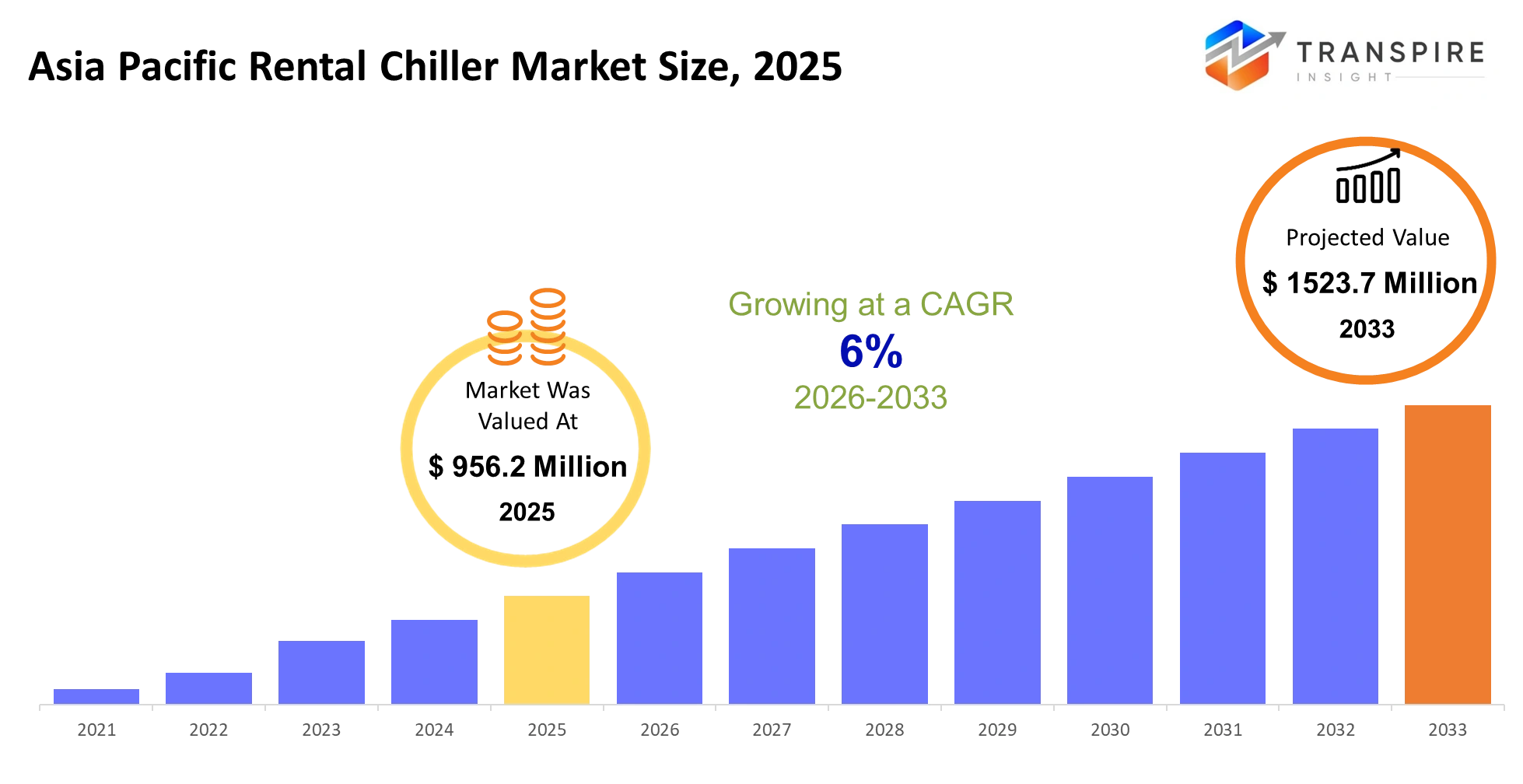
- Asia Pacific Rental Chiller Market Size 2025: USD 956.2 Million
- Asia Pacific Rental Chiller Market Size 2033: USD 1523.7 Million
- Asia Pacific Rental Chiller Market CAGR: 6%
- Asia Pacific Rental Chiller Market Segments: By Type (Air-cooled Chillers, Water-cooled Chillers, Absorption Chillers, Others); By Application (Industrial Cooling, Commercial Buildings, Events, Oil & Gas, Power Plants, Others); By End-User (Industrial Firms, Commercial Users, Event Organizers, Energy Companies, Construction Firms, Others); By Capacity (Below 100 Ton, 100–500 Ton, Above 500 Ton, Others).
To learn more about this report,  Download Free Sample Report
Asia Pacific Rental Chiller Market Summary
The Asia Pacific Rental Chiller Market was valued at USD 956.2 Million in 2025. It is forecast to reach USD 1523.7 Million by 2033. That is a CAGR of 6% over the period.
The Asia Pacific rental chiller market provides essential cooling support to industrial operations and commercial facilities and large events when their permanent cooling systems face unavailability or maintenance needs or exceed their maximum cooling capacity. Rental chillers enable businesses to maintain operational activities through their equipment upgrades to semiconductor plants and their temperature control functions at pharmaceutical manufacturing sites and their emergency cooling services at data centers.
The market has shifted during the past five years from using emergency cooling solutions to developing flexible cooling systems that organizations can operate according to their demands. The market now embraces modular cooling systems because operators can monitor their actual cooling requirements through digital monitoring systems. The supply chain upheaval after the pandemic served as the main catalyst because it resulted in delivery delays for required HVAC and industrial cooling systems throughout Asia Pacific. The rental market became more popular because extended installation times forced companies to use rental equipment as their solution to prevent production downtime. Customers now purchase rental chillers because businesses use them as essential equipment for their operations, which leads to longer contract periods and increased recurring revenue for service providers.
Key Market Insights
- The Asia Pacific Rental Chiller Market now uses planned cooling strategies for industrial expansion and infrastructure modernization instead of emergency-only deployments.
- The use of digital monitoring together with IoT-enabled rental chillers resulted in a fleet utilization increase of 18% which major providers achieved between 2021 and 2025.
- The Asia Pacific Rental Chiller Market experiences rising demand because data centers expand and semiconductor manufacturing increases across high-temperature operational environments.
- The temporary cooling systems experienced rising demand because of supply chain disruptions since 2021 which led to industrial clients extending their average rental contracts by 20% more than normal.
- China maintains its position as the leading country in the Asia Pacific rental chiller market which will reach 38% market share in 2025 due to its extensive manufacturing and infrastructure development projects.
- India will achieve its status as the fastest-growing regional market through 2030 because of its pharmaceutical manufacturing capacity and its data center development projects and its commercial building expansion activities.
- Southeast Asia experiences major share increases through the development of industrial parks in Vietnam and Indonesia and Thailand.
- Air-cooled chillers will lead the market with almost 46% market share because they provide simple installation and basic operational requirements.
- The industrial process cooling sector holds the largest market share at 41% because it serves the chemical and food processing and electronics manufacturing industries.
- The data center cooling segment operates as the quickest growing application area because it will experience substantial growth throughout the entire forecast period.
What are the Key Drivers, Restraints, and Opportunities in the Asia Pacific Rental Chiller Market?
The Asia Pacific rental chiller market experiences its highest growth rate because companies construct temperature-sensitive industrial facilities which include semiconductor fabrication sites and pharmaceutical manufacturing plants and hyperscale data centers. The market trend accelerated after supply chain disruptions from 2020 created equipment purchasing delays and project execution halts which lasted for two years. The delivery period for permanent cooling systems increased from six to eight months because certain markets needed more than one year to deliver the systems. Operators turned to rental chillers for two purposes which included using them to cover their commissioning needs and using them to support ongoing production activities. The transition has resulted in higher fleet utilization and extended contract periods which create more predictable revenue streams for providers.
The market’s most significant structural barrier is the limited availability of high-capacity rental fleets across emerging Asia Pacific economies. The process of creating and operating these rental fleets demands extensive financial resources because it needs both operational facilities and specialized technical personnel. The service networks in this region face obstacles because they operate through various regional service centers which include secondary industrial cities throughout Southeast Asia and India. The result is slower deployment timelines and missed contract opportunities which suppress market penetration in high-growth industrial clusters.
The primary growth potential for the business exists through its modular IoT-enabled rental chiller system, which serves edge data centers and decentralized industrial facilities. Regional digital infrastructure development in India and Indonesia receives strong investment because operators need temporary cooling solutions that can grow with their business needs during their expansion phase. The companies that implement remote monitoring for their modular fleet system will effectively acquire this new market opportunity.
What Has the Impact of Artificial Intelligence Been on the Asia Pacific Rental Chiller Market?
Artificial intelligence technology currently transforms rental cooling systems by providing automated equipment monitoring and dispatching control functions. The advanced control systems now utilize real-time telemetry data to monitor temperature stability and compressor load and refrigerant pressure and energy consumption throughout the operational cooling systems. AI-driven fleet management platforms enable rental providers to maintain automatic control of their operational settings that respond to existing environmental conditions and customer demand changes, which results in better cooling accuracy and decreased electrical power consumption that is not necessary for their operations.
Predictive maintenance systems now gain increased capabilities through the application of machine learning models. The systems use vibration pattern analysis together with compressor cycle frequency data and historical fault information to predict performance degradation that will occur before an equipment failure happens. Equipment uptime in large industrial settings has increased by 15% to 20% through this technology, while emergency maintenance expenses have decreased. The digital optimization tools help organizations achieve energy savings because they can adjust cooling production in real time to match actual demand, which results in a 8% to 12% reduction of electricity expenses during prolonged operational periods.
Digital infrastructure across Asia Pacific remains limited because various parts of the region maintain separate systems. Many industrial sites still lack consistent connectivity or integrated building management systems, which restricts real-time data capture. The combined expenses of initial system integration and the shortage of specific operational data decrease model performance because the system needs exact knowledge about particular thermal conditions that occur during temporary manufacturing operations and outdoor cooling activities.
Key Market Trends
- The average duration of rental contracts has increased by almost 20 percent since 2021 because manufacturers now rely on temporary cooling solutions during their waiting period for permanent system installations.
- The industrial sector has changed its approach from emergency equipment rentals to scheduled acquisition of cooling systems which now includes semiconductor and pharmaceutical projects that will begin operation between 2023 and 2026.
- Aggreko and Carrier Global have advanced their distribution of IoT-enabled chillers because these units enable better remote troubleshooting which leads to fewer unexpected maintenance needs.
- After 2022 clients started to use air-cooled modular systems more because these systems enabled quicker setup times and reduced site-preparation expenses for their temporary industrial operations.
- The post-pandemic equipment shortage led to higher rental fleet usage because rental companies in Asia Pacific experienced equipment deployment growth that exceeded 15 percent during the period from 2022 until 2024.
- India and Indonesia developed into key expansion territories after hyperscale data center funding moved cooling requirements away from established data centers in China and Japan.
- Suppliers needed to replace their outdated high-emission fleets because environmental compliance standards established after 2023 required them to adopt refrigerant systems that use low-global-warming-potential materials.
- Performance-based service contracts have become the preferred choice for buyers because providers who offer reliability guarantees and system monitoring capabilities have gained a competitive edge in the market.
- The number of companies competing in the market has increased because international businesses established service agreements with local companies which enabled them to deliver quicker service in essential industrial regions.
Asia Pacific Rental Chiller Market Segmentation
By Type :
The air-cooled chillers segment maintains a dominant standing in the Asia Pacific Rental Chiller Market due to its straightforward installation process and portable design and minimal upkeep requirements. The systems fulfill the temporary cooling requirements of commercial facilities and short-term industrial work sites which need fast installation. The cooling systems serve projects that demand immediate cooling functions because of their adaptable design.
Water-cooled chillers serve larger operations better because they deliver consistent cooling performance through extended time periods. Manufacturing facilities and extensive infrastructure projects commonly use these chillers through rental agreements. Absorption chillers become more popular in waste heat recovery systems because they provide energy-saving advantages. The other segment includes specialized cooling systems built for unique industrial conditions and customized project requirements.
By Application :
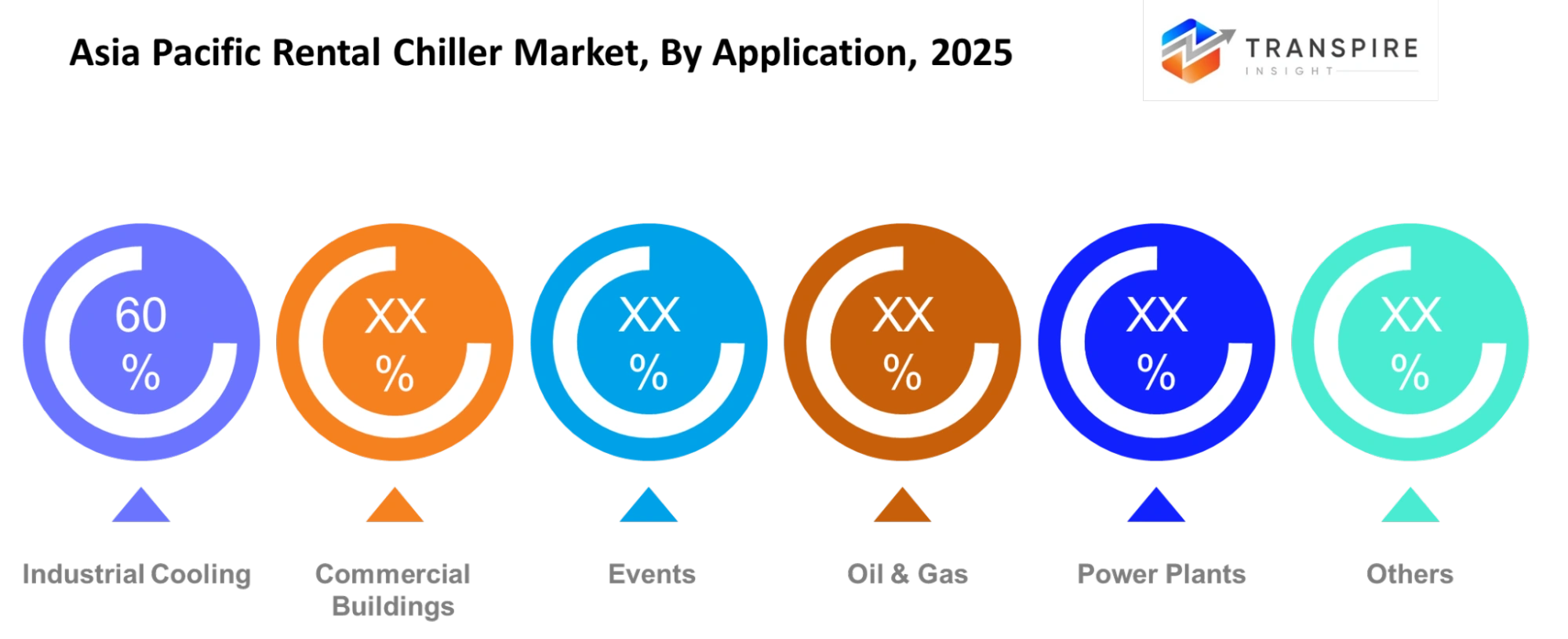
Industrial cooling remains one of the most important application segments in the Asia Pacific Rental Chiller Market due to continuous cooling needs in production facilities, chemical plants, and processing units. The rental of temporary cooling systems enables businesses to sustain their operations while they conduct maintenance work and replace their equipment without stopping their production process.
Commercial buildings use rental chillers during system breakdowns, seasonal demand peaks, and renovation activities. The events segment depends on these systems for exhibitions, concerts, and public gatherings where temporary climate control is essential. Oil and gas facilities and power plants also represent strong demand centers because uninterrupted cooling directly supports operational safety and efficiency. The healthcare and transport sectors require temporary cooling solutions for various applications.
To learn more about this report, Download Free Sample Report
By End-User :
Industrial facilities across the Asia Pacific region require chiller rentals because their operational processes depend on trustworthy cooling equipment. The companies use chiller rentals to handle equipment maintenance needs and unexpected equipment failures and to support their business growth initiatives.Commercial users who operate shopping malls and office buildings and hotel establishments need continuous temperature regulation which creates a substantial demand for their services.
Event organizers need temporary cooling systems to create comfortable conditions for both outdoor events and indoor events. Rental chillers serve as essential equipment for energy companies which need to operate their utility plants and energy processing facilities. Construction companies utilize these systems during their infrastructure projects to control environmental conditions and operate their specialized machinery. The other segment includes institutional and public-sector facilities requiring temporary cooling support.
By Capacity :
The below 100 ton segment serves small-scale cooling needs which include retail spaces and temporary offices and limited-duration events. This category is popular because of easy transport and quick setup. Demand remains steady where compact cooling solutions are sufficient and cost efficiency is a primary consideration.
The 100–500 ton category captures broad market demand because it offers flexible solutions which fit various industrial and commercial needs. The two systems achieve operational efficiency through controlled performance characteristics which allow users to adjust system parameters. The above 500 ton segment is designed for large industrial complexes power facilities and major infrastructure projects which require extensive cooling output. The strong growth of industrial development in Asia Pacific leads to increased rental demand for high-capacity equipment.
What are the Key Use Cases Driving the Asia Pacific Rental Chiller Market?
Industrial process cooling generates the highest demand for rental chiller systems which different industries use, especially semiconductor fabrication facilities, chemical production plants, and pharmaceutical manufacturing sites. The facilities need to maintain constant temperature levels because they use temporary cooling systems during maintenance periods and plant enhancements and system malfunctions to prevent production delays.
Commercial construction projects and hyperscale data centers now function as primary deployment locations which extend beyond their main operational purpose. Developers increasingly use temporary cooling during phased commissioning, while healthcare facilities and food processing plants deploy rental systems to maintain strict environmental control during HVAC retrofits or capacity expansion projects.
New applications are developing in renewable energy infrastructure and battery manufacturing plants, where they require thermal stability to conduct their testing and initial production increases. Temporary district cooling support needs to develop into a major solution for Southeast Asian cities, which experience fast infrastructure development that produces urgent but valuable cooling needs.
|
Report Metrics |
Details |
|
Market size value in 2025 |
USD 956.2 Million |
|
Market size value in 2026 |
USD 1013.6 Million |
|
Revenue forecast in 2033 |
USD 1523.7 Million |
|
Growth rate |
CAGR of 6% from 2026 to 2033 |
|
Base year |
2025 |
|
Historical data |
2021 - 2024 |
|
Forecast period |
2026 - 2033 |
|
Report coverage |
Revenue forecast, competitive landscape, growth factors, and trends |
|
Regional scope |
Asia Pacific (China, India, Japan, South Korea, Australia, Rest of Asia Pacific) |
|
Key company profiled |
Aggreko, Carrier, Trane, Daikin, Johnson Controls, Mitsubishi Electric, LG, Blue Star, Climaveneta, Swegon, GEA Group, SPX Cooling, Andrews Sykes, United Rentals, Ingersoll Rand. |
|
Customization scope |
Free report customization (country, regional & segment scope). Avail customized purchase options to meet your exact research needs. |
|
Report Segmentation |
By Type (Air-cooled Chillers, Water-cooled Chillers, Absorption Chillers, Others); By Application (Industrial Cooling, Commercial Buildings, Events, Oil & Gas, Power Plants, Others); By End-User (Industrial Firms, Commercial Users, Event Organizers, Energy Companies, Construction Firms, Others); By Capacity (Below 100 Ton, 100–500 Ton, Above 500 Ton, Others). |
Which Regions are Driving the Asia Pacific Rental Chiller Market Growth?
China maintains its position as the dominant force in the Asia Pacific rental chiller market through its superior industrial manufacturing capabilities and its extensive data center development projects and its ongoing major infrastructure building projects. The combination of industrial modernization programs and advanced manufacturing policy support has driven more funding toward semiconductor fabs and electronics manufacturing and pharmaceutical production facilities which need consistent thermal control. The country benefits from a complete service network because it has established logistics systems and it contains numerous industrial areas and it possesses local technical assistance resources which enable fast chiller installation. The rental industry operates through its established system which enables domestic and international rental companies to achieve optimal equipment use while delivering quick solutions for short-term cooling needs.
Japan stands as the second biggest regional contributor because its market presence depends on stable operations instead of aggressive growth. The Japanese market differs from China because it features continuous equipment replacement and requires high operational reliability and its existing industrial companies make long-term capital investments. The combination of its advanced commercial real estate industry and its systematic facility management processes produces reliable demand for scheduled maintenance rentals and emergency cooling system rentals. Japan serves as a reliable market for providers who deliver high-quality services through extended service contracts.
India has become the fastest-growing market because digital infrastructure development progresses and industrial investments grow at an increasing pace. The establishment of hyperscale data centers together with the rise of pharmaceutical production and the execution of industrial corridor initiatives backed by the government have created a need for temporary cooling solutions which started in 2023. The ongoing HVAC system delivery delays have resulted in increased dependence on rental cooling systems for use during equipment testing. The period from 2026 to 2033 offers market newcomers and investors an opportunity to develop regional service networks and operational fleets before competition reaches established market conditions.
Who are the Key Players in the Asia Pacific Rental Chiller Market and How Do They Compete?
The Asia Pacific rental chiller market remains moderately fragmented with international equipment manufacturers and local cooling companies competing in the marketplace. Companies now compete through their ability to provide equipment availability and fast deployment and digital monitoring systems and local technical support services instead of using basic pricing methods. Established companies are maintaining their market position through advances in their fleets which use low-GWP refrigerants and remote diagnostics while new regional companies operate in industrial areas which lack service through flexible contract agreements. Businesses now use geographical responsiveness as a key competitive advantage because customers want fast installation and uptime guarantees more than they want the cheapest rental solutions.
Aggreko uses large modular cooling fleets and advanced remote monitoring systems to create a unique value proposition which enables predictive maintenance in complex industrial systems. The company plans to expand its operations in India and Southeast Asia by establishing service hubs close to new manufacturing centers which will give it better operational speed than its rivals who depend on main service centers. Carrier Global provides integrated rental and engineering solutions which enable clients to create customized cooling systems for data centers and pharmaceutical facilities that require precise temperature control.
Daikin Industries uses its manufacturing facilities located in different regions and its refrigerant technology to provide energy-saving temporary cooling systems which comply with increasing environmental regulations. Trane Technologies develops digitally connected chillers which enable better operational monitoring for industrial contracts that extend over long periods. Atlas Copco expands its operations through partnerships with local engineering contractors, which allows the company to reach secondary industrial markets that larger competitors find difficult to access because of deployment logistics challenges.
Company List
- Aggreko
- Carrier
- Trane
- Daikin
- Johnson Controls
- Mitsubishi Electric
- LG
- Blue Star
- Climaveneta
- Swegon
- GEA Group
- SPX Cooling
- Andrews Sykes
- United Rentals
- Ingersoll Rand
Recent Development News
In February 2026, Johnson Controls launched Smart Ready YORK Chillers. The factory-installed connected chiller platform delivers real-time analytics from day one and is expected to strengthen rental chiller fleet efficiency and uptime across high-demand Asia Pacific commercial and industrial cooling applications.
Source: https://www.johnsoncontrols.com/
In February 2026, Johnson Controls launched the YORK YDAM high-density air-cooled magnetic bearing centrifugal chiller. The new 3.5MW cooling solution expands advanced thermal management capacity for hyperscale and AI-driven facilities, creating stronger deployment opportunities for rental chiller providers serving Asia Pacific data center infrastructure projects.
Source: https://www.johnsoncontrols.com/
What Strategic Insights Define the Future of the Asia Pacific Rental Chiller Market?
The Asia Pacific rental chiller market will transition from equipment rental transactions to digital cooling systems which service-based operations will manage throughout the next five to seven years. The region experiences this transformation because its investments in high-value temperature-sensitive infrastructure projects such as semiconductor manufacturing and edge data centers and advanced pharmaceutical facilities and battery production plants have reached an accelerated pace. The industrial sector will achieve its operational targets through equipment providers who deliver modular solutions together with performance-based contracts and predictive monitoring systems, which enable customers to make ongoing business decisions.
The less evident danger arises from industrial users who operate permanent modular cooling systems, which now offer cost-effective solutions for their continuous thermal load requirements. The process will lead to declining demand for long-term rental agreements in established markets. An emerging opportunity exists in Southeast Asia, especially through the expansion of edge data centers in Indonesia and Vietnam, which requires temporary scalable cooling solutions that support construction projects.
The primary strategic recommendation for market participants requires them to make early financial commitments toward building service centers which will provide local support and operate fleets with low global warming potential refrigerants that use digital technology. The ability to deploy resources quickly together with the capability to control operations from a distance will become the main competitive advantage for entities that handle specialized cooling needs in different parts of the region.
Asia Pacific Rental Chiller Market Report Segmentation
By Type
- Air-cooled Chillers
- Water-cooled Chillers
- Absorption Chillers
By Application
- Industrial Cooling
- Commercial Buildings
- Events
- Oil & Gas
- Power Plants
By End-User
- Industrial Firms
- Commercial Users
- Event Organizers
- Energy Companies
- Construction Firms
By Capacity
- Below 100 Ton
- 100–500 Ton
- Above 500 Ton
Frequently Asked Questions
Find quick answers to common questions.
The Asia Pacific Rental Chiller Market size is USD 1523.7 Million in 2033.
Key segments for the Asia Pacific Rental Chiller Market are By Type (Air-cooled Chillers, Water-cooled Chillers, Absorption Chillers, Others); By Application (Industrial Cooling, Commercial Buildings, Events, Oil & Gas, Power Plants, Others); By End-User (Industrial Firms, Commercial Users, Event Organizers, Energy Companies, Construction Firms, Others); By Capacity (Below 100 Ton, 100–500 Ton, Above 500 Ton, Others).
Major Asia Pacific Rental Chiller Market players are Aggreko, Carrier, Trane, Daikin, Johnson Controls, Mitsubishi Electric, LG, Blue Star, Climaveneta, Swegon, GEA Group, SPX Cooling, Andrews Sykes, United Rentals, Ingersoll Rand.
The Asia Pacific Rental Chiller Market size is USD 956.2 Million in 2025.
The Asia Pacific Rental Chiller Market CAGR is 6% from 2026 to 2033.
- Aggreko
- Carrier
- Trane
- Daikin
- Johnson Controls
- Mitsubishi Electric
- LG
- Blue Star
- Climaveneta
- Swegon
- GEA Group
- SPX Cooling
- Andrews Sykes
- United Rentals
- Ingersoll Rand
Recently Published Reports
-
Apr 2026
Active Power Filter Market
Active Power Filter Market Size, Share & Analysis Report By Type (Shunt Active Power Filters, Series Active Power Filter, Hybrid Active Power Filter), By Application (Harmonics Mitigation, Reactive Power Compensation, Voltage Regulation, Power Factor Correction), By Phase (Single Phase, Three Phase), By End-User Industry (Manufacturing, Healthcare, Commercial, Automotive, Oil and Gas, Others), and Geography (North America, Europe, Asia-Pacific, Middle East and Africa, South and Central America), 2021 - 2031
-
Apr 2026
Electrical Transformer Market
Electrical Transformer Market Size, Share & Analysis Report By Core (Closed, Shell, and Berry), By Insulation (Gas, Oil, Solid, Air, and Other), By Phase (Single, and Three), By Rating (100 MVA to 500 MVA, 501 MVA to 800 MVA, and 801 MVA to 1200 MVA), and Geography (North America, Europe, Asia-Pacific, Middle East and Africa, South and Central America), 2021 – 2031
-
Apr 2026
Hydraulic Piston Pumps Market
Hydraulic Piston Pumps Market Size, Share & Analysis Report By Type (Axial Piston Pumps, Radial Piston Pumps), By Operating Pressure (Low Pressure, Medium Pressure, High Pressure), By Application (Construction, Mining, Agriculture, Automotive, Oil & Gas, Industrial Machinery, Others), By End-User (OEMs, Aftermarket), and Geography (North America, Europe, Asia-Pacific, Middle East and Africa, South and Central America), 2021 – 2031
-
Apr 2026
Laboratory Gas Generators Market
Laboratory Gas Generators Market Size, Share & Analysis Report By Product (Nitrogen Gas Generator, Hydrogen Gas Generator, Zero Air Gas Generator, Purge Gas Generator, TOC Gas Generators, Others), By Application (Gas Chromatography, Liquid Chromatography-mass Spectrometry (LC-MS), Gas Analyzers, Others), By End-user (Life Science, Chemical & Petrochemical, Food & Beverage, Others), and Geography (North America, Europe, Asia-Pacific, Middle East and Africa, South and Central America), 2021 – 2031