

Asia Pacific Reconstituted Juice Market Size & Forecast:
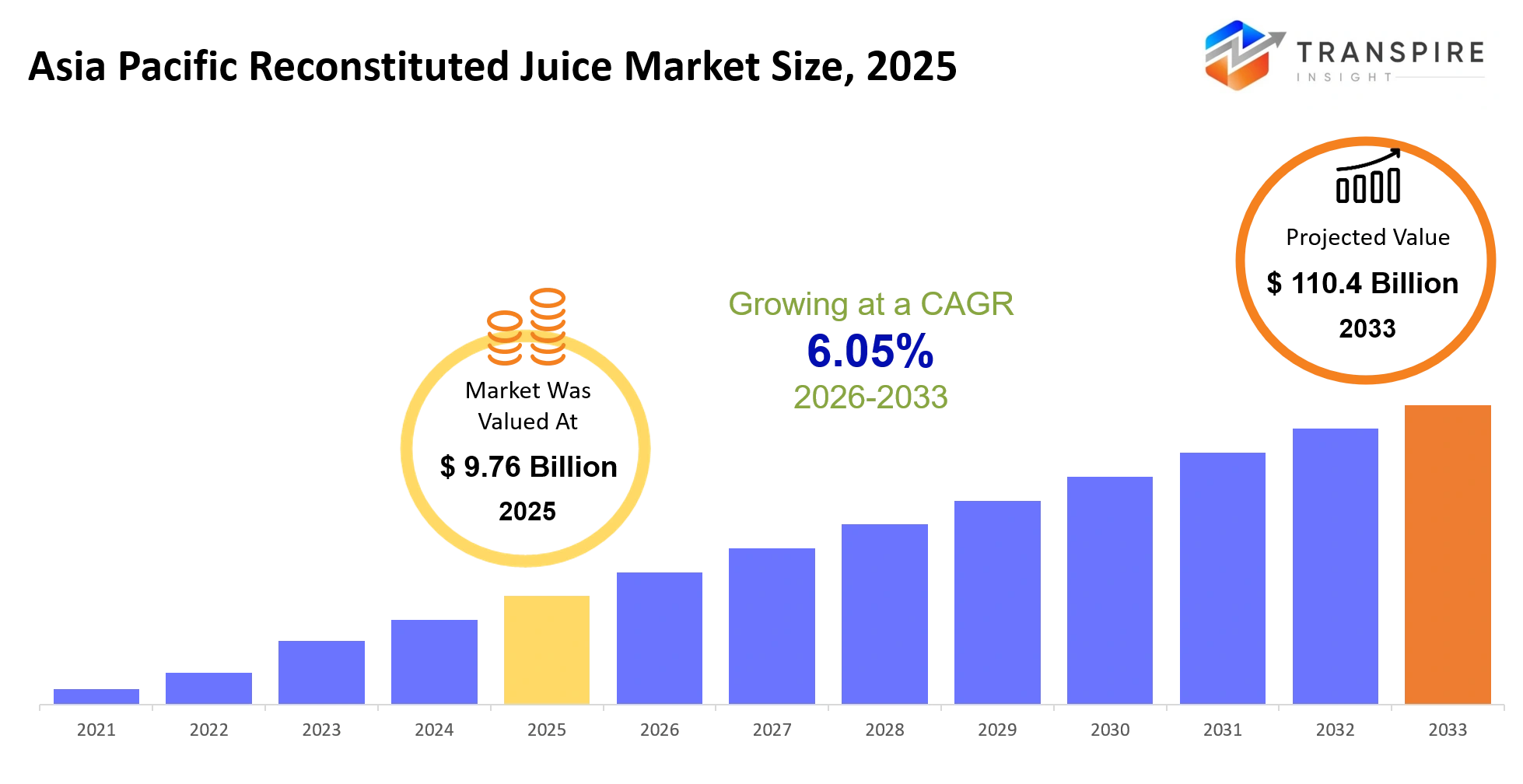
- Asia Pacific Reconstituted Juice Market Size 2025: USD 9.76 Billion
- Asia Pacific Reconstituted Juice Market Size 2033: USD 110.4 Billion
- Asia Pacific Reconstituted Juice Market CAGR: 6.05%
- Asia Pacific Reconstituted Juice Market Segments: By Product Type (Fruit Juice, Vegetable Juice, Mixed Juice, Others); By Distribution Channel (Supermarkets, Convenience Stores, Online Retail, Others); By End User (Households, Foodservice Industry, Beverage Industry, Others).
To learn more about this report,  Download Free Sample Report
Asia Pacific Reconstituted Juice Market Summary
The Asia Pacific Reconstituted Juice Market was valued at USD 9.76 Billion in 2025. It is forecast to reach USD 110.4 Billion by 2033. That is a CAGR of 6.05%over the period.
The Asia Pacific reconstituted juice market sort of plays a critical role in keeping fruit-based drinks basically available all year, by converting concentrated fruit juice back into something you can actually drink near where people buy or consume it.In practice this kind of thing reduces transportation cost for beverage makers, helps them stretch the shelf life a bit , and it keeps the overall supply feeling steadier even when fruit production is seasonal and sort of uneven. So reconstituted juice ends up becoming like a core component across retail drinks, foodservice setups, schools, and also hospitality operations through the whole region, kind of.
Over the last five years, the market has seen this structural shift toward lower sugar recipes, more clear label ingredients, and fruit blends that match more closely the way people decide what to pick up. During and after the COVID-19 period, supply chain issues made manufacturers lean more on juice concentrates, because concentrates are easier to store and move around compared with fresh juice. This transition, in a way, has boosted production efficiency and then supported margins for beverage companies. Growth is getting a lift from the ongoing expansion of modern retail networks , the push for product premiumization, and a wider supply of value-added fruit beverages, creating fresh revenue streams across both developed and emerging Asia Pacific economies.
Key Market Insights
- The Asia Pacific Reconstituted Juice Market seems to be moving , though it kind of happened in stages, toward reduced-sugar items and fortified juice products, and functional beverages are taking up more noticeable shelf space since around 2022.
- In this whole region, China still leads the money side, with an estimated 30%+ market share in 2025, helped by major beverage manufacturing capacity at scale.
- Meanwhile, Southeast Asia is acting as the fastest growing regional cluster all the way through 2033, mostly because middle-income households are increasing and organized retail channels are becoming more common.
- Fruit-based blends that use multiple fruit concentrates grew by about 20% from 2021 to 2025, and they beat the single-fruit offerings , pretty consistently.
- Orange-based reconstituted juice is still the top product category, with an estimated 35%+ share of regional sales in 2025.
- Mixed fruit drinks plus exotic fruit beverages are expected to see the strongest growth pace through 2033, as brands start diversifying their portfolios, sort of broaden the lineup.
- For distribution, supermarkets and hypermarkets together make up nearly 40% of regional distribution revenue, staying the main route for purchases.
- Online grocery platforms have also pushed beverage sales volumes up by more than 15% every year since 2021, and this is especially visible in China and India.
- Overall, the Asia Pacific Reconstituted Juice Market is seeing strategic expansion , where the big beverage companies are leaning into premium packaging and health oriented product launches.
- Players like PepsiCo, Coca-Cola, Dabur, Suntory, and Nongfu Spring are putting resources into innovation, premiumization, and regional expansion strategies.
What are the Key Drivers, Restraints, and Opportunities in the Asia Pacific Reconstituted Juice Market?
The strongest growth driver is modernization of beverage retail and distribution networks across Asia Pacific. Big supermarket chains, convenience outlets,and e-commerce grocery platforms have really widened beverage availability beyond just major urban areas. Manufacturers more and more lean toward reconstituted juice because concentrate based production cuts down transportation and storage expenses, while still keeping fairly steady product quality. That cost efficiency also makes it easier to introduce a broader range of flavors, move into fresh markets, and end up with better profitability. As distribution networks keep getting deeper and more sophisticated, the revenue openings stretch across both premium items and mass market product categories.
The biggest restraint is still volatility in fruit concentrate supply and pricing. Orange, apple, mango,and tropical fruit concentrate markets stay exposed to weather shocks, crop diseases, water shortages, and agricultural input inflation. These problems are kind of structural, since fruit cultivation cycles need years of investment and can’t be scaled up fast. So when concentrate prices jump, beverage producers get margin pressure, and they might postpone product launches, or simply pass more costs to consumers, which then caps volume growth.
A key opportunity shows up in functional fortified juice drinks. Manufacturers are increasingly mixing reconstituted juice with vitamins, minerals, probiotics,and botanical add ins. Markets like India, Indonesia, and Vietnam are turning into especially attractive arenas for these products because organized retail channels and digital commerce are expanding, almost quickly. If a company manages to frame juice as both refreshment and wellness, it could unlock a new premium revenue band over the next decade.
What Has the Impact of Artificial Intelligence Been on the Asia Pacific Reconstituted Juice Market?
Artificial intelligence is, increasingly, transforming operations across the reconstituted juice value chain, like all of a sudden its everywhere. Beverage manufacturers are starting to use AI driven forecasting systems to guess demand based on region, season, and the retail channel. In practice, these systems assist with concentrate procurement, help cut inventory costs, and reduce the chance of stock shortages happening. Machine learning models also comb through production data in order to keep flavor profiles steady, watch sugar levels, and hold product quality consistent across huge manufacturing facilities.
Then there are advanced analytics platforms, which really back predictive maintenance in juice processing plants. They do this by keeping an eye on how equipment performs and flagging possible failures before they can disrupt the production line. The result is better plant uptime, and maintenance costs can be kept lower. On top of that, AI powered supply chain systems optimize logistics routes, warehouse operations, and inventory distribution, which makes companies able to react more smoothly when fruit concentrate availability changes.
More and more, digital quality control systems are appearing in bottling facilities. They rely on computer vision technology to spot packaging defects, labeling mistakes, and filling inconsistencies with a level of accuracy that often beats traditional manual inspection, by quite a bit actually.
That said, AI adoption still has some roadblocks. Integration costs can stay high for small and medium sized beverage manufacturers. Also, supply chains that are spread across several countries lead to data standardization problems, and its messy. In many emerging markets, limited digital infrastructure plus uneven data quality can undermine how accurate and useful advanced AI models end up being.
Key Market Trends
- Since 2021, reduced sugar juice formulations started taking more market share, kind of like beverage companies reshaping their products, to match what people seem to want lately, and yeah consumer preferences kept shifting.
- Premium fruit blends went up by almost 20% from 2021 to 2025, which suggests demand is getting more serious for more differentiated drink experiences.
- After 2020, e-commerce beverage sales grew at double digit annual rates across China, India,and Southeast Asia, and that trend didn’t just pause.
- Manufacturers also leaned harder into concentrate sourcing diversification following pandemic related logistics problems between 2020 and 2023, because supply chains were just… messy for a while.
- Functional juice beverages that include vitamins and minerals were getting better shelf coverage across major retail chains since 2022.
- Aseptic packaging adoption rose quite a bit after 2021, as brands chased longer shelf life, and also tried to cut distribution costs which always matters.
- Dabur broadened its beverage line-up through fresh product launches and packaging modernization moves in 2025, so it’s not just “more products” but also better presentation.
- Tropicana rolled out lower sugar beverage variants in 2025, mirroring the wider industry reformulation direction.
- Regional beverage players have pushed premiumization strategies faster since 2023 , aiming for improved margins and clearer brand distinction.
- Finally, strategic investments in digital supply chain technologies have sharpened forecasting and helped with inventory control across major manufacturers.
Asia Pacific Reconstituted Juice Market Segmentation
By Product Type
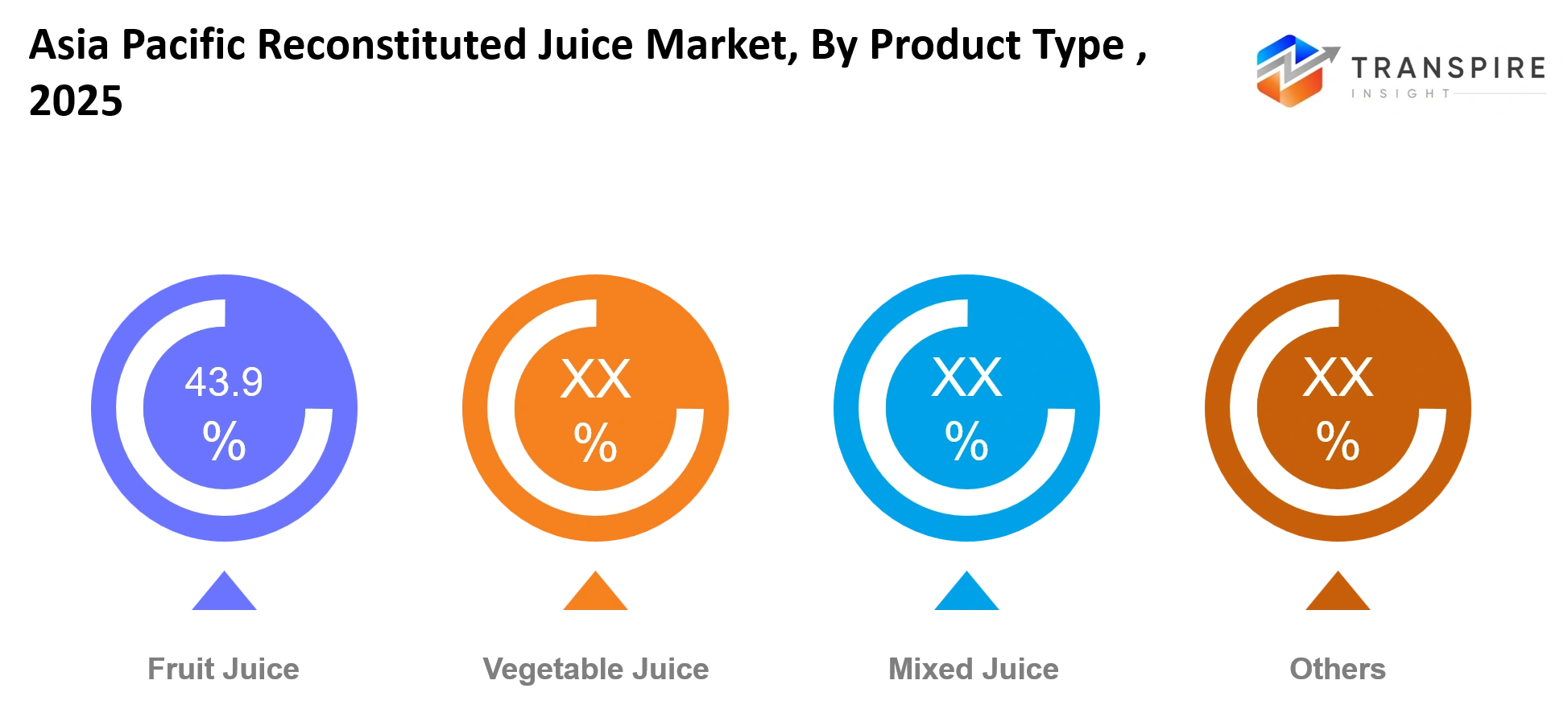
Fruit Juice holds a major share , mostly because people really like the taste and it is broadly available in basically all retail channels. There are familiar flavor profiles, lots of flavor selection, and the product quality stays consistent. So sales stay steady across the region. Also it is easier to store and it tends to last longer than the fresh alternatives , which helps manufacturers and retailers adopt it more readily.
Vegetable Juice pulls in consumers who want nutrient rich drinks, with lower sugar content, and a more distinct taste vibe. Mixed Juice is also getting more attention because beverage producers blend fruit and vegetable ingredients together, so they can make products that feel differentiated. That combination helps with taste variety too , rather than just staying flat. Other types include specialty formulations, fortified juice products, and seasonal offerings that are designed around changing consumer preferences , while also supporting growth of the product line.
To learn more about this report, Download Free Sample Report
By Distribution Channel
Supermarkets take up a big chunk of the total share, largely because there is a lot of product on hand , and the shelves look really visible,so people are more likely to grab beverages. Big retail chains basically give shoppers access to a range of brands and different package sizes, and there are frequent promotional pushes that help keep sales steady. Plus, strong distribution routes and a well built retail setup keep helping the brand get deeper into both city and suburban areas.
Convenience Stores hold a steadier kind of demand thanks to fast grab and go purchasing and their many locations, especially around high traffic spots. Online Retail keeps growing as digital grocery sites make it easier to find products, and home delivery becomes more common across Asia Pacific markets . The rest would include specialty shops, independent retailers, and direct selling channels too,which also add to how widely the product shows up and how far the market can reach.
By End User
Households are basically the leading end user slice, since reconstituted juice kind of works as a handy drink choice for everyday use. On top of that, product affordability availability, plus the longer shelf life help households keep buying in a steady way. People also increasingly lean toward ready to drink beverages , so demand at the family level stays fairly consistent even when incomes differ.
The Foodservice Industry drives a big amount of use through restaurants, hotels, cafés and catering setups where teams need dependable beverage supplies all the time. The Beverage Industry still matters a lot because producers often treat reconstituted juice as a start ingredient for packaged drinks, mixed beverages, and added value product ideas. Other customers include institutional buyers, educational campuses, healthcare organizations, and business groups that need juice products in large quantities for group consumption needs.
What are the Key Use Cases Driving the Asia Pacific Reconstituted Juice Market?
The biggest use case still seems to be packaged retail beverages, moving through supermarkets, convenience stores, and also online grocery platforms. Reconstituted juice helps manufacturers deliver a more even taste , steady quality, and pricing that stays competitive, while they manage transportation, and storage costs in a fairly efficient way. This segment ends up having the highest demand because it reaches millions of people every day across urban, as well as semi-urban markets.
Meanwhile, foodservice applications are growing, pretty steadily across restaurants, hotels, cafés, quick-service chains, and institutional catering operations. These buyers tend to like concentrate-based juice products because they make inventory control simpler and they also cut down on product wastage , all the while keeping the beverage profile consistent.
On the other hand, emerging applications are starting to show up, including functional beverages boosted with vitamins, minerals and botanical ingredients. Sports nutrition drinks, wellness beverages, and premium fruit blends are also making openings, as manufacturers aim at higher-value consumer groups through the full forecast period.
|
Report Metrics |
Details |
|
Market size value in 2025 |
USD 9.76 Billion |
|
Market size value in 2026 |
USD 10.35 Billion |
|
Revenue forecast in 2033 |
USD 110.4 Billion |
|
Growth rate |
CAGR of6.05% from 2026 to 2033 |
|
Base year |
2025 |
|
Historical data |
2021 - 2024 |
|
Forecast period |
2026 - 2033 |
|
Report coverage |
Revenue forecast, competitive landscape, growth factors, and trends |
|
Regional scope |
Asia Pacific (India, China, Japan, Australia, South Korea, Rest of Asia Pacific) |
|
Key company profiled |
PepsiCo, Coca-Cola, Del Monte, Dabur, Tropicana, Minute Maid, Ocean Spray, Welch’s, Suntory, Nongfu Spring, Uni-President, Tingyi, Kagome, Britvic, Parle Agro. |
|
Customization scope |
Free report customization (country, regional & segment scope). Avail customized purchase options to meet your exact research needs. |
|
Report Segmentation |
By Product Type (Fruit Juice, Vegetable Juice, Mixed Juice, Others); By Distribution Channel (Supermarkets, Convenience Stores, Online Retail, Others); By End User (Households, Foodservice Industry, Beverage Industry, Others). |
Which Regions are Driving the Asia Pacific Reconstituted Juice Market Growth?
China still feels like the dominant market across Asia Pacific, mainly because its beverage manufacturing scene is massive, the retail system is already well built, and people there buy a lot domestically. Big producers run large production facilities, and that’s a real advantage since scale economics kicks in pretty fast. Then there are logistics networks that keep getting better, so distribution works across cities and also those more rural areas, without too much trouble. On top of that, constant product innovation just keeps strengthening the leadership narrative, so it’s hard for others to catch up.
India lands as the second biggest driver of regional revenue growth. But unlike China, in India the momentum seems tied more to modern retail growing, plus packaged beverages being easier to find even in smaller cities. Local beverage brands keep putting money into distribution routes and also in product diversification, so the shelves stay stocked with fresh options. And yes, the demographics also matter here, because the population profile helps long-term consumption trends across multiple drink categories.
Southeast Asia is turning into the fastest-growing regional market through 2033, at least that’s the overall direction being seen. Things like quick urbanization, a rising middle class, and more investment into retail infrastructure have reshaped competition in a noticeable way. Places such as Indonesia, Vietnam and the Philippines are seeing stronger appetite for packaged fruit beverages, plus convenience-oriented items. All of this basically opens room for both multinational players and local regional manufacturers that are trying to expand.
Who are the Key Players in the Asia Pacific Reconstituted Juice Market and How Do They Compete?
Competition still looks fairly consolidated, but it’s not like the market is just one big monolith , instead multinational beverage companies run head to head with pretty strong regional brands. What really seems to shape market share are product innovation, pricing approach, distribution coverage and brand recognition , kind of in that order. Lately, companies are leaning harder on healthier formulations , premium packaging, and more diversified flavor collections… not only on price, at least not as a single lever.PepsiCo keeps its position mostly by using its extensive distribution networks plus a wide beverage range. The firm keeps pushing investments into innovation and supply chain modernization initiatives across Asia Pacific, aiming to boost operational efficiency and also improve sustainability outcomes.
Dabur stands out more through regional brand strength and fruit-centered beverage choices. It has also grown into more product categories, refreshed its packaging, and launched adjacent drink products, so it can deepen consumer engagement and broaden its category reach, even when consumers are not strictly looking for “that one” type.
Suntory, meanwhile, leans into premium beverage positioning and health-oriented product creation. Their playbook really emphasizes innovation in wellness drink concepts, and then expansion across selected Asia Pacific markets.Other players that matter include Coca-Cola, Del Monte, Nongfu Spring, Uni-President, and Parle Agro, and each of them brings regional advantages together with distribution muscle , so they can compete fairly effectively.
Company List
- PepsiCo
- Coca-Cola
- Del Monte
- Dabur
- Tropicana
- Minute Maid
- Ocean Spray
- Welch’s
- Suntory
- Nongfu Spring
- Uni-President
- Tingyi
- Kagome
- Britvic
- Parle Agro
Recent Development News
In May 2026, PepsiCo launched the 2026 Greenhouse Program ‘Impact Edition’ in Asia Pacific. The initiative expands proven sustainability, logistics, and agricultural technologies across PepsiCo’s regional supply chain, strengthening operational efficiency and supporting long-term beverage production resilience.
Source: https://www.pepsico.com
In June 2025, Dabur launched ‘Réal Cheers’, a premium cocktail mixer range under its Réal beverage portfolio. The product launch broadened Dabur’s beverage offerings, helped the company target younger consumers, and strengthened its position in adjacent fruit-based drink categories.
Source: https://www.dabur.com
In May 2026, PepsiCo entered a partnership with TalusAg through a low-carbon ammonia attribute agreement covering Asia Pacific and other global operations. The collaboration supports fertilizer decarbonization across agricultural supply chains and enhances sustainability initiatives linked to fruit and beverage ingredient sourcing.
Source: https://www.pepsico.com
What Strategic Insights Define the Future of the Asia Pacific Reconstituted Juice Market?
The Asia Pacific reconstituted juice market is kinda moving toward a more premium, health oriented , and technology enabled future. The real engine behind this shift is basically the overlap between efficient concentrate based manufacturing and the way consumers now want easy to use fruit drinks that still bring extra nutritional worth. In the coming seven years, firms are likely to unlock more value via fortified options, upscale fruit blends, and digital supply chain tuning rather than just chasing bigger volumes, and thats it.
There’s also a quieter hazard, more like the concentration in global fruit concentrate supply networks. Things like sudden weather swings, crop illnesses , and pressure on agricultural inputs could keep showing up as recurring cost swings and margin squeeze for the whole industry. Meanwhile, functional juice beverages, with extra vitamins, probiotics, and plant derived components, are showing up as a real chance that is still not fully exploited in many Asia Pacific markets.
Market players should focus on spending for varied sourcing approaches, smarter forecasting tools, and premium product development too. The companies that manage to blend supply chain robustness with distinct beverage creativity will probably be the ones , that end up capturing future market share and profit.
Asia Pacific Reconstituted Juice Market Report Segmentation
By Product Type
- Fruit Juice
- Vegetable Juice
- Mixed Juice
- Others
By Distribution Channel
- Supermarkets
- Convenience Stores
- Online Retail
- Others
By End User
- Households
- Foodservice Industry
- Beverage Industry
- Others
Frequently Asked Questions
Find quick answers to common questions.
The expected Asia Pacific Reconstituted Juice Market size for the market will be USD 110.4 Billion in 2033.
Key segments for the Asia Pacific Reconstituted Juice Market are By Product Type (Fruit Juice, Vegetable Juice, Mixed Juice, Others); By Distribution Channel (Supermarkets, Convenience Stores, Online Retail, Others); By End User (Households, Foodservice Industry, Beverage Industry, Others).
Major Asia Pacific Reconstituted Juice Market players are PepsiCo, Coca-Cola, Del Monte, Dabur, Tropicana, Minute Maid, Ocean Spray, Welch’s, Suntory, Nongfu Spring, Uni-President, Tingyi, Kagome, Britvic, Parle Agro.
The Asia Pacific Reconstituted Juice Market size is USD 9.76 Billion in 2025.
The Asia Pacific Reconstituted Juice Market CAGR is 6.05% from 2026 to 2033.
- PepsiCo
- Coca-Cola
- Del Monte
- Dabur
- Tropicana
- Minute Maid
- Ocean Spray
- Welch’s
- Suntory
- Nongfu Spring
- Uni-President
- Tingyi
- Kagome
- Britvic
- Parle Agro
About the Authors

Chetan Dhatrak
I’m Chetan Dhatrak, a Senior Research Analyst at Transpire Insight, specializing in the Consumer Goods, Foods and Beverages industry. I focus on analyzing market trends, consumer behavior, competitive landscapes, and industry developments to deliver accurate, data-driven insights. My research at Transpire Insight is built on credible sources and in-depth analysis, helping businesses and readers better understand market dynamics, emerging opportunities, and evolving consumer preferences. I’m committed to creating reliable, well-researched content that supports informed decision-making and reflects the latest developments in the consumer goods and food & beverage sectors.

Chakradhar Khansole
Chakradhar serves as the Research Director at Transpire Insight, bringing over 8 years of experience in technology, innovation, and strategic market intelligence. He specializes in transforming complex market data into actionable business insights that enable organizations to make informed, growth-oriented decisions. Recognized for his strategic vision and analytical expertise, Chakradhar leads high-impact research initiatives, delivering comprehensive market assessments, competitive intelligence, and forward-looking industry analysis.
Recently Published Reports
-
Apr 2026
Baby Infant Formula Market
Baby Infant Formula Market Size, Share & Analysis Report By ype (Infant Milk, Follow On Milk, Specialty Baby Milk, Growing-Up Milk), By Ingredient (Carbohydrate, Fat, Protein, Minerals, Vitamins, and Others), By Product Form (Powder, Liquid, and Ready-to-feed), By Distribution Channels (Supermarket/Hypermarket, Specialty Store, Pharmacies, Online Retail, and Others), and Geography (North America, Europe, Asia-Pacific, Middle East and Africa, South and Central America), 2021 - 2031
-
Apr 2026
Edible Insects for Animal Feed Market
Edible Insects for Animal Feed Market Size, Share & Analysis Report By Type (Insect Powder, Insect Meal, Insect Bar, Insect Paste, Insect Oil, and Others), By Insect Type (Beetles, Cricket, Caterpillar, Hymenoptera, Orthoptera, Tree Bugs, and Others), By Application (Livestock, Pet Food, and Aquaculture), By Livestock Type (Poultry, Swine, and Others), and Geography (North America, Europe, Asia-Pacific, Middle East and Africa, South and Central America), 2021 - 2031
-
Apr 2026
Food Industry Disinfection and Bacterial Control Market
Food Industry Disinfection and Bacterial Control Market Size, Share & Analysis Report By Type (Chemical Disinfectants, Physical Disinfectants, and Biocides and Antimicrobials), By Application (Food Processing Equipment Surface Disinfection, Food Preparation Areas Surface Disinfection, Storage Areas Surface Disinfection, Anti-microbial Coatings Food Preservation, and Preservative Solutions Food Preservation), By End User (Meat and Poultry Processing, Dairy Processing, Seafood Processing, Bakery and Confectionery, Restaurants and Commercial Kitchens, and Food Service Providers), By Sales Channel (Online, Offline), and Geography (North America, Europe, Asia-Pacific, Middle East and Africa, South and Central America), 2021 - 2031
-
May 2026
Freeze Dried Food Market
Freeze Dried Food Market Size, Share & Analysis Report By Product Type (Fruits, Vegetables, Freeze-Dried Dairy Products, Freeze-Dried Meat and Seafood, Freeze-Dried Pet Food, and Prepared Meal), By Nature (Organic, and Conventional), By Form (Powdered, Granules, and Diced), By End Use (Breakfast Cereals, Dairy Products, Bakery & Confectionery, Nutritional Bars & Supplements, Powdered Beverages, Snacks, and Retail (Household)), and Geography (North America, Europe, Asia-Pacific, Middle East and Africa, South and Central America), 2021 - 2031