
Asia Pacific Purified Terephthalic Acid Market Size & Forecast:
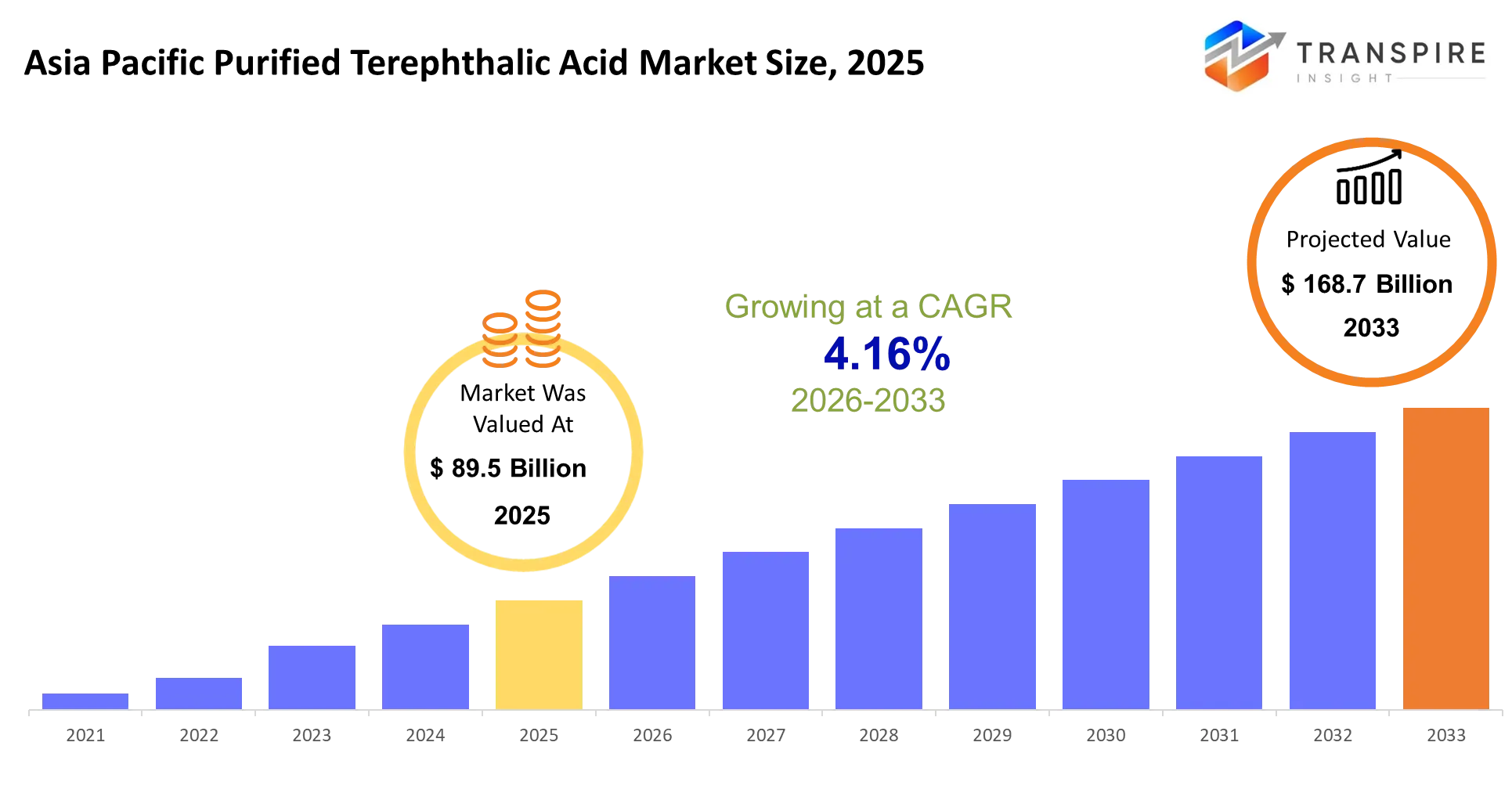
- Asia Pacific Purified Terephthalic Acid Market Size 2025: USD 89.5 Billion
- Asia Pacific Purified Terephthalic Acid Market Size 2033: USD 168.7 Billion
- Asia Pacific Purified Terephthalic Acid Market CAGR: 4.16%
- Asia Pacific Purified Terephthalic Acid Market Segments: By Type (Fiber Grade PTA, Bottle Grade PTA, Film Grade PTA, Others); By Application (Polyester Fiber, PET Bottles, Films, Industrial Use, Others); By End-User (Textile Industry, Packaging Industry, Automotive Industry, Electronics Industry, Others); By Form (Powder, Granules, Others)
To learn more about this report,  Download Free Sample Report
Asia Pacific Purified Terephthalic Acid Market Summary
The Asia Pacific Purified Terephthalic Acid Market was valued at USD 89.5 Billion in 2025. It is forecast to reach USD 168.7 Billion by 2033. That is a CAGR of 4.16% over the period.
The Asia Pacific purified terephthalic acid market operates as the central part of the region's polyester production process because it provides necessary raw materials which manufacturers use to create clothing fibers and packaging materials and industrial films for various sectors including electronics and automotive and construction industries. The system enables manufacturing to produce lightweight materials which possess both strength and low production costs because they need.
The market has experienced a structural transformation during the last five years because producers adopted larger production facilities which combine cutting-edge oxidation systems to enhance production output while decreasing power consumption. The shift gained momentum when pandemic-related disruptions to logistics operations revealed how dangerous it is to have fragmented supply chains which led regional customers to start buying products from nearby suppliers.
The Chinese government implemented energy policy changes and established stricter environmental regulations which created new operational challenges that forced inefficient industrial operations to cease. PTA suppliers experience increased contract business because downstream packaging and textile manufacturers build new production facilities near their customers, which results in consistent income streams that support more investment in operational efficiency projects.
Key Market Insights
- China will control more than 60 percent of the Asia Pacific Purified Terephthalic Acid Market in 2025 because its petrochemical and polyester production facilities operate as integrated systems.
- The Indian market will experience its highest growth rate until 2030 because of textile export growth and the development of PET packaging production facilities.
- Southeast Asia has become a key location for companies to develop their PTA-based polyester production operations.
- The Asia Pacific Purified Terephthalic Acid Market shows its highest demand through polyester-grade PTA which manufacturers use to produce fiber and PET resin.
- The food-grade PET market expansion drives the growth of high-purity PTA which serves as the second-largest market segment for specialty packaging.
- The period from 2026 to 2032 will see bio-based and low-carbon PTA become its fastest expanding sector which sustainability requirements drive.
- Polyester fibers dominate the market because they hold more than 55% market share which comes from demand in both the apparel and industrial textile sectors.
- The demand for PET bottles and packaging materials has increased because of the rising needs from the beverage and fast-moving consumer goods markets.
- The end-user group which experiences the fastest growth consists of food and beverage packaging companies that adopt PET bottle substitutions.
- The automotive industry experiences increased demand for plastic materials because car manufacturers use lightweight materials in their production processes.
What are the Key Drivers, Restraints, and Opportunities in the Asia Pacific Purified Terephthalic Acid Market?
The Asia Pacific Purified Terephthalic Acid Market develops because polyester manufacturing industrial plants create base support for textile production and PET packaging operations across China India and Southeast Asia. Manufacturers adopted regional integration after the post-pandemic supply chain realignment period which enabled them to decrease their dependence on imported intermediate petrochemicals. The establishment of PTA production plants next to refining and polyester facilities has resulted in better cost efficiency for producers who now generate revenue through increased contract-based offtake volumes.
The market experiences a permanent barrier because crude oil and paraxylene prices fluctuate between two extreme points which affects PTA production costs. Upstream price changes lead to upstream price changes for PTA since this substance comes from petrochemical feedstocks. Producers face margin compression dangers which affect their operations across all competitive export markets, especially in China and South Korea. The PTA plants face operational restrictions because their capital cycle requires extended periods which prevents instant operational changes and delays the decision-making process for urgent capacity expansion.
The development of low-carbon energy-efficient PTA production technologies through investment in India and China presents a significant opportunity. The textile and packaging industries show growing interest in sustainable supply chains which has led to increased adoption of oxidation process upgrades and carbon reduction retrofits in integrated complexes. The Asia Pacific Purified Terephthalic Acid Market will experience premium pricing potential and improved long-term demand stability because of this market trend.
What Has the Impact of Artificial Intelligence Been on the Asia Pacific Purified Terephthalic Acid Market?
Artificial intelligence and advanced digital systems are increasingly transforming operational efficiency in the Asia Pacific Purified Terephthalic Acid Market, which operates through large integrated petrochemical complexes. Producers implement AI-based process control systems to handle reactor temperature control and oxidation unit balancing and emissions scrubber monitoring, which lets them make real-time adjustments that decrease human involvement while making their processes more stable. Digital twins are being utilized at several Chinese and Indian PTA facilities to create plant performance simulations which help operators optimize throughput without product purity issues when feedstock conditions change.
The organization uses machine learning models to conduct predictive maintenance for high-pressure compressors and heat exchangers and exhaust gas treatment units. The systems use vibration and pressure and thermal data analysis to predict equipment degradation two weeks before actual failure, which results in 5 to 12 percent improved plant uptime across advanced installations. AI-based emissions forecasting tools help companies meet regulatory requirements by providing advance predictions of sulfur and NOx output levels, which enables companies to make operational changes before actual emissions occur.
The present system prevents proper technology adoption because it requires excessive costs for system integration and it deals with existing outdated infrastructure which creates challenges for mid-sized PTA plants that do not have common data standards. The presence of outdated distributed control systems which lack proper compatibility with advanced AI systems creates deployment challenges because these systems cannot reach their maximum operational potential while their performance benefits are substantial.
Key Market Trends
- China has implemented stricter emissions standards since 2023 which led to the closure of small inefficient PTA facilities while their production operations moved to larger integrated refinery-petrochemical complexes.
- The demand for PTA products in India has grown since 2024 because of increased textile exports and the establishment of new PET bottle manufacturing facilities in Gujarat.
- In 2022, major PTA plants in China and South Korea deployed AI-driven process control, improving uptime by 5–12%.
- Between 2021 and 2025, beverage producers in the Asia Pacific region began using PET packaging instead of glass which resulted in higher PTA-linked resin consumption.
- The Chinese government implemented stricter carbon reporting regulations in 2025 which required PTA producers to establish emissions tracking systems and energy optimization systems.
- The time period between 2020 and 2022 which followed the COVID pandemic created obstacles that led Asia Pacific PTA customers to start using local suppliers instead of relying on imported intermediate materials.
- The pilot bio-based PTA projects which started in 2024 established their operations across India and Thailand to achieve lower-carbon polyester production for international fashion brands.
- The unpredictable nature of paraxylene prices which began in 2023 has compelled PTA manufacturers to implement both permanent hedging agreements and self-sourced raw material procurement methods.
Asia Pacific Purified Terephthalic Acid Market Segmentation
By Type :
The Asia Pacific Purified Terephthalic Acid Market consists of Fiber Grade PTA, Bottle Grade PTA, Film Grade PTA, and Other products. Fiber grade supports polyester fiber production in textiles, while bottle grade supports PET container manufacturing. Film grade supports package films and industrial applications. Others cover niche industrial chemical uses across the region.
Demand differences across grades will depend on textile growth, packaging expansion, and industrial applications in Asia Pacific countries. Each grade will support specific production needs based on material quality and end use requirements across manufacturing sectors.
By Application :
The Asia Pacific market for purified terephthalic acid will experience its biggest demand from polyester fiber and PET bottle consumption. Polyester fiber supports clothing and home textiles, while PET bottles support beverages and packaged food industries.
Films, industrial use, and other applications will increase because of rising packaging requirements and growth in electronics manufacturing and regional market development. Rising consumption patterns will continue to support steady demand across multiple application areas.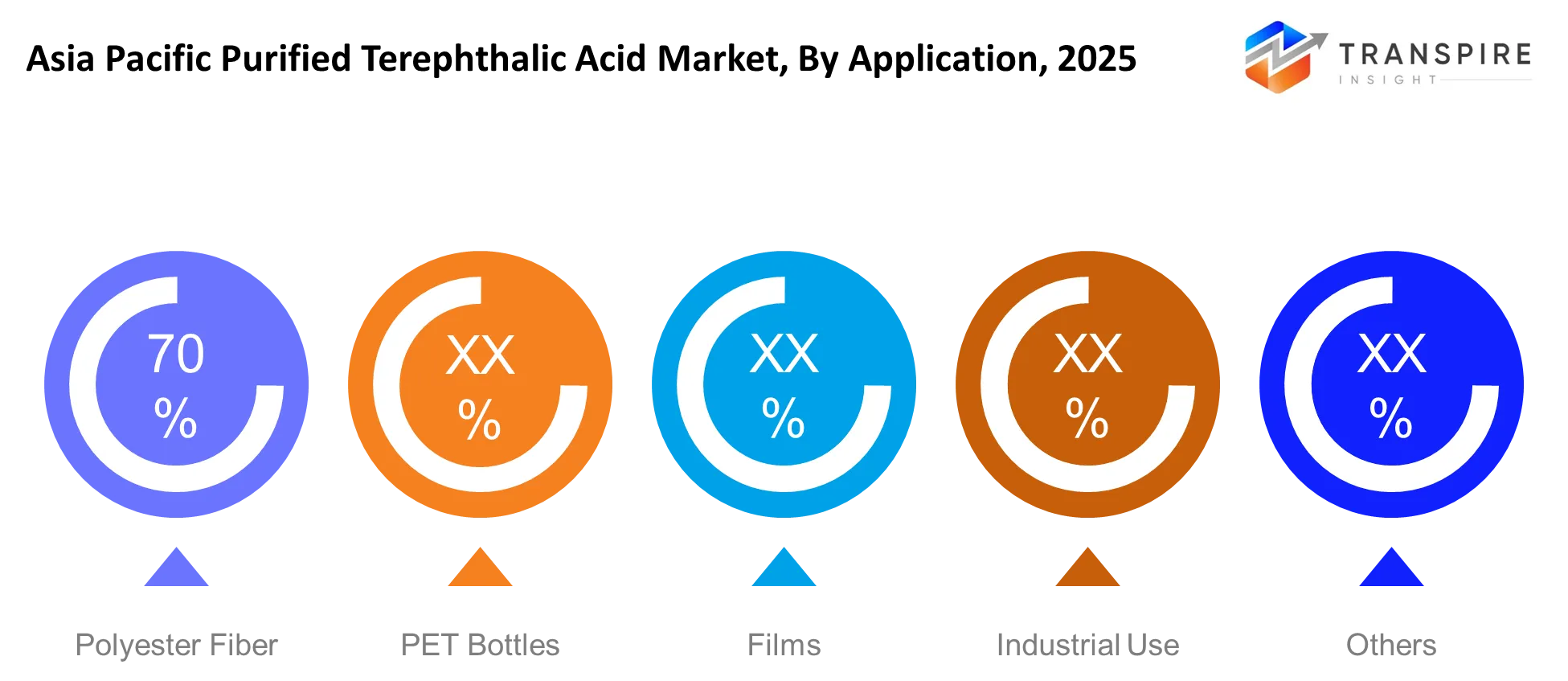
To learn more about this report, Download Free Sample Report
By End-User :
The textile industry and packaging industry in Asia Pacific use purified terephthalic acid as their main material. The textile industry uses fibers which create demand for textiles and the packaging industry requires PET-based products and containers.
The automotive and electronics sectors plus other fields will increase their consumption of lightweight plastics and insulation materials and industrial components when manufacturing activities grow throughout the region. The production sectors will generate increased material consumption which will create additional demand for materials.
By Form :
Markets in Asia Pacific use both powdered and granulated forms of purified terephthalic acid. The powder form enhances chemical processing efficiency while the granules enable better handling and storage capabilities.
Manufacturing operations will use both forms of materials to maintain quality throughout their production of fiber products and packaging goods and industrial materials. Processing requirements and production system needs will determine which form should be selected by different industries.
What are the Key Use Cases Driving the Asia Pacific Purified Terephthalic Acid Market?
The Asia Pacific Purified Terephthalic Acid Market primarily serves the polyester fiber production sector which delivers materials for clothing production and home textile creation and industrial fabric manufacturing. The Chinese textile manufacturing industry together with the Indian textile industry and the Vietnamese textile industry creates this demand because these countries produce low-cost fibers which support their export-oriented garment supply chains and their ongoing PTA consumption.
The growing market for PET resin extends to beverage bottle production and food packaging materials which FMCG companies and urban Asia bottling facilities currently utilize. Industrial film production is increasing because manufacturers in the electronics and automotive insulation industries need lightweight durable polymer layers to improve their products performance.
The new applications require bio-based polyester materials and advanced engineering plastics which manufacturers use to create electric vehicle interiors and lightweight transport components. The Japanese and South Korean governments enforce regulations which restrict single-use plastics while they pursue carbon reduction goals thus driving organizations to implement pilot projects which will enable these needs to develop into commercial applications throughout the forecast period.
|
Report Metrics |
Details |
|
Market size value in 2025 |
USD 89.5 Billion |
|
Market size value in 2026 |
USD 4.56 Million |
|
Revenue forecast in 2033 |
USD 168.7 Billion |
|
Growth rate |
CAGR of 4.16% from 2026 to 2033 |
|
Base year |
2025 |
|
Historical data |
2021 - 2024 |
|
Forecast period |
2026 - 2033 |
|
Report coverage |
Revenue forecast, competitive landscape, growth factors, and trends |
|
Regional scope |
Asia Pacific ( China, India, Japan, South Korea, Australia, Rest of Asia Pacific) |
|
Key company profiled |
Reliance Industries, Sinopec, BP, Indorama Ventures, Alpek, SABIC, Mitsubishi Chemical, Formosa Plastics, Far Eastern New Century, SK Chemicals, Eastman, Lotte Chemical, Hengli Petrochemical, Zhejiang Hengyi, JBF Industries |
|
Customization scope |
Free report customization (country, regional & segment scope). Avail customized purchase options to meet your exact research needs. |
|
Report Segmentation |
By Type (Fiber Grade PTA, Bottle Grade PTA, Film Grade PTA, Others); By Application (Polyester Fiber, PET Bottles, Films, Industrial Use, Others); By End-User (Textile Industry, Packaging Industry, Automotive Industry, Electronics Industry, Others); By Form (Powder, Granules, Others) |
Which Regions are Driving the Asia Pacific Purified Terephthalic Acid Market Growth?
China maintains its top position in the Asia Pacific Purified Terephthalic Acid Market because it operates the most advanced system for combining petrochemical refining with polyester production. The combination of state-backed industrial policies and coastal port infrastructure enables large-scale PTA production for exporting downstream PET and polyester products. The continuous need for purified terephthalic acid exists because refineries and textile hubs maintain strong supply chain connections with their mega producers. The enforcement of environmental regulations has led to industry consolidation because compliant large facilities can operate at their full production capacity. China maintains its control over regional PTA production because South Korea and Southeast Asian countries depend on its export of purified terephthalic acid and its consumption.
South Korea serves as a stable market presence that exports advanced technology yet produces less material than China does for the Asia Pacific Purified Terephthalic Acid Market. The company achieves success through its efficient petrochemical operations which receive stable funding from its export-focused partners S-OIL and LG Chem. The market operates under established governmental rules which create trustworthy long-term agreements between international packaging companies and textile manufacturers. South Korea operates its business by maintaining efficient operations and delivering products that meet established quality standards, while China pursues expansion through production volume growth. The company supplies international value chains with high-quality polyester feedstock, which serves as a dependable source of materials.
The Purified Terephthalic Acid Market in Asia Pacific shows India as its fastest-growing area because of business expansion and increasing demand from local textile and packaging sectors. The market for PTA has grown since 2024 because of new investments in refinery-petrochemical plants and PET bottle production facilities. The government built industrial corridors while FMCG demand increased, which created more economic activity in various states. Investors can find good chances to enter the market until 2033 because of the businesses that operate integrated PTA-polyester systems and export production facilities.
Who are the Key Players in the Asia Pacific Purified Terephthalic Acid Market and How Do They Compete?
The Asia Pacific Purified Terephthalic Acid Market exhibits moderate market concentration with integrated petrochemical producers from China, India, and the Middle East serving as the primary market leaders. The existing market players maintain their market share through backward integration which enables them to control paraxylene and refining operations that result in lower expense fluctuations. Brand recognition does not drive market competition because companies compete through cost efficiency and feedstock availability and their distance from polyester manufacturing hubs.
Reliance Industries](https://www.ril.com?utm_source=chatgpt.com) improves its cost leadership position through the Jamnagar refining complex because this facility connects PTA production with polyester manufacturing operations to boost its capacity for international trade. [Sinopec](https://www.sinopec.com?utm_source=chatgpt.com) expands its operations through production capacity increases and energy-saving oxidation technology improvements which enable the company to maintain its leading position within China's polyester manufacturing sector. [PetroChina](https://www.petrochina.com.cn?utm_source=chatgpt.com) establishes feedstock security through its inland refinery system which produces consistent PTA supplies for industrial operations throughout northern regions.
Indorama Ventures](https://www.indoramaventures.com?utm_source=chatgpt.com) strengthens its business through ASEAN acquisitions while establishing vertical control over PET packaging production which improves its ability to manage operations in different regions. [SABIC](https://www.sabic.com?utm_source=chatgpt.com) establishes itself as a unique market player through technology-based PTA optimization methods which it develops through partnerships with other companies in Asia Pacific to create industrial and packaging solutions based on high-performance polymers.
Company List
- Reliance Industries
- Sinopec
- BP
- Indorama Ventures
- Alpek
- SABIC
- Mitsubishi Chemical
- Formosa Plastics
- Far Eastern New Century
- SK Chemicals
- Eastman
- Lotte Chemical
- Hengli Petrochemical
- Zhejiang Hengyi
- JBF Industries
Recent Development News
In April 2026, USD Analytics reported updated industry positioning and expansion-linked activity across Asia Pacific PTA value chains, highlighting continued integration-driven investment momentum across PTA–PET–polyester production systems, particularly in Asia’s dominant production base. The update reflects ongoing capacity alignment strategies by major producers to support polyester demand growth and packaging expansion.
Source https://www.usdanalytics.com/
In March 2026, Lotte Chemical Pakistan (under PTA Global Holding ownership transition) completed a major stake restructuring deal involving its high-purity PTA production facility in Karachi. The transaction shifts control of a 500,000-ton PTA plant and is expected to support consolidation strategies and potential M&A-driven expansion across Asia-linked PTA supply chains. Source https://www.reuters.com/world/
What Strategic Insights Define the Future of the Asia Pacific Purified Terephthalic Acid Market?
The Asia Pacific Purified Terephthalic Acid Market develops toward tighter connections between refining operations and petrochemical activities and polyester production processes because companies need to maintain stable access to essential materials while minimizing their risks linked to fluctuations in worldwide paraxylene prices. The production activities of the next 5 to 7 years will focus on large coastal hubs located in China and India and Southeast Asia because these areas provide better logistical operations and closer access to downstream facilities which helps companies manage their expenses. The consolidation process receives additional support from regulatory requirements which mandate that heavy chemical industries must control both their emissions and their energy utilization.
The Chinese market faces a hidden danger because three major companies control most of the capacity, which creates risks that stem from government-imposed production reductions and unanticipated environmental regulations which disrupt the regional supply system. The demand for virgin PTA in packaging applications faces a new challenge because recycled PET and chemically recycled polyester materials start to compete with traditional PTA usage.
The development of chemically recycled PTA production facilities in India and Thailand presents a new business opportunity because FMCG companies have committed to their circular packaging initiatives. The market players need to focus their resources on developing hybrid PTA-recycling integration systems which will help them establish their future demand needs and comply with regulations.
Asia Pacific Purified Terephthalic Acid Market Report Segmentation
By Type
- Fiber Grade PTA
- Bottle Grade PTA
- Film Grade PTA
By Application
- Polyester Fiber
- PET Bottles
- Films
- Industrial Use
By End-User
- Textile Industry
- Packaging Industry
- Automotive Industry
- Electronics Industry
By Form
- Powder
- Granules
Frequently Asked Questions
Find quick answers to common questions.
The Asia Pacific Purified Terephthalic Acid Market size is USD 168.7 Billion in 2033.
Key segments for the Asia Pacific Purified Terephthalic Acid Market are By Type (Fiber Grade PTA, Bottle Grade PTA, Film Grade PTA, Others); By Application (Polyester Fiber, PET Bottles, Films, Industrial Use, Others); By End-User (Textile Industry, Packaging Industry, Automotive Industry, Electronics Industry, Others); By Form (Powder, Granules, Others).
Major Asia Pacific Purified Terephthalic Acid Market Players are Reliance Industries, Sinopec, BP, Indorama Ventures, Alpek, SABIC, Mitsubishi Chemical, Formosa Plastics, Far Eastern New Century, SK Chemicals, Eastman, Lotte Chemical, Hengli Petrochemical, Zhejiang Hengyi, JBF Industries.
The Current Asia Pacific Purified Terephthalic Acid Market size is USD 89.5 Billion in 2025.
The Asia Pacific Purified Terephthalic Acid Market CAGR is 4.16% from 2026 to 2033.
- Reliance Industries
- Sinopec
- BP
- Indorama Ventures
- Alpek
- SABIC
- Mitsubishi Chemical
- Formosa Plastics
- Far Eastern New Century
- SK Chemicals
- Eastman
- Lotte Chemical
- Hengli Petrochemical
- Zhejiang Hengyi
- JBF Industries
Recently Published Reports
-
Apr 2026
Healthcare Polymer Packaging Market
Healthcare Polymer Packaging Market Size, Share & Analysis Report By Packaging Type (Syringes, IV Bottles and Pouches, Clamshells, Blisters, Bottles & Jars, Containers, Tubes, IV Parental Packaging, Others), By Type (Regulated, Non-regulated), By Polymer Type (LDPE (Low-Density Polyethylene), HDPE (High-Density Polyethylene), Homo-polymer (Homo), Random Copolymer (Random), Block Copolymer (Block), PET, Polystyrene, Polyvinyl Chloride, Polyamide/EVOH, Others), and Geography (North America, Europe, Asia-Pacific, Middle East and Africa, South and Central America), 2021 - 2031
-
Apr 2026
Hydrophilic Tape (Waterstop) Market
Hydrophilic Tape (Waterstop) Market Size, Share & Analysis Report By Type (Bentonite-Based Hydrophilic Tape, Rubber-Based Hydrophilic Tape), By Application (Residential Buildings, Commercial Buildings, Infrastructure Projects), and Geography (North America, Europe, Asia-Pacific, Middle East and Africa, South and Central America), 2021 - 2031
-
Apr 2026
Metalens Market
Metalens Market Size, Share & Analysis Report By Type (Visible Light Metalens, and Infrared Metalens), By Application (Consumer Electronics, Automotive Electronics, Industrial, Medical, and Others), and Geography (North America, Europe, Asia-Pacific, Middle East and Africa, South and Central America), 2021 - 2031
-
Apr 2026
PBT Resin Market
PBT Resin Market Size, Share & Analysis Report By Type (Reinforced PBT Resin, Unreinforced PBT Resin), By Processing Method (Injection Molding, Extrusion, Blow Molding, Others), By End-User (Automotive, Electrical & Electronics, Consumer Appliances, Industrial Machinery, Medical Devices, Packaging, Others), and Geography (North America, Europe, Asia-Pacific, Middle East and Africa, South and Central America), 2021 - 2031