

Asia Pacific Pumps Market Summary
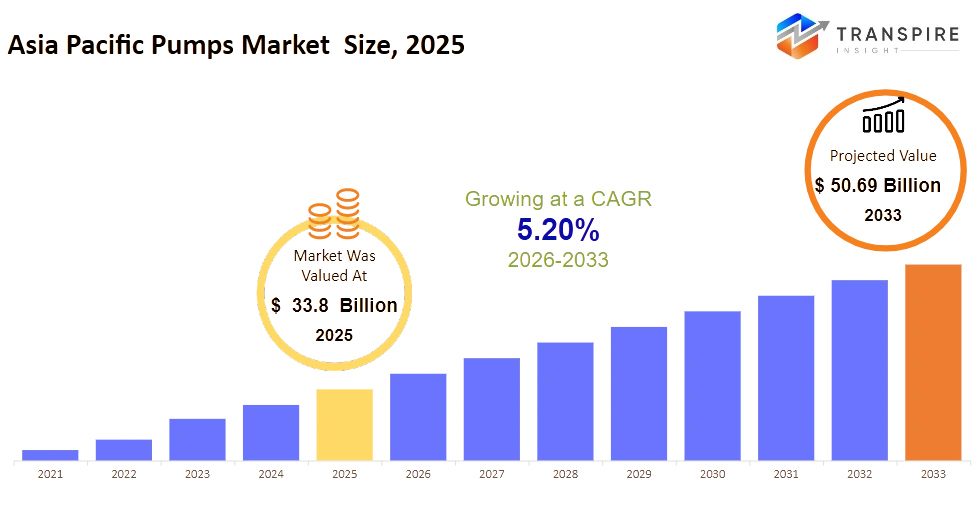
As per Transpire Insight Analysis the Asia Pacific Pumps Market size is estimated at USD 33.8 Billion in 2025 and is anticipated to reach USD 50.69 Billion by 2033, growing at a CAGR of 5.20% from 2026 to 2033.
The Asia Pacific Pumps Market kind of helps in moving water , chemicals, oil, wastewater, and other industrial fluids from one place to another , across manufacturing plants, power stations, construction areas, mining activities, and even municipal infrastructure . In general, if the pumping systems are reliable then the production lines can keep moving, process efficiency stays roughly the same , and utilities can still supply those essential services without so much unexpected stoppage of operations.Over the last three to five years the market has been leaning more and more toward energy-efficient pump systems that are digitally monitored, because a lot of industrial operators are trying to cut down operating expenses and also satisfy tougher environmental expectations. During the pandemic, supply chain disruptions made it pretty clear where the weak spots were, like equipment availability, so manufacturers and end users started diversifying sourcing and also strengthening regional production capacity. Together these resilience and efficiency priorities, have pushed organizations to replace older assets faster with smarter pumping solutions. And as industrial spending, water infrastructure projects, and process automation keep rolling across Asia Pacific, suppliers that can deliver dependable connected, and energy-efficient systems are likely to end up with better revenue opportunities.
Asia Pacific Pumps Market Size & Forecast:
- Asia Pacific Pumps Market Size 2025: USD 33.8 Billion
- Expected Market Value 2033: USD 50.69 Billion
- Forecast CAGR: 5.20%
- Leading region in 2025: China
- Fastest Growing region: India
- Key Profile: Grundfos, Xylem, KSB, Flowserve, Sulzer, Ebara Corporation, Wilo, Kirloskar Brothers, Pentair, Franklin Electric, ITT Inc., Tsurumi Manufacturing, Weir Group, Atlas Copco, Ruhrpumpen
Key Market Insights
- China pretty much dominated the Asia Pacific Pumps Market, landing at around 42% market share in 2025, and that was helped by big scale industrial output, municipal infrastructure expansion, and then the usual manufacturing upgrades, you know.
- India, though, will keep moving as the fastest-growing regional market through 2025–2033, fueled by industrial corridors, urban water programs, plus quick capacity additions across process industries.
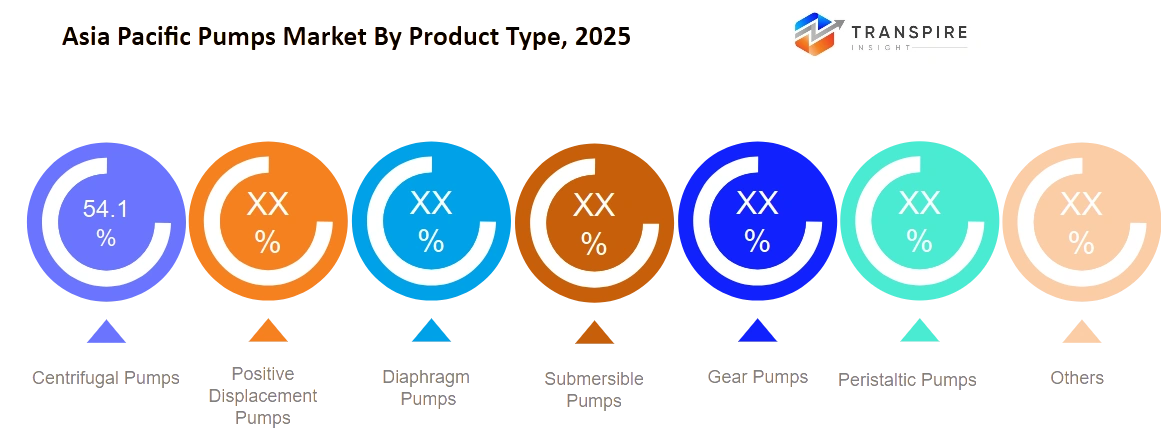
- On the product side, centrifugal pumps took the lead with close to 68% market share in 2025, mainly due to wide adoption across water treatment, chemicals, oil and gas, and manufacturing.
- Positive displacement pumps were right behind, as the second-largest segment, benefiting from more and more usage in food processing, pharmaceuticals, and precision chemical handling type applications.
- Now, smart, and IoT enabled pumps should actually grow at the fastest pace through 2033, backed by predictive maintenance, remote diagnostics, and industrial automation investments.
- For applications, water and wastewater management sort of ruled the place with around 35% share in 2025, and that really echoes municipal treatment capacity getting bigger, along with the rising appetite for industrial reuse.
- Industrial manufacturing is expected to grab the quickest application growth through 2033, backed by factory automation, process tuning, and regional production expansion.
- If you zoom in on end users, industrial end users held close to 57% market share in 2025, pushed by replacement cycles , energy efficiency targets , and nonstop output demands.
- At the same time, municipal utilities should become the quickest expanding end user segment through 2033, because governments are pushing out water distribution, flood control, and sewage infrastructure, all in one, more or less.
What are the Key Drivers, Restraints, and Opportunities in the Asia Pacific Pumps Market?
The most powerful growth driver actually seems to come from industrial automation plus government-backed spending on water infrastructure, even if people sometimes talk about it in separate ways. Tighter energy efficiency standards and water-management rules have sped up the swap of old, worn pumping systems with smarter and more efficient gear. Manufacturers tend to be thinking about the entire lifecycle cost, not only the upfront buying price, and that little change helps premium product adoption feel a lot more reasonable. On top of that , smarter monitoring lowers the chance of sudden downtime, and it also keeps maintenance expenses down. Suppliers can then win higher-value contracts, while also growing the recurring service side of the business.
The big structural restraint stays supply chain concentration for critical items like castings, motors, electronic controls, and specialized materials. Trying to build alternative supplier networks is not quick,it takes years of money, technical vetting, and regulatory sign-offs. When key components go missing, equipment deliveries can slip by several months, and then industrial expansion plans stall, plus revenue recognition gets pushed out. From a Transpire Insight review of regional procurement notices and product launch timelines, supply chain concentration is still the main execution risk here. And yes, these delays can also lift procurement costs while squeezing project profitability across multiple industries.
The next growth opportunity is gonna pop up in connected pumping systems that are tied into industrial digital platforms, you know sort of end to end. With AI-enabled monitoring, plus digital twins, and cloud based asset management , teams can keep tuning performance without pause across manufacturing, mining, and utilities. India and parts of Southeast Asia look especially good , since governments keep backing industrial parks, smart city rollouts, desalination programs, and wastewater treatment setups. Suppliers that blend digital services with energy efficient equipment should end up in a stronger long term competitive position, and also lean more toward service based income.
What Has the Impact of Artificial Intelligence Been on the Asia Pacific Pumps Market?
Artificial intelligence and digital technology are kind of reshaping how pump work gets done, by automating stuff like monitoring, control, and those equipment diagnostic routines across factories, utilities, mining areas, and water treatment facilities. In practice AI driven control systems keep on scanning pressure, vibration, temperature, and flow situation, then they nudge the operating parameters in real time to hold the process steady while cutting down on unnecessary energy use. At the same time machine learning models help with predictive upkeep, they spot component wear earlier than the usual mechanical failure, so the team can plan maintenance around scheduled shutdown windows instead of waiting for an unexpected breakdown, which feels messier.
All of this boosts equipment availability, stretches the service life of assets, and lowers maintenance expenses, while also backing better overall production efficiency. On top of that, digital twins plus cloud based analytics add another layer of optimization because they line up current operating conditions with past performance records. From there they can suggest configuration tweaks that improve pump efficiency, even if the situation changes. Operators also lean on AI forecasting to estimate spare-part needs and manage inventory decisions across several facilities, rather than doing it one site at a time.
But widespread adoption still hits a real roadblock. The integration cost can be high, legacy systems are often fragmented, and operational data is sometimes inconsistent, which then drags down model accuracy in complicated industrial settings. Smaller facilities in particular may not have solid sensor networks or stable connectivity, so the practical gains from advanced AI applications get limited, even though the long-term value is still there.
Key Market Trends
- In 2022, replacements for energy efficient pumps will sped up, because industrial operators are aiming for less electricity use and also lower lifecycle operating expenses, overall.
- After 2021, smart pumps with IoT connectivity kind of really started getting far more traction , so teams could do remote diagnostics , get predictive maintenance signals, and even keep centralized asset monitoring across industrial sites in a more systematic way.
- From 2023 to 2025, China pushed up its own domestic manufacturing capacity , which in turn helped lower the reliance on imported components for certain industrial pumping jobs.
- In India, after 2022, municipal water and wastewater funding ramped up , so vendors selling high capacity pumping equipment were seeing steadier buying demand.
- Between 2022 and 2025, mining and mineral processing operations leaned more into heavy duty pumping systems , largely to improve operational dependability, especially when the conditions are brutal and pretty much constant .
- Grundfos, Xylem, and Flowserve expanded their digital service options, which slowly shifted competition from pure equipment sales toward lifecycle performance management.
- Also, variable frequency drive integration moved forward across a lot of industrial installations after 2021, supporting energy optimization, and helping equipment last longer during day to day use.
- During 2023–2025, some regional manufacturers invested in localized component sourcing, to lower delivery risk that global logistics problems had created.
- Since 2022, industrial customers have been choosing performance based maintenance contracts more often, so revenue shows up repeatedly for service work, not only from the classic equipment transactions.
Asia Pacific Pumps Market Segmentation
By Product Type:
Centrifugal pumps were basically out in front, since broad industrial work, municipal water systems, and wastewater treatment sites needed dependable fluid motion, especially when volumes are really high. A lot of investment in manufacturing centers, infrastructure buildouts, and utility growth helped keep installations rolling across many major economies. Their high operating efficiency, plus the kind of lower upkeep demands, made them stick for long periods in continuous production environments, you know. Meanwhile, positive displacement pumps took the second-largest share by managing viscous liquids in a more precise manner, across chemical processing, pharmaceuticals, food production, and oil transfer tasks.
Diaphragm pumps kept getting taken up, mainly where leak prevention, plus chemical resistance, was non-negotiable for safe operations. Submersible pumps stayed steady as well, pulled along by groundwater extraction, sewage handling, drainage projects, and various construction activities. Gear pumps served situations needing steady flow and accurate liquid conveyance. Peristaltic pumps then moved wider into medical uses, laboratory setups, and specialized processing industries. Product innovation has centered on energy efficient layouts, smart monitoring features, and better durability, which should in turn support future replacement demand across several industrial sectors, without much pause.
By Operation:
Electric pumps took the biggest slice, mostly because manufacturing plants, commercial edifices, and municipal backbone work started choosing electrically driven setups for dependable yet efficient output. At the same time, energy efficiency rules plus automation spend kinda pushed more systems into routine use across factories and industrial lines. They also beat the usual options on day to day spend, so the longer term buy decisions got easier. Still, diesel pumps stayed fairly relevant, especially on far-off build sites, mining work, emergency response needs and anywhere the grid is not really reliable or just isn’t there.
Solar pumps saw the quickest momentum, once renewable energy investments got cheaper, and people felt more comfortable moving toward these systems for both farm irrigation and rural water delivery efforts. Hydraulic pumps basically stayed indispensable for heavy industrial gear, and for those niche machines that want high pressure performance without compromise. Pneumatic pumps, meanwhile, kept showing up in hazardous industrial contexts where electric devices run into limits or safety concerns. Ongoing upgrades in motor efficiency, better renewable linkups, and smarter control methods are going to broaden operational flexibility across a range of end-use industries.
By Application:
Water and wastewater applications held the biggest portion since, when cities started expanding the urban infrastructure, they really needed dependable pumping systems for water distribution , wastewater treatment and also flood control projects . Government spending on sanitation , and water recycling kept on backing the replacement of older equipment plus network expansion. Reliable fluid movement stayed absolutely vital , for keeping public utility services running without interruption . At the same time, oil and gas operations kept steady demand , driven by upstream production , refining runs, and pipeline hauling, all of which call for rugged pumping hardware.
Chemical processing kept creating steady chances because production sites needed corrosion resistant setups able to manage aggressive fluids, even when the operating conditions are severe and a bit unforgiving . Agriculture then pushed more installations too , especially for irrigation modernization , and for groundwater stewardship. Mining businesses also reinforced demand for slurry handling and dewatering systems, while power generation plants kept investing in cooling loops and boiler feed duties . Even food and beverage manufacturing went along, they adopted newer pumping technologies so hygiene could be better, output could be smoother and the final product quality could improve , generally.
By End User:
Industrial facilities took the biggest share, mainly because manufacturing mining, chemicals and energy work were kinda tied to steady fluid motion during pretty much every stage of production. In parallel, automation initiatives and those operational efficiency goals pushed companies to swap older pumping machines with newer , more capable setups. Even now, process dependability was still a big reason buyers chose specific systems across most industrial segments. Municipal utilities were close behind, as local governments kept extending water distribution lines, upgrading wastewater treatment capacity , and building flood control facilities that actually hold up.
Commercial buildings also kept a fairly stable need for HVAC-like equipment—especially heating, cooling, and water circulation setups—showing up in offices, hospitals, shopping areas, and hospitality venues. Residential development helped keep installations steady too, mostly because domestic water supply, plus wastewater management rules , have to be met. On the farm side , agricultural operations leaned harder into efficient irrigation equipment, aiming for better water usage and stronger crop performance. Looking ahead, fresh spending on industrial expansion and municipal infrastructure should keep opening up good opportunities for all the major end-users.
By Distribution Channel:
Direct sales stayed kinda the most important distribution path, mainly because big industrial projects need customized engineering support, technical consultation, installation work and, basically long-term upkeep agreements. A lot of large manufacturers preferred to engage directly, so they could lock in dependable after-sales service and also make better equipment choices, you know. Strong customer ties helped too, especially for repeat replacement programs and service contracts. Even so, distributors never really fell out of the picture, because they kept widening product availability in regional markets while also handling medium-sized industrial customers.
OEM supply kept bringing meaningful business, driven by equipment integration across industrial machinery, construction equipment, and manufacturing systems. Online sales slowly grew as digital procurement platforms made it easier to compare and purchase standard equipment plus replacement parts. Distribution strategies then started mixing digital platforms with local service networks in order to speed up delivery and boost the level of customer help. With ongoing investment in digital sales channels and localized inventories, market access across developing economies should get stronger.
What are the Key Use Cases Driving the Asia Pacific Pumps Market?
Water along with wastewater management still ends up being the biggest use case, because municipal utilities, industrial facilities, and infrastructure authorities basically need dependable fluid movement for treatment , distribution, drainage and flood control . Even so, there’s also continuous investment in public infrastructure and tighter water quality standards, which keep procurement steady and drive equipment replacement on a regular basis.
On another front, chemical manufacturing plus mining are pushing ahead with more pump installations to deal with corrosive liquids, slurry conveyance, and process circulation , all while facing tough operating conditions . Meanwhile , in food and beverage processing , companies are increasingly adopting advanced pumping systems to preserve hygiene standards, boost production efficiency, and back regulatory compliance across their manufacturing sites.
Looking forward, hydrogen production facilities and desalination projects look like strong emerging applications through the forecast period . At the same time, renewable energy efforts, semiconductor manufacturing, and advanced battery production should open additional purchasing possibilities , since specialized fluid handling needs become more crucial across these high-value industrial investments.
|
Report Metrics |
Details |
|
Market size value in 2025 |
USD 33.8 Billion |
|
Market size value in 2026 |
USD 35.55 Billion |
|
Revenue forecast in 2033 |
USD 50.69 Billion |
|
Growth rate |
CAGR of 5.20% from 2026 to 2033 |
|
Base year |
2025 |
|
Historical data |
2021 - 2024 |
|
Forecast period |
2026 - 2033 |
|
Report coverage |
Revenue forecast, competitive landscape, growth factors, and trends |
|
Regional scope |
Asia Pacific (India, China, Japan, Australia, South Korea, Rest of Asia Pacific) |
|
Key company profiled |
Grundfos, Xylem, KSB, Flowserve, Sulzer, Ebara Corporation, Wilo, Kirloskar Brothers, Pentair, Franklin Electric, ITT Inc., Tsurumi Manufacturing, Weir Group, Atlas Copco, Ruhrpumpen . |
|
Customization scope |
Free report customization (country, regional & segment scope). Avail customized purchase options to meet your exact research needs. |
|
Report Segmentation |
By Product Type (Centrifugal Pumps, Positive Displacement Pumps, Diaphragm Pumps, Submersible Pumps, Gear Pumps, Peristaltic Pumps, Others); By Operation (Electric Pumps, Diesel Pumps, Solar Pumps, Hydraulic Pumps, Pneumatic Pumps, Others); By Application (Water & Wastewater, Oil & Gas, Chemicals, Agriculture, Power Generation, Mining, Food & Beverage, Others); By End User (Industrial, Commercial, Residential, Municipal Utilities, Agriculture, Others); By Distribution Channel (Direct Sales, Distributors, Online Sales, OEM Supply, Others) |
Which Regions are Driving the Asia Pacific Pumps Market Growth?
China is still the biggest regional market , with roughly 42% market share during 2025 . Ongoing national investment aimed at industrial modernization , water infrastructure , and tighter energy efficiency standards keeps pushing large batches of equipment into both factories and public utilities . On top of that, strong domestic production capability, a mature set of component suppliers , and a wide pool of engineering know-how make for a pretty connected pump manufacturing environment . As industrial automation keeps widening, municipal systems expand , and replacement orders keep rolling in, that regional lead should hold through most of the forecast period .
Japan comes in next, as the second-largest regional contributor , mainly because many purchasing choices lean toward longer equipment service life , day to day operational dependability , and meeting strict industrial quality rules, not just chasing fast capacity growth . Industrial output is steady , capital spending stays fairly consistent, and infrastructure upkeep plans are predictable, so procurement basically runs on a reliable rhythm across several industries . Demand from chemicals , automotive manufacturing , power generation , plus municipal utilities keeps fueling repeat replacement activity . Overall that investment mix looks balanced, so even if the wider market doesn’t grow super aggressively, it still opens steady revenue chances .
India is set to show the quickest growth in the period between 2026 and 2033, mostly because of ramped up investment along industrial corridors, along with urban water infrastructure , and a push toward manufacturing expansion that sits under national development initiatives. In the last stretch, new funding tied to wastewater treatment plants irrigation systems and also smart city projects has widened procurement windows across both public and private players. At the same time rapid plant buildout and the broader use of energy efficient industrial equipment keeps reinforcing the demand for gear, across multiple sectors. Overall this momentum is likely to open up pretty promising chances for manufacturers , distributors and technology providers who want longer term regional reach, plus fresh customer acquisition, and it should feel like a slow build then sudden lift.
Who are the Key Players in the Asia Pacific Pumps Market and How Do They Compete?
Competition is still pretty moderately fragmented, with international manufacturers working right alongside solid regional producers, in industrial, municipal, and also commercial uses. In practice, it’s not only pricing , technology and energy efficiency have the most weight, along with lifecycle service skills, and even the ability to make things locally. Most established players keep beefing up their regional production networks, while also rolling out digital monitoring platforms and maintenance services, so they can hold onto market share from newer regional suppliers.
Grundfos comes in through energy-saving pumping systems, smart controls, and digital monitoring platforms, which help lower operating costs across the equipment’s whole lifespan. Xylem leans into smart water technologies, and ties advanced analytics to integrated water management solutions that back municipal infrastructure modernization. KSB stays competitive by putting more into regional manufacturing, pairing that with application-specific engineering know-how, and offering customized service programs , so equipment reliability improves across industrial operations.
Flowserve pushes wider advanced monitoring abilities and predictive maintenance services, aiming to lift asset performance in tough industrial conditions. Ebara Corporation has strong manufacturing strengths across Asia, and is also expanding production capacity, in order to support regional infrastructure spending. Sulzer concentrates on high-performance pumping solutions for chemical processing, water treatment, and energy-related applications, and it supports this with ongoing product innovation plus lifecycle maintenance services, which in turn strengthen those longer-term customer relationships.
Company List
- Grundfos
- Xylem
- KSB
- Flowserve
- Sulzer
- Ebara Corporation
- Wilo
- Kirloskar Brothers
- Pentair
- Franklin Electric
- ITT Inc.
- Tsurumi Manufacturing
- Weir Group
- Atlas Copco
- Ruhrpumpen
Recent Development News
In April 2025, EBARA Corporation launched the wall cabinet type "PURE FRESSURE" PNAHM and PNEHM direct water supply booster pumps. The lightweight design improves installation efficiency and supports labor-saving requirements for building water supply systems, strengthening EBARA's position in urban infrastructure projects.
Source https://www.ebara.com/
In June 2026, Xylem expanded its long-term partnership with Dow to design, build, and operate advanced industrial water systems for the Path2Zero project in Canada. The agreement strengthens Xylem's advanced water treatment portfolio and highlights continued investment in large-scale industrial water infrastructure that supports demand for advanced pumping solutions. Sourcehttps://xyleminc.gcs-web.com/
What Strategic Insights Define the Future of the Asia Pacific Pumps Market?
The Asia Pacific Pumps market is likely to go more toward “smart” type, energy saving, and kinda service minded solutions, over the next five to seven years, as many industrial operators rethink what they’re buying. Instead of focusing only on the initial equipment cost, they’re looking at the whole lifecycle value, more or less. Things like digital monitoring , tighter efficiency requirements , and bigger spending on water infrastructure will push suppliers to change their priorities. In turn, software enabled asset handling will become a lot more important than before.
One risk is a bit less obvious, but still worth attention. It has to do with how concentrated some critical parts are, for example motors, electronic controls, and specialty materials. If there is a long supply disruption, then projects can get slowed down, even when capital investment looks solid on paper.
At the same time, there’s a real opportunity forming. Hydrogen production sites, semiconductor manufacturing, and advanced desalination undertakings are all expanding. In those places, specialized pumping systems will likely be required as regional investment starts speeding up.
So, manufacturers and investors should help grow localized supply chains while also widening digital service offerings. They should also build more application specific product lines, so they can keep an edge long term and generate recurring revenue, not just from selling the equipment itself.
Asia Pacific Pumps Market Report Segmentation
By Product Type
- Centrifugal Pumps
- Positive Displacement Pumps
- Diaphragm Pumps
- Submersible Pumps
- Gear Pumps
- Peristaltic Pumps
By Operation
- Electric Pumps
- Diesel Pumps
- Solar Pumps
- Hydraulic Pumps
- Pneumatic Pumps
By Application
- Water & Wastewater
- Oil & Gas
- Chemicals
- Agriculture
- Power Generation
- Mining
- Food & Beverage
By End User
- Industrial
- Commercial
- Residential
- Municipal Utilities
- Agriculture
By Distribution Channel
- Direct Sales
- Distributors
- Online Sales
- OEM Supply
Frequently Asked Questions
Find quick answers to common questions.
The expected Asia Pacific Pumps Market size for the market will be USD 50.69 Billion in 2033.
Key segments for the Asia Pacific Pumps Market are By Product Type (Centrifugal Pumps, Positive Displacement Pumps, Diaphragm Pumps, Submersible Pumps, Gear Pumps, Peristaltic Pumps, Others); By Operation (Electric Pumps, Diesel Pumps, Solar Pumps, Hydraulic Pumps, Pneumatic Pumps, Others); By Application (Water & Wastewater, Oil & Gas, Chemicals, Agriculture, Power Generation, Mining, Food & Beverage, Others); By End User (Industrial, Commercial, Residential, Municipal Utilities, Agriculture, Others); By Distribution Channel (Direct Sales, Distributors, Online Sales, OEM Supply, Others).
Major Asia Pacific Pumps Market players are Grundfos, Xylem, KSB, Flowserve, Sulzer, Ebara Corporation, Wilo, Kirloskar Brothers, Pentair, Franklin Electric, ITT Inc., Tsurumi Manufacturing, Weir Group, Atlas Copco, Ruhrpumpen.
The Asia Pacific Pumps Market size is USD 33.8 Billion in 2025.
The Asia Pacific Pumps Market CAGR is 5.20% from 2026 to 2033.
- Grundfos
- Xylem
- KSB
- Flowserve
- Sulzer
- Ebara Corporation
- Wilo
- Kirloskar Brothers
- Pentair
- Franklin Electric
- ITT Inc.
- Tsurumi Manufacturing
- Weir Group
- Atlas Copco
- Ruhrpumpen
About the Authors

Avinash Kumar
I’m Avinash Kumar, a Senior Research Analyst at Transpire Insight, with expertise in the Electronics and Semiconductor and Energy & Power industry. My work focuses on analyzing emerging technologies, market trends, industry developments, and innovation across these sectors. I specialize in transforming complex technical and market insights into clear, research-backed content that helps professionals, businesses, and decision-makers stay informed. Through continuous industry research and data-driven analysis, I strive to deliver accurate, reliable, and practical perspectives on the latest advancements shaping the semiconductor and energy landscape.

Chakradhar Khansole
Chakradhar serves as the Research Director at Transpire Insight, bringing over 8 years of experience in technology, innovation, and strategic market intelligence. He specializes in transforming complex market data into actionable business insights that enable organizations to make informed, growth-oriented decisions. Recognized for his strategic vision and analytical expertise, Chakradhar leads high-impact research initiatives, delivering comprehensive market assessments, competitive intelligence, and forward-looking industry analysis.
Recently Published Reports
-
Apr 2026
Active Power Filter Market
Active Power Filter Market Size, Share & Analysis Report By Type (Shunt Active Power Filters, Series Active Power Filter, Hybrid Active Power Filter), By Application (Harmonics Mitigation, Reactive Power Compensation, Voltage Regulation, Power Factor Correction), By Phase (Single Phase, Three Phase), By End-User Industry (Manufacturing, Healthcare, Commercial, Automotive, Oil and Gas, Others), and Geography (North America, Europe, Asia-Pacific, Middle East and Africa, South and Central America), 2021 - 2031
-
Apr 2026
Electrical Transformer Market
Electrical Transformer Market Size, Share & Analysis Report By Core (Closed, Shell, and Berry), By Insulation (Gas, Oil, Solid, Air, and Other), By Phase (Single, and Three), By Rating (100 MVA to 500 MVA, 501 MVA to 800 MVA, and 801 MVA to 1200 MVA), and Geography (North America, Europe, Asia-Pacific, Middle East and Africa, South and Central America), 2021 – 2031
-
Apr 2026
Hydraulic Piston Pumps Market
Hydraulic Piston Pumps Market Size, Share & Analysis Report By Type (Axial Piston Pumps, Radial Piston Pumps), By Operating Pressure (Low Pressure, Medium Pressure, High Pressure), By Application (Construction, Mining, Agriculture, Automotive, Oil & Gas, Industrial Machinery, Others), By End-User (OEMs, Aftermarket), and Geography (North America, Europe, Asia-Pacific, Middle East and Africa, South and Central America), 2021 – 2031
-
Apr 2026
Laboratory Gas Generators Market
Laboratory Gas Generators Market Size, Share & Analysis Report By Product (Nitrogen Gas Generator, Hydrogen Gas Generator, Zero Air Gas Generator, Purge Gas Generator, TOC Gas Generators, Others), By Application (Gas Chromatography, Liquid Chromatography-mass Spectrometry (LC-MS), Gas Analyzers, Others), By End-user (Life Science, Chemical & Petrochemical, Food & Beverage, Others), and Geography (North America, Europe, Asia-Pacific, Middle East and Africa, South and Central America), 2021 – 2031