
Asia Pacific Polytrimethylene Terephthalate Market Size & Forecast:
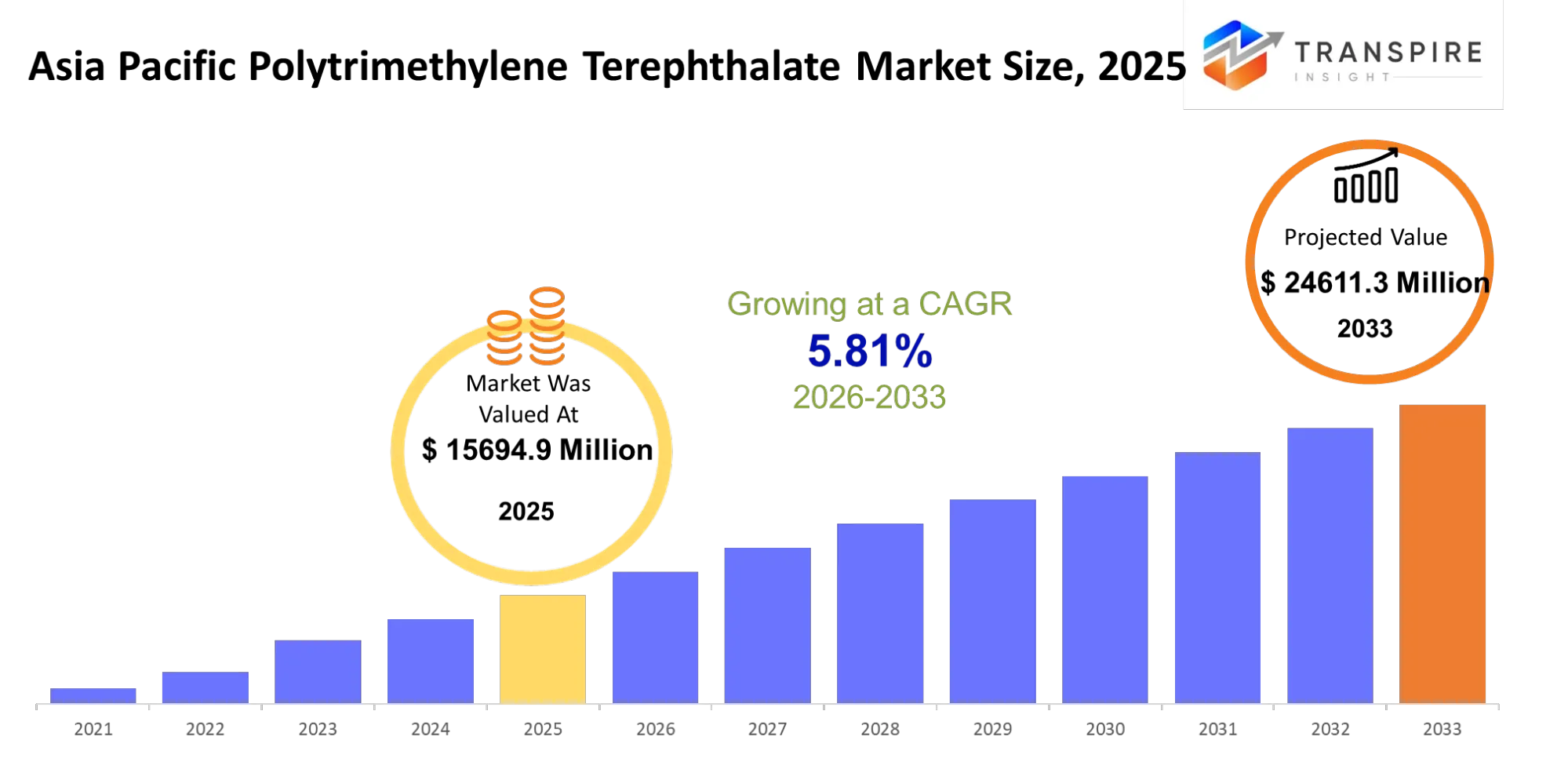
- Asia Pacific Polytrimethylene Terephthalate Market Size 2025: USD 15694.9 Million
- Asia Pacific Polytrimethylene Terephthalate Market Size 2033: USD 24611.3 Million
- Asia Pacific Polytrimethylene Terephthalate Market CAGR: 5.81%
- Asia Pacific Polytrimethylene Terephthalate Market Segments: By Type (Fiber Grade PTT, Resin Grade PTT, Others); By Application (Textiles, Carpets, Automotive, Packaging, Others); By End-User (Textile Industry, Automotive Industry, Packaging Industry, Industrial Firms, Others); By Form (Fibers, Pellets, Others)
To learn more about this report,  Download Free Sample Report
Asia Pacific Polytrimethylene Terephthalate Market Summary
The Asia Pacific Polytrimethylene Terephthalate Market was valued at USD 15694.9 Million in 2025. It is forecast to reach USD 24611.3 Million by 2033. That is a CAGR of 5.81% over the period.
The Asia Pacific Polytrimethylene Terephthalate market provides materials needed for creating high resilience fibers which manufacturers use to produce carpets and upholstery and automotive interiors and performance apparel. The solution enables textile and automotive supply chains to substitute their standard polyester and nylon materials with advanced lightweight materials which provide superior comfort and durability while decreasing their total replacement expenses.
Market dynamics have evolved during the last five years as bio based PTT production has become the dominant method of manufacturing PTT from renewable 1,3 propanediol and producers now utilize lower carbon feedstocks to create standard fiber products. Manufacturers across Asia needed to find alternative solutions because COVID 19 supply chain interruptions and petrochemical price fluctuations made oil-based materials less reliable. Textile hubs in China, Japan and Southeast Asia adopted this combination of solutions at an accelerated pace. Industrial and consumer applications now drive demand growth through material substitution choices which increase revenue predictability for integrated polymer manufacturers.
Key Market Insights
- The Asia Pacific Polytrimethylene Terephthalate Market will be controlled by Asia Pacific which will achieve a 45 to 50 percent market share through its fiber production facilities in China by 2025.
- The period from 2025 to 2030 will show Southeast Asia as the most rapidly developing area because of its growing textile export centers and its ability to produce goods at lower costs.
- Japanese and South Korean markets show consistent demand because of their need for advanced automotive interior solutions which require high-performance materials.
- Sustainability requirements and renewable feedstock usage will drive bio-based PTT to capture almost 60 percent of the market share in 2025.
- The second largest market segment in PTT which serves as the primary synthetic PTT market segment provides cost advantages through its existing petrochemical production facilities.
- Bio-based PTT is also the fastest-growing segment which will continue until 2030 because both carbon reduction targets and brand sustainability commitments drive its growth.
- The Asia Pacific Polytrimethylene Terephthalate Market in 2025 shows textile fibers as the most dominant material which accounts for approximately 55% of the market share and finds particular use in carpets and apparel.
- The apparel and textile manufacturing sector accounts for almost 50% of total usage because Asia has established extensive capacity for fiber processing facilities.
- PTT-based materials now replace nylon-based interiors at automotive original equipment manufacturers which represent the fastest expanding group of end users.
- Home furnishing producers keep increasing their product adoption because they value the stain resistance and elasticity advantages of their materials.
What are the Key Drivers, Restraints, and Opportunities in the Asia Pacific Polytrimethylene Terephthalate Market?
The Asia Pacific Polytrimethylene Terephthalate market experiences its main growth because of the ongoing shift that creates bio-based polymer usage across both textile and automotive industries. The market for renewable 1,3 propanediol has expanded because its commercial production allows fiber manufacturers in China, Japan, and South Korea to use PTT for making carpet yarns and clothing materials and home textiles. The industry change occurred because post-2020 supply chain problems and fluctuating crude oil prices forced manufacturers to find stable low-emission material sources. The premium textile market now shows increased adoption because its durable and comfortable materials lead to better revenue results for companies that produce integrated polymer products.
The market faces limitations because manufacturing processes require complex operations and there is insufficient supply of feedstock materials needed for production at large facilities. Manufacturers of bio-based PTT must establish strict fermentation process controls while ensuring continuous access to sugar-based raw materials which currently come from a few international suppliers. The current system prevents manufacturers from accessing affordable production methods which would enable them to produce products at the same speed as standard polyester. The cost difference between two options prevents companies from using the complete range of materials because their profit margins remain too low in the fabric market that contains low-cost products.
The Southeast Asian region presents its most significant opportunity through its dual capacity expansion and vertical integration development throughout Thailand and Vietnam which currently experience rapid growth in their textile export infrastructure. The establishment of integrated bio-refinery projects through PDO-linked polymer facilities will achieve both lower input expenses and enhanced supply chain reliability which will facilitate the expansion of Asia Pacific Polytrimethylene Terephthalate Market applications within automotive textiles and performance apparel.
What Has the Impact of Artificial Intelligence Been on the Asia Pacific Polytrimethylene Terephthalate Market?
The Asia Pacific Polytrimethylene Terephthalate market undergoes transformation through artificial intelligence because it enables polymer manufacturers to enhance their production efficiency and quality control and emission control capabilities across their industrial chemical operations. AI-based process control systems at modern PTT and polyester production facilities operate 24/7 to control temperature and pressure and catalyst dosing during polymerization processes, which results in decreased batch variation and increased production of textile and automotive interior fiber-grade materials.
Chemical plants increasingly use predictive analytics models to perform predictive maintenance on their extrusion lines and spinning equipment and scrubber performance systems. The systems identify equipment degradation and emission deviations at an early stage, which enables operators to stop unplanned shutdowns while they continue to meet regulatory standards. Manufacturers use machine learning tools to predict emissions through analysis of past operational data and current sensor measurements, which enables them to enhance energy efficiency while minimizing production expenses.
The Asia Pacific Polytrimethylene Terephthalate market shows directional benefits because producers report several operational improvements which include better plant uptime and reduced energy use and decreased waste disposal rates. The adoption process faces obstacles because manufacturers with outdated equipment systems experience difficulties in establishing sensor networks, which leads to incomplete data collection and decreased accuracy for their operational model. The textile chemical production sector shows strong demand for AI optimization technologies, but mid-tier companies face challenges in implementing full-scale systems because of their automation system requirements.
Key Market Trends
- The Asia Pacific Polytrimethylene Terephthalate Market transitioned from fossil fuel resources to bio-based PTT usage which now accounts for 60% of premium fiber production by 2025.
- China and Japan decreased their need for petrochemicals after the 2021 market disruptions, which resulted in faster adoption of polymer materials for textiles and development of more stable resource acquisition methods.
- After 2022, automotive manufacturers started using PTT for their interior fabric materials because PTT offered better weight savings and greater comfort results.
- After 2023, Teijin and Toray increased their research activities for bio-based materials development because they wanted to create technologies which produce low-carbon fibers and enable circular material systems.
- Textile production facilities in Vietnam and Thailand increased their operational capacity since 2022, which resulted in worldwide supply networks becoming less reliant on production facilities located in China.
- From 2023 onwards, digital process automation technology at polymer production facilities achieved better operational consistency, which led to decreased rates of fiber-grade output line batches being rejected.
- The Indorama Ventures company established backward supply chains after 2024 to gain better control over feedstock price fluctuations while achieving operational cost control throughout its business activities.
- The South Korean and Japanese governments have implemented stricter industrial emission regulations since 2021, which caused manufacturers to adopt more environmentally friendly methods for polymerization and energy-saving technologies.
- The Asia Pacific Polytrimethylene Terephthalate Market used AI-based maintenance systems to decrease unexpected downtime at extrusion and spinning facilities after 2023.
Asia Pacific Polytrimethylene Terephthalate Market Segmentation
By Type:
The Asia Pacific market for Polytrimethylene Terephthalate divides its products into three types which are fiber grade and resin grade and other variants. The textile industry uses fiber grade PTT for producing stretchable and durable textiles. The resin grade PTT material is used for molding processes. The other forms of the material exist to fulfill specific industrial requirements which drive specialized manufacturing needs.
Fiber grade PTT supports textile production where elasticity and comfort are important. The apparel and fabric industries experience rising demand because of PTT materials that provide softness and resilience. Resin grade PTT supports engineering and molding applications that demand both strength and thermal stability. Other material types find use in minor industrial applications which need special material characteristics to achieve particular operational goals.
By Application:
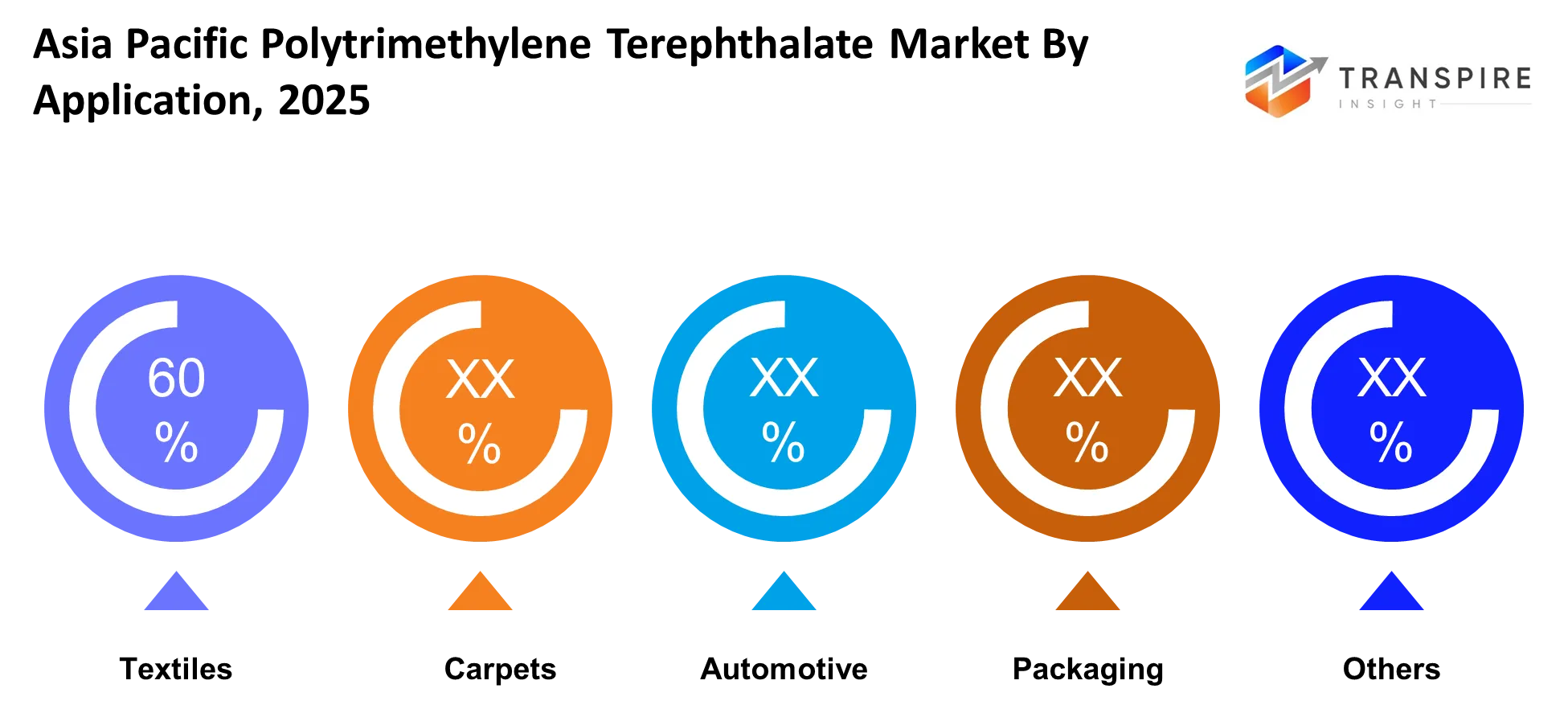
Polytrimethylene Terephthalate finds applications across textiles and carpets and automotive parts and packaging materials and various other fields. Textile applications lead due to strong fiber performance. PTT functions as the primary material used in carpets because it provides both durability and stain resistance. The automotive and packaging industries use PTT because it delivers both lightweight strength and better operational capabilities for their products.
Textiles remain the primary application area due to comfort, elasticity, and easy dyeing properties. The carpet industry needs materials that offer both resilience and extended wear resistance. The automotive industry uses lightweight materials in its interior fabrics and molded components to enhance operational efficiency. PTT packaging applications use PTT for strength and recyclability which enables better material handling and product protection during transport and storage operations.
To learn more about this report, Download Free Sample Report
By End-User:
The end-user segmentation for this study includes five main user segments which are textile industry, automotive industry, packaging industry, industrial firms, and other small-scale users. The textile industry remains the dominant consumer due to fabric production demand. The automotive and packaging industries utilize PTT for their performance-based applications. Industrial firms use the material in their specialized production processes which need material properties to remain unchanged.
Textile industry usage is driven by growing demand for functional and comfortable fabrics. The automotive industry uses the technology to develop interior components which require lightweight material solutions. The packaging industry uses PTT for strong and flexible packaging structures. Industrial firms use the material for engineered applications where durability and chemical resistance are important in controlled manufacturing environments.
By Form:
Polytrimethylene Terephthalate exists as a material which can be found in fibers and pellets plus other processed variants. The textile and carpet industries widely utilize fibers as their primary material. The industry uses pellets to create products through molding and extrusion processes. The industry uses other forms to meet specific industrial needs which require particular material properties and specific processing conditions that must be met for product development.
Fiber form supports textile and carpet manufacturing with flexibility and strength characteristics. The pinewood tree resources produce pellet form which enables industrial processing through injection molding and extrusion used in automotive and packaging component production. Specialized applications use other forms which require changed material structure. The different production needs of multiple Asia Pacific industries receive support through each production form.
What are the Key Use Cases Driving the Asia Pacific Polytrimethylene Terephthalate Market?
The Asia Pacific Polytrimethylene Terephthalate market shows textile fibers as its main application because manufacturers need to develop carpets and apparel and upholstery products which require materials with elastic properties and stain resistance and long-lasting strength. The application creates maximum demand because major textile manufacturers in China and India need fiber materials which maintain uniform quality to achieve their export-focused production schedules.
Automotive interior fabrics are growing as an additional application because OEMs from Japan and South Korea currently switch from traditional nylon fabrics to PTT-based materials for manufacturing their seat covers and floor mats and trim components. Home furnishing applications are also gaining traction as retailers demand materials that maintain texture and color stability under heavy consumer use.
The emerging use cases of performance sportswear and filtration textiles are designed for industrial air and fluid systems. The applications continue to develop because manufacturing companies are investigating high-resilience fibers that meet advanced industrial and consumer durability and efficiency standards.
|
Report Metrics |
Details |
|
Market size value in 2025 |
USD 15694.9 Million |
|
Market size value in 2026 |
USD 16573.4 Million |
|
Revenue forecast in 2033 |
USD 24611.3 Million |
|
Growth rate |
CAGR of 5.81% from 2026 to 2033 |
|
Base year |
2025 |
|
Historical data |
2021 - 2024 |
|
Forecast period |
2026 - 2033 |
|
Report coverage |
Revenue forecast, competitive landscape, growth factors, and trends |
|
Regional scope |
Asia Pacific (India, China, Japan, Australia,South Korea, Rest of Asia Pacific) |
|
Key company profiled |
DuPont, Toray, Teijin, Asahi Kasei, Covestro, BASF, DSM, Eastman, Mitsubishi Chemical, Reliance Industries, Indorama Ventures, Far Eastern New Century, SK Chemicals, Sinopec, Lotte Chemical |
|
Customization scope |
Free report customization (country, regional & segment scope). Avail customized purchase options to meet your exact research needs. |
|
Report Segmentation |
By Type (Fiber Grade PTT, Resin Grade PTT, Others); By Application (Textiles, Carpets, Automotive, Packaging, Others); By End-User (Textile Industry, Automotive Industry, Packaging Industry, Industrial Firms, Others); By Form (Fibers, Pellets, Others) |
Which Regions are Driving the Asia Pacific Polytrimethylene Terephthalate Market Growth?
The Asia Pacific Polytrimethylene Terephthalate market shows textile fibers as its main application because manufacturers need to develop carpets and apparel and upholstery products which require materials with elastic properties and stain resistance and long-lasting strength. The application creates maximum demand because major textile manufacturers in China and India need fiber materials which maintain uniform quality to achieve their export-focused production schedules.
Automotive interior fabrics are growing as an additional application because OEMs from Japan and South Korea currently switch from traditional nylon fabrics to PTT-based materials for manufacturing their seat covers and floor mats and trim components. Home furnishing applications are also gaining traction as retailers demand materials that maintain texture and color stability under heavy consumer use.
The emerging use cases of performance sportswear and filtration textiles are designed for industrial air and fluid systems. The applications continue to develop because manufacturing companies are investigating high-resilience fibers that meet advanced industrial and consumer durability and efficiency standards.
Who are the Key Players in the Asia Pacific Polytrimethylene Terephthalate Market and How Do They Compete?
The Asia Pacific Polytrimethylene Terephthalate market displays a competitive structure which contains several leading integrated polymer and chemical manufacturers who dominate the market for high-value bio-based and specialty fiber production while regional converters use pricing strategies to compete against each other. The primary factors that determine competition between companies are their technological capabilities and their ability to integrate feedstock materials into their operations. Organizations that establish renewable 1,3 propanediol supply chains together with enhancing their polymerization processes achieve better profit margins while smaller organizations face difficulties because of price fluctuations and their restricted access to textile and automotive original equipment manufacturer supply chains.
DuPont develops bio-based polymers through its Sorona platform which enables the company to create renewable content certified products which deliver consistent performance in textile and carpet fiber applications. The company established an early bio-based PTT product market introduction which helps them build long-term relationships with premium textile companies in Japan and South Korea.
Indorama Ventures establishes its cost advantage by using backward integration to obtain petrochemical feedstock materials and create extensive polyester production operations throughout Southeast Asia. The company's operational system enables it to operate traditional PET production facilities while meeting new PTT market demands together with maintaining its ability to adjust product prices.
Toray Industries and Teijin Limited focus on developing high-performance materials which they use to create automotive interior products and technical textile materials that feature advanced fiber technology. Both companies expand their business operations by establishing partnerships with Japanese original equipment manufacturers to develop lightweight cabin components which meet their durability requirements. Mitsubishi Chemical Group uses material science research and development partnerships to establish its presence in Southeast Asia while creating better access to textile production centers which are experiencing rapid growth.
Company List
- DuPont
- Toray
- Teijin
- Asahi Kasei
- Covestro
- BASF
- DSM
- Eastman
- Mitsubishi Chemical
- Reliance Industries
- Indorama Ventures
- Far Eastern New Century
- SK Chemicals
- Sinopec
- Lotte Chemical
Recent Development News
In January 2026, Mordor Intelligence (report publication) highlighted DuPont and SK Chemicals as primary market players who drive bio-based PTT expansion in Asia Pacific through their use of certified renewable feedstock. The report showed that Asia Pacific supply chains become more competitive through bio-based PTT production and renewable content certification initiatives which help the region adopt sustainable textile practices.Source https://www.giiresearch.com/
In October 2025, The academic research study about PET-replacement copolymers demonstrated existing progress toward finding polyester substitutes through its examination of materials that can compete with PTT in textile and packaging markets, thus supporting the development of sustainable polyester solutions which create a new trend for PTT adoption in the Asia Pacific region. Source https://arxiv.org/
What Strategic Insights Define the Future of the Asia Pacific Polytrimethylene Terephthalate Market?
The Asia Pacific Polytrimethylene Terephthalate market will create new market structures through its seven-year period because it will implement bio-based materials and build stronger ties with circular textile supply chains.The current trend exists because both apparel brands and automotive original equipment manufacturers have implemented low-carbon material sourcing commitments that limit their purchasing options to specific materials. The process of value creation will transition from basic polymer supply operations to verified sustainable material systems which manufacturers will establish within their local production facilities.
The feedstock concentration problem produces hidden dangers because the limited worldwide capacity to produce bio-based 1,3 propanediol together with agricultural input cycle restrictions and policy change probabilities will result in supply chain interruptions and cost increases. Demand for substitution from traditional polyester materials will face delays because of strong market indicators which show increasing demand for materials.
The textile industry in Southeast Asia presents a new opportunity through its development of high-performance recycling systems which will use PTT technology for their recycling operations. Early investors in closed-loop fiber recovery systems and co-located polymer production facilities will achieve operational benefits. Market participants should establish upstream bio-feedstock partnerships while developing downstream recycling partnerships to secure both cost stability and long-term demand visibility.
Asia Pacific Polytrimethylene Terephthalate Market Report Segmentation
By Type
- Fiber Grade PTT
- Resin Grade PTT
By Application
- Textiles
- Carpets
- Automotive
- Packaging
By End-User
- Textile Industry
- Automotive Industry
- Packaging Industry
- Industrial Firms
By Form
- Fibers
- Pellets
Frequently Asked Questions
Find quick answers to common questions.
The Asia Pacific Polytrimethylene Terephthalate Market size is USD 24611.3 Million in 2033.
Key segments for the Asia Pacific Polytrimethylene Terephthalate Market are By Type (Fiber Grade PTT, Resin Grade PTT, Others); By Application (Textiles, Carpets, Automotive, Packaging, Others); By End-User (Textile Industry, Automotive Industry, Packaging Industry, Industrial Firms, Others); By Form (Fibers, Pellets, Others).
Major Asia Pacific Polytrimethylene Terephthalate Market players are DuPont, Toray, Teijin, Asahi Kasei, Covestro, BASF, DSM, Eastman, Mitsubishi Chemical, Reliance Industries, Indorama Ventures, Far Eastern New Century, SK Chemicals, Sinopec, Lotte Chemical.
The Asia Pacific Polytrimethylene Terephthalate Market size is USD 15694.9 Million in 2025.
The Asia Pacific Polytrimethylene Terephthalate Market CAGR is 5.81% from 2026 to 2033.
- DuPont
- Toray
- Teijin
- Asahi Kasei
- Covestro
- BASF
- DSM
- Eastman
- Mitsubishi Chemical
- Reliance Industries
- Indorama Ventures
- Far Eastern New Century
- SK Chemicals
- Sinopec
- Lotte Chemical
Recently Published Reports
-
Apr 2026
Handling and Lifting Equipment Market
Handling and Lifting Equipment Market Size, Share & Analysis Report By Product (Cranes and Hoists, Forklifts, Conveyor Systems, Aerial Work Platforms, Others), By Application (E-Commerce, Automotive and Railway, Food and Beverages, Aviation, Others), and Geography (North America, Europe, Asia-Pacific, Middle East and Africa, South and Central America), 2021 - 2031
-
Apr 2026
HVAC Equipment Market
HVAC Equipment Market Size, Share & Analysis Report By Heating Equipment Type (Boilers and Furnaces, Heat Pumps, and Unitary Heaters), By Ventilation Equipment (Air Handling Units, Humidifiers and Dehumidifiers, Air Filters, and Fan Coiling Units), By Air Conditioning Equipment (Unitary Air Conditioners, Room Air Conditioners, Packaged Terminal Air Conditioners, and Chillers), By End User (Commercial, Residential, Industrial, and others), and Geography (North America, Europe, Asia-Pacific, Middle East and Africa, South and Central America), 2021 – 2031
-
Apr 2026
Refrigeration Valves Market
Refrigeration Valves Market Size, Share & Analysis Report By Type (Solenoid Valves, Expansion Valves, Check Valves, Service Valves, Others), By Application (Commercial Refrigeration, Industrial Refrigeration, Transport Refrigeration, Residential Refrigeration, Air Conditioning Systems), By End User (Food and Beverage Industry, Pharmaceutical Industry, HVAC Industry, Chemical Industry, Others), and Geography (North America, Europe, Asia-Pacific, Middle East and Africa, South and Central America), 2021 – 2031
-
Apr 2026
E-Commerce Packaging Materials Market
E-Commerce Packaging Materials Market By Material Type (Corrugated Boxes, Paper & Paperboard, Foam & Cushioning Materials, Plastic Packaging, Flexible Packaging, Protective Packaging, Others), By Product(Primary Packaging, Secondary Packaging, Tertiary Packaging), By Packaging Function (Protective Packaging, Branding & Presentation Packaging, Transit & Logistic Packaging, Sustainable Packaging, Tamper Evidence Packaging), By End-User (Retail & Consumer Goods, Electronic Appliances, Food & Beverages, Healthcare & Pharmaceutical, Fashion & Apparel, Home & Furnishing, Others); By Industry Analysis, Size, Share, Growth, Trends, and Forecasts 2021-2033