

Asia Pacific Plywood Market Summary
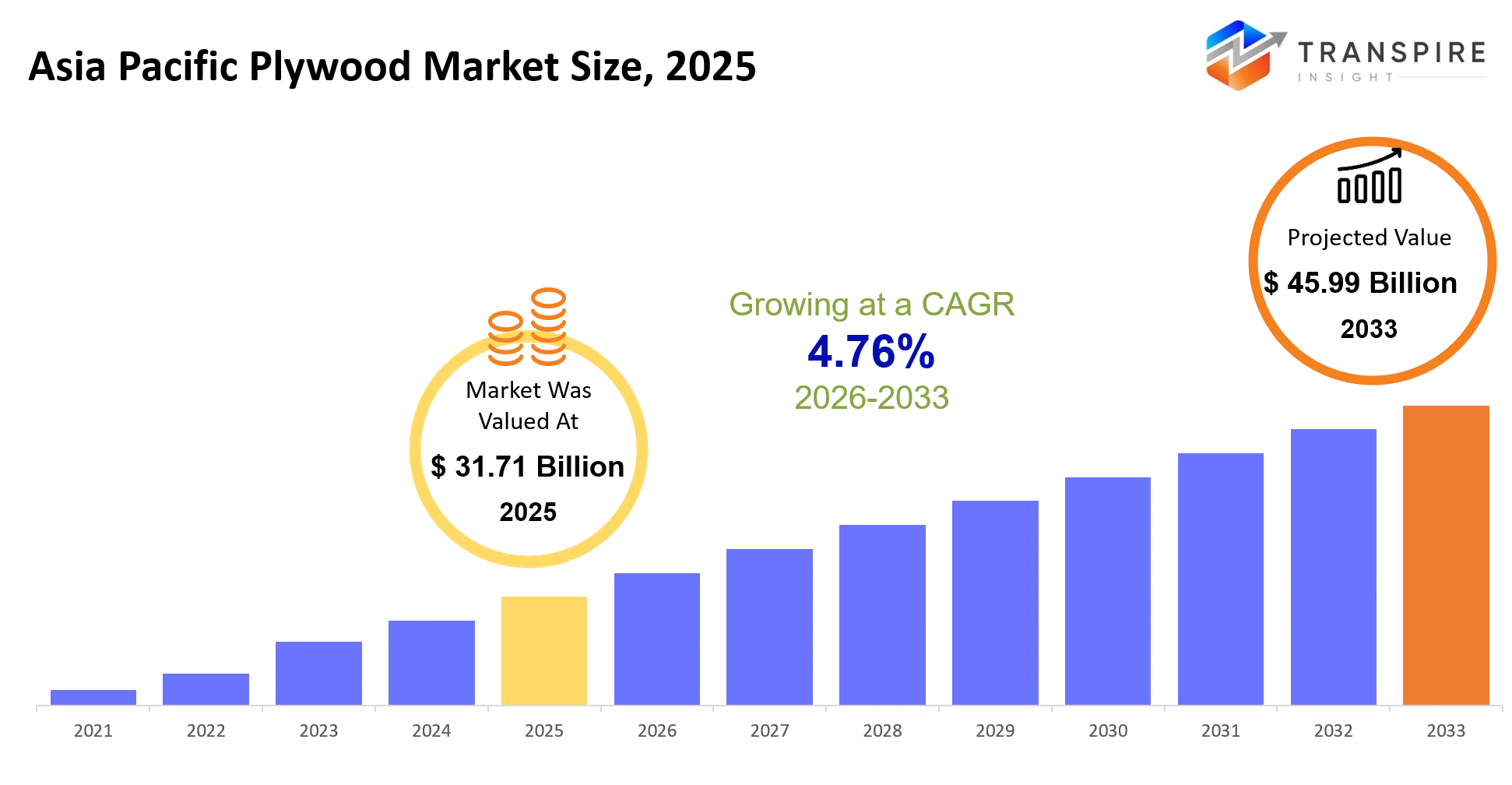
As per Transpire Insight Analysis the Asia Pacific Plywood Market size is estimated at USD 31.71 Billion in 2025 and is anticipated to reach USD 45.99 Billion by 2033, growing at a CAGR of 4.76% from 2026 to 2033.
The Asia Pacific plywood market kinda matters a whole lot for construction, furniture manufacturing , interior decoration , packaging, and a bunch of other industrial uses, mostly because it gives this durable yet relatively light engineered wood that also stays cost-friendly. In practice it helps builders and manufacturers cut down on material waste but still keep structural strength, so it ends up fitting residential, commercial, and even infrastructure projects pretty well, you know. Over the last few years the market changed a lot, since producers leaned more toward certified sustainable timber, low-emission adhesives , and also automated production lines. That move was mostly to satisfy tighter environmental expectations while at the same time improving output efficiency, and I mean, it honestly feels like everything is moving faster now.
One big thing that pushed this shift was the disruption in global timber supply chains during and right after the COVID-19 period, which made regional makers rethink things and strengthen domestic sourcing. They also started investing in more resilient production networks, not just for today’s problems but for the next cycles too. This kind of approach has improved supply stability, and it also supports long-term capacity expansion. Meanwhile governments are still putting money into urban infrastructure and housing projects across Asia Pacific, so plywood companies are growing their catalogs with premium grades, specialty grades, and more targeted product lines. That means better revenue chances across construction furniture and industrial sectors, even if the demand is a bit uneven here and there.
Asia Pacific Plywood Market Size & Forecast:
- Asia Pacific Plywood Market Size 2025: USD 31.71 Billion
- Expected Market Value 2033: USD 45.99 Billion
- Forecast CAGR: 4.76%
- Leading region in 2025:China
- Fastest Growing region:India
- Key Profile: UPM-Kymmene Corporation, Georgia-Pacific LLC, Weyerhaeuser Company, West Fraser Timber Co. Ltd., Greenply Industries Limited, Century Plyboards (India) Ltd., Merino Industries Ltd., SVEZA Group, Samling Group, Austral Plywoods Pty Ltd.
Key Market Insights
- China kind of dominated the Asia Pacific Plywood Market, roughly 46% market share in 2025, and that’s mainly backed by all that broad furniture manufacturing plus the construction side of things , it’s not small.
- India meanwhile is seen as the fastest-growing regional market through 2033, mainly because affordable housing initiatives are rolling forward , there’s also industrial expansion and engineered wood demand just keeps climbing.
- For the product mix , Softwood plywood actually made up about 32% of market revenue in 2025, and it kept its top position mostly due to competitive pricing and really broad building use cases .
- Hardwood plywood sits around 27% market share, supported by premium furniture production, commercial interior works, and requirements that lean more toward higher structural durability.
- Marine plywood is forecast to show a CAGR above 6% through 2033, helped along by coastal infrastructure buildouts, shipbuilding activity, and moisture-resistant construction uses.
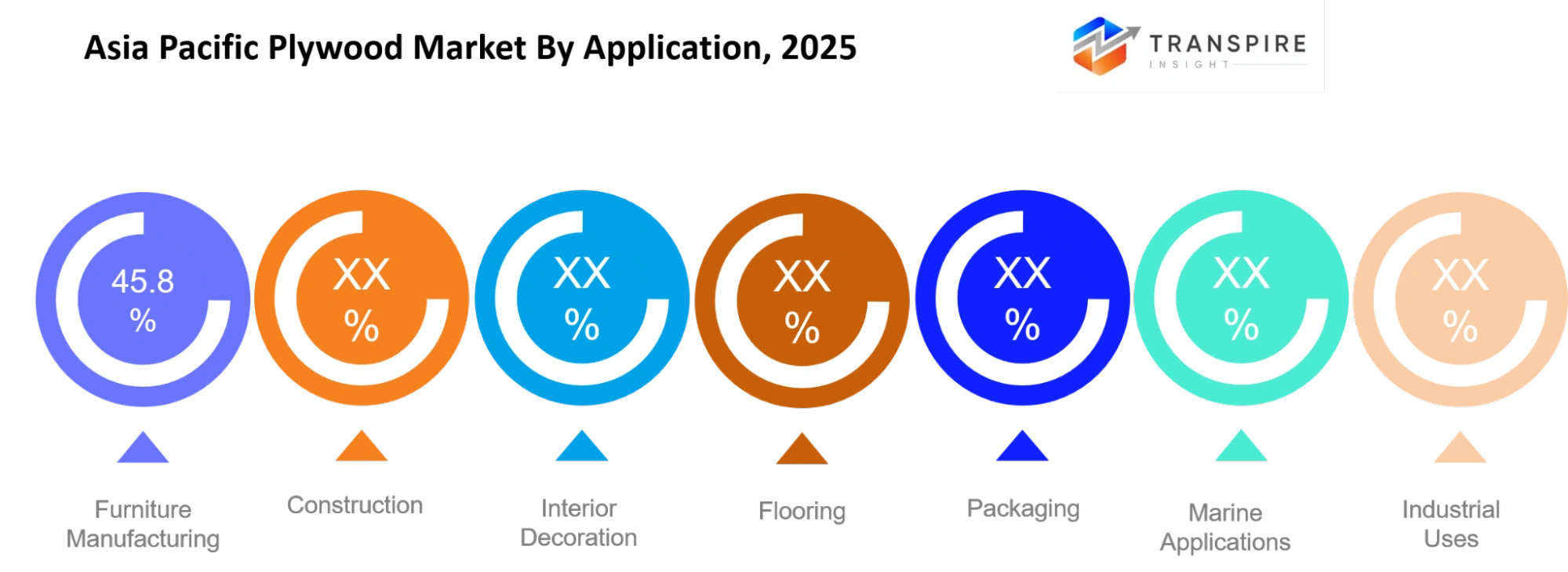
- When you look at applications , furniture manufacturing is still the biggest driver with nearly 38% market share in 2025, supported by increasing exports and more automated furniture production setups.
- Interior decoration is expected to stay the fastest-growing application too, it’s fueled by premium home renovations and the modernization of commercial offices across Southeast Asia.
- As for end users, residential construction stays largest with nearly 43% market share, while commercial infrastructure projects are growing quicker across the forecast window.
- Key players like Greenply Industries Limited, Century Plyboards (India) Ltd., UPM-Kymmene Corporation, Weyerhaeuser Company, West Fraser Timber Co. Ltd., and Georgia-Pacific LLC keep spending on automated manufacturing, certified timber sourcing , and regional production expansion even as demand shifts.
What are the Key Drivers, Restraints, and Opportunities in the Asia Pacific Plywood Market?
Government backed housing projects, plus infrastructure spending, keep acting like the strongest pushing force for market growth. In India, programs for affordable housing, in China the urban renewal pushes, and across Southeast Asia all the transport improvements have raised demand for engineered wood products. Meanwhile, a lot of modern furniture manufacturers have switched to automated production setups, and in practice they need consistent , standardized plywood sheets, with dependable mechanical performance. Together this mix has boosted output, helped production efficiency go up, and brought steadier revenue in residential, commercial and industrial uses
Still, the biggest structural problem is that certified timber isn’t always easy to get , and at the same time forestry regulations are getting tighter. Sustainable forestry policies limit raw material extraction. On top of that, tighter enforcement around illegal logging is shrinking access to cheaper timber. As a result, costs climb, and manufacturers have to deal with raw material prices that can swing a lot. Also, because new plantation forests take years to grow , the supply mismatch can’t be fixed quickly. This slows down broader production expansion and can squeeze profit margins for plywood producers
Engineered plywood that’s built to resist moisture, improve fire protection, and keep formaldehyde emissions low, is looking like a meaningful long term growth path. Companies are putting more focus on premium grade panels for healthcare buildings, commercial projects, modular construction, and overseas markets too. Vietnam and India for example are also drawing investment into newer plywood manufacturing plants. The reason is that global furniture brands are diversifying supply chains away from China, so the region gains new production capacity, plus fresh export opportunities
What Has the Impact of Artificial Intelligence Been on the Asia Pacific Plywood Market?
Artificial intelligence is quietly, and steadily, transforming plywood manufacturing it mostly helps production efficiency, quality checking, and day to day factory operations. For example, computer vision systems scan veneer sheets for cracks, knots, moisture changes and other surface defects, right before pressing. That means manufacturers can cut down on material waste and keep the finished product more consistent, even when incoming timber varies. On the planning side, AI enabled production systems usually optimize cutting patterns, adhesive spread, and raw material allocation which helps factories make better use of timber and at the same time reduce manufacturing costs.
Then there are machine learning models that back predictive maintenance by watching hot presses, dryers, sanding machines, conveyors and the cutting equipment. They learn from vibration, temperature, and routine operating signals so potential failures can be spotted before a breakdown happens. This reduces those surprise stopages and also stretches the life of the machines. AI based demand forecasting also plays a role in inventory planning, because it tries to match plywood production with seasonal construction activity and furniture production cycles. In practice, that lowers excess stock, while keeping deliveries on time or at least closer to schedule.
More recently, manufacturers are turning to digital twins and industrial IoT platforms to follow production efficiency, energy use, and even emissions across more than one facility. With these tools there is better operational visibility, plus it becomes easier to meet regulatory requirements. Still, AI adoption is not totally smooth, because the implementation costs are high, many facilities are fragmented, and digital infrastructure is inconsistent especially for smaller and medium sized plywood producers. A lot of regional companies still do not have enough production data, and they may also be missing skilled personnel needed to deploy advanced AI driven manufacturing systems properly.
Key Market Trends
- Since 2021 , manufacturers have been speeding up investments in automated veneer grading and pressing systems, and yeah it has helped production efficiency by about 10–20% in big facilities overall.
- At the same time, certified timber sourcing keeps growing steadily—especially when export-oriented manufacturers took up FSC and PEFC certification , so they could reach premium global furniture markets, and not just the usual ones.
- India ’s plywood production capacity also rose noticeably since 2022. This was backed by brand new manufacturing plants plus stronger domestic housing investments, which sort of fed the demand.
- Meanwhile furniture exporters have adjusted where they buy from. They moved part of procurement away from China toward Vietnam and India , helping regional supply chain diversification after the pandemic disruptions really shook things up.
- Low-formaldehyde adhesives are now basically the norm in premium plywood production too. Builders increasingly ask for indoor air quality compliance, particularly for commercial projects, so the specification pressure is there.
- Also, digital quality inspection using AI-enabled vision systems has largely replaced manual checks in leading plants. The result has been better consistency and lower rejection rates , which sounds simple but it actually matters a lot.
- Premium waterproof and fire-retardant plywood has been seeing broader adoption. Commercial buildings, and public infrastructure projects in particular, are pushing higher safety standards , so demand keeps following.
- Companies like Greenply Industries, Century Plyboards, UPM-Kymmene, and West Fraser have expanded manufacturing capacity while investing in sustainable forestry partnerships , which helps on both supply and reputation fronts.
- On the sales side, manufacturers have tightened their regional dealer networks along with direct sales channels. This improves product availability and helps shorten delivery timelines across Southeast Asia, even when logistics get messy.
- Finally, investment is shifting toward value-added engineered wood products rather than sticking only to commodity plywood. In practice this allows producers to protect margins even when timber prices are fluctuating a bit too much.
Asia Pacific Plywood Market Segmentation
By Product Type
Softwood plywood kind of keeps a strong spot in the market, mostly due to low weight, kinda easy handling, and cost effective results when you build or make furniture. Hardwood plywood meanwhile gives more strength, stronger load carrying ability, and a longer service life, so it fits well for premium furniture, flooring, and also commercial interior setups. Then you have tropical plywood, it brings excellent durability, plus natural resistance against moisture so it tends to last better in tricky conditions. Decorative plywood gives you nice surface looks, decorative faces that work for residential and commercial interior use. Marine plywood supports the sort of projects that meet high humidity or direct water exposure, because it’s built with strong bonding and water resistant properties that actually hold up.
Structural plywood is made for construction jobs that need dependable strength, like walls, roofs, and flooring systems, in real life. Flexible plywood is for curved furniture and wall panels, and for more creative interior ideas, since it can bend a lot without marring the surface. Other types of plywood include specialty boards designed for fire resistance, sound insulation, lightweight building, and custom industrial requirements. Overall the variety matters, because manufacturers can match different performance expectations across residential, commercial, industrial, and infrastructure uses, and that helps keep the market moving and expanding steadily.
By Grade
MR Grade is still widely used for indoor furniture, cabinets, and general interior jobs, mostly because it holds up well against moisture when things are normal and prices stay competitive. Then there is BWR Grade, which brings more solid water resistance, so it tends to be chosen for kitchens, bathrooms, and commercial interiors where moisture shows up more often. BWP Grade is the top tier for waterproof performance, it actually supports applications that face continuous water contact too, like exterior installations and tough construction work. Fire-Retardant Grade adds that extra safety layer, slowing flame spread , and it aligns with building safety rules for commercial and public spaces.
Commercial Grade is more for regular home and office uses, where the mix of performance and affordability matters. Industrial Grade is aimed at manufacturing, transportation, and heavy duty activities, basically where higher strength and durability are needed for continuous operation. Premium Grade is for people who care about the final look and stability , it gives a nicer finish, better dimensional steadiness, and a longer service life, usually for luxury furniture and high end interior projects. Other grades exist as well, like specialty plywood for tailored industrial, decorative, and technical applications, so it can match specific performance and compliance needs across many sectors.
By Application
Furniture manufacturing takes up a big share, mainly because plywood brings strength, good dimensional stability, and a good looking surface for tables, wardrobes, cabinets, beds, and even office furniture . In the same way, construction is still a key application too, since plywood gets used for roofing, wall panels, partitions , concrete formwork, plus structural support in both residential and commercial buildings. For interior decoration, people use it for decorative panels, modular furniture, ceilings and wall cladding, which help the overall look while still keeping the material durable, and yes it matters.
On top of that, flooring uses plywood as a steady underlayer, so it supports different floor finishes and can extend the service life in the long run. Packaging then leans on plywood for crates, pallets, and protective boxes, where it has to guard heavy machinery, industrial equipment , and export goods during transit. Marine work is another area, using water-resistant plywood for boats, docks , and coastal structures where there’s constant moisture exposure.
Industrial applications cover machine platforms, storage systems, vehicle flooring and factory installations, all of which depend on reliable strength when conditions are tough. Finally, other uses include specialized products made for agricultural, transportation, exhibition, and custom engineering projects, adjusted to the particular performance requirements needed at the time.
By Distribution Channel
Direct sales still count as an important way for big construction companies, furniture manufacturers, and industrial buyers to get what they need, especially when it comes to bulk orders, custom specifications ,and those long term supply agreements. Building material dealers also stay relevant, they make products easy to find across both urban and rural markets ,while still giving some technical direction and a range of brand choices. Retail stores are mostly for homeowners, carpenters, and small businesses, they usually buy plywood for renovations, patch jobs and repairs. Online retail keeps growing too, it gives easier product comparison, digital ordering, and doorstep delivery for standard plywood items.
Wholesale distributors help reinforce regional supply networks, basically they push out large volumes to dealers, retailers, and commercial buyers, and they try to keep inventory across more than one site. Contractors often buy plywood straight from suppliers, for housing works, commercial builds, and infrastructure projects, so materials show up on time and costs stay controlled. OEM supply backs furniture manufacturers, modular kitchen producers, and prefabricated building companies that want steady product quality so production keeps moving without hiccups. Other channels include specialized industrial suppliers and project based procurement networks, which cover customized purchasing needs across different industries.
By End User
Residential construction really comes out as the biggest end user segment because plywood is used pretty much everywhere , like for roofing, wall partitions, flooring, doors and windows, plus modular furniture when people are building new homes or doing renovations. Commercial construction then leans on plywood for office buildings, shopping centers, hotels, schools, and healthcare facilities, where strength durability and even design flexibility are still non‑negotiable. Furniture makers also rely on plywood, not just for cabinets and wardrobes but for tables, chairs, and a bunch of related items, mainly because it keeps a steady quality and stays dimensionally stable over time. And interior designers tend to choose decorative or premium plywood so they can get good looking wall panels, ceilings, storage units, and tailored interior setups that feel a bit more personal.
On the other side packaging uses plywood for making crates, pallets and protective boxes, so machinery electronics and export goods can be shipped safely across long distances, even when conditions are not great. Infrastructure projects call for structural plywood in bridges, transport facilities, public buildings, and even temporary construction support systems. Industrial manufacturers put plywood to work in factory equipment, vehicle flooring, storage systems, and production areas, since the mechanical behavior is dependable and the service life usually stays long. Other users include agricultural, marine, educational, and specialty industries too, where they often need customized plywood sheets or panels that match specific operational needs and project constraints.
What are the Key Use Cases Driving the Asia Pacific Plywood Market?
Furniture manufacturing is kind of the big one, honestly , because plywood has that steady strength, dimensional stability and also a nice surface look for modular setups like wardrobes, cabinets, office furniture, and even kitchen installations. Big furniture makers often go with engineered wood panels too, not just plywood alone , since they can cut down production waste, and they help machining move faster, so this use case ends up becoming the biggest part of overall market revenue.
Construction and interior fit-out projects keep pushing plywood use across both residential and commercial buildings. Contractors rely on structural panels for concrete formwork, roofing, wall partitions, and flooring systems, while interior designers pick decorative grades for wall cladding , ceilings, and tailor-made furnishings that mix durability with some real design flexibility.
There are also emerging uses that are getting noticed more, especially prefabricated building systems and modular construction, where lighter engineered panels can reduce installation time and make projects more efficient overall. Demand is rising for fire-retardant and low-emission plywood as well, particularly for hospitals, schools, data centers, and green-certified commercial buildings, since building regulations are focusing more on occupant safety and indoor environmental quality.
|
Report Metrics |
Details |
|
Market size value in 2025 |
USD 31.71 Billion |
|
Market size value in 2026 |
USD 33.22 Billion |
|
Revenue forecast in 2033 |
USD 45.99 Billion |
|
Growth rate |
CAGR of 4.76% from 2026 to 2033 |
|
Base year |
2025 |
|
Historical data |
2021 - 2024 |
|
Forecast period |
2026 - 2033 |
|
Report coverage |
Revenue forecast, competitive landscape, growth factors, and trends |
|
Regional scope |
United States; Canada; Mexico; United Kingdom; Germany; France; Italy; Spain; Denmark; Sweden; Norway; China; Japan; India; Australia; South Korea; Thailand; Brazil; Argentina; South Africa; Saudi Arabia; United Arab Emirates |
|
Key company profiled |
Greenply Industries, Century Plyboards, Georgia-Pacific, Weyerhaeuser, UPM-Kymmene, Boise Cascade, Samling Group, SVEZA, Austral Plywoods, Roseburg Forest Products, PotlatchDeltic, Eksons Corporation, Kitply Industries, Jaya Tiasa, Metsä Wood |
|
Customization scope |
Free report customization (country, regional & segment scope). Avail customized purchase options to meet your exact research needs. |
|
Report Segmentation |
By Product Type (Softwood Plywood, Hardwood Plywood, Tropical Plywood, Decorative Plywood, Marine Plywood, Structural Plywood, Flexible Plywood, Others); By Grade (MR Grade, BWR Grade, BWP Grade, Fire-Retardant Grade, Commercial Grade, Industrial Grade, Premium Grade, Others); By Application (Furniture Manufacturing, Construction, Interior Decoration, Flooring, Packaging, Marine Applications, Industrial Uses, Others); By Distribution Channel (Direct Sales, Building Material Dealers, Retail Stores, Online Retail, Wholesale Distributors, Contractors, OEM Supply, Others); By End User (Residential Construction, Commercial Construction, Furniture Manufacturers, Interior Designers, Packaging Industry, Infrastructure Projects, Industrial Manufacturers, Others) |
Which Regions are Driving the Asia Pacific Plywood Market Growth?
China still looks like the biggest regional market, mainly because it has this tightly connected timber processing industry, a huge furniture manufacturing base, and a lot of residential plus commercial building work going on. The domestic supply chains are pretty strong , so producers can keep running at high volumes while still covering both local demand and export orders. On top of that, ongoing investment in automated manufacturing keeps bumping up production efficiency, also the product consistency. And yeah, government backing for urban redevelopment and infrastructure programs basically keeps plywood demand steady across several sectors.
Southeast Asia lands in the second spot, with countries like Vietnam, Indonesia, and Malaysia pulling a lot of weight as manufacturing and export hubs. Here it’s a bit different from China, because the growth story leans more on timber resources, furniture production aimed at exports, and lower or competitive manufacturing costs, rather than domestic construction alone. Big international furniture brands keep spreading their sourcing across these places, partly to reduce risk and improve supply chain resilience. With stable export demand, plus more processing capacity coming online, manufacturers there get more reliable revenue opportunities over time.
India is expected to grow the quickest in the 2026–2033 window, mainly as affordable housing initiatives pick up, commercial real estate keeps developing, and infrastructure spending rises—so engineered wood usage climbs. More recently, tighter quality standards and BIS certification have encouraged companies to invest in organized or structured manufacturing, and that also helps raise overall product quality. There’s also rapid expansion in modular furniture production which, in practice, supports higher plywood consumption throughout the country.
Who are the Key Players in the Asia Pacific Plywood Market and How Do They Compete?
Competition is still kind of moderately fragmented, with multinational manufacturers going head-to-head alongside strong regional brands. The regional guys usually have big dealer networks, plus localized production, so it feels pretty balanced. In the standard plywood space, price stays a key factor, no doubt. But when you move to premium products , the battle shifts. It’s more about product quality, the right certifications, durability, moisture resistance, and even manufacturing technology. At the same time, capacity expansion, smoother distribution , and sustainable sourcing are turning into real competitive edges, because buyers are now caring more about certified options and dependable supply.
Greenply Industries sort of sets itself apart via automated manufacturing, certified timber sourcing, and specialty plywood that has fire-retardant plus waterproof performance. Century Plyboards keeps pushing manufacturing capacity up, and also focusing on strengthening MDF, plywood, and particle board output. This helps them support India’s expanding construction and furniture markets. UPM-Kymmene, meanwhile, emphasizes sustainable forestry practices and certified wood products, which enables stronger involvement in premium commercial and export segments.
Weyerhaeuser stays tough by using integrated timber resource management and keeping raw material supply steady, which helps control production costs and keep product consistency in place. Samling Group, for its part, relies on extensive forestry operations and vertically integrated manufacturing, so exports across Asia Pacific feel more reliable. Overall these companies keep putting money into manufacturing technology, value-added product development, regional capacity expansion, and sustainable certification programs. This is basically what helps their long-term market positioning stay stronger.
Company List
- Greenply Industries
• Century Plyboards
• Georgia-Pacific
• Weyerhaeuser
• UPM-Kymmene
• Boise Cascade
• Samling Group
• SVEZA
• Austral Plywoods
• Roseburg Forest Products
• PotlatchDeltic
• Eksons Corporation
• Kitply Industries
• Jaya Tiasa
• Metsä Wood
Recent Development News
In May 2026, Greenply Industries launched Ecotec Prime Plywood. The new product combines IS 5509-certified fire-retardant technology with Boiling Waterproof performance, expanding the company's safety-focused plywood portfolio for residential and commercial applications.https://www.constructionworld.in
In May 2026, Century Plyboards (India) Ltd. announced the commencement of commercial production at its new resin manufacturing facility in Andhra Pradesh through its subsidiary Century Adhesives & Chemicals Ltd. The new plant strengthens raw material integration and supports future plywood production expansion.https://economictimes.indiatimes.com
What Strategic Insights Define the Future of the Asia Pacific Plywood Market?
The market seems to be tilting toward higher-value engineered wood goods , backed by automated manufacturing, certified timber sourcing, and stricter quality standards. In the end, competitive advantage will probably lean more on production efficiency, specialty product development , and the ability to lock in dependable raw material supply rather than just pushing more manufacturing capacity.
There is also a risk that is kinda less obvious… the long-term pressure on certified timber availability. That sort of constraint can raise raw material costs and, in turn, curb production growth even while downstream demand stays healthy.
At the same time , modular construction and prefabricated building systems are starting to look like a real opening. These projects tend to need lightweight, standardized, and high-performance plywood products. Firms that put money into digital manufacturing, low-emission adhesives, specialty plywood grades, and regional production facilities—especially nearer to high-growth markets like India and Southeast Asia—should be in a better spot to capture future revenue. They also improve supply chain resilience and keep stronger operating margins, which is not a small thing.
Asia Pacific Plywood Market Report Segmentation
By Product Type
• Softwood Plywood
• Hardwood Plywood
• Tropical Plywood
• Decorative Plywood
• Marine Plywood
• Structural Plywood
• Flexible Plywood
• Others
By Grade
• MR Grade
• BWR Grade
• BWP Grade
• Fire-Retardant Grade
• Commercial Grade
• Industrial Grade
• Premium Grade
• Others
By Application
• Furniture Manufacturing
• Construction
• Interior Decoration
• Flooring
• Packaging
• Marine Applications
• Industrial Uses
• Others
By Distribution Channel
• Direct Sales
• Building Material Dealers
• Retail Stores
• Online Retail
• Wholesale Distributors
• Contractors
• OEM Supply
• Others
By End User
• Residential Construction
• Commercial Construction
• Furniture Manufacturers
• Interior Designers
• Packaging Industry
• Infrastructure Projects
• Industrial Manufacturers
• Others
Frequently Asked Questions
Find quick answers to common questions.
The expected Asia Pacific Plywood Market size for the market will be USD 45.99 Billion in 2033.
Key segments for the Asia Pacific Plywood Market are By Product Type (Softwood Plywood, Hardwood Plywood, Tropical Plywood, Decorative Plywood, Marine Plywood, Structural Plywood, Flexible Plywood, Others); By Grade (MR Grade, BWR Grade, BWP Grade, Fire-Retardant Grade, Commercial Grade, Industrial Grade, Premium Grade, Others); By Application (Furniture Manufacturing, Construction, Interior Decoration, Flooring, Packaging, Marine Applications, Industrial Uses, Others); By Distribution Channel (Direct Sales, Building Material Dealers, Retail Stores, Online Retail, Wholesale Distributors, Contractors, OEM Supply, Others); By End User (Residential Construction, Commercial Construction, Furniture Manufacturers, Interior Designers, Packaging Industry, Infrastructure Projects, Industrial Manufacturers, Others)
Major Asia Pacific Plywood Market players are Greenply Industries, Century Plyboards, Georgia-Pacific, Weyerhaeuser, UPM-Kymmene, Boise Cascade, Samling Group, SVEZA, Austral Plywoods, Roseburg Forest Products, PotlatchDeltic, Eksons Corporation, Kitply Industries, Jaya Tiasa, Metsä Wood
The Asia Pacific Plywood Market size is USD 31.71 Billion in 2025.
The Asia Pacific Plywood Market CAGR is 4.76% from 2026 to 2033.
- Greenply Industries
• Century Plyboards
• Georgia-Pacific
• Weyerhaeuser
• UPM-Kymmene
• Boise Cascade
• Samling Group
• SVEZA
• Austral Plywoods
• Roseburg Forest Products
• PotlatchDeltic
• Eksons Corporation
• Kitply Industries
• Jaya Tiasa
• Metsä Wood
About the Authors

Pankaj Ghogare Patil
I am Pankaj Ghogare Patil, a Senior Research Analyst at Transpire Insight, specializing in the Pharmaceutical, Chemicals & Materials, Healthcare IT, and Biotechnology industry. My expertise lies in conducting comprehensive market research, analyzing industry trends, evaluating competitive landscapes, and translating complex data into actionable insights. At Transpire Insight, I closely follow emerging technologies, regulatory developments, and market innovations to create accurate, well-researched, and informative content that helps businesses and professionals make informed decisions. I am committed to producing credible, evidence-based articles that reflect industry best practices while making technical topics accessible and valuable for a broad audience.

Chakradhar Khansole
Chakradhar serves as the Research Director at Transpire Insight, bringing over 8 years of experience in technology, innovation, and strategic market intelligence. He specializes in transforming complex market data into actionable business insights that enable organizations to make informed, growth-oriented decisions. Recognized for his strategic vision and analytical expertise, Chakradhar leads high-impact research initiatives, delivering comprehensive market assessments, competitive intelligence, and forward-looking industry analysis.
Recently Published Reports
-
May 2026
Healthcare Polymer Packaging Market
Healthcare Polymer Packaging Market Size, Share & Analysis Report By Packaging Type (Syringes, IV Bottles and Pouches, Clamshells, Blisters, Bottles & Jars, Containers, Tubes, IV Parental Packaging, Others), By Type (Regulated, Non-regulated), By Polymer Type (LDPE (Low-Density Polyethylene), HDPE (High-Density Polyethylene), Homo-polymer (Homo), Random Copolymer (Random), Block Copolymer (Block), PET, Polystyrene, Polyvinyl Chloride, Polyamide/EVOH, Others), and Geography (North America, Europe, Asia-Pacific, Middle East and Africa, South and Central America), 2021 - 2031
-
Apr 2026
Hydrophilic Tape (Waterstop) Market
Hydrophilic Tape (Waterstop) Market Size, Share & Analysis Report By Type (Bentonite-Based Hydrophilic Tape, Rubber-Based Hydrophilic Tape), By Application (Residential Buildings, Commercial Buildings, Infrastructure Projects), and Geography (North America, Europe, Asia-Pacific, Middle East and Africa, South and Central America), 2021 - 2031
-
Apr 2026
Metalens Market
Metalens Market Size, Share & Analysis Report By Type (Visible Light Metalens, and Infrared Metalens), By Application (Consumer Electronics, Automotive Electronics, Industrial, Medical, and Others), and Geography (North America, Europe, Asia-Pacific, Middle East and Africa, South and Central America), 2021 - 2031
-
Apr 2026
PBT Resin Market
PBT Resin Market Size, Share & Analysis Report By Type (Reinforced PBT Resin, Unreinforced PBT Resin), By Processing Method (Injection Molding, Extrusion, Blow Molding, Others), By End-User (Automotive, Electrical & Electronics, Consumer Appliances, Industrial Machinery, Medical Devices, Packaging, Others), and Geography (North America, Europe, Asia-Pacific, Middle East and Africa, South and Central America), 2021 - 2031