
Asia Pacific Mobile Data Market Size & Forecast:
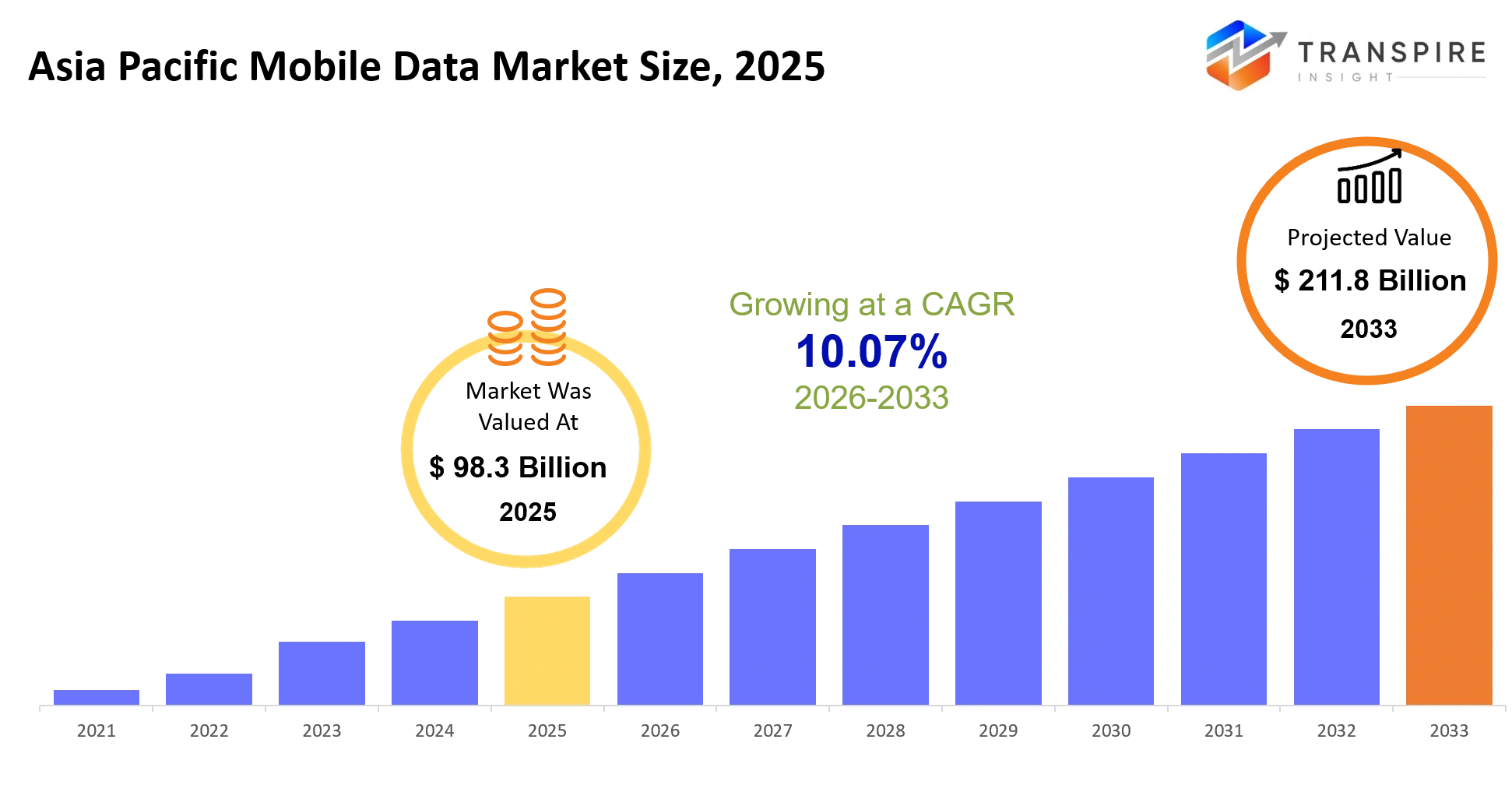
- Asia Pacific Mobile Data Market Size 2025: USD 98.3 Billion
- Asia Pacific Mobile Data Market Size 2033: USD 211.8 Billion
- Asia Pacific Mobile Data Market CAGR: 10.07%
- Asia Pacific Mobile Data Market Segments: By Network Type (2G, 3G, 4G LTE, 5G, Private Networks, Fixed Wireless Access, Satellite Mobile Networks, Others); By Device (Smartphones, Tablets, Laptops, IoT Devices, Wearables, Mobile Routers, Connected Vehicles, Others); By Service Type (Prepaid Data, Postpaid Data, Unlimited Plans, Enterprise Data, Roaming Services, Broadband Bundles, IoT Connectivity, Others); By Application (Video Streaming, Social Media, Online Gaming, Mobile Banking, E-Commerce, Remote Working, Education, Others); By End User (Consumers, Enterprises, SMEs, Government Organizations, Educational Institutions, Healthcare Providers, Industrial Users, Others).
Asia Pacific Mobile Data Market Summary
The Asia Pacific Mobile Data Market was valued at USD 98.3 Billion in 2025. It is forecast to reach USD 211.8 Billion by 2033. That is a CAGR of 10.07% over the period.
The Asia Pacific Mobile Data Market, lets consumers , businesses , and public institutions get to high speed internet via mobile networks , and in practice it supports digital chat, cloud workloads, video streaming, online trade, financial tools, plus industrial connectivity. So basically it’s become a key base for digital economies, where smartphones are often the main door to web services , for both city people and those in rural areas. Over the last five years the scene has changed quite a lot, from mostly 4G rollout to much bigger 5G deployment. That shift brings more bandwidth, better responsiveness , and connectivity that feels “enterprise-ready”. Then the COVID-19 pandemic came, and it pushed remote work, distance learning, telemedicine , and online commerce faster than before, and since then mobile data use stayed higher, like it never went back.
Meanwhile, telecom operators keep increasing network capacity, and governments are also backing digital infrastructure spend. As a result, traffic hungry services like AI apps, IoT ecosystems, and cloud gaming keep leaning harder on networks , which boosts network utilization. That ongoing climb in usage tends to feed premium data plans, business-grade connectivity packages, and more infrastructure investments, and this helps lock in steadier, long-term market revenue.
Key Market Insights
- East Asia kind of dominated the Asia Pacific Mobile Data Market at more than 46% market share in 2025, and you can see it from the advanced 5G coverage plus the high smartphone penetration.
- Southeast Asia ,on the other hand, should show the fastest growth through 2033, mostly because digital economies are expanding, affordable handsets are getting more common, and nationwide network upgrades keep rolling out.
- In 2025, consumer mobile broadband made up around 64% of market revenue, so it stayed as the top service line for most telecom operators in the region.
- Enterprise mobile connectivity was close behind as the second-largest segment, sitting at nearly 23% market share, and this is being pushed by cloud migration, plus hybrid workplace connectivity.
- Private 5G , along with industrial mobile data services, is expected to keep climbing at more than 15% per year through the forecast window, because manufacturing digitalization is just speeding up, like quite a lot.
- Meanwhile, smartphones ended up making close to 82% of all mobile data traffic in 2025, and IoT-connected devices kept taking a more visible share, notably for industrial scenarios.
- Telecom operators are also pushing monetization of the higher-tier 5G plans by bundling things like cloud gaming, AI powered offerings, and ultra-HD video streaming, so it feels more “premium” in practice.
- Firms such as China Mobile, NTT DOCOMO, SK Telecom, Singtel, Bharti Airtel and Reliance Jio keep reinforcing their edge through spectrum investments, network modernization , and AI-enabled traffic management.
- Strategic partnerships between telecom providers and cloud companies have helped edge computing roll out faster too , and that indirectly trims latency for enterprise applications across many key Asia Pacific economies.
- More recently, AI-driven network optimization, Open RAN rollouts, and energy-efficient base stations are turning up as the main tech story lines, lifting service quality while improving operational efficiency across the whole Asia Pacific Mobile Data Market.
What are the Key Drivers, Restraints, and Opportunities in the Asia Pacific Mobile Data Market?
The strongest growth driver is the fast commercialization of 5G networks, combined with government-backed digital infrastructure programs across China, India, Japan, South Korea and Southeast Asia. Telecom operators have put billions of dollars into spectrum acquisition fiber backhaul and next-generation base stations, which lets users consume more bandwidth-heavy services without running into network congestion. Also the quick take up of AI-powered applications, cloud computing, digital payments, video streaming and enterprise mobility has boosted the average mobile data use per subscriber quite a lot. This movement helps operators roll out premium service tiers and enterprise connectivity bundles, supporting higher ARPU while also opening up new business chances across consumer and industrial markets.
But even with rapid expansion, uneven network infrastructure is still the biggest structural hurdle. Remote and rural areas keep getting limited high-speed coverage, because fiber rollout , spectrum assignment, and tower construction demand heavy capital spending, with comparatively weaker financial returns. That infrastructure mismatch slows down advanced service adoption, constrains enterprise digital transformation beyond major cities and it also dampens the revenue potential from underserved zones. On top of that, spectrum expenses and regulatory complexity stretch deployment schedules, which creates stubborn barriers that can’t be fixed quickly.
The biggest future opening sits in enterprise digital transformation, enabled by private 5G networks, edge computing, and industrial IoT deployments. Manufacturing hubs across China, South Korea, Japan, and India are increasingly asking for secure.
What Has the Impact of Artificial Intelligence Been on the Asia Pacific Mobile Data Market?
Artificial intelligence has, kind of become a core technology for making mobile network operations better across much of the Asia Pacific region. Telecom companies are more and more putting AI algorithms in place, to automate traffic management, shuffle spectrum dynamically, and tune radio resources depending on what users are actually doing in real time. These kinds of systems keep an eye on network congestion, try to foresee capacity needs, and then automatically reroute traffic, which ends up boosting customer experience while also cutting down on day to day operational costs.
On top of that, machine learning models help with predictive maintenance too, because they can spot early signals of equipment wear in base stations, antennas, and transmission infrastructure, before the failures ever show up. AI driven analytics also make network planning more solid, by forecasting how mobile traffic will grow, pointing to better tower placements and generally improving spectrum utilization. Operators additionally use AI to curb energy consumption by automatically tweaking power levels when network activity is lower, so you get higher operational efficiency while lowering electricity expenses.
More advanced analytics have, at the same time, strengthened things like fraud detection, cybersecurity monitoring, customer behavior analysis, and personalized service recommendations. This helps telecom providers reduce churn, meaning subscriber loss, and it can also lift how many users adopt premium services. AI-assisted automation has even reduced fault resolution time and, overall, it tends to improve network availability.
Still, AI adoption isn’t completely smooth, there are practical limits. Bringing AI platforms into older telecom infrastructure can mean heavy capital spending and it demands technical know-how and expertise.
Key Market Trends
- Between 2022 and 2025, Commercial 5G subscriptions kind of expanded sharply, and by now multiple regional operators cover roughly 80% to 95% of city people.
- In several Asia Pacific countries, average monthly mobile data use has more than doubled since 2020, mostly because video streaming and cloud applications became pretty normal, like mainstream already.
- At the same time, telecom operators have increasingly redirected spending toward AI-enabled network automation , which in some deployments cut network tuning or optimization costs by about 20% to 30%.
- After 2023, Open RAN adoption also picked up pace, as operators chased more vendor latitude, lower infrastructure costs, and quicker network modernization cycles.
- Meanwhile cloud gaming , generative AI apps, and ultra-HD video streaming pushed premium 5G data plan adoption up a lot across developed regional markets.
- Companies like Reliance Jio, China Mobile, SK Telecom, NTT DOCOMO, and Singtel started widening strategic tie ups with major hyperscale cloud providers, basically trying to give their edge computing muscle a boost.
- And then Private 5G deployments moved in more often, kind of replacing the usual enterprise Wi‑Fi, especially in manufacturing, logistics, and mining, where secure connections and low delay are the whole point.
- On top of that energy efficient networking equipment became a stronger procurement target , because telecom operators wanted to shrink operating costs and also keep their sustainability promises on track.
- Meanwhile Fixed Wireless Access really gained momentum after 2023, helping operators extend broadband coverage without having to roll out massive fiber builds across underserved neighborhoods.
- Finally, telecom firms started differentiating services through AI-powered customer analytics, personalized digital experiences, and integrated cloud connectivity, rather than competing mainly on price, and that shift is showing up more often in market positioning.
Asia Pacific Mobile Data Market Segmentation
By Network Type
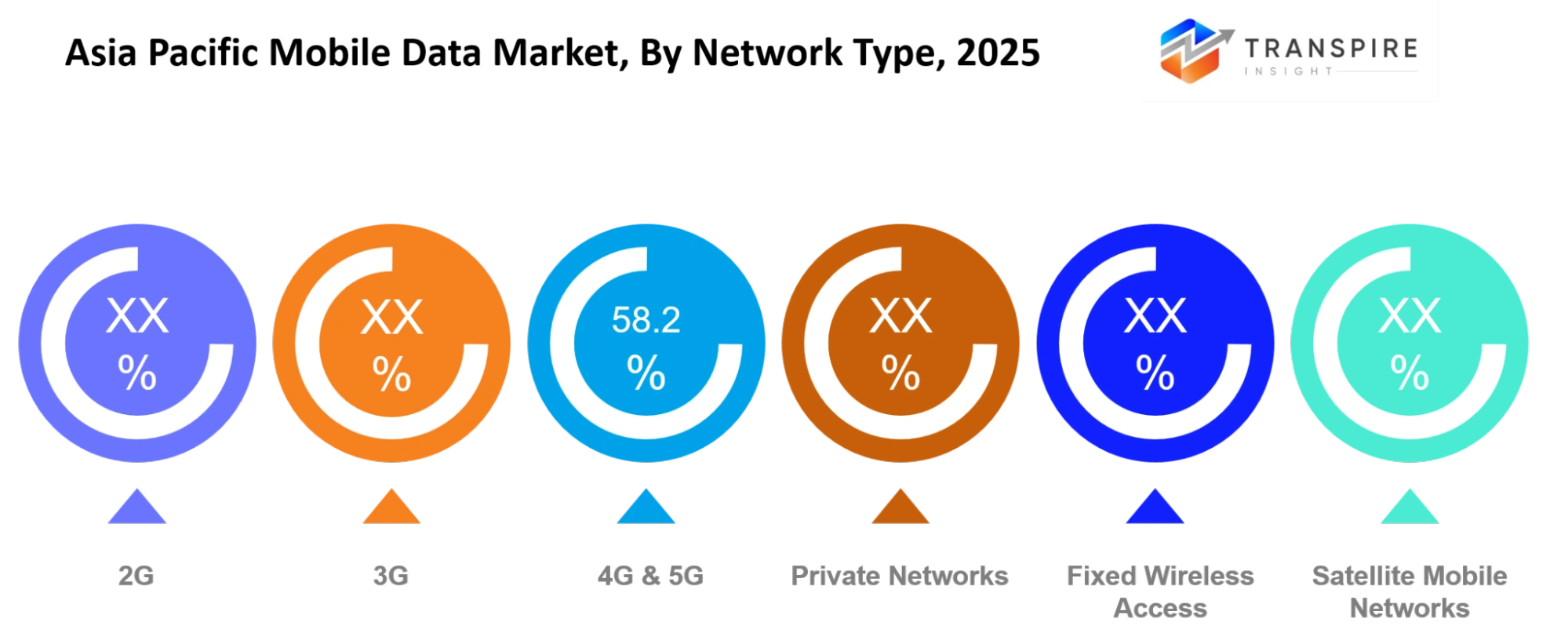
Network type kind of becomes the base layer for mobile connectivity across the Asia Pacific region, and yeah it matters a lot. 2G keeps running the more basic stuff, voice calls, text messaging, and even those simple machine-to-machine links where the older infrastructure is still active. 3G is still there too, offering essential internet access in a few selected markets, but the slow network shutdown programs are steadily pushing people over to faster options, bit by bit. 4G LTE stays the biggest network category because it has wide reach, steady performance, and affordable smartphones which means video streaming , digital payments, online shopping, and day-to-day business communication can work well in both cities and countryside.
Meanwhile 5G keeps rolling out , driven by major investments in spectrum and network infrastructure, so it can deliver high speed connectivity for newer consumer services and also enterprise use. Private Networks work for manufacturing, logistics, mining, and smart factory operations where they really need secure, dedicated wireless communication. Fixed Wireless Access gives broadband where fiber deployment is still limited, and Satellite Mobile Networks help extend connectivity across far flung places like remote areas, islands, and regions affected by disasters. Others include emerging wireless methods and specialized connectivity options, aimed at unusual commercial or industrial needs, things that don’t fit the standard playbook.
By Device
Device adoption keeps shaping mobile data use all over the Asia Pacific region , kind of steadily, you know. Smartphones still end up taking the largest portion of traffic , mostly because daily contact , digital payments, video streaming , navigation, and social networking all lean hard on mobile internet access. Tablets help with education, healthcare, and business tasks by giving bigger screens plus that portable connectivity thing. Laptops are still a big deal too, especially for remote work, cloud computing, and enterprise collaboration , they fit where a “real” workstation vibe is needed. And then IoT Devices keep expanding across manufacturing , transportation, utilities, and smart city initiatives, mainly by allowing ongoing machine-to-machine talk and real-time data exchange.
Wearables end up boosting health monitoring, fitness tracking, and lifestyle connected features via constant mobile synchronization. Mobile Routers provide internet access for groups of users and different business operations where fixed broadband is missing , or when temporary connectivity becomes necessary . Connected Vehicles also lean on mobile networks for navigation, fleet management, remote diagnostics, safety services, and infotainment functions, which in turn improve transportation efficiency. Others show up as well , like emerging connected equipment and specialized wireless devices, supporting industrial automation, commercial day-to-day work, and the future requirements of digital communication.
By Service Type
Service type kind of steers how customers spend their money, and also affects network usage across different mobile connectivity services. Prepaid Data is still the most common choice, mostly because recharge is flexible, the prices feel manageable, and there’s no long-term agreement, which works well for price sensitive people. Postpaid Data pulls in customers who want uninterrupted connectivity, bigger data amounts, and extra digital features through monthly billing plans. It's steady and less hassle for them. Unlimited Plans keep getting more traction as video streaming, cloud tools, and online gaming eat up more data, but people don't want to worry about usage limits.
Enterprise Data is used for secure business messaging, cloud access, remote team operations, and even connected industrial applications across several industries. Roaming Services help maintain connectivity for business travelers, tourists, and international professionals who move between countries, but still within the region. Broadband Bundles mix mobile plus home internet, so customers see more value and adopt services faster. IoT Connectivity covers connected sensors, smart devices, logistics tracking, and industrial automation using dedicated mobile networks. Others basically includes specialized data services that are built for niche needs, like commercial, government, and public sector requirements.
By Application
Application areas still kind of shape how mobile data gets used, both in consumer life and business settings too. For example, Video Streaming grabs the biggest part of the network traffic because high-definition shows, live broadcasts, and on-demand entertainment all need steady, fast connectivity. Social Media keeps users connected in a loop via content sharing, messaging, and real-time interactions, and Online Gaming leans on low-latency networks, so multiplayer sessions feel smoother. Meanwhile Mobile Banking and E-Commerce keep growing as secure digital transactions, online shopping, and financial services become a normal thing in everyday work and personal routines.
Remote Working also matters here , since it depends on virtual meetings, cloud-based teamwork, and protected access to business tools across different locations. Education takes mobile connectivity for virtual classrooms, digital learning platforms, online evaluations and educational materials, all of which improve access to learning resources. Then there are Others like telemedicine, smart agriculture, digital public services, location-aware applications, and new AI-driven mobile ideas that will likely open fresh doors for service providers and technology firms in the next few years.
By End User
End-user demand still seems to steer mobile data adoption across a bunch of sectors. Most of the pull comes from consumers, since everyday routines like communication, video streaming, digital payments , online shopping, and social networking require steady mobile connectivity. Enterprises, for their part, lean on advanced mobile services to back cloud applications, mobile workforce movement, cybersecurity work, and real-time business activities, kind of all at once. SMEs keep pushing ahead too, using reasonably priced mobile broadband to grow their digital operations so they can improve customer interaction, online sales, and smoother communication, without making huge infrastructure investments.
Government Organizations also tap into mobile networks to bolster public services , handle emergency communications and drive digital governance programs. Educational Institutions rely on them for virtual classes, online collaboration, and the sharing of digital learning resources across schools , colleges and universities. Healthcare Providers depend on reliable and secure mobile connectivity for telemedicine, electronic health records, and remote monitoring of patients. Industrial Users connect mobile networks with automation, predictive upkeep, and related connected machinery to boost operational effectiveness, while Others cover transportation, utilities, financial services, hospitality, and media organizations using more specialized wireless connectivity for specific operational demands.
What are the Key Use Cases Driving the Asia Pacific Mobile Data Market?
Consumer mobile broadband stays the main use case across the Asia Pacific Mobile Data Market, and yes, smartphones keep taking the biggest chunk of network traffic. People stream video, scroll social media, use mobile payments, lean on cloud storage, and generally consume digital entertainment, so bandwidth gets eaten pretty fast. Affordable 5G plans, plus more widespread smartphone ownership, keeps pushing average data usage per subscriber higher, bit by bit. Together this tends to produce the best revenue outcomes for telecom operators, and it also keeps funding those ongoing network investments, not just promises.
On the other hand enterprise mobility and industrial connectivity are growing pretty quickly across manufacturing, logistics, healthcare, and financial services. Companies increasingly lean on secure mobile networks for cloud apps and remote team collaboration, plus AI-enabled analytics. They also connect a lot of IoT devices, so mobile connectivity becomes something closer to a utility. Retailers and financial institutions are doing similar things too, using mobile data platforms for digital payments, customer engagement, and real time transaction processing across locations that are more spread out.
Then there are the newer kinds of applications coming in, like private 5G networks for smart factories, autonomous warehouse operations, and connected ports, which sounds niche but it’s getting attention. Satellite-enabled direct to device communication, along with edge computing services, is also catching interest, especially in remote industrial areas and in disaster recovery moments. In those cases uninterrupted mobile connectivity becomes strategic operational value , because downtime can be a real problem.
|
Report Metrics |
Details |
|
Market size value in 2025 |
USD 98.3 Billion |
|
Market size value in 2026 |
USD 108.2 Billion |
|
Revenue forecast in 2033 |
USD 211.8 Billion |
|
Growth rate |
CAGR of 10.07% from 2026 to 2033 |
|
Base year |
2025 |
|
Historical data |
2021 - 2024 |
|
Forecast period |
2026 - 2033 |
|
Report coverage |
Revenue forecast, competitive landscape, growth factors, and trends |
|
Regional scope |
United States; Canada; Mexico; United Kingdom; Germany; France; Italy; Spain; Denmark; Sweden; Norway; China; Japan; India; Australia; South Korea; Thailand; Brazil; Argentina; South Africa; Saudi Arabia; United Arab Emirates |
|
Key company profiled |
China Mobile, China Telecom, China Unicom, Reliance Jio, Bharti Airtel, NTT Docomo, SoftBank, SK Telecom, KT Corporation, Singtel, Telstra, AIS, Globe Telecom, Indosat Ooredoo Hutchison, Maxis. |
|
Customization scope |
Free report customization (country, regional & segment scope). Avail customized purchase options to meet your exact research needs. |
|
Report Segmentation |
By Network Type (2G, 3G, 4G LTE, 5G, Private Networks, Fixed Wireless Access, Satellite Mobile Networks, Others); By Device (Smartphones, Tablets, Laptops, IoT Devices, Wearables, Mobile Routers, Connected Vehicles, Others); By Service Type (Prepaid Data, Postpaid Data, Unlimited Plans, Enterprise Data, Roaming Services, Broadband Bundles, IoT Connectivity, Others); By Application (Video Streaming, Social Media, Online Gaming, Mobile Banking, E-Commerce, Remote Working, Education, Others); By End User (Consumers, Enterprises, SMEs, Government Organizations, Educational Institutions, Healthcare Providers, Industrial Users, Others). |
Which Regions are Driving the Asia Pacific Mobile Data Market Growth?
East Asia still feels like the dominant regional market, largely because its telecommunications setup is already pretty well developed, there’s broad 5G availability , and the government keeps backing digital transformation. China Japan, and South Korea keep putting significant effort into spectrum allocation, fiber backhaul, and AI driven network tuning. Also, high smartphone adoption rates along with mature enterprise digital ecosystems keep the whole thing supported, so mobile data use stays substantial. On top of that, you get globally competitive telecom operators and equipment suppliers, which sort of locks in the regional leadership, too.
South Asia keeps adding steady momentum mainly because it has a huge subscriber pool and a cost efficient mobile connectivity framework. But unlike East Asia, the growth pattern here relies more on adding new users , plus keeping data prices within reach, and extending networks nationwide rather than depending on premium digital services. India is still pushing further 5G coverage while telecom providers improve rural connectivity and widen enterprise offerings. That mix—population scale, regulatory help , and continuous infrastructure spending—should keep revenue more stable over the long haul.
Southeast Asia is projected to be the fastest growing region through 2033, as governments push harder on digital economy plans and operators modernize their older mobile networks. Indonesia, Vietnam, the Philippines, and Thailand are, in particular, investing in fresh spectrum, fiber infrastructure, and smart city programs that raise mobile broadband activity. At the same time, digital commerce expansion, cloud take up, and industrial digitalization are opening up chances for more advanced connectivity offerings. So the region is becoming more appealing not just for telecom equipment vendors, but also for infrastructure investors and cloud service providers, all looking for long term expansion.
Who are the Key Players in the Asia Pacific Mobile Data Market and How Do They Compete?
Competition in the Asia Pacific mobile data market is still pretty moderately consolidated , with the national telecom operators holding most of the subscribers but also moving fast against each other using network quality, spectrum assets, digital ecosystems, and enterprise services rather than just chasing price . With 5G being commercialized so quickly , the real rivalry has started to tilt toward AI based network management, cloud tie ins, private wireless networks, and bundled digital services , which in turn help retention and lift average revenue per user.
China Mobile stands out because it has the world’s largest 5G subscriber base plus very extensive nationwide infrastructure , and it keeps leaning into large scale AI rollouts to optimize the network . The company keeps putting money into cloud computing , industrial internet platforms , and smart city connectivity , all of that mainly to strengthen enterprise revenue streams. Reliance Jio plays a different card, it pushes rapid nationwide 5G roll out, builds affordable digital ecosystems, and offers integrated packages that blend broadband, cloud services , entertainment, and enterprise connectivity . On top of that, its AI platforms and fixed wireless access effort keeps pushing its competitive position across both consumer and business spaces.
NTT Docomo tries to win through tech innovation , bringing satellite direct to device connectivity, working around Open RAN approaches, and shipping advanced enterprise mobility solutions that make the network more resilient. SK Telecom meanwhile differentiates with AI native telecommunications, edge computing, and intelligent network automation , mainly to enable industrial digital transformation .
Company List
- China Mobile
- China Telecom
- China Unicom
- Reliance Jio
- Bharti Airtel
- NTT Docomo
- SoftBank
- SK Telecom
- KT Corporation
- Singtel
- Telstra
- AIS
- Globe Telecom
- Indosat Ooredoo Hutchison
- Maxis
Recent Development News
In April 2026, NTT Docomo launched its enterprise-focused satellite direct-to-device mobile communication service in partnership with SpaceX Starlink. The service extends LTE connectivity to remote and disaster-affected areas, strengthening next-generation mobile coverage and enterprise resilience.
Source: http://www.telecomtv.com/content/access-evolution/spark-ntt-docomo-announce-d2d-services-55242/ (TelecomTV).
In February 2026, NTT Docomo announced the rollout of satellite direct-to-smartphone services using Starlink technology. The initiative expands mobile data availability in mountainous regions, remote islands, and offshore locations without requiring dedicated devices.
Source: http://www.lightreading.com
In October 2025, Reliance Jio entered a strategic partnership with Google to provide Gemini AI Pro capabilities to eligible subscribers. The collaboration enhances AI-powered digital services, strengthens premium mobile offerings, and increases the value of high-speed mobile data connectivity.
Source: http://www.mobileworldlive.com
What Strategic Insights Define the Future of the Asia Pacific Mobile Data Market?
The Asia Pacific Mobile Data Market is moving into a period where revenue growth is depending more on higher-value digital connectivity rather than just adding more subscribers, and honestly that’s where the real shift is happening. Over the next five to seven years the whole structural move toward AI applications, private 5G networks, edge computing , satellite-enabled communications, and enterprise digital transformation will sort of flip operator business models on their head.
Still, there is this underappreciated risk, like the growing concentration of capital expenditure going into spectrum acquisition and advanced network infrastructure, and that could end up widening the competitive gap between the big national players and the smaller providers. Meanwhile, there’s an opportunity that seems overlooked—satellite direct-to-device services along with AI-managed private wireless networks aimed at manufacturing, mining, logistics, and remote infrastructure across Southeast Asia and South Asia.
Market participants should really put more weight on partnerships that cover cloud computing, AI platforms, satellite communications, and industrial automation, not only leaning on consumer mobile broadband. Integrated digital ecosystems are expected to deliver the most durable long-term competitive advantage, even if the transition feels slow at first.
Asia Pacific Mobile Data Market Report Segmentation
By Network Type
- 2G
- 3G
- 4G LTE
- 5G
- Private Networks
- Fixed Wireless Access
- Satellite Mobile Networks
- Others
By Device
- Smartphones
- Tablets
- Laptops
- IoT Devices
- Wearables
- Mobile Routers
- Connected Vehicles
- Others
By Service Type
- Prepaid Data
- Postpaid Data
- Unlimited Plans
- Enterprise Data
- Roaming Services
- Broadband Bundles
- IoT Connectivity
- Others
By Application
- Video Streaming
- Social Media
- Online Gaming
- Mobile Banking
- E-Commerce
- Remote Working
- Education
- Others
By End User
- Consumers
- Enterprises
- SMEs
- Government Organizations
- Educational Institutions
- Healthcare Provider
- Industrial Users
- Others
Frequently Asked Questions
Find quick answers to common questions.
The expected Asia Pacific Mobile Data Market size for the market will be USD 211.8 Billion in 2033.
Key segments for the Asia Pacific Mobile Data Market are By Network Type (2G, 3G, 4G LTE, 5G, Private Networks, Fixed Wireless Access, Satellite Mobile Networks, Others); By Device (Smartphones, Tablets, Laptops, IoT Devices, Wearables, Mobile Routers, Connected Vehicles, Others); By Service Type (Prepaid Data, Postpaid Data, Unlimited Plans, Enterprise Data, Roaming Services, Broadband Bundles, IoT Connectivity, Others); By Application (Video Streaming, Social Media, Online Gaming, Mobile Banking, E-Commerce, Remote Working, Education, Others); By End User (Consumers, Enterprises, SMEs, Government Organizations, Educational Institutions, Healthcare Providers, Industrial Users, Others).
Major Asia Pacific Mobile Data Market players are China Mobile, China Telecom, China Unicom, Reliance Jio, Bharti Airtel, NTT Docomo, SoftBank, SK Telecom, KT Corporation, Singtel, Telstra, AIS, Globe Telecom, Indosat Ooredoo Hutchison, Maxis.
The Asia Pacific Mobile Data Market size is USD 98.3 Billion in 2025.
The Asia Pacific Mobile Data Market CAGR is 10.07% from 2026 to 2033.
- China Mobile
- China Telecom
- China Unicom
- Reliance Jio
- Bharti Airtel
- NTT Docomo
- SoftBank
- SK Telecom
- KT Corporation
- Singtel
- Telstra
- AIS
- Globe Telecom
- Indosat Ooredoo Hutchison
- Maxis
About the Authors

Mayur Shinde
I am Mayur Shinde, a Senior Research Analyst at Transpire Insight, specializing in the Automotive & Transportation and Information & Communication Technology (ICT) Industry. My work focuses on analyzing emerging market trends, technological advancements, competitive landscapes, and industry developments to deliver accurate, data-driven insights. I am passionate about transforming complex market information into clear, actionable content that helps businesses, professionals, and decision-makers stay informed and make confident strategic decisions.

Chakradhar Khansole
Chakradhar serves as the Research Director at Transpire Insight, bringing over 8 years of experience in technology, innovation, and strategic market intelligence. He specializes in transforming complex market data into actionable business insights that enable organizations to make informed, growth-oriented decisions. Recognized for his strategic vision and analytical expertise, Chakradhar leads high-impact research initiatives, delivering comprehensive market assessments, competitive intelligence, and forward-looking industry analysis.
Recently Published Reports
-
Apr 2026
3D Optical Profiler Market
3D Optical Profiler Market Size, Share & Analysis Report By Type (Desktop 3D Optical Profiler, and Portable 3D Optical Profiler), By Technology (Confocal Technology, and White Light Interference), By End-Use Industry (Manufacturing, Research Institutions, Automotive, Aerospace and Defense, Medical Devices, and Other), and Geography (North America, Europe, Asia-Pacific, Middle East and Africa, South and Central America), 2021 - 2031
-
Apr 2026
Depth Sensor Market
Depth Sensor Market Size, Share & Analysis Report By Type (Infrared Depth Sensors, Time-of-Flight (ToF) Sensors, Stereo Vision Sensors, Structured Light Sensors, Ultrasonic Depth Sensors), By Application (Automotive, Robotics, Gaming, Consumer Electronics, Industrial Automation, Healthcare, Security & Surveillance, Others), By End Users (Automotive Manufacturers, Consumer Electronics Companies, Healthcare Providers, Industrial Companies, Security Agencies, Gaming Companies, Robotics Companies, Others), and Geography (North America, Europe, Asia-Pacific, Middle East and Africa, South and Central America), 2021 – 2031
-
Apr 2026
Digital Manufacturing Market
Digital Manufacturing Market Size, Share & Analysis Report By Component (Hardware, Software, and Services), By Technology (Robotics, 3D Printing, Internet of Things (IoT), and Others), By Application (Automotive and Transportation, Aerospace and Defense, Consumer Electronics, Industrial Machinery, and Others), By Process Type (Computer-Based Designing, Computer-Based Simulation, Computer 3D Visualization, Analytics, and Others), and Geography (North America, Europe, Asia-Pacific, Middle East and Africa, South and Central America), 2021 – 2031
-
Apr 2026
Digital Visa Services Market
Digital Visa Services Market Size, Share & Analysis Report By Type (Individual Travelers, Group Travelers), By Application (Tourism, Business Travel, Others), and Geography (North America, Europe, Asia-Pacific, Middle East and Africa, South and Central America), 2021 – 2031