
Asia Pacific Isobutene Market Size & Forecast:
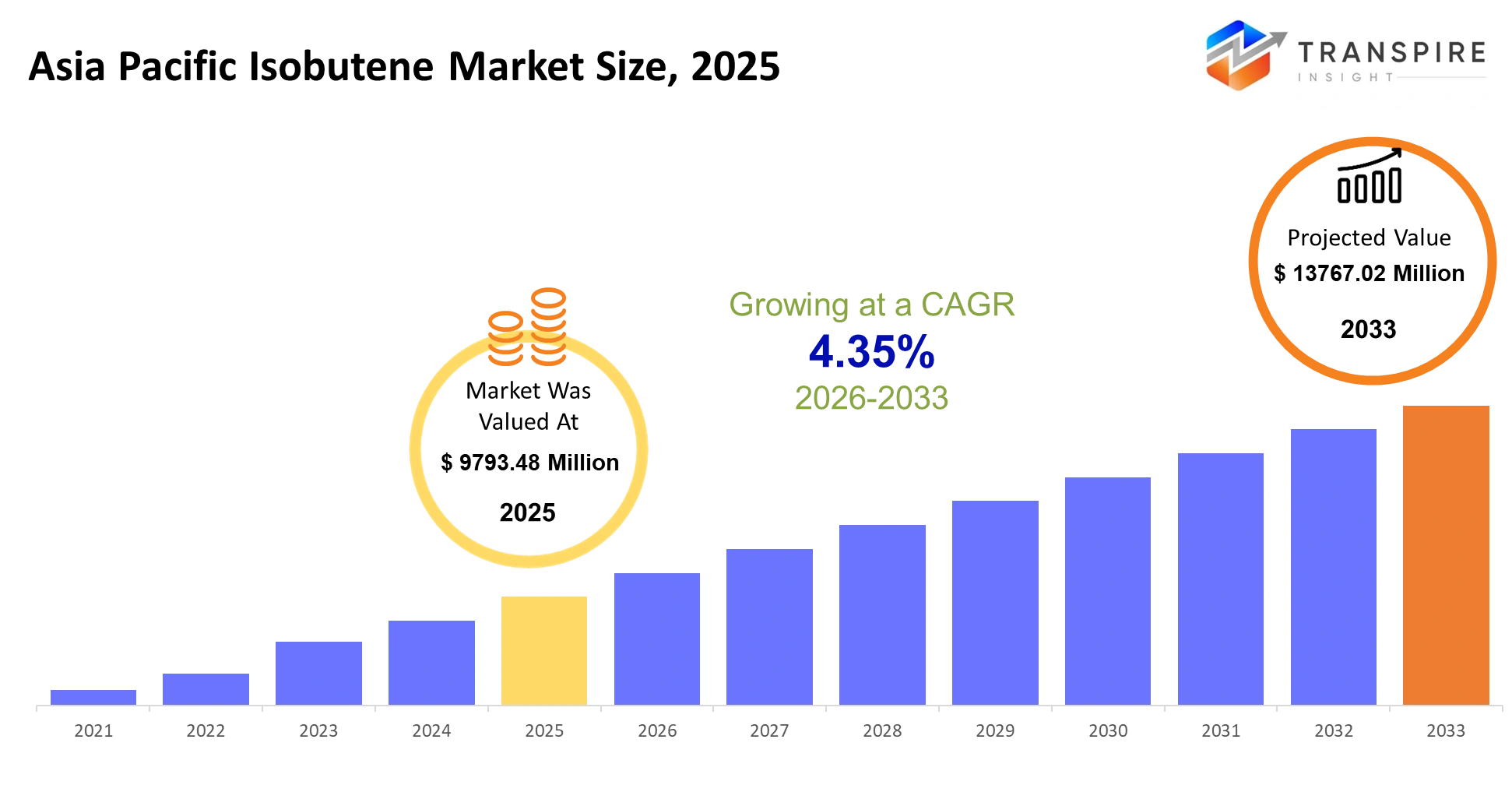
- Asia Pacific Isobutene Market Size 2025: USD 9793.48 Million
- Asia Pacific Isobutene Market Size 2033: USD 13767.02 Million
- Asia Pacific Isobutene Market CAGR: 4.35%
- Asia Pacific Isobutene Market Segments: By Type (Bio-based Isobutene, Synthetic Isobutene, High-purity, Low-purity, Blended, Others); By Application (Fuel Additives, Butyl Rubber, Polyisobutylene, Lubricants, Chemicals, Others); By End-User (Automotive, Chemical, Energy, Industrial, Manufacturing, Others); By Form (Gas, Liquid, Compressed, Bulk, Packaged, Others)
To learn more about this report,  Download Free Sample Report
Asia Pacific Isobutene Market Summary:
The Asia Pacific Isobutene Market size is estimated at USD 9793.48 Million in 2025 and is anticipated to reach USD 13767.02 Million by 2033, growing at a CAGR of 4.35% from 2026 to 2033.
The petrochemical industry will use the Asia Pacific isobutene market as a vital component for C4 hydrocarbon production and its accompanying chemical processing operations. The Asia Pacific isobutene market will maintain its support for fuel additives and synthetic rubber and chemical intermediates because industrial demand patterns will change across various regional manufacturing centers. Refineries will adjust their production priorities based on growing consumer demand for clean fuels and advanced materials while environmental regulations will establish their operational standards. Producers will control their supply stability through technological improvements that increase separation and processing efficiency and maintain steady output levels. The Asia Pacific isobutene market will show changing trade patterns that exist between China and India and Japan and South Korea because these countries will undergo industrial growth and infrastructure development while their future consumption patterns will change.
What Has the Impact of Artificial Intelligence Been on the Asia Pacific Isobutene Market?
Artificial intelligence is transforming how petrochemical companies make decisions because it boosts their operational productivity while improving their ability to forecast outcomes which creates significant changes in the Asia Pacific Isobutene Market. AI in Asia Pacific Isobutene Market operations is increasingly used to process large datasets from refining units, pricing movements, and demand cycles. Artificial intelligence in Asia Pacific Isobutene Market analysis improves market research accuracy by identifying consumption patterns in fuel additives, synthetic rubber, and chemical intermediates. Machine learning models help producers understand short-term disruptions better which enables them to respond faster to feedstock volatility and production changes.
The Asia Pacific Isobutene Market gains major advantages from predictive analytics tools which improve demand forecasting accuracy while decreasing supply-demand mismatches in the market. Smart automation systems are improving refinery operations by optimizing cracking efficiency and reducing energy loss, which directly improves output stability. AI in Asia Pacific Isobutene Market supply chain management helps companies reduce logistics delays while improving their inventory control and operational costs throughout their distribution networks. These advancements allow producers to strengthen profitability while maintaining consistent product quality across varying industrial conditions.
Asian companies develop their Isobutene Market strategies through artificial intelligence technologies which provide them with dynamic pricing data and predictive modeling tools. Market trends indicate increasing use of AI-driven platforms to optimize production planning and identify high-growth application segments such as fuel additives and butyl rubber. The Asia Pacific Isobutene Market will achieve better efficiency and innovation through AI adoption which will also support sustainable development while improving regional competitiveness and industrial decision-making.
Key Market Trends & Insights:
- The Asia Pacific Isobutene Market keeps growing because petrochemical companies combine their operations, which lets China control 35 to 40 percent of the market by 2025 because of its extensive refining capacity and high demand from its industrial activities.
- Indian automotive sector growth together with increasing chemical production capacity will drive its development between 2025 and 2030, making India the most rapidly expanding region for isobutene in Asia Pacific.
- The Asia Pacific Isobutene Market shows synthetic isobutene as its main product because it controls more than 60 percent of the market through steam cracking and refinery-based production systems that operate in China South Korea and Japan.
- The Asia Pacific isobutene market identifies high-purity isobutene as the second most important market segment because industrial centers need this chemical for their specialty chemicals and fuel additive production.
- Developed Asia Pacific economies show high demand for bio-based isobutene because organizations implement sustainability projects while they shift toward environmentally friendly chemical solutions.
- Butyl rubber leads the Asia Pacific Isobutene Market as its main application because it holds between 30 and 35 percent of the market share, which results from tire manufacturers who supply the automotive industry.
- The application segment for fuel additives will experience the highest growth because emission regulations become more stringent while people seek technologies that enable cleaner combustion.
- The automotive sector leads demand from end users who make up over 40 percent of the Asia Pacific isobutene market because vehicle production increases and tire replacement cycles become more frequent.
- The chemical manufacturing sector represents the second largest end-user segment as industrial facilities in Asia Pacific require intermediates and coatings and polymer production.
- The Asia Pacific Isobutene Market expands strategically through capacity upgrades and refinery integration and partnerships which aim to improve operational efficiency.
Asia Pacific Isobutene Market Segmentation
By Type:
The Asia Pacific Isobutene Market consists of two main product categories which include Bio-based isobutene and Synthetic isobutene. Bio-based isobutene will attract more attention from chemical industries because it helps them achieve their sustainability targets. Synthetic isobutene remains the dominant form due to established refining and cracking processes. The advanced applications require high-purity grades but low-purity and blended types enable cost-sensitive industrial operations throughout the Asia Pacific Isobutene Market.
The Asia Pacific Isobutene Market uses synthetic petrochemical plant output as its main production source which provides reliable material for downstream users. The current bio-based options will grow in availability because green chemical policies continue to develop. Organizations need blended grades to create products which match their specific manufacturing requirements while they experience rising demand for high-purity materials used in unique applications.
By Application:
The field of fuel additives functions as the primary application area which helps achieve better combustion results and effective emission control methods. Butyl rubber usage will stay strong due to demand in automotive and tire manufacturing. Polyisobutylene serves its purpose in lubricants and adhesives while industrial production processes in the Asia Pacific Isobutene Market
The Asia Pacific Isobutene Market is driven by rising automotive sales and industrial sector development. The energy requirements of the market will maintain constant fuel consumption levels while rubber manufacturing will support the expansion of tire production operations. The region will continue to experience demand for lubricants and chemical intermediates as industrial operations and manufacturing activities grow.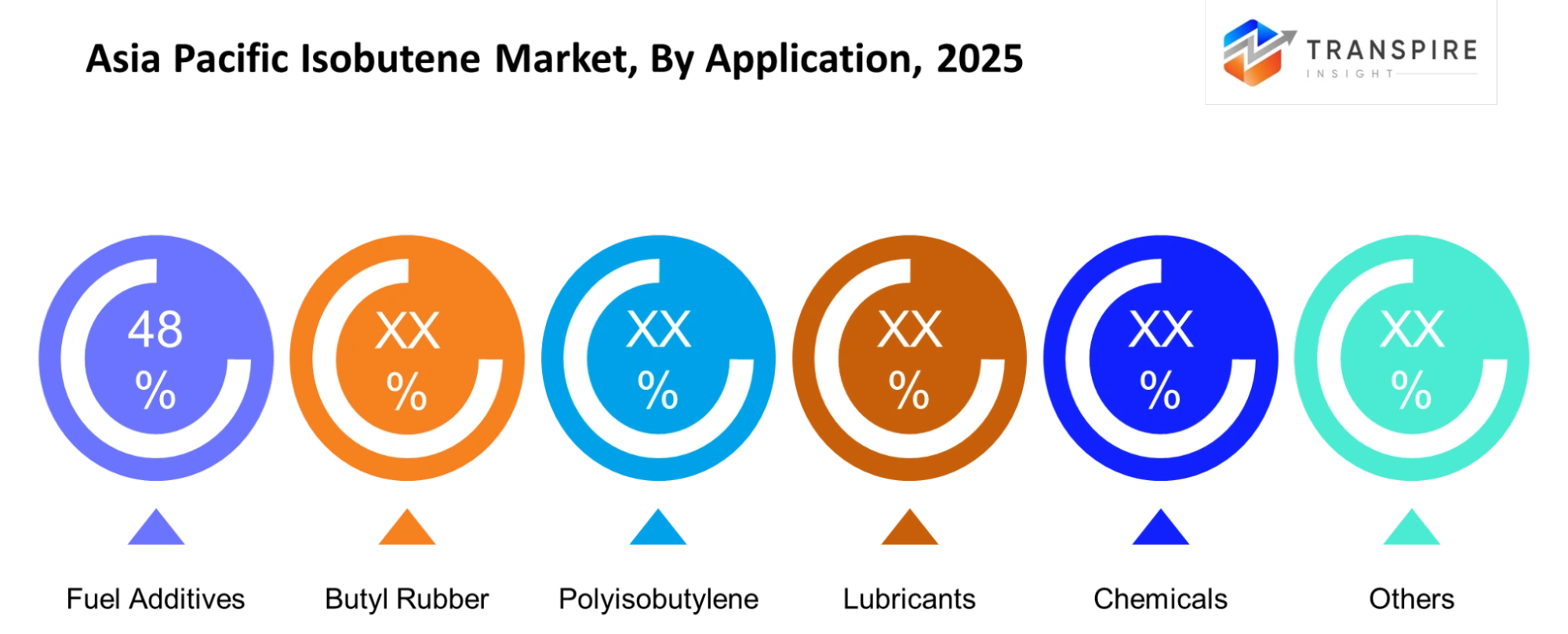
To learn more about this report, Download Free Sample Report
By End-User:
The automotive sector functions as the primary market for isobutene because it supplies materials needed for tire production and fuel efficiency testing. The chemical industry requires isobutene for various synthesis operations. The energy sector requires materials for refining and fuel blending while industrial and manufacturing sectors create widespread demand for materials and coatings and chemical processing operations.
Industrial growth and vehicle production rates determine end-user demand for the Asia Pacific Isobutene Market. Automotive usage will continue to dominate due to rubber and additive requirements. The chemical and energy sectors will show stable consumption patterns while manufacturing industries will create various uses which will result in equal demand from different industrial sectors.
By Form:
Gas form is the primary method for processing and refining because it enables operators to handle the material safely in controlled environments. The liquid state of materials enables efficient storage and transportation operations. The Asia Pacific Isobutene Market uses compressed isobutene because it maximizes storage space, while different facilities use bulk and packaged formats to meet their specific industrial scale needs.
The Asia Pacific Isobutene Market uses form-based distribution methods that depend on the existing storage facilities and the required transportation systems. The operational efficiency of gas and liquid forms will maintain their dominance in large-scale petrochemical plants. Industrial logistics operations use compressed and bulk handling systems, while packaged products provide smaller customers with multiple supply choices that can serve different industries and markets.
What are the Main Challenges for the Asia Pacific Isobutene Market Growth?
The Asia Pacific Isobutene Market faces operational and technical challenges due to feedstock fluctuations, the process's high sensitivity, and the need to separate C4 hydrocarbon streams. The refining and steam cracking units, which produce Isobutene face production risks because crude oil prices and operational disturbances affect their output. The Asia Pacific Isobutene Market struggles to maintain constant purity levels because different countries operate their refineries with distinct configurations which leads to different supply capabilities and limits petrochemical system expansion.
The Asia Pacific Isobutene Market faces manufacturing and commercialization challenges because of its high capital demands and strict environmental regulations and increasing operational expenditures.
The Asia Pacific Isobutene Market in emerging economies faces challenges because adoption and infrastructure development take time to advance. The organization experiences decreased production capacity and distribution capabilities because it lacks access to advanced processing technology, has insufficient skilled workers and operates with limited logistics infrastructure.
The Asia Pacific Isobutene Market faces growing competition and emerging risks as rubber and fuel applications increasingly use alternative chemical pathways and substitution materials. Mid-scale producers face margin pressures because large integrated petrochemical companies use pricing strategies to control the market. The combination of rapid technological advancements and environmental regulations creates market boundary conditions which require businesses to develop new strategies for staying competitive in their industries.
Regional Insights
The Asia Pacific Isobutene Market demonstrates growing petrochemical demand which results in increased isobutene utilization for fuel additives and synthetic rubber and chemical production. The combination of rising refining operations and C4 stream distributions will establish secure supply conditions. The industrial growth in China and India and Southeast Asian countries will transform both production and consumption trends throughout the entire region.
The market conditions demonstrate continuous changes because feedstock availability and pricing patterns undergo frequent alterations which depend on crude oil price fluctuations. The producers work to enhance their cracking and separation operational efficiency which will enable them to achieve superior output results. The automotive and manufacturing sectors create strong demand which will drive long-term consumption while integrated complexes will establish equilibrium through their capacity expansions.
The Asia Pacific isobutene supply chain depends on China because of its extensive refining and petrochemical facilities. The domestic market exhibits strong demand for plastics and synthetic rubber which results in continuous product consumption. The industrial production and transportation requirements of India drive increasing plastic consumption while Southeast Asia experiences petrochemical growth through its export-driven activities.
The production capacity of Japan and South Korea remains constant because advanced technologies and effective processing systems support their operations. The countries produce high-value chemicals while maintaining their product quality across different production batches. Australia provides industrial applications with steady demand which occurs at a limited level. The region shows strong interconnectedness between feedstock supply networks and manufacturing operations.
Recent Development News
In January 2026, ASP Isotopes announced acquisition. ASP Isotopes completed its acquisition of Renergen Limited to strengthen its position in gas-based critical materials, integrating natural gas and helium assets that are part of the broader petrochemical feedstock ecosystem supporting derivatives like isobutene.https://www.indianchemicalnews.com
In March 2026, TotalEnergies reported acquisition-related portfolio expansion. TotalEnergies highlighted continued integration of acquired petrochemical and refining assets in its 2025–2026 financial filing, reinforcing its downstream hydrocarbons portfolio that includes C4 streams used in isobutene production across Asia-Pacific operations.https://totalenergies.com
|
Report Metrics |
Details |
|
Market size value in 2025 |
USD 9793.48 Million |
|
Market size value in 2026 |
USD 10218.91 Million |
|
Revenue forecast in 2033 |
USD 13767.02 Million |
|
Growth rate |
CAGR of 4.35% from 2026 to 2033 |
|
Base year |
2025 |
|
Historical data |
2021 - 2024 |
|
Forecast period |
2026 - 2033 |
|
Report coverage |
Revenue forecast, competitive landscape, growth factors, and trends |
|
Regional scope |
Asia Pacific (China, India, Japan, South Korea, Australia, Rest of Asia Pacific) |
|
Key company profiled |
BASF, ExxonMobil, LyondellBasell, Evonik, INEOS, TPC Group, Chevron Phillips, Sumitomo Chemical, Sinopec, Reliance Industries, Shell, SABIC, Dow, Mitsui Chemicals, Arkema |
|
Customization scope |
Free report customization (country, regional & segment scope). Avail customized purchase options to meet your exact research needs. |
|
Report Segmentation |
By Type (Bio-based Isobutene, Synthetic Isobutene, High-purity, Low-purity, Blended, Others); By Application (Fuel Additives, Butyl Rubber, Polyisobutylene, Lubricants, Chemicals, Others); By End-User (Automotive, Chemical, Energy, Industrial, Manufacturing, Others); By Form (Gas, Liquid, Compressed, Bulk, Packaged, Others) |
How Can New Companies Establish a Strong Foothold in the Asia Pacific Isobutene Market?
New companies entering Asia Pacific isobutene market must focus on niche applications like high-purity feedstock for specialty chemicals and fuel additives. The Asia Pacific isobutene market experiences growth because refineries upgrade their equipment while the automotive and industrial sectors increase their product demand. New entrants will achieve initial success by developing healthcare-grade derivatives and low-emission fuel solutions which currently remain unfulfilled in the market.
New companies can build partnerships with refinery operators and downstream manufacturers to reduce entry barriers and ensure stable supply chains. The Asia Pacific isobutene market benefits from technological advancements which include bio-based production methods and energy-efficient cracking technologies that enhance market competition. Startups like InnovButene Labs and Southeast HydroChem demonstrate innovation by focusing on low-carbon synthesis routes and modular production units for regional scalability.
Companies should adopt digital monitoring systems which enable them to implement predictive supply chain planning and cleaner production technologies that will improve their operational efficiency while achieving sustainability goals. The market position will improve through strong alignment with regional industrial policies and smart manufacturing initiatives. Continuous investment in process optimization and material innovation will support long-term expansion in the Asia Pacific isobutene market.
Key Asia Pacific Isobutene Market Company Insights
The Asia Pacific Isobutene Market is seeing increasing demand, as fuel additive production requires isobutene for refining operations. Methyl tert-butyl ether production supports improved fuel quality and lower transportation fuel emissions. The growing vehicle population in China and India drives refinery enhancements and performance additive usage which creates stable industrial demand across the entire downstream petrochemical value chain.
Isobutene serves as a vital component in butyl rubber production which manufacturers use to create tyre sealing systems and vibration control components. The Southeast Asian automotive industry expansion, together with the Indian automotive market growth creates higher demand for durable rubber materials.
The chemical stability of isobutene derivatives enables their use in pharmaceutical production as intermediate materials, in cosmetic products and in specialty lubricant manufacturing.
The petrochemical industry in Asia continues to face market competition, as integrated petrochemical companies, refinery-based supply networks, and capacity expansion initiatives dominate the sector. The organization concentrates its efforts on better production methods through feedstock recovery enhancements and environmentally friendly technology advancements. Bio-based production systems and circular chemical processes which the organization strategically invests in will create a strong competitive position for its business in the Asia Pacific isobutene market because those systems enable industrial growth at scale.
Company List
- BASF
- ExxonMobil
- LyondellBasell
- Evonik
- INEOS
- TPC Group
- Chevron Phillips
- Sumitomo Chemical
- Sinopec
- Reliance Industries
- Shell
- SABIC
- Dow
- Mitsui Chemicals
- Arkema
What are the Key Use-Cases Driving the Growth of the Asia Pacific Isobutene Market?
The market for isobutene in the Asia Pacific region is experiencing strong growth due to its essential role in automotive applications and fuel production. Isobutene is an important raw material that manufacturers use to produce high-quality fuel additives, including methyl tert-butyl ether (MTBE), which improves fuel efficiency while reducing harmful emissions.
Isobutene serves a vital purpose in manufacturing because it enables the production of butyl rubber, which serves as a key component in tire production and industrial sealing applications. The automotive industry requires heat-resistant rubber materials, which Southeast Asian countries need to support their growing automotive manufacturing centres and infrastructure development projects.
The Asia Pacific isobutene market is growing due to rising applications in healthcare and personal care product development. The chemical stability and broad application range of isobutene derivatives make them essential components in pharmaceutical products, lubricants, and cosmetic formulations.
Asia Pacific Isobutene Market Report Segmentation
By Type
- Bio-based Isobutene
- Synthetic Isobutene
- High-purity
- Low-purity
- Blended
- Others
By Application
- Fuel Additives
- Butyl Rubber
- Polyisobutylene
- Lubricants
- Chemicals
- Others
By End-User
- Automotive
- Chemical
- Energy
- Industrial
- Manufacturing
- Others
By Form
- Gas
- Liquid
- Compressed
- Bulk
- Packaged
- Others
Frequently Asked Questions
Find quick answers to common questions.
The Approximate Asia Pacific Isobutene Market size for the Market will be USD 13767.02 Million in 2033.
Key Segments for the Asia Pacific Isobutene Market are By Type (Bio-based Isobutene, Synthetic Isobutene, High-purity, Low-purity, Blended, Others); By Application (Fuel Additives, Butyl Rubber, Polyisobutylene, Lubricants, Chemicals, Others); By End-User (Automotive, Chemical, Energy, Industrial, Manufacturing, Others); By Form (Gas, Liquid, Compressed, Bulk, Packaged, Others).
Major Asia Pacific Isobutene Market Players are BASF, ExxonMobil, LyondellBasell, Evonik, INEOS, TPC Group, Chevron Phillips, Sumitomo Chemical, Sinopec, Reliance Industries, Shell, SABIC, Dow, Mitsui Chemicals, Arkema.
The Current Asia Pacific Isobutene Market size is USD 9793.48 Million in 2025.
The Asia Pacific Isobutene Market CAGR is 4.35%.
- BASF
- ExxonMobil
- LyondellBasell
- Evonik
- INEOS
- TPC Group
- Chevron Phillips
- Sumitomo Chemical
- Sinopec
- Reliance Industries
- Shell
- SABIC
- Dow
- Mitsui Chemicals
- Arkema
Recently Published Reports
-
Dec 2024
Healthcare Polymer Packaging Market
Healthcare Polymer Packaging Market Size, Share & Analysis Report By Packaging Type (Syringes, IV Bottles and Pouches, Clamshells, Blisters, Bottles & Jars, Containers, Tubes, IV Parental Packaging, Others), By Type (Regulated, Non-regulated), By Polymer Type (LDPE (Low-Density Polyethylene), HDPE (High-Density Polyethylene), Homo-polymer (Homo), Random Copolymer (Random), Block Copolymer (Block), PET, Polystyrene, Polyvinyl Chloride, Polyamide/EVOH, Others), and Geography (North America, Europe, Asia-Pacific, Middle East and Africa, South and Central America), 2021 - 2031
-
Jan 2025
Hydrophilic Tape (Waterstop) Market
Hydrophilic Tape (Waterstop) Market Size, Share & Analysis Report By Type (Bentonite-Based Hydrophilic Tape, Rubber-Based Hydrophilic Tape), By Application (Residential Buildings, Commercial Buildings, Infrastructure Projects), and Geography (North America, Europe, Asia-Pacific, Middle East and Africa, South and Central America), 2021 - 2031
-
Jan 2025
Metalens Market
Metalens Market Size, Share & Analysis Report By Type (Visible Light Metalens, and Infrared Metalens), By Application (Consumer Electronics, Automotive Electronics, Industrial, Medical, and Others), and Geography (North America, Europe, Asia-Pacific, Middle East and Africa, South and Central America), 2021 - 2031
-
Jan 2025
PBT Resin Market
PBT Resin Market Size, Share & Analysis Report By Type (Reinforced PBT Resin, Unreinforced PBT Resin), By Processing Method (Injection Molding, Extrusion, Blow Molding, Others), By End-User (Automotive, Electrical & Electronics, Consumer Appliances, Industrial Machinery, Medical Devices, Packaging, Others), and Geography (North America, Europe, Asia-Pacific, Middle East and Africa, South and Central America), 2021 - 2031