
Asia Pacific ISO Tank Container Market Size & Forecast:
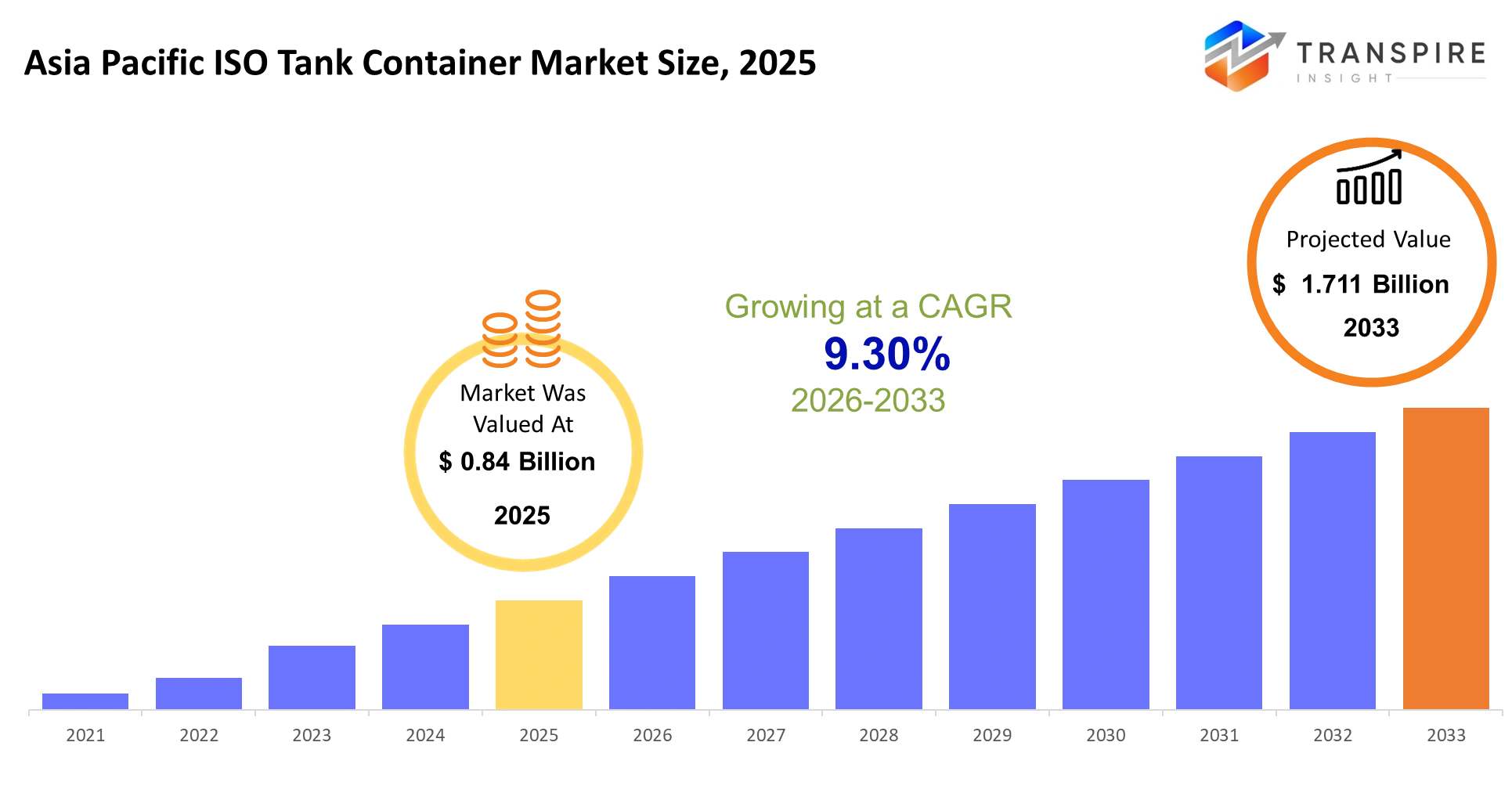
- Asia Pacific ISO Tank Container Market Size 2025: USD 0.84 Billion
- Asia Pacific ISO Tank Container Market Size 2033: USD 1.711 Billion
- Asia Pacific ISO Tank Container Market CAGR: 9.30%
- Asia Pacific ISO Tank Container Market Segments: By Type (Standard ISO Tanks, Cryogenic Tanks, Gas Tanks, Food-grade Tanks, Chemical Tanks, Others); By Application (Chemicals, Food & Beverages, Oil & Gas, Pharmaceuticals, Industrial, Others); By End-User (Chemical Companies, Logistics Firms, Oil & Gas, Food Industry, Pharma, Others); By Capacity (Below 20 ft, 20 ft, Above 20 ft, Medium Capacity, High Capacity, Others)
To learn more about this report,  Download Free Sample Report
Asia Pacific ISO Tank Container Market Summary
The Asia Pacific ISO Tank Container Market was valued at USD 0.84 Billion in 2025. It is forecast to reach USD 1.711 Billion by 2033. That is a CAGR of 9.30% over the period.
The Asia Pacific ISO tank container market enables secure and uniform transportation of bulk liquids and chemicals and food-grade items and dangerous goods through port facilities and rail systems and inland transportation networks. The system provides a critical operational solution to shippers because it decreases product contamination risks and handling losses while enabling smooth multimodal transportation which requires no product unloading or repackaging. ISO tanks have developed into vital tools for regional chemical trade operations and cross-border industrial supply chain management.
The market progressed during the past five years from basic fleet growth to advanced asset deployment based on regulatory requirements. The company integrated digital tracking systems with telematics to achieve better cargo visibility and equipment utilization. The supply chain breakdown together with the port congestion that occurred throughout Asia after the pandemic generated high expenses for inefficient liquid bulk transportation. The manufacturers together with logistics companies increased their spending on flexible tank leasing and intermodal infrastructure development. Operators achieved better turnaround times and asset productivity improvements which enabled them to handle increased cargo volumes while using optimized fleets and dependable services to boost their profit margins.
Key Market Insights
- The Asia Pacific ISO Tank Container Market belongs to China which controls approximately 38% market share for 2025 because of its extensive chemical exports and comprehensive port facilities.
- The Indian market grows at the fastest rate among regional markets because petrochemical capacity increases and logistics corridor development will continue until 2030.
- Southeast Asia captured approximately 22% industry size in 2025 which occurred because cross-border liquid chemical transportation demand continued to grow.
- Japan and South Korea maintain a significant share through advanced manufacturing exports and high-value specialty chemical shipments.
- The market for standard ISO tank containers leads with a 52% market share because the containers function as standard equipment for bulk chemical and food-grade liquid shipments.
- Reefer and insulated tank containers represent the second-largest segment, benefiting from temperature-sensitive pharmaceutical and edible oil transport.
- The smart telematics-enabled tanks market expands at the highest rate until 2030 because of sustained demand for real-time tracking and predictive maintenance technologies.
- Operators choose leasing services because they want to operate their fleets without spending money on equipment purchases. \
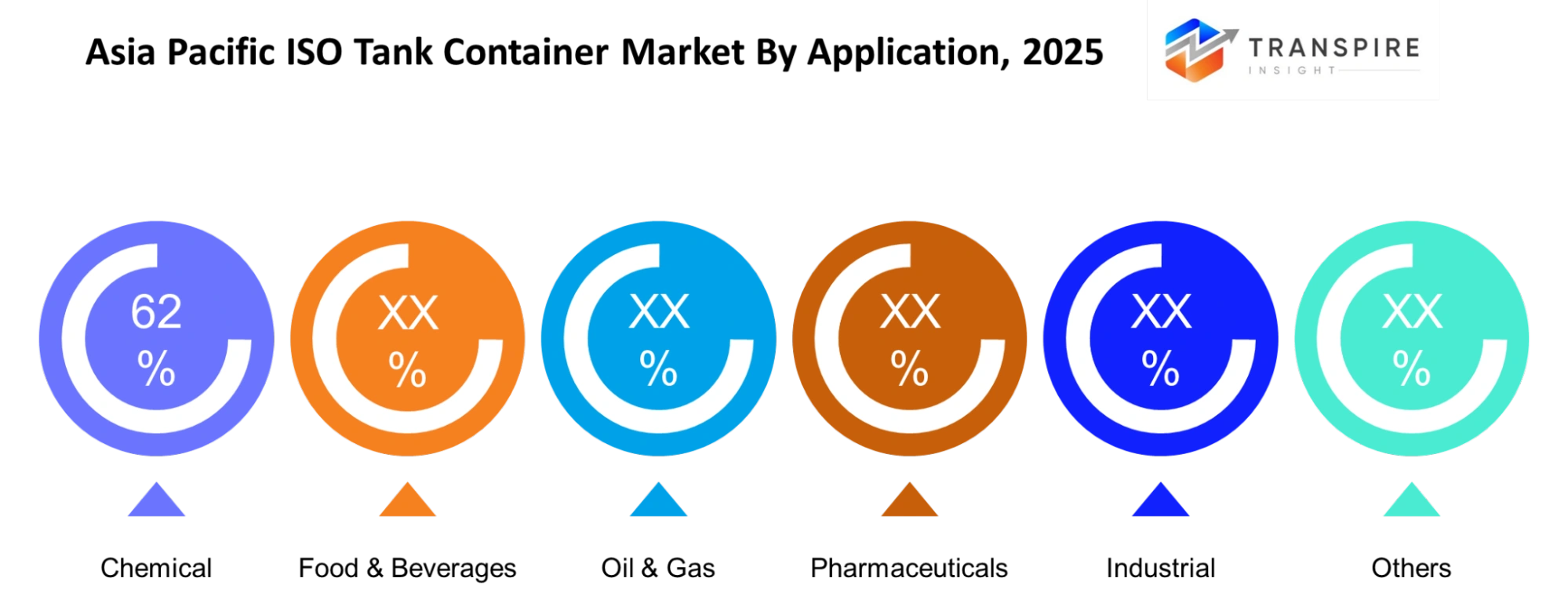
- Chemical transportation dominates the market with a 47% market share during 2025 because of strong export activities and regional petrochemical production.
- The fastest-growing application in transportation involves food-grade liquids because of the expanding trade in edible oils and beverage ingredients.
- The maritime transport sector experiences strong growth in hazardous liquid logistics because of increasing safety compliance requirements.
- The petrochemical manufacturing sector constitutes the largest end-user market with 41% market share because they need to export bulk liquids.
- The second-largest market segment belongs to third-party logistics providers who use multimodal freight optimization methods.
- The pharmaceutical and specialty chemical industries will experience the fastest growth among end-user categories until the end of the forecast period because they need to establish contact with customers.
What are the Key Drivers, Restraints, and Opportunities in the Asia Pacific ISO Tank Container Market?
The Asia Pacific ISO tank container market experiences its strongest growth because regional petrochemical and specialty chemical trade activities have increased since the pandemic caused supply chain changes and logistics problems. Manufacturers in China, India and Southeast Asia adopted multiple sourcing methods while establishing local production facilities to decrease their reliance on specific export points. The transition has resulted in increased bulk liquid chemical transportation through multimodal systems which use ISO tank containers to minimize contamination and expedite cargo handling compared to standard drums and flexitanks. Leasing operators together with logistics providers have expanded their fleet size, which leads to two outcomes, which include rising container usage and increasing operational income from ongoing business activities.
The most significant structural barrier is the limited availability of specialized cleaning, inspection, and maintenance infrastructure across several emerging Asia Pacific logistics corridors. ISO tank containers which transport hazardous materials and food-grade liquids require certified turnaround facilities to meet strict international compliance standards. The construction of these facilities requires extensive funding together with the necessary regulatory permissions and specialized technical knowledge, which results in operational development. The existing infrastructure deficiency creates three operational challenges for companies which include extended fleet turnover times, increased costs for vehicle relocation, and decreased income because of diminished operational capabilities.
The implementation of smart tank container systems through IoT-based telematics and predictive maintenance technology represents a significant growth opportunity. Singapore and South Korea are making substantial investments to build their digital port ecosystem infrastructure. The combination of real-time cargo tracking and route optimization technology enables operators to enhance their asset utilization which results in decreased operational downtime and access to premium logistics services with higher profit margins.
What Has the Impact of Artificial Intelligence Been on the Asia Pacific ISO Tank Container Market?
Artificial intelligence together with advanced digital systems transforms liquid bulk transport operations throughout Asia Pacific by providing better container tracking and compliance control and equipment distribution management. Logistics operators use AI-based telematics systems to automate their fleet compliance monitoring while they track pressure and temperature levels and identify any conditions that might endanger chemical or food-grade cargo. The systems generate alerts for unauthorized route changes and unapproved stop durations and cleaning certification violations which decrease the need for manual monitoring while assisting operators to comply with international transportation regulations.
Machine learning models use valve performance data and structural stress patterns and past inspection records to predict when maintenance needs to occur before equipment failures happen. Regional operators achieved faster turnaround times which improved by 10 to 15 percent and reduced idle time through better container repositioning and maintenance scheduling. AI-based route optimization decreases empty vehicle return trips which leads to better fuel consumption and decreased operational expenses.
The main limitation remains integration complexity. Many fleets still operate with outdated systems that do not support sensor technology while data gaps emerge from unreliable connections throughout inland logistics corridors which leads to decreased predictive model performance and hinders the use of real-time optimization systems.
Key Market Trends
- The operators of HOYER Group and Bertschi AG have implemented telematics systems since 2022 which enhanced their fleet tracking capabilities and decreased their container downtime by almost 12 percent.
- Chinese exporters shifted procurement strategies after 2021 port disruptions which led to their increased use of leased ISO tanks as a solution for maintaining supply continuity during unpredictable shipping times.
- The period from 2021 to 2025 saw India attract major private investments for its chemical logistics corridors which resulted in faster inland tank repositioning and shorter turnaround times.
- The industry strengthened its regulatory enforcement after various hazardous material transport incidents which required operators to enhance their digital compliance tracking systems and their automated cleanup validation processes.
- Buyers increasingly moved away from drum-based liquid transport in 2023 because standardized tank solutions provided better operational efficiency while contamination risks and handling costs increased.
- The regional leasing market saw providers expand their operations throughout Southeast Asia after 2022 because customers preferred flexible access to fleet containers instead of owning their container assets.
- Smart sensor integration emerged as a competitive differentiator, with predictive maintenance systems helping some operators cut unplanned servicing events by approximately 15%.
- Singapore and South Korea accelerated port digitization initiatives between 2023 and 2025, which enabled the two countries to process customs faster and achieve better coordination between different transportation modes.
- The competition now extends beyond fleet size to data-based service reliability, as operators utilize route analytics to decrease empty repositioning expenses on major trade routes.
Asia Pacific ISO Tank Container Market Segmentation
By Type:
The Asia Pacific ISO Tank Container Market uses type-based segmentation to show how different transportation requirements create varying container needs in multiple industries. Standard ISO tanks hold a large share because these containers are widely used for moving liquids in bulk across domestic and international routes. The solution provides industrial facilities with a practical choice that delivers both flexible operations and cost savings while meeting international transportation standards.
Cryogenic tanks are used for carrying liquefied gases at very low temperatures, which makes them essential for industries that require medical gases and industrial cooling materials. Gas tanks enable the safe movement of compressed and liquefied gases which companies use for their manufacturing and energy needs. Food-grade tanks are specially designed with strict hygiene controls to safely transport edible liquids such as oils, syrups, and dairy ingredients. Chemical tanks are built with additional protective features which enable them to manage corrosive or sensitive materials while the other category includes customized tanks developed for special cargo requirements.
By Application:
ISO tank containers see widespread operational use across multiple industries in Asia Pacific according to application segmentation. The chemicals segment remains one of the strongest contributors because many industrial chemicals require safe and efficient bulk transportation across manufacturing centers. The region maintains demand because industrial production continues to grow and cross-border trade keeps expanding.
These containers provide food and beverage companies with hygienic transportation solutions for liquid products which need to travel long distances while preserving quality standards. The oil and gas segment uses them for secure transportation of fuel products and specialty liquids. Pharmaceuticals require controlled transport conditions because their liquid compounds need protection from environmental factors. Industrial applications include coatings, lubricants, and specialty liquids used in production facilities, while the others category covers niche sectors where liquid bulk transport supports specialized operational requirements.
To learn more about this report, Download Free Sample Report
By End-User:
The end-user segmentation of the Asia Pacific ISO Tank Container Market shows how demand is distributed across major commercial users. Chemical companies operate as the main market driver because they regularly transfer bulk liquid chemicals between their manufacturing sites and storage facilities and their international shipping points. The group selects ISO tanks as their logistics solution because these tanks provide both operational efficiency and safety standard compliance.
Logistics firms also hold a strong position as third-party service providers managing transport for multiple industries. The oil and gas sector depends on these containers for specialized liquid transport needs. The food industry uses them to maintain hygiene and preserve product quality during movement. The pharmaceutical industry requires specialized transport systems for their liquid products while smaller industrial users need specific transportation solutions for their distinct requirements.
By Capacity:
Capacity segmentation shows how different industries in Asia Pacific need different transportation volumes. The 20 ft container size functions as the standard for 20 ft container operation because it matches intermodal transport systems while providing efficient load handling capabilities. Businesses which need to transport goods at moderate amounts and lack sufficient storage space will find these solutions useful.
The 20 ft container size has become the most popular choice because it fits standard intermodal systems and provides efficient equipment handling capabilities. Businesses in industrial sectors that load between 20 ft and 40 ft containers need these containers to transport their products. Medium-capacity tanks meet routine transport demands, while high-capacity units are chosen for large-scale operations where reducing shipment frequency improves overall logistics efficiency.
What are the Key Use Cases Driving the Asia Pacific ISO Tank Container Market?
Petrochemical manufacturers and industrial processors primarily need bulk chemical transportation services which serve as the main reason for their service adoption. ISO tanks become essential because the shipments need proper protection against contamination while they travel through port and rail and road networks which require standard procedures for handling.
The food industry and pharmaceutical sector are developing their operations to ship liquid products that meet food safety standards and handle pharmaceutical raw materials. The exporter of edible oil products and beverage ingredient suppliers and specialty chemical manufacturers now depend on insulated and certified tanks to fulfill their hygiene requirements which apply during cross-border operations throughout Asia Pacific trading routes.
The transportation of battery precursor materials and high-purity electronic chemicals for semiconductor manufacturing now serves as emerging use cases which require special handling. Advanced manufacturing facilities in South Korea and Japan and India drive the rising demand for specialized tank solutions which handle direct temperature control and traceability and hazardous material standards required for their operations.
|
Report Metrics |
Details |
|
Market size value in 2025 |
USD 0.84 Billion |
|
Market size value in 2026 |
USD 0.918 Billion |
|
Revenue forecast in 2033 |
USD 1.711 Billion |
|
Growth rate |
CAGR of 9.30% from 2026 to 2033 |
|
Base year |
2025 |
|
Historical data |
2021 - 2024 |
|
Forecast period |
2026 - 2033 |
|
Report coverage |
Revenue forecast, competitive landscape, growth factors, and trends |
|
Regional scope |
India, China, Japan, and Australia |
|
Key company profiled |
HOYER Group, Suttons Group, Stolt-Nielsen, EXSIF, Intermodal Tank Transport, Bertschi Group, Den Hartogh, VTG, Bulkhaul, Trifleet, Newport Tank, Qingdao LAF, Sinochem, Royal Den Hartogh, Shanghai CIMC |
|
Customization scope |
Free report customization (country, regional & segment scope). Avail customized purchase options to meet your exact research needs. |
|
Report Segmentation |
By Type (Standard ISO Tanks, Cryogenic Tanks, Gas Tanks, Food-grade Tanks, Chemical Tanks, Others); By Application (Chemicals, Food & Beverages, Oil & Gas, Pharmaceuticals, Industrial, Others); By End-User (Chemical Companies, Logistics Firms, Oil & Gas, Food Industry, Pharma, Others); By Capacity (Below 20 ft, 20 ft, Above 20 ft, Medium Capacity, High Capacity, Others) |
Which Regions are Driving the Asia Pacific ISO Tank Container Market Growth?
The ISO tank container market in the Asia Pacific region continues to be controlled by East Asia which has China, Japan and South Korea as its primary partners. The region maintains its leadership position because of its numerous petrochemical production centers and its advanced port facilities and its strict rules that control dangerous liquid transportation. The Port of Shanghai and Port of Busan together provide major ports which allow fast transfer between multiple transportation modes that maintain high tank usage. The ecosystem consists of established businesses which operate leasing services and inspection centers and cleaning facilities and digital logistics networks to support effective fleet management throughout local and international shipping routes.
Southeast Asia represents the second-largest contributor but its market strength comes from flexibility rather than scale. The countries of Singapore and Malaysia and Thailand gain advantages from their ability to handle shipping activities and their regular updates to their rules because of the region's manufacturing base. The logistics services which they provide to connect various regions help them maintain stability during times when global trade patterns change. The international tank operators and chemical exporters have invested continuously in this region which has turned it into a reliable source of revenue through their secure cross-border liquid cargo operations.
The fastest-growing area in the world currently exists in South Asia because India drives most of this development. The market environment of 2023 has experienced major changes from recent investments in dedicated freight corridors and port modernization programs and expanded petrochemical manufacturing capacity. The regulatory focus on hazardous material transport safety has resulted in increased use of standardized tank logistics systems instead of outdated legacy operations. The period from 2026 to 2033 presents investors and new market entrants with a valuable chance to establish fleet operations and develop servicing facilities while they capture industrial export demand.
Who are the Key Players in the Asia Pacific ISO Tank Container Market and How Do They Compete?
The Asia Pacific ISO tank container market currently exists in a state of moderate consolidation because only a few global companies control the main international shipping routes while local companies compete by providing adaptable regional solutions. The market is not being radically disrupted by new entrants because fleet acquisition, certification compliance, and depot infrastructure require high capital commitment. The industry now competes through three main factors which include service model effectiveness and digital fleet tracking and network operational capabilities. The companies that successfully decrease repositioning expenses and quicken turnaround times and maintain compliance with various corridors will achieve the most significant competitive edge.
The HOYER Group operates its business through complete logistics solutions while using advanced telematics technology for its customers to access real-time shipment monitoring and compliance records throughout the Asia Pacific region. The company operates through its ability to manage both fleet resources and complete logistics operations which allows for better management of transportation schedules and resource allocation. Bertschi AG establishes its unique market position through its expertise in intermodal chemical transportation and its strong collaborative relationships with chemical manufacturers who handle valuable dangerous materials that need special treatment.
Stolt-Nielsen Limited uses its maritime bulk liquid expertise to provide complete tank and shipping services which enable customers to achieve better operational results than what independent tank lessors can provide. Den Hartogh Logistics provides dedicated food-grade and specialty chemical logistics services which enable niche customization, supported by its certified cleaning facilities. NewPort Tank Containers is expanding its operations throughout South and Southeast Asia by establishing regional depot partnerships which allow it to deploy fleets more quickly into new industrial areas.
Company List
- HOYER Group
- Suttons Group
- Stolt-Nielsen
- EXSIF
- Intermodal Tank Transport
- Bertschi Group
- Den Hartogh
- VTG
- Bulkhaul
- Trifleet
- Newport Tank
- Qingdao LAF
- Sinochem
- Royal Den Hartogh
- Shanghai CIMC
Recent Development News
In February 2026, International Tank Container Organisation announced expanded operational engagement across India and China through its 2026 regional logistics initiatives, including participation at Transport Logistics India Expo and Transport Logistics Shanghai. The move supports technology standardisation and certification adoption for ISO tank container operators, reinforcing Asia Pacific’s role as the fastest-growing regional market for compliant tank container deployment. Sourcehttps://www.international-tank-container.org/
In December 2025, Nissin Corporation entered a joint venture partnership with Royal Den Hartogh Logistics to establish Den Hartogh Nissin Corporation in Tokyo. The partnership expanded specialised tank container logistics capabilities in Japan and enhanced ISO tank distribution infrastructure across the wider Asia Pacific chemical logistics market. Source https://www.denhartogh.com/
What Strategic Insights Define the Future of the Asia Pacific ISO Tank Container Market?
The Asia Pacific ISO tank container market will develop digital asset-free logistics systems which use network intelligence for operator competition during the next five to seven years. The current market shift occurs because of three factors which include complex chemical trade patterns and new cargo tracking rules and customer demands for immediate shipment status updates. The leasing access model together with its predictive analytics and automated compliance tracking functions will create new methods to manage capacity between rapidly evolving trade routes.
Market concentration develops into a hidden risk because only a few certified cleaning depots and inspection hubs exist in the market. The fleet expansion will force operators into bottlenecks which will increase turnaround times while silently reducing profit margins from high cargo volumes. India’s western industrial corridor now presents a major emerging opportunity because port modernization and specialty chemical investment will establish conditions for smart tank infrastructure deployment.
Market participants should make their primary strategic investment in developing regional service ecosystems which incorporate telematics systems and certified maintenance facilities and local partnership programs. Companies will need to adopt digital systems which enhance operational efficiency instead of depending on their existing scale.
Asia Pacific ISO Tank Container Market Report Segmentation
By Type
- Standard ISO Tanks
- Cryogenic Tanks
- Gas Tanks
- Food-grade Tanks
- Chemical Tanks
By Application
- Chemicals
- Food & Beverages
- Oil & Gas
- Pharmaceuticals
- Industrial
By End-User
- Chemical Companies
- Logistics Firms
- Oil & Gas
- Food Industry
- Pharma
By Capacity
- Below 20 ft
- 20 ft
- Above 20 ft
- Medium Capacity
- High Capacity
Frequently Asked Questions
Find quick answers to common questions.
The Asia Pacific ISO Tank Container Market size is USD 1.711 Billion in 2033.
Key segments for the Asia Pacific ISO Tank Container Market are By Type (Standard ISO Tanks, Cryogenic Tanks, Gas Tanks, Food-grade Tanks, Chemical Tanks, Others); By Application (Chemicals, Food & Beverages, Oil & Gas, Pharmaceuticals, Industrial, Others); By End-User (Chemical Companies, Logistics Firms, Oil & Gas, Food Industry, Pharma, Others); By Capacity (Below 20 ft, 20 ft, Above 20 ft, Medium Capacity, High Capacity, Others).
Major Asia Pacific ISO Tank Container Market players are HOYER Group, Suttons Group, Stolt-Nielsen, EXSIF, Intermodal Tank Transport, Bertschi Group, Den Hartogh, VTG, Bulkhaul, Trifleet, Newport Tank, Qingdao LAF, Sinochem, Royal Den Hartogh, Shanghai CIMC.
The Asia Pacific ISO Tank Container Market size is USD 0.84 Billion in 2025.
The Asia Pacific ISO Tank Container Market CAGR is 9.30% from 2026 to 2033.
- HOYER Group
- Suttons Group
- Stolt-Nielsen
- EXSIF
- Intermodal Tank Transport
- Bertschi Group
- Den Hartogh
- VTG
- Bulkhaul
- Trifleet
- Newport Tank
- Qingdao LAF
- Sinochem
- Royal Den Hartogh
- Shanghai CIMC
Recently Published Reports
-
Apr 2026
Handling and Lifting Equipment Market
Handling and Lifting Equipment Market Size, Share & Analysis Report By Product (Cranes and Hoists, Forklifts, Conveyor Systems, Aerial Work Platforms, Others), By Application (E-Commerce, Automotive and Railway, Food and Beverages, Aviation, Others), and Geography (North America, Europe, Asia-Pacific, Middle East and Africa, South and Central America), 2021 - 2031
-
Apr 2026
HVAC Equipment Market
HVAC Equipment Market Size, Share & Analysis Report By Heating Equipment Type (Boilers and Furnaces, Heat Pumps, and Unitary Heaters), By Ventilation Equipment (Air Handling Units, Humidifiers and Dehumidifiers, Air Filters, and Fan Coiling Units), By Air Conditioning Equipment (Unitary Air Conditioners, Room Air Conditioners, Packaged Terminal Air Conditioners, and Chillers), By End User (Commercial, Residential, Industrial, and others), and Geography (North America, Europe, Asia-Pacific, Middle East and Africa, South and Central America), 2021 – 2031
-
Apr 2026
Refrigeration Valves Market
Refrigeration Valves Market Size, Share & Analysis Report By Type (Solenoid Valves, Expansion Valves, Check Valves, Service Valves, Others), By Application (Commercial Refrigeration, Industrial Refrigeration, Transport Refrigeration, Residential Refrigeration, Air Conditioning Systems), By End User (Food and Beverage Industry, Pharmaceutical Industry, HVAC Industry, Chemical Industry, Others), and Geography (North America, Europe, Asia-Pacific, Middle East and Africa, South and Central America), 2021 – 2031
-
Apr 2026
E-Commerce Packaging Materials Market
E-Commerce Packaging Materials Market By Material Type (Corrugated Boxes, Paper & Paperboard, Foam & Cushioning Materials, Plastic Packaging, Flexible Packaging, Protective Packaging, Others), By Product(Primary Packaging, Secondary Packaging, Tertiary Packaging), By Packaging Function (Protective Packaging, Branding & Presentation Packaging, Transit & Logistic Packaging, Sustainable Packaging, Tamper Evidence Packaging), By End-User (Retail & Consumer Goods, Electronic Appliances, Food & Beverages, Healthcare & Pharmaceutical, Fashion & Apparel, Home & Furnishing, Others); By Industry Analysis, Size, Share, Growth, Trends, and Forecasts 2021-2033