

Asia Pacific Handicrafts Market Size & Forecast:
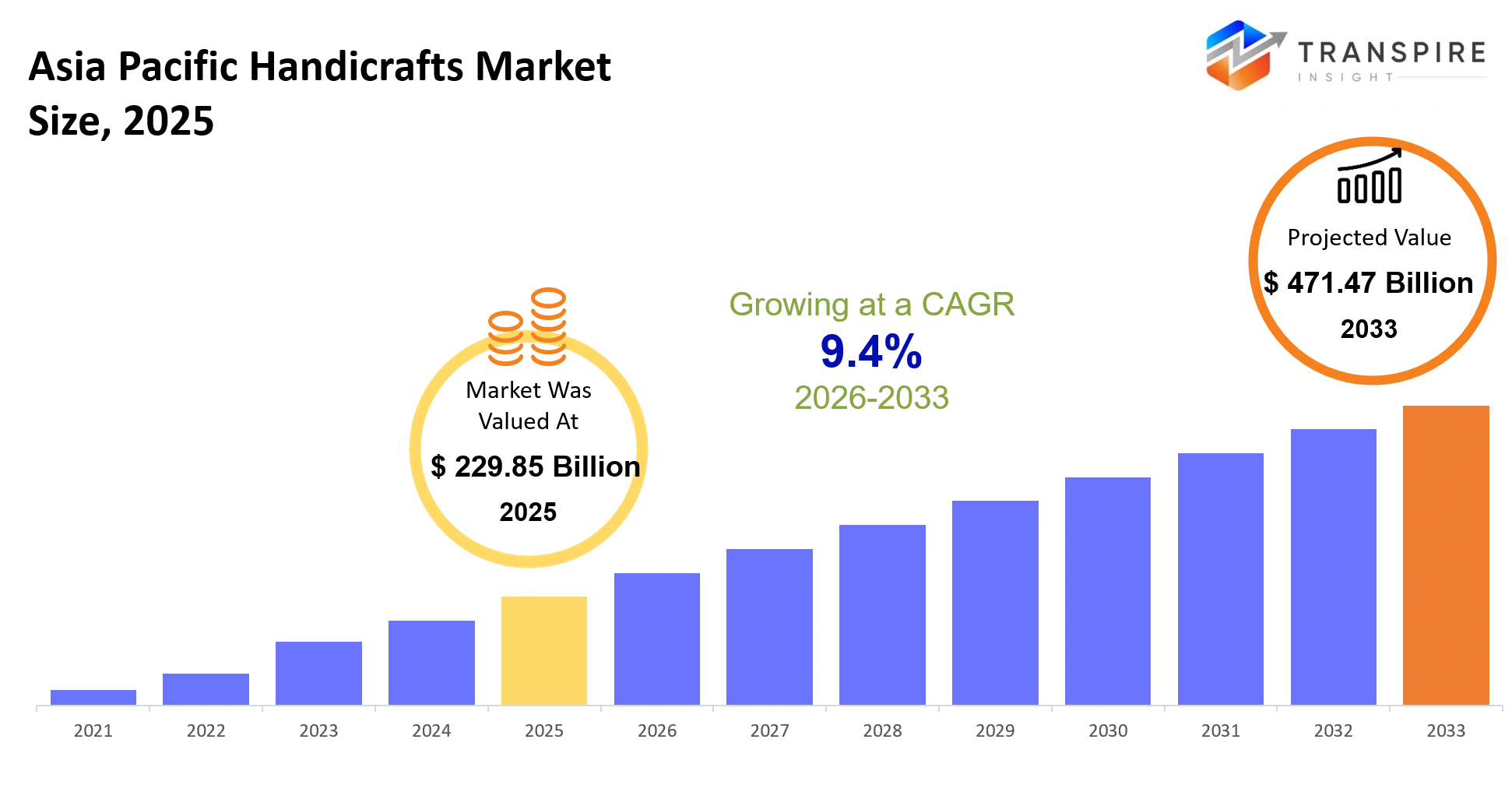
- Asia Pacific Handicrafts Market Size 2025: USD 229.85 Billion
- Asia Pacific Handicrafts Market Size 2033: USD 471.47 Billion
- Asia Pacific Handicrafts Market CAGR: 9.4%
- Asia Pacific Handicrafts Market Segments: By Product Type (Home Decor, Textiles, Jewelry, Pottery, Woodcrafts, Metal Crafts, Others); By Distribution Channel (Retail Stores, Online Retail, Exhibitions, Specialty Stores, Others); By Material (Wood, Metal, Clay, Fabric, Bamboo, Others); By End User (Households, Tourists, Collectors, Others)
Asia Pacific Handicrafts Market Summary
The Asia Pacific Handicrafts Market was valued at USD 229.85 billion in 2025. It is forecast to reach USD 471.47 billion by 2033. That is a CAGR of 9.4% over the period.
The Asia Pacific handicrafts market connects traditional artisan skills with modern retail and lifestyle demand, providing culturally distinctive products that serve home décor, gifting, fashion accessories, furnishings, and hospitality applications. Beyond preserving heritage, the market creates income opportunities for rural craft communities while offering retailers and brands differentiated products that stand out from mass-produced alternatives.
Over the past five years, the market has undergone a structural shift toward digital commerce and direct-to-consumer sales channels. Artisans, cooperatives, and craft enterprises increasingly use online marketplaces and social commerce platforms to reach buyers across domestic and international markets. The COVID-19 pandemic acted as a major trigger, disrupting physical exhibitions and retail stores while accelerating online purchasing behavior. This change expanded market access for producers and reduced dependence on traditional intermediaries.
Current growth is being driven by consumers and commercial buyers seeking authentic, traceable, and handcrafted products with cultural value. As digital platforms improve market visibility and cross-border reach, artisans gain access to larger customer bases, supporting higher transaction volumes, premium pricing opportunities, and stronger revenue generation across the regional handicrafts ecosystem.
Key Market Insights
- The Asia Pacific Handicrafts Market is expanding steadily, supported by digital commerce, tourism recovery, and growing preference for culturally authentic handmade products.
- The market outlook remains positive through 2030, with online retail channels and premium handcrafted goods creating new revenue opportunities across regional craft ecosystems.
- India dominates the Asia Pacific Handicrafts Market, accounting for approximately 35–40% market share in 2025, supported by its large artisan base and export network.
- China represents the second-largest regional market, benefiting from extensive production capabilities and growing domestic demand for artisanal décor products.
- Southeast Asia is the fastest-growing region during 2025–2030, driven by tourism-led purchases, e-commerce penetration, and government support for local crafts.
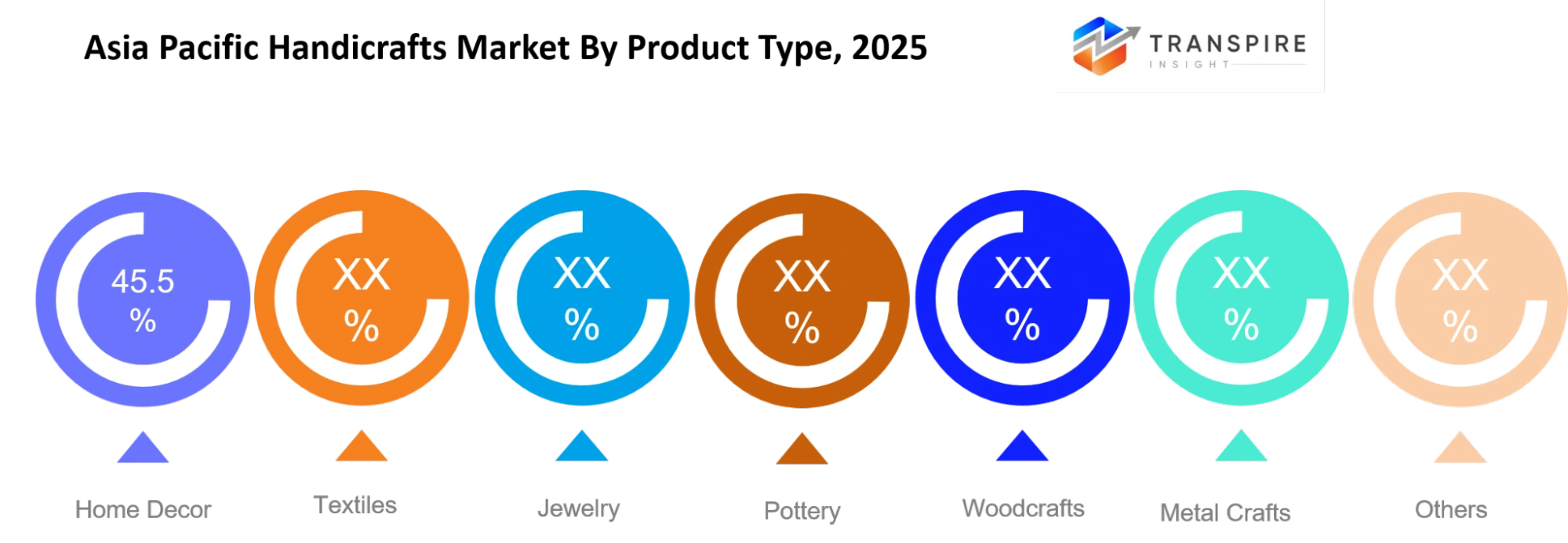
- Home décor products dominate, holding nearly 30–35% market share in 2025, fueled by residential renovation and hospitality sector procurement.
- Textiles and handcrafted furnishings represent the second-largest segment, supported by demand for culturally inspired interior design products.
- Handcrafted jewelry is the fastest-growing segment through 2030, benefiting from fashion personalization trends and direct-to-consumer online sales.
- Household and interior decoration applications lead the market, contributing around 40% of total revenue in 2025 due to strong décor spending.
- Corporate gifting and premium lifestyle applications are the fastest-growing categories, supported by brand differentiation and customized product requirements.
What are the Key Drivers, Restraints, and Opportunities in the Asia Pacific Handicrafts Market?
The strongest force accelerating the Asia Pacific handicrafts market is the rapid expansion of digital commerce infrastructure across India, China, Indonesia, and other emerging economies. The widespread adoption of mobile payments, social commerce platforms, and cross-border online marketplaces has reduced the traditional dependence on intermediaries and physical exhibitions. This shift was accelerated by pandemic-era disruptions that pushed both artisans and buyers toward digital transactions. As a result, producers can now access larger customer bases, improve product visibility, and capture higher margins through direct sales. The ability to reach international consumers has expanded revenue streams and increased transaction volumes across multiple handicraft categories.
The most significant barrier remains the fragmented and highly decentralized nature of handicraft production. Most artisans operate as small-scale enterprises with limited access to financing, standardized quality systems, and modern logistics networks. This is a structural challenge because it is rooted in the industry’s dispersed workforce and traditional production methods. Scaling output while maintaining craftsmanship standards requires long-term investments in training, supply chain coordination, and capacity building. The result is inconsistent product availability, longer delivery times, and missed opportunities in large commercial contracts and export markets.
A major growth opportunity lies in the premium hospitality and tourism sectors across Southeast Asia. Luxury hotels, resorts, and cultural tourism projects are increasingly incorporating locally crafted furnishings, décor, and gift products into their guest experiences. Countries such as Vietnam and Thailand are witnessing investment in experiential tourism, creating new procurement channels for artisan-made products and enabling higher-value commercial partnerships.
What Has the Impact of Artificial Intelligence Been on the Asia Pacific Handicrafts Market?
Artificial intelligence and advanced digital technologies are changing how handicraft businesses across Asia Pacific design, market, and distribute artisan products. Online marketplaces and craft brands increasingly use AI-powered recommendation engines to match consumers with products based on browsing behavior, purchase history, and regional preferences. This improves product discovery, increases conversion rates, and helps sellers generate higher revenue from digital channels.
Machine learning models are also being applied to demand forecasting and inventory planning. By analyzing seasonal buying patterns, tourism flows, and online search trends, these systems help producers anticipate demand and optimize production schedules. This reduces excess inventory, lowers storage costs, and improves order fulfillment performance. In supply chain operations, digital tracking platforms provide greater visibility into sourcing, production progress, and delivery timelines, enabling better coordination between artisan groups, cooperatives, and retailers.
Generative AI tools are emerging as design-support systems that help brands identify popular color palettes, motifs, and product styles without replacing traditional craftsmanship. These insights allow businesses to align product portfolios with market preferences while preserving cultural authenticity.
However, AI adoption remains constrained by high implementation costs and limited digital infrastructure among small artisan enterprises. Many producers lack access to structured sales data, making it difficult to train accurate predictive models and fully realize the benefits of advanced analytics.
Key Market Trends
- Since 2020, online marketplaces have captured a larger share of handicraft sales as artisans shifted from exhibitions and local retailers to digital channels.
- Cross-border e-commerce expanded significantly between 2021 and 2025, enabling small producers to access customers in North America, Europe, and East Asia.
- Buyers increasingly favor products with verified artisan origin and production transparency, pushing brands to strengthen traceability and storytelling capabilities.
- Hospitality operators across Thailand, Vietnam, and Indonesia have increased procurement of handcrafted décor to create locally differentiated guest experiences.
- Companies such as Fabindia, Jaypore, and Etsy have expanded digital merchandising tools, helping artisans reach niche consumer segments more efficiently.
- Traditional craft clusters have adopted digital payment systems and social commerce platforms, reducing dependence on intermediaries and improving profit retention.
- Product development strategies shifted toward contemporary designs after 2020, blending traditional craftsmanship with modern aesthetics for urban consumers.
- Supply chains became more decentralized following pandemic disruptions, prompting retailers to diversify sourcing across multiple artisan communities and regions.
- Sustainability expectations have evolved beyond raw materials, with consumers increasingly evaluating packaging, sourcing practices, and community impact credentials.
- Data-driven demand forecasting gained traction after 2022, helping handicraft businesses improve inventory planning and reduce seasonal sales volatility.
Asia Pacific Handicrafts Market Segmentation
By Product Type:
Home décor products hold a strong position across the market as households, hotels, and commercial spaces continue to seek handcrafted items that add cultural value and visual appeal. Decorative wall pieces, handmade furnishings, artistic accessories, and traditional artifacts support steady sales across urban and tourist-driven locations. Product innovation has encouraged the blending of traditional techniques with contemporary styles, helping handcrafted décor reach a wider customer base.
Textiles represent another important category due to continued demand for handmade fabrics, embroidered products, and woven home furnishings. Jewelry maintains a significant presence through artisan-made accessories that attract both local and international buyers. Pottery, woodcrafts, and metal crafts contribute to market diversity by offering region-specific products that reflect local craftsmanship traditions. Continued product diversification supports stronger market penetration across different consumer groups and retail channels.
By Distribution Channel:
Retail stores remain an important sales channel because physical locations allow customers to evaluate craftsmanship, material quality, and product authenticity before purchase. Specialty stores strengthen market visibility by offering curated collections that highlight regional artistry and traditional production methods. Exhibitions and trade fairs continue to support direct engagement between artisans, buyers, and institutional purchasers.
Online retail has transformed sales dynamics by creating access to broader domestic and international customer networks. Digital marketplaces enable artisans and handicraft brands to showcase products beyond geographical limitations and connect with niche consumer segments. Improved digital payment systems and logistics infrastructure have supported higher transaction volumes. Growth in online channels will continue to reshape purchasing behavior and market accessibility across the region.
By Material:
Wood remains one of the most widely used materials due to versatility, durability, and strong consumer preference for handcrafted decorative products. Skilled artisans create furniture, decorative items, and utility products that appeal to both traditional and modern design preferences. Consistent availability of raw materials in several countries further supports production activities.
Metal-based handicrafts maintain demand across decorative and gifting applications because of craftsmanship value and product longevity. Textile-based materials support a wide range of products, including home furnishings, apparel accessories, and cultural artifacts. Natural and mixed-material products have also gained attention as buyers seek distinctive handcrafted items with authentic cultural connections. Material diversity allows producers to address varying customer preferences and price points across regional markets.
By End User:
Individual consumers account for a major share of purchases as handcrafted products continue to attract buyers seeking unique décor, gifts, and lifestyle accessories. Personalization, cultural significance, and artistic value influence purchasing decisions across many consumer groups. Expanding digital access has also enabled direct interaction between artisans and end customers.
Commercial end users have increased procurement activities across hospitality, corporate gifting, and interior design applications. Hotels, resorts, restaurants, and commercial establishments frequently incorporate handcrafted products to create distinctive customer experiences and local design themes. Institutional purchasing has created new opportunities for artisan communities and handicraft enterprises. Strong participation from both consumer and commercial segments will support long-term market development across the region.
What are the Key Use Cases Driving the Asia Pacific Handicrafts Market?
The largest share of demand comes from home decoration and interior styling applications. Handcrafted décor products such as wall art, decorative accessories, traditional furnishings, and cultural artifacts are widely used in residential spaces, hotels, and hospitality venues. Strong demand exists because handcrafted items provide uniqueness, cultural identity, and aesthetic value that mass-produced alternatives often cannot replicate.
Additional adoption is emerging in corporate gifting and tourism-related retail. Businesses increasingly use artisan-made products for executive gifts, event merchandise, and brand engagement programs. Tourism operators, cultural centers, and specialty retailers also rely on locally crafted products to enhance visitor experiences and support regional heritage promotion, creating new commercial opportunities for producers.
Emerging applications are developing within premium hospitality projects and customized lifestyle collections. Luxury resorts and boutique accommodations are incorporating locally sourced handcrafted furnishings and decorative elements to create authentic guest environments. At the same time, digital-first brands are exploring limited-edition handcrafted collections and personalized products, opening new revenue streams that could expand significantly throughout the forecast period.
|
Report Metrics |
Details |
|
Market size value in 2025 |
USD 229.85 Billion |
|
Market size value in 2026 |
USD 251.45 Billion |
|
Revenue forecast in 2033 |
USD 471.47 Billion |
|
Growth rate |
CAGR of 9.4% from 2026 to 2033 |
|
Base year |
2025 |
|
Historical data |
2021 - 2024 |
|
Forecast period |
2026 - 2033 |
|
Report coverage |
Revenue forecast, competitive landscape, growth factors, and trends |
|
Regional scope |
Asia Pacific (India, China, Japan, Australia, South Korea, Rest of Asia Pacific) |
|
Key company profiled |
Fabindia, Ten Thousand Villages, Etsy, Amazon Handmade, Okhai, Jaypore, Asian Handicrafts, Gaatha, Craftsvilla, World Crafts Council, IKEA, West Elm, Handmade at Amazon, Novica, Pepperfry |
|
Customization scope |
Free report customization (country, regional & segment scope). Avail customized purchase options to meet your exact research needs. |
|
Report Segmentation |
By Product Type (Home Decor, Textiles, Jewelry, Pottery, Woodcrafts, Metal Crafts, Others); By Distribution Channel (Retail Stores, Online Retail, Exhibitions, Specialty Stores, Others); By Material (Wood, Metal, Clay, Fabric, Bamboo, Others); By End User (Households, Tourists, Collectors, Others) |
Which Regions are Driving the Asia Pacific Handicrafts Market Growth?
India leads the regional market due to its extensive artisan network, strong handicraft export base, and long-standing government support programs for traditional crafts. National and state-level initiatives promote skill development, market access, and participation in international trade exhibitions. A large domestic consumer base also provides consistent demand across home décor, textiles, jewelry, and gift products. This combination of production capacity, cultural heritage, and institutional support creates a strong ecosystem that sustains market leadership.
China represents the second-largest regional contributor, but growth dynamics differ from those in India. Strong manufacturing capabilities, advanced logistics networks, and widespread digital commerce adoption support efficient distribution of handcrafted products across domestic and international markets. Market stability comes from a balanced mix of local consumption and export activity, reducing dependence on any single sales channel. Continued investment in online retail platforms and creative product development helps maintain steady revenue generation.
Southeast Asia is the fastest-growing region, driven by expanding tourism activity and increasing investment in cultural and creative industries. Countries such as Vietnam, Thailand, and Indonesia have strengthened programs that promote artisan communities and locally produced crafts. Growing adoption of e-commerce platforms has also improved access to international buyers, allowing smaller producers to reach wider markets. This momentum creates attractive opportunities for investors and market entrants seeking exposure to high-growth craft categories and emerging consumer segments between 2026 and 2033.
Who are the Key Players in the Asia Pacific Handicrafts Market and How Do They Compete?
The competitive landscape remains highly fragmented, with thousands of artisan groups, cooperatives, regional brands, and digital marketplaces competing across domestic and export channels. Competition is driven less by price and more by product authenticity, design differentiation, distribution reach, and access to skilled craftsmanship. Traditional handicraft businesses continue to defend market share through heritage-based branding and regional specialization, while digital-first platforms are reshaping customer acquisition and market visibility. The ability to connect artisans directly with consumers has become an important source of competitive advantage.
Fabindia differentiates itself through a large network of artisan producers and a retail model that combines traditional craftsmanship with contemporary consumer preferences. The company strengthens market reach through store expansion, omnichannel sales, and product diversification across home décor, apparel, and lifestyle categories. Jaypore focuses on premium handcrafted collections and curated design experiences that target higher-value customer segments. Strong emphasis on storytelling, artisan identity, and limited-edition collections helps create distinction from mass-market competitors.
Etsy expands access to international buyers by providing a global marketplace where independent artisans can reach niche consumer groups without significant distribution investment. Amazon Handmade leverages logistics infrastructure, digital marketing capabilities, and customer trust to support scalable online sales. Novica differentiates itself through direct partnerships with artisan communities and transparent sourcing practices that highlight cultural authenticity. These companies continue to expand through digital platform enhancements, cross-border commerce initiatives, and broader access to emerging consumer markets across Asia Pacific and beyond.
Key Market Players
- Fabindia
- Ten Thousand Villages
- Etsy
- Amazon Handmade
- Okhai
- Jaypore
- Asian Handicrafts
- Gaatha
- Craftsvilla
- World Crafts Council
- IKEA
- West Elm
- Handmade at Amazon
- Novica
- Pepperfry
Recent Development News
In August 2025, the Office of the Development Commissioner (Handicrafts), Ministry of Textiles, inaugurated The Kunj, a flagship retail and cultural destination dedicated to Indian handicrafts and handlooms in New Delhi. The initiative was designed to improve artisan market access, promote craft visibility, and create a design-led platform for handicraft sales and exhibitions. Source:https://www.pib.gov.
In February 2026, the Office of the Development Commissioner (Handicrafts) invited proposals for the formation of Artisan Producer Companies (APCs) under the National Handicrafts Development Programme (NHDP) for FY 2026–27. The initiative aims to formalize artisan enterprises, strengthen market access, and build sustainable business structures across handicraft clusters. Source:https://skillspedia.in/inviting
In August 2025, the Government of Arunachal Pradesh launched the Arunachal Pradesh Handloom and Handicrafts Policy 2025. The policy established a structured framework to support artisans and weavers, preserve tribal craft traditions, and create new economic opportunities for the handicrafts sector. Source:https://timesofindia.indiatimes.com
What Strategic Insights Define the Future of the Asia Pacific Handicrafts Market?
Over the next five to seven years, the market is likely to move toward a more organized, digitally connected, and brand-driven structure. The underlying force behind this shift is the growing integration of artisans into e-commerce ecosystems, supported by improved logistics networks, digital payments, and cross-border retail platforms. As direct market access expands, value creation will increasingly depend on design differentiation, supply chain reliability, and the ability to communicate product origin and authenticity to consumers.
A less visible risk lies in the gradual concentration of sales through a small number of dominant online marketplaces. While these platforms provide reach and scalability, excessive dependence on a limited set of distribution channels could weaken pricing power for artisans and smaller handicraft enterprises. Changes in platform algorithms, commission structures, or marketplace policies could affect profitability across large parts of the industry.
An emerging opportunity is developing in Southeast Asia’s premium tourism and hospitality sectors, where investment in cultural tourism is creating demand for locally sourced handcrafted furnishings and décor. Market participants should invest in digital traceability, artisan certification, and commercial partnerships with hospitality operators to secure higher-value contracts and strengthen long-term competitive positioning.
Asia Pacific Handicrafts Market Report Segmentation
By Product Type
- Home Decor
- Textiles
- Jewelry
- Pottery
- Woodcrafts
- Metal Crafts
- Others
By Distribution Channel
- Retail Stores
- Online Retail
- Exhibitions
- Specialty Stores
- Others
By Material
- Wood
- Metal
- Clay
- Fabric
- Bamboo
- Others
By End User
- Households
- Tourists
- Collectors
- Others
Frequently Asked Questions
Find quick answers to common questions.
The expected Asia Pacific Handicrafts Market size for the market will be USD 471.47 Billion in 2033.
Key segments for the Asia Pacific Handicrafts Market are By Product Type (Home Decor, Textiles, Jewelry, Pottery, Woodcrafts, Metal Crafts, Others); By Distribution Channel (Retail Stores, Online Retail, Exhibitions, Specialty Stores, Others); By Material (Wood, Metal, Clay, Fabric, Bamboo, Others); By End User (Households, Tourists, Collectors, Others)
Major Asia Pacific Handicrafts Market players are Fabindia, Ten Thousand Villages, Etsy, Amazon Handmade, Okhai, Jaypore, Asian Handicrafts, Gaatha, Craftsvilla, World Crafts Council, IKEA, West Elm, Handmade at Amazon, Novica, Pepperfry
The Asia Pacific Handicrafts Market size is USD 229.85 Billion in 2025.
The Asia Pacific Handicrafts Market CAGR is 9.4% from 2026 to 2033.
- Fabindia
- Ten Thousand Villages
- Etsy
- Amazon Handmade
- Okhai
- Jaypore
- Asian Handicrafts
- Gaatha
- Craftsvilla
- World Crafts Council
- IKEA
- West Elm
- Handmade at Amazon
- Novica
- Pepperfry
About the Authors

Chetan Dhatrak
I’m Chetan Dhatrak, a Senior Research Analyst at Transpire Insight, specializing in the Consumer Goods, Foods and Beverages industry. I focus on analyzing market trends, consumer behavior, competitive landscapes, and industry developments to deliver accurate, data-driven insights. My research at Transpire Insight is built on credible sources and in-depth analysis, helping businesses and readers better understand market dynamics, emerging opportunities, and evolving consumer preferences. I’m committed to creating reliable, well-researched content that supports informed decision-making and reflects the latest developments in the consumer goods and food & beverage sectors.

Chakradhar Khansole
Chakradhar serves as the Research Director at Transpire Insight, bringing over 8 years of experience in technology, innovation, and strategic market intelligence. He specializes in transforming complex market data into actionable business insights that enable organizations to make informed, growth-oriented decisions. Recognized for his strategic vision and analytical expertise, Chakradhar leads high-impact research initiatives, delivering comprehensive market assessments, competitive intelligence, and forward-looking industry analysis.
Recently Published Reports
-
Apr 2026
Bottled Water Market
Bottled Water Market Size, Share & Analysis Report By Product Type (Still Bottled Water, Carbonated Bottled Water, Functional Bottled Water, and Others), By Packaging (PET, Cans, and Others), By Sales Channel (Supermarkets/Hypermarkets, Convenience Stores/Drug Stores, Grocery Stores/Club Stores, Foodservice, and Others) and Geography (North America, Europe, Asia-Pacific, Middle East and Africa, South and Central America), 2021 - 2032
-
Apr 2026
Color Cosmetic Packaging Market
Color Cosmetic Packaging Market Size, Share & Analysis Report By Application (Mascara Packaging, Liquid Packaging, and Liquid Face), By Type (Tubes & Bottles, Pens & Markers, Compacts & Containers, and Droppers & Pumps), and Geography (North America, Europe, Asia-Pacific, Middle East and Africa, South and Central America), 2021 - 2031
-
Apr 2026
External Microphone For Camera Market
External Microphone For Camera Market Size, Share & Analysis Report By Type (Shotgun Microphone, Lavalier Microphone, and Others), By Application (Digital Camera, Professional Video Camera, and Others), and Geography (North America, Europe, Asia-Pacific, Middle East and Africa, South and Central America), 2021 - 2031
-
Apr 2026
Foot Orthotic Insoles Market
Foot Orthotic Insoles Market Size, Share & Analysis Report By Type (Pre-fabricated, and Custom-made), By Material (Thermoplastic, Composite Carbon Fiber, and Others), By Distribution Channel (Drug Stores, Hospitals & Clinics, and Others), and Geography (North America, Europe, Asia-Pacific, Middle East and Africa, South and Central America), 2021 - 2031