

Asia Pacific Freelance Platforms Market Size & Forecast:
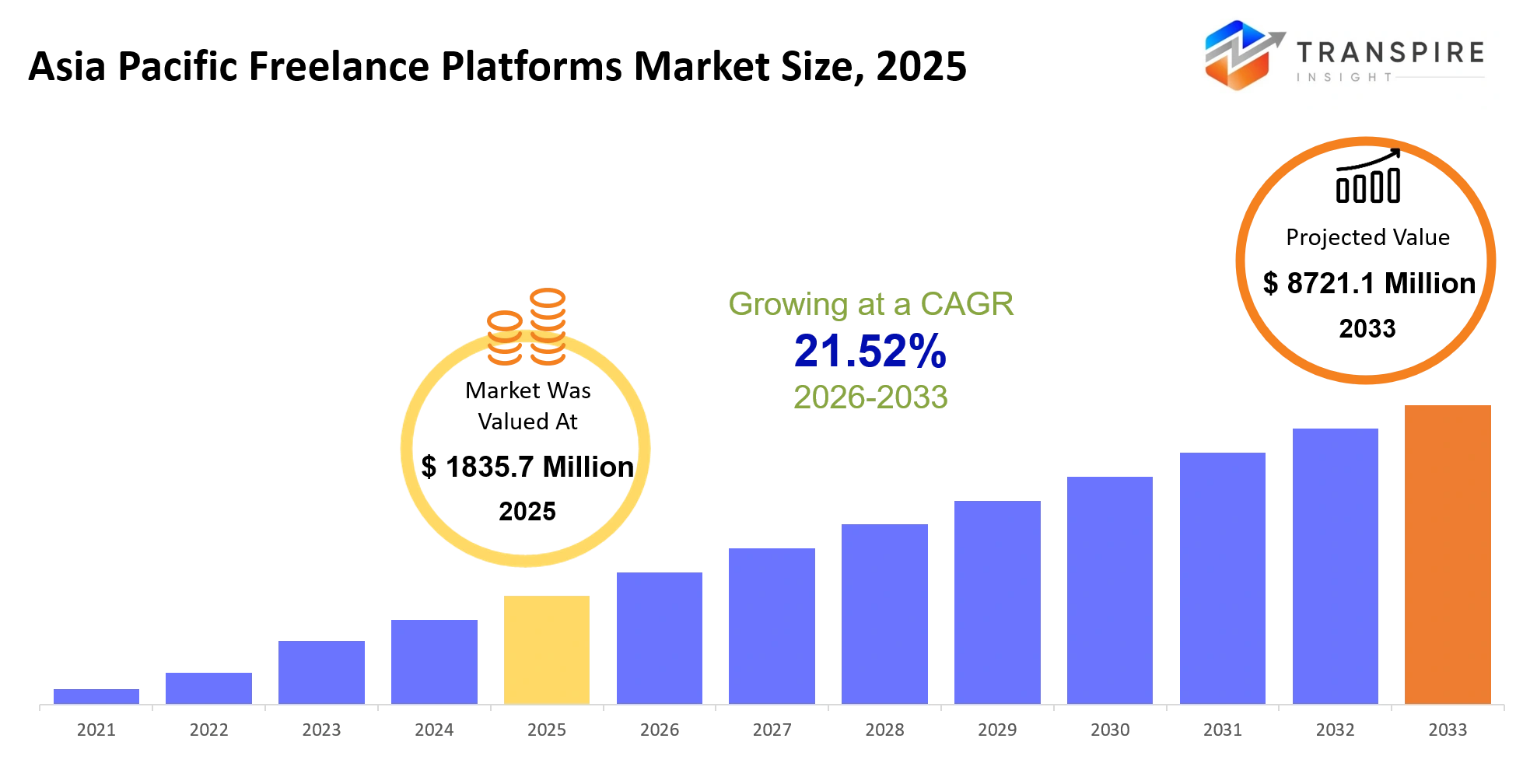
- Asia Pacific Freelance Platforms Market Size 2025:USD 1835.7 Million
- Asia Pacific Freelance Platforms Market Size 2033: USD 8721.1 Million
- Asia Pacific Freelance Platforms Market CAGR: 21.52%
- Asia Pacific Freelance Platforms Market Segments: By Platform Type (General Freelancing, IT Freelancing, Creative Freelancing, Professional Services, Microtask Platforms, Consulting Platforms, Remote Work Platforms, Others); By Service Type (Software Development, Graphic Design, Content Writing, Digital Marketing, Video Editing, Consulting, Data Analysis, Others); By End User (SMEs, Large Enterprises, Startups, Individuals, Government Organizations, Educational Institutions, Others); By Industry Vertical (IT & Telecom, Media & Entertainment, Retail, Healthcare, BFSI, Education, Manufacturing, Others).
To learn more about this report,  Download Free Sample Report
Asia Pacific Freelance Platforms Market Summary
The Asia Pacific Freelance Platforms Market was valued at USD 1835.7 Million in 2025. It is forecast to reach USD 8721.1 Million by 2033. That is a CAGR of 21.52%over the period.
The Asia Pacific freelance platforms market is slowly turned into a sort of critical digital labor framework that links enterprises, startups, and independent professionals across multiple roles like software development, design, marketing, consulting and also business support. In a very practical way, these platforms handle the workforce problem by letting companies tap specialized talent on a flexible basis, without going through long hiring cycles ,or locking into permanent employment expenses. At the same time, freelancers get a better chance to land cross border projects and steadier, repeatable income sources.
In the last five years, the whole space has moved away from simple project based gig work and more toward connected remote workforce ecosystems. These ecosystems are held up by AI matching systems, digital payment rails, and collaboration suites that feel pretty enterprise-grade, kind of smooth and polished. The COVID-19 situation, basically acted like a massive catalyst, remote work became normal across a lot of sectors, and companies started trusting distributed teams faster than before. Now, as firms across the Asia Pacific region keep sharpening operational agility and leaning into lean staffing models freelance platforms are also landing higher-value contracts , and longer duration engagements. And because of that shift, the monetization pathways are getting wider too, including subscriptions, managed talent services, and built in financial options for both freelancers and employers.
Key Market Insights
- The Asia Pacific Freelance Platforms Market is seeing steady uptick in momentum as companies start to lean into remote talent patterns, AI-enhanced recruiting tools, and more adaptable workforce approaches through digital industries, and honestly it feels like everything is moving faster than before.
- The Asia Pacific Freelance Platforms Market is expected to keep growing strongly into 2032, helped by cross border freelancing demand, more startup activity, plus wider digital workforce transformation, where platforms basically become the “place” for matching, paying, and managing work.
- Between 2021 and 2025, the Asia Pacific freelance economy logged noticeable growth in platform uptake, mostly because enterprise buyers wanted faster, more task based hiring arrangements, not the slower kind and it kind of shows.
- In 2024, AI powered freelancer matching systems improved hiring speed by almost 30% , which helped accelerate income streams across several large freelance marketplace platforms.
- Cloud teamwork software along with bundled payment gateways boosted platform scaling, and that in turn improved freelancer stickiness, plus client interaction especially across regional markets.
- Government encouragement for digital entrepreneurship in India, Singapore, and Indonesia pushed more participation on freelance platforms among skilled independent workers during 2023 to 2025, and the effect was pretty clear.
- India led the Asia Pacific Freelance Platforms Market, holding roughly 38% share in 2025, driven by its huge digital workforce, along with a solid IT outsourcing ecosystem.
- IT freelancing also pulled ahead, with more than 42% share in 2025, mostly because software development outsourcing demand stayed constant, pretty steady actually.
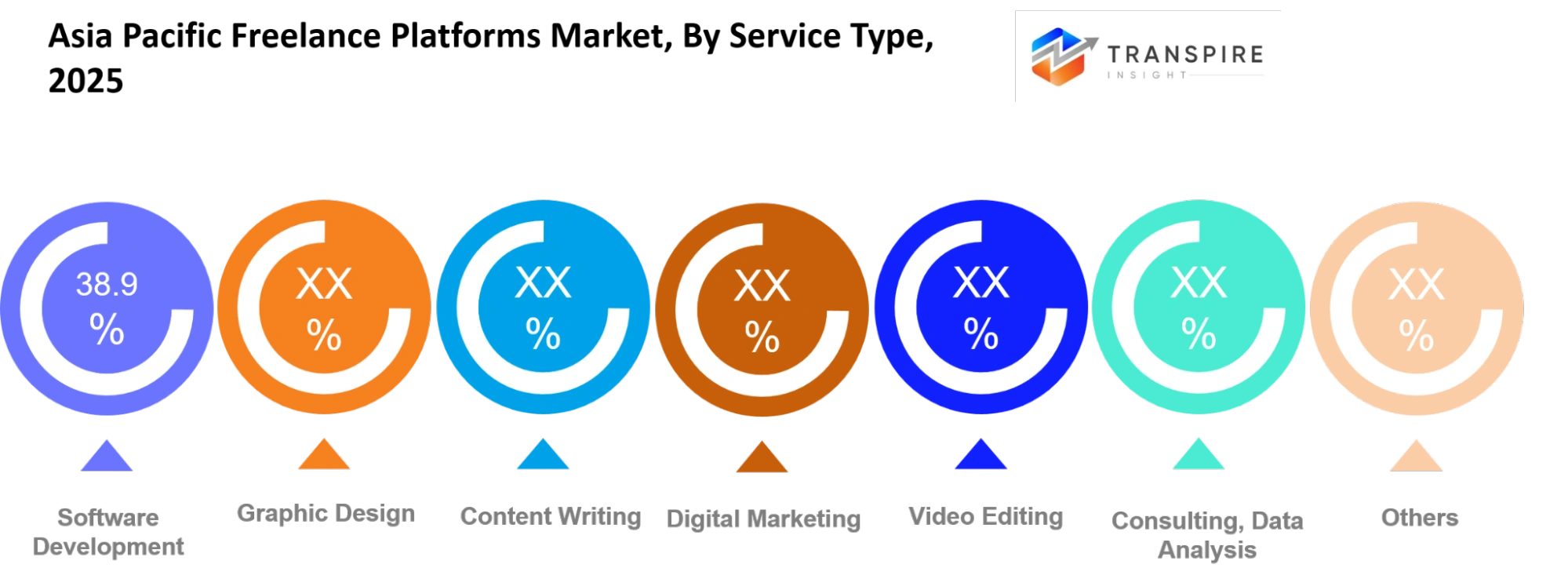
- In 2025, software development applications made up about 35% of total platform revenue, tied to cloud migration moves and enterprise digitization initiatives.
- SMEs dominated end user adoption with around 48% market share in 2025, since hiring freelancers.
What are the Key Drivers, Restraints, and Opportunities in the Asia Pacific Freelance Platforms Market?
The most powerful force pushing the Asia Pacific Freelance Platforms Market is basically that structural pivot toward distributed digital workforces, you know, where teams aren’t stuck in one place. Companies in technology, e-commerce, fintech, and media eventually started swapping their traditional hiring templates, especially after COVID-19 showed how heavy it can be to keep big in-house squads around full time. Meanwhile, cloud collaboration platforms, digital payment systems, and AI-driven talent matching made remote work feel less messy. Less friction in day to day execution, so platform revenues climbed. The reason is simple: firms went from sporadic freelance engagements to more steady, continuous collaboration, and this happens a lot in software development, digital promotion, and design work services.
On the other hand, the biggest obstacle that slows growth is a kind of fragmented regulatory and labor compliance situation across Asia Pacific countries. Taxation rules, how freelancers are classified, cross-border payment regulations, and data protection obligations don’t line up cleanly between, say, India, China, Indonesia, and Australia. It’s sort of structural, because governments keep updating digital labor laws on their own, so harmonizing everything is hard. Because of that platforms end up paying more compliance expenses, expansions in the region become slower, and enterprises often hesitate to adopt these platforms for large international projects.
AI infused enterprise freelance management platforms are showing up as kinda the next big growth chance. More companies are putting money into systems that kinda tie together talent sourcing, workflow handling, auto payments, and productivity analytics into one place—instead of keeping everything separate. Southeast Asia feels especially promising here, since the startup scene in Vietnam and Indonesia is scaling fast, while local businesses are still looking for flexible access to specialized digital talent. At the same time they dont want to widen their permanent payroll structures, so these platforms kinda fit better, and yes, they can be more cost efficient.
What Has the Impact of Artificial Intelligence Been on the Asia Pacific Freelance Platforms Market?
Artificial intelligence, and advanced digital technologies are quietly transforming freelance platforms across the Asia Pacific region, mainly by making talent matching more precise, automating the workflow, improving fraud checks, and speeding up project management. In many places, AI driven recommendation engines now sift through freelancer portfolios, the way clients behave, pricing patterns, and past completion records, which helps automate candidate shortlisting, and it cuts the time spent in hiring from several days down to just a couple of hours. Some platforms are also rolling out machine learning models that estimate freelancer dependability, forecast delivery risk, and even map client retention tendencies, so enterprises can raise their project success odds and balance workforce placement more rationally.
Meanwhile, advanced analytics systems are supporting operations by automating payment verification, contract drafting, and multilingual customer help. Several regional platforms say they’ve seen lower admin costs, along with higher freelancer involvement, after adding AI assisted communication features and smoother automated onboarding flows. Predictive tools are also giving companies a better view of upcoming demand for digital skills, like software engineering, cybersecurity, and AI consulting, so platforms can tune their pricing approaches and refresh recruitment campaigns in a more responsive way.
Still, AI adoption has a real constraint, mostly the high integration expense, plus fragmented workforce data across markets in Asia Pacific. A lot of smaller and mid sized platforms don’t have access to standardized datasets needed to train solid machine learning models, so prediction quality drops and bigger deployments get delayed, or they stall entirely.
Key Market Trends
- Between 2021 and 2025, companies moved close to 25% of their short-term tech recruitment toward freelance marketplaces instead of the usual staffing agency routes, a kind of quiet pivot that sort of stuck.
- Upwork, Fiverr, and Freelancer.com then kept growing enterprise-ready workforce offerings after corporate customers asked for managed remote squads, plus real compliance help, not just a platform.
- Since 2023, AI matching features cut down freelancer vetting time by around 40% , which meant work got shipped faster and clients stayed longer.
- At the same time, India pushed harder into regional leadership , because digital payments rolled out more widely, and startup funding rose enough to boost independent professionals across software and marketing work too.
- In Southeast Asia, lots of platforms saw quicker client pickup after cross border remote hiring became normal for SMEs following those pandemic era workforce disruptions.
- Since 2022, freelance sites also started weaving in escrow payments, automated agreements, and tax documentation, basically to soothe enterprise compliance worries.
- Demand for cybersecurity, AI engineering, and cloud specialists picked up speed, too after regional orgs increased their digital transformation spend in 2024 and 2025.
- On the creative side, the platforms that focus on freelancing leaned more into subscription style service models because brands kept funding recurring short-form video, as well as influencer marketing pushes.
- Australia and Singapore also saw higher take up of premium consulting marketplaces since financial and legal firms outsourced specific expertise in time bound project formats.
- Competition got more intense after regional startups built smaller freelance ecosystems, like healthcare, fintech, and multilingual digital content services, all sort of niche but very targeted.
Asia Pacific Freelance Platforms Market Segmentation
By Platform
General freelancing platforms keep on supporting businesses looking for flexible project based talent, across multiple categories, yes. There was strong growth in digital business operations, which in turn bumped up activity on IT freelancing and remote work platforms across India, Southeast Asia, and Australia .
Creative freelancing platforms started getting more attention from media , retail and advertising companies, mostly because the demand for visual content and branding, plus digital campaigns, keeps rising . Consulting and professional service platforms also pulled in corporate clients who wanted specialized expertise without all those long hiring procedures , you know.
Microtask platforms expanded steadily too, because e commerce companies , data firms and technology providers often need large scale help with repetitive online tasks. Meanwhile remote work platforms improved collaboration using integrated communication tools, workflow management systems, and secure payment features . Platform operators are now leaning hard on AI based talent matching and project verification systems to boost client confidence and help freelancer retention . And with market competition getting sharper, service providers are building more industry focused platforms for healthcare , finance , and technology projects.
By Service Type
Software development services kept a strong market presence largely because cloud migration projects were moving along, mobile application development stayed busy and enterprise automation programs kept drawing attention. In fintech, retail and IT sectors, companies started to outsource more often, coding and cybersecurity plus even software testing tasks , mainly to squeeze operational costs a bit. At the same time, digital marketing and content writing services also kept climbing, since brands needed ongoing online engagement and multilingual promotional campaigns. Graphic design services seemed to ride that wave too, supporting website development, social media branding, and small user interface improvements, that made everything feel a bit more polished.
On the video side, editing services grew as short form content got everywhere, plus live commerce and influencer marketing activities were spreading across regional digital platforms . Consulting services picked up interest from startups and SMEs that were looking for legal, operational, and technology guidance without locking themselves into permanent hiring. Data analysis services expanded as well, because organizations wanted customer insights, predictive reporting, and business intelligence support for better planning. Service providers kept introducing bundled solutions , where design marketing analytics and development support were wrapped into one freelance contract, so clients didn’t need to juggle too many separate agreements at once.
To learn more about this report, Download Free Sample Report
By End User
SMEs had a big chunk of the platform usage, basically because flexible hiring kept recruitment expenses lower and reduced the need for new infrastructure investment. Startups, as they were expanding fast, leaned more and more on freelance talent for software development stuff, branding tasks and marketing projects, sometimes even in pretty early stages of growth. Big enterprises too started folding in a freelance workforce, not just for staffing but to handle short term digital transformation initiatives ,and also to cover specialized operational needs. At the same time individual users showed up, driven by demand for personal branding, website creation, online tutoring, and even help with creative project support.
Government organizations looked at freelance platforms for digital communication, translation work and temporary technology assignments in certain regional markets. Educational institutions started using these services for online course creation, content design, and remote technical support, especially after digital learning expansion picked up speed. For end users, it seemed the most appealing platforms were the ones with transparent pricing, verified skills, and quicker project completion timelines. And honestly, the growing acceptance of remote work made people more confident about project based collaboration, across both public and private sectors, overall.
By Industry Vertical
In IT and telecom , the platform engagement stayed high because software modernization and cybersecurity spending needed constant access to skilled professionals, you know. Media and entertainment firms started using more freelance help for content creation, animation, video production, and also digital advertising campaign work. Retail organizations went a step further, expanding freelance support for e-commerce oversight, social media marketing, and multilingual customer touchpoints too. BFSI companies, meanwhile, leaned into project based hiring approaches, especially for compliance analysis tasks, software integration assignments , and financial consulting work.
On the healthcare side , organizations slowly increased their freelance partnerships for medical content work, telehealth assistance, and healthcare data management services. Educational institutions also widened freelance collaboration for online learning platforms, virtual classroom administration, and digital course production. Manufacturing groups explored freelance engineering, supply chain analytics, plus automation consulting, mainly to sharpen operational performance.Overall, industry demand really pushed platform operators to reinforce their cybersecurity systems, harden payment infrastructure, and refine sector specific talent verification processes.
What are the Key Use Cases Driving the Asia Pacific Freelance Platforms Market?
Software development still stays as the main “real” use case in the Asia Pacific Freelance Platforms Market, since enterprises lean on outside developers for cloud migration, application upgrades and also cybersecurity programs. You can see IT and telecom firms pushing the highest demand because rapid digital transformation really needs ongoing access to specialized coding and testing, people. This use case keeps platform activity fairly stable too, since most projects are short cycle, skill heavy and pretty cost sensitive, so freelance hiring ends up feeling more sensible than hiring staff in a permanent way.
On the other hand digital marketing, plus content creation are getting bigger roles, especially for retail, BFSI and media businesses that want constant online presence. SMEs and startups, these days more often bring in independent talent for campaign design, social media operations and multilingual writing, to connect with nearby audiences. Meanwhile data analysis services are also picking up momentum as companies focus on customer behavior monitoring and performance tuning, for digital sales channels.
Emerging use cases are starting to look like AI model training support plus compliance documentation, especially inside fintech and healthcare, where teams are leaning on automation tools more and more. Educational institutions meanwhile show early adoption too, for interactive e learning content development, and also for virtual course design. These applications are still not fully matured but they will probably pick up speed, once organizations expand their digital operations and start needing flexible, project based specialist support.
|
Report Metrics |
Details |
|
Market size value in 2025 |
USD 1835.7 Million |
|
Market size value in 2026 |
USD 2228.5 Million |
|
Revenue forecast in 2033 |
USD 8721.1 Million |
|
Growth rate |
CAGR of 21.52% from 2026 to 2033 |
|
Base year |
2025 |
|
Historical data |
2021 - 2024 |
|
Forecast period |
2026 - 2033 |
|
Report coverage |
Revenue forecast, competitive landscape, growth factors, and trends |
|
Regional scope |
Asia Pacific (India, China, Japan, Australia, South Korea, Rest of Asia Pacific) |
|
Key company profiled |
Upwork, Fiverr, Freelancer.com, Toptal, Guru, PeoplePerHour, Workana, Truelancer, FlexJobs, 99designs, DesignCrowd, TaskRabbit, Gigster, Catalant, Outsourcely. |
|
Customization scope |
Free report customization (country, regional & segment scope). Avail customized purchase options to meet your exact research needs. |
|
Report Segmentation |
By Platform Type (General Freelancing, IT Freelancing, Creative Freelancing, Professional Services, Microtask Platforms, Consulting Platforms, Remote Work Platforms, Others); By Service Type (Software Development, Graphic Design, Content Writing, Digital Marketing, Video Editing, Consulting, Data Analysis, Others); By End User (SMEs, Large Enterprises, Startups, Individuals, Government Organizations, Educational Institutions, Others); By Industry Vertical (IT & Telecom, Media & Entertainment, Retail, Healthcare, BFSI, Education, Manufacturing, Others). |
Which Regions are Driving the Asia Pacific Freelance Platforms Market Growth?
Asia Pacific Freelance Platforms Market growth is mostly carried by India, where a decent digital policy set up and a big skilled pool keep pulling demand onto these platforms. The government initiatives for digital entrepreneurship, plus how UPI payments are now used everywhere, have lowered transaction friction, even for cross-border freelance work. In places like Bengaluru and Hyderabad, there is also this tight IT services ecosystem that keeps delivering software developers, designers, and analysts to customers abroad. That whole setup then makes platform liquidity sturdier, and it also helps keep projects coming in fast across both tech work and creative services, pretty regularly.
China is the next major contributor, and it benefits from a more organized digital economy plus enterprises that are already comfortable using remote talent platforms. While India’s freelance supply feels export-oriented, China’s demand is more tied to local companies that fold freelance services into broader digital transformation efforts. Then the regulatory side, around data governance and day to day platform operations, stays fairly stable, so enterprise buying decisions become easier to predict. On top of that, steady spending from technology, retail, and manufacturing companies keeps platform usage steady, even when the wider economy is going through a bit of adjustment.
Southeast Asia is showing the fastest growth momentum, mostly because of rapid SME digitization and this kind of expanding startup ecosystems in Vietnam, Indonesia and the Philippines. Lately there have been more investments in digital infrastructure, plus higher fintech penetration and better cross-border payment systems. That combo improved freelancer accessibility and made onboarding feel faster, kind of smoother. Also the governments in these markets rolled out supportive policies for gig economy participation. So platform registrations jumped a lot after 2023, even if it wasnt perfectly evenly distributed. All in all, this looks like really strong entry opportunities for platform operators and investors who want to reach underserved talent pools and tap emerging demand for digital services between 2026 and 2033.
Who are the Key Players in the Asia Pacific Freelance Platforms Market and How Do They Compete?
Competition in the Asia Pacific Freelance Platforms Market stays kinda moderately fragmented, with a blend of global incumbents and quickly scaling regional platforms chasing enterprise accounts AND independent professionals. Most companies end up going head to head on technology capability, especially AI based talent matching, workflow automation, and payment security, not really just on price. Even so, fresh entrants keep shaking things up by aiming at specific, sharper skill groups like AI development, UI/UX design, and short term advisory type projects. Customer retention is very tied to trust systems, verified skills, and how fast tasks get assigned, so platforms are basically forced to keep upgrading their digital backbone, more or less continuously.
Upwork and Fiverr both seem to bet on technology led scaling, leaning on AI driven recommendation engines plus structured freelancer ratings to lower hiring friction and raise match accuracy. Upwork also leans into wider enterprise adoption via managed talent solutions and longer duration contracts, which should help keep revenue steadier from corporate buyers. Fiverr, on the other hand, differentiates using standardized service bundles, so small businesses can grab pre defined digital services fast without getting stuck in negotiation delays. Meanwhile, Freelancer.com stays relevant thanks to its wide global footprint and competitive bidding setups that pull in more cost sensitive clients across the Asia Pacific region.
Toptal and PeoplePerHour go for those niche specializ ation vibes, really zooming in on vetted, high-skill folks for software engineering, consulting , and design work. In practice, Toptal builds its advantage with pretty strict screening processes, so enterprise clients get access to premium talent that feels reliable, not necessarily the lowest cost option. PeoplePerHour, on the other hand, expands by leaning into flexible freelance marketplaces and some partnerships with SMEs , mainly in emerging Asian markets. That approach helps improve regional reach, and it kind of keeps things more fluid penetration. These strategies collectively intensify competition while pushing platforms toward higher specialization and service automation.
Company List
- Upwork
- Fiverr
- Freelancer.com
- Toptal
- Guru
- PeoplePerHour
- Workana
- Truelancer
- FlexJobs
- 99designs
- DesignCrowd
- TaskRabbit
- Gigster
- Catalant
- Outsourcely
Recent Development News
In February 2026, upGrad announced the acquisition of Internshala, India’s largest internship and early-talent marketplace, in a 90% stock-swap deal, strengthening its integrated education-to-employment ecosystem across the Asia Pacific region. The acquisition expands access to internships and freelance-ready talent pipelines across India’s rapidly growing digital workforce.
Source: https://finance.yahoo.com
What Strategic Insights Define the Future of the Asia Pacific Freelance Platforms Market?
Over the next 5–7 years, the Asia Pacific freelance platforms market is drifting toward embedded, AI orchestrated talent networks, where getting to freelancers is more and more “built in” inside enterprise software, fintech apps, and regional superapps. This shift is pushed by ongoing skills shortages, plus that broader move to a variable workforce style. There is also this kind of hidden, but pretty material risk, around regulatory fragmentation , especially on gig worker classification and cross-border data localization. That stuff could suddenly crank up compliance costs and make it harder for platforms to scale, even if demand signals look really strong.
On the flip side, there’s an emerging opportunity too: government enabled digital credentialing, and verifiable skill passports in places like India and ASEAN. If it works as intended, it can unlock trusted cross border hiring at scale, and it can also cut down the friction enterprises feel when they try to adopt freelance talent.
Market participants should probably focus on compliance first, AI verified talent matching systems, and then go deeper on integration with enterprise procurement workflows. Not just racing for marketplace size alone, because as automation increases and regulatory oversight tightens across the region, defensible positioning will depend more on these fundamentals.
Asia Pacific Freelance Platforms Market Report Segmentation
By Platform Type
- General Freelancing
- IT Freelancing
- Creative Freelancing
- Professional Services
- Microtask Platforms
- Consulting Platforms
- Remote Work Platforms
- Others
By Service Type
- Software Development
- Graphic Design
- Content Writing
- Digital Marketing
- Video Editing
- Consulting
- Data Analysis
- Others
By End User
- SMEs
- Large Enterprises
- Startups
- Individuals
- Government Organizations
- Educational Institutions
- Others
By Industry Vertical
- IT & Telecom
- Media & Entertainment
- Retail
- Healthcare
- BFSI
- Education
- Manufacturing
- Others
Frequently Asked Questions
Find quick answers to common questions.
The expected Asia Pacific Freelance Platforms Market size for the market will be USD 8721.1 Million in 2033.
By Platform Type (General Freelancing, IT Freelancing, Creative Freelancing, Professional Services, Microtask Platforms, Consulting Platforms, Remote Work Platforms, Others); By Service Type (Software Development, Graphic Design, Content Writing, Digital Marketing, Video Editing, Consulting, Data Analysis, Others); By End User (SMEs, Large Enterprises, Startups, Individuals, Government Organizations, Educational Institutions, Others); By Industry Vertical (IT & Telecom, Media & Entertainment, Retail, Healthcare, BFSI, Education, Manufacturing, Others).
Major Asia Pacific Freelance Platforms Market players are Upwork, Fiverr, Freelancer.com, Toptal, Guru, PeoplePerHour, Workana, Truelancer, FlexJobs, 99designs, DesignCrowd, TaskRabbit, Gigster, Catalant, Outsourcely.
The Asia Pacific Freelance Platforms Market size is USD 1835.7 Million in 2025.
The Asia Pacific Freelance Platforms Market CAGR is 21.52% from 2026 to 2033.
- Upwork
- Fiverr
- Freelancer.com
- Toptal
- Guru
- PeoplePerHour
- Workana
- Truelancer
- FlexJobs
- 99designs
- DesignCrowd
- TaskRabbit
- Gigster
- Catalant
- Outsourcely
About the Authors

Mayur Shinde
I am Mayur Shinde, a Senior Research Analyst at Transpire Insight, specializing in the Automotive & Transportation and Information & Communication Technology (ICT) Industry. My work focuses on analyzing emerging market trends, technological advancements, competitive landscapes, and industry developments to deliver accurate, data-driven insights. I am passionate about transforming complex market information into clear, actionable content that helps businesses, professionals, and decision-makers stay informed and make confident strategic decisions.

Chakradhar Khansole
Chakradhar serves as the Research Director at Transpire Insight, bringing over 8 years of experience in technology, innovation, and strategic market intelligence. He specializes in transforming complex market data into actionable business insights that enable organizations to make informed, growth-oriented decisions. Recognized for his strategic vision and analytical expertise, Chakradhar leads high-impact research initiatives, delivering comprehensive market assessments, competitive intelligence, and forward-looking industry analysis.
Recently Published Reports
-
Apr 2026
3D Optical Profiler Market
3D Optical Profiler Market Size, Share & Analysis Report By Type (Desktop 3D Optical Profiler, and Portable 3D Optical Profiler), By Technology (Confocal Technology, and White Light Interference), By End-Use Industry (Manufacturing, Research Institutions, Automotive, Aerospace and Defense, Medical Devices, and Other), and Geography (North America, Europe, Asia-Pacific, Middle East and Africa, South and Central America), 2021 - 2031
-
Apr 2026
Depth Sensor Market
Depth Sensor Market Size, Share & Analysis Report By Type (Infrared Depth Sensors, Time-of-Flight (ToF) Sensors, Stereo Vision Sensors, Structured Light Sensors, Ultrasonic Depth Sensors), By Application (Automotive, Robotics, Gaming, Consumer Electronics, Industrial Automation, Healthcare, Security & Surveillance, Others), By End Users (Automotive Manufacturers, Consumer Electronics Companies, Healthcare Providers, Industrial Companies, Security Agencies, Gaming Companies, Robotics Companies, Others), and Geography (North America, Europe, Asia-Pacific, Middle East and Africa, South and Central America), 2021 – 2031
-
Apr 2026
Digital Manufacturing Market
Digital Manufacturing Market Size, Share & Analysis Report By Component (Hardware, Software, and Services), By Technology (Robotics, 3D Printing, Internet of Things (IoT), and Others), By Application (Automotive and Transportation, Aerospace and Defense, Consumer Electronics, Industrial Machinery, and Others), By Process Type (Computer-Based Designing, Computer-Based Simulation, Computer 3D Visualization, Analytics, and Others), and Geography (North America, Europe, Asia-Pacific, Middle East and Africa, South and Central America), 2021 – 2031
-
Apr 2026
Digital Visa Services Market
Digital Visa Services Market Size, Share & Analysis Report By Type (Individual Travelers, Group Travelers), By Application (Tourism, Business Travel, Others), and Geography (North America, Europe, Asia-Pacific, Middle East and Africa, South and Central America), 2021 – 2031