
Asia Pacific Electrolyzer Market Size & Forecast:
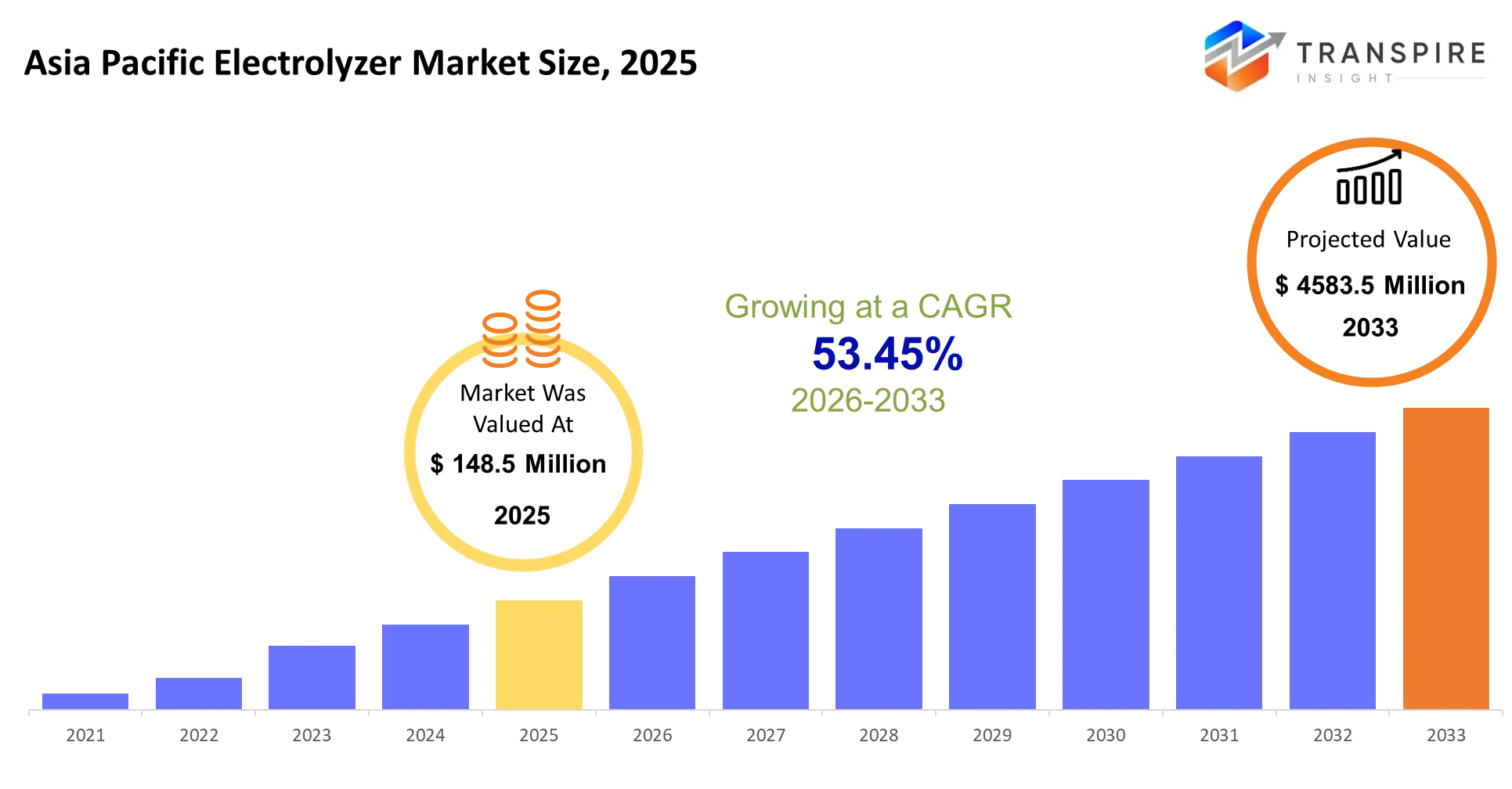
- Asia Pacific Electrolyzer Market Size 2025: USD 148.5 Million
- Asia Pacific Electrolyzer Market Size 2033: USD 4583.5 Million
- Asia Pacific Electrolyzer Market CAGR: 53.45%
- Asia Pacific Electrolyzer Market Segments: By Type (Alkaline Electrolyzer, PEM Electrolyzer, Solid Oxide Electrolyzer, Others); By Application (Hydrogen Production, Energy Storage, Industrial Processes, Power Generation, Mobility, Others); By End-User (Energy Companies, Industrial Firms, Governments, Utilities, Research Institutes, Others); By Capacity (Small-scale, Medium-scale, Large-scale, Others)
To learn more about this report,  Download Free Sample Report
Asia Pacific Electrolyzer Market Summary
The Asia Pacific Electrolyzer Market was valued at USD 148.5 Million in 2025. It is forecast to reach USD 4583.5 Million by 2033. That is a CAGR of 53.45% over the period.
The Asia Pacific Electrolyzer Market provides its main service through its ability to transform electrical energy together with water into hydrogen which industrial facilities use to replace hydrogen produced through fossil fuels for their refining needs and ammonia production and steel manufacturing and new maritime fuel technologies. The system enables heavy industries together with ports to achieve emissions reduction for their operations which require solutions beyond direct electric power conversion.
The hydrogen production process has undergone a complete transformation during the last three to five years as the industry has shifted from using steam methane reforming to employing renewable energy sources for electrolysis which now operates at scale throughout China and India and Japan and Australia. The 2022 global energy price shock exposed the weaknesses of gas-based hydrogen production systems which led governments to urgently implement their national hydrogen development plans.
The existing electrolyzer deployment growth occurs because renewable energy sources create excess production capacity and industrial decarbonization requirements create financial project support while the early large-scale installations lead to lower costs and better supply chain development which enables more widespread usage.
Key Market Insights
- The Asia Pacific Electrolyzer Market will become 40 to 45 percent controlled by China in 2025. ‘
- The hydrogen industrial hubs which China operates together with its government support will create this market share.
- The hydrogen export programs which Australia develops together with its capacity to handle additional renewable energy will make the country its most rapidly growing region between 2025 and 2030.
- Japan and South Korea show ongoing development because they focus their efforts on creating hydrogen transportation infrastructure and fuel-cell technology.
- Alkaline electrolyzers maintain their market leadership because they offer industrial solutions which account for 55 to 60 percent of the market.
- Solid oxide electrolyzers represent the fastest expanding market segment from 2025 to 2030 because they achieve high efficiency for industrial heat integration purposes.
- The Asia Pacific Electrolyzer Market develops mostly through industrial hydrogen production which maintains a 50 percent market share between its refining and ammonia production sectors.
- The hydrogen storage market expands at its fastest rate through power generation and grid balancing applications which increase with renewable energy sources.
- The chemical and fertilizer industries dominate end-use demand with a 35 to 40 percent market share because they require ammonia and methanol production needs.
- The oil refining sector exhibits rapid adoption growth as refineries shift from using grey hydrogen to using green hydrogen.
- Hydrogen fuel usage in logistics drives the transportation and shipping industries to become the fastest expanding end-user sector.
What are the Key Drivers, Restraints, and Opportunities in the Asia Pacific Electrolyzer Market?
The Asia Pacific Electrolyzer Market experiences its main growth force from national decarbonization policies in China, India, Japan and Australia which support the development of hydrogen production facilities that use renewable energy sources. The situation developed this way because the energy market became unstable after 2022 which showed that natural gas hydrogen production methods involved financial dangers that forced governmental and industrial organizations to develop energy security systems which depended on green hydrogen. Electrolyzer implementation results in revenue increase through major refinery upgrades and ammonia production facility expansions and hydrogen blending operations across various industrial areas.
The growth of the market faces a significant obstacle because electrolyzer systems require substantial capital investment while renewable electricity costs vary throughout the Asia Pacific region. The barrier remains in place because electrolyzer systems require inexpensive electricity for their entire operational time which developing and developed nations do not currently provide as a standard service. The situation causes delays for project financing activities while extending the time needed for profit recovery and it hampers the process of moving operations to their initial commercial stage especially in developing Southeast Asian nations which experience power distribution challenges.
Australia and Middle East-related Asian supply chains create an opportunity through hydrogen export hubs which have emerged as important commercial centers. Western Australia's Pilbara hydrogen projects and other green hydrogen corridor developments lead to the creation of export-based systems which connect electrolyzer production facilities with renewable energy sources and liquefaction centers. The region prepares for its upcoming development phase which will allow electrolyzers to move from their initial testing phase to their new status as essential components of worldwide integrated hydrogen distribution systems.
What Has the Impact of Artificial Intelligence Been on the Asia Pacific Electrolyzer Market?
The Asian Pacific Electrolyzer Market now uses artificial intelligence technology together with digital networks to create new methods for hydrogen production which extend to maritime fuel systems. AI-powered control systems for industrial processes maintain stack temperature and water feedstock and renewable power levels through automatic monitoring functions which produce stable hydrogen output throughout different solar and wind weather patterns. The digital systems which operate in integrated maritime environments enable operations for exhaust gas cleaning and fuel switching while simultaneously enhancing compliance monitoring activities which track low-carbon shipping routes.
Predictive capabilities are becoming central to plant reliability. Machine learning models analyze vibration and voltage degradation and membrane performance data to predict electrolyzer stack failures weeks in advance which enables scheduled maintenance instead of emergency shutdowns. The models enable operators to predict emissions while creating efficiency maps to help control load between alkaline and PEM systems based on electricity prices and available renewable energy sources.
The technologies increase operational uptime between 5 and 10 percent. The technologies decrease maintenance expenses through reduced unplanned outages. The technologies enhance asset utilization. The electrolyzer installations which provide high-quality training data remain limited which results in decreased model accuracy for real-world scenarios. The region experiences slow AI deployment because organizations face high integration costs when their industrial systems lack standardized digital interfaces.
Key Market Trends
- China increased its domestic electrolyzer production capacity by more than 60% since 2023 because the country now depends on its own supply chains instead of foreign imports.
- Australia developed new hydrogen export pipelines which started their operations after 2024 because they wanted to use electrolyzers in global energy distribution systems instead of their national power grid.
- Japan moved from conducting hydrogen pilot studies toward implementing commercial hydrogen operations which led to faster adoption of PEM electrolyzers in transportation applications.
- India increased its green hydrogen mission funding after 2023 which resulted in industrial customers choosing alkaline electrolyzers to produce ammonia at lower manufacturing costs.
- Siemens Energy and Nel ASA established multiple gigafactories across the Asia Pacific region which enabled faster delivery of large-scale electrolyzer systems in the year 2024.
- The company established new partnerships with local steel manufacturers to develop decarbonization technologies through electrolyzer integration at their steelmaking pilot facilities.
- After 2022 manufacturers redesigned their systems to handle flexible load balancing between solar and wind energy because of renewable energy volatility.
- The hydrogen hub policies in Singapore and South Korea created a shift in demand from individual units to systems that combine electrolyzers into industrial clusters.
- The companies Plug Power Inc. and Cummins Inc. expanded their joint ventures throughout the Asia Pacific region to establish assembly plants while they worked on decreasing operational expenses.
Asia Pacific Electrolyzer Market Segmentation
By Type :
Alkaline electrolyzer systems will remain widely used because they deliver economical solutions which maintain consistent operations throughout extensive hydrogen production projects. The systems function effectively in industrial environments which require continuous operation because they deliver dependable hydrogen production through their straightforward design and established operational methods.
PEM electrolyzers will gain attention because they provide rapid response capabilities together with increased efficiency for systems which require energy flexibility. Solid oxide electrolyzers will enable high-temperature industrial applications through their improved energy conversion performance, while emerging technologies will remain in their initial development phase to support specific hydrogen production applications.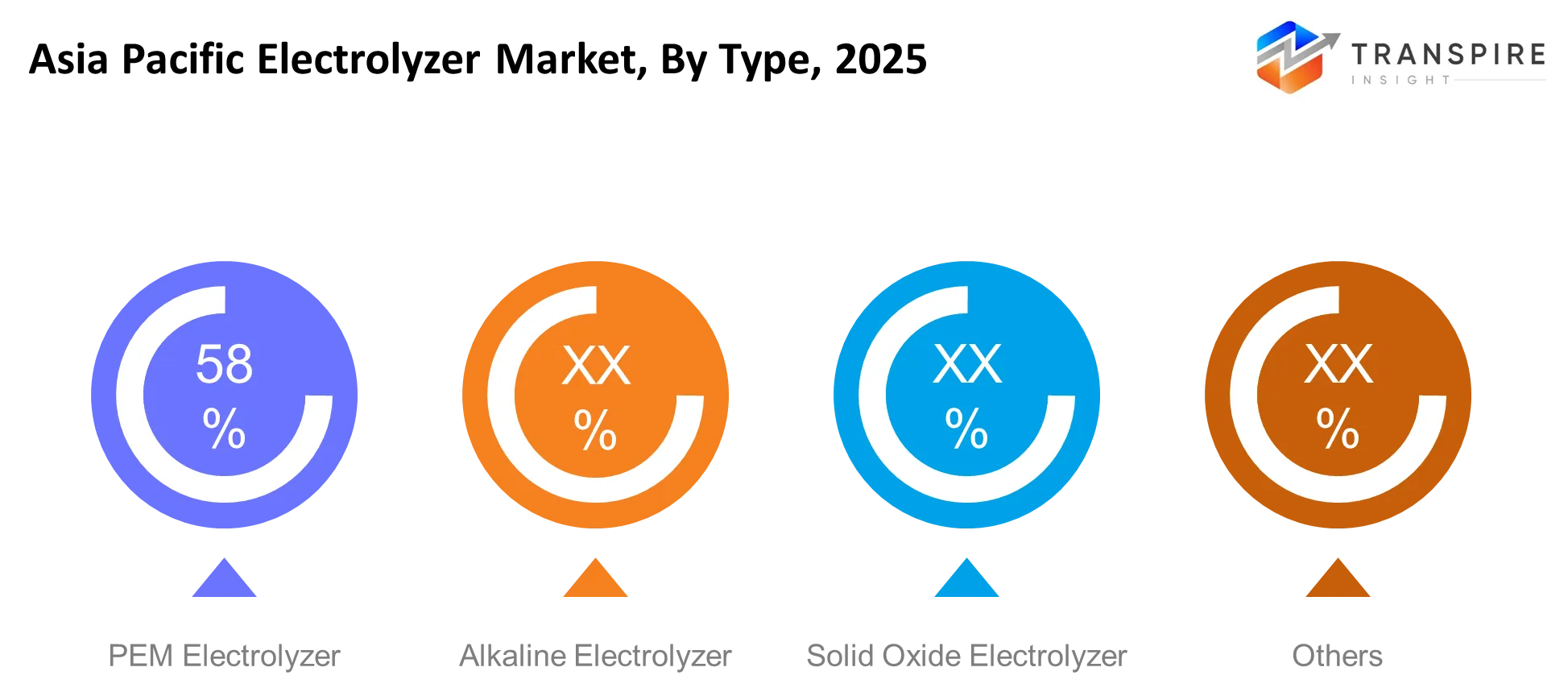
To learn more about this report, Download Free Sample Report
By Application :
Hydrogen production will remain the main application area as demand for clean fuel increases across industries. Electrolyzers will support large-scale hydrogen supply systems that reduce dependence on conventional fossil-based sources and support cleaner energy transitions in multiple sectors.
The use of energy storage systems will grow because surplus renewable energy will be converted into hydrogen through hydrogen production facilities which enable future storage of hydrogen. Industrial processes will adopt electrolyzers for cleaner chemical production, while power generation and mobility will use hydrogen-based systems to support low-emission operations and improve energy efficiency across transport and electricity sectors.
By End-User :
Energy companies will lead adoption by integrating electrolyzers into renewable energy projects for hydrogen production. The companies will work on developing clean fuel supply systems which will enable their long-term energy transition objectives while decreasing carbon emissions throughout extensive infrastructure systems.
Industrial firms will use electrolyzers to support cleaner production processes. The governments and utilities will spend money on hydrogen systems which will protect energy security and build public infrastructure. Research institutes will concentrate on efficiency improvements and production cost reductions while other users will investigate small-scale and pilot projects.
By Capacity :
Small-scale electrolyzers will enable local hydrogen production through decentralized systems which will be used in pilot projects and minor industrial operations. These systems provide essential functionality for testing environments and smaller facilities which require energy solutions that are both flexible and compact.
Medium-scale systems will provide hydrogen supply to industrial operations which have medium demand in regional areas. Large-scale electrolyzers will operate as the primary hydrogen production system at major hydrogen production facilities which support national energy initiatives and large-scale industrial operations. The development of additional capacity types will proceed to meet the needs of specialized applications which require customized operational capabilities.
What are the Key Use Cases Driving the Asia Pacific Electrolyzer Market?
The primary application of Asia Pacific Electrolyzer Market technology serves to produce hydrogen for industrial purposes which supports both refining processes and ammonia production. The chemical production facilities and oil refineries use electrolyzers to substitute grey hydrogen because their operations must comply with new emissions regulations and increasing carbon costs which affect major markets like China and Japan. The continuous operation of this application generates industrial feedstock costs which drive its demand because it provides essential industrial resources.
The field of application has grown beyond its initial scope to include both steel decarbonization and hydrogen blending operations within current natural gas systems. The Indian and South Korean steel industry, through its direct reduced iron projects, implements electrolyzers, while the power industry tests hydrogen co-firing technology in gas distribution networks to achieve lower emissions. Heavy industrial manufacturers now prefer these applications because they provide sustainable solutions for gradual operational development.
Green shipping fuel production at port hubs and synthetic fuel generation for aviation emerge as new application areas. Singapore and Australian ports test hydrogen-based bunkering systems, while initial power-to-liquid projects investigate electrolyzer-generated e-fuel production. The current operational capacity of these applications remains limited, but their future benefits show substantial potential because maritime and aviation industries face increasing decarbonization requirements.
|
Report Metrics |
Details |
|
Market size value in 2025 |
USD 148.5 Million |
|
Market size value in 2026 |
USD 228.8 Million |
|
Revenue forecast in 2033 |
USD 4583.5 Million |
|
Growth rate |
CAGR of 53.45% from 2026 to 2033 |
|
Base year |
2025 |
|
Historical data |
2021 - 2024 |
|
Forecast period |
2026 - 2033 |
|
Report coverage |
Revenue forecast, competitive landscape, growth factors, and trends |
|
Regional scope |
Asia Pacific (China, India, Japan, South Korea, Australia, Rest of Asia Pacific) |
|
Key company profiled |
Siemens Energy, Nel ASA, ITM Power, Plug Power, Cummins, Thyssenkrupp, Toshiba, Panasonic, Air Liquide, Linde, McPhy, Enapter, Ballard Power, Bloom Energy, Sunfire |
|
Customization scope |
Free report customization (country, regional & segment scope). Avail customized purchase options to meet your exact research needs. |
|
Report Segmentation |
By Type (Alkaline Electrolyzer, PEM Electrolyzer, Solid Oxide Electrolyzer, Others); By Application (Hydrogen Production, Energy Storage, Industrial Processes, Power Generation, Mobility, Others); By End-User (Energy Companies, Industrial Firms, Governments, Utilities, Research Institutes, Others); By Capacity (Small-scale, Medium-scale, Large-scale, Others) |
Which Regions are Driving the Asia Pacific Electrolyzer Market Growth?
China leads the Asia Pacific Electrolyzer Market because it implements an active hydrogen policy framework while using electrolyzers for industrial decarbonization across all its industrial areas. The national mandates which connect hydrogen usage to steel and refining and chemical production have established a continuous requirement for hydrogen at gigawatt scale. The ongoing establishment of electrolyzers receives support from both state-backed financial resources and renewable energy projects which maintain operational control across their entire supply chain. The nation maintains an advanced manufacturing capability for electrochemical systems which helps the country decrease its need for foreign products while establishing better control over its supply chain operations.
The Japanese market values advanced technology which produces stable results whereas the Chinese market pursues growth through market expansion. The development of this sector exists based on hydrogen roadmaps which establish future plans for energy security and energy sources except for hydrogen replacement of existing industrial facilities. The marine industry together with utilities proceeds to fund projects related to fuel-cell-based transportation and ammonia co-firing because they have noticed a reliable pattern of future security regulations. The Japanese market generates consistent revenues because of its regular business activity which brings in revenue throughout the year without experiencing major sales increases.
The hydrogen export infrastructure in Australia and its Western Australian renewable energy zones create conditions for rapid growth which make Australia the fastest expanding region. The recent funding of hydrogen hubs connected to ports together with international energy trade agreements has advanced electrolyzer usage from its initial testing stage to facilities which produce hydrogen for export purposes. The project viability has improved because of increased solar and wind power capacity which has been happening since 2024. The period from 2026 to 2033 offers investors an exceptional chance which allows them to establish permanent positions within the worldwide green hydrogen supply chain network.
Who are the Key Players in the Asia Pacific Electrolyzer Market and How Do They Compete?
The Asia Pacific electrolyzer market displays a moderate level of internal competition which includes both global companies and local businesses. The existing companies strive to expand their operational capacity to gigawatt levels while they work on renewable energy-based industrial projects. The three main factors that differentiate products in the market are system efficiency, stack lifespan and integrated EPC solutions which match local electricity pricing and hydrogen demand clusters.
Siemens Energy develops high-efficiency PEM systems that use renewable energy to balance power supply between peak and off-peak times in Japan and Australia. Nel ASA develops alkaline electrolyzers which industrial customers use to produce hydrogen through their Asian manufacturing facilities. Thyssenkrupp Nucera establishes new business operations through steel partnerships which include China and India, where they implement systems into green steel projects that feature long-term offtake agreements.
Plug Power Inc. combines electrolyzers with storage systems and fuel cell technology to create hydrogen value chains that operate throughout logistics and port centers. Cummins Inc. uses its industrial engine knowledge to produce modular electrolyzers, which refineries use to change from grey hydrogen to new hydrogen solutions. Mitsubishi Heavy Industries develops ammonia and offshore hydrogen initiatives for Japan which government infrastructure investment programs support through infrastructure development.
Company List
- Siemens Energy
- Nel ASA
- ITM Power
- Plug Power
- Cummins
- Thyssenkrupp
- Toshiba
- Panasonic
- Air Liquide
- Linde
- McPhy
- Enapter
- Ballard Power
- Bloom Energy
- Sunfire
Recent Development News
In October 2025, Plug Power announced a binding supply agreement with Allied Biofuels FE LLC to deploy up to 2 GW of GenEco PEM electrolyzers. The project will support a large-scale sustainable aviation fuel, eSAF, and green diesel facility in Uzbekistan, reinforcing Plug Power’s position in utility-scale hydrogen infrastructure tied to synthetic fuels.
Source https://www.ir.plugpower.com/
In February 2026, Waaree Clean Energy Solutions signed a memorandum of understanding with Zero Footprint Industries to deliver and manage a 50 MW alkaline electrolyzer system through an electrolyzer-as-a-service model. The partnership operates for decentralized green hydrogen production which will serve both industrial and transportation needs across northern India while demonstrating increasing use of service-based electrolyzer deployment models.
Source https://www.pv-magazine-india.com/
What Strategic Insights Define the Future of the Asia Pacific Electrolyzer Market?
The Asia Pacific Electrolyzer Market is currently evolving toward integrated hydrogen ecosystems which use electrolyzers as essential components of renewable energy industrial systems and international energy distribution systems. The implementation of this strategy results from both increasing industrial decarbonization requirements and the imperative to use domestic green hydrogen for energy security instead of relying on imported fossil fuels.
Industry experts identify supply chain risk concentrations for critical materials which include iridium and nickel-based components that service PEM and alkaline systems. The project will face schedule delays when geopolitical restrictions and mining operations create more extensive restrictions because the project requires continuous work to meet its demands.
Australia and Southeast Asia and Northeast Asia will establish a new hydrogen export opportunity through their development of cross-border hydrogen export infrastructure which will connect these regions for liquefied hydrogen and ammonia shipping operations. The export corridors will enable electrolyzers to function as export facilities instead of being used for domestic power generation.Market participants must adopt modular electrolyzer platforms which have scalable capabilities that enable fast deployment across hydrogen hub ecosystems while meeting requirements of new financing models which link projects to international markets.
Asia Pacific Electrolyzer Market Report Segmentation
By Type
- Alkaline Electrolyzer
- PEM Electrolyzer
- Solid Oxide Electrolyzer
By Application
- Hydrogen Production
- Energy Storage
- Industrial Processes
- Power Generation
- Mobility
By End-User
- Energy Companies
- Industrial Firms
- Governments
- Utilities
- Research Institutes
By Capacity
- Small-scale
- Medium-scale
- Large-scale
Frequently Asked Questions
Find quick answers to common questions.
The Asia Pacific Electrolyzer Market size is USD 4583.5 Million in 2033.
Key Segments for the Asia Pacific Electrolyzer Market are By Type (Alkaline Electrolyzer, PEM Electrolyzer, Solid Oxide Electrolyzer, Others); By Application (Hydrogen Production, Energy Storage, Industrial Processes, Power Generation, Mobility, Others); By End-User (Energy Companies, Industrial Firms, Governments, Utilities, Research Institutes, Others); By Capacity (Small-scale, Medium-scale, Large-scale, Others).
Major Asia Pacific Electrolyzer Market players are Siemens Energy, Nel ASA, ITM Power, Plug Power, Cummins, Thyssenkrupp, Toshiba, Panasonic, Air Liquide, Linde, McPhy, Enapter, Ballard Power, Bloom Energy, Sunfire.
The Current Asia Pacific Electrolyzer Market size is USD 148.5 Million in 2025.
The Asia Pacific Electrolyzer Market CAGR is 53.45% from 2026 to 2033.
- Siemens Energy
- Nel ASA
- ITM Power
- Plug Power
- Cummins
- Thyssenkrupp
- Toshiba
- Panasonic
- Air Liquide
- Linde
- McPhy
- Enapter
- Ballard Power
- Bloom Energy
- Sunfire
Recently Published Reports
-
Apr 2026
Active Power Filter Market
Active Power Filter Market Size, Share & Analysis Report By Type (Shunt Active Power Filters, Series Active Power Filter, Hybrid Active Power Filter), By Application (Harmonics Mitigation, Reactive Power Compensation, Voltage Regulation, Power Factor Correction), By Phase (Single Phase, Three Phase), By End-User Industry (Manufacturing, Healthcare, Commercial, Automotive, Oil and Gas, Others), and Geography (North America, Europe, Asia-Pacific, Middle East and Africa, South and Central America), 2021 - 2031
-
Apr 2026
Electrical Transformer Market
Electrical Transformer Market Size, Share & Analysis Report By Core (Closed, Shell, and Berry), By Insulation (Gas, Oil, Solid, Air, and Other), By Phase (Single, and Three), By Rating (100 MVA to 500 MVA, 501 MVA to 800 MVA, and 801 MVA to 1200 MVA), and Geography (North America, Europe, Asia-Pacific, Middle East and Africa, South and Central America), 2021 – 2031
-
Apr 2026
Hydraulic Piston Pumps Market
Hydraulic Piston Pumps Market Size, Share & Analysis Report By Type (Axial Piston Pumps, Radial Piston Pumps), By Operating Pressure (Low Pressure, Medium Pressure, High Pressure), By Application (Construction, Mining, Agriculture, Automotive, Oil & Gas, Industrial Machinery, Others), By End-User (OEMs, Aftermarket), and Geography (North America, Europe, Asia-Pacific, Middle East and Africa, South and Central America), 2021 – 2031
-
Apr 2026
Laboratory Gas Generators Market
Laboratory Gas Generators Market Size, Share & Analysis Report By Product (Nitrogen Gas Generator, Hydrogen Gas Generator, Zero Air Gas Generator, Purge Gas Generator, TOC Gas Generators, Others), By Application (Gas Chromatography, Liquid Chromatography-mass Spectrometry (LC-MS), Gas Analyzers, Others), By End-user (Life Science, Chemical & Petrochemical, Food & Beverage, Others), and Geography (North America, Europe, Asia-Pacific, Middle East and Africa, South and Central America), 2021 – 2031