Asia Pacific Driving Simulator Market Size & Forecast:
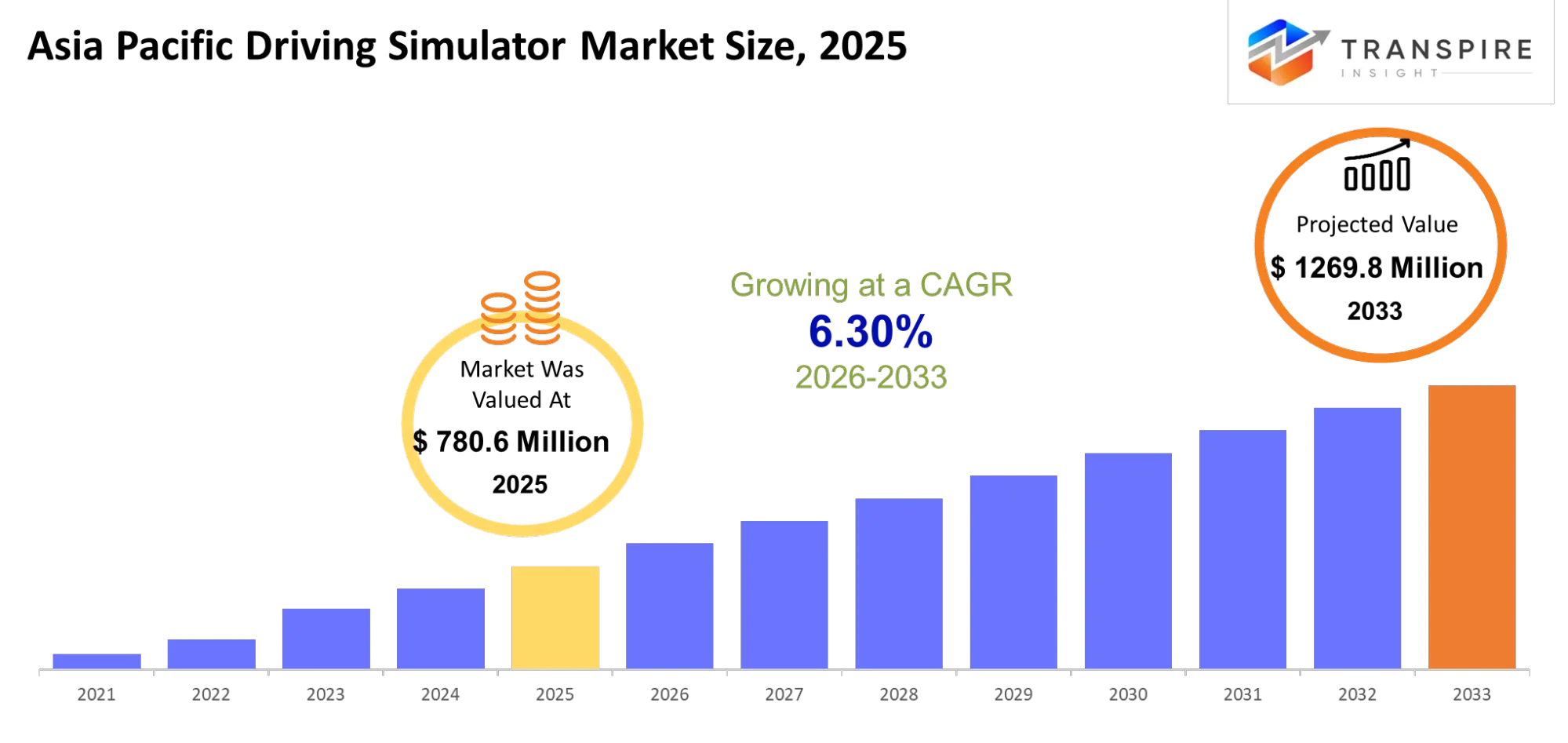
- Asia Pacific Driving Simulator Market Size 2025: USD 780.6 Million
- Asia Pacific Driving Simulator Market Size 2033: USD 1269.8 Million
- Asia Pacific Driving Simulator Market CAGR: 6.30%
- Asia Pacific Driving Simulator Market Segments: By Type (Compact Simulator, Full-scale Simulator, VR Simulator, AR Simulator, Desktop Simulator, Others); By Application (Automotive Training, Aviation Training, Marine Training, Research, Gaming, Others); By Component (Hardware, Software, Services, Displays, Motion Systems, Others); By End-User (Automotive OEMs, Training Institutes, Research Centers, Defense, Gaming Industry, Others)
To learn more about this report,  Download Free Sample Report
Asia Pacific Driving Simulator Market Summary:
The Asia Pacific Driving Simulator Market size is estimated at USD 780.6 Million in 2025 and is anticipated to reach USD 1269.8 Million by 2033, growing at a CAGR of 6.30% from 2026 to 2033.
The asia pacific driving simulator market within the broader simulation and mobility technology industry will represent a specialized space dedicated to creating authentic virtual driving environments which serve training, testing, and research activities. The demand for training solutions will shift because users want safer methods which provide controlled environments to practice driving skills in urban areas with high traffic density. Organizations will use digital simulation at increasing rates because it helps them manage training risks while creating uniform training programs.
The progression of technology will determine system capabilities because virtual reality and artificial intelligence together with data-driven feedback tools will enhance both accuracy and user interaction. Transportation and safety authorities will implement new regulations which will establish organized training procedures that encourage more organizations to use simulators. The design of simulation platforms will be affected by changing consumer demands for operational efficiency and safety which will require platforms to provide flexible systems and realistic experiences while maintaining cost efficiency to stay operational in the future.
What Has the Impact of Artificial Intelligence Been on the Asia Pacific Driving Simulator Market ?
The artificial intelligence revolutionizes the Asia Pacific driving simulator market through its impact on simulation system development and evaluation and implementation processes. The Asia Pacific driving simulator market uses artificial intelligence technology to execute advanced data processing which enables companies to monitor driver behavior and system performance and environmental responses in real time. The machine learning models conduct market research through their ability to identify usage patterns while they simultaneously optimize simulator settings according to specific industry requirements which leads to better results.
The Asia Pacific driving simulator market operations use artificial intelligence to enhance demand forecasting and trend analysis through its digital prediction tools. Businesses can forecast their training needs and technology adoption patterns and regional demand changes with enhanced accuracy. The ability to make smarter investment choices enables organizations to adapt their strategies according to emerging market developments. The production workflows of smart automation are optimized through its capacity to minimize human work and speed up software development and maintain uniform system operation on various simulation systems.
Artificial intelligence serves as the driving force for operational processes while it creates new business opportunities through personalized training programs and adaptive learning technologies that companies can use to maintain their competitive edge in the Asia Pacific driving simulator market. Supply chain optimization further reduces costs by streamlining component sourcing and inventory management. The growing use of artificial intelligence technology empowers businesses to create simulation products which are both intelligent and scalable and respond to market needs which strengthens their market position.
Key Market Trends & Insights:
- The asia pacific driving simulator market experiences consistent development because of increasing needs for driver training programs and autonomous vehicle testing facilities. The market is projected to grow at a CAGR of over 7.5% between 2024 and 2030.
- East Asia drives the asia pacific driving simulator market because it holds more than 40% market share which will reach 2025, with its automotive and technology industries backing its growth.
- Southeast Asia emerges as the fastest-growing region, with a projected CAGR above 8% through 2030 due to infrastructure development.
- The market for full-scale simulators accounts for almost 35% of total market share because users need extreme accuracy in their automotive and defense training programs.
- VR-based simulators rank as the second-largest segment, gaining traction for cost-effective and immersive training solutions.
- The AR and cloud-based simulators market sector operates as the fastest-growing segment which will experience rapid development between 2026 and 2030 because of its ability to deploy systems at various levels.
- The automotive training sector controls more than 45% of the market because people now understand the importance of road safety and because training requirements by regulations have increased.
- Automotive original equipment manufacturers control 38 percent of the market which they use to develop their products through simulation-based testing methods.
- Companies develop product innovation through AI-powered analytics and virtual reality technology to improve simulation performance and accuracy.
- The continuous investment in cloud platforms and modular systems provides organizations with a competitive advantage because these investments enable them to expand their operations while decreasing expenses.
Asia Pacific Driving Simulator Market Segmentation
By Type:
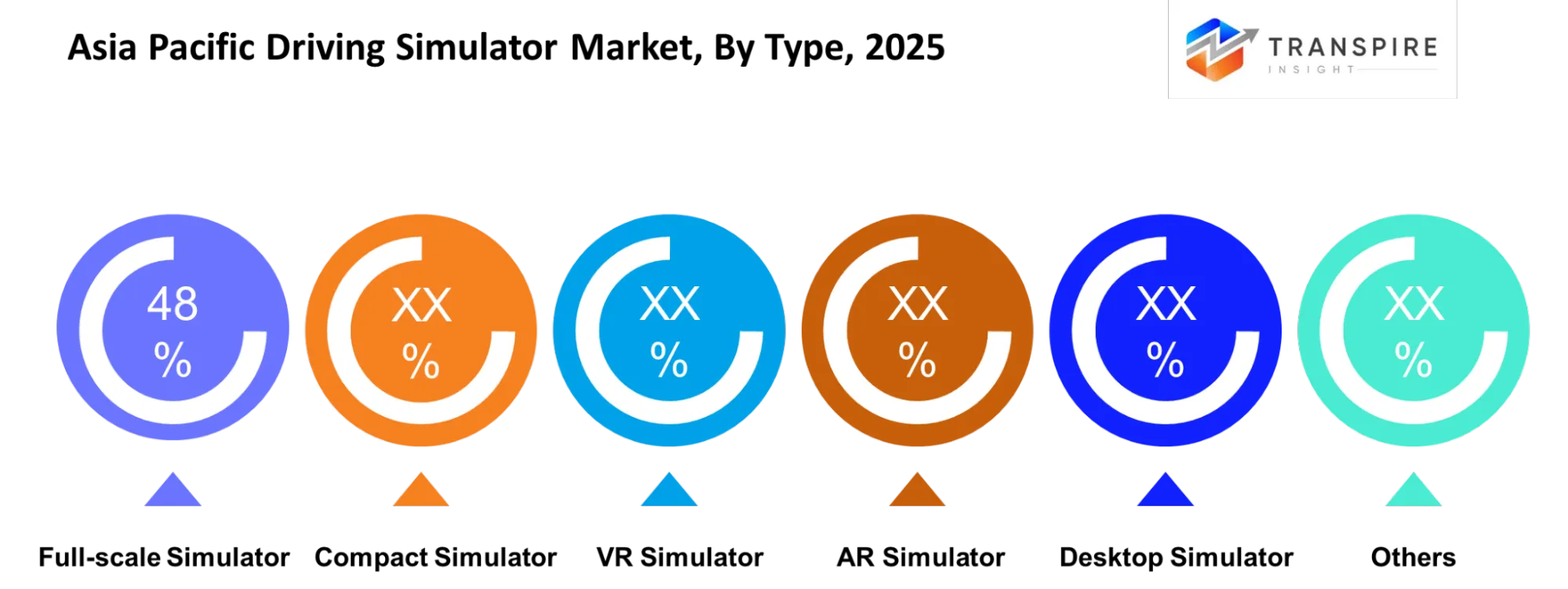
The study examines the Driving Simulator Market in the Asia Pacific region which operates through six types of simulators: Compact Simulator, Full-scale Simulator, VR Simulator, AR Simulator, Desktop Simulator, and Other simulators. Compact simulators will support basic training needs with lower cost and easy setup. Full-scale simulators will provide advanced testing through realistic and immersive testing environments. The VR and AR simulators will provide improved interactive capabilities whereas desktop systems will continue to function as basic entry-level systems. Demand across segments will change according to budget constraints and required training levels and specific needs of different industries.
To learn more about this report, Download Free Sample Report
By Application:
The Asia Pacific Driving Simulator Market examines its applications through six sectors which include Automotive Training, Aviation Training, Marine Training, Research, Gaming, and other functions. The automotive training sector will experience growth because of increasing safety requirements and driver skill assessment programs. Precision-based simulation will function as the primary training method which aviation and marine training programs use to prepare their personnel. The research and gaming industries will experience growth through advancements in technology and rising user participation. The segments will expand according to how different sectors implement their solutions and the continuous requirement for efficient and secure learning environments.
By Component:
The Asia Pacific Driving Simulator Market examines its components through six categories which include Hardware, Software, Services, Displays, Motion Systems, and Other elements. Hardware will include all essential physical components which create simulation environments and control systems which simulate physical environments. The software system will handle two main functions which include environmental modeling and performance tracking. The company provides maintenance support while display systems and motion systems create realistic simulation experiences for users. The system will achieve improved efficiency through component integration which enhances user experiences in all operational settings.
By End-User:
Asia Pacific Driving Simulator Market : By End-User (Automotive OEMs, Training Institutes, Research Centers, Defense, Gaming Industry, Others): Automotive OEMs will use simulators for product testing and development. Training institutes will focus on driver education and certification programs. Research centers will explore innovation, while defense and gaming sectors will adopt simulation for specialized training and entertainment. The segments will experience adoption growth because organizations prioritize safety measures and expense management and their need to assess performance.
What are the Main Challenges for the Asia Pacific Driving Simulator Market Growth?
The asia pacific driving simulator market experiences severe technical and operational issues which result in restricted system performance and reduced ability to grow. High-fidelity simulators need sophisticated hardware systems which can process data in real time and create precise models of their surroundings but these requirements create problems that lead to equipment failures and increased difficulty of repair work. The deployment process takes longer because of operational requirements which create higher expenses for users in the Asia Pacific driving simulator market.
The Asia Pacific driving simulator market faces manufacturing and commercialization obstacles because high production expenses and complicated system design needs create challenges. The process of obtaining regional safety certification requires additional time because companies have to navigate different regulations which exist in multiple countries. The market restrictions create obstacles for new businesses because they need to scale operations while offering their products at competitive rates.
The Asia Pacific driving simulator market faces significant adoption obstacles which continue to affect developing economies through the region. The absence of necessary infrastructure together with the shortage of qualified workers and financial limitations hinders extensive execution especially in public training institutions and government-operated programs. The growth of adoption in regions with budget restrictions experiences delays because of two main factors which are the low public understanding of systems and the lack of visibility for return-on-investment.
The asia pacific driving simulator market faces two major danger sources which come from competitive market dynamics and technological advancements. Training programs which use augmented reality and remote simulation training tools create pricing pressures which force companies to develop new products continuously. In a market with strong competition companies need to achieve cost savings while they implement technological improvements to stay competitive.
Regional Insights
The market maintains high demand throughout China Japan and South Korea because of automotive technological progress and government-supported safety initiatives. Driving simulation adoption will rise with increased focus on autonomous vehicle testing and structured driver training systems. East Asia operates with better infrastructure than Southeast Asia which grows at a stable pace through its upgrades in transportation systems and training development.
The market for driving simulators in Asia Pacific shows growth through two countries which are India and Southeast Asian nations. The rising logistics industry in Southeast Asian countries drives up the demand for commercial driver training programs. Simulation-based learning will support cost-effective and safe skill development across high-density traffic environments. Public-private partnerships will drive economic growth in South Asia while ASEAN countries will benefit from better infrastructure and cross-border transport projects.
Australia and the emerging economies of the region devote their resources to developing simulation technologies which serve both defense training and research purposes. The combination of increased funding and technology partnerships will create new opportunities for innovation through the development of regional solutions. Developed markets focus on high-end systems and research integration while developing areas adopt scalable and budget-friendly simulator solutions to expand accessibility.
Recent Development News
In March 2026, CAE Inc. launched a new Boeing 777X full-flight simulator at its Singapore training center, strengthening its simulation capabilities across Asia-Pacific and supporting advanced pilot training demand in the region. https://aviationworld.in
In March 2026, VI-grade announced event expansion, confirming strong industry participation and speaker line-up for its Smart Prototypes Summit 2026, highlighting growing adoption of simulation-driven vehicle development technologies across global and Asia-linked automotive ecosystems. https://www.vi-grade.com
|
Report Metrics |
Details |
|
Market size value in 2025 |
USD 780.6 Million |
|
Market size value in 2026 |
USD 828.2 Million |
|
Revenue forecast in 2033 |
USD 1269.8 Million |
|
Growth rate |
CAGR of 6.30% from 2026 to 2033 |
|
Base year |
2025 |
|
Historical data |
2021 - 2024 |
|
Forecast period |
2026 - 2033 |
|
Report coverage |
Revenue forecast, competitive landscape, growth factors, and trends |
|
Regional scope |
Asia Pacific ( China, India, Japan, South Korea, Australia, Rest of Asia Pacific) |
|
Key company profiled |
CAE Inc., Thales Group, L3Harris, VI-grade, Moog, Cruden, ECA Group, Tecknotrove, Ansible Motion, Bosch Rexroth, Siemens, NVIDIA, Honda, Toyota, Hyundai |
|
Customization scope |
Free report customization (country, regional & segment scope). Avail customized purchase options to meet your exact research needs. |
|
Report Segmentation |
By Type (Compact Simulator, Full-scale Simulator, VR Simulator, AR Simulator, Desktop Simulator, Others); By Application (Automotive Training, Aviation Training, Marine Training, Research, Gaming, Others); By Component (Hardware, Software, Services, Displays, Motion Systems, Others); By End-User (Automotive OEMs, Training Institutes, Research Centers, Defense, Gaming Industry, Others) |
How Can New Companies Establish a Strong Foothold in the Asia Pacific Driving Simulator Market ?
New entrants aiming to gain traction in the asia pacific driving simulator market must begin with focused niche targeting rather than broad competition. Companies can achieve their business goals when they choose commercial driver training and electric vehicle testing and smart city mobility projects as their primary focus areas. This approach enables businesses to create products which meet regulatory requirements while establishing simpler market entry processes which lead to quicker business expansion.
Technology differentiation remains a key success factor in the asia pacific driving simulator market. Startups that integrate virtual reality and AI-based driver behavior analytics and cloud-enabled simulation platforms will create solutions which are both scalable and cost-efficient. Emerging players like DriveSimTech and AutoVirt Labs are developing modular simulators which fleet operators and urban planners can use to decrease training expenses while enhancing their operational performance.
The asia pacific driving simulator market depends on strategic partnerships to establish credibility and accelerate market growth. Automotive OEMs and government agencies and training institutes provide companies with access to established networks which include long-term contracts. Companies that support smart infrastructure programs and public safety initiatives can establish themselves as vital players in industry development.
New companies need to address operational problems which involve high initial expenses and restricted regional availability and difficulties with system expansion in order to maintain their competitive edge. The company plans to strengthen customer adoption through flexible pricing options and regional simulation scenarios and ongoing software enhancements which will deliver continuous value to customers.
Key Asia Pacific Driving Simulator Market Company Insights
The automotive research and validation process creates high demand for simulation tools which manufacturers need to test advanced driver-assistance systems and autonomous features in their testing facilities. The industry adopts new technologies because businesses need to reduce costs while speeding up their product development processes in their main manufacturing locations. The leading companies compete by developing high-fidelity software products which enable real-time data connections to function while they build partnerships with original equipment manufacturers.
The driving simulator market in Asia Pacific experiences growth because commercial transport companies need driver training programs to meet safety regulations and address growing problems with accidents. The training centers use simulators to create realistic driving environments which help trainees practice their skills safely. The enhanced skill assessment method together with standardized evaluation procedures produces specific measurable results. The regional companies in the market compete through their provision of cost-effective products and their development of regional content together with their building of partnerships with government organizations to obtain permanent contracts.
The defense and logistics sector uses driving simulators for tactical training and fleet management purposes which makes driving simulators essential for their operations. Military training benefits from scenario-based virtual environments, while logistics firms use simulators to reduce fuel costs and operational errors. The training program enables organizations to train their entire workforce through its scalable deployment system. The market participants create steady revenue streams by investing in their custom solutions together with their long-term service contracts.
The Asia Pacific Driving Simulator Market needs virtual reality technologies together with artificial intelligence and cloud platforms to achieve better system performance and user access. Data-driven insights improve driver behavior analysis and predictive training outcomes. The company can achieve future development through its expansion into smart mobility ecosystems. Innovation-led firms establish a competitive edge through their ongoing system improvements and software-as-a-service business model and cross-industry partnership initiatives.
Company List
- CAE Inc.
- Thales Group
- L3Harris
- VI-grade
- Moog
- Cruden
- ECA Group
- Tecknotrove
- Ansible Motion
- Bosch Rexroth
- Siemens
- NVIDIA
- Honda
- Toyota
- Hyundai
What are the Key Use-Cases Driving the Growth of the Asia Pacific Driving Simulator Market ?
The asia pacific driving simulator market is expanding rapidly because automotive research and development organizations are starting to use driving simulators more frequently. Automakers use advanced driving simulators to evaluate their driver-assistance systems and self-driving technologies and user interface systems in secure testing environments. The process enables businesses to decrease their prototyping expenses while achieving faster product approval timelines which applies mainly to markets that drive innovation like Japan and South Korea and China.
Driver training and road safety programs serve as another essential application that supports the growth of the asia pacific driving simulator market. Governments and private training institutes are investing in simulators to enhance commercial driver education especially for heavy vehicles public transport and hazardous driving scenarios. The solutions allow users to practice driving during severe weather and high traffic conditions and emergencies which helps them prepare better while decreasing their likelihood of accidents.
The asia pacific driving simulator market is expanding because defense and logistics organizations need simulation-based training to achieve mission readiness and operational efficiency. Military organizations use advanced simulators for tactical vehicle training while logistics companies deploy them to optimize fleet performance and reduce operational risks.
The market will experience new growth opportunities because virtual reality integration and AI-driven behavioral analytics and cloud-based simulation platforms have emerged as new trends. The asia pacific driving simulator market will maintain its demand from public and private sectors because industries now focus on safety and cost-effective training programs that can expand their operations.
Asia Pacific Driving Simulator Market Report Segmentation
By Type
- Compact Simulator
- Full-scale Simulator
- VR Simulator
- AR Simulator
- Desktop Simulator
- Others
By Application
- Automotive Training
- Aviation Training
- Marine Training
- Research
- Gaming
- Others
By Component
- Hardware
- Software
- Services
- Displays
- Motion Systems
- Others
By End-User
- Automotive OEMs
- Training Institutes
- Research Centers
- Defense
- Gaming Industry
- Others
Frequently Asked Questions
Find quick answers to common questions.
The approximate Asia Pacific Driving Simulator Market size for the market will be USD 1269.8 Million in 2033.
Key segments for the Asia Pacific Driving Simulator Market are By Type (Compact Simulator, Full-scale Simulator, VR Simulator, AR Simulator, Desktop Simulator, Others); By Application (Automotive Training, Aviation Training, Marine Training, Research, Gaming, Others); By Component (Hardware, Software, Services, Displays, Motion Systems, Others); By End-User (Automotive OEMs, Training Institutes, Research Centers, Defense, Gaming Industry, Others).
Major Asia Pacific Driving Simulator Market players are CAE Inc., Thales Group, L3Harris, VI-grade, Moog, Cruden, ECA Group, Tecknotrove, Ansible Motion, Bosch Rexroth, Siemens, NVIDIA, Honda, Toyota, Hyundai.
The Asia Pacific Driving Simulator Market size is USD 780.6 Million in 2025.
The Asia Pacific Driving Simulator Market CAGR is 6.30%.
- CAE Inc.
- Thales Group
- L3Harris
- VI-grade
- Moog
- Cruden
- ECA Group
- Tecknotrove
- Ansible Motion
- Bosch Rexroth
- Siemens
- NVIDIA
- Honda
- Toyota
- Hyundai
Recently Published Reports
-
Apr 2026
ATV & UTV Market
ATV & UTV Market Size, Share & Analysis Report By Type (ATV, and UTV), By Variants (Less Than 400 CC, 400 CC To 800 CC, and More Than 800 CC), and Geography (North America, Europe, Asia-Pacific, Middle East and Africa, South and Central America), 2021 - 2031
-
Apr 2026
Automotive Central Gateway Module Market
Automotive Central Gateway Module Market Size, Share & Analysis Report By Type (Ethernet Central Gateway Module, CAN Central Gateway Module, LIN Central Gateway Module, and FlexRay), By Application (Powertrain Control, Body Control, Infotainment System, Advanced Driver Assistance Systems (ADAS), and Others), By End User (Passenger Vehicles, and Commercial Vehicles), and Geography (North America, Europe, Asia-Pacific, Middle East and Africa, South and Central America), 2021 - 2031
-
Apr 2026
Automotive Engine Oil Filter Market
Automotive Engine Oil Filter Market Size, Share & Analysis Report By Filter Type (Fuel Filter, Engine Oil Filter, Hydraulic Oil Filter, and Others), By Filter Media (Cellulose, Synthetic, and Micro), By Sales Channel (OEMs, and Aftermarket), By Vehicle Type (Passenger Cars, Light Commercial Vehicles, Heavy Duty Trucks, Buses and Coaches, and Off-road Vehicles), and Geography (North America, Europe, Asia-Pacific, Middle East and Africa, South and Central America), 2021 - 2031
-
Apr 2026
Automotive Parts Aluminium Die Casting Market
Automotive Parts Aluminium Die Casting Market Size, Share & Analysis Report By Production Process (Pressure Die Casting, Vacuum Die Casting, Squeeze Die Casting, Gravity Die Casting), By Application (Body Parts, Engine Parts, Transmission Parts, Battery And Related Components, Other Application Types), and Geography (North America, Europe, Asia-Pacific, Middle East and Africa, South and Central America), 2021 - 2031
Our Clients