

Asia Pacific Condom Market Size & Forecast:
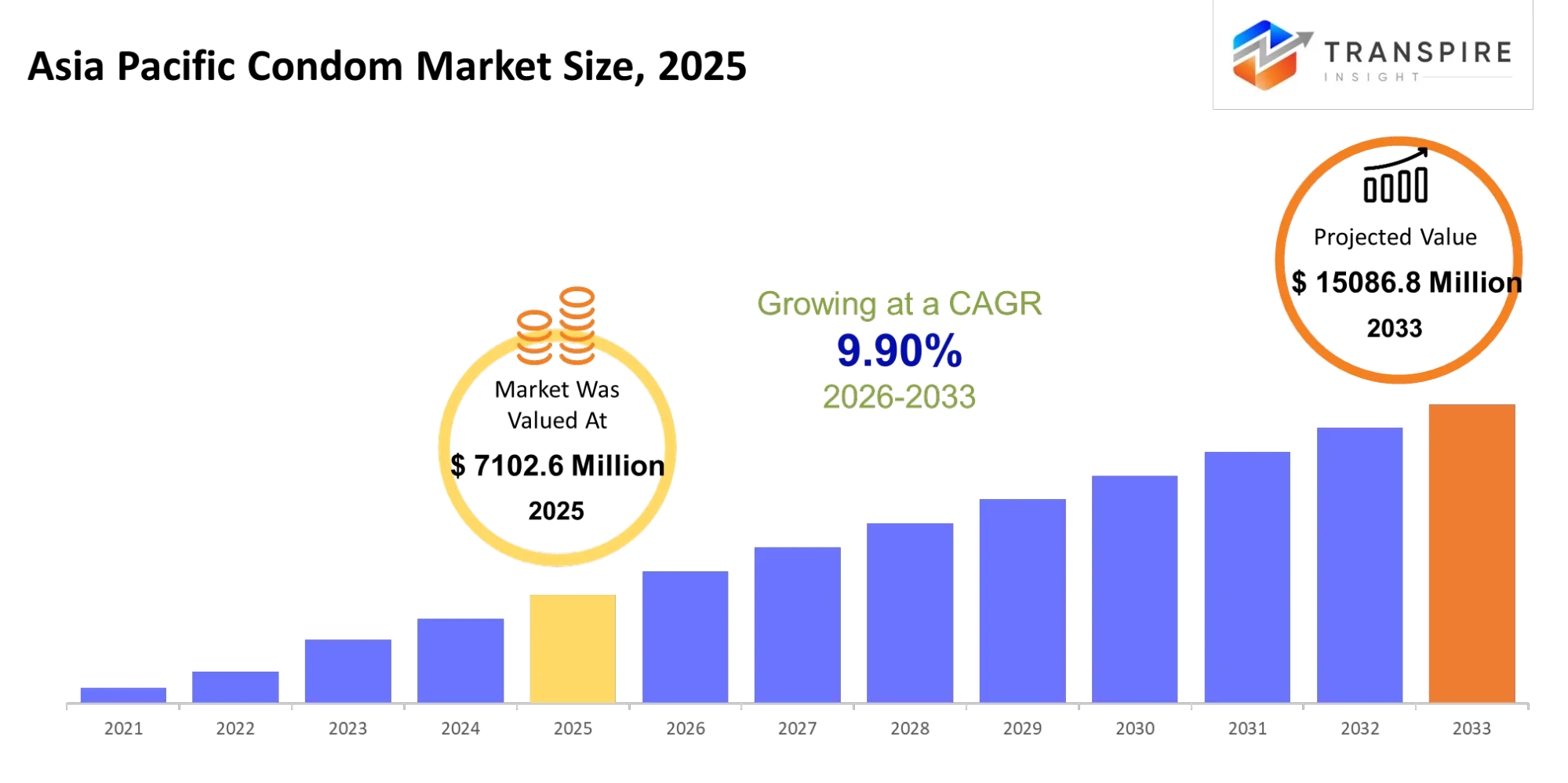
- Asia Pacific Condom Market Size 2025: USD 7102.6 Million
- Asia Pacific Condom Market Size 2033: USD 15086.8 Million
- Asia Pacific Condom Market CAGR: 9.90%
- Asia Pacific Condom Market Segments: By Product Type (Male Condoms, Female Condoms, Flavored Condoms, Textured Condoms, Latex-Free Condoms, Others); By Distribution Channel (Pharmacies, Supermarkets, Online Retail, Convenience Stores, Others); By Material (Latex, Polyurethane, Polyisoprene, Others); By End User (Men, Women, Couples, Others)
Asia Pacific Condom Market Summary
To learn more about this report,  Download Free Sample Report
The Asia Pacific Condom Market was valued at USD 7102.6 Million in 2025. It is forecast to reach USD 15086.8 Million by 2033. That is a CAGR of 9.90% over the period.
Asia Pacific condom market is a first-line public health and sexual health supply chain, through providing barrier protection devices to women/men through the retail pharmacy and health clinics as well as the NGOs and online stores. For the last 3-5 years, it has been undergoing transition from purely offline with the support of clinic driven distribution to on/offline integration with significant expansion of e-commerce, direct to consumer sales channel through internet and mobile devices and penetration into the urban and semi-urban segments and also the convenience and privacy issues. Structural evolution also led to a shift toward value-added products, including ultra-thin, non-latex condoms, responding to the demand for increased consumer comfort and sensation. COVID-19 acted as a critical real-world stressor and catalyst, interrupting the clinic-led supply system and global distribution but rapidly increasing e-commerce purchases. Consequently, manufacturers and distributors adapted their supply and packaging networks for a more stable availability and wider product range, building momentum for commercial adoption in emerging and existing urban segments.
Key Market Insights
- East Asia is estimated to be leading the Asia Pacific Condom Market by acquiring a share of approximately 40% in the year 2025 owing to its large-scale manufacturing base and high density of urban population.
- The fastest growing region for Asia Pacific Condom Market is expected to be Southeast Asia over the period 2025-2030 driven by tourist revivals and increasing penetration of retail pharmacies.
- Rising contribution of India toward the growth of Asia Pacific Condom Market is expected due to expansion of government led distribution and digital retailing channels.
- Latex condoms hold the largest share in the Asia Pacific Condom Market, capturing nearly more than 70% due to the bulk production scale and affordability.
- Ultra thin condoms hold the second largest share driven by increasing premiumization of consumers in urban clusters.
- Non-latex and hypoallergenic condom-the segment with highest growth during (2025-2030), with the increase in awareness regarding hypersensitivity to condoms.
- Preventing pregnancy; still the largest application with more than 55% share in the Asia Pacific Condom Market.
- Preventing STIs in the high-risk groups is the fastest growing application, driven by the NGO programs promoting awareness on STI.
- Retail pharmacy leads distribution channels with almost 45% share, driven by reliability and ready availability of condoms.
- Online channels-fastest growing end-user channel, driven by privacy concern of the customers
What are the Key Drivers, Restraints, and Opportunities in the Asia Pacific Condom Market?
The main drivers for the Asia Pacific Condom Market are increasing digital/pharmacy distribution, which took off significantly following the Covid-19 pandemic and disruptions to clinic access and retail channels. Governments and NGOs, especially in India and Southeast Asia, significantly increased purchase schemes, which fueled constant institutional purchasing. This smoothed volumes significantly and dampened seasonality directly impacting revenue stability for producers through wider reach.
Key constraints are ongoing cultural sensitivity and lack of comprehensive sex education in parts of Asia Pacific's markets. This systemic constraint limits explicit purchasing and depth of the category across rural and conservative communities which leads to sub-par per-capita purchases relative to available supply. This also limits marketing effectiveness and brands' ability to market and position themselves more directly in front of the target consumer.
Key opportunity is the burgeoning e-commerce-led discreet delivery channel infrastructure, especially in India, Indonesia, and Vietnam, where swift adoption of digital payments has transformed consumer behavior. Subscription models and telehealth integrated distribution channels are in early stage development which has the potential to drive recurrent purchase cycles and, thus, expand volumes long-term.
What Has the Impact of Artificial Intelligence Been on the Asia Pacific Condom Market?
AI has been revolutionizing the APAC condom market in terms of production efficiencies, demand predictions and e-commerce personalization. In manufacturing operations, the adoption of AI-based vision systems helps with automated detection of defects with increased accuracy, decreasing batch rejection rate and enabling immediate identification of microscopic flaws or tears in the product.
Predictive analytics models are now widely employed within supply chain operations to effectively predict the variation in demand patterns across both urban and rural segments in the country, resulting in higher inventory turnover and significantly reduced stock-out in peak seasons. From the commercial perspective, ML algorithms have revolutionized e-commerce through a better understanding of customer purchasing patterns, facilitating the implementation of custom product bundling or discreet promotional tactics which result in increased sales.
Logistics optimization tools also help with warehouse efficiency and faster last-mile deliveries in urban areas of Asia. The high integration cost associated with new-age AI systems remains a challenge, particularly for medium sized manufacturers in the Asia Pacific region. Additionally, fractured data across systems hinder the overall accuracy and efficiency of these models in prediction.
Key Market Trends
- E-commerce share within Asia Pacific Condom Market escalated above 25% between 2021-2025 influencing and altering discreet purchase behavior of urban consumers.
- Post 2020, manufacturers diverted from regular latex SKUs to ultra-thin models, achieving approximately 18% faster shelf turnover on premium products regionally.
- Post 2022 deregulation, India expanded government procured condoms increasing the volume of institutional distribution volumes across public health segments.
- Rapid proliferation of retail pharmacy networks in Southeast Asia during 2023 closed rural access gaps and faster first-time condom usage for young adults.
- From 2021, local manufacturing has expanded with increased supply chain limitations among players, Karex Berhad among them with increased production capacity in Malaysia.
- Growing concerns for digital privacy boosted anonymous packaging & subscription-based models by 30% between 2020-2024 across Asia Pacific.
- Direct-to-consumer penetration was boosted by digital partnerships for Reckitt & peers with e-commerce platforms throughout 2024.
- Increased demand for comfort-driven materials led to a significant rise in the usage of non-latex condoms post 2022 due to allergies.
- Government & NGO led campaigns targeting STI prevention increased preventive health related purchases instead of recreational ones in the Asia Pacific Condom Market by 2025.
Asia Pacific Condom Market Segmentation
By Product Type:
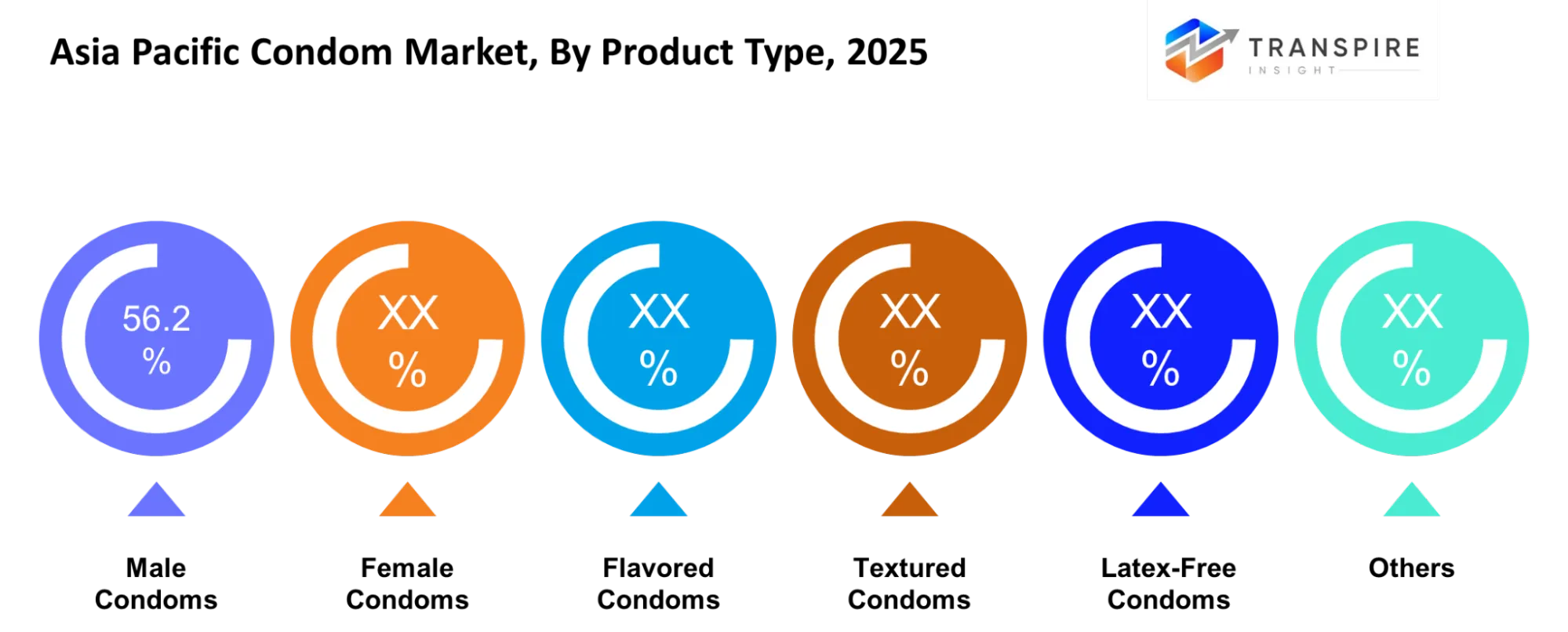
Male condoms will continue to remain a top sold category across Asia Pacific owing to being inexpensive, readily available, and a widely accepted product by various public health programs. Sales would continue to remain flat both in urban and rural channels. Female condoms, flavored and textured variants, latex-free variants and others to supplement evolving consumer demands.
Male condoms maintain a commanding presence in sales by pharmacies and through institutional supply chains on account of assured supply and lower price points. Sales of female condoms continue to grow at a moderate pace with aided consumer awareness in select economies. Flavored and textured condoms register rising demand among the youth while latex-free products take off due to health related reasons and growing comfort driven purchase considerations in urban markets.
To learn more about this report, Download Free Sample Report
By Distribution Channel:
Pharmacies dominate in sales due to the higher consumer trust in selling pharmaceuticals in conjunction with a personalized service and prompt consumer guidance at the point of purchase. Supermarkets provide consistent volume growth by the virtue of sheer visibility and convenience to consumers. The channel also registers rapid sales through online mediums which cater to buyer needs for a private purchase and home delivery. Convenience stores and others tap on the impulse buy behaviour among consumers.
The pharmacy remains at the core of sales due to its link with pharmaceuticals and accessibility of the product across all the cities and semi urban pockets. Supermarkets also offer volumes on the strength of packaged product visibility, integrated with retail offers. The sales of online channels is to grow at a faster pace and influenced by user concern over a discrete buy; while convenience stores cater to the urban impulsive purchases in and around metropolitan locations.
By Material:
Latex is preferred for cost and stretch properties, and the massive Asian Pacific production capacity. Polyurethane and polyisoprene will take market share with latex-sensitive users. Other specialty materials are needed for specific use cases with specific consumer needs.
Latex remains the leading material as there is a massive Asian production base and general health authority procurement. Polyurethane condoms are becoming more popular in premium segments due to their thinness and heat transfer; polyisoprene condoms are gaining share with latex-sensitive consumers. Other materials are used on a limited basis in select markets to fulfill specific consumer needs (e.g. Comfort, sensitivity, endurance).
By End User:
The primary end-user segment remains male users, given ownership and control over product usage, as well as ease of access through retail and institutions. The role of women is increasing due to access to products via awareness and public health systems. Couples and other users will play more of a part in family planning and safe sex initiatives in urban areas.
The leading end-user segment remains male, owing to tradition and product accessibility. The usage share of women is increasing with awareness and accessibility to female condoms. Couples are increasingly a major part in the decision-making process for safe sex practices in urban locations due to increasing shared decision-making and growing access to condoms of both male and female use.
What are the Key Use Cases Driving the Asia Pacific Condom Market?
Primary use in AP Condom Market focuses on protection from pregnancy and STIs through outlets like pharmacies, clinics, and government channels. Usage is sustained by the affordable, barriers nature of the product and inclusion in public health systems, in both urban and rural areas.
Expanded use can be seen in covert purchases via e-commerce and subscription wellness services for urban couples and young individuals. NGO campaigns and school based health programs are pushing uptake in India and Southeast Asia, reinforcing use for prevention among secondary target groups.
Future use cases are emerging around models that include distribution in sync with telehealth, automatic refill systems and smart vending machines in universities and transport hubs, at-home wellness kits combined with digital doctor consultations and insurance based preventive care.
|
Report Metrics |
Details |
|
Market size value in 2025 |
USD 7102.6 Million |
|
Market size value in 2026 |
USD 7791.3 Million |
|
Revenue forecast in 2033 |
USD 15086.8 Million |
|
Growth rate |
CAGR of 9.90% from 2026 to 2033 |
|
Base year |
2025 |
|
Historical data |
2021 - 2024 |
|
Forecast period |
2026 - 2033 |
|
Report coverage |
Revenue forecast, competitive landscape, growth factors, and trends |
|
Regional scope |
Asia Pacific (India, China, Japan, Australia, South Korea, Rest of Asia Pacific) |
|
Key company profiled |
Durex, Okamoto, Trojan, SKYN, Mankind, Karex, Sagami, Fuji Latex, LifeStyles, Sir Richard's, Kimono, Playboy, Trustex, ONE Condoms, Pasante |
|
Customization scope |
Free report customization (country, regional & segment scope). Avail customized purchase options to meet your exact research needs. |
|
Report Segmentation |
By Product Type (Male Condoms, Female Condoms, Flavored Condoms, Textured Condoms, Latex-Free Condoms, Others); By Distribution Channel (Pharmacies, Supermarkets, Online Retail, Convenience Stores, Others); By Material (Latex, Polyurethane, Polyisoprene, Others); By End User (Men, Women, Couples, Others) |
Which Regions are Driving the Asia Pacific Condom Market Growth?
The East Asia region is still dominant in the Asia Pacific Condom Market owing to its solid manufacturing base and mature health care procurement channels. China holds a significant share of overall production and distribution with its vertically integrated manufacturing and pharmacy and drug store distribution channels while Japan and South Korea influence via high value purchase segment and reliable product quality. An evolved regulatory framework together with mature retail distribution is helping steady supply of condoms in the region, mostly in urban areas.
South Asia, which is headed by India, holds an equally important and stable position in the Asia Pacific Condom Market with an entirely different set of market dynamics and demand drivers from East Asia. It relies largely on population coverage and a well established governmental framework that focuses on family planning and public health. Expansion of the distribution networks to cover even small rural areas with a network of rural clinics and local pharmacies is enhancing stable availability. Unlike East Asia the demand is more driven from institutional buyers.
The Southeast Asia region is emerging as the quickest developing segment within the Asia Pacific Condom Market due to rapid modernization of the retail segments and accelerating use of e-commerce as a part of a growing number of purchasing journeys. Countries like Indonesia, Vietnam and Philippines have seen growth in their pharmacy networks and digital payments over the last few years while a recovering tourist sector and evolving urban lifestyle have also increased the discretionary purchases of condoms. Thus this region will offer many opportunities to manufacturers and e-retailers between 2026-2033.
Who are the Key Players in the Asia Pacific Condom Market and How Do They Compete?
At the top level, the Asia Pacific Condom Market is moderately concentrated, while supply at mid level is dominated by various regional suppliers and private label manufacturers. Global players compete based on product development, security standards and discrete channel positioning, whereas local companies emphasize cost advantages and local supply chains. The proliferation of digital retail outlets has shifted the competitive space to focus more on product packaging, assurances on privacy and promptness in delivery, in addition to cost efficiency.
Karex Berhad expands through contract manufacturing on an extensive scale and its cost leadership derived from efficient and high-volume production. It provides service to major global brands and private labels by leveraging direct access to large-scale rubber supply in Malaysia that helps moderate raw material costs. Okamoto Industries' competitiveness lies in advanced material technology aimed at developing a premium ultra-thin and comfortable product for urban dwellers demanding greater sensitivity and pleasure. Its market strategy involves brand-driven retail growth within Japan and its expanding exports throughout Southeast Asia.
Reckitt competes through powerful brand image and penetration of pharmacies, predominantly in urban areas of high health awareness in Asia. Church & Dwight relies on mass-market pricing tactics and wide reach in retail channels for sales growth in various economies in Asia Pacific at a high volume. Thai Nippon Rubber Industry competes primarily on OEM production and export orientation, building supply partnerships with international distributors and expanding production volume in response to increasing demand from Southeast Asian markets.
Company List
- Durex
- Okamoto
- Trojan
- SKYN
- Mankind
- Karex
- Sagami
- Fuji Latex
- LifeStyles
- Sir Richard's
- Kimono
- Playboy
- Trustex
- ONE Condoms
- Pasante
Recent Development News
In April 2026, Karex Berhad announced a price adjustment plan of up to 30% for condoms and related products. The company cited surging raw material and logistics costs driven by energy market volatility and shipping disruptions affecting Asia Pacific supply chains. The move signals a shift toward cost-pass-through pricing, reshaping procurement contracts across global health and retail buyers. Sourcehttps://www.ft.com/
In May 2026, Mankind Pharma indicated potential price increases for its condom portfolio due to rising petroleum-linked input costs. The company highlighted sustained crude oil volatility as a key pressure point impacting packaging and latex processing economics. This development reflects a broader shift among Indian manufacturers toward dynamic pricing strategies rather than fixed-margin retail positioning. Source https://www.reuters.com/
What Strategic Insights Define the Future of the Asia Pacific Condom Market?
Asia Pacific Condom Market is structurally moving toward a digitally mediated, privacy-first consumption trend driven by rapidly growing e-commerce infrastructure and holistic sexual wellness ecosystems. Product accessibility will play a secondary role in growth over the next 5-7 years, while brand immersion and establishment within online health platforms, subscription services and last-mile discrete delivery infrastructure will be key. These trends reflect increasing changes in consumption habits among urban Asian consumers where privacy and convenience take precedence over traditional pharmacy-based purchasing trends.
A less obvious risk includes the concentration of raw materials, especially reliance on natural rubber supply in Malaysia and Thailand. This raw material base is vulnerable to climate fluctuations or export restrictions which could spike production costs and create inconsistent pricing among regional players. Concurrently, a strong emerging opportunity is being built on top of telehealth and directly fulfilled contraceptives and contraception across India and Southeast Asia.Companies that leverage this trend will want to build digital health partnerships rather than retail scale in a platform distribution system.
Asia Pacific Condom Market Report Segmentation
By Product Type
- Male Condoms
- Female Condoms
- Flavored Condoms
- Textured Condoms
- Latex-Free Condoms
By Distribution Channel
- Pharmacies
- Supermarkets
- Online Retail
- Convenience Stores
By Material
- Latex
- Polyurethane
- Polyisoprene
By End User
- Men
- Women
- Couples
Frequently Asked Questions
Find quick answers to common questions.
The Asia Pacific Condom Market size is USD 15086.8 Million in 2033.
Key segments for the Asia Pacific Condom Market are By Product Type (Male Condoms, Female Condoms, Flavored Condoms, Textured Condoms, Latex-Free Condoms, Others); By Distribution Channel (Pharmacies, Supermarkets, Online Retail, Convenience Stores, Others); By Material (Latex, Polyurethane, Polyisoprene, Others); By End User (Men, Women, Couples, Others).
Major Asia Pacific Condom Market players are Durex, Okamoto, Trojan, SKYN, Mankind, Karex, Sagami, Fuji Latex, LifeStyles, Sir Richard's, Kimono, Playboy, Trustex, ONE Condoms, Pasante.
The Asia Pacific Condom Market size is USD 7102.6 Million in 2025.
The Asia Pacific Condom Market CAGR is 9.90% from 2026 to 2033.
- Durex
- Okamoto
- Trojan
- SKYN
- Mankind
- Karex
- Sagami
- Fuji Latex
- LifeStyles
- Sir Richard's
- Kimono
- Playboy
- Trustex
- ONE Condoms
- Pasante
About the Authors

Chetan Dhatrak
I’m Chetan Dhatrak, a Senior Research Analyst at Transpire Insight, specializing in the Consumer Goods, Foods and Beverages industry. I focus on analyzing market trends, consumer behavior, competitive landscapes, and industry developments to deliver accurate, data-driven insights. My research at Transpire Insight is built on credible sources and in-depth analysis, helping businesses and readers better understand market dynamics, emerging opportunities, and evolving consumer preferences. I’m committed to creating reliable, well-researched content that supports informed decision-making and reflects the latest developments in the consumer goods and food & beverage sectors.

Chakradhar Khansole
Chakradhar serves as the Research Director at Transpire Insight, bringing over 8 years of experience in technology, innovation, and strategic market intelligence. He specializes in transforming complex market data into actionable business insights that enable organizations to make informed, growth-oriented decisions. Recognized for his strategic vision and analytical expertise, Chakradhar leads high-impact research initiatives, delivering comprehensive market assessments, competitive intelligence, and forward-looking industry analysis.
Recently Published Reports
-
Apr 2026
Bottled Water Market
Bottled Water Market Size, Share & Analysis Report By Product Type (Still Bottled Water, Carbonated Bottled Water, Functional Bottled Water, and Others), By Packaging (PET, Cans, and Others), By Sales Channel (Supermarkets/Hypermarkets, Convenience Stores/Drug Stores, Grocery Stores/Club Stores, Foodservice, and Others) and Geography (North America, Europe, Asia-Pacific, Middle East and Africa, South and Central America), 2021 - 2032
-
Apr 2026
Color Cosmetic Packaging Market
Color Cosmetic Packaging Market Size, Share & Analysis Report By Application (Mascara Packaging, Liquid Packaging, and Liquid Face), By Type (Tubes & Bottles, Pens & Markers, Compacts & Containers, and Droppers & Pumps), and Geography (North America, Europe, Asia-Pacific, Middle East and Africa, South and Central America), 2021 - 2031
-
Apr 2026
External Microphone For Camera Market
External Microphone For Camera Market Size, Share & Analysis Report By Type (Shotgun Microphone, Lavalier Microphone, and Others), By Application (Digital Camera, Professional Video Camera, and Others), and Geography (North America, Europe, Asia-Pacific, Middle East and Africa, South and Central America), 2021 - 2031
-
Apr 2026
Foot Orthotic Insoles Market
Foot Orthotic Insoles Market Size, Share & Analysis Report By Type (Pre-fabricated, and Custom-made), By Material (Thermoplastic, Composite Carbon Fiber, and Others), By Distribution Channel (Drug Stores, Hospitals & Clinics, and Others), and Geography (North America, Europe, Asia-Pacific, Middle East and Africa, South and Central America), 2021 - 2031