
Asia Pacific Compliance as a Service Market Size & Forecast:
- Asia Pacific Compliance as a Service Market Size 2025: USD 1.39 Billion
- Asia Pacific Compliance as a Service Market Size 2033: USD 3.96 Billion
- Asia Pacific Compliance as a Service Market CAGR: 14.03%
- Asia Pacific Compliance as a Service Market Segments: By Service Type (Regulatory Compliance, Risk Management, Audit Management, Data Protection Compliance, ESG Compliance, Financial Compliance, Policy Management, Others); By Deployment (Cloud, On-Premise, Hybrid, SaaS Platforms, Private Cloud, Multi-Tenant Platforms, Managed Services, Others); By Organization Size (Large Enterprises, SMEs, Startups, Government Organizations, Financial Institutions, Healthcare Organizations, Educational Institutions, Others); By End User (BFSI, Healthcare, Retail, Manufacturing, IT & Telecom, Government, Energy & Utilities, Others)
Asia Pacific Compliance as a Service Market Summary
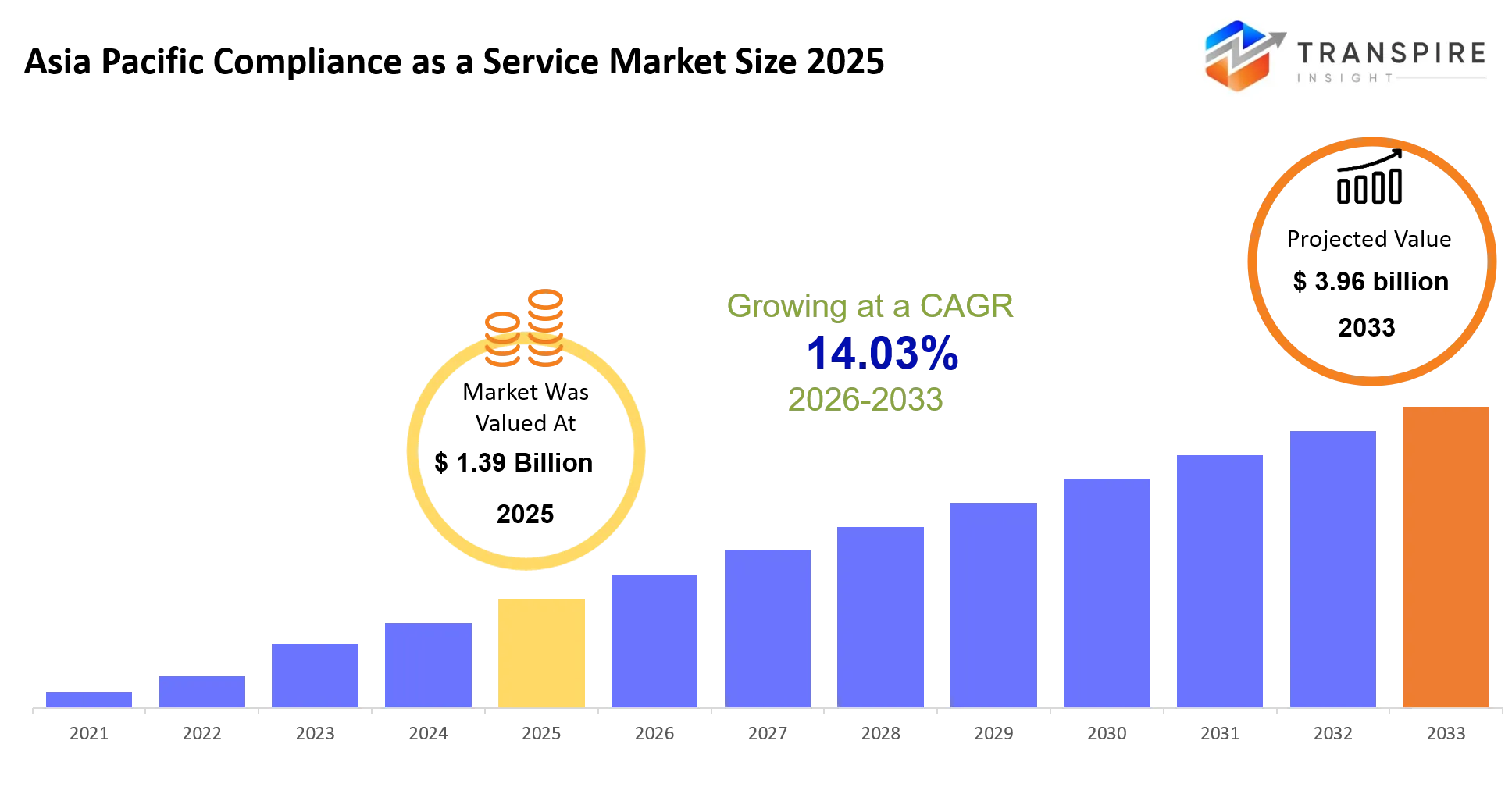
The Asia Pacific Compliance as a Service Market was valued at USD 1.39 billion in 2025. It is forecast to reach USD 3.96 billion by 2033. That is a CAGR of 14.03% over the period.
The Asia Pacific Compliance as a Service Market helps organizations by keeping track of obligations automating audit readiness and managing risk reporting across sectors such as finance, healthcare and public administration. In terms it replaces manual compliance tracking systems with cloud-based platforms. These platforms flag violations, standardize documentation. Ensure organizations meet changing legal and security requirements.Organizations use Compliance as a Service to avoid having internal compliance teams. Over the few years there has been a big change in how compliance is managed. Companies are now using native governance platforms. This change has moved compliance from audits to real-time monitoring.
Stricter data protection laws and cross-border data transfer rules have driven this change. These laws require visibility into compliance status. The increase in cybersecurity incidents and regulatory penalties has also played a role. Many enterprises and governments have adopted compliance frameworks. This helps reduce risk.As a result there is a growing demand for Compliance as a Service solutions. These solutions use AI-driven monitoring to enable reporting. They also reduce oversight costs and improve regulatory accuracy. The Compliance as a Service Market is growing rapidly. More organizations are looking for Compliance as a Service solutions to manage their compliance needs.
Key Market Insights
- The Asia Pacific Compliance as a Service Market now focuses on compliance monitoring instead of periodic audits. This change reduces delays in reporting. Lowers operational risk.
- Big companies made up more than 45% of the market's revenue in 2025. This is because they have to follow complex regulations across different jurisdictions.
- Cloud-based compliance platforms are leading with 55% of the market share. They are popular because they are cheaper to set up and can be implemented quickly.
- Financial services are still the users of compliance services. They make up over 30% of the demand because they have to meet regulatory requirements.
- Between 2025 and 2033 risk and compliance management solutions grew the fastest. This is because companies have to follow governance rules.
- medium-sized businesses started using subscription-based compliance services more often after 2023. This way they don't have to build internal compliance teams.
- AI-powered tools for intelligence reduced the workload of manual reviews by 30-40%. This improves audit readiness. The accuracy of reports.
- Companies like Thomson Reuters, Wolters Kluwer, OneTrust, NAVEX and MetricStream are working on products. They are focusing on automated controls and tracking regulations in time.
- Partnerships between compliance software providers and cloud vendors are helping to deploy compliance services. This is happening across industries that're heavily regulated and in the public sector.
- The Asia Pacific Compliance, as a Service Market is seeing a lot of investment in platforms that combine governance, risk and compliance. These platforms also handle cybersecurity, privacy and regulatory management.
What are the Key Drivers, Restraints, and Opportunities in the Asia Pacific Compliance as a Service Market?
Driver
The Asia Pacific Compliance as a Service Market is growing fast because of rules on data protection, cybersecurity and financial reporting. These rules are changing often. Are different in various industries and places. This makes it hard for organizations to follow them manually. They are now using cloud-based platforms to help with compliance. These platforms automate tasks like monitoring policies, collecting evidence, preparing for audits and reporting. This change is increasing revenue for software companies. Creating demand for managed compliance services. Financial institutions, healthcare providers and government organizations are looking for these services.
Restraint
The biggest problem is that regulations are different across the region. Compliance requirements vary between industries and authorities. This makes it hard for service providers to integrate and customize their services. The problem is likely to persist because regulations are unlikely to become uniform. Vendors have to update their platforms and customers need industry-specific configurations. This increases costs, delays deployment. Slows adoption among small and medium-sized businesses.
Opportunity
There is an opportunity in AI-powered platforms that can interpret new regulations and map them to internal controls. Large companies are investing in governance, risk and compliance ecosystems that combine cybersecurity, privacy and operational risk management. Companies that offer automated compliance monitoring, predictive risk analytics and continuous control testing will be well-positioned to grow as digital governance requirements become more complex. Compliance, as a Service Market will see growth.
What Has the Impact of Artificial Intelligence Been on the Asia Pacific Compliance as a Service Market?
Artificial intelligence is really changing how companies handle compliance management. It is replacing the way of doing things with manual reviews. Now companies use monitoring and automated control validation.AI platforms can scan updates from regulators, map requirements to the company's internal policies and find compliance gaps across the business. This all happens automatically. Natural language processing tools can review contracts and other documents in minutes. This used to take days. It reduces the amount of work and makes reports more accurate.AI also helps with workflow. It streamlines the process of collecting evidence and getting ready for audits. This helps companies stay compliant all year round.
Machine learning models are also being used to predict compliance risks. These models look at what happened in the past, how employees behave and what is going on with the business. They use this information to find areas that might have compliance problems. This helps companies focus their resources on the things that need the attention.Companies that use AI for compliance say they have audit cycles, better reporting, lower costs and better governance.Cloud platforms are also making things more efficient. They provide a place to see what is going on across the company. However it can be expensive to connect AI systems to software and data sources. The data might also not be very good. Regulations can change. This means the models need to be updated all the time to make sure they are working correctly.AI and compliance management are closely linked. Compliance management is a part of what companies do. Artificial intelligence is helping with compliance management in ways. It is making things easier and more efficient. Compliance management and artificial intelligence are the future.
Key Market Trends
- Since 2022 companies have started to use automated platforms for compliance tracking of spreadsheets. This helps them monitor regulations in time and be ready for audits.
- Financial institutions are using compliance tools that are powered by intelligence. These tools reduce the need for reviews by up to 40 percent and also improve the accuracy of reports.
- Companies prefer to use cloud-based compliance solutions over systems that are based on premises. This is because they want to get updates on regulations and reduce the costs of maintenance.
- After 2021 new rules about data privacy were introduced. This led to companies in the healthcare, finance and public sectors using continuous control monitoring.
- Companies are combining governance, risk and compliance functions into one platform. They do not want to manage compliance tools anymore.
- Thomson Reuters, NAVEX and OneTrust have improved their intelligence capabilities using artificial intelligence. This helps to automate policy mapping and compliance assessments.
- Managing third-party risks has become a priority. This is because supply chain disruptions have shown that companies are vulnerable when it comes to compliance.
- The time given to submit reports has been reduced in many industries. This is why companies are investing in technologies that automate the collection of evidence and workflow.
- Between 2023 and 2025, small and medium enterprises have started to use subscription-based compliance services. This helps them avoid having teams for compliance internally.
- The focus has shifted from complying with rules to using predictive risk analytics testing automated controls and having continuous assurance capabilities. Compliance is not about following rules, it is about being proactive and using compliance as a strategic advantage for companies, like Thomson Reuters, NAVEX and OneTrust and other compliance companies.
Asia Pacific Compliance as a Service Market Segmentation
By Service Type:
Compliance services help organizations deal with rules and laws by using a structured approach to monitoring, reporting and governance. Many businesses are using platforms to make their operations more transparent and to keep up with changing laws. Automated workflows reduce the amount of paperwork. Make sure everyone is accountable.More and more companies are investing in compliance management because they have to follow many rules. New technologies are making it easier to keep track of documents, assess risks and get ready for audits. Companies are focusing on governance. Making their operations more efficient which will keep the demand for compliance services strong.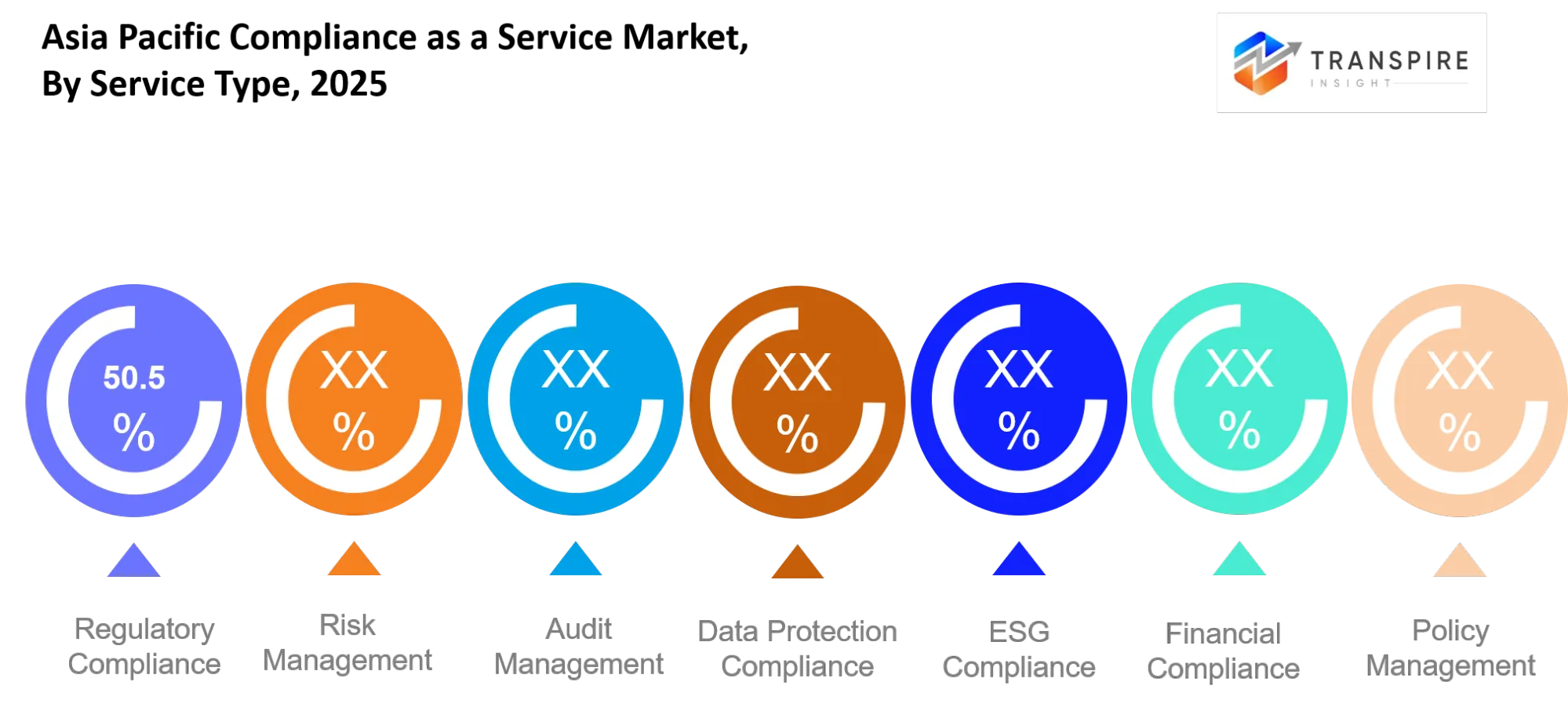
By Deployment:
The way compliance services are set up is important for flexibility, scalability and security. Companies choose how to set up their compliance services based on what they need for infrastructure, laws and long-term plans. Modern set ups make it easy to work with existing systems.Many companies are adopting platforms that can grow with them and are easy to use. This is because they want to be able to manage their data and have a clear view of what is going on with compliance. Setting up compliance services in a way helps companies balance security with efficiency and cost.
By Organization Size:
Companies of all sizes use compliance solutions based on how complex their operations are what laws they have to follow and what resources they have. Big companies often need systems that can handle everything while smaller companies focus on cost-effective compliance. Having an approach to compliance helps companies stay stable and control risks.Technology is making it possible for compliance platforms to work well in all kinds of companies. Automated monitoring and reporting make things more efficient no matter how big or small the company is. As laws keep changing more and more companies will use compliance solutions.
By End User:
The demand for compliance services comes from companies that need to follow laws and rules in their industry. Many companies use compliance solutions to be more accountable, make reporting easier and follow laws. Digital platforms make it easier to manage compliance tasks.Companies are investing in automated compliance technologies because they want to modernize. Being able to see everything, having control over everything and being able to monitor in real-time makes it easier to make decisions and operate well. Companies will keep using compliance services because they need to follow laws and be prepared for audits. Compliance services are used by companies to manage compliance-related activities.
What are the Key Use Cases Driving the Asia Pacific Compliance as a Service Market?
The main thing that banks and other financial companies have to do is follow all the rules. These companies have to do a lot of things to make sure they are following the rules like keeping peoples information private, stopping money laundering reporting about money and making sure they are not taking many risks. There are computer programs that can help these companies follow the rules by automatically checking everything, making documents and getting ready for audits. This helps the companies do their jobs easily while still following the rules. A lot of companies need help following the rules all the time. This is a big reason why people want to use these computer programs.
Some other companies are starting to use these computer programs. For example hospitals and doctors offices use them to keep people's health information private. Computer and phone companies are also using these programs to help them follow rules about keeping people's information safe on the internet working with companies and using cloud computers.
There are some things that companies are starting to use these computer programs for. One of these things is making sure they are being good to the environment and following the rules about it. Companies are starting to use programs that help them keep track of how they are doing with the environment and if they are following all the rules. There are also programs that use intelligence to help companies understand the rules and what they need to do to follow them. These programs can even tell companies what they need to do to fix problems. These programs are still new. They will probably be very helpful in the future because the rules are getting more complicated all the time.
|
Report Metrics |
Details |
|
Market size value in 2025 |
USD 1.39 Billion |
|
Market size value in 2026 |
USD 1.58 Billion |
|
Revenue forecast in 2033 |
USD 3.96 Billion |
|
Growth rate |
CAGR of 14.03% from 2026 to 2033 |
|
Base year |
2025 |
|
Historical data |
2021 - 2024 |
|
Forecast period |
2026 - 2033 |
|
Report coverage |
Revenue forecast, competitive landscape, growth factors, and trends |
|
Regional scope |
Asia Pacific |
|
Key company profiled |
Thomson Reuters, Wolters Kluwer, NAVEX, MetricStream, IBM, Microsoft, SAP, Oracle, Deloitte, PwC, KPMG, OneTrust, LogicGate, VComply, Hyperproof |
|
Customization scope |
Free report customization (country, regional & segment scope). Avail customized purchase options to meet your exact research needs. |
|
Report Segmentation |
By Service Type (Regulatory Compliance, Risk Management, Audit Management, Data Protection Compliance, ESG Compliance, Financial Compliance, Policy Management, Others); By Deployment (Cloud, On-Premise, Hybrid, SaaS Platforms, Private Cloud, Multi-Tenant Platforms, Managed Services, Others); By Organization Size (Large Enterprises, SMEs, Startups, Government Organizations, Financial Institutions, Healthcare Organizations, Educational Institutions, Others); By End User (BFSI, Healthcare, Retail, Manufacturing, IT & Telecom, Government, Energy & Utilities, Others) |
Which Regions are Driving the Asia Pacific Compliance as a Service Market Growth?
North America leads the Compliance as a Service market due to a mature regulatory environment and early adoption of digital governance frameworks. Organizations across financial services, healthcare, and public administration face strict requirements related to privacy, cybersecurity, and corporate reporting. Strong regulatory enforcement encourages continuous investment in automated compliance platforms rather than periodic compliance reviews. A well-developed ecosystem of cloud providers, consulting firms, legal technology vendors, and managed service providers strengthens regional leadership and supports ongoing innovation.
Europe represents the second-largest market, but growth is driven more by regulatory consistency than by technology leadership alone. Comprehensive compliance frameworks covering data protection, sustainability reporting, and operational governance create stable long-term demand. Organizations typically prioritize risk reduction, audit readiness, and regulatory transparency, resulting in steady adoption across multiple sectors. Economic resilience and structured implementation of regulatory directives make Europe a dependable contributor to global market revenue.
Asia Pacific is the fastest-growing region as governments accelerate digital transformation programs and strengthen data governance regulations. Recent investments in cloud infrastructure, cybersecurity frameworks, and digital public services have increased demand for scalable compliance solutions. Rapid expansion of financial technology, healthcare digitization, and cross-border business operations has created new compliance challenges that traditional systems struggle to address. This momentum creates significant opportunities for service providers, software vendors, and investors seeking exposure to high-growth markets between 2026 and 2033.
Who are the Key Players in the Asia Pacific Compliance as a Service Market and How Do They Compete?
The Asia Pacific Compliance as a Service Market remains moderately fragmented, with competition centered on technology capabilities, regulatory content depth, and integration flexibility rather than price alone. Established enterprise software providers compete with specialized compliance vendors that offer faster deployment and industry-specific expertise. Market participants increasingly differentiate through AI-driven risk monitoring, automated audit workflows, and support for multiple regulatory frameworks. New entrants continue to challenge larger vendors by targeting niche compliance requirements, while incumbents defend market share through ecosystem expansion and platform consolidation.
IBM, Microsoft, and SAP compete through technology innovation and enterprise integration capabilities. IBM differentiates itself by combining compliance management with AI-powered governance and risk analytics, enabling organizations to identify compliance gaps more efficiently. Microsoft leverages its cloud ecosystem to integrate compliance controls directly into productivity and security environments, reducing operational complexity for large enterprises. SAP strengthens its position through compliance tools embedded within enterprise resource planning platforms, creating a unified governance structure across business operations.
OneTrust, MetricStream, and NAVEX focus on specialization and regulatory expertise. OneTrust differentiates through privacy and data governance capabilities that address complex data protection requirements. MetricStream emphasizes integrated risk and compliance management with advanced workflow automation for highly regulated industries. NAVEX expands through ethics, governance, and policy management solutions, helping organizations centralize compliance activities while improving accountability and audit readiness.
Company List
- IBM
- Microsoft
- SAP
- Oracle
- Deloitte
- PwC
- KPMG
- OneTrust
- LogicGate
- VComply
- Hyperproof
Recent Development News
In March 2026, OneTrust expanded its AI-driven governance and compliance automation capabilities through new real-time control and monitoring features. The update strengthens continuous compliance enforcement across data, AI systems, and enterprise risk environments, improving regulatory responsiveness for global organizations.https://www.onetrust.com
In December 2025, NAVEX launched expanded AI capabilities across its NAVEX One compliance platform, including compliance assistants and automated risk insights. The enhancement improves regulatory monitoring, case management, and policy alignment for enterprises operating across complex multi-jurisdiction environments.https://www.navex.com
In October 2025, KPMG in India partnered with OneTrust to accelerate AI-ready governance and compliance solutions for enterprises. The collaboration combines advisory expertise with compliance automation technology to support privacy, AI governance, and regulatory risk management across Asia Pacific markets.https://kpmg.com
What Strategic Insights Define the Future of the Asia Pacific Compliance as a Service Market?
Over the next 5–7 years, the Asia Pacific Compliance as a Service market is set to shift from point-solution compliance tools to deeply embedded, AI-enabled governance layers integrated across enterprise cloud ecosystems. This structural movement is driven by accelerating digital transformation, expanding cross-border data flows, and tightening sector-specific regulatory regimes, particularly in finance, healthcare, and digital commerce. A less visible risk lies in regulatory fragmentation combined with over-reliance on hyperscaler-driven compliance frameworks, which may create blind spots in jurisdiction-specific interpretation and increase systemic compliance errors. At the same time, a major emerging opportunity is the rise of AI governance and automated regulatory mapping solutions aligned with evolving regional digital economy agreements, especially for mid-market enterprises. Market participants should prioritize building modular, jurisdiction-aware platforms with explainable AI capabilities and establish early collaborations with regulators to secure long-term compliance credibility and adoption advantage.
Asia Pacific Compliance as a Service Market Report Segmentation
By Component
- Software
- Services
- Managed Services
By Deployment Mode
- Cloud-Based
- On-Premise
- Hybrid
By Organization Size
- Small & Medium Enterprises (SMEs)
- Large Enterprises
By Compliance Type
- Regulatory Compliance
- Data Protection & Privacy Compliance
- Risk & Audit Compliance
- Industry-Specific Compliance
By Industry Vertical
- Banking, Financial Services & Insurance (BFSI)
- Healthcare & Life Sciences
- IT & Telecom
- Retail & E-commerce
- Government & Public Sector
- Manufacturing
- Energy & Utilities
- Others
By Function
- Audit Management
- Policy Management
- Risk Management
- Reporting & Analytics
- Incident Management
Frequently Asked Questions
Find quick answers to common questions.
The Expected Asia Pacific Compliance as a Service Market size for the Market will be USD 3.96 Billion in 2033.
Key Segments for the Asia Pacific Compliance as a Service Market are By Service Type (Regulatory Compliance, Risk Management, Audit Management, Data Protection Compliance, ESG Compliance, Financial Compliance, Policy Management, Others); By Deployment (Cloud, On-Premise, Hybrid, SaaS Platforms, Private Cloud, Multi-Tenant Platforms, Managed Services, Others); By Organization Size (Large Enterprises, SMEs, Startups, Government Organizations, Financial Institutions, Healthcare Organizations, Educational Institutions, Others); By End User (BFSI, Healthcare, Retail, Manufacturing, IT & Telecom, Government, Energy & Utilities, Others).
Major Asia Pacific Compliance as a Service Market Players are Thomson Reuters, Wolters Kluwer, NAVEX, MetricStream, IBM, Microsoft, SAP, Oracle, Deloitte, PwC, KPMG, OneTrust, LogicGate, VComply, Hyperproof.
The Current Asia Pacific Compliance as a Service Market size is USD 1.39 Billion in 2025.
The Asia Pacific Compliance as a Service Market CAGR is 14.03% from 2026 to 2033.
- Thomson Reuters
- Wolters Kluwer
- NAVEX
- MetricStream
- IBM
- Microsoft
- SAP
- Oracle
- Deloitte
- PwC
- KPMG
- OneTrust
- LogicGate
- VComply
- Hyperproof
About the Authors

Mayur Shinde
I am Mayur Shinde, a Senior Research Analyst at Transpire Insight, specializing in the Automotive & Transportation and Information & Communication Technology (ICT) Industry. My work focuses on analyzing emerging market trends, technological advancements, competitive landscapes, and industry developments to deliver accurate, data-driven insights. I am passionate about transforming complex market information into clear, actionable content that helps businesses, professionals, and decision-makers stay informed and make confident strategic decisions.

Chakradhar Khansole
Chakradhar serves as the Research Director at Transpire Insight, bringing over 8 years of experience in technology, innovation, and strategic market intelligence. He specializes in transforming complex market data into actionable business insights that enable organizations to make informed, growth-oriented decisions. Recognized for his strategic vision and analytical expertise, Chakradhar leads high-impact research initiatives, delivering comprehensive market assessments, competitive intelligence, and forward-looking industry analysis.
Recently Published Reports
-
Apr 2026
3D Optical Profiler Market
3D Optical Profiler Market Size, Share & Analysis Report By Type (Desktop 3D Optical Profiler, and Portable 3D Optical Profiler), By Technology (Confocal Technology, and White Light Interference), By End-Use Industry (Manufacturing, Research Institutions, Automotive, Aerospace and Defense, Medical Devices, and Other), and Geography (North America, Europe, Asia-Pacific, Middle East and Africa, South and Central America), 2021 - 2031
-
Apr 2026
Depth Sensor Market
Depth Sensor Market Size, Share & Analysis Report By Type (Infrared Depth Sensors, Time-of-Flight (ToF) Sensors, Stereo Vision Sensors, Structured Light Sensors, Ultrasonic Depth Sensors), By Application (Automotive, Robotics, Gaming, Consumer Electronics, Industrial Automation, Healthcare, Security & Surveillance, Others), By End Users (Automotive Manufacturers, Consumer Electronics Companies, Healthcare Providers, Industrial Companies, Security Agencies, Gaming Companies, Robotics Companies, Others), and Geography (North America, Europe, Asia-Pacific, Middle East and Africa, South and Central America), 2021 – 2031
-
Apr 2026
Digital Manufacturing Market
Digital Manufacturing Market Size, Share & Analysis Report By Component (Hardware, Software, and Services), By Technology (Robotics, 3D Printing, Internet of Things (IoT), and Others), By Application (Automotive and Transportation, Aerospace and Defense, Consumer Electronics, Industrial Machinery, and Others), By Process Type (Computer-Based Designing, Computer-Based Simulation, Computer 3D Visualization, Analytics, and Others), and Geography (North America, Europe, Asia-Pacific, Middle East and Africa, South and Central America), 2021 – 2031
-
Apr 2026
Digital Visa Services Market
Digital Visa Services Market Size, Share & Analysis Report By Type (Individual Travelers, Group Travelers), By Application (Tourism, Business Travel, Others), and Geography (North America, Europe, Asia-Pacific, Middle East and Africa, South and Central America), 2021 – 2031