
Asia Pacific Caramel Ingredients Market Size & Forecast:
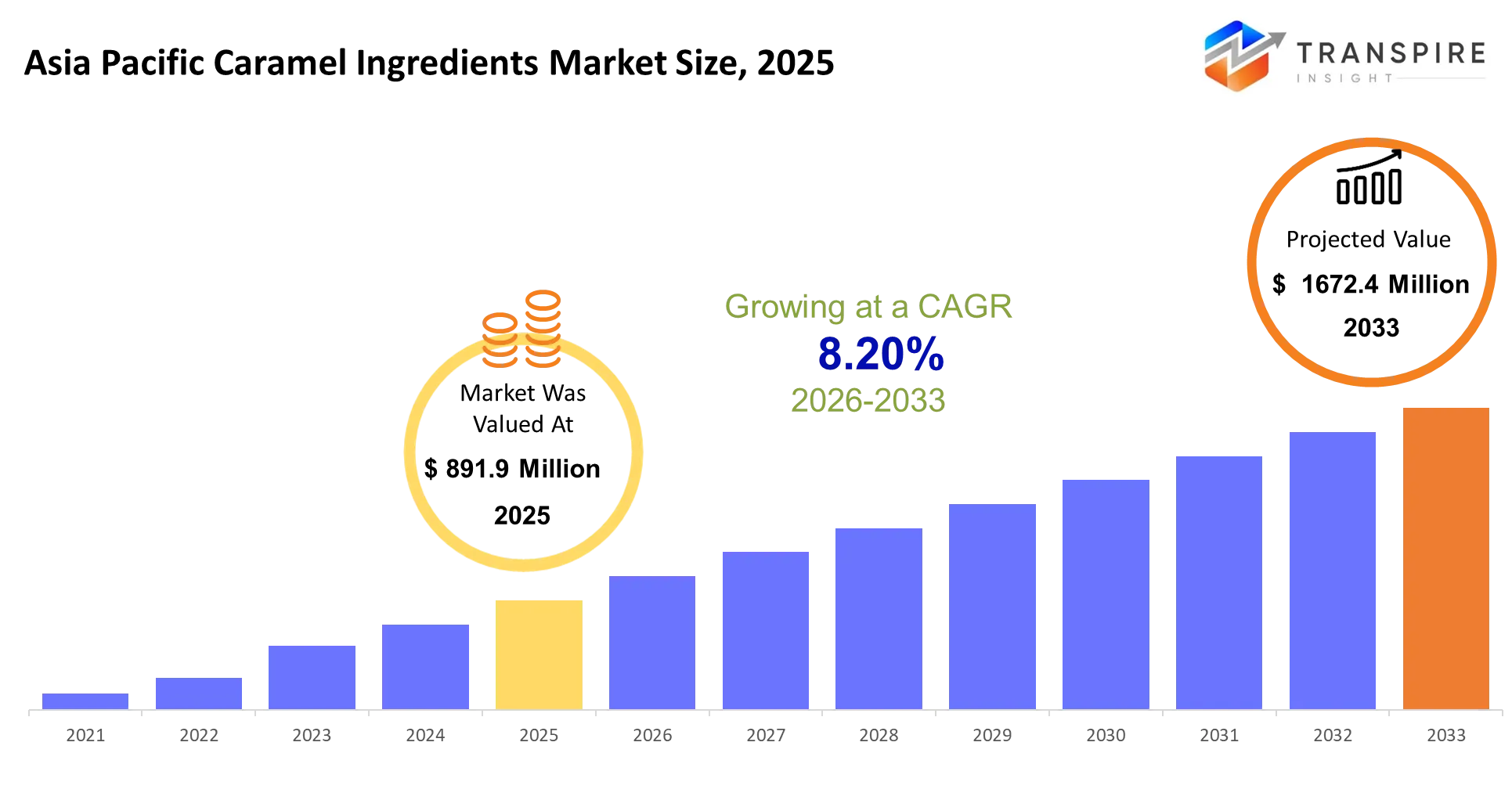
- Asia Pacific Caramel Ingredients Market Size 2025: USD 891.9 Million
- Asia Pacific Caramel Ingredients Market Size 2033: USD 1672.4 Million
- Asia Pacific Caramel Ingredients Market CAGR: 8.20%
- Asia Pacific Caramel Ingredients Market Segments: By Type (Caramel Color, Caramel Flavor, Caramel Syrup, Caramel Powder, Burnt Sugar, Others); By Application (Beverages, Bakery, Confectionery, Dairy, Snacks, Others); By End-User (Food Industry, Beverage Industry, Retail, Industrial, Commercial, Others); By Form (Liquid, Powder, Paste, Granules, Syrup, Others)
To learn more about this report,  Download Free Sample Report
Asia Pacific Caramel Ingredients Market Summary
The Asia Pacific Caramel Ingredients Market was valued at USD 891.9 Million in 2025. It is forecast to reach USD 1672.4 Million by 2033. That is a CAGR of 8.20% over the period.
Food and beverage manufacturers achieve uniform color and flavor intensity and distinct product features through their use of caramel ingredients from the Asia Pacific market. These ingredients solve a key formulation challenge by allowing producers to maintain taste uniformity and visual appeal at industrial scale while meeting changing consumer expectations around texture and shelf stability.
The market has shifted toward cleaner-label and low-process caramel solutions during the last three to five years because regional food brands need to meet current ingredient tracking requirements and new packaging disclosure regulations. After pandemic-related supply chain disruptions showed manufacturers needed specialty additives from abroad, Asian Pacific manufacturers began to localize their supply chains and change their product formulas. Food processors have increased their investments in customized caramel systems because premium packaged foods and café-style beverages have become more popular. The revenues of suppliers are increasing because ingredient manufacturers are developing specialized formulations for regional taste preferences while moving away from their basic product range.
Key Market Insights
- China controls almost 34% of the Asia Pacific Caramel Ingredients Market in 2025 because of its extensive food processing and beverage production facilities.
- The Indian market shows the fastest growth rate because it will increase by more than 7.5% until 2032 when the packaged food industry grows.
- Southeast Asia develops into a main growth area because urban consumption patterns change and beverage processing facilities receive substantial financial backing.
- Caramel color ingredients lead the market, contributing approximately 47% of total market size in 2025 because they find wide industrial use in beverage production.
- Caramel flavor ingredients hold the second-largest share, which confectionery and bakery and dairy product manufacturers support.
- The fastest expanding market segment until 2032 involves specialty low-sugar caramel systems which demonstrate clean-label product development trends throughout the Asia Pacific region.
- The beverage market sector holds the largest share of the market with almost 39% market share because it includes carbonated beverages and ready-to-drink coffee and flavored milk products.
- The fastest expanding application sector uses premium bakery fillings and dessert toppings which are experiencing rapid growth throughout urban retail chain locations.
- The 2025 Asia Pacific Caramel Ingredients Market demand is driven by large-scale food and beverage companies which represent more than 52% of total market needs.
- The fastest expanding end-user segment consists of mid-sized regional packaged food brands which achieve growth through their development of products for specific local markets.
What are the Key Drivers, Restraints, and Opportunities in the Asia Pacific Caramel Ingredients Market?
The rapid growth of premium packaged beverage and convenience food production in China and India and Southeast Asia serves as the primary force that drives the growth of the Asia Pacific caramel ingredients market. The shift gained traction when food processors in the region upgraded their equipment because the pandemic had shown them the weaknesses of using multiple sources to obtain their raw materials. Companies that develop automated beverage filling systems and high-throughput food processing equipment now require caramel ingredients that maintain precise color matching and flavor durability and heat resistance. Manufacturers are shifting their production methods from using inexpensive standard caramel ingredients to utilizing premium custom-made caramel products that meet their processing needs and regional taste requirements which results in higher revenue for suppliers.
Manufacturing businesses face their biggest operational challenge because they need to deal with raw material price instability which affects both sugar derivatives and glucose syrups and the costs of energy-intensive thermal processing. The resolution of this problem proves challenging because ingredient production relies on agricultural supply chains which depend on weather conditions and energy price changes that affect multiple Asia Pacific nations. Food processing companies that operate at a smaller scale tend to postpone their product development efforts and decrease their purchasing activities whenever input costs experience significant increases which prevents them from using specialty caramel systems and developing premium products.
The clean-label caramel ingredient innovation through low-process and reduced-contaminant formulations presents a major growth opportunity for our business. Japan and South Korea serve as initial adoption markets because premium beverage brands are developing new ingredient systems which meet advanced labeling requirements. The companies that create precision-controlled heating technologies will obtain permanent supply agreements with global food manufacturers who need products that meet regulations and serve high-end markets.
What Has the Impact of Artificial Intelligence Been on the Asia Pacific Caramel Ingredients Market?
The artificial intelligence systems together with advanced digital technologies now initiate transformation processes for caramel ingredient production operations throughout Asia Pacific regions since these technologies enhance manufacturing accuracy and operational efficiency while meeting demanding food safety requirements. The major ingredient manufacturers use AI-based control systems to handle all aspects of caramel production which includes monitoring temperatures and controlling viscosity and moisture levels and verifying batch quality throughout continuous manufacturing operations. The manufacturing process uses these systems to monitor actual sensor data which leads to automatic modifications of heating profiles and cooling schedules that decrease product differences while handling mass production processes.
Machine learning models currently serve as tools for predicting when thermal processing equipment which includes reactors and evaporators and heat exchangers will require maintenance. The manufacturers who identify abnormal pressure changes together with thermal efficiency problems can decrease unexpected equipment downtime by 15 to 20 percent while achieving better operational dependability. The large-scale facilities now employ predictive analytics to enhance their material and energy efficiency which results in energy savings of 8 to 12 percent for advanced digitalized plants through process simulation techniques.
These technologies create enhanced operational performance which helps organizations comply with stricter government regulations about contaminant limits and product ingredient tracking. The process of implementing these technologies encounters a critical obstacle because existing facilities require significant funds to achieve system integration for their current processing systems. The majority of mid-sized manufacturers in the region continue to use their traditional batch-processing systems because their facilities lack essential sensor technologies and digital infrastructure needed to implement AI solutions which hampers the spread of modern technological advancements.
Key Market Trends
- The beverage industry in major regional markets has experienced a 40% shift toward low-process caramel formulas since 2022 because manufacturers need to comply with strict ingredient disclosure rules.
- The supply chain problems that occurred after the pandemic forced processors in China and India to start using local sources which led to a 12 to 15 percent decrease in imported specialty caramel needs since 2021.
- The expansion of regional technical support teams by Cargill and Ingredion occurred because Asian Pacific customers started requesting customized formulations at a higher rate.
- The launch of premium ready-to-drink coffee and milk beverages in 2023 resulted in Southeast Asian processing facilities increasing their caramel flavor customization projects by 18 percent.
- AI-based thermal control systems became the preferred choice for manufacturers because they successfully decreased batch inconsistency rates by 10 to 14 percent when compared to traditional manual caramelization methods which began in 2024.
- The requirement for regulatory bodies to examine 4-MEI contaminant limits has compelled ingredient manufacturers to develop new heating methods while they spend money on advanced reaction control systems.
- Mid-sized food processors have shifted from bulk caramel purchases toward application-specific contracts, reshaping supplier pricing strategies across bakery and confectionery sectors.
- The premium food brands that began their clean-label product transformations in 2023 established Japan and South Korea as the initial markets for reduced-sugar caramel systems.
- Manufacturers have turned to heat recovery technology because energy prices became unpredictable after 2022 which enabled them to cut thermal treatment costs by 8 to 10 percent in their top-tier facilities.
Asia Pacific Caramel Ingredients Market Segmentation
By Type :
The Asia Pacific Caramel Ingredients Market designates caramel color as its primary market segment because processed food and beverage manufacturing requires this ingredient in large quantities. The market expansion receives support from strong customer demand who purchase soft drinks and sauces and ready-to-eat meals. The food industry chooses caramel color because it provides product stability through extended shelf life and economical manufacturing advantages which benefit their extensive production facilities.
Bakery and confectionery producers show consistent growth in demand for caramel flavor because they develop new product options. The production process benefits from caramel syrup and powder which enable simple blending and maintain uniform flavor throughout the entire process. Burnt sugar functions as an essential component for specialized food preparation processes while various caramel ingredient types fulfill specific product needs which require different texture and appearance and flavor characteristics.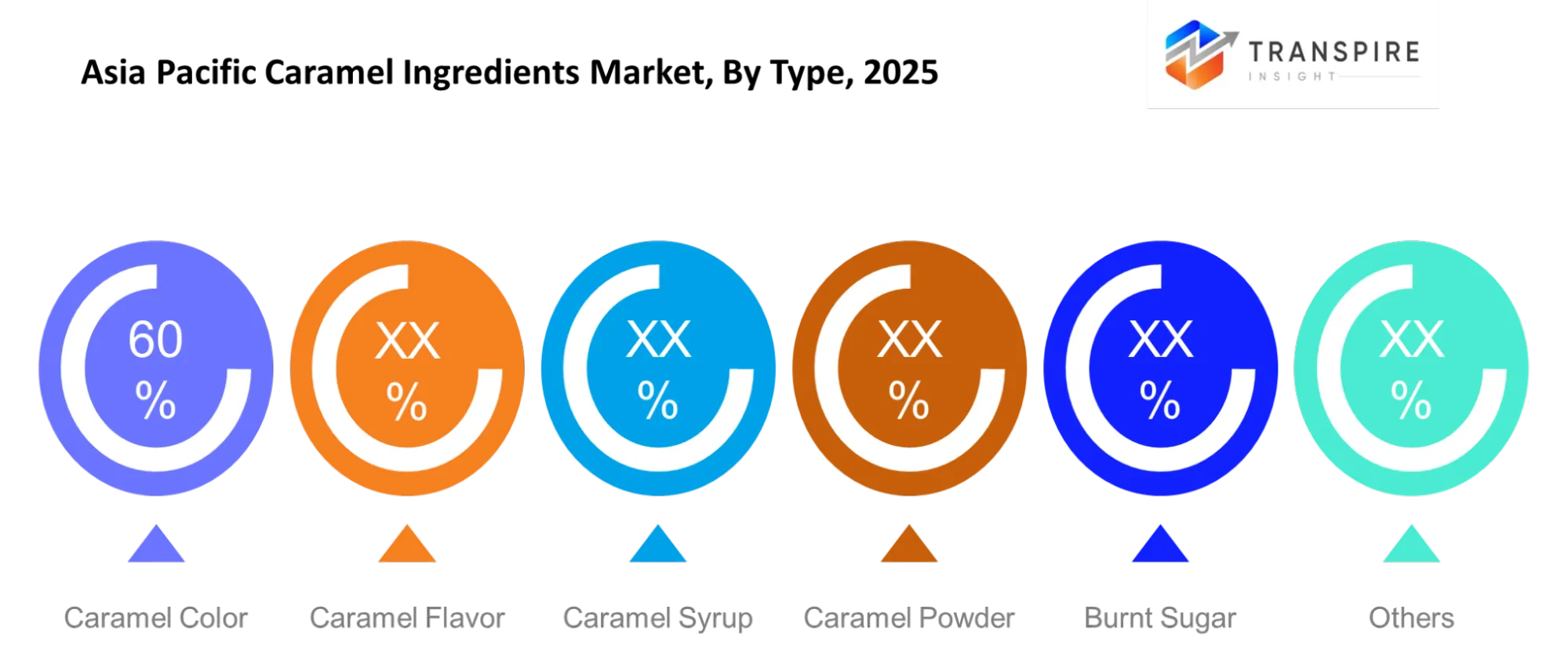
To learn more about this report, Download Free Sample Report
By Application :
The beverage segment leads application demand due to high consumption of flavored drinks, carbonated products, and ready-to-drink beverages across Asia Pacific. Caramel ingredients help improve color consistency and flavor depth which makes products more attractive to consumers. Beverage manufacturers are increasing their use of caramel ingredients because urban consumption patterns keep rising in cities.
The bakery and confectionery industry expands rapidly because caramel-based fillings and coatings and flavoring solutions maintain their strong popularity. Caramel serves as the primary ingredient that dairy products use to create their flavored milk and ice cream and dessert products. Snack manufacturers increasingly add caramel ingredients to create premium offerings, while other applications continue to grow through experimentation in packaged food innovation.
By End-User :
The food industry constitutes a substantial market segment because caramel ingredients find use in various processed food products. Manufacturers who operate at large scales depend on these ingredients to achieve uniformity and enhance taste and create visually appealing products. The need for standard product quality across regional markets supports regular procurement from ingredient suppliers.
The beverage industry remains a primary customer because caramel solutions find extensive use in flavored drink manufacturing. Retail demand is increasing because home baking activities and small packaged ingredient sales are rising. Foodservice operators and catering businesses together with industrial and commercial users now use caramel ingredients to customize their products while other users maintain steady but smaller demand.
By Form :
Liquid caramel ingredients dominate because they allow manufacturers to create products quickly through straightforward blending methods. The beverage and dairy industries prefer liquid formats because they provide easy mixing and consistent results. This form supports efficient processing and reduces preparation time, making it highly suitable for large-volume production environments.
The bakery and confectionery industries now use powder and paste formats because these options enable precise quantity measurement. Customers find granules helpful for creating dry mixes and instant products but syrup continues to be the preferred choice for dessert and topping usage. Other forms continue serving specialized processing needs where texture control and formulation flexibility are required.
What are the Key Use Cases Driving the Asia Pacific Caramel Ingredients Market?
The highest percentage of caramel ingredient usage originates from beverage production which includes carbonated soft drinks and ready-to-drink coffee and flavored dairy beverages. These products require highly consistent color stability and flavor balance across large production runs because their production needs caramel systems to create identical products that match established brand standards.
Regional packaged food manufacturers now produce premium dessert fillings and biscuit coatings and flavored snack products which have led to bakery and confectionery applications that use caramel to expand their operations. Quick-service restaurant chains and large foodservice suppliers are also increasing use of caramel-based flavor systems in sauces and dessert toppings to standardize taste across outlets.
The development of new applications focuses on plant-based dairy alternatives and functional nutrition products. Japanese and South Korean and Australian producers are testing reduced-sugar caramel solutions for protein beverages and fortified snack formulations because clean-label positioning and precise flavor masking will create new commercial opportunities during the forecast period.
|
Report Metrics |
Details |
|
Market size value in 2025 |
USD 891.9 Million |
|
Market size value in 2026 |
USD 963.3 Million |
|
Revenue forecast in 2033 |
USD 1672.4 Million |
|
Growth rate |
CAGR of 8.20% from 2026 to 2033 |
|
Base year |
2025 |
|
Historical data |
2021 - 2024 |
|
Forecast period |
2026 - 2033 |
|
Report coverage |
Revenue forecast, competitive landscape, growth factors, and trends |
|
Regional scope |
India, China, Japan, and Australia |
|
Key company profiled |
Sethness Roquette, DDW Color, Sensient Technologies, Kerry Group, Cargill, Ingredion, Tate & Lyle, Givaudan, Symrise, ADM, Puratos, FDL, Nigay, Bakels, Döhler |
|
Customization scope |
Free report customization (country, regional & segment scope). Avail customized purchase options to meet your exact research needs. |
|
Report Segmentation |
By Type (Caramel Color, Caramel Flavor, Caramel Syrup, Caramel Powder, Burnt Sugar, Others); By Application (Beverages, Bakery, Confectionery, Dairy, Snacks, Others); By End-User (Food Industry, Beverage Industry, Retail, Industrial, Commercial, Others); By Form (Liquid, Powder, Paste, Granules, Syrup, Others) |
Which Regions are Driving the Asia Pacific Caramel Ingredients Market Growth?
China dominates the Asia Pacific caramel ingredients market because it possesses the largest food processing capacity and complete control over its raw material supply chains and its robust manufacturing capabilities. The country operates multiple industrial food production centers which enable it to produce large amounts of caramel ingredients used in beverages and confectionery and packaged foods. Manufacturers have developed advanced systems for caramel processing because of increasing needs for product quality control and food safety regulations which require them to maintain their product quality at consistent standards. The company maintains its market leadership through its extensive supplier connections and its ability to process ingredients in huge quantities and its ongoing development of automated systems for food production.
Japan holds the second-largest position, but its strength comes from formulation precision rather than production scale. Japan's market operates according to premium food innovation and stable purchasing patterns with strict quality standards required by established beverage and confectionery brands, which differ from China's volume-driven manufacturing model. Large manufacturers commit to continuous research and development of their products for two purposes: first they want to meet changing consumer demands which require cleaner ingredient labels and second they aim to produce products with reduced sugar content. High-value specialized caramel ingredient suppliers maintain a reliable revenue stream through their focus on developing customized technical solutions.
India is developing into the quickest-growing market because its packaged food industry expands and its beverage sector updates its production methods. The organized food processing parks and cold-chain logistics system received three years of investment, which enhanced manufacturing operations at all main production sites. The domestic market for ready-to-drink beverages and café chains and branded snack production has increased its demand for stable flavor and color systems. India provides suppliers and investors between 2026 and 2033 with major benefits through its local manufacturing partnerships and technical service growth and development of application-specific products.
Who are the Key Players in the Asia Pacific Caramel Ingredients Market and How Do They Compete?
China maintains its position as the leading country in the Asia Pacific caramel ingredients market because its food processing operations function at unmatched levels and its supply chains deliver raw materials through vertical integration and its manufacturing base operates at high capacity. The country operates multiple industrial food production centers which enable factories to produce caramel ingredients in large quantities for use in beverages and confectionery products and packaged food items. The need for food contamination control and food labeling requirements has driven manufacturers to implement advanced caramel processing systems which achieve better quality control through improved consistency measures. The organization maintains its leadership position through extensive supplier connections and its ability to process ingredients at high volume and its ongoing development of automated systems for food production facilities.
Japan holds the second-largest position in the market but its strength originates from its ability to create precise formulations instead of its production capabilities. Japan operates as a market which develops through premium food innovation and established beverage and confectionery brands maintain their regular buying patterns while enforcing strict quality standards. To meet changing consumer requirements for product transparency and reduced sugar content large manufacturers allocate resources toward reformulation efforts and product development. This business model provides specialty caramel ingredient suppliers with a stable revenue stream from their premium customized technical solutions.
India is presently developing into its fastest-growing market because of its quick growth in packaged food products and its modernizing beverage industry. The last three years have seen organized food processing parks and cold-chain logistics receive investments which have resulted in better manufacturing efficiency at important production centers. The domestic ready-to-drink beverage market and café chains and branded snack production have all grown which has increased the need for steady flavor and color systems. Between 2026 and 2033 India provides suppliers and investors with major growth opportunities through its local manufacturing partnerships and technical service development and application-specific product creation.
Company List
- Sethness Roquette
- DDW Color
- Sensient Technologies
- Kerry Group
- Cargill
- Ingredion
- Tate & Lyle
- Givaudan
- Symrise
- ADM
- Puratos
- FDL
- Nigay
- Bakels
- Döhler
Recent Development News
In May 2025, Cargill launched a new collection of bakery fillings and caramel-based indulgence solutions at IBA 2025. The freeze/thaw-stable caramel and flavor solutions were introduced for commercial bakery applications and are expected to support product innovation pipelines for food manufacturers serving Asia Pacific’s fast-growing bakery and dessert ingredient market.
Source https://www.cargill.com/
In March 2026, Cargill Incorporated launched a portfolio of scalable food ingredient innovations at AAHAR 2026 in India. The showcase included premium indulgence and bakery solutions using advanced ingredient systems (including caramel-based applications), strengthening its position in Asia’s processed food ingredient market. Source https://www.cargill.co.in/
What Strategic Insights Define the Future of the Asia Pacific Caramel Ingredients Market?
The Asia Pacific caramel ingredients market will develop through the next five to seven years until it reaches a state which requires customized solutions for specific functions instead of using standard bulk products. The premium beverage and functional nutrition and clean-label food markets require tighter formulation standards which require manufacturers to achieve specific color and flavor and regulatory compliance for their specialized products.
As value shifts from volume production to technical formulation expertise supplier differentiation will depend more on process innovation than manufacturing scale. The organization faces hidden dangers because it increasingly relies on specific sources for both basic materials and energy needs. The production costs for specialty caramel will increase significantly because of two factors which are climate-related agricultural disruptions and regional trade restrictions that limit sugar derivative availability.
The plant-based beverage sector in Southeast Asia creates new business opportunities which local brands in Thailand and Vietnam now pursue through their search for reduced-sugar caramel systems which work for protein-enriched products. Companies in the market should make immediate investments into regional application laboratories and collaborative product development facilities because their initial technical partnerships with fast-scaling food manufacturers will create their future market advantage.
Asia Pacific Caramel Ingredients Market Report Segmentation
By Type
- Caramel Color
- Caramel Flavor
- Caramel Syrup
- Caramel Powder
- Burnt Sugar
By Application
- Beverages
- Bakery
- Confectionery
- Dairy
- Snacks
By End-User
- Food Industry
- Beverage Industry
- Retail
- Industrial
- Commercial
By Form
- Liquid
- Powder
- Paste
- Granules
- Syrup
Frequently Asked Questions
Find quick answers to common questions.
The Asia Pacific Caramel Ingredients Market size is USD 1672.4 Million in 2033.
Key Segments for the Asia Pacific Caramel Ingredients Market are By Type (Caramel Color, Caramel Flavor, Caramel Syrup, Caramel Powder, Burnt Sugar, Others); By Application (Beverages, Bakery, Confectionery, Dairy, Snacks, Others); By End-User (Food Industry, Beverage Industry, Retail, Industrial, Commercial, Others); By Form (Liquid, Powder, Paste, Granules, Syrup, Others).
Major Asia Pacific Caramel Ingredients Market Players are Sethness Roquette, DDW Color, Sensient Technologies, Kerry Group, Cargill, Ingredion, Tate & Lyle, Givaudan, Symrise, ADM, Puratos, FDL, Nigay, Bakels, Döhler.
The Current Asia Pacific Caramel Ingredients Market size is USD 891.9 Million in 2025.
The Asia Pacific Caramel Ingredients Market CAGR is 8.20% from 2026 to 2033.
- Sethness Roquette
- DDW Color
- Sensient Technologies
- Kerry Group
- Cargill
- Ingredion
- Tate & Lyle
- Givaudan
- Symrise
- ADM
- Puratos
- FDL
- Nigay
- Bakels
- Döhler
Recently Published Reports
-
Apr 2026
Baby Infant Formula Market
Baby Infant Formula Market Size, Share & Analysis Report By ype (Infant Milk, Follow On Milk, Specialty Baby Milk, Growing-Up Milk), By Ingredient (Carbohydrate, Fat, Protein, Minerals, Vitamins, and Others), By Product Form (Powder, Liquid, and Ready-to-feed), By Distribution Channels (Supermarket/Hypermarket, Specialty Store, Pharmacies, Online Retail, and Others), and Geography (North America, Europe, Asia-Pacific, Middle East and Africa, South and Central America), 2021 - 2031
-
Apr 2026
Edible Insects for Animal Feed Market
Edible Insects for Animal Feed Market Size, Share & Analysis Report By Type (Insect Powder, Insect Meal, Insect Bar, Insect Paste, Insect Oil, and Others), By Insect Type (Beetles, Cricket, Caterpillar, Hymenoptera, Orthoptera, Tree Bugs, and Others), By Application (Livestock, Pet Food, and Aquaculture), By Livestock Type (Poultry, Swine, and Others), and Geography (North America, Europe, Asia-Pacific, Middle East and Africa, South and Central America), 2021 - 2031
-
Apr 2026
Food Industry Disinfection and Bacterial Control Market
Food Industry Disinfection and Bacterial Control Market Size, Share & Analysis Report By Type (Chemical Disinfectants, Physical Disinfectants, and Biocides and Antimicrobials), By Application (Food Processing Equipment Surface Disinfection, Food Preparation Areas Surface Disinfection, Storage Areas Surface Disinfection, Anti-microbial Coatings Food Preservation, and Preservative Solutions Food Preservation), By End User (Meat and Poultry Processing, Dairy Processing, Seafood Processing, Bakery and Confectionery, Restaurants and Commercial Kitchens, and Food Service Providers), By Sales Channel (Online, Offline), and Geography (North America, Europe, Asia-Pacific, Middle East and Africa, South and Central America), 2021 - 2031
-
Apr 2026
Freeze Dried Food Market
Freeze Dried Food Market Size, Share & Analysis Report By Product Type (Fruits, Vegetables, Freeze-Dried Dairy Products, Freeze-Dried Meat and Seafood, Freeze-Dried Pet Food, and Prepared Meal), By Nature (Organic, and Conventional), By Form (Powdered, Granules, and Diced), By End Use (Breakfast Cereals, Dairy Products, Bakery & Confectionery, Nutritional Bars & Supplements, Powdered Beverages, Snacks, and Retail (Household)), and Geography (North America, Europe, Asia-Pacific, Middle East and Africa, South and Central America), 2021 - 2031