

Asia Pacific Call And Contact Center Outsourcing Market Size & Forecast:
- Asia Pacific Call And Contact Center Outsourcing Market Size 2025: USD 22.1 Billion
- Asia Pacific Call And Contact Center Outsourcing Market Size 2033:USD 56.7 Billion
- Asia Pacific Call And Contact Center Outsourcing Market CAGR: 12.47%
- Asia Pacific Call And Contact Center Outsourcing Market Segments: By Service Type (Inbound, Outbound, Technical Support, Customer Care, Sales Support, Others); By Channel (Voice, Email, Chat, Social Media, Omnichannel, Others); By Enterprise Size (Large, Medium, Small, Others); By End User (BFSI, Telecom, Retail, Healthcare, Others)
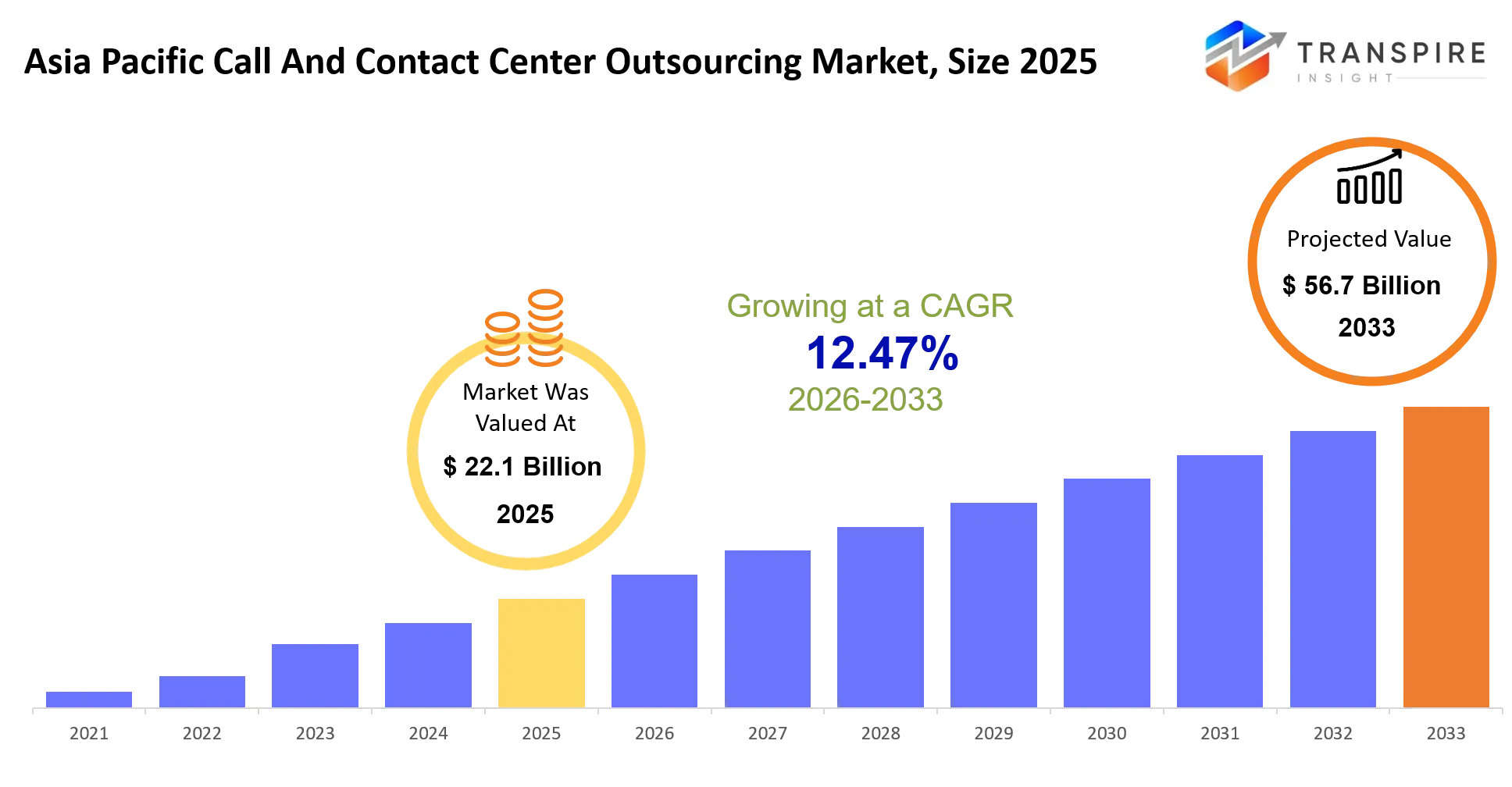
Asia Pacific Call And Contact Center Outsourcing Market Summary
The Asia Pacific Call And Contact Center Outsourcing Market was valued at USD 22.1 Billion in 2025. It is forecast to reachUSD 56.7 Billion by 2033. That is a CAGR of 12.47% over the period.
In the Asia Pacific Call and Contact Center Outsourcing Market, enterprises kind of try to handle customer interactions at scale, so they deal with customer support and technical assistance, but also sales, collections, and those multilingual service moments too. And for companies that operate across different markets, outsourcing gives them a route to specialized talent, longer operating windows , and generally lower operational complexity, without the hassle of creating huge internal teams in house.
Over the last five years, things shifted in a more structural way, from voice-first support models , to digitally integrated customer engagement platforms, where voice sits next to chat, email, social media, and AI-enabled self service tools. The COVID-19 pandemic sort of acted as a big trigger, speeding up remote service delivery , and pushing firms to rethink how they engage customers. Once interactions started happening more often, and across more channels, organizations leaned harder on outsourcing providers that already have strong automation plus analytics functions.
That whole move has widened the service footprint, boosted productivity levels, and opened up fresh revenue opportunities for outsourcing firms that can deliver both operational efficiency and better customer experience results.
Key Market Insights
- India is basically leading the Asia Pacific Call And Contact Center Outsourcing Market , taking the biggest piece of the market in 2024, mainly because it has a large skilled workforce and also these cost advantages that still matter.
- Meanwhile Southeast Asia is showing the quickest momentum through the forecast period , and it is being pushed by growing digital economies and multilingual service capabilities, so more businesses can reach customers in different languages, more easily.
- The Philippines keeps a notable chunk of regional revenue, and that is mostly tied to strong English-language proficiency and the already built outsourcing infrastructure , which feels pretty established at this point.
- Australia and Singapore keep pulling in higher value outsourcing contracts, especially those centered on customer experience management , plus advanced analytics services and related work.
- On the services side, inbound customer support services dominate overall, they hold the largest market share , because enterprises tend to have heavy expectations for customer retention and service quality.
- Technical support and helpdesk services rank as the second-largest segment, backed by software, telecom, and digital platform ecosystems that keep on expanding.
- Meanwhile, omnichannel customer engagement services seem to be the fastest-growing bit from 2025–2030, mostly because enterprises weave together voice, chat, email ,and social media support all in one flow.
- Customer service and support take the dominant application share, and it’s really contributing more than one third of outsourcing contract volumes across the region too.
- On the other hand, sales and customer acquisition services represent the fastest-growing application, and this is largely fueled by e-commerce expansion, plus the adoption of digital financial services.
- Lastly, customer experience management platforms continue picking up momentum as organizations put heavier weight on retention and lifetime customer value.
What are the Key Drivers, Restraints, and Opportunities in the Asia Pacific Call And Contact Center Outsourcing Market?
Market growth mostly gets pushed by a fast turn toward digital customer experience management, not just in theory but in daily practice, like, everywhere. Banks, telecom companies, retailers, and even tech firms now run customer interactions through more than one channel—voice, chat, email, messaging apps , and social media too. With all that, operational complexity goes up, and honestly the cost of keeping big in-house service groups becomes harder to justify. So a lot of organizations end up outsourcing customer engagement, and they pick specialized providers that can bring scalable infrastructure, multilingual skills and AI enabled workforce management tools. The result is more outsourcing penetration, bigger contract sizes, and service portfolios that keep broadening.
Data security and regulatory compliance still sit there as the biggest structural hurdles for expansion. Customer support operations regularly handle sensitive financial, healthcare, and personal details across multiple regions. Compliance rules differ a lot between countries, which makes the legal and day-to-day operations messier for outsourcing providers. Setting up secure infrastructure, governance structures, and compliance monitoring systems takes meaningful long term investment. Because of this, outsourcing decisions can get delayed, especially for industries that are heavily regulated, so contract growth slows down and revenue opportunities feel capped.
The strongest future opportunity kind of lies in AI enabled customer experience services across newer Southeast Asian markets. Countries like Vietnam, Indonesia, and Malaysia are putting a lot of money into digital infrastructure and business process outsourcing know-how, at the same time enterprises are also looking for conversational AI, real time analytics,and automated customer support. Meanwhile, providers that blend human agents with AI driven engagement platforms can manage to deliver quicker replies, reduce service costs, and keep interactions more personal. This can spark a new kind of phase for market expansion, plus higher value service offerings overall.
What Has the Impact of Artificial Intelligence Been on the Asia Pacific Call And Contact Center Outsourcing Market?
Artificial intelligence has basically shifted operational models across the Asia Pacific Call and Contact Center Outsourcing Market, by automating repetitive customer interactions, and somehow also nudging service efficiency forward. Contact center providers are more and more deploying conversational AI, virtual assistants, speech analytics, and intelligent routing systems that can deal with routine questions without a person getting involved. As a result, average handling times often shrink, first-contact resolution looks better, and human agents get to work on the more complex kinds of customer concerns instead of everything feeling the same.
On the machine learning side, predictive capabilities have also been reinforced. Providers use predictive analytics models to anticipate call volumes, fine-tune workforce scheduling, spot customer churn risks early, and even project service disruptions before they fully show up. In parallel, real-time sentiment analysis tools watch customer conversations and help supervisors step in earlier, before the whole thing turns into a bigger service problem. Then advanced analytics platforms add another layer by surfacing process bottlenecks, and suggesting workflow improvements, so teams can keep tightening the loop.
From an operational angle, AI adoption has contributed to lower service delivery costs, better agent productivity, quicker response times, and more steady compliance monitoring. A lot of outsourcing firms report tangible improvements in resource utilization and customer satisfaction when AI-assisted service models are in place. Still, there’s a stubborn limitation that stays: the high cost and the complicated work needed to integrate AI platforms with older legacy enterprise systems. Also, many organizations struggle with data quality, language diversity, and model accuracy across different regional dialects, which can reduce how well automation performs, and it can slow down large scale rollouts, more than teams expect.
Key Market Trends
- Since 2020 enterprises have sorta moved away from voice-only help towards a more connected approach with voice , chat, email ,and even social media service stuff across the whole customer journey.
- Cloud-based contact center platforms, started replacing a lot of older on-premise systems from around 2021 to 2025. This made it possible to scale quicker ,and also support geographically distributed teams without as much friction.
- AI-powered virtual assistants are also taking on a larger slice of the everyday questions now, which cuts down on agent workloads and keeps replies more consistent across different industries, yeah.
- Around the Philippines and India, spending on digital service delivery capabilities grew, because customers asked for higher-value analytics plus better customer experience management services.
- Since 2022, BFSI and e-commerce firms have signed more outsourcing agreements that focus on keeping customers ,tracking fraud, and doing more personalized engagement, rather than just generic support.
- Providers including Teleperformance and Concentrix pushed harder into AI, automation, and workforce optimization investments to keep their competitive edge strong.
- Enterprises are increasingly judging outsourcing partners by cybersecurity strengths too, because after 2021 regional data protection rules got stricter, and everyone had to adjust.
- Hybrid workforce models became normal after the pandemic, so providers had to pour more effort into remote agent management and performance monitoring tools.
- Adoption of real-time speech analytics grew a lot from 2022 onward, and it helps organizations spot customer sentiment sooner, and improve overall service quality faster.
- Meanwhile, Southeast Asian delivery hubs got more attention between 2023 and 2026 as companies expanded operations beyond the usual outsourcing destinations, partly to lower concentration risk.
Asia Pacific Call And Contact Center Outsourcing Market Segmentation
By Service Type :
Inbound services are more about getting those customer interactions in , like questions, complaints, account info , order tracking , and then service requests too. A lot of organizations lean on inbound support to keep customer satisfaction up, and to make sure problems get handled quickly . The customer care side is usually tied in quite closely with inbound operations, because both are basically trying to make the experience smoother and also build stronger, long term relationships.
Outbound services are different, it’s when agents reach out proactively to customers for sales campaigns , feedback gathering, appointment scheduling, surveys, payment nudges, and all those promotional things. Technical support usually deals with product troubleshooting and fixing the actual problem, while sales support helps with lead generation and customer acquisition. There are also other services, like back office support and more specialized customer engagement functions, which help businesses boost operational effectiveness , without everything turning into chaos.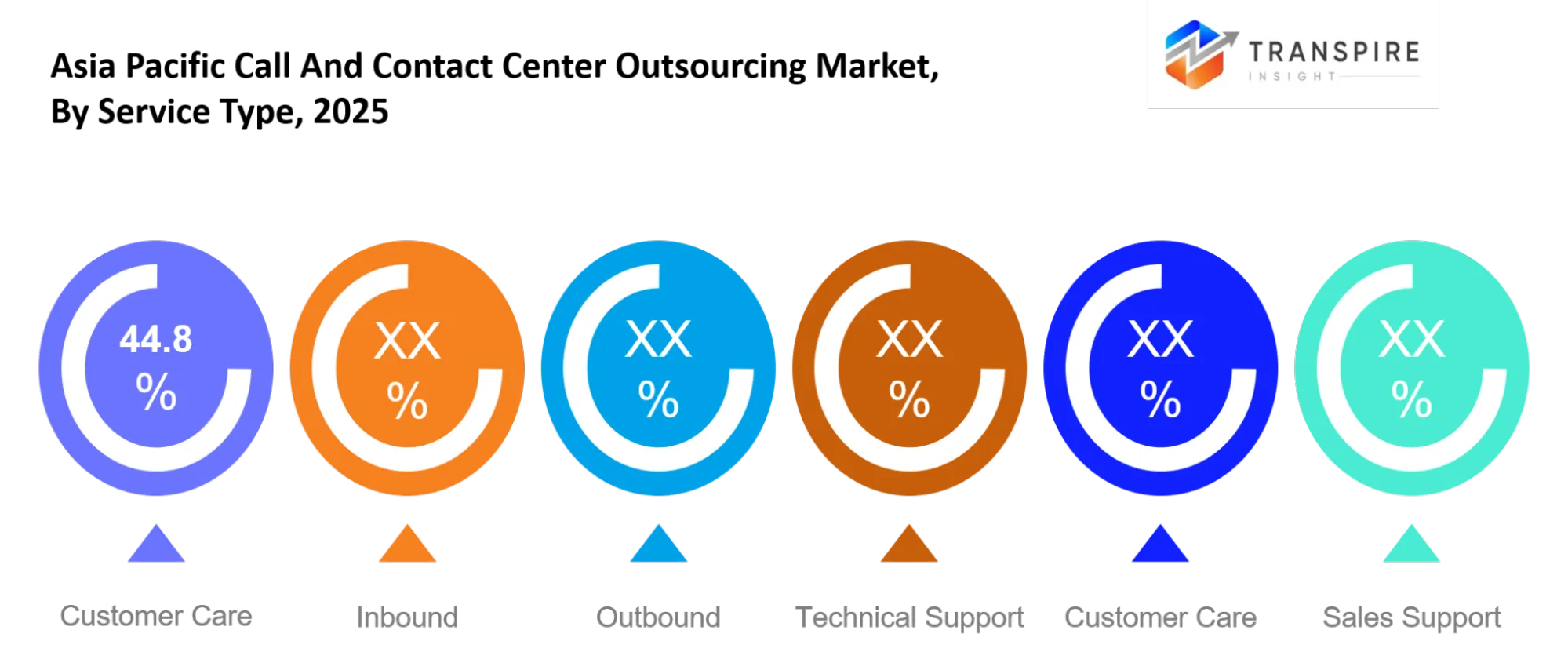
By Channel :
Voice channels keep playing a pretty important role in customer communication, mostly when customers need immediate help or they want more detailed discussions. Email is still widely used for formal communication, as well as documentation and issue tracking, it’s kind of the default in a lot of places. Chat services on the other hand provide real time support, and they let businesses reply fast to customer requests ,and also juggle several conversations at the same time.
Social media channels have also become a big deal for customer engagement, because consumers interact with brands through digital platforms more and more. Omnichannel solutions bring voice, email, chat, social media, and other communication ways together into one unified experience. Other routes might include messaging applications and self service platforms too, these give customers extra options for reaching support or finding information ,without going through the usual steps.
By Enterprise Size :
Large enterprises usually end up needing a lot of outsourcing services, mostly because they deal with tons of customer interaction and they operate in several different locations, kind of all at once. In general, those organizations look for vendors that can provide multilingual assistance, plus smoother technology integration and yes, service coverage 24/7. Big outsourcing setups tend to keep the customer experience pretty steady while also helping rein in operational costs.
Medium-sized enterprises are also leaning more and more toward outsourced contact center solutions, mainly so they can tap specialized know-how without putting heavy money into new infrastructure. Small enterprises, on the other hand, often turn to outsourcing to strengthen customer support features and to compete better with larger rivals. Beyond that, other groups like startups and niche organizations can have special service requirements, so a flexible outsourcing approach really fits their needs better than rigid contracts.
By End User :
The BFSI space leans on outsourced contact center services, for stuff like customer support, account management, loan questions, transaction help, and even fraud-related messages. Meanwhile, telecom companies count on these centers to handle billing questions, technical troubles, service upgrades, and subscriber support, all day long. Basically these sectors often push big volumes of interactions so you end up needing fast, well tuned customer engagement approaches.
Retail orgs also turn to outsourcing for order management, returns handling, product inquiries, and customer loyalty programs, and sometimes the wording is a bit more “customer-first” than it sounds. Healthcare providers commonly use contact centers for appointment scheduling, patient assistance, claims support, and general information services. Other end users, like travel , education, utilities, and government bodies tend to need organized communication channels to serve both customers and stakeholders in a steady manner.
What are the Key Use Cases Driving the Asia Pacific Call And Contact Center Outsourcing Market?
Customer service management stays the main use case pushing adoption across the Asia Pacific Call And Contact Center Outsourcing Market. Banking, telecommunications, and retail organizations are pulling in huge amounts of customer interactions every day, so using outsourced support feels like a practical approach for managing questions, complaints, account help, and service requests while still keeping response quality fairly steady.
And it is not only the classic support side anymore, because outsourced contact centers are gradually taking on technical assistance too, plus more sales oriented functions. Telecommunications providers often staff up specialized teams to untangle network troubles and device issues, while e-commerce and retail firms lean on outside agents for order management, customer retention programs, and lead conversion activities that basically tie back to revenue generation.
Newer applications are also showing up, like AI assisted customer engagement, predictive customer analytics, and multilingual digital help. Healthcare organizations are looking at outsourced patient communication services and financial institutions are starting to use advanced analytics to spot customer behavior patterns, then improve more personalized service delivery. These directions are expected to become more common as automation, and data driven customer experience strategies keep getting more mature across the region.
|
Report Metrics |
Details |
|
Market size value in 2025 |
USD 22.1 Billion |
|
Market size value in 2026 |
USD 24.9 Billion |
|
Revenue forecast in 2033 |
USD 1.894 Billion |
|
Growth rate |
CAGR of 12.47% from 2026 to 2033 |
|
Base year |
2025 |
|
Historical data |
2021 - 2024 |
|
Forecast period |
2026 - 2033 |
|
Report coverage |
Revenue forecast, competitive landscape, growth factors, and trends |
|
Regional scope |
Asia Pacific (India, China, Japan, Australia, South Korea, Rest of Asia Pacific) |
|
Key company profiled |
Teleperformance, Concentrix, Foundever, TTEC, WNS, Genpact, Infosys BPM, HGS, TaskUs, Alorica, Firstsource, Tech Mahindra, Accenture, Sutherland, IBM |
|
Customization scope |
Free report customization (country, regional & segment scope). Avail customized purchase options to meet your exact research needs. |
|
Report Segmentation |
By Service Type (Inbound, Outbound, Technical Support, Customer Care, Sales Support, Others); By Channel (Voice, Email, Chat, Social Media, Omnichannel, Others); By Enterprise Size (Large, Medium, Small, Others); By End User (BFSI, Telecom, Retail, Healthcare, Others) |
Which Regions are Driving the Asia Pacific Call And Contact Center Outsourcing Market Growth?
India still feels like the biggest player in the Asia Pacific landscape, mostly because it has a deep talent pool, a well-developed business process outsourcing sector, and solid digital infrastructure investments. Over the years, the country has built up decades of know how in customer service delivery, so it now has a big workforce that can handle multilingual support, technical assistance, and back office tasks. On top of that, government initiatives that push digital services, and encourage technology investments, basically make the whole operating environment easier for outsourcing providers. There’s also this chain of tech hubs, training institutions, cloud infrastructure providers, and global enterprise customers that keeps the market moving forward, and kind of locks in long term leadership.
The Philippines shows up as the second most influential market, but the growth story is a bit different. Instead of trying to win mainly on scale, the country leans on other strengths. For example strong English language proficiency, a cultural match with Western markets, and a service-minded workforce. Because of that, the Philippines is especially appealing for customer experience management, premium support services, and those high touch customer engagement programs. And since there’s been consistent investment in workforce development, plus business continuity capabilities, the market has stayed a dependable source of regional outsourcing revenue even when economic conditions start shifting around.
Southeast Asia, especially Indonesia, Vietnam ,and Malaysia ,is sort of emerging as the quickest growing regional cluster. In the last while ,new investments in digital infrastructure, cloud connectivity, and tech-enabled service centers have really boosted the region’s capacity to handle international outsourcing contracts. On top of that, the domestic digital economies are growing too, so demand for customer engagement services keeps rising across e-commerce, financial technology, and telecommunications. During the 2026–2033 stretch, this momentum should open fresh chances for outsourcing providers, technology vendors, and investors who want access to customer experience markets that are rapidly expanding.
Who are the Key Players in the Asia Pacific Call And Contact Center Outsourcing Market and How Do They Compete?
Within the Asia Pacific Call and Contact Center Outsourcing Market, competition is kind of moderately consolidated, with big international players competing next to more regional specialists. Price effectiveness still matters, but technology strength, automation know how, multilingual coverage, and industry know-how are getting more and more as the real differentiators. Firms are not choosing providers only because of labor costs now, it feels like. Instead, buyers look closely at outsourcing partners for digital transformation competence, customer experience outcomes, cybersecurity compliance, and the ability to handle omnichannel engagement plans effectively.
Teleperformance has been leaning hard into AI enabled customer experience solutions, mixing automation tools and big human support operations. This style helps them boost productivity while maintaining stable service quality across many industries. Concentrix sets itself apart with integrated customer experience technology, analytics capabilities, and consulting offerings, enabling clients to reshape their customer engagement workflows, not just hand them off. The company keeps moving forward by investing in technology and adding strategic service improvements across Asia Pacific locations.
Foundever kind of leans into flexible delivery frameworks and multilingual support, which it seems to fit global brands that work across many markets. TTEC Holdings mixes cloud based customer engagement platforms together with outsourced service delivery, so the whole pitch ends up feeling more technology driven. Wipro, on the other hand, taps into know how across information technology, automation, and business process management, and then bundles that into integrated transformation services. From what it looks like, all of them keep pushing forward via cloud alliances, AI rollout plans and also regional delivery center investments meant to boost scalability and operational efficiency, overall.
Company List
- Teleperformance
- Concentrix
- Foundever
- TTEC
- WNS
- Genpact
- Infosys BPM
- HGS
- TaskUs
- Alorica
- Firstsource
- Tech Mahindra
- Accenture
- Sutherland
- IBM
Recent Development News
In September 2025, Concentrix announced acquisition of SAI Digital. The acquisition strengthened Concentrix's digital commerce and customer experience technology capabilities in Asia Pacific while expanding its delivery presence in Vietnam, supporting intelligent customer engagement services across regional markets. Sourcehttps://www.concentrix.com/
What Strategic Insights Define the Future of the Asia Pacific Call And Contact Center Outsourcing Market?
The Asia Pacific call and contact center outsourcing market is kind of structurally shifting, from labor-arbitrage-driven delivery toward AI-augmented outcome-led customer experience ecosystems, you know. Over the next 5–7 years growth will be shaped less by seat expansion and more by platformization, where providers basically embed automation, analytics and conversational AI into the service stacks, compressing those classic voice-heavy models while at the same time expanding digital-first engagement.
There is also a less visible risk that people maybe don’t talk about much : technology substitution. Enterprise adoption of generative AI and in-house virtual agents can quietly reduce dependency on outsourced human agents faster than the headline demand suggests, and that can erode volume-based revenue pools without much noise. At the same time, stricter data localization and privacy regimes across APAC might fragment delivery networks, which increases compliance costs , sometimes a lot.
An emerging opportunity sits in vernacular AI-powered voice automation for Tier-2 and Tier-3 Asian markets, where multilingual capability is still underdeveloped. Providers should pivot toward outcome-based pricing, invest in proprietary AI training datasets, and build domain-specific CX platforms rather than just trying to outscale headcount, only.
Asia Pacific Call And Contact Center Outsourcing Market Report Segmentation
By Service Type
- Inbound
- Outbound
- Technical Support
- Customer Care
- Sales Support
By Channel
- Voice
- Chat
- Social Media
- Omnichannel
By Enterprise Size
- Large
- Medium
- Small
By End User
- BFSI
- Telecom
- Retail
- Healthcare
Frequently Asked Questions
Find quick answers to common questions.
The Asia Pacific Call And Contact Center Outsourcing Market size is USD 56.7 Billion in 2033.
Key Segments for the Asia Pacific Call And Contact Center Outsourcing Market are By Service Type (Inbound, Outbound, Technical Support, Customer Care, Sales Support, Others); By Channel (Voice, Email, Chat, Social Media, Omnichannel, Others); By Enterprise Size (Large, Medium, Small, Others); By End User (BFSI, Telecom, Retail, Healthcare, Others).
Major Asia Pacific Call And Contact Center Outsourcing Market Players are Teleperformance, Concentrix, Foundever, TTEC, WNS, Genpact, Infosys BPM, HGS, TaskUs, Alorica, Firstsource, Tech Mahindra, Accenture, Sutherland, IBM.
The Current Asia Pacific Call And Contact Center Outsourcing Market size is USD 22.1 Billion in 2025.
The Asia Pacific Call And Contact Center Outsourcing Market CAGR is 12.47% from 2026 to 2033.
- Teleperformance
- Concentrix
- Foundever
- TTEC
- WNS
- Genpact
- Infosys BPM
- HGS
- TaskUs
- Alorica
- Firstsource
- Tech Mahindra
- Accenture
- Sutherland
- IBM
About the Authors

Mayur Shinde
I am Mayur Shinde, a Senior Research Analyst at Transpire Insight, specializing in the Automotive & Transportation and Information & Communication Technology (ICT) Industry. My work focuses on analyzing emerging market trends, technological advancements, competitive landscapes, and industry developments to deliver accurate, data-driven insights. I am passionate about transforming complex market information into clear, actionable content that helps businesses, professionals, and decision-makers stay informed and make confident strategic decisions.

Chakradhar Khansole
Chakradhar serves as the Research Director at Transpire Insight, bringing over 8 years of experience in technology, innovation, and strategic market intelligence. He specializes in transforming complex market data into actionable business insights that enable organizations to make informed, growth-oriented decisions. Recognized for his strategic vision and analytical expertise, Chakradhar leads high-impact research initiatives, delivering comprehensive market assessments, competitive intelligence, and forward-looking industry analysis.
Recently Published Reports
-
Apr 2026
3D Optical Profiler Market
3D Optical Profiler Market Size, Share & Analysis Report By Type (Desktop 3D Optical Profiler, and Portable 3D Optical Profiler), By Technology (Confocal Technology, and White Light Interference), By End-Use Industry (Manufacturing, Research Institutions, Automotive, Aerospace and Defense, Medical Devices, and Other), and Geography (North America, Europe, Asia-Pacific, Middle East and Africa, South and Central America), 2021 - 2031
-
Apr 2026
Depth Sensor Market
Depth Sensor Market Size, Share & Analysis Report By Type (Infrared Depth Sensors, Time-of-Flight (ToF) Sensors, Stereo Vision Sensors, Structured Light Sensors, Ultrasonic Depth Sensors), By Application (Automotive, Robotics, Gaming, Consumer Electronics, Industrial Automation, Healthcare, Security & Surveillance, Others), By End Users (Automotive Manufacturers, Consumer Electronics Companies, Healthcare Providers, Industrial Companies, Security Agencies, Gaming Companies, Robotics Companies, Others), and Geography (North America, Europe, Asia-Pacific, Middle East and Africa, South and Central America), 2021 – 2031
-
Apr 2026
Digital Manufacturing Market
Digital Manufacturing Market Size, Share & Analysis Report By Component (Hardware, Software, and Services), By Technology (Robotics, 3D Printing, Internet of Things (IoT), and Others), By Application (Automotive and Transportation, Aerospace and Defense, Consumer Electronics, Industrial Machinery, and Others), By Process Type (Computer-Based Designing, Computer-Based Simulation, Computer 3D Visualization, Analytics, and Others), and Geography (North America, Europe, Asia-Pacific, Middle East and Africa, South and Central America), 2021 – 2031
-
Apr 2026
Digital Visa Services Market
Digital Visa Services Market Size, Share & Analysis Report By Type (Individual Travelers, Group Travelers), By Application (Tourism, Business Travel, Others), and Geography (North America, Europe, Asia-Pacific, Middle East and Africa, South and Central America), 2021 – 2031