

Asia Pacific Biofilter Market Summary
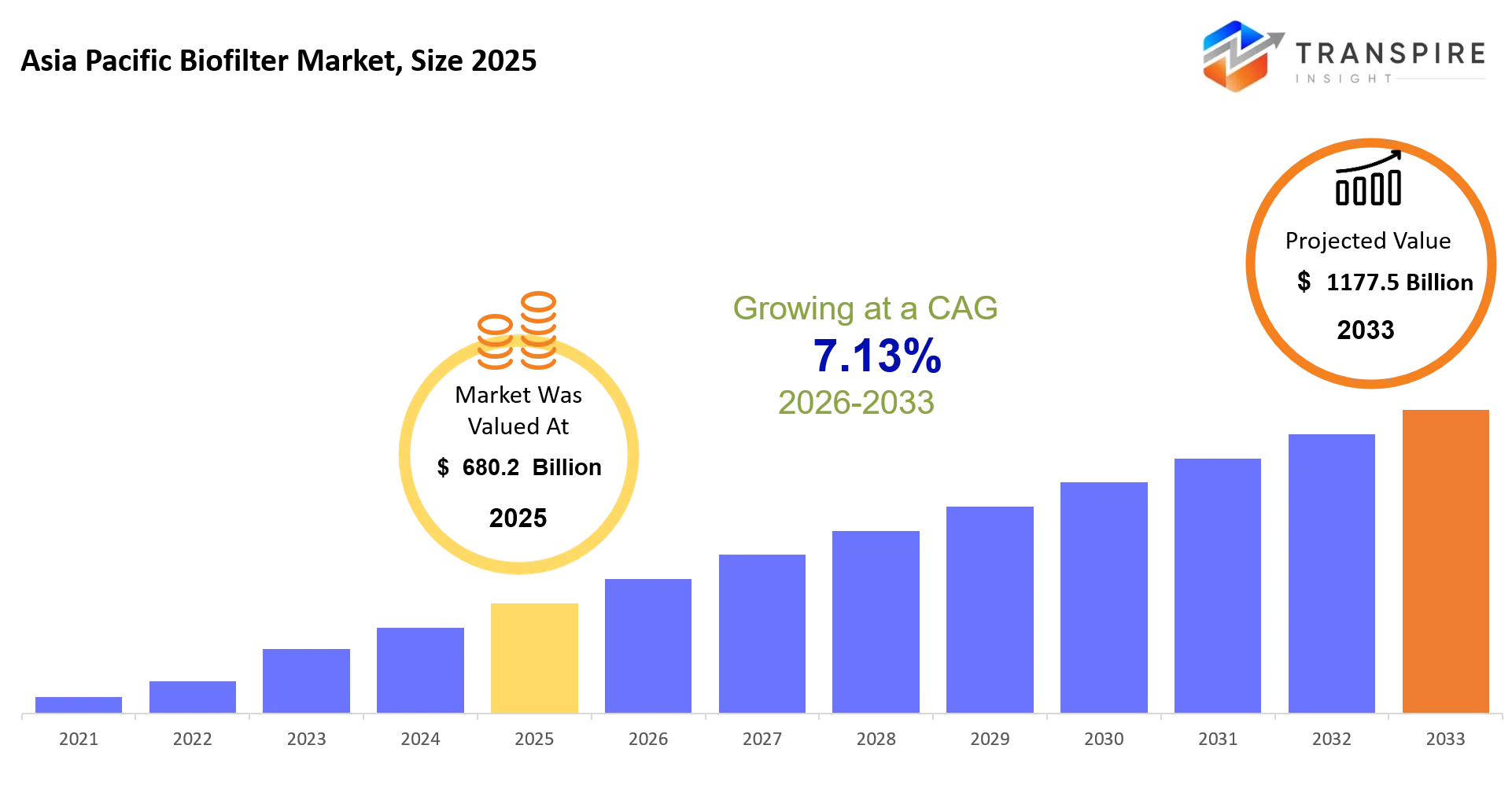
As per Transpire Insight Analysis, the Asia Pacific Biofilter Market size is estimated at USD 680.2 Million in 2025 and is anticipated to reach USD 1177.5 Million by 2033, growing at a CAGR of 7.13% from 2026 to 2033.
In the Asia Pacific biofilter market, the ecosystem, well, supports industries and municipalities by pulling out contaminants, strange odors and harmful gases from air and wastewater streams before they end up back in the environment. A lot of manufacturing facilities , wastewater treatment plants, food processing units, and chemical operations depend on biofilters to stay within environmental requirements and still keep operating costs down, mainly because biological treatment methods are used. Over the last three to five years, the market sort of moved away from conventional filtration systems toward more advanced biofiltration solutions that bring better efficiency, digital monitoring, and less routine work. Newer and tighter environmental regulations across several Asia Pacific economies have also pushed this shift forward. On top of that, the COVID-19 pandemic created disruptions that highlighted weak points in industrial infrastructure, so operators began modernizing treatment systems once production restarted. All of this has, in practice, driven long term investment in sustainable emission control and wastewater treatment, which helps suppliers expand deployments across long established industrial hubs, and also into newly developing manufacturing clusters.
Asia Pacific Biofilter Market Size & Forecast:
- Asia Pacific Biofilter Market Size 2025: USD 680.2 Million
- Expected Market Value 2033: USD 1177.5 Million
- Forecast CAGR: 7.13%
- Leading region in 2025: China
- Fastest-growing region: India
- Key Profile: Veolia, SUEZ, Evoqua Water Technologies, Xylem, BioAir Solutions, Pentair, Aquatech International, Envirogen Technologies, Nijhuis Saur Industries, Pall Corporation, WOG Technologies, Biorem, PureAir Filtration, Ecolutia Services, Organica Water
Key Market Insights
- China pretty much ran the show in 2025, holding an estimated 38% market share. This was backed by huge industrial clusters , plus that continuous push for pollution control infrastructure upgrades.
- India, meanwhile, is expected to become the fastest-growing regional market from 2025 through 2033, mainly because industrial capacity is expanding and municipal wastewater modernization projects are picking up.
- On the product side, biological air biofilters ended up taking the lead segment around 56% market share in 2025. That happened largely due to stricter rules for industrial air emissions, and honestly, tighter compliance tends to drive adoption.
- Wastewater biofilters were ranked as the second-largest segment. They are also growing steadily, aided by industrial water reuse efforts and upgrades to municipal treatment systems.
- Hybrid and smart biofilter systems are forecast to grow the fastest from 2025 to 2033, as facilities adopt automated monitoring technologies and more advanced operational controls.
- In applications, industrial air pollution control accounted for nearly 48% of revenue in 2025. Manufacturing plants strengthened their environmental compliance programs, and that likely kept demand firm.
- Industrial wastewater treatment is projected to be the fastest-moving application through 2033, supported by tighter discharge limits and more investments in water recycling.
- As for end users, the manufacturing industries segment led, with about 46% market share in 2025. This reflects broad deployment across chemical, food, and pharmaceutical facilities.
- Municipal utilities are anticipated to become the fastest-growing end-user category during 2025–2033, supported by government-funded environmental infrastructure initiatives.
What are the Key Drivers, Restraints, and Opportunities in the Asia Pacific Biofilter Market?
More stringent industrial emissions limits, plus tighter wastewater discharge rules, remain the strongest drivers of the market. Across China, India, South Korea, and into Southeast Asia, governments have added stricter compliance obligations for both manufacturing plants and municipal facilities. Firms are now leaning into biological filtration, mostly to steer clear of regulatory penalties and keep operating costs lower. At the same time, the steady industrial buildup is pushing demand for treatment capacity upward. Put together, regulation and modernization tend to squeeze procurement timelines, boost installation volumes, and keep generating repeat money via maintenance and replacement services.
Even so, high installation costs and uneven technical know-how are the biggest, most stubborn structural obstacles. Many sites have complicated layouts, so they end up requiring bespoke engineering rather than off-the-shelf units. Smaller and mid sized manufacturers often delay new capex because the project payback stretches past whatever immediate budgeting windows they’re working with. Based on the Transpire Insight review of regional procurement notices and launch timing, supply chain concentration still appears to be the main execution risk. And, when specialized biological media and biological control components aren’t consistently available, it can slow commissioning, delay completion, and in turn dampen the revenue that would otherwise follow.
The most convincing long-term opportunity is kinda about blending smart monitoring with advanced biological filtration systems. AI-enabled sensors, cloud-based performance analytics, and remote compliance platforms are already becoming very workable for industrial sites, so they can keep optimising without too much friction. In particular, India and Southeast Asia look interesting for investors because new manufacturing plants are often built with digital environmental infrastructure right from the design stage. That change should also help push higher-value solutions, more recurring software services, and, in general, steadier aftermarket revenue.
What Has the Impact of Artificial Intelligence Been on the Asia Pacific Biofilter Market?
Artificial intelligence and digital monitoring tech are, somehow, reshaping biological filtration operation by giving better process visibility and more exact operational control. In industrial plants, people are already leaning on AI enabled sensors to track airflow, contaminant levels, moisture, and even microbial activity in real time, not just occasionally. Then automated control platforms will continuously tweak operating conditions, helping operators maintain regulatory compliance while reducing manual fuss. Some cloud linked systems also make environmental reporting easier and less painful for audit preparation, even when teams are busy.
Machine learning, in particular, has made predictive maintenance feel much stronger. It can catch performance drop offs before a real equipment failure shows up. Using past operating records, algorithms forecast media replacement timing, balance airflow distribution, and estimate treatment efficiency when production conditions change. With that, companies see fewer unplanned shutdowns, better equipment uptime, and reduced maintenance spending, while treatment performance stays more stable than before. Digital forecasting tools also let suppliers guess replacement demand sooner, and improve inventory planning across different regional sites.
Still, AI adoption stays uneven. The integration costs can be high, especially for older industrial facilities where legacy control systems do not really connect digitally. Predictive models also need consistent operational data, and some smaller facilities cannot yet produce it reliably. But as digital infrastructure expands across Asia Pacific, broader rollouts of intelligent monitoring platforms should improve operational efficiency, reinforce environmental compliance, and deliver extra value beyond standard filtration equipment.
Key Market Trends
- Since 2022, industrial facilities have sped up switching out old-fashioned filtration with smart biofilter systems that come with automated tracking and some remote “tune up” of performance. Kinda, you know, not just better equipment but more steady control.
- In 2025 China made up about 38% of the regional revenue, while makers also pushed local production forward to keep the supply chain less fragile and more reliable.
- Meanwhile India is turning into the quickest-growing market across 2025–2033. This is backed by wastewater infrastructure buildouts and fresh manufacturing investments. More and more capacity, basically.
- In food and beverage, producers boosted biological odour control installations by roughly 20% since 2021. They did it because environmental rules got tighter, and they had to stay compliant without delays.
- Hybrid biofilter systems that mix biological media with advanced filtration technologies… those started getting broader buy-in during 2023 to 2025. The point is to improve treatment efficiency at the same time.
- Firms like Veolia, SUEZ, and Xylem increased spending on digital monitoring platforms, which help with predictive maintenance and make compliance reporting easier to manage.
- Since 2023, industrial buyers have been shifting priorities toward lifecycle operating costs rather than just the upfront equipment price. So they’re more open to higher efficiency systems, even if the initial number looks higher.
- Regional suppliers, after pandemic-related supply issues exposed vulnerabilities in imported filtration components, expanded localized manufacturing and service networks. Less dependence, more coverage.
- And in municipal wastewater, authorities have been rolling biofiltration technologies into new treatment projects between 2024 and 2025. This supports long term infrastructure modernization across Southeast Asia, step by step.
Asia Pacific Biofilter Market Segmentation
By Filter Media :
Organic media had an important role because natural materials provided dependable biological treatment while keeping operating costs competitive, so overall it felt practical. Wastewater treatment plants as well as industrial sites leaned toward organic media for odor removal that actually works and for contaminant reduction across long run periods. When microbial life stayed stable, and the expense for replacement was lower, more municipal and industrial projects were willing to adopt it. Also, ongoing spending on environmental infrastructure helped keep these systems working over the long haul in developing economies, even when resources were limited.
Meanwhile, synthetic media slowly but surely became more popular, mainly due to their longer service life and stable filtration results even under harsh operating conditions. Activated carbon media kept strong demand because the removal of volatile organic compounds, plus odor control, stayed non negotiable for many operators. Ceramic and composite media started getting real attention, not just for durability but also because treatment efficiency could be improved in specialized industrial settings. Then there were other media types that served smaller, niche needs where certain contaminants or particular operating environments demanded more tailored filtration solutions, which is why not everyone went with the same choice.
By Application :
Wastewater treatment was kind of the biggest application, because municipalities and manufacturing facilities expanded their treatment capacity to satisfy those stricter discharge standards… and it sort of created a momentum. Industrial investment in water reuse projects also increased the installation of biological filtration systems across multiple industries. There was more weight put on sustainable water stewardship, so operators kept modernizing older treatment infrastructure , kind of replacing aging assets. And ongoing urban growth kept pushing further demand for efficient bioprocess based treatment technologies.
Air pollution control stayed another major use. Industrial operators upgraded their emission management systems to comply with environmental regulations, so the pressure didn’t really stop. In parallel, aquaculture sites adopted biofilters to keep water quality steady and, in a practical sense, improve production performance . Drinking water treatment, industrial emission control, and even composting uses continued to grow, mainly as environmental performance requirements became more exacting. Then there were additional opportunities from other niche applications tied to specialized environmental treatment projects.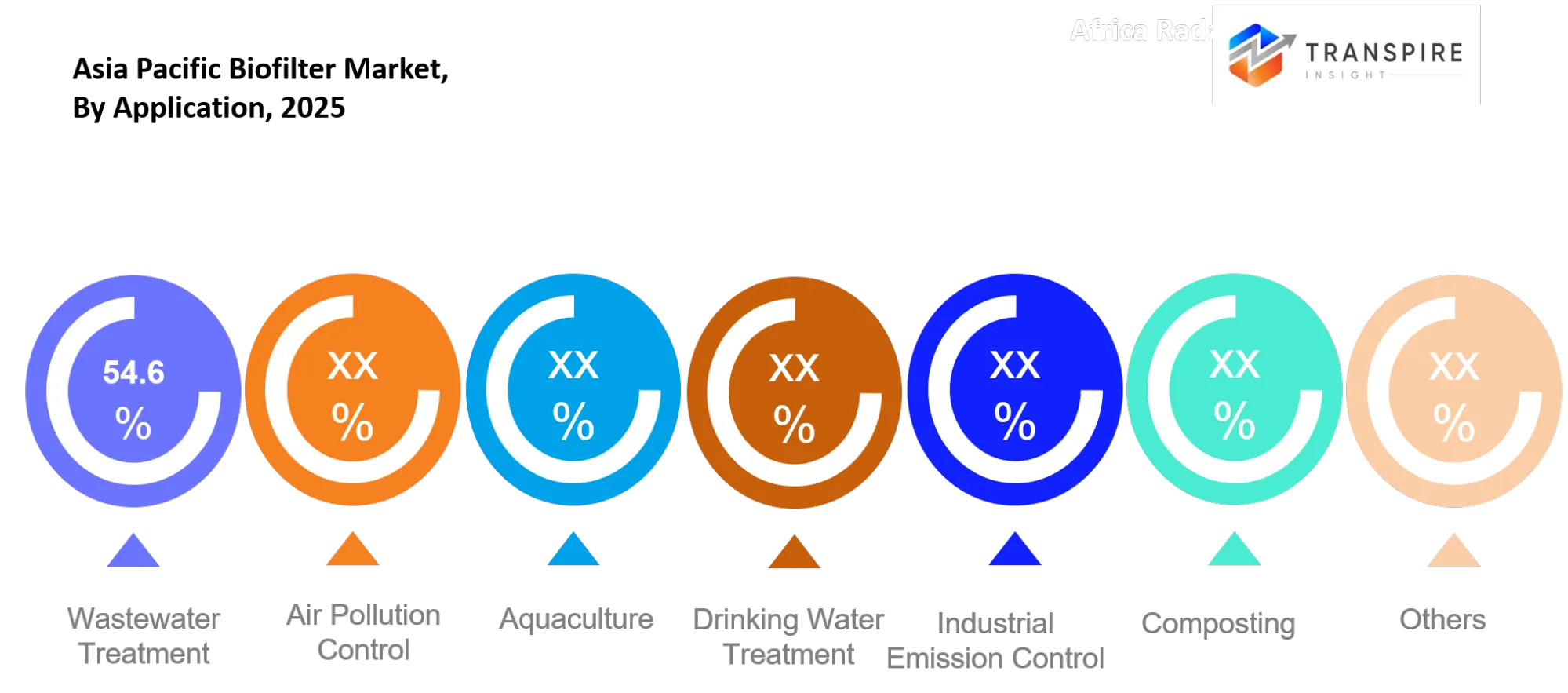
By End User :
Municipal utilities held a rather leading share because public investment kept on strengthening wastewater treatment infrastructure across the region , basically. Bigger treatment plants leaned into biological filtration technologies that help lower operating expenses while still keeping regulatory compliance intact. As urban populations grew, it also pushed more capital into modern environmental treatment systems, and that kept the momentum going. The long project lifecycles then supported recurring maintenance , plus frequent replacement activities too, over time.
Industrial facilities made up another important customer set thanks to broad adoption in manufacturing , pharmaceutical and processing industries. Meanwhile, aquaculture farms expanded biological filtration capacity in order to improve water quality as well as production stability. Food and beverage companies increased deployment to handle both wastewater , and odor control needs, quite directly. Chemical producers, in turn, invested in advanced treatment systems designed for complex process streams. Outside of that, other end users supported steady demand through smaller industrial and commercial installations too.
By System Type :
Open biofilters kept a strong market position because the system design stays on the simple side, which really reduced installation costs and it helped for big outdoor treatment operations. Municipal facilities , and industrial plants continued choosing open configurations for dependable long term performance. The proven operational efficiency kind of made them spread across many familiar treatment projects. On top of that, the lower maintenance load also supported continued market acceptance, in a steady sort of way.
Closed biofilters moved forward too, especially at sites needing tighter process control and also reduced environmental exposure. Modular biofilters gained attention because scalable layouts made it easier to plan for later capacity increases. Hybrid biofilters saw quicker adoption, mainly by combining biological treatment with advanced monitoring together with filtration technologies. Meanwhile other system types ended up being used for tailored industrial needs, with particular operational demands that didn’t quite match the standard setups.
By Installation :
Outdoor installations pretty much took the biggest chunk, since wastewater treatment plants, and heavy industrial facilities needed high capacity systems to run without a break. Also the large available install areas sort of helped with efficient processing, for substantial air AND water treatment volumes. Public infrastructure projects leaned toward outdoor setups too, because upkeep access stayed easy enough. When the long run operation stayed stable, adoption grew across both municipal and industrial facilities.
Indoor installations, meanwhile, started showing up more in manufacturing surroundings where controlled operating conditions made the treatment more consistent. Portable systems got a slow but steady nod for temporary industrial activities and for pilot treatment efforts. Fixed systems were still the go-to for permanent infrastructure, because the long service life basically paid back the higher upfront cost. There were also other installation formats, used when the project had specialized needs across certain industrial applications.
What are the Key Use Cases Driving the Asia Pacific Biofilter Market?
Wastewater treatment stays like the main use case, because municipal utilities, and big industrial plants need dependable biological filtration to keep meeting tighter discharge standards. Public authorities as well as manufacturing operators put money into these systems to enhance treatment efficiency, lower day to day operating costs , and keep up the long run environmental compliance.
Air pollution control and the management of industrial emissions are still growing, especially in chemical manufacturing, food and beverage processing, and pharmaceutical production. Aquaculture operators are also turning toward biofilter use, not just to keep water quality stable, but also to push better production performance. At the same time they want to satisfy more demanding operational expectations, which is kind of becoming normal now
New directions are starting to show up too, like decentralized wastewater treatment for industrial parks and modular biofiltration setups for smart manufacturing sites. More investments in sustainable infrastructure and digital environmental monitoring will likely help adoption grow across industrial zones that are developing, plus more commercial treatment projects over the forecast period.
|
Report Metrics |
Details |
|
Market size value in 2025 |
USD 680.2 Million |
|
Market size value in 2026 |
USD 728.5 Million |
|
Revenue forecast in 2033 |
USD 1177.5 Million |
|
Growth rate |
CAGR of 7.13% from 2026 to 2033 |
|
Base year |
2025 |
|
Historical data |
2021 - 2024 |
|
Forecast period |
2026 - 2033 |
|
Report coverage |
Revenue forecast, competitive landscape, growth factors, and trends |
|
Regional scope |
Asia Pacific (India, China, Japan, Australia, South Korea, Rest of Asia Pacific) |
|
Key company profiled |
Veolia, SUEZ, Evoqua Water Technologies, Xylem, BioAir Solutions, Pentair, Aquatech International, Envirogen Technologies, Nijhuis Saur Industries, Pall Corporation, WOG Technologies, Biorem, PureAir Filtration, Ecolutia Services, Organica Water . |
|
Customization scope |
Free report customization (country, regional & segment scope). Avail customized purchase options to meet your exact research needs. |
|
Report Segmentation |
By Filter Media (Organic Media, Synthetic Media, Activated Carbon Media, Ceramic Media, Composite Media, Others); By Application (Wastewater Treatment, Air Pollution Control, Aquaculture, Drinking Water Treatment, Industrial Emission Control, Composting, Others); By End User (Municipal Utilities, Industrial Facilities, Aquaculture Farms, Food & Beverage Industry, Chemical Industry, Others); By System Type (Open Biofilters, Closed Biofilters, Modular Biofilters, Hybrid Biofilters, Others); By Installation (Indoor, Outdoor, Portable Systems, Fixed Systems, Others) |
Which Regions are Driving the Asia Pacific Biofilter Market Growth?
China stayed the most dominant regional market, with an estimated 38% share of revenue in 2025. Strict environmental rules , plus large wastewater treatment programs, and nonstop industrial modernization really have, in practice, strengthened adoption across different sectors. On top of that, strong home grown manufacturing capability, well established equipment suppliers, and continued spending on environmental infrastructure help keep a steady supply chain. With further improvements to industrial plants and public treatment networks, this regional lead should remain in place during most of the forecast period.
Japan was the second-largest regional market, mainly since long-term infrastructure scheduling and consistent environmental compliance have built fairly stable purchasing habits. Industrial players keep swapping out older treatment systems for better efficient biofiltration technologies, rather than simply leaning on big capacity add-ons. There’s also solid engineering know-how, dependable maintenance support, and predictable capital investment cycles, which together make it a dependable recurring revenue source. That kind of measured, balanced investment is what sustains steady growth even if industrial expansion is slower than in several nearby economies.
India is expected to see the fastest growth, with industrial development and urban infrastructure projects moving along and, on top of that, tougher wastewater regulations speeding up new installations. In the meantime, recent investments in manufacturing corridors and municipal treatment facilities have really broadened the chances for advanced biological filtration systems. As environmental compliance keeps expanding across food processing , chemicals, and pharmaceuticals, it has also pulled in more demand from private sector buyers. Between 2026 and 2033, that same push will likely keep turning into solid opportunities for equipment suppliers, technology providers, and investors looking for long-run expansion across emerging industrial regions.
Who are the Key Players in the Asia Pacific Biofilter Market and How Do They Compete?
Competition is still rather fragmented, sort of yes, because multinational environmental technology companies are in the same arena as regional engineering firms, plus specialized filtration providers. The way people, well, buyers decide who wins is mainly tied to technology performance , total lifecycle operating costs, digital monitoring abilities and also after-sales service, you know. Even so, the established suppliers keep adding to their portfolios via continual innovation, while the regional players try to win with localized engineering support, quicker project delivery and tailored system design, sometimes more bespoke than you’d expect.
Veolia leans into integrated water and air treatment solutions, mixing biological filtration with digital monitoring platforms, so industrial customers can enhance day to day efficiency and regulatory adherence. SUEZ stands out via sophisticated process engineering and long running service contracts that back municipal utilities and more complicated industrial facilities. Xylem pushes adoption by pairing intelligent monitoring technologies with their treatment equipment, helping customers fine tune maintenance timetables and system performance overall.
DuPont is strengthening their market standing, via advanced filtration technologies that go along with biological treatment processes for a bunch of industrial uses. Aquatech International keeps putting the focus on customized wastewater treatment work, especially where water-intensive industries need specialized process design, sort of like a tailored workflow. A broader regional push , plus continued technology spending, and partnerships with municipal authorities and industrial operators all keep shaping the competitive playbook. Meanwhile, suppliers are trying to win higher-value projects and, on top of that, long-term service revenue, which is kind of the real win in the end.
Company List
- Veolia
- SUEZ
- Evoqua Water Technologies
- Xylem
- BioAir Solutions
- Pentair
- Aquatech International
- Envirogen Technologies
- Nijhuis Saur Industries
- Pall Corporation
- WOG Technologies
- Biorem
- PureAir Filtration
- Ecolutia Services
- Organic Water
Recent Development News
In February 2026, Veolia secured two 15-year operation and maintenance contracts for Mumbai's largest drinking water production plants. The investment expands advanced water treatment infrastructure in India and strengthens demand for biological and advanced filtration technologies across large municipal projects. Source https://www.veolia.in/
In March 2026, Veolia announced the acquisition of a major Australian soil remediation company to strengthen PFAS treatment capabilities. The acquisition expands the company's environmental technology portfolio in Asia Pacific and supports broader adoption of advanced water and wastewater treatment solutions. Source https://www.veolia.com/
What Strategic Insights Define the Future of the Asia Pacific Biofilter Market?
The Asia Pacific biofilter market is drifting toward more integrated environmental treatment platforms, where biological filtration is bundled together with digital monitoring , automation , and data- based process tweaking. That shift should get a boost from tighter industrial discharge rules, ongoing spending on wastewater infrastructure, and the continued growth of advanced manufacturing across up-and-coming economies.
There is also a quieter kind of risk, not so easy to spot early on, which is supply chain concentration for specialized filter media and monitoring components; this could drag out project schedules and nudge up system costs, even while demand stays pretty favorable.
A notable opportunity sits in modular biofilter systems, aimed at industrial parks and smaller decentralized treatment sites in India and Southeast Asia, especially where infrastructure investment is speeding up. Firms that localize manufacturing, build regional service coverage, and fold predictive monitoring features into their product lines will likely be in a better spot to win long-term agreements, cut delivery headaches, and maintain stronger differentiation as environmental compliance keeps getting more strict.
Asia Pacific Biofilter Market Report Segmentation
By Filter Media
- Organic Media
- Synthetic Media
- Activated Carbon Media
- Ceramic Media
- Composite Media
By Application
- Wastewater Treatment
- Air Pollution Control
- Aquaculture
- Drinking Water Treatment
- Industrial Emission Control
- Composting
By End User
- Municipal Utilities
- Industrial Facilities
- Aquaculture Farms
- Food & Beverage Industry
- Chemical Industry
By System Type
- Open Biofilters
- Closed Biofilters
- Modular Biofilters
- Hybrid Biofilters
By Installation
- Indoor
- Outdoor
- Portable Systems
- Fixed Systems
Frequently Asked Questions
Find quick answers to common questions.
The Expected Asia Pacific Biofilter Market size for the Market will be USD 1177.5 Million in 2033.
Key Segments for the Asia Pacific Biofilter Market are By Filter Media (Organic Media, Synthetic Media, Activated Carbon Media, Ceramic Media, Composite Media, Others); By Application (Wastewater Treatment, Air Pollution Control, Aquaculture, Drinking Water Treatment, Industrial Emission Control, Composting, Others); By End User (Municipal Utilities, Industrial Facilities, Aquaculture Farms, Food & Beverage Industry, Chemical Industry, Others); By System Type (Open Biofilters, Closed Biofilters, Modular Biofilters, Hybrid Biofilters, Others); By Installation (Indoor, Outdoor, Portable Systems, Fixed Systems, Others).
Major Asia Pacific Biofilter Market players are Veolia, SUEZ, Evoqua Water Technologies, Xylem, BioAir Solutions, Pentair, Aquatech International, Envirogen Technologies, Nijhuis Saur Industries, Pall Corporation, WOG Technologies, Biorem, PureAir Filtration, Ecolutia Services, Organica Water.
The Current Asia Pacific Biofilter Market size is USD 680.2 Million in 2025.
The Asia Pacific Biofilter Market CAGR is 7.13% from 2026 to 2033.
- Veolia
- SUEZ
- Evoqua Water Technologies
- Xylem
- BioAir Solutions
- Pentair
- Aquatech International
- Envirogen Technologies
- Nijhuis Saur Industries
- Pall Corporation
- WOG Technologies
- Biorem
- PureAir Filtration
- Ecolutia Services
- Organic Water
About the Authors

Kartik bhong
I am Kartik Bhong, a Senior Research Analyst at Transpire Insight, specializing in the Packaging, Manufacturing, and Construction industry. My work focuses on analyzing market trends, emerging technologies, industry regulations, and competitive landscapes to deliver accurate, data-driven insights. I am passionate about transforming complex industry information into clear, practical content that helps businesses, professionals, and decision-makers stay informed and make confident strategic decisions. Through continuous research and a strong commitment to accuracy, I strive to create reliable, well-researched content that reflects the latest developments across these dynamic industries and supports the vision of Transpire Insight in delivering valuable market intelligence.

Chakradhar Khansole
Chakradhar serves as the Research Director at Transpire Insight, bringing over 8 years of experience in technology, innovation, and strategic market intelligence. He specializes in transforming complex market data into actionable business insights that enable organizations to make informed, growth-oriented decisions. Recognized for his strategic vision and analytical expertise, Chakradhar leads high-impact research initiatives, delivering comprehensive market assessments, competitive intelligence, and forward-looking industry analysis.
Recently Published Reports
-
Apr 2026
Handling and Lifting Equipment Market
Handling and Lifting Equipment Market Size, Share & Analysis Report By Product (Cranes and Hoists, Forklifts, Conveyor Systems, Aerial Work Platforms, Others), By Application (E-Commerce, Automotive and Railway, Food and Beverages, Aviation, Others), and Geography (North America, Europe, Asia-Pacific, Middle East and Africa, South and Central America), 2021 - 2031
-
Apr 2026
HVAC Equipment Market
HVAC Equipment Market Size, Share & Analysis Report By Heating Equipment Type (Boilers and Furnaces, Heat Pumps, and Unitary Heaters), By Ventilation Equipment (Air Handling Units, Humidifiers and Dehumidifiers, Air Filters, and Fan Coiling Units), By Air Conditioning Equipment (Unitary Air Conditioners, Room Air Conditioners, Packaged Terminal Air Conditioners, and Chillers), By End User (Commercial, Residential, Industrial, and others), and Geography (North America, Europe, Asia-Pacific, Middle East and Africa, South and Central America), 2021 – 2031
-
Apr 2026
Refrigeration Valves Market
Refrigeration Valves Market Size, Share & Analysis Report By Type (Solenoid Valves, Expansion Valves, Check Valves, Service Valves, Others), By Application (Commercial Refrigeration, Industrial Refrigeration, Transport Refrigeration, Residential Refrigeration, Air Conditioning Systems), By End User (Food and Beverage Industry, Pharmaceutical Industry, HVAC Industry, Chemical Industry, Others), and Geography (North America, Europe, Asia-Pacific, Middle East and Africa, South and Central America), 2021 – 2031
-
Apr 2026
E-Commerce Packaging Materials Market
E-Commerce Packaging Materials Market By Material Type (Corrugated Boxes, Paper & Paperboard, Foam & Cushioning Materials, Plastic Packaging, Flexible Packaging, Protective Packaging, Others), By Product(Primary Packaging, Secondary Packaging, Tertiary Packaging), By Packaging Function (Protective Packaging, Branding & Presentation Packaging, Transit & Logistic Packaging, Sustainable Packaging, Tamper Evidence Packaging), By End-User (Retail & Consumer Goods, Electronic Appliances, Food & Beverages, Healthcare & Pharmaceutical, Fashion & Apparel, Home & Furnishing, Others); By Industry Analysis, Size, Share, Growth, Trends, and Forecasts 2021-2033