Asia Pacific Autonomous Ship Market Size & Forecast:
- Asia Pacific Autonomous Ship Market Size 2025: USD 2.27 Billion
- Asia Pacific Autonomous Ship Market Size 2033: USD 6.34 Billion
- Asia Pacific Autonomous Ship Market CAGR: 13.71%
- Asia Pacific Autonomous Ship Market Segments: By Type (Remote Operated Ships, Fully Autonomous Ships, Semi-autonomous Ships, Smart Ships, Unmanned Vessels, Others); By Application (Commercial Shipping, Defense, Research, Offshore, Logistics, Others); By Component (Hardware, Software, Sensors, Navigation Systems, Communication Systems, Others); By End-User (Shipping Companies, Defense, Govt, Offshore Companies, Research Institutes, Others)
Asia Pacific Autonomous Ship Market Summary
To learn more about this report,  Download Free Sample Report
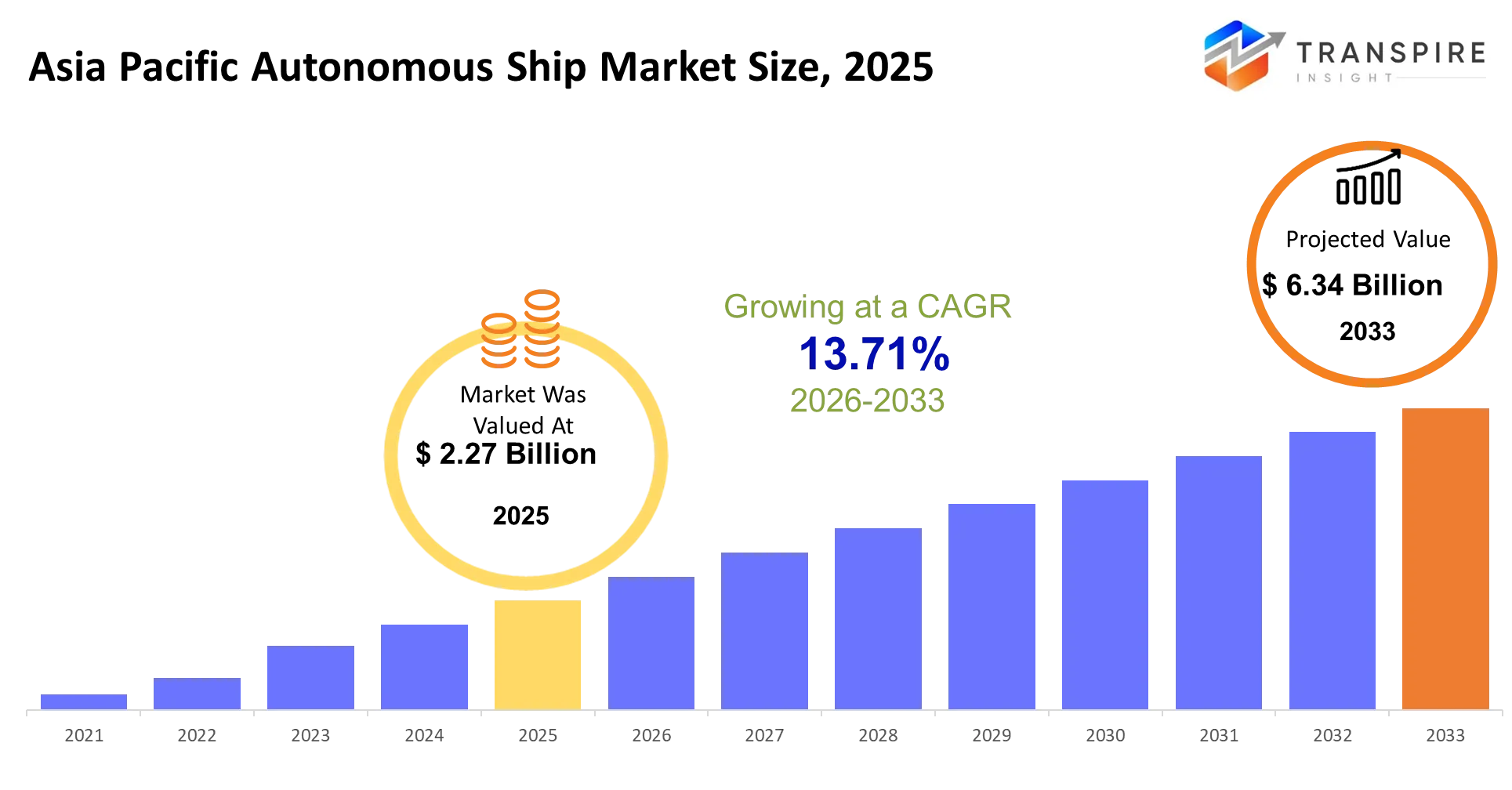
The Asia Pacific Autonomous Ship Market was valued at USD 2.27 Billion in 2025. It is forecast to reach USD 6.34 Billion by 2033. That is a CAGR of 13.71% over the period.
The autonomous ship market in Asia Pacific region aims to establish ships which can autonomously navigate their routes while either partially or completely handling operations without needing any human presence on board. The shipping industry has transitioned from doing pilot projects to developing commercial operations during the last three to five years because artificial intelligence navigation systems together with satellite technology and sensor fusion have reached their current operational capabilities.
The shipping industry has undergone a major change because companies now develop their fleets through autonomous systems instead of building new vessels from scratch. The crew shortages which occurred during the pandemic together with the supply chain interruptions required shipping companies to develop their systems for remote monitoring and automated navigation. The shipping industry now requires operators to implement safety measures together with fuel management systems and ongoing voyage control which results in the rapid development of software-based marine technologies and new revenue generation methods through service delivery.
Key Market Insights
- The Asia Pacific Autonomous Ship Market will dominate the worldwide market with its 35% share in 2025 because China, Japan, and South Korea have strong shipbuilding capabilities.
- Southeast Asia will experience the fastest growth among all sub-regions between 2025 and 2030 because of increasing maritime trade automation and the expansion of smart port facilities.
- The Asia Pacific Autonomous Ship Market develops its technology-based solutions through Japan and South Korea scientific research projects that advance their naval research and development efforts.
- The Asia Pacific Autonomous Ship Market shows its highest deployment rate in 2025 through semi-autonomous vessel systems that operate across commercial shipping fleets.
- The autonomous navigation software market has become the second biggest market segment because of increasing demand for AI-based tools that optimize shipping routes.
- The period from 2026 to 2030 will see fully autonomous vessels as the fastest expanding field which receives backing from pilot programs and regulatory sandbox certifications.
- The Asia Pacific Autonomous Ship Market is led by cargo shipping which holds almost 40% market share because of its requirements for optimizing long-distance trade routes.
- The application field for offshore operations which includes oil and gas support vessels shows rapid growth because automation enhances operational efficiency.
- The end-user category which shows the fastest growth includes government and defense organizations that expand their autonomous naval testing and acquisition programs.
- Port operators use autonomous ship technologies to enhance their berth management systems while decreasing the time needed for ships to return to service.
What are the Key Drivers, Restraints, and Opportunities in the Asia Pacific Autonomous Ship Market?
The Asia Pacific Autonomous Ship Market develops through two main factors which exist because commercial shipping fleets now use AI-based navigation systems together with remote vessel tracking systems. The industry shift occurs because shipping companies face increasing crew expenses while maritime safety regulations become more stringent and satellite-based systems now provide instant route changes together with advance warning about potential collisions. Shipping companies now use semi-autonomous technologies to achieve fuel efficiency and better route performance which helps them increase their revenue through decreased operational interruptions and better fleet performance.
The Restraint exists because Asia Pacific maritime authorities maintain separate regulatory systems which create fragmented regulations. Japan, South Korea, and China currently progress toward their different timelines for autonomous vessel testing and certification approval. The existing rules need to be standardized because international shipping operations depend on common compliance requirements. The lack of uniform regulations results in complicated insurance procedures which hinder shipping operations and prevent naval technology companies from attaining full operational capacity until they generate revenue.
The Opportunity emerges from smart port integration projects which are currently being developed in China’s Greater Bay Area and Singapore’s Maritime Smart Nation initiative. Ports are making financial investments into digital twin systems and 5G vessel docking networks to establish autonomous navigation paths. The autonomous ships will create a scalable ecosystem which enables their operation within controlled spaces to drive their real-world deployment while creating new revenue streams based on technology integration for maritime software companies operating in the Asia Pacific Autonomous Ship Market.
What Has the Impact of Artificial Intelligence Been on the Asia Pacific Autonomous Ship Market?
The Asia Pacific Autonomous Ship Market experiences transformation because artificial intelligence enables ships to make operational decisions through onboard systems and remote control facilities. Shipping companies now implement AI-based automation systems to operate their scrubber performance systems which monitor sulfur emissions through exhaust gas cleaning technology and adjust fuel switching operations in real time. The systems enable operators to decrease their need for manual inspections while achieving better compliance with IMO emission standards throughout their extended service routes across the region.
Machine learning models find increasing applications in predictive maintenance through analysis of engine and propulsion systemand navigation equipment sensor data to predict future component failures. The system has decreased unexpected equipment failures while increasing maintenance intervals which has resulted in higher operational availability of our fleet and backed emissions prediction models that determine optimal fuel consumption for varying maritime conditions. Shipping companies operating in primary maritime routes which connect China to Japan and Singapore experience more consistent voyage performance with reduced fuel consumption fluctuations because they use software to determine their sailing paths and vessel speed.
The actual maritime data used in real-world situations suffers from inconsistent quality which creates a major obstacle for research. The combination of severe ocean conditions and delayed satellite connections and scarce complete weather records makes it difficult to predict model performance during extreme climatic situations. The hybrid human–AI control system needs integration expenses because human operators must take control to make system decisions which prevents complete autonomous operation from developing in the Asia Pacific Autonomous Ship Market despite quick digital development.
Key Market Trends
- The regulatory alignment efforts among Japan, South Korea, and China developed after 2022 yet their fragmented approval processes continued to hinder the international deployment of autonomous vessels.
- The implementation of AI-powered navigation systems experienced substantial growth after 2023 because operators began using advanced algorithms for their voyage planning activities instead of traditional manual methods.
- The shipping industry first used semi-autonomous vessels for their initial deployments but Asia Pacific shipping corridors established pilot programs which tested fully autonomous ship technology from 2024 onward.
- Singapore and China expanded their smart port infrastructure development activities after 2022 to create designated areas for testing autonomous docking and cargo handling technologies.
- The naval and coast guard agencies increased their purchase of unmanned maritime surveillance systems between 2023 and 2026 to strengthen their coastal security operations.
- The maritime industry deployed predictive maintenance systems powered by machine learning across their entire fleet after 2023 which led to fewer engine breakdowns and increased operational availability on long-distance routes.
- The operational functionality of satellite networks and new 5G maritime networks gained operational continuity after 2024. The deep ocean areas still experience coverage deficiencies which remain unaddressed.
- The business partners Kongsberg Maritime and Wärtsilä and NYK Line together with HD Hyundai increased their collaborative competitive efforts through their joint development of autonomous ship technology.
Asia Pacific Autonomous Ship Market Segmentation
By Type :
Ships that operate remotely receive control signals from their shore-based centers which use communication links to enable human operators to control the ships without needing to be onboard. The operation of fully autonomous ships requires only minimal human presence because the ships use their onboard systems to control both propulsion and decision-making processes.
The operation of semi-autonomous ships requires both automated systems and human operators to maintain safety standards and operational control. Smart ships employ connected systems to optimize their fleet performance while managing fuel consumption and navigation routes. Unmanned vessels operate without onboard crew, mainly used for specific tasks and controlled through remote systems or programmed instructions. Other types include mixed designs built for special needs.
By Application :
Commercial shipping uses autonomous technology to move goods across routes with better efficiency and reduced human workload. Defense applications focus on surveillance, patrol, and risk operations without exposing personnel to danger. Researchers use this support to conduct ocean studies while collecting data in challenging marine environments. Offshore operations employ these systems to conduct inspection and maintenance activities while providing operational support for energy platforms.
Logistics operations improve supply movement between ports and coastal points. The system provides support for emergency response and specialized marine operations which require human presence in areas where contact is difficult.
By Component :
The hardware system consists of all tangible ship components which include both control units and all machines installed onboard to enable navigation and operational capabilities. Software controls the three main functions of the system which include navigation and decision-making and system coordination to achieve smooth operation. The sensors enable detection of water conditions and obstacles and changes in the environment to ensure safe travel.
The navigation systems provide accurate routing information which enables precise tracking of vessel movement. The communication systems permit ongoing data transfer between ships and their respective control stations. The system includes additional components which contain tools that enhance safety and monitoring capabilities and their ability to integrate with other systems for improved operational efficiency.
By End-User :
Shipping companies utilize autonomous systems to enhance their delivery process while decreasing their operational expenses and enabling them to transport goods over extended distances. The defense sectors employ these systems to conduct secure surveillance operations and to perform essential tasks within maritime environments. Government agencies use these systems to monitor safety regulations and oversee maritime operations.
Offshore companies rely on these systems to provide essential support for their energy operations and to conduct inspections in remote maritime regions. Research institutes utilize them for conducting marine research and monitoring environmental changes. The system serves various users which include private operators and specialized marine service providers.
What are the Key Use Cases Driving the Asia Pacific Autonomous Ship Market?
The Asia Pacific Autonomous Ship Market mainly focuses on cargo shipping automation which uses autonomous navigation systems to improve freight transport between major trade routes that connect China to Singapore and Japan to Korea. The application creates maximum demand because it helps commercial shipping operators to decrease fuel usage and decrease their need for personnel while their operational schedules become more dependable.
The operational scope now includes two new areas which are offshore support operations and the integration of port logistics. Vessels that operate in offshore oil and gas service increasingly adopt semi-autonomous control systems which help them with positioning and hazard monitoring tasks and major ports implement automated docking and tug coordination systems. The main drivers of these use cases are commercial shipping companies and port authorities who want to achieve faster turnaround times while they minimize human mistakes which occur in areas with heavy pedestrian traffic.
The field of research now explores two new areas which involve automated naval surveillance systems and unmanned systems that monitor coastal regions. The defense departments of Japan and South Korea are evaluating patrol vessels which use AI technology for continuous maritime surveillance operations. Environmental monitoring agencies are investigating autonomous ships which can track emissions and collect oceanic data. The technology shows early-stage development but carries high potential for commercial use during the forecast period.
|
Report Metrics |
Details |
|
Market size value in 2025 |
USD 2.27 Billion |
|
Market size value in 2026 |
USD 2.58 Billion |
|
Revenue forecast in 2033 |
USD 6.34 Billion |
|
Growth rate |
CAGR of 13.71% from 2026 to 2033 |
|
Base year |
2025 |
|
Historical data |
2021 - 2024 |
|
Forecast period |
2026 - 2033 |
|
Report coverage |
Revenue forecast, competitive landscape, growth factors, and trends |
|
Regional scope |
India, China, Japan, and Australia |
|
Key company profiled |
Kongsberg, Rolls-Royce, Wärtsilä, ABB, Siemens, Mitsubishi Heavy Industries, Hyundai Heavy Industries, Samsung Heavy Industries, Fugro, Thales, L3Harris, Raytheon, General Dynamics, Lockheed Martin, Hitachi |
|
Customization scope |
Free report customization (country, regional & segment scope). Avail customized purchase options to meet your exact research needs. |
|
Report Segmentation |
By Type (Remote Operated Ships, Fully Autonomous Ships, Semi-autonomous Ships, Smart Ships, Unmanned Vessels, Others); By Application (Commercial Shipping, Defense, Research, Offshore, Logistics, Others); By Component (Hardware, Software, Sensors, Navigation Systems, Communication Systems, Others); By End-User (Shipping Companies, Defense, Govt, Offshore Companies, Research Institutes, Others) |
Which Regions are Driving the Asia Pacific Autonomous Ship Market Growth?
China dominates the Asia Pacific Autonomous Ship Market because it possesses extensive shipbuilding facilities and operates comprehensive state-sponsored maritime automation initiatives and maintains a broad network of coastal shipping operations. The government-sponsored smart port projects in Shanghai and Shenzhen and Ningbo have expedited the process of implementing autonomous ship navigation and port-side automation technologies. The availability of major shipbuilding facilities together with digital maritime resources enables quick creation and testing of semi-autonomous ship prototypes. The tightly organized regulatory system enables both testing and commercial activities by streamlining the process which transforms pilot programs into operational vehicle fleets. The maritime industry requires autonomous technologies for both commercial shipping operations and their activities along coastal shipping routes.
Japan represents a more stability-driven market where adoption is guided by incremental modernization rather than large-scale fleet expansion. The shipping industry in Japan demands safe operations together with precise navigation and dependable service which provides funding for the development of autonomous vessel systems. The regulatory authorities established testing systems which enable controlled implementation of AI-enabled navigation and remote monitoring technologies. Japan primarily concentrates on enhancing its current fleet through the addition of autonomous systems to its premium shipping operations while China pursues a fleet size expansion strategy. The company maintains an ongoing investment strategy which results in steady revenue generation for the company in global markets especially within advanced maritime electronic devices and control system technologies.
The region of Southeast Asia experiences its fastest growth because of ongoing port modernization projects in Singapore and Malaysia and Indonesia. The smart port infrastructure investments which include Singapore's Maritime Digital Twin project have established actual testing sites for autonomous vessel operations. Governments have implemented automation solutions because rising intra-regional trade and shipping lane congestion have created needs for better operational efficiency. Technology providers now have access to new business opportunities because the industry needs to implement autonomous navigation and port coordination systems that can expand their operations. From 2026 to 2033, this region presents strong growth opportunities for investors and market newcomers because of the increasing demand for port-centered autonomous solutions and hybrid fleet management systems.
Who are the Key Players in the Asia Pacific Autonomous Ship Market and How Do They Compete?
The Asia Pacific Autonomous Ship Market displays moderate market consolidation because its particular technology and system integration sectors show partial consolidation while its shipowners and pilot operators show complete market fragmentation. Established marine technology providers compete primarily on autonomous navigation capability, sensor integration accuracy, and fleet connectivity solutions rather than price alone. The competitive landscape now requires shipping companies to establish permanent technology partnerships which create ecosystem integration as their main strategic advantage.
The industry now competes through complete digital maritime service solutions which integrate hardware and software with remote operation support instead of selling individual products. Kongsberg Maritime establishes its market presence through its development of sophisticated autonomous systems and its real-time vessel monitoring system which operates in European and Asian pilot projects. Wärtsilä develops voyage optimization software that combines fuel efficiency analytics with predictive navigation tools to expand its product offerings through partnerships with regional ship operators.
HD Hyundai establishes its market position through smart shipbuilding capabilities which integrate AI control systems into vessel designs and its partnerships with Korean naval programs for testing autonomous maritime systems. Mitsui OSK Lines and NYK Line use their autonomous cargo vessel trials to demonstrate operational capabilities which they test on long-haul trade routes. Their strategy focuses on adding autonomy features to their current fleet rather than creating new types of ships. The two companies are growing their business through joint technology development agreements which position them as industry leaders for deploying new technologies throughout the Asia Pacific shipping network.
Company List
- Kongsberg
- Rolls-Royce
- Wärtsilä
- ABB
- Siemens
- Mitsubishi Heavy Industries
- Hyundai Heavy Industries
- Samsung Heavy Industries
- Fugro
- Thales
- L3Harris
- Raytheon
- General Dynamics
- Lockheed Martin
- Hitachi
Recent Development News
In April 2026, Orca AI entered into a memorandum of understanding with Samsung Heavy Industries to jointly accelerate the development and deployment of integrated autonomous navigation, berthing, and speed-control systems across both newbuild and retrofit vessels. The collaboration embeds AI-driven situational awareness and autonomous ship functions into Samsung’s “Samsung Autonomous Ship (SAS)” platform, supporting large-scale commercial rollout of autonomy features across more than 1,200 active vessels and future ship orders. Source https://en.portnews.ru/
In April 2026, Neptune Robotics completed a US$12 million expansion investment in a new Singapore manufacturing and R&D facility to scale AI-driven autonomous hull-cleaning robotics. The expansion supports broader adoption of autonomous maritime maintenance solutions across Asia Pacific ports, improving vessel efficiency and reducing fuel consumption through automated biofouling control systems.Source https://www.asiacargonews.com/
What Strategic Insights Define the Future of the Asia Pacific Autonomous Ship Market?
The Asia Pacific Autonomous Ship Market is creating software-based shipping systems that use integrated systems to control ship operations because autonomous ship operations have become a standard part of operational maritime networks. The operational efficiency standards of major trade routes have been transformed by the combination of AI navigation technologies and satellite connectivity solutions and port digitalization initiatives. The next 5 to 7 years will see platforms that integrate fleet intelligence and route optimization and regulatory compliance systems create new business value for organizations.
The maritime technology sector might face dangerous risks because most of its technological resources are controlled by a few companies which provide maritime technology solutions. The dominance of proprietary systems would create two challenges for operators: they would need to spend more on switching processes and their systems would develop multiple data silos which would prevent them from achieving full autonomy.
The development of autonomous shipping corridors that connect smart ports in Southeast Asia presents an opportunity for development because Singapore and Malaysia have created regulated testing zones that now operate as semi-commercial routes. Market participants should prioritize early integration with port digital infrastructure partnerships, as first movers in these corridors will secure long-term operating advantages and data dominance in next-generation maritime logistics.
Asia Pacific Autonomous Ship Market Report Segmentation
By Type
- Remote Operated Ships
- Fully Autonomous Ships
- Semi-autonomous Ships
- Smart Ships
- Unmanned Vessels
By Application
- Commercial Shipping
- Defense
- Research
- Offshore
- Logistics
By Component
- Hardware
- Software
- Sensors
- Navigation Systems
- Communication Systems
By End-User
- Shipping Companies
- Defense
- Govt
- Offshore Companies
- Research Institutes
Frequently Asked Questions
Find quick answers to common questions.
The Asia Pacific Autonomous Ship Market size is USD 6.34 Billion in 2033.
Key segments for the Asia Pacific Autonomous Ship Market are By Type (Remote Operated Ships, Fully Autonomous Ships, Semi-autonomous Ships, Smart Ships, Unmanned Vessels, Others); By Application (Commercial Shipping, Defense, Research, Offshore, Logistics, Others); By Component (Hardware, Software, Sensors, Navigation Systems, Communication Systems, Others); By End-User (Shipping Companies, Defense, Govt, Offshore Companies, Research Institutes, Others).
Major Asia Pacific Autonomous Ship Market players are Kongsberg, Rolls-Royce, Wärtsilä, ABB, Siemens, Mitsubishi Heavy Industries, Hyundai Heavy Industries, Samsung Heavy Industries, Fugro, Thales, L3Harris, Raytheon, General Dynamics, Lockheed Martin, Hitachi.
The Asia Pacific Autonomous Ship Market size is USD 2.27 Billion in 2025.
The Asia Pacific Autonomous Ship Market CAGR is 13.71% from 2026 to 2033.
- Kongsberg
- Rolls-Royce
- Wärtsilä
- ABB
- Siemens
- Mitsubishi Heavy Industries
- Hyundai Heavy Industries
- Samsung Heavy Industries
- Fugro
- Thales
- L3Harris
- Raytheon
- General Dynamics
- Lockheed Martin
- Hitachi
Recently Published Reports
-
Apr 2026
ATV & UTV Market
ATV & UTV Market Size, Share & Analysis Report By Type (ATV, and UTV), By Variants (Less Than 400 CC, 400 CC To 800 CC, and More Than 800 CC), and Geography (North America, Europe, Asia-Pacific, Middle East and Africa, South and Central America), 2021 - 2031
-
Apr 2026
Automotive Central Gateway Module Market
Automotive Central Gateway Module Market Size, Share & Analysis Report By Type (Ethernet Central Gateway Module, CAN Central Gateway Module, LIN Central Gateway Module, and FlexRay), By Application (Powertrain Control, Body Control, Infotainment System, Advanced Driver Assistance Systems (ADAS), and Others), By End User (Passenger Vehicles, and Commercial Vehicles), and Geography (North America, Europe, Asia-Pacific, Middle East and Africa, South and Central America), 2021 - 2031
-
Apr 2026
Automotive Engine Oil Filter Market
Automotive Engine Oil Filter Market Size, Share & Analysis Report By Filter Type (Fuel Filter, Engine Oil Filter, Hydraulic Oil Filter, and Others), By Filter Media (Cellulose, Synthetic, and Micro), By Sales Channel (OEMs, and Aftermarket), By Vehicle Type (Passenger Cars, Light Commercial Vehicles, Heavy Duty Trucks, Buses and Coaches, and Off-road Vehicles), and Geography (North America, Europe, Asia-Pacific, Middle East and Africa, South and Central America), 2021 - 2031
-
Apr 2026
Automotive Parts Aluminium Die Casting Market
Automotive Parts Aluminium Die Casting Market Size, Share & Analysis Report By Production Process (Pressure Die Casting, Vacuum Die Casting, Squeeze Die Casting, Gravity Die Casting), By Application (Body Parts, Engine Parts, Transmission Parts, Battery And Related Components, Other Application Types), and Geography (North America, Europe, Asia-Pacific, Middle East and Africa, South and Central America), 2021 - 2031
Our Clients