
Asia Pacific Automotive Car Audio Market Size & Forecast:
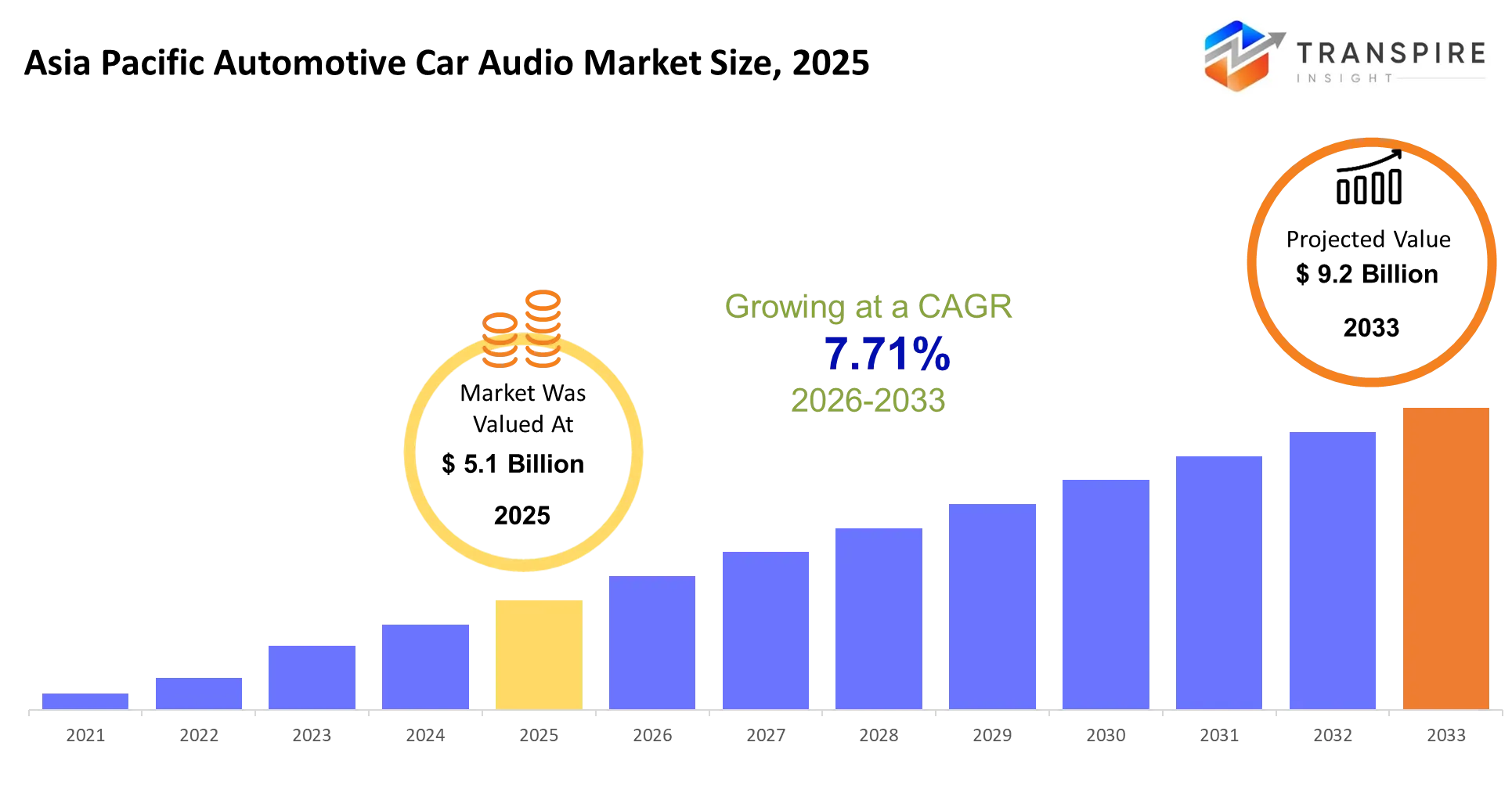
- Asia Pacific Automotive Car Audio Market Size 2025: USD 5.1 Billion
- Asia Pacific Automotive Car Audio Market Size 2033: USD 9.2 Billion
- Asia Pacific Automotive Car Audio Market CAGR: 7.71%
- Asia Pacific Automotive Car Audio Market Segments: By Type (Speakers, Amplifiers, Subwoofers, Head Units, Others); By Application (Passenger Vehicles, Commercial Vehicles, Electric Vehicles, Luxury Vehicles, Others); By End-User (Automotive OEMs, Aftermarket, Consumers, Automotive Dealers, Others); By Technology (Bluetooth Audio, Voice-controlled Systems, Smart Infotainment, Others)
To learn more about this report,  Download Free Sample Report
Asia Pacific Automotive Car Audio Market Summary
The Asia Pacific Automotive Car Audio Market was valued at USD 5.1 Billion in 2025. It is forecast to reach USD 9.2 Billion by 2033. That is a CAGR of 7.71% over the period.
The Asia Pacific automotive car audio market now uses vehicle audio systems to provide drivers with their main control system for driving directions and their communication needs and the system alerts which modern vehicles now include. The market has transitioned during the last three to five years from using separate head units to employing complete infotainment systems which manufacturers now install in their connected and electric vehicles.
The transition developed because original equipment manufacturers selected software-defined vehicle platforms which used audio hardware to deliver both voice assistants and real-time data services instead of providing entertainment functions. The semiconductor supply chain disruption which occurred during the pandemic period served as the primary force which drove this change because it forced automakers to establish new sourcing methods while they needed to combine their operations into fewer special modules. The demand for complete high-end systems increased after production reached normal levels together with the strong electric vehicle rollout policies which China and India implemented.
Key Market Insights
- The Asia Pacific Automotive Car Audio Market holds the top position in the global market because both vehicle production levels and infotainment system usage rates are strong in China, Japan, and India.
- The market in China will reach more than 45% market share by 2025 because of the fast growth of electric vehicles and the existence of extensive automotive manufacturing facilities.
- The Indian market shows the fastest growth rate because it will continue to develop until 2030 when more people will use connected cars and demand for mid-range vehicles will increase.
- The leading product segment in the market consists of infotainment head units which OEMs use to combine their navigation systems with voice control and multimedia capabilities.
- The market for wireless and AI-enabled audio systems shows the highest growth rate because users want smart cockpit testing solutions which include over-the-air updates.
- The Asia Pacific Automotive Car Audio Market shows its highest market share which reaches approximately 70% through passenger vehicles because of the strong trend of private vehicle ownership.
- The electric and connected vehicle sector shows the highest growth rate because software-defined vehicle platforms and digital cockpit technology create new possibilities.
- The demand from end-users comes through OEM integration because automakers install advanced audio systems directly into their production facilities which create connected vehicle systems.
- The aftermarket segment experiences fast growth because more consumers choose to upgrade their vehicles with premium sound systems and infotainment systems in their older vehicles.
- The Asia Pacific Automotive Car Audio Market companies establish their competitive edge through partnerships with automakers and their development of infotainment systems designed for electric vehicles.
What are the Key Drivers, Restraints, and Opportunities in the Asia Pacific Automotive Car Audio Market?
The Asia Pacific Automotive Car Audio Market experiences its main growth because of the transition towards software-based vehicles which include complete infotainment systems. The transition occurred when car manufacturers developed vehicle designs that combined entertainment systems with navigation systems and voice-assist technology into one digital cockpit system which minimized the need for separate physical equipment. Automotive original equipment manufacturers from China and Japan and India have started to implement advanced audio systems in their production process which leads to increased value of each vehicle and higher financial returns for their business partners.
The most significant barrier exists because manufacturers need to depend on semiconductor and advanced chip technology which creates difficulties in production processes and makes it hard to create mid-range vehicle systems that workers can afford. The audio systems need processors which control sound processing and system connectivity and operate AI technology because all these components rely on international supply chains for their availability. The production process experiences delays which result in higher costs for each unit produced which makes it difficult for automakers to enter price-sensitive markets that include Southeast Asia.
The development of AI-based immersive cockpit audio systems which operate through 5G vehicle networks creates a major forward-looking business opportunity. Automakers in India and Southeast Asia develop subscription-based audio systems which allow users to customize their sound experience through remote updates of their sound profiles. The Asia Pacific Automotive Car Audio Market expands from hardware sales to software-based services after this development creates new business opportunities which will generate income for an extended period.
What Has the Impact of Artificial Intelligence Been on the Asia Pacific Automotive Car Audio Market?
Artificial intelligence together with digital technological innovations is changing the Asia Pacific Automotive Car Audio Market because these developments enable audio systems to utilize software-based cockpit intelligence instead of traditional fixed audio equipment. Automakers use AI-based digital signal processing systems to automatically adjust vehicle sound profiles according to cabin sound levels and vehicle speed and road conditions which enables better sound consistency across different car models. The combination of voice recognition systems and infotainment platforms allows drivers to control navigation and media playback and vehicle diagnostics which results in decreased driver distractions and better system performance.
Machine learning models now serve as predictive tools that identify early errors in infotainment systems and speaker performance and connection problems. The system enables condition-based maintenance which allows maintenance activities to occur when required thus enhancing equipment availability while decreasing warranty costs for original equipment manufacturers. AI enables connected vehicles to perform over-the-air updates which enhance system performance and deliver new audio capabilities without requiring physical access to the vehicle thus increasing its total value during its lifespan.
The region in Asia Pacific needs to standardize its acoustic training data because existing systems use inconsistent real-world acoustic training data to evaluate various vehicle environments. The model accuracy decreases because cabin design and climate and road noise create different conditions while the high costs of edge AI chip integration create delays in mid-range vehicle adoption. AI technology achieves market success through its ability to improve system efficiency and provide individualized user experiences and decrease costs for maintenance throughout the product lifecycle.
Key Market Trends
- OEMs switched from using aftermarket products to installing complete systems for their manufacturing processes after 2022 which led to higher rates of backseat entertainment system implementation in new vehicle production.
- The 2023 EV market expansion led by China required automotive manufacturers to adopt AI-powered audio systems which they included in their digital cockpit systems.
- Automotive manufacturers decreased their production of separate head units because the 2021 to 2022 semiconductor shortages revealed their supply chain weaknesses and made them prefer integrated multifunctional systems.
- The software-defined vehicle platform system developed after 2023 because it permitted manufacturers to install new updates through wireless connections which transformed their infotainment systems into digital systems that receive ongoing upgrades.
- Harman International and Sony increased investment in AI-based sound optimization after 2024 to strengthen OEM partnerships in the EV segment.
- The Japanese and South Korean markets for premium vehicles started to adopt immersive 3D audio systems as their main audio system for new vehicle introductions.
- The Indian market established supply chain localization programs after 2022 which decreased its need for imported audio components while boosting local production and expense management.
- Drivers started to prefer voice-operated infotainment systems in 2023 which led to a decrease in mid-range and premium vehicle systems that required physical buttons.
- The companies Pioneer Corporation and Panasonic developed their partnerships with electric vehicle manufacturers to create connected infotainment systems which would improve the user experience inside vehicles.
Asia Pacific Automotive Car Audio Market Segmentation
By Type :
The Asia Pacific automotive car audio market maintains a strong preference for speakers because drivers across different vehicle types require speakers that deliver clear sound. Vehicle buyers now demand advanced speaker systems because they want superior in-vehicle entertainment when they drive through cities and travel across long distances. Manufacturers develop new products by using lightweight materials together with advanced acoustic engineering methods which help them achieve sound balance without increasing vehicle weight.
Premium and customized vehicle categories show steady adoption of amplifiers and subwoofers because these systems provide deeper bass sounds together with better sound clarity. Head units operate as the main component which handles system functions by enabling links between various audio sources and navigation tools and smartphone connections. Modern vehicle audio systems require digital signal processors and integrated control modules as essential components because these systems need to deliver better connectivity and user-driven functionalities.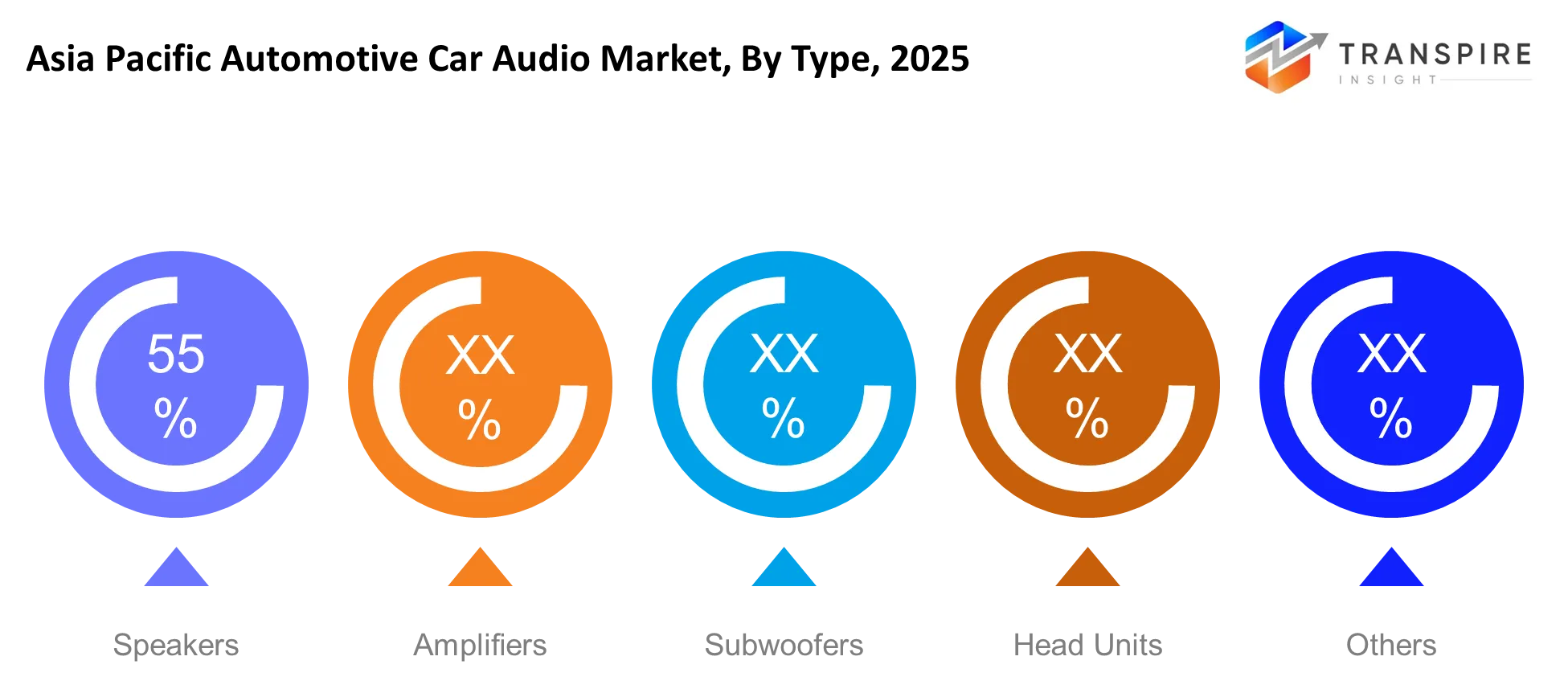
To learn more about this report, Download Free Sample Report
By Application :
The passenger vehicle market represents the biggest share of automotive usage because personal transportation needs continue to increase across Asia Pacific countries. The need for improved audio systems stems from daily commuting patterns and rising demands for better in-car comfort. Manufacturers of mid-range passenger vehicles are now equipping their vehicles with superior factory-installed sound systems because they want to deliver additional benefits without raising vehicle costs.
Electric vehicles create new possibilities because their silent cabin spaces allow users to perceive sound quality in a more critical way. Car audio systems positioned as premium features for advanced audio technology create high-end vehicle models which continue to push industry boundaries. Audio systems with high reliability now receive increasing demand from commercial vehicles because they support essential driver functions and enable effective communication. The vehicle market now sees other specialized vehicle types adopting better audio systems because infotainment systems have become essential to vehicle performance.
By End-User :
The market share for automotive OEMs has grown because car manufacturers now install advanced audio systems which customers have begun to accept. Vehicle manufacturers are working closely with audio technology providers to install systems that align with vehicle design and digital connectivity features. Integrated systems provide customers with dependable performance which streamlines their purchasing experience.
The aftermarket remains highly active because customers want to personalize their vehicles while upgrading their systems. Most vehicle owners want to improve their audio experience because they want more powerful bass and better sound quality and new ways to connect their devices. Automotive dealers also contribute through bundled upgrade packages offered at the point of sale. Current consumer demand for customized in-car entertainment systems supports product sales while specific user groups create niche demand through their unique installation needs.
By Technology :
The Asia Pacific automotive car audio market has adopted Bluetooth audio as a standard technology because wireless connectivity provides users with both convenient and user-friendly audio solutions. Drivers today need to have smartphone connections that work smoothly for music streaming, call handling, and application usage. The wireless technology in this field keeps gaining momentum because its performance for sound transmission and connection reliability continues to progress.
Hands-free systems which use voice control technology have become more popular because users need these systems to maintain their safety and user-friendly operation. The smart infotainment platforms are experiencing rapid growth because vehicles now include advanced digital connectivity features. These systems integrate navigation features with entertainment options and communication tools together with vehicle control systems into one unified interface. The ongoing development of artificial intelligence systems and their ability to deliver immediate responses will determine how different automotive brands adopt technology in their regular and high-end vehicle models.
What are the Key Use Cases Driving the Asia Pacific Automotive Car Audio Market?
The primary application of integrated passenger vehicle infotainment systems in the Asia Pacific Automotive Car Audio Market shows that current audio systems enable users to access navigation, make phone calls without using their hands, and receive instantaneous vehicle warnings. The systems receive maximum demand because OEMs install them into factory-built dashboards, which enhances safety features and convenient functionality and creates better user experiences for people who travel in busy urban areas.
The market expands to include EV cockpits which connect to premium in-vehicle entertainment systems used by ride-hailing services. Electric vehicle manufacturers in China, Japan, and India implement AI-based sound optimization and voice assistants into their vehicles while fleet operators use advanced audio interfaces to improve passenger experiences and create distinct service options for urban transportation systems.
The industry is creating new use cases which combine audio profiles that users pay for with personalized audio profiles which use augmented reality to create navigation audio cues. Next-generation EV platforms and autonomous driving pilot projects are implementing these applications as automakers test new in-cabin systems which modify sound environments based on driver actions and traffic patterns and real-time digital mapping information.
|
Report Metrics |
Details |
|
Market size value in 2025 |
USD 5.1 Billion |
|
Market size value in 2026 |
USD 5.47 Billion |
|
Revenue forecast in 2033 |
USD 9.2 Billion |
|
Growth rate |
CAGR of 7.71% from 2026 to 2033 |
|
Base year |
2025 |
|
Historical data |
2021 - 2024 |
|
Forecast period |
2026 - 2033 |
|
Report coverage |
Revenue forecast, competitive landscape, growth factors, and trends |
|
Regional scope |
Asia Pacific (China, India, Japan, South Korea, Australia, Rest of Asia Pacific) |
|
Key company profiled |
Bosch, Harman, Pioneer, Alpine, Sony, Panasonic, Clarion, JVC Kenwood, Bang & Olufsen, Bose, Continental, Delphi, Visteon, Denso, Hyundai Mobis |
|
Customization scope |
Free report customization (country, regional & segment scope). Avail customized purchase options to meet your exact research needs. |
|
Report Segmentation |
By Type (Speakers, Amplifiers, Subwoofers, Head Units, Others); By Application (Passenger Vehicles, Commercial Vehicles, Electric Vehicles, Luxury Vehicles, Others); By End-User (Automotive OEMs, Aftermarket, Consumers, Automotive Dealers, Others); By Technology (Bluetooth Audio, Voice-controlled Systems, Smart Infotainment, Others) |
Which Regions are Driving the Asia Pacific Automotive Car Audio Market Growth?
East Asia leads the Asia Pacific Automotive Car Audio Market. China, Japan and South Korea serve as the region's main base for production and innovation activities. China has increased its electric vehicle incentives which led to higher adoption rates of factory-installed infotainment systems in both budget and luxury vehicles. Japan and South Korea strengthen this leadership through established automotive electronics expertise and deep partnerships between automakers and audio technology suppliers. The region maintains its market dominance through an established ecosystem which includes semiconductor production and software development and OEM collaboration.
Southeast Asia represents the second most important regional contributor, but its strength comes from production stability rather than technology leadership. The automotive industry in Thailand, Indonesia and Malaysia benefits from Thai automotive assembly plants which operate reliably and Japanese car manufacturers who make long-term commitments. The region develops cost-efficient infotainment systems for mid-range vehicles while East Asia works on premium digital cockpit systems. The company maintains its operational strength through constant domestic demand and automated export manufacturing systems which generate steady revenue streams.
The Indian market experiences the fastest growth because of quick vehicle digital transformation and increasing domestic electronic production capabilities. The automotive industry has increased its development of advanced infotainment systems through localization efforts since 2024 because domestic production-linked incentive programs and growing EV infrastructure development received government backing. Manufacturers of vehicles expanded their development of budget-friendly vehicle audio systems because consumers increasingly demanded connected car technology. The period from 2026 to 2033 will provide suppliers and investors with multiple partnership opportunities which can expand their businesses.
Who are the Key Players in the Asia Pacific Automotive Car Audio Market and How Do They Compete?
The Asia Pacific Automotive Car Audio Market displays moderate consolidation because established electronics companies control original equipment manufacturer supply agreements while software companies develop innovative solutions for connected car entertainment systems. The primary basis of competition has shifted from hardware pricing to integrated software capabilities, AI-driven sound optimization, and long-term partnerships with electric vehicle manufacturers. Existing companies maintain their market presence through extended involvement in vehicle development processes while startups enter the market through advanced digital cockpit solutions and their ability to deliver rapid software updates. Companies that have manufacturing bases in different regions possess a competitive advantage because their manufacturing operations enable them to produce goods at lower costs while also meeting local customer demands.
Harman International differentiates itself through premium branded audio ecosystems and deep integration with connected vehicle software platforms. The company establishes recurring revenue streams through its partnership with Asian EV manufacturers, which enables them to provide adaptive sound systems that customers can upgrade through software updates. Sony competes through acoustic engineering and immersive 360 Reality Audio applications tailored for next-generation electric cabins while leveraging strategic collaborations with automotive OEMs to expand across Asia.
Pioneer Corporation. The company specializes in modular infotainment systems which provide affordable solutions that enable vehicle connectivity. This advantage enables the company to operate its mid-range vehicle programs throughout India and Southeast Asia. Panasonic uses its expertise in semiconductor technology and cockpit electronics to create integrated infotainment systems which help the company strengthen its market position with Japanese automakers. Alpine Electronics maintains its specific market segment through high-end aftermarket customization services which attract customers who want to upgrade their systems beyond what comes with their products.
Company List
- Bosch
- Harman
- Pioneer
- Alpine
- Sony
- Panasonic
- Clarion
- JVC Kenwood
- Bang & Olufsen
- Bose
- Continental
- Delphi
- Visteon
- Denso
- Hyundai Mobis
Recent Development News
"In December 2025, HARMAN International announced acquisition of the advanced driver assistance systems business of ZF Group for approximately USD 1.8 billion. The deal strengthens HARMAN’s software-defined vehicle capabilities across Asia Pacific and is expected to enhance next-generation integrated automotive audio and connected cockpit solutions for regional OEMs.Source https://www.ctinsider.com/
"In April 2026, Dolby Laboratories expanded its automotive partnerships at Auto China 2026, with multiple automakers in Asia introducing vehicles equipped with Dolby Atmos and Dolby Vision technologies. This development accelerates the adoption of immersive in-car audio systems across the Asia Pacific automotive market. Source https://www.autocarpro.in/
What Strategic Insights Define the Future of the Asia Pacific Automotive Car Audio Market?
The Asia Pacific Automotive Car Audio Market is moving toward software-based cabin environments which will enable audio systems to operate together with smart transportation systems instead of functioning as independent parts of automobiles. The current trend is driven by three major forces which include the rising adoption of electric vehicles and the development of AI-based personalized systems and the transition of automobile manufacturers toward software-based systems which enable them to earn ongoing income through system upgrades and digital product sales.
The actual danger emerges from the high development of OEM software ecosystems which fewer companies control as their main platforms. The automobile industry has developed standardized infotainment systems which create challenges for suppliers who do not adopt these primary digital systems since they will lose power to negotiate deals while their options for partnership will decrease even though the market continues to grow. Indians and Southeast Asians currently have an emerging chance to develop their own edge-computing audio systems for inexpensive electric vehicles because production incentives have reached the point where they will drive business growth.
The best approach for market players involves making an early investment into software audio platforms which offer both remote software updates and custom audio options. Companies that develop flexible digital systems tailored to specific regions will achieve success in establishing their long-term business value.
Asia Pacific Automotive Car Audio Market Report Segmentation
By Type
- Speakers
- Amplifiers
- Subwoofers
- Head Units
By Application
- Passenger Vehicles
- Commercial Vehicles
- Electric Vehicles
- Luxury Vehicles
By End-User
- Automotive OEMs
- Aftermarket
- Consumers
- Automotive Dealers
By Technology
- Bluetooth Audio
- Voice-controlled Systems
- Smart Infotainment
Frequently Asked Questions
Find quick answers to common questions.
The Asia Pacific Automotive Car Audio Market size is USD 9.2 Billion in 2033.
Key segments for the Asia Pacific Automotive Car Audio Market are By Type (Speakers, Amplifiers, Subwoofers, Head Units, Others); By Application (Passenger Vehicles, Commercial Vehicles, Electric Vehicles, Luxury Vehicles, Others); By End-User (Automotive OEMs, Aftermarket, Consumers, Automotive Dealers, Others); By Technology (Bluetooth Audio, Voice-controlled Systems, Smart Infotainment, Others).
Major Asia Pacific Automotive Car Audio Market Players are Bosch, Harman, Pioneer, Alpine, Sony, Panasonic, Clarion, JVC Kenwood, Bang & Olufsen, Bose, Continental, Delphi, Visteon, Denso, Hyundai Mobis.
The Current Asia Pacific Automotive Car Audio Market size is USD 5.1 Billion in 2025.
The Asia Pacific Automotive Car Audio Market CAGR is 7.71% from 2026 to 2033.
- Bosch
- Harman
- Pioneer
- Alpine
- Sony
- Panasonic
- Clarion
- JVC Kenwood
- Bang & Olufsen
- Bose
- Continental
- Delphi
- Visteon
- Denso
- Hyundai Mobis
Recently Published Reports
-
Apr 2026
ATV & UTV Market
ATV & UTV Market Size, Share & Analysis Report By Type (ATV, and UTV), By Variants (Less Than 400 CC, 400 CC To 800 CC, and More Than 800 CC), and Geography (North America, Europe, Asia-Pacific, Middle East and Africa, South and Central America), 2021 - 2031
-
Apr 2026
Automotive Central Gateway Module Market
Automotive Central Gateway Module Market Size, Share & Analysis Report By Type (Ethernet Central Gateway Module, CAN Central Gateway Module, LIN Central Gateway Module, and FlexRay), By Application (Powertrain Control, Body Control, Infotainment System, Advanced Driver Assistance Systems (ADAS), and Others), By End User (Passenger Vehicles, and Commercial Vehicles), and Geography (North America, Europe, Asia-Pacific, Middle East and Africa, South and Central America), 2021 - 2031
-
Apr 2026
Automotive Engine Oil Filter Market
Automotive Engine Oil Filter Market Size, Share & Analysis Report By Filter Type (Fuel Filter, Engine Oil Filter, Hydraulic Oil Filter, and Others), By Filter Media (Cellulose, Synthetic, and Micro), By Sales Channel (OEMs, and Aftermarket), By Vehicle Type (Passenger Cars, Light Commercial Vehicles, Heavy Duty Trucks, Buses and Coaches, and Off-road Vehicles), and Geography (North America, Europe, Asia-Pacific, Middle East and Africa, South and Central America), 2021 - 2031
-
Apr 2026
Automotive Parts Aluminium Die Casting Market
Automotive Parts Aluminium Die Casting Market Size, Share & Analysis Report By Production Process (Pressure Die Casting, Vacuum Die Casting, Squeeze Die Casting, Gravity Die Casting), By Application (Body Parts, Engine Parts, Transmission Parts, Battery And Related Components, Other Application Types), and Geography (North America, Europe, Asia-Pacific, Middle East and Africa, South and Central America), 2021 - 2031
Our Clients