Asia Pacific Astringent Market Size & Forecast:
- Asia Pacific Astringent Market Size 2025: USD 492.6 Million
- Asia Pacific Astringent Market Size 2033: USD 802.5 Million
- Asia Pacific Astringent Market CAGR: 6.26%
- Asia Pacific Astringent Market Segments: By Type (Natural Astringents, Synthetic Astringents, Others); By Application (Skincare, Personal Care, Pharmaceuticals, Others); By End-User (Cosmetic Companies, Pharma Companies, Consumers, Healthcare Providers, Others); By Form (Liquid, Powder, Cream, Others)
To learn more about this report,  Download Free Sample Report
Asia Pacific Astringent Market Summary
The Asia Pacific Astringent Market was valued at USD 492.6 Million in 2025. It is forecast to reach USD 802.5 Million by 2033. That is a CAGR of 6.26% over the period.
Astringents function as essential components for personal care and pharmaceutical products and certain industrial applications throughout the Asia Pacific region because they assist in tissue tightening and oil control and surface irritation reduction and product stability enhancement for daily skincare and wound care and hygiene product formulations. The commercial value of their products exists because they provide solutions to formulation problems which need moisture management and pore control and antimicrobial protection to determine product efficiency. The market has experienced a complete transformation during the last five years because consumers now prefer plant-based and dermatologically-tested products over alcohol-based synthetic items which fail to meet their safety requirements and regional cosmetic regulations.
The post-pandemic transition accelerated because people developed new shopping habits throughout China and Japan and South Korea and India after they started focusing on skin barrier protection and experienced extended mask-related skin problems. The demand for multifunctional active ingredients from astringent suppliers has increased because brands develop new product formulas that meet cleaner-label standards while maintaining product effectiveness, which results in higher-value opportunities for premium skincare and medicated cosmetics and pharmacy-led personal care products.
Key Market Insights
- The Asia Pacific Astringent Market has its main operations based in East Asia which controls almost 44% of the market share in 2025 through its premium skincare manufacturing capabilities located in South Korea and Japan and China.
- South Asia stands as the most rapidly expanding market because local companies invest in manufacturing cosmetics and retail distribution increases between 2026 and 2031.
- The Indian market shows growing demand which results from Ayurvedic skincare development and rising exports of herbal astringent products.
- Natural plant-derived astringents dominate the market through their 41% market share which results from a trend toward alcohol-free skincare product formulations.
- The second biggest market segment for astringents stays active because people use synthetic astringents in affordable personal care products while manufacturers benefit from their reduced production expenses.
- The alcohol-free dermatological astringents market will experience its most rapid growth until 2031 because current trends focus on maintaining skin barrier protection.
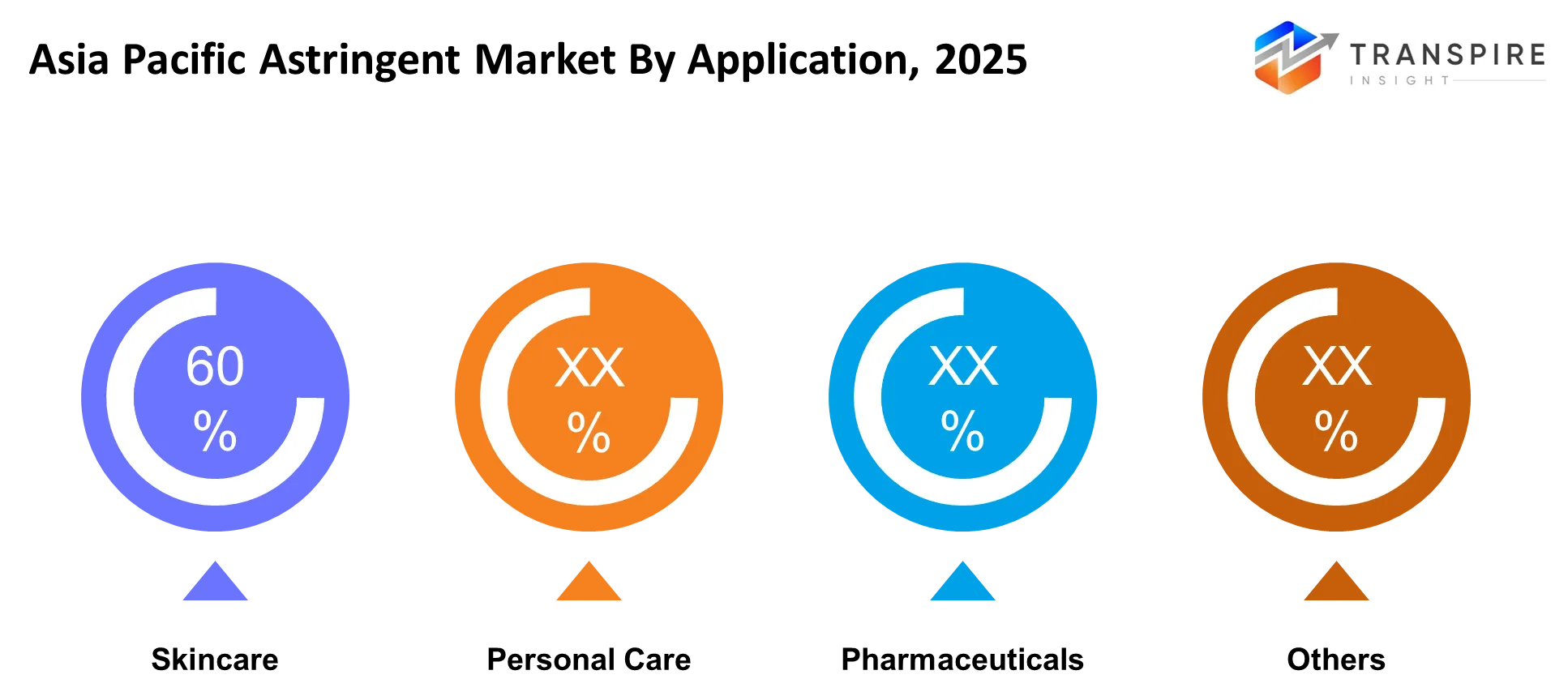
- The skincare and cosmetic market sector leads the market with a 56% share because new product introductions have strengthened the toner acne treatment and facial care product segments.
- The pharmaceutical industry experiences its fastest growth through topical formulations because post-treatment skin recovery and antiseptic product development drive demand.
- The urban Asian Pacific markets show strong potential for growth in men's grooming products as they become a key application segment.
- Personal care manufacturers will control 52% of the market in 2025 while regional cosmetic brands drive their success through high-volume product demand.
What are the Key Drivers, Restraints, and Opportunities in the Asia Pacific Astringent Market?
The strongest force accelerating the Asia Pacific Astringent Market is the rapid reformulation cycle underway across regional skincare and pharmaceutical manufacturing. The cosmetic industry experienced this transformation when South Korea, Japan and China introduced stricter rules that required full disclosure of cosmetic ingredients while consumers started to reject products containing high alcohol content which caused skin barrier damage. The major beauty and personal care brands now develop products which use low-irritation ingredients and provide multiple functions. The suppliers who provide plant-based and dermatologically proven astringent materials will receive more business opportunities because of this trend. The process increases revenue streams because it raises the value of ingredients in each product and drives premium pricing for mass-market and clinical skincare products.
The most important structural obstacle in the market operator framework exists because different Asia Pacific countries use different rules to manage their cosmetic and pharmaceutical ingredients. The major markets require suppliers to follow distinct testing and labeling and approval processes which results in extended time frames from product development until market entry in different Asian regions. The challenge of developing regulatory systems for international markets requires different countries to agree on their policies and complete time-consuming scientific tests. The result causes delays in product launches which need companies to spend compliance costs repeatedly while it takes longer to achieve international market entry which reduces revenue opportunities for both global companies and local businesses.
The primary forward-looking opportunity exists in biotech-based botanical active compounds which include fermentation-based astringent compounds. Singapore and South Korea currently experience a precision fermentation facility investment wave which enables manufacturers to produce bioactive extracts with higher purity levels through scalable production methods. The technologies provide businesses with a way to increase profit margins through their ability to deliver dependable results and enhanced product stability and rapid adoption into high-end skincare products.
What Has the Impact of Artificial Intelligence Been on the Asia Pacific Astringent Market?
The combination of artificial intelligence with advanced digital systems creates new methods for developing and testing astringent ingredients in Asia Pacific, which affects both formulation laboratories and specialty chemical production facilities. The automated ingredient screening process of AI-powered formulation platforms simulates the skin interaction of different astringent compounds, which enables product development to progress 30 percent faster by decreasing the number of necessary trials. In the manufacturing process smart process control systems utilize real-time sensor data to modify extraction settings which leads to improved astringent yield consistency and decreased manufacturing waste.
The deployment of machine learning models predicts stability outcomes and shelf-life performance based on different climate conditions that occur in Asia Pacific markets. The predictive tools enable manufacturers to enhance their preservative systems while decreasing product failure rates during the commercialization phase. Producers report significant enhancements in their batch success rates while achieving lower costs for dermatological product reformulation especially in high-value products.
A major barrier exists that prevents organizations from reaching their goals. Regional manufacturers face challenges because they do not have the historical datasets needed to develop accurate models which particularly applies to botanical inputs that contain high variability. The combination of this data deficiency with the expenses associated with integrating old production systems prevents mid-sized ingredient suppliers from using AI technology at full capacity.
Key Market Trends
- The alcohol-free toner products have become the primary choice for more than 35% of new facial toner products that have been launched in Japanese and South Korean markets since 2022.
- Chinese manufacturers began to invest more in botanical extraction technologies after the cosmetic compliance reforms of 2023 which accelerated the process to approve standardized plant-based active ingredients.
- The rising demand for multifunctional active ingredients among regional buyers has led BASF SE and Evonik Industries AG to develop their hybrid ingredient product lines which hybridize multiple active components.
- Premium skincare brands decreased their use of synthetic astringents between 2021 and 2025 because their barrier-repair products obtained better sales results in retail stores.
- The contract manufacturers in India increased their exports of herbal astringent products by approximately 18% since 2023 because of their improved partnerships with private-label companies.
- The introduction of AI-assisted formulation screening in 2024 has enabled regional dermaceutical producers to decrease their ingredient testing cycles by approximately 25%.
- The South Korean and Japanese regulatory agencies implemented stricter requirements for ingredient disclosure which compelled mass-market personal care brands to complete their product reformulation process at an accelerated pace.
- The competitive dynamics changed when Clariant AG and other companies began to establish regional technical centers that their teams could use to create customized product formulations.
- The commercial availability of fermentation-derived bioactive astringents started to grow in Singapore and South Korea after 2023 because of the increased biotech investments which enabled the development of new ingredients for commercial production.
Asia Pacific Astringent Market Segmentation
By Type:
The Asia Pacific Astringent Market sees natural astringents segment performing well because consumers increasingly choose plant-derived ingredients which safely benefit their skin. Skincare and wellness products use witch hazel and green tea and aloe vera and herbal blends as their primary ingredients. The market experiences growing demand because customers search for mild products which enable them to maintain their skin while experiencing less discomfort than they would from using aggressive chemical products.
Manufacturers continue to use synthetic astringents because these products provide consistent performance with extended shelf life and they offer manufacturers lower costs during large production runs. Established cosmetic and pharmaceutical companies use these components for their standardized product development. The other segment includes blended and specialty formulations developed for niche applications, which provide targeted effects and customized performance to meet diverse consumer requirements across different regional markets.
By Application:
The Asia Pacific Astringent Market shows its largest segment in skincare applications because people are now more knowledgeable about facial cleansing and pore tightening and acne treatment methods. The younger generation and working professionals who want convenient skincare options show increasing interest in astringent-based toners and serums and treatment products. Digital channels now establish beauty education as a powerful force which enables consumers to adopt products on a regular basis.
Astringents now find applications in personal care products through their use in deodorants and aftershave products and cleansing formulations. The pharmaceutical field witnesses rising usage through its application in wound care and development of topical medicinal products. The other category represents new applications which manufacturers develop for specialty hygiene products and customized wellness formulations according to their changing product development methods.
To learn more about this report, Download Free Sample Report
By End-User:
The market demand for cosmetic products reaches its highest point because companies constantly introduce new products to match evolving beauty trends. The companies dedicate their resources to researching ingredient components which enables them to create skincare products that meet customer demands for safe and effective performance. The competition between local and global companies has led to increased adoption of advanced astringent products among consumers.
Pharma companies maintain their product demand through medicinal uses and therapeutic uses of their products especially in topical care formulations. End-users who purchase products directly from stores exercise their power to choose based on their need for product ingredient information and how well the products perform. The healthcare providers supply professional recommendations while the others segment consists of wellness centers and specialty product developers who help grow the market.
By Form:
The liquid astringents dominate this market segment because users find them simple to apply and they have become standard components in toners and cleansers and medicated solutions. The product achieves high consumer preference because it offers users a lightweight texture which enables fast product absorption during their daily skincare routines. The manufacturers prefer liquid products because they enable simple active ingredient mixing and they fit multiple retail packaging options.
Powder products attract industrial users because they provide extended shelf life and various formulation options. The moisturizing treatment market shows ongoing demand for cream-based astringents which provide controlled delivery and skin comfort. The remaining product forms enable specialized use cases which assist brands in meeting diverse consumer demands while expanding their product range throughout Asia Pacific markets.
What are the Key Use Cases Driving the Asia Pacific Astringent Market?
Facial skincare remains the dominant use case across the Asia Pacific Astringent Market, particularly in toners, acne-control products, and post-cleansing treatments. The application of oil control and pore-refining performance products generates the highest demand because South Korean and Japanese and Chinese beauty companies keep reformulating their products.
Clinical skincare and pharmaceutical topical formulations now experience steady growth through their development of adjacent applications. Astringent compounds find increasing use among dermatology brands because they serve as active ingredients in post-procedure calming solutions and medicated skin recovery products which contract manufacturers now use in men's grooming and scalp-care treatments for regional personal care companies.
Biotech-derived activities which support microbiome skincare and advanced cosmetic patches which treat targeted blemishes represent emerging use cases. The applications remain niche but demonstrate strong forecast potential because regional dermaceutical startups and precision skincare developers create high-performance products with science-backed formulation platforms.
|
Report Metrics |
Details |
|
Market size value in 2025 |
USD 492.6 Million |
|
Market size value in 2026 |
USD 524.8 Million |
|
Revenue forecast in 2033 |
USD 802.5 Million |
|
Growth rate |
CAGR of 6.26% from 2026 to 2033 |
|
Base year |
2025 |
|
Historical data |
2021 - 2024 |
|
Forecast period |
2026 - 2033 |
|
Report coverage |
Revenue forecast, competitive landscape, growth factors, and trends |
|
Regional scope |
Asia Pacific (India, China, Japan, Australia,South Korea, Rest of Asia Pacific) |
|
Key company profiled |
L'Oréal, Unilever, Procter & Gamble, Estée Lauder, Johnson & Johnson, Beiersdorf, Shiseido, Amorepacific, Himalaya, Dabur, VLCC, Avon, Oriflame, Natura, Kao |
|
Customization scope |
Free report customization (country, regional & segment scope). Avail customized purchase options to meet your exact research needs. |
|
Report Segmentation |
By Type (Natural Astringents, Synthetic Astringents, Others); By Application (Skincare, Personal Care, Pharmaceuticals, Others); By End-User (Cosmetic Companies, Pharma Companies, Consumers, Healthcare Providers, Others); By Form (Liquid, Powder, Cream, Others) |
Which Regions are Driving the Asia Pacific Astringent Market Growth?
The Asia Pacific Astringent Market sees East Asia as its primary regional power with South Korea, Japan, and China serving as its leading nations. The country maintains its top position because of its advanced cosmetic production systems which produce safe products through their strict safety regulations and their extensive research into skin care products. South Korea’s rapid product development process together with Japan’s strict quality assessment standards enable businesses to expand their high-end astringent product lines. The system maintains its market leadership through its complete supplier network system together with its state-of-the-art research facilities and close partnerships between raw material suppliers and product development companies.
The Southeast Asian market operates differently because it depends on affordable manufacturing processes instead of high-end product development to produce personal care items for local markets and export markets. The consumer goods market in Thailand and Indonesia and Malaysia experiences strong demand which helps develop the country's private-label production capabilities. The region has slower rule changes than East Asia but its production costs remain consistent which enables companies to establish prolonged supply partnerships. The Southeast Asian market provides consistent income to suppliers who specialize in high-volume contracts and basic product lines.
The regional market in South Asia has developed into its fastest expanding phase because India serves as the main driver of this growth. The recent changes stem from two factors which include increased domestic cosmetic manufacturing incentives and the establishment of new botanical extraction facilities and the growth of pharmaceutical skincare manufacturing operations. The existing developments now enable local businesses to obtain their required materials while decreasing their need for imported specialized components. The period until 2033 presents valuable business opportunities for market newcomers and investors who target herbal astringents and contract manufacturing relationships and scientific personal care products that meet budget constraints of fast-changing consumer markets.
Who are the Key Players in the Asia Pacific Astringent Market and How Do They Compete?
The Asia Pacific Astringent Market displays moderate market fragmentation because worldwide specialty ingredient manufacturers compete with local botanical extract producers and their contract formulation partners. The market operates beyond simple price competition. The main factors that distinguish competitors in the market include their ability to create technology-based product formulations and their knowledge of regulatory requirements and their capability to provide custom ingredient solutions. Established suppliers use formulation science and their technical support centers to safeguard their market share while new companies create disruptive products through plant-based innovations and rapid product development.
BASF SE uses its formulation technology and its ability to integrate various ingredients as its competitive advantages in the market. The company achieves its market advantage by using astringent activities to create multifunctional skincare systems that enable manufacturers to produce products with fewer ingredients. BASF operates technical collaboration centers throughout East Asia to enhance its ability to meet local cosmetic compliance requirements. Evonik Industries AG develops its unique market position through its active ingredients derived from biotechnology and its sophisticated dermaceutical solutions. The company possesses a competitive advantage in premium clinical skincare relationships across Japan and South Korea because of its skin microbiome research investments.
Clariant AG focuses on sustainable and naturally derived activities, which enables the company to compete successfully with clean-label cosmetic brands. The certification-based sourcing system of the company establishes trustworthy connections with local high-end beauty manufacturers. The formulation support services of Ashland Inc. enable clients to speed up their product development process through testing of their applications. Symrise AG creates business growth through its strategic alliances with Asian skincare innovators, which develop unique sensory and effectiveness testing methods for their niche product markets.
Company List
- L'Oréal
- Unilever
- Procter & Gamble
- Estée Lauder
- Johnson & Johnson
- Beiersdorf
- Shiseido
- Amorepacific
- Himalaya
- Dabur
- VLCC
- Avon
- Oriflame
- Natura
- Kao
Recent Development News
In January 2026, Shiseido launched its first AI-developed mist-type suncare product under the fibona program. The launch marked a significant technology certification milestone for Asia Pacific skincare formulation, accelerating innovation in lightweight oil-control and astringent-adjacent facial care products tailored for humid regional climates.
Source https://corp.shiseido.com/
In May 2026, Shiseido Travel Retail launched NARS Natural Matte Longwear Foundation across Asia Pacific travel retail channels. The product’s humidity-resistant, pore-refining formulation directly targets oil-control skincare and complexion management demand in the region, reinforcing competitive momentum in adjacent astringent-focused beauty segments. Source https://www.trbusiness.com/
What Strategic Insights Define the Future of the Asia Pacific Astringent Market?
The Asia Pacific Astringent Market will undergo structural changes during the upcoming five to seven years because it will adopt precision-formulated and biotech-enabled ingredient systems which pharmaceutical-grade and clinically validated skin care solutions require. The stricter ingredient performance standards which businesses now need to meet for their products to prove effectiveness through scientific evidence have become the driving force behind this transition. The company will create value through high-margin formulation partnerships which use customized solutions and scientific proof instead of standard ingredient supply products.
The risk of material supply interruption from raw material concentration becomes more dangerous because botanical extracts must be sourced from specific regions which only exist in India and Southeast Asia. Manufacturers who rely on natural active ingredients will experience pricing instability because climate changes and agricultural supply chain interruptions will create pricing challenges. The production cost of fermentation-derived bioactive astringents from South Korea and Singapore has now reached a point where they create a major business opportunity. The technologies will change how businesses obtain materials because they will decrease the need for seasonal plant-based resources.
For market participants the best approach requires them to make immediate investments in regional formulation laboratories together with data-driven efficacy testing capabilities which will help them meet changing regulatory requirements and develop high-end products at a faster pace.
Asia Pacific Astringent Market Report Segmentation
By Type
- Natural Astringents
- Synthetic Astringents
By Application
- Skincare
- Personal Care
- Pharmaceuticals
By End-User
- Cosmetic Companies
- Pharma Companies
- Consumers
- Healthcare Providers
By Form
- Liquid
- Powder
- Cream
Frequently Asked Questions
Find quick answers to common questions.
The Asia Pacific Astringent Market size is USD 802.5 Million in 2033.
Key segments for the Asia Pacific Astringent Market are By Type (Natural Astringents, Synthetic Astringents, Others); By Application (Skincare, Personal Care, Pharmaceuticals, Others); By End-User (Cosmetic Companies, Pharma Companies, Consumers, Healthcare Providers, Others); By Form (Liquid, Powder, Cream, Others).
Major Asia Pacific Astringent Market players are L'Oréal, Unilever, Procter & Gamble, Estée Lauder, Johnson & Johnson, Beiersdorf, Shiseido, Amorepacific, Himalaya, Dabur, VLCC, Avon, Oriflame, Natura, Kao.
The Asia Pacific Astringent Market size is USD 492.6 Million in 2025.
The Asia Pacific Astringent Market CAGR is 6.26% from 2026 to 2033.
- L'Oréal
- Unilever
- Procter & Gamble
- Estée Lauder
- Johnson & Johnson
- Beiersdorf
- Shiseido
- Amorepacific
- Himalaya
- Dabur
- VLCC
- Avon
- Oriflame
- Natura
- Kao
Recently Published Reports
-
Apr 2026
AI in Diabetic Retinopathy Market
AI in Diabetic Retinopathy Market Size, Share & Analysis Report By Type (Screening AI Systems, Diagnostic AI Systems, and Predictive AI Models), By Application Segment (Hospitals, Ophthalmology Clinics, Diagnostic Centers, and Research and Development), and Geography (North America, Europe, Asia-Pacific, Middle East and Africa, South and Central America), 2021 - 2031
-
Apr 2026
Psychometric Tests Market
Psychometric Tests Market Size, Share & Analysis Report By Type (Personality Tests, Ability/Aptitude Tests, Skill/Knowledge Tests, and Others), By Application (Talent Acquisition and Talent Management), and Geography (North America, Europe, Asia-Pacific, Middle East and Africa, South and Central America), 2021 – 2031
-
Apr 2026
Rare Biological Sample Collection Market
Rare Biological Sample Collection Market Size, Share & Analysis Report By Type (Isolation Kits & Reagent, Blood Collection Tubes, and Others), By Application (Oncology, Transcriptomics, Pharmacogenomics, and Others), and Geography (North America, Europe, Asia-Pacific, Middle East and Africa, South and Central America), 2021 – 2031
-
Apr 2026
Patient Lift Pendant Market
Patient Lift Pendant Market By Product Type (Wired Pendants, Wireless, Programmable), By Operation Type(Manual, Electric), By End-Users (Healthcare Professionals, Patients), By Application (Hospitals, Homecare, Rehabilitation Centers, Others), By Industry Analysis, Size, Share, Growth, Trends, and Forecasts 2021-2033
Our Clients
.jpg)