
Asia Pacific Appendicitis Market Size & Forecast:
- Asia Pacific Appendicitis Market Size 2025: USD 1.13 Billion
- Asia Pacific Appendicitis Market Size 2033: USD 1.97 Billion
- Asia Pacific Appendicitis Market CAGR: 7.21%
- Asia Pacific Appendicitis Market Segments: By Type (Acute Appendicitis, Chronic Appendicitis, Complicated Appendicitis, Uncomplicated Appendicitis, Recurrent Appendicitis, Others); By Treatment (Surgery, Antibiotics, Laparoscopy, Open Surgery, Minimally Invasive, Others); By End-User (Hospitals, Clinics, Surgical Centers, Emergency Care, Specialty Centers, Others); By Diagnosis (Imaging, Blood Tests, CT Scan, Ultrasound, Clinical Exam, Others).
To learn more about this report,  Download Free Sample Report
Asia Pacific Appendicitis Market Summary
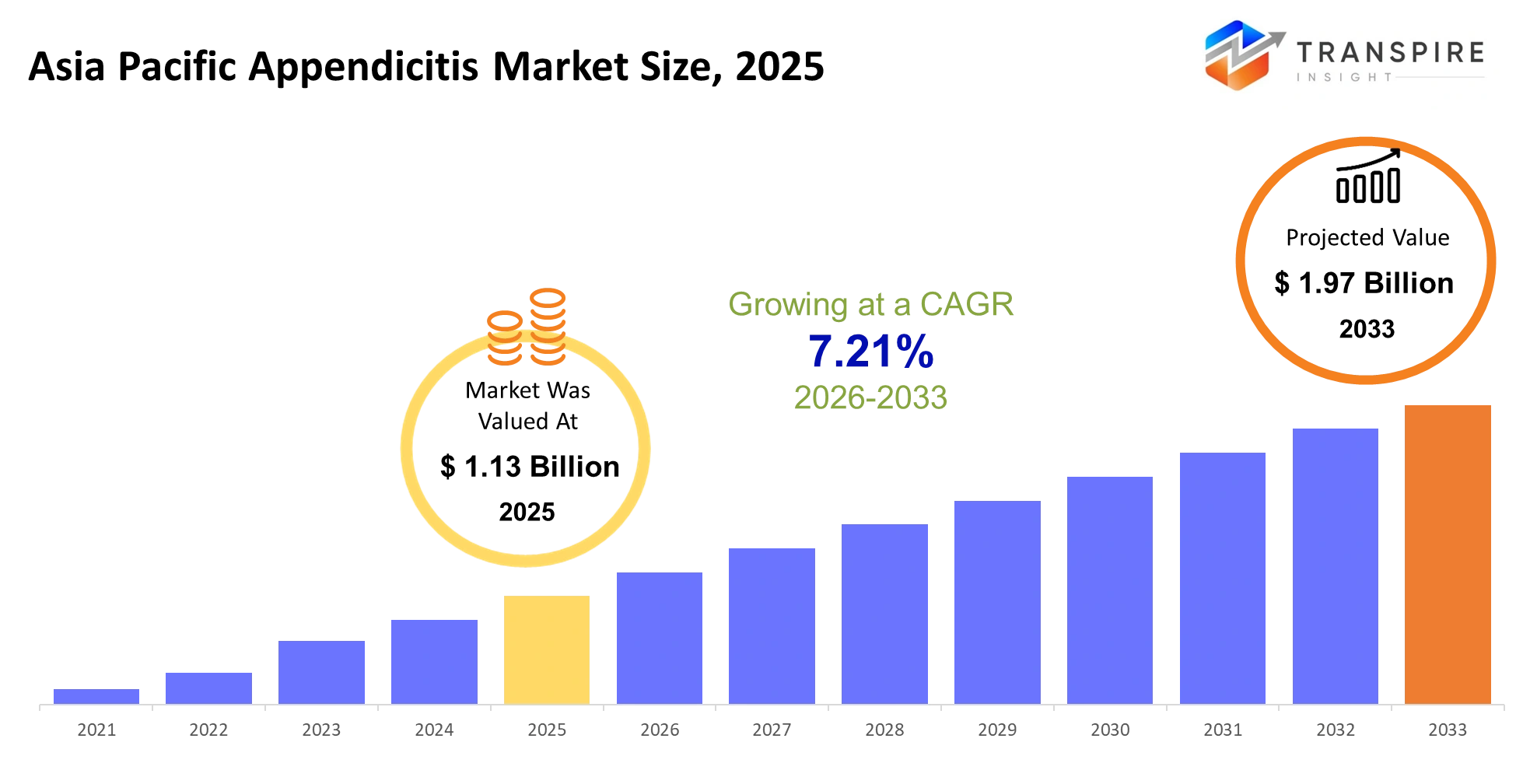
The Asia Pacific Appendicitis Market was valued at USD 1.13 Billion in 2025. It is forecast to reach USD 1.97 Billion by 2033. That is a CAGR of 7.21% over the period.
The Asia Pacific appendicitis market focuses on diagnosing and treating acute appendix conditions which enable hospitals and emergency departments to use surgical and pharmaceutical treatments for avoiding dangerous outcomes including perforation and sepsis and extended hospital stays. The system benefits healthcare organizations through its ability to generate quick clinical decisions while it decreases the need for emergency medical services. The market has undergone a structural transformation during the last five years because hospitals now favor using minimally invasive laparoscopic techniques and AI-powered diagnostic imaging to achieve quicker patient recovery and superior surgical results.
The COVID-19 pandemic served as a major driving force which resulted in temporary postponement of elective abdominal operations while it revealed deficiencies in emergency surgery capacity which led healthcare facilities to enhance their imaging systems and optimize their emergency treatment processes. The market expansion process has been directly influenced by this development. Faster diagnosis leads to earlier intervention, lower complication rates, and reduced treatment costs, which results in increased adoption of advanced surgical devices and imaging solutions while public and private healthcare networks in the region experience higher procurement activities.
Key Market Insights
- China controls almost 34% of the Asia Pacific Appendicitis Market in 2025 because of its extensive hospital network and high rates of emergency surgeries.
- The Indian market will experience its most rapid growth until 2030 because of three factors which include the development of tertiary healthcare facilities and better surgical access and increased government funding for public health systems.
- Southeast Asian nations experience rising medical needs because private hospitals expand their services which enables them to treat more patients with appendicitis at a rate of 6.5�ch year.
- The Asia Pacific Appendicitis Market attributes its leading position to laparoscopic surgical devices which contribute approximately 41% of the market size in 2025 because these devices enable faster recovery processes while minimizing surgical complications.
- Diagnostic imaging solutions which include CT and ultrasound systems, maintain their position as the second largest market segment because they enable quick medical assessments with a market share of approximately 28%.
- Between 2026 and 2030 AI-assisted imaging platforms will grow into the most rapidly expanding market segment according to current forecasts.
- The market will receive 67% of its revenue during 2025 from acute appendicitis treatment because patients need immediate medical treatment.
- The application for complicated appendicitis management shows rapid growth because of its specialized surgical treatment needs and its connection to cases which were diagnosed after their initial onset.
- The Asia Pacific Appendicitis Market sees hospitals controlling 72% of its market share because their emergency departments receive high patient admissions and their surgical facilities possess extensive capabilities.
- The end-user category of ambulatory surgical centers shows the fastest growth because their procedures cost less and patients can return home after same-day laparoscopic surgery.
What are the Key Drivers, Restraints, and Opportunities in the Asia Pacific Appendicitis Market?
The Asia Pacific market for appendicitis treatment shows its highest expansion because hospitals have invested in modern surgical facilities during the past five years which has led to more doctors using minimally invasive laparoscopic procedures. The three countries of China Japan and South Korea developed new reimbursement systems for laparoscopic abdominal surgeries which made these medical procedures more affordable for their healthcare providers.The procedure volumes increased because hospitals can treat more patients through shorter hospital stays and lower complication rates and faster patient recovery times which results in higher surgical capacity and additional revenue for each operating room.
The most important obstacle to development in the Asia Pacific region arises from the uneven distribution of diagnostic imaging facilities and emergency surgical services which medical facilities in developing areas of the region use. The secondary hospitals that serve rural areas in India, Indonesia and the Philippines still need to establish round-the-clock CT imaging facilities and skilled laparoscopic surgeons and standardized acute abdominal care pathways. The limitation exists because of gaps in healthcare infrastructure and shortages of specialists and the unequal distribution of public health funding. The existing constraints need multiple years of investment in infrastructure and workforce development to achieve resolution which results in delayed diagnosis and increased dependency on open surgery and reduced market revenue potential.
The next growth phase will increase through AI-enabled diagnostic imaging which offers the most promising opportunity. Hospitals across Singapore and Australia increasingly test AI-powered systems for interpreting abdominal scans which help them decrease the time required for making diagnoses. Mid-tier hospitals will achieve better deployment results for these technologies because of their decreasing costs which will enable more hospitals to implement early intervention programs and advanced appendicitis treatments.
What Has the Impact of Artificial Intelligence Been on the Asia Pacific Appendicitis Market?
The region of Asia Pacific is experiencing changes in appendicitis treatment because artificial intelligence together with advanced digital technologies enables doctors to make faster diagnoses while they develop more accurate treatment protocols and improve hospital efficiency. Emergency radiology departments now use AI-powered imaging systems to automatically identify appendiceal inflammation through their examination of CT and ultrasound images. The systems help medical professionals identify urgent patients who require immediate examination which results in a 20% to 30% reduction of time needed to reach a diagnosis in hospitals that have adopted digital technologies. Emergency departments use automated clinical decision support tools to determine patient emergency levels based on their symptoms and laboratory results and imaging results which results in better operating room scheduling and shorter times needed for emergency medical care.
Machine learning models use historical patient data to create predictive models which estimate the risk of perforation and the chance of postoperative complications and the expected time until recovery. The system enables doctors to create better treatment plans while they maximize their ability to handle bed resources. Digital surgical management systems help hospitals achieve operational efficiency gains which reduce patient stay times and enhance theater capacity and minimize readmission frequency thus resulting in better organizational performance and expense management.
The region faces a significant challenge because different areas possess varying levels of digital infrastructure development. Secondary hospitals face challenges because they lack essential components such as imaging standardization and interoperable electronic health records and comprehensive clinical databases which are necessary for developing precise AI models which hinders their ability to use AI technology despite its evident medical advantages.
Key Market Trends
- The percentage of urban hospitals which adopted laparoscopic appendectomy procedures increased by almost 25% since 2021 because the method provided faster recovery times which helped hospitals manage their bed capacity and schedule surgeries more effectively.
- Hospitals in China and Japan shifted procurement toward AI-enabled CT imaging after 2022 which resulted in a 20�crease in time needed to diagnose appendicitis.
- Hospitals expanded their emergency operating capacity instead of building new facilities for elective procedures because of surgical backlogs which occurred between 2020 and 2023.
- Medtronic and Johnson & Johnson established more partnerships for regional laparoscopic instrument distribution after 2023 to benefit from growing surgical procedures at tertiary hospitals.
- The public reimbursement changes in South Korea and Australia which began in 2022 have made hospitals prefer minimally invasive appendectomy procedures instead of traditional open surgery methods.
- Since 2021 secondary hospitals in India have increased their use of portable ultrasound systems to solve the problem of slow appendicitis diagnosis in remote areas.
- The clinical protocols implemented after 2020 required hospitals to use imaging-first triage systems at the beginning of clinical processes because this method improved patient outcomes by decreasing both emergency readmission rates and perforation-related complications.
- Private healthcare groups in Southeast Asia expanded same-day surgical pathways between 2023 and 2025 which demonstrates their growing commitment to achieve better operational results while decreasing costs associated with inpatient hospital stays.
- The development of AI-assisted surgical workflow platforms which started after 2024 enables hospitals to improve their operating room efficiency while decreasing the time needed to plan appendectomy surgeries.
Asia Pacific Appendicitis Market Segmentation
By Type:
The most frequently diagnosed type of appendicitis in the Asia Pacific market persists as acute appendicitis because its patients experience sudden abdominal pain which develops into a medical emergency that needs immediate treatment. The rising need for early symptom detection has led to better diagnosis results in urban medical facilities. The main healthcare facilities in the region have improved their treatment results through their ability to quickly admit patients and use imaging technologies.
Chronic appendicitis represents a less common but clinically important segment which doctors usually diagnose through patients who experience repeated abdominal pain for extended periods. . Advanced medical treatment exists for complicated appendicitis which includes both perforated and gangrenous cases, while patients with uncomplicated appendicitis generally respond to surgical treatment when it is administered without delay. The diagnostic methods used in regional healthcare institutions continue to improve, which allows researchers to study both recurrent appendicitis and other uncommon appendicitis types.
By Treatment:
Surgery maintains its position as the most common method to treat appendicitis in the Asia Pacific market because it has proven successful at preventing disease recurrence while reducing surgical complications. Doctors at most hospitals choose appendectomy as their primary treatment method for patients with acute or complicated medical conditions. The combination of enhanced surgical facilities and better postoperative treatment has enabled hospitals to implement advanced surgical procedures more effectively.
Doctors now use antibiotic treatment to handle specific easy medical cases which require non-surgical solutions. The medical field has started using laparoscopy as a standard procedure because it offers faster recovery times and reduced infection rates, yet open surgery remains necessary for patients with critical or postponed medical conditions. Healthcare organizations are expanding their use of minimally invasive surgical methods because they are acquiring advanced surgical equipment which enables them to provide tailored medical solutions for various patient health conditions.

To learn more about this report, Download Free Sample Report
By End-User:
The Asia Pacific Appendicitis Market shows its highest market share through hospital facilities because those facilities provide complete emergency services together with their surgical treatment capabilities. The majority of appendicitis cases need hospitals for their immediate medical assessment and surgical treatment operations which serve as the main facilities for both diagnosis and medical care. The infrastructure strength and presence of specialists which exist in this area continue to maintain its position as the leading industry segment.
Clinics function as supportive entities which detect early symptoms to refer patients for emergency medical treatment when it is necessary. Surgical centers now operate as popular facilities which perform scheduled minimally invasive operations while emergency care centers still serve as essential locations for immediate patient stabilization. Specialty centers provide advanced gastrointestinal expertise which helps regional healthcare networks to deliver better patient management through their supporting services.
By Diagnosis:
Imaging serves as the primary method for diagnosing appendicitis because doctors in the Asia Pacific region use visual evidence to identify the medical condition and avoid performing unnecessary surgical procedures. Medical facilities increasingly depend on advanced imaging systems to validate their findings of inflammation and assess its intensity. The improved availability of diagnostic equipment has increased trust in clinical judgment.
Blood tests remain important for identifying infection markers, which often provide support during the initial clinical assessment process. CT scans are the preferred method for studying internal body structures, whereas ultrasound is mainly used to examine children and pregnant patients because of its safety benefits. The first step in clinical examination proceeds through physician evaluation, which directs further testing and creates conditions for successful treatment through prompt medical intervention.
What are the Key Use Cases Driving the Asia Pacific Appendicitis Market?
Hospital emergency departments use their primary care services to detect acute appendicitis cases which require laparoscopic surgical procedures. The healthcare system needs this procedure because it enables quick treatment which prevents patients from developing perforated appendicitis while reducing their time in the hospital and enhancing their overall health results at urban medical facilities that treat many patients.
The system now provides new capabilities which allow medical personnel to perform diagnosis tests at secondary care hospitals and monitor patients after surgery in their outpatient centers. The healthcare system increasingly implements these use cases because mid-tier medical facilities acquire portable imaging technologies and digital systems for tracking patient progress which helps them improve their treatment results for patients with acute abdominal conditions.
Healthcare institutions now research how they can use artificial intelligence to create tools which help emergency departments and use tele-radiology systems to support their remote hospital operations. The current applications of these technologies show limited usage but they have considerable potential to develop because regional healthcare systems build their digital infrastructures and work to establish quick diagnosis methods for their underserved areas with limited surgical specialist resources.
|
Report Metrics |
Details |
|
Market size value in 2025 |
USD 1.13 Billion |
|
Market size value in 2026 |
USD 1.21 Billion |
|
Revenue forecast in 2033 |
USD 1.97 Billion |
|
Growth rate |
CAGR of 7.21% from 2026 to 2033 |
|
Base year |
2025 |
|
Historical data |
2021 - 2024 |
|
Forecast period |
2026 - 2033 |
|
Report coverage |
Revenue forecast, competitive landscape, growth factors, and trends |
|
Regional scope |
India, China, Japan, and Australia |
|
Key company profiled |
Johnson & Johnson, Medtronic, B. Braun, Olympus, Stryker, Boston Scientific, Cook Medical, Conmed, Karl Storz, Smith & Nephew, Zimmer Biomet, GE Healthcare, Siemens Healthineers, Philips, Fujifilm. |
|
Customization scope |
Free report customization (country, regional & segment scope). Avail customized purchase options to meet your exact research needs. |
|
Report Segmentation |
By Type (Acute Appendicitis, Chronic Appendicitis, Complicated Appendicitis, Uncomplicated Appendicitis, Recurrent Appendicitis, Others); By Treatment (Surgery, Antibiotics, Laparoscopy, Open Surgery, Minimally Invasive, Others); By End-User (Hospitals, Clinics, Surgical Centers, Emergency Care, Specialty Centers, Others); By Diagnosis (Imaging, Blood Tests, CT Scan, Ultrasound, Clinical Exam, Others). |
Which Regions are Driving the Asia Pacific Appendicitis Market Growth?
The appendicitis market for Asia Pacific regions sees its highest demand from East Asia because of its advanced healthcare system, complete public reimbursement policies, and its network of high-level medical facilities. The three countries of China, Japan, and South Korea keep spending on advanced imaging systems and their development of surgical technology and their improvements to emergency medical services. The combination of strict treatment guidelines together with established emergency referral networks enables medical personnel to diagnose and treat patients with acute appendicitis more rapidly. The system operates through two major assets which include a large number of specialist surgeons and a network of medical device research facilities and centers which enable facilities to acquire medical supplies for their operations.
Oceania contributes differently to the region because Australia and New Zealand maintain a healthcare system that functions as a stable mature market which evaluates healthcare results instead of counting treatment procedures. The region of East Asia experiences greater growth through infrastructure development which requires less investment compared to the ongoing medical enhancements which need healthcare facilities to apply research-based treatment methods. Healthcare funding from the government maintains stable patterns which enable hospitals to continuously fund their research into digital imaging technologies and AI diagnostic systems and same-day surgery models. The region provides stable revenue sources for international medical device companies that specialize in advanced surgical equipment.
The South and Southeast Asian region has emerged as the fastest developing area because people in India, Indonesia, Thailand, and Vietnam gain better access to healthcare services. Public and private organizations worked together to construct hospitals and enhance emergency imaging services and establish training programs for doctors which improved treatment access in urban and semi-urban areas. The introduction of government-sponsored health insurance programs in multiple nations has made it easier for people to afford minimally invasive appendicitis treatment. The time frame between 2026 and 2033 presents new market possibilities which will benefit both startups and investors because developing healthcare systems will need scalable diagnostic platforms and affordable laparoscopic solutions.
Who are the Key Players in the Asia Pacific Appendicitis Market and How Do They Compete?
The Asia Pacific appendicitis market shows a competitive landscape which exists between two main groups, multinational medical device manufacturers and regional surgical technology providers and diagnostic imaging specialists. The primary factors driving competition between businesses in the market involve their ability to develop unique technologies and achieve accurate results and create systems which hospitals can use. The businesses that have existed for an extended period maintain their market position through continuous development of their minimally invasive surgical technologies while startups work to develop affordable imaging systems and digital diagnostic solutions that mid-sized hospitals require. The market increasingly rewards vendors that can combine surgical efficiency with rapid diagnosis and workflow optimization in acute care environments.
Through its precision laparoscopic instruments and complete surgical visualization solutions Medtronic enables hospitals to achieve simpler operations which lead to better patient recovery results. The company uses its connections with leading hospital networks that operate in China and Southeast Asia to promote its medical procedures throughout those regions. Johnson & Johnson establishes its market position through surgeon training programs and advanced energy devices which improve surgical consistency during procedures at high-volume tertiary centers.
Olympus Corporation uses its expertise in endoscopy and imaging to create high-definition visualization systems which support minimally invasive abdominal surgery, thereby establishing a strong presence in Japan and South Korea. Stryker Corporation develops digital operating room ecosystems which enhance workflow coordination between surgical teams and improve efficiency of case processing. B. Braun expands its business in South Asian emerging markets through cost-effective laparoscopic product lines which provide hospitals with scalable solutions that maintain high-quality procedural standards.
Company List
- Johnson & Johnson
- Medtronic
- B. Braun
- Olympus
- Stryker
- Boston Scientific
- Cook Medical
- Conmed
- Karl Storz
- Smith & Nephew
- Zimmer Biomet
- GE Healthcare
- Siemens Healthineers
- Philips
- Fujifilm
Recent Development News
In March 2026, Olympus Corporation launched the VISERA ELITE™ III surgical imaging platform. The next-generation 4K and fluorescence-guided surgical visualization system strengthens minimally invasive general surgery capabilities across Asia-Pacific hospitals, supporting faster and more precise laparoscopic appendectomy procedures used in appendicitis treatment.
Source: https://www.olympus-global.com/
In December 2025, Olympus Corporation entered a partnership with RSUP Dr. M. Djamil Padang. The collaboration to advance endoscopy service access in Western Indonesia expands regional minimally invasive surgical infrastructure, improving diagnostic and operative capacity relevant to appendicitis management across Southeast Asia.
Source: https://www.olympus-global.com/
What Strategic Insights Define the Future of the Asia Pacific Appendicitis Market?
The Asia Pacific appendicitis market is developing towards digital acute care systems which use AI-powered diagnostics and minimally invasive treatments and remote emergency care capabilities for the next five to seven years. Healthcare systems need to decrease emergency room traffic while boosting surgical performance and patient recovery to achieve this goal. Healthcare providers will need to adopt diagnostic technologies that provide immediate results as governments work to build healthcare facilities in areas outside of major cities.
The rise of multinational vendors who control most advanced surgical and imaging technology distribution presents a hidden danger to the system. Hospitals face procurement challenges because equipment becomes inaccessible during pricing pressures and component shortages and regional trade limitations. The implementation of cloud-based diagnostic decision support platforms in mid-tier hospitals throughout India and Southeast Asia creates a new business opportunity because digital healthcare systems develop at a fast pace.
Market participants should invest now in scalable, interoperable diagnostic ecosystems rather than standalone devices. Regional healthcare providers will adopt companies that combine hardware with software and clinical workflow systems to better their day-to-day operations.
Asia Pacific Appendicitis Market Report Segmentation
By Type
- Acute Appendicitis
- Chronic Appendicitis
- Complicated Appendicitis
- Uncomplicated Appendicitis
- Recurrent Appendicitis
By Treatment
- Surgery
- Antibiotics
- Laparoscopy
- Open Surgery
- Minimally Invasive
By End-User
- Hospitals
- Clinics
- Surgical Centers
- Emergency Care
- Specialty Centers
By Diagnosis
- Imaging
- Blood Tests
- CT Scan
- Ultrasound
- Clinical Exam
Frequently Asked Questions
Find quick answers to common questions.
The Asia Pacific Appendicitis Market size is USD 1.97 Billion in 2033.
Key segments for the Asia Pacific Appendicitis Market are By Type (Acute Appendicitis, Chronic Appendicitis, Complicated Appendicitis, Uncomplicated Appendicitis, Recurrent Appendicitis, Others); By Treatment (Surgery, Antibiotics, Laparoscopy, Open Surgery, Minimally Invasive, Others); By End-User (Hospitals, Clinics, Surgical Centers, Emergency Care, Specialty Centers, Others); By Diagnosis (Imaging, Blood Tests, CT Scan, Ultrasound, Clinical Exam, Others).
Major Asia Pacific Appendicitis Market players are Johnson & Johnson, Medtronic, B. Braun, Olympus, Stryker, Boston Scientific, Cook Medical, Conmed, Karl Storz, Smith & Nephew, Zimmer Biomet, GE Healthcare, Siemens Healthineers, Philips, Fujifilm.
The Asia Pacific Appendicitis Market size is USD 1.13 Billion in 2025.
The Asia Pacific Appendicitis Market CAGR is 7.21% from 2026 to 2033.
- Johnson & Johnson
- Medtronic
- B. Braun
- Olympus
- Stryker
- Boston Scientific
- Cook Medical
- Conmed
- Karl Storz
- Smith & Nephew
- Zimmer Biomet
- GE Healthcare
- Siemens Healthineers
- Philips
- Fujifilm
Recently Published Reports
-
Apr 2026
AI in Diabetic Retinopathy Market
AI in Diabetic Retinopathy Market Size, Share & Analysis Report By Type (Screening AI Systems, Diagnostic AI Systems, and Predictive AI Models), By Application Segment (Hospitals, Ophthalmology Clinics, Diagnostic Centers, and Research and Development), and Geography (North America, Europe, Asia-Pacific, Middle East and Africa, South and Central America), 2021 - 2031
-
Apr 2026
Psychometric Tests Market
Psychometric Tests Market Size, Share & Analysis Report By Type (Personality Tests, Ability/Aptitude Tests, Skill/Knowledge Tests, and Others), By Application (Talent Acquisition and Talent Management), and Geography (North America, Europe, Asia-Pacific, Middle East and Africa, South and Central America), 2021 – 2031
-
Apr 2026
Rare Biological Sample Collection Market
Rare Biological Sample Collection Market Size, Share & Analysis Report By Type (Isolation Kits & Reagent, Blood Collection Tubes, and Others), By Application (Oncology, Transcriptomics, Pharmacogenomics, and Others), and Geography (North America, Europe, Asia-Pacific, Middle East and Africa, South and Central America), 2021 – 2031
-
Apr 2026
Patient Lift Pendant Market
Patient Lift Pendant Market By Product Type (Wired Pendants, Wireless, Programmable), By Operation Type(Manual, Electric), By End-Users (Healthcare Professionals, Patients), By Application (Hospitals, Homecare, Rehabilitation Centers, Others), By Industry Analysis, Size, Share, Growth, Trends, and Forecasts 2021-2033
Our Clients
.jpg)