

Asia Pacific Anime Merchandising Market Size & Forecast:
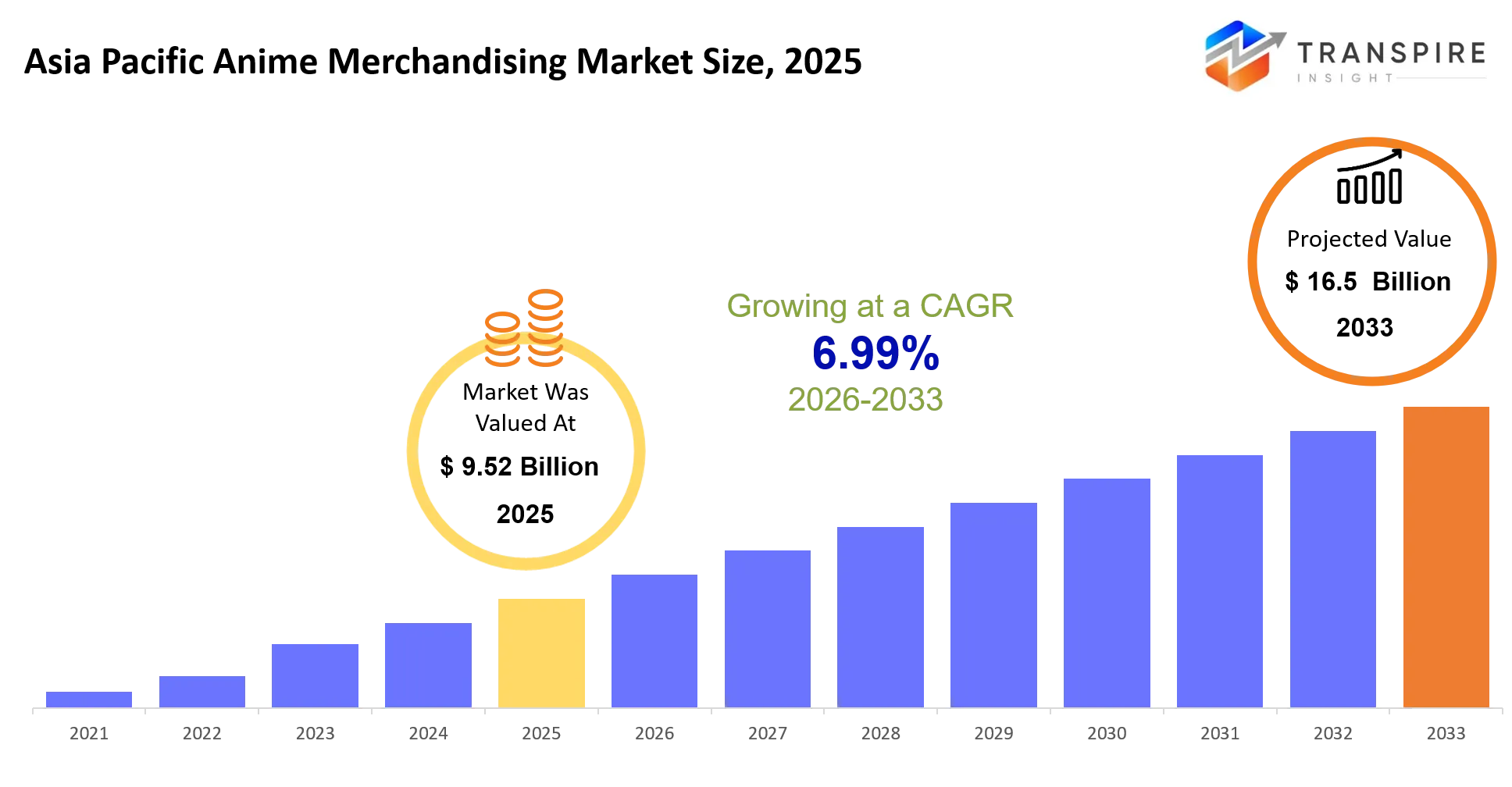
- Asia Pacific Anime Merchandising Market Size 2025: USD 9.52 Billion
- Asia Pacific Anime Merchandising Market Size 2033: USD 16.5 Billion
- Asia Pacific Anime Merchandising Market CAGR: 6.99%
- Asia Pacific Anime Merchandising Market Segments: By Product Type (Figures, Apparel, Accessories, Collectibles, Posters, Home Decor, Stationery, Others); By Distribution Channel (Online Retail, Specialty Stores, Events & Conventions, Brand Stores, Others); By Franchise Type (TV Anime, Movies, Manga-Based, Gaming Anime, Others); By End User (Children, Teenagers, Adults, Collectors, Others)
Asia Pacific Anime Merchandising Market Summary
The Asia Pacific Anime Merchandising Market was valued at USD 9.52 Billion in 2025. It is forecast to reach USD 16.5 Billion by 2033. That is a CAGR of 6.99% over the period.
Asia Pacific anime merchandising transforms animated IP into physical/digital products which can be bought through e-commerce sites, specialty shops, events/conventions and brand partnerships and is how animated studios and licensors monetise a fanbase beyond a digital screen, and prolong engagement with an IP. Over the past five years, the market has evolved from a store-driven ecosystem to a platform-driven ecosystem in which social media and streaming platforms determine and drive IP licenses and discovery, and e-commerce drives quick cross border access to finite merchandise. The COVID-19 store and convention closures have forced a fast turn to pre-orders and secondary market place and global logistics disruptions have created bottlenecks that are altering production and shipping for collectibles and apparel. IP owners are now in turn fast-tracking license cycles and going region-agnostic for new product launches, consolidating revenue around high performing IPs and bringing monetization to the Asia Pacific fandom economies faster.
Key Market Insights
- The Asia Pacific Anime Merchandising Market is led by Japan which captures about 40%-45% share on account of the established IP licensing system and advanced domestic fandom infrastructure in Japan.
- China, which accounts for the fast growing share in the regional market with an expected CAGR during 2024-2030 driven by increase in digital retail market along with substantial investment in domestic production.
- Growing interest for branded merchandise in the Southeast Asian region attributed to the increasing trend of mobile based consumption coupled with cross border e-commerce channels for sale of collectibles.
- The category of figures and collectibles captures the largest share in the merchandise market with more than 35%-40% due to better commercialization of character franchise rights.
- Apparel and lifestyle categories capture the second highest share supported by increasing street style collaborations and an upswing in fashion trends.
- Digital Merchandise and NFTs as the Fastest Growing Segment from 2025-2030 in Asia Pacific Anime Merchandising Market.
- Digital goods and NFTs account for the highest CAGR for digital products across 2025-2030 in Asia Pacific Anime Merchandising Market.
- Franchise based merchandising accounts for roughly 50% share as IP based networks have high durability and the strength of character licensing.
- Cross media merchandising strategy implementation through esports and gaming integration leads to highest CAGR application.
- Consumers aged 15-34 account for over 55% of the end-user demand in Asia Pacific Anime Merchandising Market.
- The corporate and individual collector segment along withInstitutional Buyers shows the highest CAGR in acquiring limited editions and collectibles in higher price points.
What are the Key Drivers, Restraints, and Opportunities in the Asia Pacific Anime Merchandising Market?
The APAC Anime Merchandising Market is primarily driven by the increasing speed of digital consumption of IP through streaming platforms, which also shrinks the time interval between content releases and merchandise marketing. This shortens the time it takes for licensors to capitalize on consumer demand immediately following the launch of an anime episode or film and is one of the largest contributing factors to conversion rate increases from viewer to customer. Additionally, integration with cross-border e-commerce boosts revenue, offering Japanese and Korean IP merchandise directly to consumers in Southeast Asia and China.
The largest limiting factor is structural dependency, where fragmenting licensing across countries slows unified launches and causes disparate price points. Fragmentation inhibits scaling due to per-region rights negotiations, delaying time-to-market and suppressing profits that can be made from a synchronized, global launch. Additionally, fragmentation adds operational burden to manufacturers and distributors working throughout the APAC Anime Merchandising Market.
An emerging opportunity is artificial intelligence (AI)-driven personalization and print-on-demand (POD) manufacturing. Many firms have begun piloting market-specific micro-collections based on fan analysis in countries such as Indonesia and India, which can be profitable because they lower inventory costs while leveraging long-tail demand.
What Has the Impact of Artificial Intelligence Been on the Asia Pacific Anime Merchandising Market?
AI is already impacting the Asia Pacific Anime Merchandising Market as AI has allowed for improved accuracy in forecasting demand, product personalization, and efficiencies for converting digital IP into physical product. The increased ability of machine learning for the merchandising owners/retailers to forecast the behavior of fans based on fan interaction with content across streaming platforms, social media, and e-commerce sites has given way to personalized recommendations and consequently a more effective way to maximize conversion rates and Average Order Value.
Recommendation engines, as mentioned, are helping larger anime merchandisers discover products and this strategy is beginning to take hold with cross-selling characters-such as action figures, characters on apparel, accessories. Meanwhile, the capabilities of generative AI models enable studios to accelerate product prototyping by iterating through various design concepts prior to mass production, shrinking the product development timeline and decreasing associated expenses.
Demand forecasting is optimized through the utilization of predictive analytics by estimating increases in merchandise needs leading up to the premiere of new anime seasons, upcoming conventions, and exclusive product launches, which mitigates both stockouts and overstock issues. From an operational standpoint, this allows for increased efficiency and agility in supply chain collaboration, and enables faster reactions to anime fan induced fluctuations within the Asia Pacific Anime Merchandising Market.
The biggest drawback is a lack of consistent training data between disparate regions. Most small-to-medium sized retailers do not have connected datasets which subsequently hampers model accuracy.
Key Market Trends
- Nearly 35% faster IP-to-merchandising conversion via streaming services from 2021 to 2025 will speed up delays caused by the traditional broadcast-to-retail model.
- Japanese licensors went from an annual release to continuous drops post-2022 allowing for quicker monetization of anime trends.
- Demand for cross-border e-commerce skyrocketed post-2021 with 30+% rise in imports due to demand from Southeast Asia, especially among Japanese anime collectible enthusiasts.
- Product launch strategies of limited-edition items grew post-2023, replacing mass-market sales and introducing a premium/scarce product focus for the anime merchandise sector.
- China’s digital retail platforms increased their anime IP integration efforts post-2022, boosting Chinese merchandise delivery times within mobile-first consumption patterns.
- Manufacturing diversification across regions was more heavily used by global manufacturers after 2020-2022 and therefore less dependence on the domestic country of the exporter of the commodity was generated.
- Product design of newly released merchandise after 2023 and thereafter are prioritizing easily viralized characters due to fan driven social media marketing campaigns (e.g. TikTok, X) rather than merchandise catalog sale formats.
- Since 2021 well-known companies such as Bandai Namco and Good Smile Company have increased the online direct-to-consumer stores and avoided traditional retail distribution.
- Application of the use of AI-driven demand forecasting technologies after 2024 onwards created Merchandise inventory turnover rates of prominent anime merchandising companies improved by almost 20%.
- The importance of conventional sales events decreased in relative importance after the COVID era and has been replaced by online-launch and virtual fan-engagement event hybrid models in the APAC region.
Asia Pacific Anime Merchandising Market Segmentation
By Product Type :
Asia Pacific Anime Merchandising Market is changing its product mix towards higher value, character oriented product lines (primarily figures, collectibles) and also growing across the apparel & accessories range as anime has spread into personal lifestyle use, while posters, stationery products remain as initial point products at low prices.
The growth for figures and collectibles persists, as dedicated fans are prone to buy the whole series because of the limited edition nature of merchandise and accuracy of characters, and there is a momentum in apparel and accessories product lines starting in 2022 with rise of partnerships with various fashion retail chains across the region including Japan, China, and Southeast Asia. There is also a slow increase in Home & Décor products as anime becomes a part of domestic space, facilitated by e-commerce proliferation.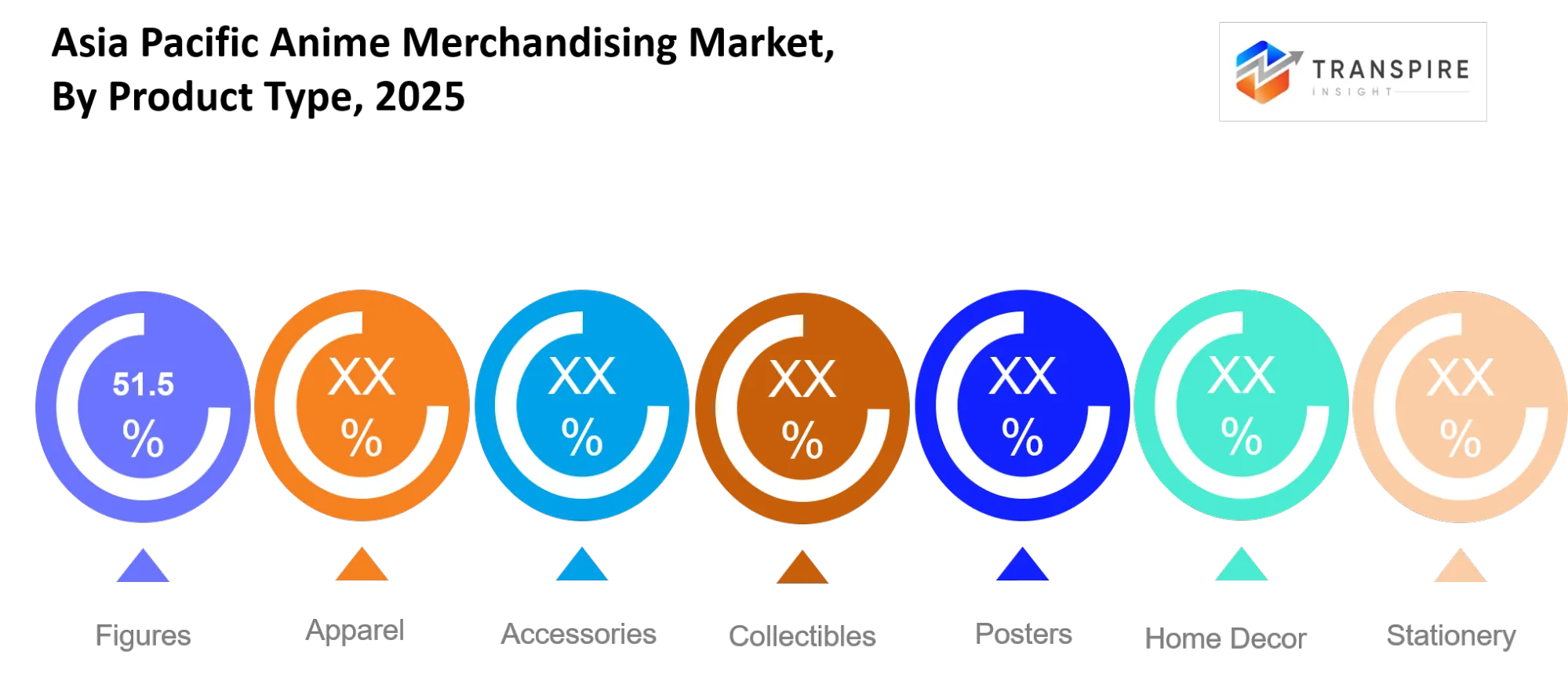
By Distribution Channel :
Asia Pacific Anime Merchandising Market is clearly moving toward online retail after 2020 with limitations on purchasing at physical stores. As digital platforms can now allow quick launch of products and sell to across regions, there are more consumers willing to participate. However specialty stores continue to remain as strong channels for communities in large cities to make their purchase decisions.
The role of events & conventions has been decreasing in contrast as points of sale after events & conventions were heavily restricted and were not able to conduct successfully. Brand stores have recovered with flagship stores and consumer direct strategy aiming to increase profit margins. Online retail continues to be a booming trend in the region, powered by mobile purchasing habits in countries such as South Korea, China, and India, with increasing adoption of digital payments.
By Franchise Type :
Demand for franchised anime merchandise in Asia Pacific is highly correlated with TV anime due to continued seasonal release of series with continued highest merchandising demand. Manga-based franchises still remain relatively steady with prolonged storyline and steady franchise fans.
While game-based animation franchise growth has been rapid since 2021 as game to anime series growth continues. The phenomenon generates new cycles of merchandise on games' update and character enhancement. Animation based franchises drive shorter spike demand on particular periods, most likely on global movie launch. While other niches further enable long-tail revenue by collector edition and individual region license rights.
By End User :
The end-user demand segment in Asia Pacific Anime Merchandise Market changes, while teens and adults are the main spending segment. While teen demand on affordable consumer-level merchandise onmass-marketwhile adults are more on collecting, collectible items, high-end products and limited editions on the market.
Collectibles became a growing segment rapidly from 2022 as consumers look for collectible value and exclusivity. It was the fastest segment to grow on the market while children still constitute a basic spending and toy level on newcomers. While the rest are either festival related demand (Corporate buyers and gift buyers) and it is especially true in big cities of Asia Pacific.
What are the Key Use Cases Driving the Asia Pacific Anime Merchandising Market?
The primary use case in the Asia Pacific Anime Merchandising Market is based on character merchandise (specifically, figures and collectible items tied to popular TV anime), as strong emotional connections between viewer and character turn casual watchers into repeat buyers. The faster sale cycle of figures and collectibles for seasonal story lines has quickened the purchasing cycle throughout all Asian markets.
The second use case is in gaming, in which characters are used in e-sports and mobile games; and lifestyle-based merchandise (such as collaborations with clothing brand owners), in which anime characters and designs are featured on popular clothing items. These two use cases are growing in importance with teenagers and young adults who are exposed to anime from digital platforms such as video games and the usage of social media and other shopping trends that encourage impulse purchases within the Asian market.
Upcoming use cases include both AI-driven customization of merchandise and digitally rendered characters in the form of digital collectibles on the fandom platform. This segment also includes augmented reality (AR) based product visualization and pre-purchase design previews, along with print-on-demand production that enable a faster turnaround time for custom-designed items. This development will improve fan engagement models and further the direct-to-fan model throughout the market.
|
Report Metrics |
Details |
|
Market size value in 2025 |
USD 9.52 Billion |
|
Market size value in 2026 |
USD 10.28 Billion |
|
Revenue forecast in 2033 |
USD 16.5 Billion |
|
Growth rate |
CAGR of 6.99% from 2026 to 2033 |
|
Base year |
2025 |
|
Historical data |
2021 - 2024 |
|
Forecast period |
2026 - 2033 |
|
Report coverage |
Revenue forecast, competitive landscape, growth factors, and trends |
|
Regional scope |
Asia Pacific (India, China, Japan, Australia, South Korea, Rest of Asia Pacific) |
|
Key company profiled |
Bandai Namco, Good Smile Company, Aniplex, Toei Animation, Crunchyroll Store, AmiAmi, Kotobukiya, Sega, Bushiroad, Kadokawa, Animate, Banpresto, Furyu, Hobby Link Japan, Sanrio |
|
Customization scope |
Free report customization (country, regional & segment scope). Avail customized purchase options to meet your exact research needs. |
|
Report Segmentation |
By Product Type (Figures, Apparel, Accessories, Collectibles, Posters, Home Decor, Stationery, Others); By Distribution Channel (Online Retail, Specialty Stores, Events & Conventions, Brand Stores, Others); By Franchise Type (TV Anime, Movies, Manga-Based, Gaming Anime, Others); By End User (Children, Teenagers, Adults, Collectors, Others) |
Which Regions are Driving the Asia Pacific Anime Merchandising Market Growth?
Strongest with its domestically integrated licensing ecosystem and its domestic IP pipeline. The relationships among anime producers, publishers, and consumers ensure that there's always some new franchise to market and a copyright system that streamlines merchandising. Production is centralized in Tokyo and Osaka, so new releases can always feed into a fresh stream of merchandise. Dedicated fan culture and event networks also sustain consumer demand for existing and new products on both physical and digital platforms.
A highly structured but static market that offers more than Japan based on growth logic; expansion in this sector will depend on digital entertainment behemoths and solid domestic e-commerce operations instead of legacy IP infrastructure. Strict content regulations on imports and high local demand for anime-style productions led local players to make heavy investments in home-grown works that provide an adequate stream of revenue through established channels. Stable consumer spending on licensed content will continue to draw interest in this predictable market.
Fastest growing, as a direct result of rapid mobile commerce adoption and increasingly intense youth fan-base culture (Indonesia, Vietnam, Philippines, Thailand). Since 2022, a growing number of people have been introduced to anime thanks to the widespread use of social media and affordable streaming subscriptions. Enhanced e-commerce services, cross-border trade practices, and a digital payment system that has been more easily adopted in both developing and developed Southeast Asian countries have led to greater availability and circulation of licensed merchandise from both China and Japan. Global licensors should actively target and explore the region from 2026-2033 as an ideal target market in terms of potential demand for products to satisfy long-tail demands and diversification for revenue stream.
Who are the Key Players in the Asia Pacific Anime Merchandising Market and How Do They Compete?
Within Asia Pacific Anime Merchandising Market, competition remained moderately consolidated, the majority of IPs was monopolized by incumbents, whilst numerous niche studios try to attract their fan base by specializing their collectibles. Competition is based on licensing power, ability of product innovation and direct-to-consumer model, instead of the traditional pricing battle. Players would battle out by shortening lead time from animation to merchandise launch, as product lead time often determines revenues.
Bandai Namco is extending its business range via vertically integrating in an entire flow, to cover content production to merchandise designing & producing, to ensure products to be launched soon after new anime air. Bandai Namco gains a certain lead from direct ownership of strong intellectual properties and rapid production, to match the new season release cycle both within Japan and export markets. Moreover, international popup stores and digital direct sales were launched to improve direct consumer connection and sales.
Good Smile Company’s primary competitive strategy is to emphasize highly-detailed collectible items. Targeting fans at global scale, Goods Smile company focuses on producing unique collectible series and premium scale figures. Limited availability and the strong resale market of these collectibles help them differentiate their brands from competitors. International distributors were set up to support global presence, alongside partnerships of IPs.
Crunchyroll and Aniplex extend their reach by providing integrated services ranging from anime streaming to online merchandise stores. In this business model, the time lag between viewers engaging with animation and making a purchase can be significantly reduced, resulting in improved monetization effectiveness. Crunchyroll and Aniplex leverage exclusive licensing contracts and simultaneous regional release plans for products to further solidify their market position.
Company List
- Bandai Namco
- Good Smile Company
- Aniplex
- Toei Animation
- Crunchyroll Store
- AmiAmi
- Kotobukiya
- Sega
- Bushiroad
- Kadokawa
- Animate
- Banpresto
- Furyu
- Hobby Link Japan
- Sanrio
Recent Development News
In March 2025, Aniplex and Crunchyroll established the Hayate joint venture to produce premium anime content for global streaming platforms. The collaboration strengthened integrated production and merchandising pipelines across Asia Pacific markets.
Source https://www.crunchyroll.com/
In April 2026, Hayate Inc., the Aniplex–Crunchyroll production joint venture, announced acquisition of studio Lay-duce to expand in-house animation capacity. The move is expected to accelerate merchandise-linked anime production cycles across regional licensing ecosystems.
Source https://www.aniplex.co.jp/
What Strategic Insights Define the Future of the Asia Pacific Anime Merchandising Market?
The structural trend in the Asia Pacific anime merchandising market is a movement towards an IP-to-commerce digital pipeline, where a franchise’s content releases instantly translate to revenue generating merchandise in days rather than months. This shift is largely fueled by the rise of streaming, seamless cross border e-commerce and an acceleration of licensing structures that reduce the historical delay from product to market. In the next 5-7 years, growth will focus on franchises capable of real-time alignment of content story, community activation and product release.
A less publicized risk, however, is the concentration of IP among a handful of studios and streaming giants. If this centralization limits content creativity or over-reliance on these limited franchises, any interruption to these main pipelines would instantly cause instability in a vast network of merchandising revenues.
A significant emergent opportunity is localized micro-licensing in Southeast Asia and India where regional creators are building IP-driven communities alongside the rise of mobile first consumers, and those businesses investing in regional co-creation and fast production can capitalize on untapped fans segments. Direct-to-fan digital shops and demand-based forecasting models will be key for continued competitiveness.
Asia Pacific Anime Merchandising Market Report Segmentation
By Product Type
- Figures
- Apparel
- Accessories
- Collectibles
- Posters
- Home Decor
- Stationery
By Distribution Channel
- Online Retail
- Specialty Stores
- Events & Conventions
- Brand Stores
By Franchise Type
- TV Anime
- Movies
- Manga-Based
- Gaming Anime
By End User
- Children
- Teenagers
- Adults
- Collectors
Frequently Asked Questions
Find quick answers to common questions.
The Asia Pacific Anime Merchandising Market size is USD 16.5 Billion in 2033.
Key Segments for the Asia Pacific Anime Merchandising Market are By Product Type (Figures, Apparel, Accessories, Collectibles, Posters, Home Decor, Stationery, Others); By Distribution Channel (Online Retail, Specialty Stores, Events & Conventions, Brand Stores, Others); By Franchise Type (TV Anime, Movies, Manga-Based, Gaming Anime, Others); By End User (Children, Teenagers, Adults, Collectors, Others).
Major Asia Pacific Anime Merchandising Market players are Bandai Namco, Good Smile Company, Aniplex, Toei Animation, Crunchyroll Store, AmiAmi, Kotobukiya, Sega, Bushiroad, Kadokawa, Animate, Banpresto, Furyu, Hobby Link Japan, Sanrio.
The Current Asia Pacific Anime Merchandising Market size is USD 9.52 Billion in 2025.
The Asia Pacific Anime Merchandising Market CAGR is 6.99% from 2026 to 2033.
- Bandai Namco
- Good Smile Company
- Aniplex
- Toei Animation
- Crunchyroll Store
- AmiAmi
- Kotobukiya
- Sega
- Bushiroad
- Kadokawa
- Animate
- Banpresto
- Furyu
- Hobby Link Japan
- Sanrio
About the Authors

Chetan Dhatrak
I’m Chetan Dhatrak, a Senior Research Analyst at Transpire Insight, specializing in the Consumer Goods, Foods and Beverages industry. I focus on analyzing market trends, consumer behavior, competitive landscapes, and industry developments to deliver accurate, data-driven insights. My research at Transpire Insight is built on credible sources and in-depth analysis, helping businesses and readers better understand market dynamics, emerging opportunities, and evolving consumer preferences. I’m committed to creating reliable, well-researched content that supports informed decision-making and reflects the latest developments in the consumer goods and food & beverage sectors.

Chakradhar Khansole
Chakradhar serves as the Research Director at Transpire Insight, bringing over 8 years of experience in technology, innovation, and strategic market intelligence. He specializes in transforming complex market data into actionable business insights that enable organizations to make informed, growth-oriented decisions. Recognized for his strategic vision and analytical expertise, Chakradhar leads high-impact research initiatives, delivering comprehensive market assessments, competitive intelligence, and forward-looking industry analysis.
Recently Published Reports
-
Apr 2026
Bottled Water Market
Bottled Water Market Size, Share & Analysis Report By Product Type (Still Bottled Water, Carbonated Bottled Water, Functional Bottled Water, and Others), By Packaging (PET, Cans, and Others), By Sales Channel (Supermarkets/Hypermarkets, Convenience Stores/Drug Stores, Grocery Stores/Club Stores, Foodservice, and Others) and Geography (North America, Europe, Asia-Pacific, Middle East and Africa, South and Central America), 2021 - 2032
-
Apr 2026
Color Cosmetic Packaging Market
Color Cosmetic Packaging Market Size, Share & Analysis Report By Application (Mascara Packaging, Liquid Packaging, and Liquid Face), By Type (Tubes & Bottles, Pens & Markers, Compacts & Containers, and Droppers & Pumps), and Geography (North America, Europe, Asia-Pacific, Middle East and Africa, South and Central America), 2021 - 2031
-
Apr 2026
External Microphone For Camera Market
External Microphone For Camera Market Size, Share & Analysis Report By Type (Shotgun Microphone, Lavalier Microphone, and Others), By Application (Digital Camera, Professional Video Camera, and Others), and Geography (North America, Europe, Asia-Pacific, Middle East and Africa, South and Central America), 2021 - 2031
-
Apr 2026
Foot Orthotic Insoles Market
Foot Orthotic Insoles Market Size, Share & Analysis Report By Type (Pre-fabricated, and Custom-made), By Material (Thermoplastic, Composite Carbon Fiber, and Others), By Distribution Channel (Drug Stores, Hospitals & Clinics, and Others), and Geography (North America, Europe, Asia-Pacific, Middle East and Africa, South and Central America), 2021 - 2031