

Asia Pacific Activated Bleaching Earth Market Summary
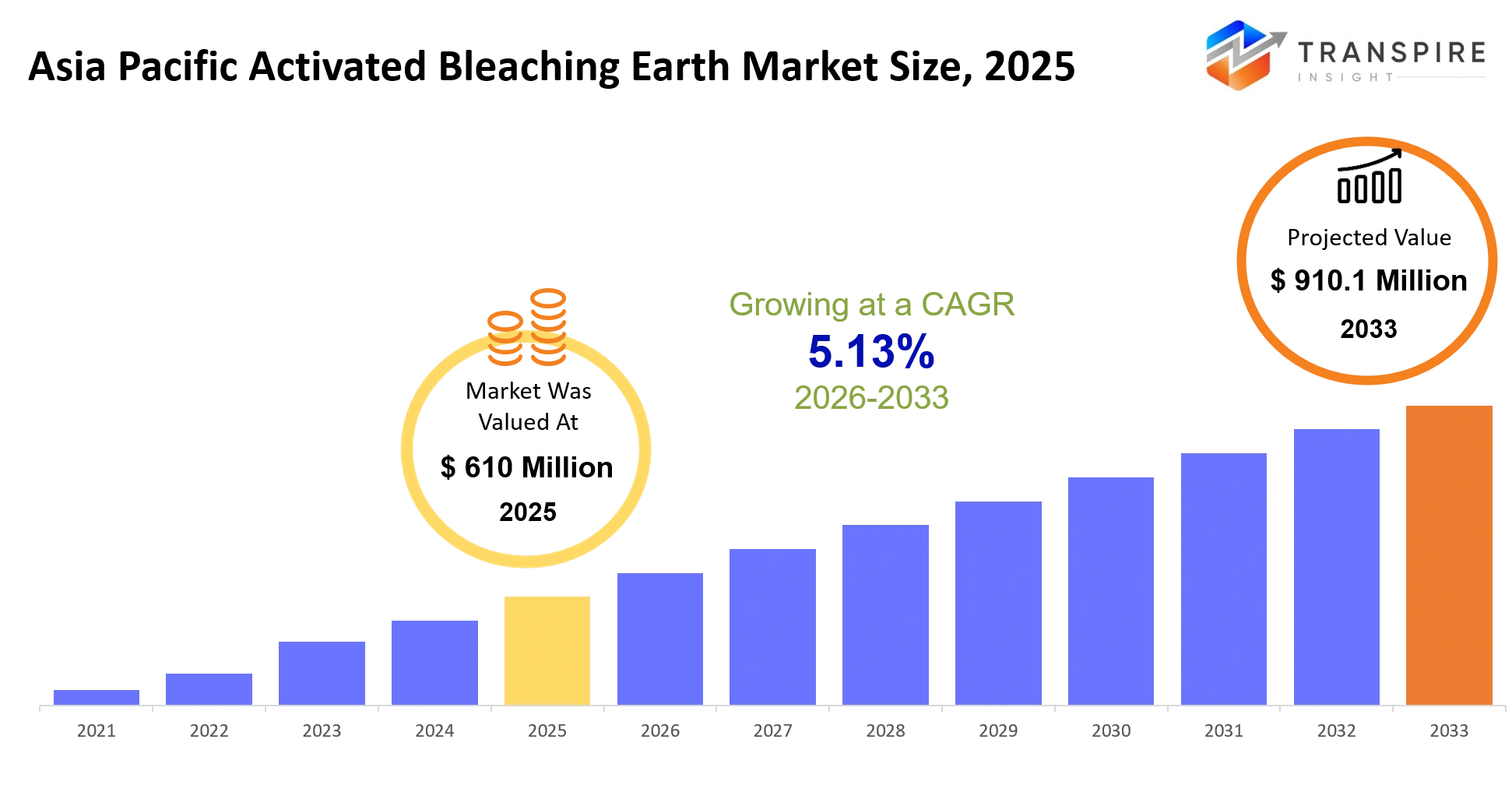
As per Transpire Insight Analysis the Asia Pacific Activated Bleaching Earth Market size is estimated at USD 610 Million in 2025 and is anticipated to reach USD 910.1 Million by 2033, growing at a CAGR of 5.13% from 2026 to 2033.
The Asia Pacific Activated Bleaching Earth Market plays a major part in refining edible oils, fats, lubricants, and specialty chemicals too, basically by wiping out pigments and other unwanted impurities, plus oxidation residues and tiny trace contaminants that mess with product quality and shorten shelf life. Food processors , and industrial producers lean on activated bleaching earth so they can keep color stable, maintain higher purity levels, and also meet tight quality requirements. At the same time, it helps downstream processing run smoother, with less fuss.
In the last five years, the whole market has been moving toward high performance, and more application specific bleaching materials, since refiners want better yield returns and lower overall processing expenses. Meanwhile, stricter food safety rules and sustainability goals have pushed adoption of upgraded purification media, with better adsorption efficiency. During the pandemic, supply chain hiccups also made manufacturers rethink risk, so they diversified sourcing and tried to bolster regional output.
All of that has, in effect, encouraged more investment in process upgrades, expanded refining activity across Asia Pacific, and opened up stronger revenue paths for suppliers who can offer technically differentiated products, along with steady and dependable delivery.
Asia Pacific Activated Bleaching Earth Market Size & Forecast:
- Asia Pacific Activated Bleaching Earth Market Size 2025: USD 610 Million
- Expected Market Value 2033: USD 910.1 Million
- Forecast CAGR: 5.13%
- Leading region in 2025: China
- Fastest Growing region: India
- Key Profile: Clariant, BASF, Taiko Group, Musim Mas, Oil-Dri Corporation, AMC (UK), EP Minerals, Ashapura Group, HRP Industries, Manek Active Clay, Refoil Earth, Geohellas, Tolsa Group, Zeotec Adsorbents, Global Bleach Chem.
Key Market Insights
- China pretty much led the Asia Pacific activated bleaching earth scene with about 38% market share in 2025, backed by lots of edible oil refining capacity and access to domestic mineral resources.
- India looks set to stay the quickest-growing regional market through 2025–2033, largely because more refining capacity is being added and investments are flowing into food processing infrastructure.
- For the product side, Natural activated bleaching earth took the lead with close to 68% share in 2025, since refiners favored cost effective purification for high volume edible oil output.
- Acid activated bleaching earth sat in the number two position, it is also gaining ground because it’s used across specialty oils, lubricants, and chemical purification tasks.
- When it comes to the more advanced categories, Highly activated specialty grades are expected to grow the quickest by 2033, supported by premium edible oil refining and tighter quality requirements.
- On applications, edible oil refining dominated, taking roughly 72% market share in 2025, which fits the ongoing ramp up of palm, soybean, and sunflower processing.
- Biofuel feedstock purification is forecast to become the fastest moving application through 2033, tied to renewable fuel investment across the Asia Pacific region.
- And for end users, edible oil manufacturers led the way with nearly 70% share in 2025, mainly because of big scale commercial refining operations.
- Specialty chemical processors are expected to show the strongest expansion through 2033, as advanced purification needs keep getting more strict.
What are the Key Drivers, Restraints, and Opportunities in the Asia Pacific Activated Bleaching Earth Market?
The main factor pushing market expansion is kind of the modernization of edible oil refining across Asia Pacific. Food safety rules got more strict after updated quality compliance frameworks, and also with tighter contaminant limits in several nearby markets. Refiners basically answered by upgrading purification systems, which improve oil color, stability, and yield while cutting down processing losses. When refining efficiency goes up, production costs go down and product consistency gets better. These day to day operational improvements are what really justify investing in premium activated bleaching earth, which then opens stronger revenue routes for suppliers that serve food processors, lubricant blenders, and specialty chemical operators too.
The biggest structural restraint still comes from uneven availability of high quality clay deposits, plus a concentrated processing footprint. Building new mines and activation plants needs environmental approvals, significant capital spending , and long qualification cycles with industrial buyers. So these things cannot be fixed fast enough. From a Transpire Insight review of regional procurement announcements and launch timing, the supply chain concentration is still the main execution risk. If supply interruptions happen, refinery expansion projects get delayed, supplier revenues get suppressed, and procurement timelines stretch out for manufacturers who are trying to secure qualified materials.
Big chance shows up with more advanced bleaching earth formulations, aimed at premium edible oils as well as renewable fuels and specialty chemicals. If companies keep funding high efficiency adsorption tech and then pair it with tailored mineral activation methods, that should open up the next growth step. India plus Southeast Asia look quite good because refining capacity keeps expanding, while processors want stronger yields and less waste produced. Suppliers who blend practical technical guidance with localized manufacturing, will end up in a stronger long term competitive stance, like very quietly but surely.
What Has the Impact of Artificial Intelligence Been on the Asia Pacific Activated Bleaching Earth Market?
Artificial intelligence is kind of reshaping activated bleaching earth production and the whole downstream refining part, mainly by tuning process control, keeping the material more consistent, and pushing plant efficiency a bit better. AI-enabled monitoring platforms keep on checking adsorption performance, moisture readings, activation temperature ranges, plus filtration quality, so that operators can nudge production settings before small deviations turn into product-quality trouble. Along with that, digital quality management systems make compliance paperwork easier, especially for food-grade refining operations.
On the planning side, machine learning models increasingly help with demand forecasting and production scheduling by merging refinery utilization rates, edible oil consumption movements, and procurement habits. Predictive maintenance tools look at vibration , pressure , and temperature signals from kilns, grinders, and filtration equipment, which helps to avoid surprise shutdowns. In the end, these upgrades support better equipment availability, lower maintenance expenses, and more reliable inventory decisions across the supply chain. A lot of manufacturers also run digital twins to mimic activation processes and improve mineral utilization before they roll out changes in normal commercial production.
Operational performance has improved through higher uptime, less energy use, and steadier adsorption efficiency. Still, AI rollouts are limited by pricey integration work and by messy, inconsistent operational data coming from older manufacturing facilities. Many regional producers stay with legacy equipment that doesn’t have connected sensors, so predictive models don’t get enough signals, and that slows down the broader digital transformation overall.
Key Market Trends
- Since 2022, refiners have, kind of more and more, been picking high-adsorption grades to get a better oil yield while at the same time cutting down on filtration losses plus lowering processing costs, you know.
- During 2023–2025, China expanded its domestic mineral processing capacity, which helped regional supply bounce back faster and also reduced import dependence a bit.
- After 2023, India accelerated refinery modernization efforts, and this in turn built stronger demand for bespoke bleaching earth formulations, with better adsorption efficiency.
- Since 2021, new food quality regulations have rolled out across several Asia Pacific economies, and they pushed refiners to swap out ordinary purification materials for more advanced alternatives.
- Between 2022 and 2025, manufacturers have been investing in AI-enabled quality monitoring. This improved process consistency, and it also reduced production variability, overall.
- Clariant also expanded specialty purification solutions aimed at edible oil refiners, supporting higher operational efficiency plus meeting product quality requirements more tightly.
- Investments in renewable diesel and biofuels, starting in 2024, created fresh demand for purification materials that can handle alternative feedstocks.
- Strategic regional sourcing agreements reduced exposure to global logistics disruptions after the pandemic, so procurement stability stayed steadier across major refining markets.
- And more suppliers have been developing customized bleaching earth grades for specialty chemicals as well as premium edible oils, which shifted competition away from just price, and more toward technical performance instead.
Asia Pacific Activated Bleaching Earth Market Segmentation
By Product Type:
Natural Activated Bleaching Earth holds the leading position because edible oil processors rely On consistent adsorption performance, stable filtration, and cost-efficient refining, it’s mostly about how well the whole process keeps working. Strong availability of raw materials plus compatibility with large-scale refining systems helps it move into widespread commercial use. Natural grades also help hold product quality, while cutting down unwanted impurities during oil purification. Long operating history in food processing facilities keeps adding weight to market acceptance, even when conditions get a bit rough.
Acid Activated Bleaching Earth comes next as the second-largest category, largely because it shows higher adsorption efficiency for harder refining applications. Neutral Activated Bleaching Earth is used for specialized processing needs, where controlled treatment conditions stay a key point. Granular Bleaching Earth tends to get picked in certain filtration systems because material handling is easier and dust is lower, so it feels more practical in day to day operations. Powdered Bleaching Earth will see the quickest growth, since advanced refining operations want better surface area and more effective contaminant removal. Other types exist too, to cover niche industrial applications that need customized purification performance, rather than one “fits all” solution.
By Application:
Edible Oil Refining is the biggest application , because refining facilities need a really effective way to get rid of pigments, phospholipids oxidation products and those trace contaminants before the oil is finally packaged for consumers. Also, continuous capacity expansion across major food processing economies helps keep the material consumption fairly steady. On top of that, higher quality standards push manufacturers toward advanced purification media , they can improve the oil look and also its shelf stability. Production efficiency still feels like a key purchasing factor, especially across large refining setups.
Biodiesel Production sits in second place, mainly due to its wider adoption inside renewable fuel processing. Mineral Oil Purification, Wax Purification, Chemical Processing, and Animal Fat Processing keep supporting solid industrial demand in several sectors. Biodiesel Production should also stay the fastest-growing application , since renewable fuel investments tend to bring higher purification needs with them. Other segments add extra opportunities too, mostly through niche or specialty industrial processing where adsorption quality has a direct effect on how the final product performs.

By End User:
Edible Oil Manufacturers take up the largest share, mostly because refining activities need steady purification materials to hit food quality standards and keep output running smoothly. Also the large processing volumes lead to stable buying needs across the year, not just in certain seasons. When capacity keeps getting added in developing economies, long-term consumption gets that extra boost. In the same vein, buyers keep focusing on product performance plus operational consistency, it stays a main priority.
Chemical Companies come in as the second-largest end-user group due to their routine reliance on purification and processing applications. Petroleum Refineries, Biodiesel Producers, and the Food Processing Industry keep pushing higher industrial adoption across more specialized production lines. Biodiesel Producers are expected to see the quickest growth, since renewable energy investments are driving more processing activity in the region. Meanwhile, the other players back more industrial use-cases where impurity removal is still a core production requirement, they really can’t skip it.
By Distribution Channel:
Direct Sales kind of leads the distribution channel , mainly because big industrial buyers often want long-term supply arrangements, with technical backing and steady product availability all the time. In practice direct procurement helps with supply planning, while also reducing procurement hassle for the high-volume manufacturing sites. These long-term commercial ties tend to make supply reliability more solid across major refining facilities. Bulk purchasing also keeps backing up why this channel stays in the lead.
Industrial Distributors sit in second place, mostly by serving medium-sized manufacturers who need more flexible inventory access. Wholesale Suppliers keep pushing outward, improving regional reach through wider industrial connections and more localized inventory handling. Direct Sales will likely keep being the fastest-growing channel since manufacturers care a lot about supply security, tailored technical support, and better commercial partnerships. The rest of the options , like Others, still fill in extra purchasing pathways for specialized industrial needs.
By Source:
Bentonite Clay kind of dominates the source segment, mainly because it has high adsorption capacity and also wide commercial availability that really backs up extensive use through refining plus purification operations. The mineral characteristics stay stable, so manufacturers can keep getting consistent processing performance and, in turn, steadier product quality. Large reserves spread across several countries help with long term supply stability, even when demand shifts. And commercial scalability keeps pushing industrial adoption, pretty much everywhere.
Attapulgite Clay comes in as the second-largest source, largely tied to adsorption properties that fit selected industrial applications. Fuller's Earth and Mixed Clay continue to support more specialized processing needs, where application specific performance still matters a lot. Mixed Clay should see the fastest growth, as manufacturers work on blended formulations and that improves purification efficiency across multiple refining processes. Then the “others” category still supports niche industrial uses that need customized mineral characteristics, not just the generic kind.
What are the Key Use Cases Driving the Asia Pacific Activated Bleaching Earth Market?
Edible oil refining still feels like the main use case, mostly because food manufacturers need a sort of consistent purification before their products land in commercial markets. Activated bleaching earth helps by pulling out those annoying pigments and trace impurities, which can mess with product quality, shelf stability and visual appearance. Big edible oil processors tend to buy in large volumes too, so they can keep production moving efficiently, and also satisfy strict food quality expectations.
Biodiesel production is also still growing , since renewable fuel facilities want dependable purification during feedstock handling. On top of that, chemical companies use activated bleaching earth in specialty chemical manufacturing, aiming to lift product quality by stripping away contaminants. Honestly these use cases keep building commercial value as industrial processing expectations become more demanding, step by step.
Now there are emerging opportunities, especially around advanced bio based chemicals and premium specialty oils that really need stronger purification performance. Companies making pharmaceutical intermediates, and other high value industrial ingredients are also looking at customized adsorption materials for certain processing stages. Broader adoption will likely depend on strong product validation, plus continued investment in specialized manufacturing technologies, and yeah these decisions take time.
|
Report Metrics |
Details |
|
Market size value in 2025 |
USD 610 Million |
|
Market size value in 2026 |
USD 641.1 Million |
|
Revenue forecast in 2033 |
USD 910.1 Million |
|
Growth rate |
CAGR of 5.13% from 2026 to 2033 |
|
Base year |
2025 |
|
Historical data |
2021 - 2024 |
|
Forecast period |
2026 - 2033 |
|
Report coverage |
Revenue forecast, competitive landscape, growth factors, and trends |
|
Regional scope |
Asia Pacific (India, China, Japan, Australia, South Korea, Rest of Asia Pacific) |
|
Key company profiled |
Clariant, BASF, Taiko Group, Musim Mas, Oil-Dri Corporation, AMC (UK), EP Minerals, Ashapura Group, HRP Industries, Manek Active Clay, Refoil Earth, Geohellas, Tolsa Group, Zeotec Adsorbents, Global Bleach Chem. |
|
Customization scope |
Free report customization (country, regional & segment scope). Avail customized purchase options to meet your exact research needs. |
|
Report Segmentation |
By Product Type (Natural Activated Bleaching Earth, Acid Activated Bleaching Earth, Neutral Activated Bleaching Earth, Granular Bleaching Earth, Powdered Bleaching Earth, Others); By Application (Edible Oil Refining, Biodiesel Production, Mineral Oil Purification, Wax Purification, Chemical Processing, Animal Fat Processing, Others); By End User (Edible Oil Manufacturers, Chemical Companies, Petroleum Refineries, Biodiesel Producers, Food Processing Industry, Others); By Distribution Channel (Direct Sales, Industrial Distributors, Wholesale Suppliers, Others); By Source (Bentonite Clay, Attapulgite Clay, Fuller’s Earth, Mixed Clay, Others). |
Which Regions are Driving the Asia Pacific Activated Bleaching Earth Market Growth?
China showed around 38% of regional revenue in 2025, so basically it stays the biggest player in the Asia Pacific Activated Bleaching Earth Market. strict food quality rules, a lot of edible oil refining capacity, plus ongoing investment into industrial processing sites, all helped to keep domestic demand pretty strong. Also there’s a fairly wide web of clay processors, refining firms, logistics providers and equipment manufacturers working together, which supports smoother output and dependable distribution. With more refinery upgrades already happening, more local consumption growing, and mineral resources staying solid, this position should hold pretty well through the forecast stretch.
Japan comes in as the second-largest regional market, mostly because buying decisions lean toward product quality and process efficiency, plus long term supply reliability, not only how much is produced. Regulatory pressure remains consistent, and industrial standards are already quite mature, so procurement tends to stay steady across edible oil, specialty chemical, and lubricant processing lines. Manufacturers also keep putting money into production optimization rather than rushing into fast capacity expansion, which creates more predictable purchasing behavior. That kind of balanced industrial setup makes Japan a reliable, repeatable revenue stream for suppliers over time.
India is projected to see the fastest growth in the 2026–2033 window, after refinery expansion projects, plus stronger food processing backers, and also more renewable fuel output. In parallel the government is backing industrial manufacturing , and ongoing investment in edible oil processing has pushed demand for advanced purification materials a lot. As domestic refining capacity keeps stretching, it has further encouraged suppliers to beef up local output and distribution routes. All of this combined momentum should open up real, interesting opportunities for manufacturers and investors looking for steady gains via localized production, technical services, and strategic collaborations.
Who are the Key Players in the Asia Pacific Activated Bleaching Earth Market and How Do They Compete?
Competition across the Asia Pacific Activated Bleaching Earth Market is still, honestly, moderately fragmented, mainly because regional mineral processors move in the same lanes as international specialty material suppliers. In practice, the game comes down to cost efficiency sometimes, adsorption performance too, product consistency plus the quality of technical support. Bigger, established manufacturers keep trying to hold ground by doing production expansion and also application oriented product development, but regional suppliers tend to sharpen their footing by improving supply reliability and offering localized customer support, which matters a lot.
Clariant sets itself apart with advanced bleaching earth formulations built for high performance edible oil refining and various specialty industrial uses. With continued investment in research and product development the company keeps raising adsorption efficiency while also helping customers meet stricter quality expectations. Taiko Group competes with strong manufacturing capacity and a regional distribution approach, so it can provide reliable supply for major refining customers across Asia. Ashapura Group leans on mineral resource integration along with processing know-how, which in turn strengthens cost control and keeps raw material availability steadier.
BASF leans into tech driven purification solutions, backed up by research power and real application know-how for industrial clients. Musim Mas seems to sharpen its competitiveness by putting money into refining infrastructure, where efficient purification processes get woven right into edible oil production. AMC (UK) Ltd. is also pushing forward its footprint via customized technical assistance and special bleaching earth grades that are kind of tuned to the customers, refining needs in a more specific way. Together, these angles help each company compete on the basis of better performance, steadier operations, and closer involvement with industrial buyers, not only on price alone.
Company List
- Clariant
- BASF
- Taiko Group
- Musim Mas
- Oil-Dri Corporation
- AMC (UK)
- EP Minerals
- Ashapura Group
- HRP Industries
- Manek Active Clay
- Refoil Earth
- Geohellas
- Tolsa Group
- Zeotec Adsorbents
- Global Bleach Chem
Recent Development News
In November 2025, Clariant showcased its TONSIL bleaching earth solutions at the International Palm Oil Congress (PIPOC) 2025 in Malaysia. The company highlighted its activated bleaching earth technologies for palm oil purification, strengthening visibility and customer engagement across the Asia Pacific edible oil refining sector.
Source: https://www.clariant.com/
In February 2026, Clariant updated its TONSIL™ Bleaching Earth product portfolio documentation. The update reaffirmed continued investment in tailor-made bleaching earth solutions for edible oil, fat, and biofuel purification, supporting customers across Asia with optimized purification performance.
Source: https://www.clariant.com/
What Strategic Insights Define the Future of the Asia Pacific Activated Bleaching Earth Market?
The Asia Pacific activated bleaching earth market will, kinda structurally lean toward higher-performance purification solutions in the next 5–7 years, mostly because food safety standards keep tightening, refined edible oil demand is rising, and big processors want better quality requirements from the market. There is a bit of a sneaky risk too—raw material supply concentration, as in the dependence on a few specific clay sources and certain processing capabilities could still cause cost volatility, even if demand keeps growing steadily. On the flip side, there’s an emerging opportunity: customized low-carbon bleaching earth solutions for sustainable oil refining, particularly since manufacturers are getting pulled into stricter environmental reporting across Asia Pacific economies.
Market players should focus on building localized production capacity, using resource-efficient activation technologies, and signing long-term supply agreements with regional refiners to make operations more resilient. In general, companies that blend technical performance with sustainability credentials will end up with better positioning as the market shifts away from simple commodity-based supply and toward value-added refining solutions.
Asia Pacific Activated Bleaching Earth Market Report Segmentation
By Product Type
- Natural Activated Bleaching Earth
- Acid Activated Bleaching Earth
- Neutral Activated Bleaching Earth
- Granular Bleaching Earth
- Powdered Bleaching Earth
By Application
- Edible Oil Refining
- Biodiesel Production
- Mineral Oil Purification
- Wax Purification
- Chemical Processing
- Animal Fat Processing
By End User
- Edible Oil Manufacturers
- Chemical Companies
- Petroleum Refineries
- Biodiesel Producers
- Food Processing Industry
By Distribution Channel
- Direct Sales
- Industrial Distributors
- Wholesale Suppliers
By Source
- Bentonite Clay
- Attapulgite Clay
- Fuller’s Earth
- Mixed Clay
Frequently Asked Questions
Find quick answers to common questions.
The expected Asia Pacific Activated Bleaching Earth Market size for the market will be USD 910.1 Million in 2033.
Key segments for the Asia Pacific Activated Bleaching Earth Market are By Product Type (Natural Activated Bleaching Earth, Acid Activated Bleaching Earth, Neutral Activated Bleaching Earth, Granular Bleaching Earth, Powdered Bleaching Earth, Others); By Application (Edible Oil Refining, Biodiesel Production, Mineral Oil Purification, Wax Purification, Chemical Processing, Animal Fat Processing, Others); By End User (Edible Oil Manufacturers, Chemical Companies, Petroleum Refineries, Biodiesel Producers, Food Processing Industry, Others); By Distribution Channel (Direct Sales, Industrial Distributors, Wholesale Suppliers, Others); By Source (Bentonite Clay, Attapulgite Clay, Fuller’s Earth, Mixed Clay, Others).
Major Asia Pacific Activated Bleaching Earth Market players are Clariant, BASF, Taiko Group, Musim Mas, Oil-Dri Corporation, AMC (UK), EP Minerals, Ashapura Group, HRP Industries, Manek Active Clay, Refoil Earth, Geohellas, Tolsa Group, Zeotec Adsorbents, Global Bleach Chem.
The Asia Pacific Activated Bleaching Earth Market size is USD 610 Million in 2025.
The Asia Pacific Activated Bleaching Earth Market CAGR is 5.13% from 2026 to 2033.
- Clariant
- BASF
- Taiko Group
- Musim Mas
- Oil-Dri Corporation
- AMC (UK)
- EP Minerals
- Ashapura Group
- HRP Industries
- Manek Active Clay
- Refoil Earth
- Geohellas
- Tolsa Group
- Zeotec Adsorbents
- Global Bleach Chem
About the Authors

Pankaj Ghogare Patil
I am Pankaj Ghogare Patil, a Senior Research Analyst at Transpire Insight, specializing in the Pharmaceutical, Chemicals & Materials, Healthcare IT, and Biotechnology industry. My expertise lies in conducting comprehensive market research, analyzing industry trends, evaluating competitive landscapes, and translating complex data into actionable insights. At Transpire Insight, I closely follow emerging technologies, regulatory developments, and market innovations to create accurate, well-researched, and informative content that helps businesses and professionals make informed decisions. I am committed to producing credible, evidence-based articles that reflect industry best practices while making technical topics accessible and valuable for a broad audience.

Chakradhar Khansole
Chakradhar serves as the Research Director at Transpire Insight, bringing over 8 years of experience in technology, innovation, and strategic market intelligence. He specializes in transforming complex market data into actionable business insights that enable organizations to make informed, growth-oriented decisions. Recognized for his strategic vision and analytical expertise, Chakradhar leads high-impact research initiatives, delivering comprehensive market assessments, competitive intelligence, and forward-looking industry analysis.
Recently Published Reports
-
May 2026
Healthcare Polymer Packaging Market
Healthcare Polymer Packaging Market Size, Share & Analysis Report By Packaging Type (Syringes, IV Bottles and Pouches, Clamshells, Blisters, Bottles & Jars, Containers, Tubes, IV Parental Packaging, Others), By Type (Regulated, Non-regulated), By Polymer Type (LDPE (Low-Density Polyethylene), HDPE (High-Density Polyethylene), Homo-polymer (Homo), Random Copolymer (Random), Block Copolymer (Block), PET, Polystyrene, Polyvinyl Chloride, Polyamide/EVOH, Others), and Geography (North America, Europe, Asia-Pacific, Middle East and Africa, South and Central America), 2021 - 2031
-
Apr 2026
Hydrophilic Tape (Waterstop) Market
Hydrophilic Tape (Waterstop) Market Size, Share & Analysis Report By Type (Bentonite-Based Hydrophilic Tape, Rubber-Based Hydrophilic Tape), By Application (Residential Buildings, Commercial Buildings, Infrastructure Projects), and Geography (North America, Europe, Asia-Pacific, Middle East and Africa, South and Central America), 2021 - 2031
-
Apr 2026
Metalens Market
Metalens Market Size, Share & Analysis Report By Type (Visible Light Metalens, and Infrared Metalens), By Application (Consumer Electronics, Automotive Electronics, Industrial, Medical, and Others), and Geography (North America, Europe, Asia-Pacific, Middle East and Africa, South and Central America), 2021 - 2031
-
Apr 2026
PBT Resin Market
PBT Resin Market Size, Share & Analysis Report By Type (Reinforced PBT Resin, Unreinforced PBT Resin), By Processing Method (Injection Molding, Extrusion, Blow Molding, Others), By End-User (Automotive, Electrical & Electronics, Consumer Appliances, Industrial Machinery, Medical Devices, Packaging, Others), and Geography (North America, Europe, Asia-Pacific, Middle East and Africa, South and Central America), 2021 - 2031