
Application Outsourcing Market Summary:
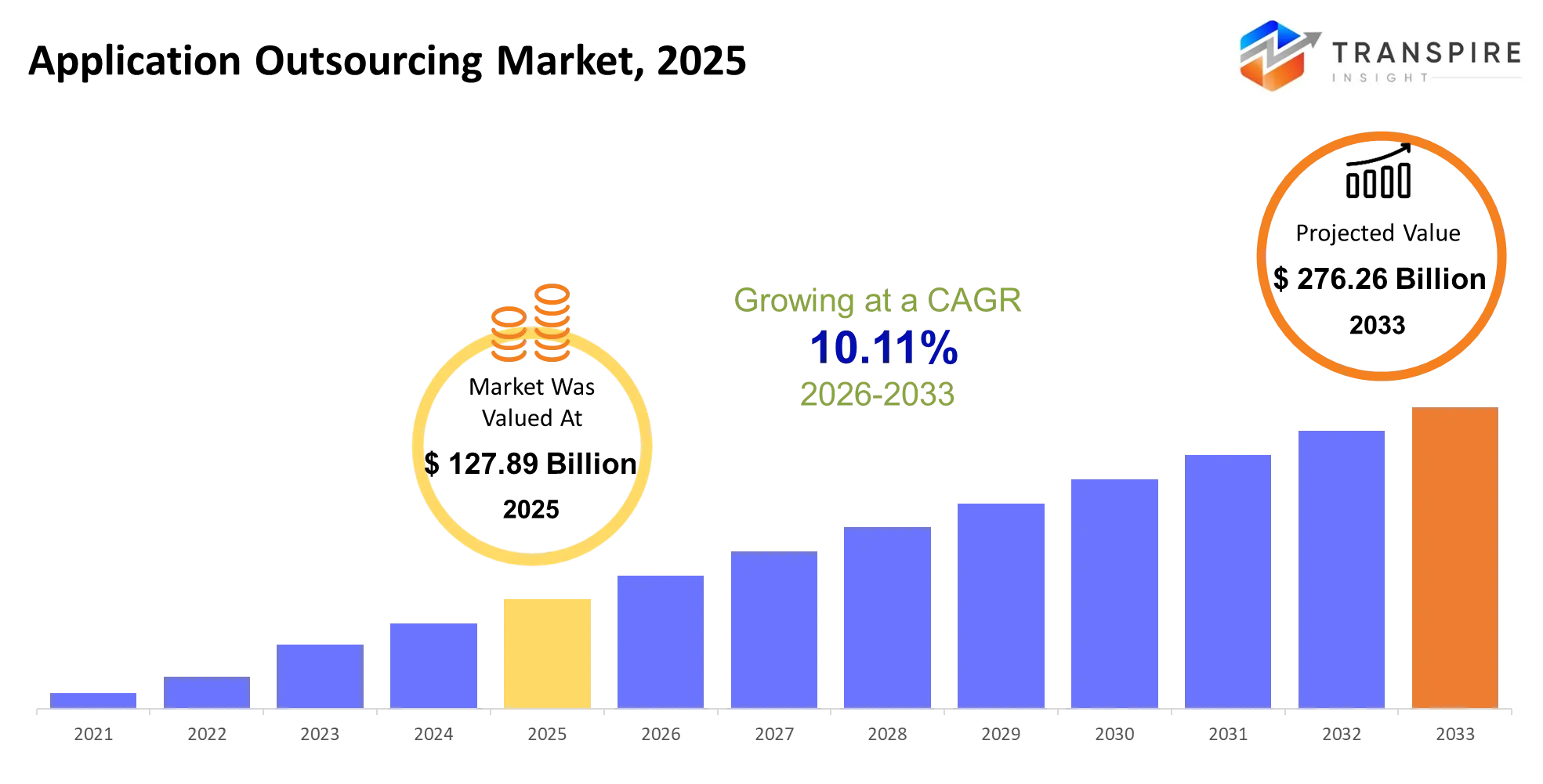
As per Transpire Insight Analysis, the Application Outsourcing Market size is estimated at USD 127.89 billion in 2025 and is anticipated to reach USD 276.26 billion by 2033, growing at a CAGR of 10.11% from 2026 to 2033.
The world Application Outsourcing market is creating new ways for businesses to develop, support, update, test, and manage their business applications without having all skills in-house. During the last three to five years, there has been a transition from conventional support services. In the process, a transition was made from traditional IT solutions to cloud services, application modernisation, automation and AI engineering solutions. For instance, the transition has been made from on-premises systems to cloud or hybrid platforms. This has led to a necessity for such services as migration, integration and management. It compelled companies to operate and revealed the vulnerabilities of their legacy IT systems. Many applications were unable to cope with the current approaches to working. This has pushed organisations to focus on digital transformation. It started from replacement of software that cannot adjust to the remote operations. As companies upgrade their IT systems, there arise new chances for outsourcing providers. Such vendors have an increasing role in application development, migration, testing and managed IT services.
Application Outsourcing Market Size & Forecast:
- Market Size 2025: USD 127.89 Billion
- Expected Market Value (2033): USD 276.26 Billion
- Forecast CAGR (2026–2033): 10.11%
- Leading Region in 2025: North America
- Fastest Growing Region: Asia Pacific
- Key Company Profiles: Accenture, IBM, TCS, Infosys, Cognizant, Wipro, HCLTech, Capgemini, DXC Technology, NTT DATA, Fujitsu, Tech Mahindra, CGI, LTIMindtree, Genpact
Key Market Insights:
The application outsourcing market is moving towards modernisation, cloud-based applications, and AI-driven solutions. Application Development continues to be the biggest category while modernisation becomes increasingly popular as companies upgrade their systems.
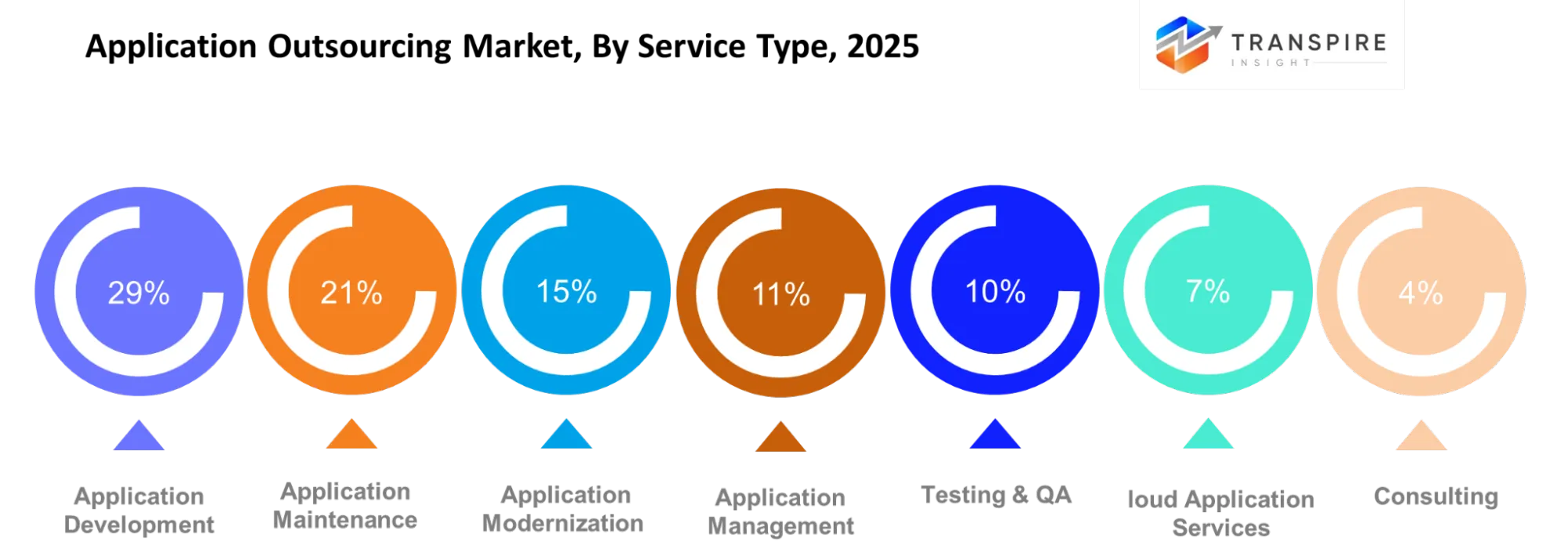
- Application Development accounts for 29% of the market, backed by the outsourcing of digital platforms and applications.
- Infosys is pushing for AI-aided development, as enterprises turn towards cloud-native and agile approaches.
- Application Maintenance makes up 21% due to ongoing outsourcing of support for the applications already used.
- Providers are including automation and AI-based monitoring to lower the need for maintenance.
- Application Modernisation is 15% and is the fastest-growing category with 15.2% CAGR. IBM and Accenture are developing modernisation services, since enterprises are switching to cloud-native architecture from legacy applications.
- Application Management takes 11% of the market, as companies are looking for continuous support of their applications. Providers are using AI-based monitoring and automated problem resolution.
- Testing and QA make up 10% of the market, where the focus of demand is now on automated and AI-based testing. Technology providers are incorporating testing in the development process.
What are the Key Drivers, Restraints, and Opportunities in the Application Outsourcing Market?
Drivers
The growth is the move from traditional applications to cloud native and artificial intelligence-enabled applications. Most organisations are running systems based on outdated architecture, therefore using outsourcing companies for refactoring, migration, integration, testing, and continuous management of the environment. The trigger is that there is need to launch products quickly while maintaining technology debt and specialist staffing under control. This means increased spending on application development, modernisation, and cloud services.
Restraints
The limitation is the challenge associated with migrating critical applications while avoiding disruptions. Customised systems usually have undocumented processes, sophisticated integration, sensitive data, and compliance issues. All these aspects make migration processes longer and increase the cost of transition, which discourages some companies from modernisation.
Opportunities
The available opportunity is the alignment of application modernisation with the development of generative AI and cloud engineering. Companies may use such technologies as AI-powered coding, automated testing, application discovery, and predictive monitoring to reduce delivery time and enhance the economics of support. Infosys and Cognition recently agreed on cooperation till and implement Devin in enterprise engineering and customer engagements, thus combining AI software development and application services.
What Has the Impact of Artificial Intelligence Been on the Application Outsourcing Market?
AI is revolutionising application outsourcing from an essentially labour-based service into an increasingly automated engineering one. Vendors are using generative AI to write and review code, develop test cases, document applications, discover technical debt, and support developers while maintaining the apps. AI is also being utilised in operations via predictive analytics, assisting teams in detecting anomalies, predicting incidents, prioritising tickets, and automating remediations. This can lead to faster releases, improved availability of services, better testing, and increased productivity of outsourced engineering teams. Certain limitations of AI adoption. The results of AI outputs still have to be reviewed by people since the generated code can pose security or accuracy risks as well as architectural or compliance problems. There are also integration costs, data governance concerns, and training required. Thus, AI will probably be used to augment rather than replace outsourcing specialists.
Instance
In June 2026, Tech Mahindra launched its Agentic Development & Modernisation Services, leveraging agentic AI throughout the software development life cycle to enhance application development, modernisation, and operations. This is indicative of how AI has evolved application outsourcing from being more development- and maintenance-driven to being AI-based application outsourcing.
Key Market Trends:
Application offshoring is trending towards AI-enabled engineering, cloud-native design, and continuous modernisation. The conventional approach of offshoring the maintenance of applications is increasingly giving way to a bundled service offering of development, modernisation, cloud management, testing, and intelligent automation.
- AI-assisted application development is becoming increasingly prevalent as outsourcing companies rely on generative AI to enable coding, testing, documenting, and software maintenance.
- Modernisation of legacy applications is becoming an area of interest for enterprises that need to move their applications to a cloud native design and lower their technical debt.
- Cloud-first application deployment is gaining momentum as companies need to scale up, become more flexible, and integrate with digital platforms better.
- Application management is evolving into predictive operations where providers use AI-driven monitoring to detect possible problems that could affect business processes.
- Automated testing is being used more often than manual quality assurance as companies want to speed up the process of releases while keeping software reliable.
- AI software agents are entering the application engineering processes and are beginning to assist developers with coding and testing,
Application Outsourcing Market Segmentation
By Service
Application Development accounts for 29% and is the biggest service type, showing continuous investments in new digital products, enterprise apps, and customer apps. Application Maintenance stands for 21%, whereas Application Modernisation accounts for 15%. This service type is the fastest-growing one with 15.2% CAGR. Application Management accounts for 11%, Testing & QA 10%, Cloud Application Services 7%, Consulting 4%, and Others 3%. Future opportunities will be created by modernisation, cloud, AI-enabled app development, and automation of application management services.
By Deployment
The cloud deployment basis becomes increasingly relevant due to the necessity of scalable infrastructure, faster app launches, and integration with digital platforms. Hybrid deployment is still valid for those cases when companies need to link their modern cloud-based applications with legacy apps or sensitive workloads. Multi-cloud also creates a necessity for outsourcing because businesses need outside assistance to manage their platforms, security, integrations, and application performance. The future potential will be created by companies that are able to manage cloud, hybrid, and multi-cloud deployments in a single service.
By Enterprise Size
Big enterprises continue being significant outsourcing targets due to their complex application portfolio and need for modernization, maintenance, and managed services. Mid-sized enterprises and SMEs have started outsourcing development to access specific engineering capabilities without building big internal development teams. Start-ups have started using outsourcing to accelerate product development and scale their technical workforce based on project needs. Also, outsourcing application development is beneficial for governmental agencies, educational institutions, and non-profit organisations since they usually have budget constraints and technology-specific needs.
By Application
Applications of ERP and CRM remain popular outsourcing targets as they provide support to financial, operational, and customer management processes within an enterprise. SCM applications are growing technologically since there is a need for better supply chain visibility and integration. HRM and finance applications will need maintenance and modernisation, while analytical applications and collaboration platforms will continue growing due to cloud-based solutions. The future trend will be interconnected applications where all data, AI, workflow automation, and enterprise systems work together through one platform.
By Industries
BFSI is a leading application outsourcing industry where financial institutions deal with both legacy and cloud application management along with other requirements like digital banking, analytics, and security. Health care organisations need services from an application outsourcing company that could cater to digital records, patient platforms, interoperability and other regulatory requirements. Application service providers have strong demands for scalable and quick release services from IT and telecom industries. Retail is now increasingly becoming a sector where organizations require solutions related to digital commerce and customer platform.
By Outsourcing Models
The managed services model is becoming increasingly important due to the demand from companies for continuous application support services rather than just project-oriented services. The application outsourcing market still has relevance in project outsourcing models for application development, migration and modernisation initiatives. Staff augmentation is another method that gives companies access to specialised resources, while a dedicated team is an option for higher engineering resource requirements. Other outsourcing models include BOT, co-sourcing, and Offshore Development, etc., depending upon control, cost, delivery etc.
By Organizations
Multinational companies continue to be relevant clients as they have to have their technology platforms standardised across the whole globe. Regional and small-medium businesses are using outsourcing as they need skilled workers and fast implementation of IT projects. Startups also gain an advantage from outsourcing as they need a flexible development team, which enables them to develop further without huge technological organisations. There is an increasing demand for modernisation from governments and educational establishments, but NGOs can utilise outsourcing as well due to small budgets for technology.
What are the Key Use Cases Driving the Application Outsourcing Market?
Application development is the use case, serving businesses that require fresh digital offerings, consumer-facing platforms, internal utilities, and vertical industry applications without having to establish all engineering capabilities in-house. This is in line with application development. The area of application modernisation has seen an increased scale, with organisations implementing changes to their existing infrastructure by moving to cloud-based systems to reduce their technical debt. Outsourcing solutions for financial, healthcare, manufacturing, and governmental clients have become popular in various fields like cloud migration, integration, ERP modernisation, CRM transformation, and application management. Some of the examples of the new emerging use cases include AI-driven software engineering, predictive application operations, test automation, cybersecurity, and multi-cloud management. These types of applications have created the need for a partner that offers an all-inclusive solution.
|
Report Metrics |
Details |
|
Market size value in 2025 |
USD 127.89 Billion |
|
Market size value in 2026 |
USD 140.82 Billion |
|
Revenue forecast in 2033 |
USD 276.26 Billion |
|
Growth rate |
CAGR of 10.11% from 2026 to 2033 |
|
Base year |
2025 |
|
Historical data |
2021 - 2024 |
|
Forecast period |
2026 - 2033 |
|
Report coverage |
Revenue forecast, competitive landscape, growth factors, and trends |
|
Regional scope |
United States; Canada; Mexico; United Kingdom; Germany; France; Italy; Spain; Denmark; Sweden; Norway; China; Japan; India; Australia; South Korea; Thailand; Brazil; Argentina; South Africa; Saudi Arabia; United Arab Emirates |
|
Key company profiled |
Accenture, IBM, TCS, Infosys, Cognizant, Wipro, HCLTech, Capgemini, DXC Technology, NTT DATA, Fujitsu, Tech Mahindra, CGI, LTIMindtree, Genpact |
|
Customization scope |
Free report customization (country, regional & segment scope). Avail customized purchase options to meet your exact research needs. |
|
Report Segmentation |
By Service Type (Application Development, Application Maintenance, Application Modernization, Application Management, Testing & QA, Cloud Application Services, Consulting, Others); By Deployment (Cloud, On-premise, Hybrid, Multi-cloud, Public Cloud, Private Cloud, Edge, Others); By Enterprise Size (Large Enterprises, Mid-sized Enterprises, SMEs, Startups, Government Organizations, Nonprofits, Educational Institutions, Others); By Application (ERP, CRM, SCM, HRM, Finance, Analytics, Collaboration, Others); By Industry (BFSI, Healthcare, IT & Telecom, Retail, Manufacturing, Government, Media & Entertainment, Others); By Service Model (Managed Services, Project-based, Staff Augmentation, Dedicated Team, BOT, Co-sourcing, Offshore Development, Others); By Organization Type (Multinational Corporations, Regional Enterprises, SMEs, Startups, Government Agencies, Educational Institutions, NGOs, Others) |
Which Regions are Driving the Application Outsourcing Market Growth?
North America
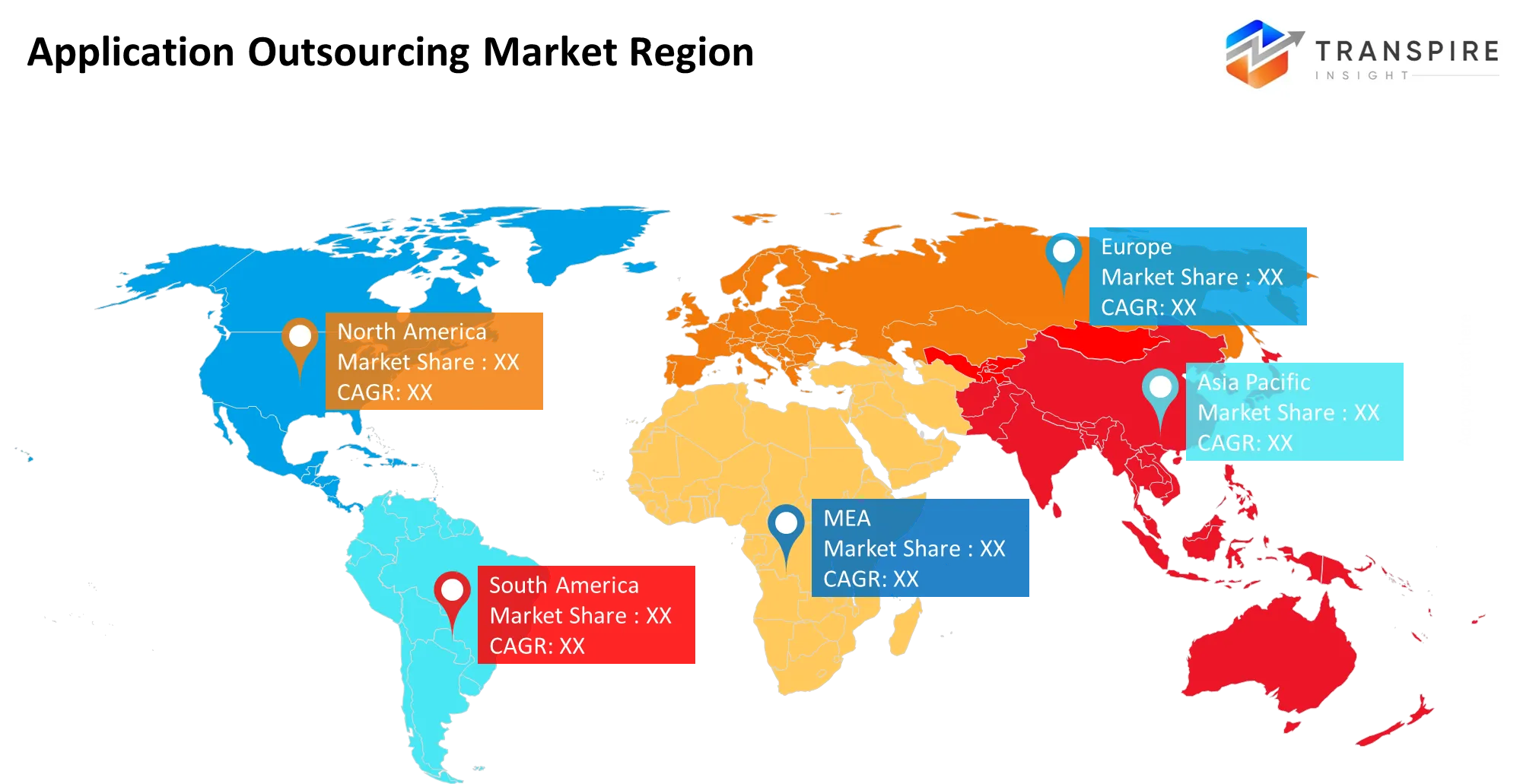
North America dominates the market share at 37% due to the presence of a mature enterprise technology ecosystem and significant investments in digital transformation. Large enterprises outsource their application development, modernisation, cloud migrations, and managed services in order to boost their technology productivity. Cloud infrastructure, the use of AI and a large number of technology service providers are other advantages of the region. Its established enterprise market provides a steady stream of modernisation and application management outsourcing opportunities.
In August 2026, The collaboration between IBM and Mitsubishi Motors North America led to the upgrade and assessment of 170 production applications comprising 110 business applications and 60 web services to migrate them to IBM WebSphere Liberty.https://www.ibm.com/new/product-blog/how-mitsubishi-motors-mapped-170-java-applications-for-a-low-disruption-move-to-ibm-websphere-liberty
Europe
Europe accounts for 27% of the world market and remains a robust player owing to its demand for secure, compliant, and digital applications. Modernisation is taking place amid issues of data security, cybersecurity, and regulation. The presence of the application portfolio in the industrial, banking, health care, and governmental sectors in Europe drives recurring outsourcing opportunities. Compliance and industry knowledge become competitive advantages compared to North America due to higher regulations.
In April 2025, Capgemini received the Leadership award from Forrester in its Application Modernisation and Multicloud Managed Services evaluation because of its expertise in application modernisation, migration, AI/ML, and managed application services.https://www.capgemini.com/gb-en/news/press-releases/capgemini-recognised-as-a-leader-in-application-modernisation-and-multicloud-managed-servicesby-independent-research-firm
Asia Pacific
Asia Pacific represents 24% of the market and is the fastest-growing region at 13.8% CAGR. The rapid digitalisation, adoption of cloud computing technology, availability of a tech-savvy workforce, and enterprise modernisation are driving the faster development of the market. The region is utilising outsourcing to grow its software development process while managing costs and gaining access to specific skill sets. There are additional growth opportunities in the region as enterprises continue cloud computing, AI, and application modernisation efforts in India, China, Southeast Asia, and Australia.
In September 2025, Accenture was recognised as a Leader in the “Asia/Pacific Application Modernisation Services to AWS 2025 Vendor Assessment” by IDC for its strengths in helping to modernise mission-critical enterprise applications on AWS.https://www.accenture.com/en/insights/ai-data/analyst-recognitions
Who are the Key Players in the Application Outsourcing Market and how do they Compete?
Competition in the market is driven by a combination of IT service firms, consultants, cloud experts, and local providers. Accenture, IBM, TCS, Infosys, Cognizant, and others compete on application development, modernisation, cloud migration, testing, and managed services in lieu of single capability. Market differentiation factors include AI engineering, industry specialisation, delivery scale, partnerships with hyperscalers, and management of legacy systems. Additionally, buyers are increasingly interested in results, fast time to market, security, and consistent operating costs. The innovation-driven approach of Accenture includes clouds, AI, modernisation assets, and ecosystems. Differentiation of the vendor consists in integration of consulting, engineering, and delivery; acquisitions and specialisation drive growth in targeted segments. IBM focuses on hybrid clouds, Oracle skills, and mainframe modernisation; acquisitions drive specialisation in applications.
Application Outsourcing Market companies
- Accenture
- IBM
- TCS
- Infosys
- Cognizant
- Wipro
- HCLTech
- Capgemini
- DXC Technology
- NTT DATA
- Fujitsu
- Tech Mahindra
- CGI
- LTIMindtree
- Genpact
Recent Development News
In January 2026, Infosys and Cognition formed a strategic alliance to implement Devin, an AI software engineer, in Infosys' engineering environment and projects. The alliance links AI-enabled software development with enterprise application engineering.https://www.infosys.com/newsroom/press-releases/2026/collaboration-accelerate-ai-value-journey.html
In January 2025, IBM announced that it is planning to acquire Applications Software Technology LLC to add to its Oracle Cloud application transformation capabilities. The acquisition builds on IBM Consulting’s existing capabilities for Oracle ERP, HCM, EPM, CPQ, and public sector cloud transformation.https://newsroom.ibm.com/2025-01-16-ibm-to-acquire-application-software-technology-llc
What Strategic Insights Define the Future of the Application Outsourcing Market?
Application outsourcing is transitioning from people-driven delivery models to outcome-based delivery driven by AI technology. Those providers who can combine application development services with modernisation, cloud, cybersecurity, data and continuous services will be well-placed in their client companies, which are consolidating their technology partnerships. The major hidden risk in this transition is that the use of AI can bring about security, governance, intellectual property and quality issues as the code developed by AI is placed in production. One of the upcoming opportunities in this area relates to AI-supported modernisation of legacy portfolios. In contrast to one-by-one system replacements, enterprises can apply automation for discovery, code transformation, testing and observability and thus modernise application portfolios as a whole. Therefore, providers need to prepare themselves for this opportunity by building reusable AI engineering platforms, industry-specific modernisation tools and human supervision.
By Service Type
- Application Development
- Application Maintenance
- Application Modernization
- Application Management
- Testing & QA
- Cloud Application Services
- Consulting
By Deployment
- Cloud
- On-premise
- Hybrid
- Multi-cloud
- Public Cloud
- Private Cloud
- Edge
By Enterprise Size
- Large Enterprises
- Mid-sized Enterprises
- SMEs
- Startups
- Government Organizations
- Nonprofits
- Educational Institutions
By Application
- ERP
- CRM
- SCM
- HRM
- Finance
- Analytic
- Collaboration
By Industry
- BFSI
- Healthcare
- IT & Telecom
- Retail
- Manufacturing
- Government
- Media & Entertainment
By Service Model
- Managed Services
- Project-based
- Staff Augmentation
- Dedicated Team
- BOT
- Co-sourcing
- Offshore Development
By Organization Type
- Multinational Corporations
- Regional Enterprises
- SMEs
- Startups
- Government Agencies
- Educational Institutions
- NGOs
By Regional Analysis
North America
- US
- Canada
- Mexico
Europe
- Germany
- UK
- France
- Italy
- Spain
- Russia
- Rest of Europe
Asia Pacific
- China
- Japan
- India
- South Korea
- Australia
- Rest of Asia Pacific
South America
- Brazil
- Argentina
- Rest of South America
Middle East & Africa
- UAE
- Saudi Arabia
- Qatar
- South Africa
- Rest of the Middle East & Africa
Frequently Asked Questions
Find quick answers to common questions.
The application outsourcing market size was valued at USD 127.89 Billion in 2025 and is poised to reach USD 276.26 Billion by 2033, expanding at a 10.11% CAGR.
Key segments for the application outsourcing market are By Service Type (Application Development, Application Maintenance, Application Modernization, Application Management, Testing & QA, Cloud Application Services, Consulting, Others); By Deployment (Cloud, On-premise, Hybrid, Multi-cloud, Public Cloud, Private Cloud, Edge, Others); By Enterprise Size (Large Enterprises, Mid-sized Enterprises, SMEs, Startups, Government Organizations, Nonprofits, Educational Institutions, Others); By Application (ERP, CRM, SCM, HRM, Finance, Analytics, Collaboration, Others); By Industry (BFSI, Healthcare, IT & Telecom, Retail, Manufacturing, Government, Media & Entertainment, Others); By Service Model (Managed Services, Project-based, Staff Augmentation, Dedicated Team, BOT, Co-sourcing, Offshore Development, Others); By Organization Type (Multinational Corporations, Regional Enterprises, SMEs, Startups, Government Agencies, Educational Institutions, NGOs, Others)
Growth is primarily driven by an increase in the use of cloud technology, requirement of IT solutions that are economical, application modernisation, integration of AI, and the need for technological expertise.
The market is led by major manufacturers including Accenture, IBM, TCS, Infosys, Cognizant, Wipro, HCLTech, Capgemini, DXC Technology, NTT DATA, Fujitsu, Tech Mahindra, CGI, LTIMindtree, Genpact
The North American region is dominant in the application outsourcing industry as it accounts for 37% of the worldwide application outsourcing market, driven by high enterprise IT investments, rapid adoption of cloud computing, need for digital transformation, and presence of technology & outsourcing vendors. The emphasis on AI, cybersecurity, and application development makes the market more prominent.
The commercial opportunities in the application outsourcing market are the increasing demand for cloud migration, AI deployment, cybersecurity services, application modernisation, and managed IT services. Digital transformation among businesses also provides opportunities for companies that offer affordable, scalable, and industry-specific application solutions.
- Accenture
- IBM
- TCS
- Infosys
- Cognizant
- Wipro
- HCLTech
- Capgemini
- DXC Technology
- NTT DATA
- Fujitsu
- Tech Mahindra
- CGI
- LTIMindtree
- Genpact
About the Authors

Mayur Shinde
I am Mayur Shinde, a Senior Research Analyst at Transpire Insight, specializing in the Automotive & Transportation and Information & Communication Technology (ICT) Industry. My work focuses on analyzing emerging market trends, technological advancements, competitive landscapes, and industry developments to deliver accurate, data-driven insights. I am passionate about transforming complex market information into clear, actionable content that helps businesses, professionals, and decision-makers stay informed and make confident strategic decisions.

Chakradhar Khansole
Chakradhar serves as the Research Director at Transpire Insight, bringing over 8 years of experience in technology, innovation, and strategic market intelligence. He specializes in transforming complex market data into actionable business insights that enable organizations to make informed, growth-oriented decisions. Recognized for his strategic vision and analytical expertise, Chakradhar leads high-impact research initiatives, delivering comprehensive market assessments, competitive intelligence, and forward-looking industry analysis.
Recently Published Reports
-
Apr 2026
3D Optical Profiler Market
3D Optical Profiler Market Size, Share & Analysis Report By Type (Desktop 3D Optical Profiler, and Portable 3D Optical Profiler), By Technology (Confocal Technology, and White Light Interference), By End-Use Industry (Manufacturing, Research Institutions, Automotive, Aerospace and Defense, Medical Devices, and Other), and Geography (North America, Europe, Asia-Pacific, Middle East and Africa, South and Central America), 2021 - 2031
-
Apr 2026
Depth Sensor Market
Depth Sensor Market Size, Share & Analysis Report By Type (Infrared Depth Sensors, Time-of-Flight (ToF) Sensors, Stereo Vision Sensors, Structured Light Sensors, Ultrasonic Depth Sensors), By Application (Automotive, Robotics, Gaming, Consumer Electronics, Industrial Automation, Healthcare, Security & Surveillance, Others), By End Users (Automotive Manufacturers, Consumer Electronics Companies, Healthcare Providers, Industrial Companies, Security Agencies, Gaming Companies, Robotics Companies, Others), and Geography (North America, Europe, Asia-Pacific, Middle East and Africa, South and Central America), 2021 – 2031
-
Apr 2026
Digital Manufacturing Market
Digital Manufacturing Market Size, Share & Analysis Report By Component (Hardware, Software, and Services), By Technology (Robotics, 3D Printing, Internet of Things (IoT), and Others), By Application (Automotive and Transportation, Aerospace and Defense, Consumer Electronics, Industrial Machinery, and Others), By Process Type (Computer-Based Designing, Computer-Based Simulation, Computer 3D Visualization, Analytics, and Others), and Geography (North America, Europe, Asia-Pacific, Middle East and Africa, South and Central America), 2021 – 2031
-
Apr 2026
Digital Visa Services Market
Digital Visa Services Market Size, Share & Analysis Report By Type (Individual Travelers, Group Travelers), By Application (Tourism, Business Travel, Others), and Geography (North America, Europe, Asia-Pacific, Middle East and Africa, South and Central America), 2021 – 2031