

Analog Integrated Circuits Market Summary:
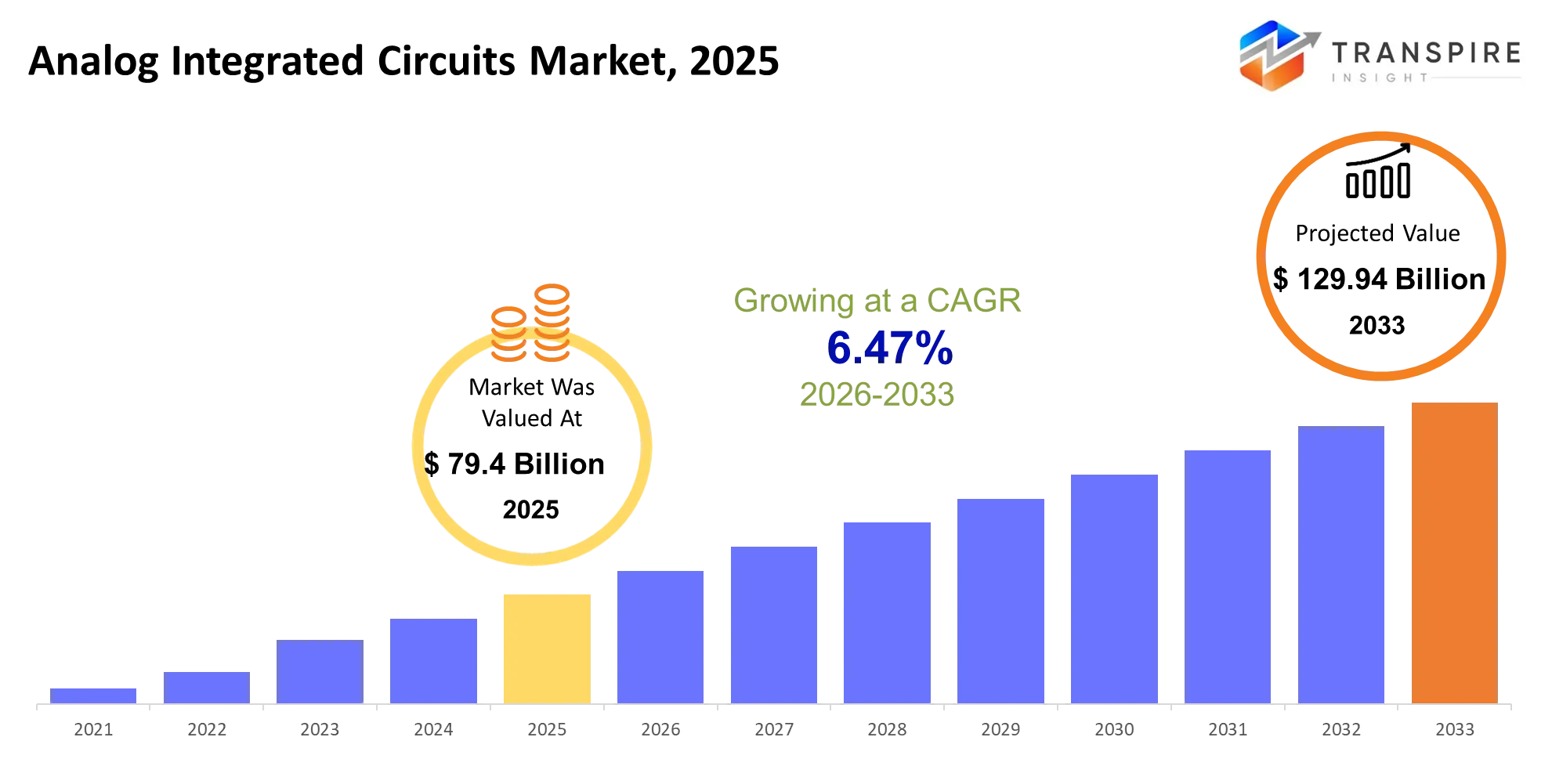
As per Transpire Insight, the Analog Integrated Circuits Market size is estimated at USD 79.4 billion in 2025 and is anticipated to reach USD 129.94 billion by 2033, growing at a CAGR of 6.47% from 2026 to 2033.
The analog integrated circuits market supports power systems that handle electricity, process signals from the real world, measure things like temperature or motion and keep parts talking to each other reliably. In the past three to five years, demand has changed because of electric vehicles, automated factories, smart connected devices and AI infrastructure. All of these need sensors and more efficient ways to deliver power. A big shift happening is the move toward application- integrated circuits. These are chips built for tasks and packed with multiple functions in small, tight designs. One main reason for this change is the growth of AI data centres. These centres use a lot of power, so they need circuits to monitor, convert and protect that power. Because of these trends, companies are investing more in integrating products, expanding their production lines and developing semiconductor tech. At the same time, cars becoming electric and industries going digital mean more electronics are built into machines and vehicles. So now growth in the market is not about making more chips. It’s about making chips. Ones that work well, use less energy stay reliable, and are designed for specific uses. Performance, energy efficiency, reliability and tailored engineering matter more than ever.
Analog Integrated Circuits Market Size & Forecast:
- Market Size 2025: USD 79.4 Billion
- Expected Market Value (2033): USD 129.94 Billion
- Forecast CAGR (2026–2033): 6.47%
- Leading Region in 2025: Asia Pacific
- Fastest Growing Region: Middle East & Africa
- Key Company Profiles: Texas Instruments, Analogue Devices, Infineon Technologies, NXP Semiconductors, STMicroelectronics, Renesas Electronics, onsemi, Microchip Technology, Skyworks Solutions, Qualcomm, ROHM, Monolithic Power Systems, Cirrus Logic, Diodes Incorporated, MaxLinear
Key Market Insights:
The market is shifting to application-based chips, which incorporate dependable signal processing and power management solutions.
- There are several applications in automotive electronics, industrial automation, and AI infrastructures, thus creating good opportunities for suppliers with reliable performance and longevity.
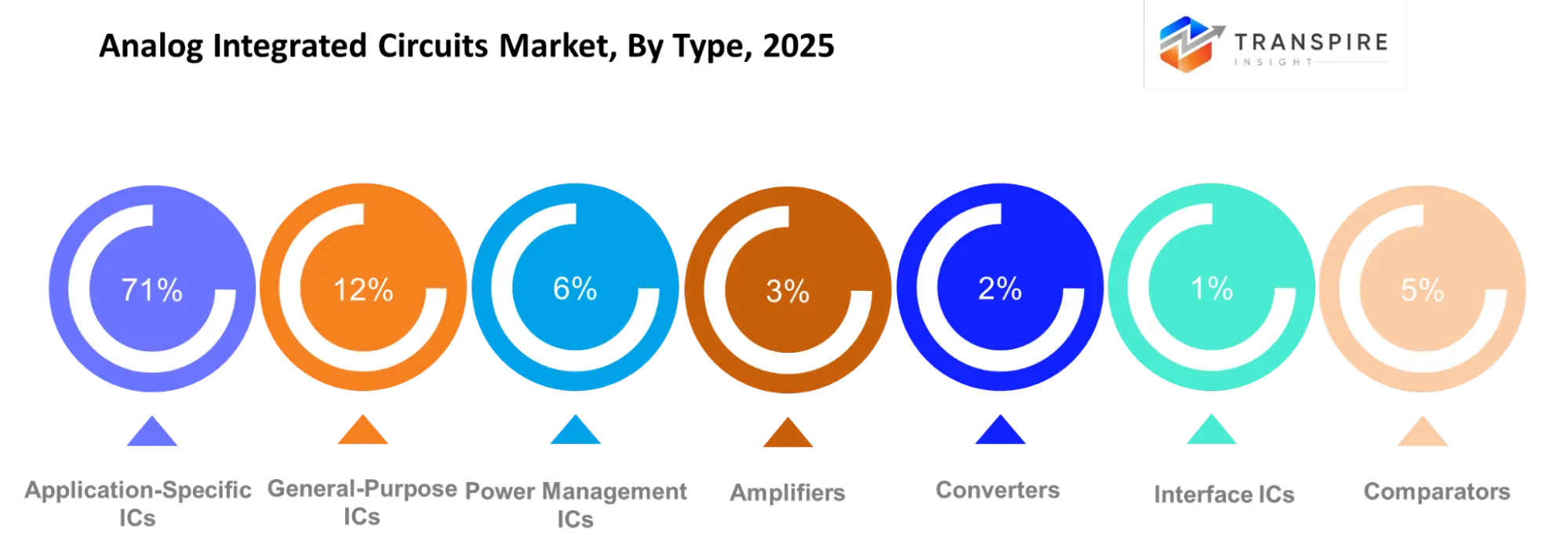
- Application-specific ICs are 71.34% of the segment breakdown, thus showing the high demand for the chips based on specific systems' needs.
- General-purpose ICs account for 12.5%, catering to the needs of producers searching for a chip able to be applied in various electronic systems.
- Power management ICs account for 6.0%, and effective power delivery is becoming popular in artificial intelligence computing and connected equipment.
- Amplifiers account for 3.0% to provide reliable signal processing in sensing, measurement, and control systems.
- Converters make up 2.5%, indicating the necessity of these devices in converting analogue signals into digital ones.
What are the Key Drivers, Restraints, and Opportunities in the Analog Integrated Circuits Market?
Drivers:
Automotive electrification, industrial automation, and AI computing are all increasing the demand for analogue integrated circuits. EVs need power management, battery sensing and monitoring, as well as other sensing and signal-conditioning instruments. Automated factories rely on precise measurement and real-time control, and the rise of AI data centres is one of the major drivers behind that because of the need for efficient voltage regulation and near real-time power monitoring and analytics.
Restraints:
Expensive to develop, expensive to produce, products with extended qualification processes may constrain markets. Automobile, aerospace, and medical end-users may require stringent testing for reliability before a component can be certified as meeting specifications. Manufacturers will also have to contend with commoditization of price, supply chain risks, and challenges in maintaining capacity for existing processes while implementing new ones.
Opportunities:
There are opportunities for suppliers who offer good power management and sensing technologies, AI infrastructure, electric mobility, and smart manufacturing. For example, integrated voltage regulators and dense power management solutions take into account the power and space requirements of AI server applications. Setting up electronics manufacturing capacity in the Asia-Pacific region provides opportunities for collaboration in the supply chain and also for local manufacturing of electronics. These firms may create a competitive advantage by making application-specific investments, optimizing packaging, and cultivating customer relationships.
Driver Impact Analysis – Analog Integrated Circuits Market
The following table ranks the five major growth drivers of the analog integrated circuits market by their estimated relative contribution to market growth. The percentage allocations are analytical estimates, not published market statistics, and total 100%. Growth mechanisms, key beneficiaries, and major constraints are each kept within 5–10 words.
|
Driver |
Relative Impact on Growth (%) |
Geographic Relevance |
Impact Timeline |
Demand Strength |
Growth Mechanism (5–10 words) |
Key Beneficiaries (5–10 words) |
Major Constraint (5–10 words) |
|
Automotive Electrification and Advanced Vehicle Electronics |
25% |
Asia-Pacific, North America, Europe |
Long-term (≥4 years) |
High |
EVs require battery monitoring, power conversion, and precision sensing. |
Analog IC manufacturers, EV makers, automotive electronics suppliers. |
High qualification costs and fluctuating electric vehicle demand. |
|
AI Data Centers and High-Performance Computing |
23% |
North America, Asia-Pacific |
Short-term (≤2 years) |
High |
AI servers increase demand for efficient power management and signal conditioning. |
Power IC vendors, data center operators, semiconductor manufacturers. |
High infrastructure costs and demanding thermal management requirements. |
|
Industrial Automation, Robotics, and Smart Manufacturing |
20% |
Asia-Pacific, Europe, North America |
Medium-term (2–4 years) |
High |
Automated equipment requires precision sensing, conversion, and motor control. |
Industrial IC suppliers, robotics manufacturers, automation system integrators. |
Capital expenditure constraints and lengthy equipment upgrade cycles. |
|
5G Connectivity, IoT, and Connected Electronics |
17% |
Asia-Pacific, North America |
Medium-term (2–4 years) |
High |
Connected devices increase demand for RF, interface, and power ICs. |
RF chipmakers, telecom equipment vendors, IoT device manufacturers. |
Price competition and uneven network infrastructure deployment. |
|
Energy Efficiency, Renewable Power, and Electrification Infrastructure |
15% |
Europe, North America, Asia-Pacific |
Long-term (≥4 years) |
High |
Efficient power conversion supports renewable energy and battery storage systems. |
Power semiconductor suppliers, inverter makers, energy equipment manufacturers. |
Grid investment delays and stringent reliability requirements. |
|
Total |
100% |
— |
— |
— |
— |
— |
— |
What Has the Impact of Artificial Intelligence Been on the Analog Integrated Circuits Market?
The use of artificial intelligence is impacting the analog integrated circuits market by increasing the demand for sensing, power delivery, and signal acquisition precision. AI applications have to be computed in challenging power and thermal environments, which create opportunities for analog devices such as voltage regulators, power monitoring units, amplifiers, and fast data converters to support signal capturing, monitoring, and power supply to processors.AI tools are also used in semiconductor fabrication and design to perform defect inspection, production planning, process improvement, and equipment maintenance tasks. Predictive maintenance solutions are capable of analysing machine data in order to detect unusual operation patterns before equipment failures stop production processes. One more trend is associated with moving AI operations to edge devices where microcontrollers with low power consumption and analogue peripherals can provide local sensing and control. Such a trend brings about opportunities for developing analogue chips for industrial machinery, connected cars, medical equipment, and smart consumer goods. The implementation of AI requires investments in computing infrastructure, data quality, software integration, and employee training. Incorrect predictions or poor system integration will negatively impact the effectiveness of operations. As a result, companies have to balance automation and reliability,
Instance:
In March 2026, Texas Instruments (TI) unveiled an 800V DC power architecture designed in collaboration with NVIDIA for future AI data centers. This example illustrates the significance of the analog IC in enhancing power conversion efficiency, providing high-performance AI processors with support, and addressing the increasing demand for electricity.
Key Market Trends:
The design of Analogue IC is becoming ever more driven by the necessity to tie physical signals with intelligent digital systems. Manufacturers are concerned about integration, energy efficiency, design specialisation, and supply chain robustness rather than increased volume alone.
- The development of AI computing increases the interest in high-density voltage regulation and power conversion.
- Car manufacturers have growing needs for sensing, power control, and signal-processing parts for electric vehicles and electronically controlled vehicles.
- Factory owners implement connected sensors and automated controls, which makes measuring and signal conditioning very important.
- Manufacturers keep using tried-and-true process nodes for analog applications, but smaller nodes are considered in cases where performance, integration or power demand justifies the costs.
- Development of new microcontrollers with built-in analog peripherals reduces the need for additional components and system
Analog Integrated Circuits Market Segmentation
By type:
Application-specific ICs lead in market share of 71.34%, followed by general-purpose ICs with 12.5%. Power management ICs have a share of 6.0%, while amplifiers, converters, interface ICs, and comparators make up 3.0%, 2.5%, 2.0%, and 1.5%, respectively. Others include 1.16% of the market. Application-specific ICs are favoured due to their capability of handling specific operational requirements, whereas general-purpose ICs are flexible in terms of applicability across different systems. Products for power management and signal conditioning will remain relevant as electronic products become more advanced.
By technology node:
The market consists of above 65 nm, 45–65 nm, 28–45 nm, 22–28 nm, 16–22 nm, below 16 nm, legacy nodes, and others. According to the provided information, below 28 nm is the fastest-growing segment, registering a CAGR of 3.56%. Smaller technology nodes may help to enable more integration in suitable cases; however, more mature processes are preferred by many analog circuits because of voltage-handling capability, reliability, and established manufacturing costs.
By wafer size:
The market consists of 150 mm, 200 mm, 300 mm, and 450 mm wafers, as well as speciality wafers, silicon-on-insulator wafers, compound semiconductor wafers, and other formats. Various wafer formats enable differentiation of platform technologies, and business cases for their use require suitable processes, tools, yield, and volume. 150 and 200 mm wafer formats are still relevant for many analog devices, while larger wafers can be cost-effective with compatible processes and volumes.
By application:
Sensor suites may be used in other markets including consumer, communication, industrial, healthcare, aerospace and defence, computing and others. In automotive, automotive sensor solutions are used for sensing, monitoring batteries, controlling power and processing signals. Consumer applications require power management ICs and audio systems; communication and computing applications require signal conversion, conditioning and buffering. Industrial, medical and aerospace applications offer larger markets where cost, accuracy, reliability and long-term component availability are critical.
By Functionally:
The market involves power management, signal processing, data conversion, amplification, interfacing, sensing, timing, and other functions. Power management allows the consistent provision of energy, whereas signal processing and amplification make it possible for electronic systems to sense and react to faint and fluctuating signals. Data conversion is the connection of analogue readings to digital processing, whereas interfacing circuits allow the communication between parts within a system. Sensing and timing functions enable monitoring, timing, and control. The prospects for these functions will be shaped by advances in connected devices, automation, electrification and computing.
By end user:
The market consists of auto OEMs, electronics manufacturers, telecommunications, industrial consumers, health care providers, aerospace and consumer electronics companies, among others. Auto OEMs are concerned with reliability and lengthy product qualification processes, whereas electronics manufacturers are concerned with low costs and integration possibilities and large-scale manufacturing; telecom and computing customers are concerned with reliable signal integrity and efficient use of power; and industrial, health care and aerospace users are interested in accuracy, stability and durability of the products. Those suppliers who are able to customise their product offering and support to meet these customer requirements are most likely to win design.
What are the Key Use Cases Driving the Analog Integrated Circuits Market?
Integrated circuits are used in application-specific electronic systems for signal processing, power regulation, and measurements. Automotive electronics is one of the fields where such chips are used for measuring battery parameters, controlling motors, performing assistance functions, and power conversion. It is necessary to note that there are integrated circuit applications that simplify circuits and provide high reliability. Fields of industrial automation and communication networks have become popular areas for using analogue integrated circuits. Factories use amplifiers, converters, interface ICs and sensing circuits for measuring physical parameters and process control. There are telecommunications equipment and computing systems which need analogue integrated circuits for power management and interconnection of electronic subsystems. New trends in using analog ICs are associated with AI data centres, edge intelligence, medical equipment, and robots. AI servers require analog integrated circuits for power management and measurement, while edge devices are characterised by a combination of sensing and processing features. There are new possibilities for healthcare and robotics applications.
|
Report Metrics |
Details |
|
Market size value in 2025 |
USD 79.4 Billion |
|
Market size value in 2026 |
USD 83.8 Billion |
|
Revenue forecast in 2033 |
USD 129.94 Billion |
|
Growth rate |
CAGR of 6.47% from 2026 to 2033 |
|
Base year |
2025 |
|
Historical data |
2021 - 2024 |
|
Forecast period |
2026 - 2033 |
|
Report coverage |
Revenue forecast, competitive landscape, growth factors, and trends |
|
Regional scope |
United States; Canada; Mexico; United Kingdom; Germany; France; Italy; Spain; Denmark; Sweden; Norway; China; Japan; India; Australia; South Korea; Thailand; Brazil; Argentina; South Africa; Saudi Arabia; United Arab Emirates |
|
Key company profiled |
Texas Instruments, Analog Devices, Infineon Technologies, NXP Semiconductors, STMicroelectronics, Renesas Electronics, onsemi, Microchip Technology, Skyworks Solutions, Qualcomm, ROHM, Monolithic Power Systems, Cirrus Logic, Diodes Incorporated, MaxLinear |
|
Customization scope |
Free report customization (country, regional & segment scope). Avail customized purchase options to meet your exact research needs. |
|
Report Segmentation |
Type (Application-Specific ICs, General-Purpose ICs, Power Management ICs, Amplifiers, Converters, Interface ICs, Comparators, Others)Technology Node (Above 65 nm, 45–65 nm, 28–45 nm, 22–28 nm, 16–22 nm, Below 16 nm, Legacy Nodes, Others)Wafer Size (150 mm, 200 mm, 300 mm, 450 mm, Specialty Wafers, SOI Wafers, Compound Semiconductor Wafers, Others)Application (Automotive, Consumer Electronics, Communication, Industrial, Healthcare, Aerospace & Defense, Computing, Others)Function (Power Management, Signal Processing, Data Conversion, Amplification, Interface, Sensing, Timing, Others)End User (Automotive OEMs, Electronics Manufacturers, Telecom Companies, Industrial Companies, Healthcare Companies, Aerospace Companies, Consumer Electronics, Others) |
Which Regions are Driving the Analog Integrated Circuits Market Growth?
North America:
North America constitutes 26.08%. North America has the advantage of semiconductor firms in the industry, sophisticated chip-designing capabilities, and demand from automotive, industrial, aerospace, and computing end users. Investments in AI data centres drive the necessity of advanced signal and power management products. Collaborations between chip designers, machinery and equipment makers and technology developers foster product innovation and specialised applications.
In June 2025, Texas Instruments made plans to spend in excess of on seven semiconductor chip fabrication facilities in Texas and Utah. This move was geared towards ramping up production capacity of analog and embedded chips for automotive and industrial applications, as well as phones and data centers.
Europe:
Europe accounts for 18.00% Automotive manufacturing strength, electronics and industrial engineering competence provide growth areas within Europe, where there exists the need for sensing, power management, and signal conditioning applications. Industrial automation and power equipment industries are other areas of application that have a need for durable analog components. Europe can derive value from application-specific products with high-quality standards that are able to meet automotive and industrial needs.
In May 2025, Infineon Technologies got the go-ahead for its Smart Power Fab in Dresden, Germany, with an initial investment plan of EUR 5 billion. The factory will support analog and power semiconductor manufacturing for automotive applications, energy-efficient data centres, and renewable energy systems in Europe.
https://www.infineon.com/press-release/2025/INFXX202505-100
Asia-Pacific:
Asia-Pacific leads the pack with the largest share at 46.59%. This is due to its manufacturing base for electronics, semiconductor fabrication capability, and consumer electronics supply chain infrastructure. Demand generated from automotive electronics, industrial equipment, telecoms, and computers will help reinforce its importance to manufacturers of analogue ICs.
In November 2025, Texas Instruments opened its second assembly and test facility in Melaka, Malaysia. The assembly facility was built with the intent of assembling and testing millions of analogue and embedded chips yearly.
Who are the Key Players in the Analog Integrated Circuits Market and how do they compete?
competition in the field of analogue ICs depends on product performance, power efficiency, manufacturing scale, design support, and long-term customer relations. Market players are Texas Instruments, Analogue Devices, Infineon Technologies, STMicroelectronics, NXP Semiconductors, Microchip Technology, Renesas Electronics, onsemi, ROHM, and Skyworks Solutions. The competitive strength of the firms is defined by the scope of their products and application areas as well as manufacturing strategies. The competitive advantage of Texas Instruments is its broad analog portfolio and manufacturing capabilities for the production of a wide range of industrial and electronic products. Analogue Devices is recognised for its precision signal processing, sensing and high-performance power solutions; moreover, it will sign an agreement to buy Empower Semiconductor in order to enhance its specialisation in the field of AI-related power delivery systems. Competitive advantage of Microchip Technology is based on the development of embedded control products, which have analogue peripherals to help customers to improve designs and use fewer external components. Infineon, STMicroelectronics, and NXP specialise in automotive electronics, power semiconductors, and other industrial applications. Differentiation is pursued through developing specialised products and supporting customers in the area of application engineering. Expansion of businesses is based on designing innovative products for future applications.
Analog Integrated Circuits Market Companies
- Texas Instruments
- Analog Devices
- Infineon Technologies
- NXP Semiconductors
- STMicroelectronics
- Renesas Electronics
- onsemi
- Microchip Technology
- Skyworks Solutions
- Qualcomm
- ROHM
- Monolithic Power Systems
- Cirrus Logic
- Diodes Incorporated
- MaxLinear
|
Company |
Est. Revenue Share Range |
Key Offerings |
Strategic Positioning |
Geographic Strength |
Technology Focus |
|
Texas Instruments |
Estimated 14–17% |
Operational amplifiers, data converters, power management ICs, interface ICs |
Broad portfolio leadership with manufacturing cost advantages |
North America, Asia Pacific, Europe |
Precision analog, power efficiency, advanced process manufacturing |
|
Analog Devices, Inc. |
Estimated 8–10% |
Precision amplifiers, ADCs/DACs, RF ICs, sensor interface ICs |
Premium positioning through high-performance signal-chain solutions |
North America, Europe, Asia Pacific |
Precision signal processing, high-resolution conversion, mixed-signal integration |
|
Infineon Technologies AG |
Estimated 8–10% |
Power management ICs, automotive analog ICs, gate drivers, battery management ICs |
Automotive power leadership with energy-efficient semiconductor integration |
Europe, Asia Pacific, North America |
Power conversion, automotive electrification, silicon carbide integration |
|
STMicroelectronics N.V. |
Estimated 7–9% |
Analog front-end ICs, power management ICs, automotive analog ICs, amplifiers |
Diversified automotive and industrial semiconductor supplier |
Europe, Asia Pacific, North America |
Smart power, mixed-signal processing, automotive semiconductor integration |
|
NXP Semiconductors N.V. |
Estimated 6–8% |
Automotive analog ICs, battery management ICs, interface ICs, power management ICs |
Automotive-focused differentiation through connected system solutions |
Europe, Asia Pacific, North America |
Automotive networking, analog signal conditioning, functional safety |
|
onsemi |
Estimated 2–4% |
Power management ICs, current-sensing ICs, gate drivers, sensor interface ICs |
Automotive and industrial specialization with intelligent power solutions |
North America, Europe, Asia Pacific |
Intelligent power, vehicle electrification, energy-efficient sensing |
|
Skyworks Solutions, Inc. |
Estimated 2–3% |
RF amplifiers, RF front-end ICs, antenna tuning ICs, connectivity ICs |
RF specialization serving wireless connectivity and mobile devices |
North America, Asia Pacific |
RF signal conditioning, 5G connectivity, integrated wireless front ends |
|
Microchip Technology Inc. |
Estimated 1–2% |
Operational amplifiers, analog interface ICs, power management ICs, mixed-signal ICs |
Broad embedded ecosystem with complementary analog components |
North America, Europe, Asia Pacific |
Mixed-signal integration, precision analog, embedded-system power management |
|
Renesas Electronics Corporation |
Estimated 1–3% |
Power management ICs, battery management ICs, analog front ends, interface ICs |
Automotive and industrial integration with broad semiconductor portfolios |
Asia Pacific, North America, Europe |
Automotive analog, power control, mixed-signal system integration |
|
ROHM Co., Ltd. |
Estimated 1–2% |
Power management ICs, operational amplifiers, current-sensing ICs, LED driver ICs |
Power-efficient analog solutions for automotive and industrial applications |
Asia Pacific, Europe, North America |
Low-power analog design, automotive power control, high-efficiency conversion |
Recent Development News
- In May 2026,Analog Devices has announced its deal for the acquisition of Empower Semiconductor. The deal is meant to enhance ADI's power delivery system for AI processors and data centres with integrated voltage regulators and silicon capacitor technology. https://www.analog.com/en/newsroom/press-releases/2026/5-19-2026-adi-to-acquire-empower-semiconductor.html
- In October 2025, ASE Technology Holding and Analog Devices launched their strategic partnership. According to the details shared by the companies, ASE will be acquiring the Penang manufacturing plant from Analog Devices in the context of the long-term supply agreement and co-investment in manufacturing capacity. https://www.analog.com/en/newsroom/press-releases/2025/10-21-2025-ase-adi-announce-strategic-collaboration.html
What Strategic Insights Define the Future of the Analog Integrated Circuits Market?
The future of the analog integrated circuits market will rely increasingly on how well suppliers cater to specific application needs rather than compete on the basis of price of components. AI infrastructure, electrification of automobiles, industrial automation, and edge intelligence present some potential areas of business for suppliers who have strong capabilities in power management, sensing, and signal processing. On the other hand, a less obvious risk is that of overinvestment in advanced manufacturing capabilities relative to the demand in various end-user industries. Analog ICs are also characterised by long qualification periods, which can result in delays in revenue generation from new products and hamper any fast portfolio changes. One possible opportunity is in the integration of analog functionalities with embedded processing and advanced power delivery. Suppliers must focus on high value-added applications, build relationships with equipment makers, and have robust sourcing and manufacturing arrangements in place. Any investment decision must take into account the actual needs of customers, manufacturing economics, and product qualification periods.
Key Segmentations are:
Type
- Application-Specific ICs
- General-Purpose ICs
- Power Management ICs
- Amplifiers
- Converters
- Interface ICs
- Comparators
- Others
Technology Node
- Above 65 nm
- 45–65 nm
- 28–45 nm
- 22–28 nm
- 16–22 nm
- Below 16 nm
- Legacy Nodes
- Others
Wafer Size
- 150 mm
- 200 mm
- 300 mm
- 450 mm
- Specialty Wafers
- SOI Wafers
- Compound Semiconductor Wafers
- Others
Application
- Automotive
- Consumer Electronics
- Communication
- Industrial
- Healthcare
- Aerospace & Defense
- Computing
- Others
Function
- Power Management
- Signal Processing
- Data Conversion
- Amplification
- Interface
- Sensing
- Timing
- Others
End User
- Automotive OEMs
- Electronics Manufacturers
- Telecom Companies
- Industrial Companies
- Healthcare Companies
- Aerospace Companies
- Consumer Electronics
- Others
By Regional Analysis
North America
- US
- Canada
- Mexico
Europe
- Germany
- UK
- France
- Italy
- Spain
- Russia
- Rest of Europe
Asia Pacific
- China
- Japan
- India
- South Korea
- Australia
- Rest of Asia Pacific
South America
- Brazil
- Argentina
- Rest of South America
Middle East & Africa
- UAE
- Saudi Arabia
- Qatar
- South Africa
- Rest of the Middle East & Africa
Frequently Asked Questions
Find quick answers to common questions.
The analog integrated circuits market size was valued at USD 79.4 Billion in 2025 and is poised to reach USD 129.94 Billion by 2033, expanding at a 6.47% CAGR.
Key segments for the analog integrated circuits market are Type (Application-Specific ICs, General-Purpose ICs, Power Management ICs, Amplifiers, Converters, Interface ICs, Comparators, Others)Technology Node (Above 65 nm, 45–65 nm, 28–45 nm, 22–28 nm, 16–22 nm, Below 16 nm, Legacy Nodes, Others)Wafer Size (150 mm, 200 mm, 300 mm, 450 mm, Specialty Wafers, SOI Wafers, Compound Semiconductor Wafers, Others)Application (Automotive, Consumer Electronics, Communication, Industrial, Healthcare, Aerospace & Defense, Computing, Others)Function (Power Management, Signal Processing, Data Conversion, Amplification, Interface, Sensing, Timing, Others)End User (Automotive OEMs, Electronics Manufacturers, Telecom Companies, Industrial Companies, Healthcare Companies, Aerospace Companies, Consumer Electronics, Others).
Growth is primarily driven by increasing adoption of electric vehicles, expanding 5G infrastructure, and growing use of automation in industrial applications. The need for energy-efficient devices, advanced medical equipment, and reliable power management solutions further supports market growth.
The market is led by major manufacturers including Texas Instruments, Analog Devices, Infineon Technologies, NXP Semiconductors, STMicroelectronics, Renesas Electronics, onsemi, Microchip Technology, Skyworks Solutions, Qualcomm, ROHM, Monolithic Power Systems, Cirrus Logic, Diodes Incorporated, MaxLinear.
The Asia Pacific region has a share of 46.59% in the worldwide analog integrated circuits market due to its advanced semiconductor manufacturing ability, high demand for consumer electronics, increasing production of automotive electronics, and increasing investments in 5G technology. The presence of electronics manufacturing companies, low-cost production, and increased industrial automation makes the region dominant in the market.
Opportunities in the analog ICs market are attributed to the increased penetration rate of electric vehicles, the need for energy-efficient electronic components, the growth of 5G networks, and greater investment in renewables. In addition, the development of advanced analog ICs for various applications such as industrial automation, healthcare, and smart consumer products is also creating growth opportunities.
- Texas Instruments
- Analog Devices
- Infineon Technologies
- NXP Semiconductors
- STMicroelectronics
- Renesas Electronics
- onsemi
- Microchip Technology
- Skyworks Solutions
- Qualcomm
- ROHM
- Monolithic Power Systems
- Cirrus Logic
- Diodes Incorporated
- MaxLinear
About the Authors

Avinash Kumar
I’m Avinash Kumar, a Senior Research Analyst at Transpire Insight, with expertise in the Electronics and Semiconductor and Energy & Power industry. My work focuses on analyzing emerging technologies, market trends, industry developments, and innovation across these sectors. I specialize in transforming complex technical and market insights into clear, research-backed content that helps professionals, businesses, and decision-makers stay informed. Through continuous industry research and data-driven analysis, I strive to deliver accurate, reliable, and practical perspectives on the latest advancements shaping the semiconductor and energy landscape.

Chakradhar Khansole
Chakradhar serves as the Research Director at Transpire Insight, bringing over 8 years of experience in technology, innovation, and strategic market intelligence. He specializes in transforming complex market data into actionable business insights that enable organizations to make informed, growth-oriented decisions. Recognized for his strategic vision and analytical expertise, Chakradhar leads high-impact research initiatives, delivering comprehensive market assessments, competitive intelligence, and forward-looking industry analysis.
Recently Published Reports
-
Apr 2026
Fiber Optic Faceplates Market
Fiber Optic Faceplates Market Size, Share & Analysis Report By Type (< 300 mm2, 300-350 mm2, and > 350 mm2, By Application (Night Vision, Holographic Imaging, Medical, and Others), and Geography (North America, Europe, Asia-Pacific, Middle East and Africa, South and Central America), 2021 - 2031
-
Apr 2026
High Temperature Superconductors Market
High Temperature Superconductors Market Size, Share & Analysis Report By Type (1G HTS, and 2G HTS), By Application (Power Cable, Fault Current Limiter, and Transformer), and Geography (North America, Europe, Asia-Pacific, Middle East and Africa, South and Central America), 2021 - 2031
-
Apr 2026
Industrial Plugs and Socket Market
Industrial Plugs and Socket Market Size, Share & Analysis Report By Type (Industrial Plugs, Industrial Sockets), By Current (Up to 32 A, 32 to 125 A, Above 125 A), By Protection (Dustproof and Splash Proof, Waterproof, Explosion Proof), By End User (Heavy Industries, Oil and Gas, Chemicals and Pharmaceuticals, Power Generation, Others), and Geography (North America, Europe, Asia-Pacific, Middle East and Africa, South and Central America), 2021 - 2031
-
Apr 2026
InGaAs Avalanche Photodiodes Market
InGaAs Avalanche Photodiodes Market Size, Share & Analysis Report By Type (1100 - 1700 nm, and 1000 - 1600 nm), By Application (Missile Warning System, Muzzle Flash Detection, Wafer Defect Inspection, Laser Rangefinders, and Others), and Geography (North America, Europe, Asia-Pacific, Middle East and Africa, South and Central America), 2021 - 2031