

Alternating Current (AC) Motor Market Summary:
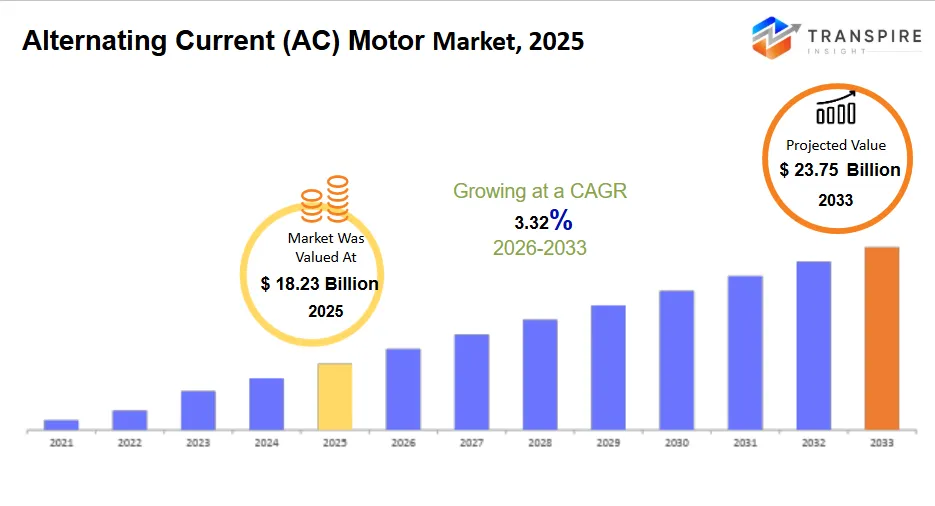
As per the Transpire Insight Analysis, The Alternating Current (AC) Motor Market size is estimated at USD 18.23 billion in 2025 and is anticipated to reach USD 23.75 billion by 2033, growing at a CAGR of 3.32% from 2026 to 2033.
The AC motor market provides key support for industrial production, building operation, water delivery, and transportation by converting electrical power into mechanical power. AC motors also operate pumps, compressors, conveyors, fans, and automated machinery. Over the past three to five years, purchasing decisions have evolved from dollar investments in equipment to cost management focused on lifetime energy use, operational dependability, and compatibility with digital control systems. The structural shift towards higher-efficiency AC motors and variable-speed operation increasingly looks to benefit from the tightening of energy-performance standards, and the IE4 efficiency category in some motor classes will further complement replacement investments. Costs of electrical power for industrial use and repair are also rising, improving the incentive to replace less-efficient models. As manufacturing companies upgrade their plants and equipment, the energy savings and control enhanced by higher efficiency motors will increasingly be seen as improving productivity rather than increasing capacity.
Alternating Current (AC) Motor Market Size & Forecast:
- Market Size 2025: USD 18.23 Billion
- Expected Market Value (2033): USD 23.75 Billion
- Forecast CAGR (2026–2033): 3.32%
- Leading Region in 2025: Asia Pacific
- Fastest Growing Region: Middle East and Africa
- Key Company Profiles: ABB, Siemens, WEG, Nidec, Regal Rexnord, TECO Westinghouse, Toshiba, Johnson Electric, Mitsubishi Electric, Rockwell Automation, Schneider Electric, Hitachi Industrial Equipment Systems, Bharat Bijlee, Kirloskar Electric, Wolong Electric.
Key Alternating Current (AC) Motor Market Insights:
The market is shifting away from traditional motor supply to a focus on efficiency and digitally-connected motion systems. The ability to combine motor engineering, intelligent drives, lifecycle services, and regional manufacturing is a key competitive advantage.
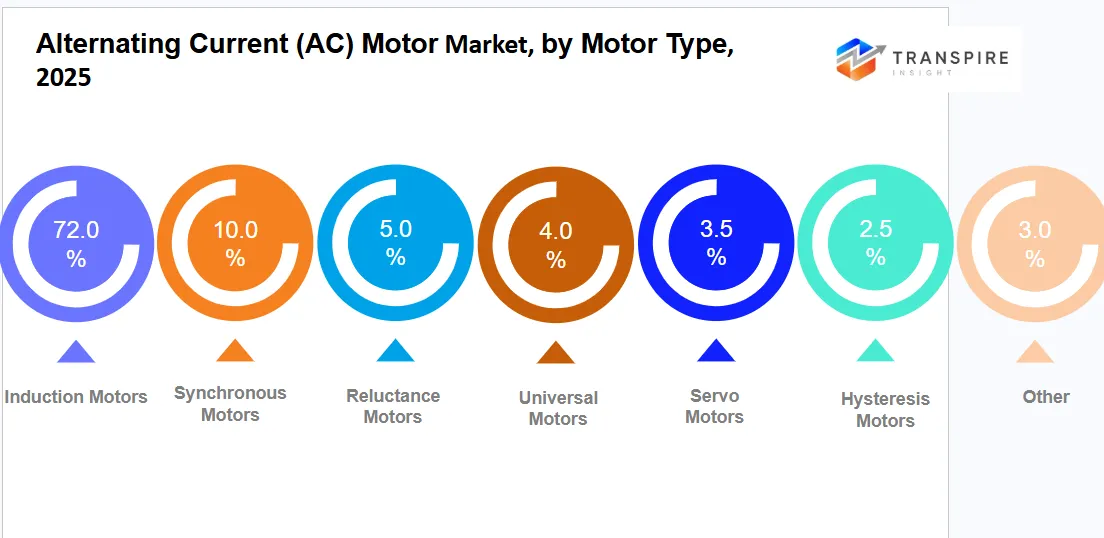
- While induction motors hold onto their 72.0% share, the synchronous motors are on the rise with precision motion and high power density and grid-support applications.
- SIMOTICS upgrades fight competition with motor systems that are software-enabled, thanks to connectivity, drive integration, and monitoring from Siemens.
- Nidec introduced the PrecisionFlow ECM technology and the next-generation compact industrial motors in 2026 for energy-efficient HVAC and automation applications.
- In 2026, WEG increased its high-efficiency motor capacity, further boosting its cost competitiveness in mining and infrastructure manufacturing.
- The spread of IE4 and IE5 is growing in manufacturing, water treatment, chemicals, mining, and HVAC, where efficiency is one of the demands placed on procurement.
- A behavioural change towards lifecycle energy management is reflected by the trend of buyers asking for motor-drive packages instead of just motors.
- This is also the case for servo motors at 3.5%, which are becoming increasingly important in the field of robotics and machine tools as precision assembly and material handling in factories are automated.
- Rare-earth exposure is helping to build reluctance-motor development, accounting for 5.0%, and provides a magnet-light efficiency path.
- MEA is expected to see 6.5% CAGR, driven by desalination, cooling, oil-and-gas processing, and industrial diversification.
What are the Key Drivers, Restraints, and Opportunities in the Alternating Current (AC) Motor Market?
Driver:
Efficiency regulation and energy-cost pressure. Mandatory minimum-efficiency rules in the EU, United States, China, and other major markets are converting motor purchases from discretionary upgrades into compliance-driven replacements. The EU’s move toward IE4 requirements for selected power ranges and China’s push for high-efficiency motor output have shortened replacement cycles and lifted demand for IE3-and-above products. This directly supports revenue because premium motors, drives, and retrofit services carry higher value than commodity IE2 units. Manufacturers are installing more servo and synchronous motor-based motion systems for robotics, machine tools, and automated material handling after labour shortages and supply-chain disruption increased the case for automation. This raises adoption of higher-precision, sensor-equipped motors rather than basic fixed-speed units.
Restraint:
High initial investment remains a barrier, particularly for smaller manufacturers operating older machinery. Premium-efficiency motors, variable-frequency drives, installation modifications, and commissioning can increase upfront expenditure. The issue persists because replacement often requires production shutdowns, compatibility assessments, and skilled technicians. Consequently, buyers may postpone upgrades despite potential electricity savings.
Opportunity:
Industrial digitalisation creates opportunities for connected motors, predictive maintenance, and efficiency-focused retrofits. Manufacturers can combine high-efficiency motors with intelligent drives and monitoring platforms to offer measurable operating-cost improvements. Emerging manufacturing investments across India and Southeast Asia provide opportunities for scalable low-voltage and industrial motor installations. Additionally, replacing ageing equipment with IE4 and IE5-compatible solutions can improve lifecycle economics, particularly in continuously operating pump, compressor, and HVAC systems. Suppliers offering integrated motor-drive-monitoring packages are positioned to capture higher-value customer relationships.
Driver Impact Analysis for the Alternating Current (AC) Motor Market
|
Driver |
Relative Impact on Growth (%) |
Geographic Relevance |
Impact Timeline |
Demand Strength |
Growth Mechanism |
Key Beneficiaries |
Major Constraint |
|
1. Energy Efficiency Regulations and Premium-Efficiency Motor Adoption |
27% |
Europe, North America, China, India |
Medium-term (2–4 years) |
High |
Mandatory efficiency standards accelerate IE3/IE4 motor replacement and premium-efficiency adoption. |
Motor OEMs, energy-efficient motor manufacturers, industrial end users, drive suppliers |
Higher upfront costs and longer payback periods. |
|
2. Industrial Automation and Smart Manufacturing Expansion |
24% |
Asia-Pacific, North America, Europe |
Long-term (≥4 years) |
High |
Robotics, automated production lines, and precision machinery increase AC servo and motor demand. |
AC servo manufacturers, automation integrators, robotics companies, industrial equipment OEMs |
High automation investment and integration complexity. |
|
3. Manufacturing Capacity Expansion and Industrial Infrastructure Investment |
20% |
China, India, Southeast Asia, North America |
Medium-term (2–4 years) |
High |
Factory expansion and industrialisation increase motor installations across manufacturing and processing applications. |
AC motor manufacturers, industrial OEMs, engineering contractors, manufacturing companies |
Economic uncertainty and industrial capital expenditure delays. |
|
4. HVAC, Water Infrastructure, and Commercial Building Development |
16% |
Asia-Pacific, North America, Middle East |
Medium-term (2–4 years) |
High |
HVAC installations, water treatment, and building infrastructure increase demand for motor-driven pumps and fans. |
HVAC manufacturers, pump suppliers, motor OEMs, infrastructure contractors |
Construction slowdowns and infrastructure funding constraints. |
|
5. Replacement of Ageing Motors and Industrial Equipment Modernisation |
13% |
Europe, North America, Japan, India |
Short-term (≤2 years) |
Medium |
Ageing motor replacement and modernization improve reliability and reduce operating costs. |
Replacement motor suppliers, maintenance providers, distributors, industrial end users |
Extended equipment lifecycles and deferred replacement spending. |
|
Total |
100% |
— |
— |
— |
— |
— |
— |
What Has the Impact of Artificial Intelligence Been on the Alternating Current (AC) Motor Market?
AI's role in managed assets over passive assets: the most promising use case for AI and IoT in energy is predictive analytics. New IoT sensors record vibration, temperature, current, and acoustic signatures; machine-learning models then spot issues such as bearing wear, misalignment, insulation degradation, and overheating - well before components fail. Studies of IoT-enabled vibration monitoring have reported reductions in unplanned downtime, energy savings, and longer lifetimes for Motors in manufacturing environments, as well as condition-based maintenance, automated work-order prioritisation, and fleet-wide energy benchmarking. Other applications include driving asset condition-based maintenance scheduling, automating work order prioritisation, benchmarking asset energy performance across the fleet, and early identification of process drift. This approach can help sectors like water utilities, mining, and continuous manufacturing defer expenditure from emergency repairs to more predictable, planned maintenance. But retrofitting old motors with sensors, edge computing, and analytics can be costly, and there is often insufficient data on failed motors to build representative models. Many mid-sized manufacturing plants therefore choose to use condition monitoring for their highest-value, continuous operation assets.
In April 2026, ABB announced its Startup Challenge winners, funding and partnering with specialised firms like Faraday Predictive to scale sensorless AI motor and drive diagnostics.https://new.abb.com/news/detail/135070/abb-startup-challenge-winners-drive-ai-powered-energy-innovation
Key Alternating Current (AC) Motor Market Trends:
The market is moving away from selling an individual motor to integrated solutions in terms of efficiency, control, and monitoring. Lifecycle performance, digital compatibility, and application-specific engineering are becoming more and more critical competitive differentiators.
- As the regulations and corporate energy goals get tighter, IE2/IE3 is moving out of the way, with an eye on IE4 and IE5 for efficient procurements.
- In variable-load applications, buyers are more likely to require a motor-and-drive package, rather than just a motor.
- Condition monitoring is being widely used in pumps, compressors, and critical HVAC assets.
- In response to growing concerns about the rare-earth elements used in permanent-magnet machines, manufacturers are shifting to other designs, including synchronous reluctance and ferrite-assisted machines.
- Data-centre cooling, heat pumps, and water treatment are growing to become a more significant demand group than traditional general industry.
- Industrial buyers are turning to motor-as-a-service and performance-based contracts, where the payment depends on the availability or energy savings.
- Motor demand in explosion-proof and hazardous areas is increasing in conjunction with oil-and-gas, chemical, and mining safety requirements.
- Beyond low-cost, standard motors, Asian manufacturers are now making inroads into premium European segments with IE5 offerings.
- Premium-efficiency claims are becoming more comparable with harmonised IEC efficiency references.
Alternating Current (AC) Motor Market Segmentation
Motor Type:
Induction motors dominate the market, accounting for 72.0% of market share. Their popularity is based on being very rugged, inexpensive, and versatile for use in pumps, fans, compressors, as well as general industrial use. Synchronous motors are experiencing growth, accounting for 10.0% of the market. Their popularity is based on extensive capability for speed control, power-factor benefits, and high-efficiency applications. Reluctance motors make up 5.0% of the market and enjoy the absence of magnets in their design, avoiding the use of rare-earth materials. Universal motors account for 4.0%, servo motors 3.5%, and hysteresis motors 2.5%. All others are at 3.0%. The future implication is moving value from standard induction units to synchronous, reluctance, and servo motors in automation and high-efficiency applications.
Voltage:
Voltage coverage includes extra-low, low, medium, and high-voltage systems, alongside single-phase, three-phase, and custom configurations. Low-voltage motors maintain strong demand across commercial buildings, small machinery, and industrial equipment because of their accessibility and installation flexibility. Medium- and high-voltage motors support energy-intensive operations, including mining, manufacturing, and power generation. As industrial facilities expand and electrification progresses, voltage-specific engineering becomes increasingly important for operational safety, compatibility, and reliable performance across diverse applications and demanding operating environments.
Power Rating:
AC motors span power ratings from below 1 HP to above 1,000 HP, serving applications with substantially different operating requirements. Smaller motors support appliances, compact machinery, and commercial equipment, where affordability and space efficiency influence purchasing decisions. Higher-powered motors serve mining, manufacturing, processing, and infrastructure operations requiring substantial mechanical output. Industrial automation and equipment modernisation are encouraging buyers to evaluate power requirements alongside efficiency, load characteristics, and operating conditions, improving equipment selection and reducing unnecessary energy consumption throughout the motor lifecycle.
Application:
Pumps, fans, compressors, conveyors, machine tools, HVAC systems, and industrial automation represent important AC motor applications. Pumping and ventilation systems prioritise continuous operation, energy efficiency, and dependable performance, while compressors require reliable torque delivery under varying loads. Conveyors and machine tools increasingly depend on variable-speed control to improve production flexibility. HVAC applications benefit from adjusting motor speed according to changing environmental conditions. Industrial automation further strengthens demand for motors capable of precise movement, coordinated control, and integration with advanced manufacturing equipment.
End User:
Manufacturing, oil and gas, mining, power generation, automotive, commercial buildings, and water and wastewater represent significant AC motor end-user industries. Manufacturing facilities prioritise productivity, equipment reliability, and energy management, while mining and oil and gas operations require motors capable of handling demanding environmental conditions. Commercial buildings depend on motors for ventilation, cooling, and circulation. Water infrastructure supports sustained pumping requirements. Automotive production increasingly integrates motors into automated manufacturing processes, strengthening demand for dependable equipment, specialised engineering, and application-specific performance.
Efficiency:
Efficiency segmentation includes IE1, IE2, IE3, IE4, IE5, premium-efficiency, and ultra-premium-efficiency motors. Lower-efficiency equipment remains relevant in existing installations and cost-sensitive applications, while higher-efficiency designs attract investment where operating hours and electricity expenses justify upgrades. Regulatory requirements and lifecycle-cost assessments increasingly influence procurement decisions. Manufacturers are developing improved motor designs and drive compatibility to reduce energy losses. However, installation costs, equipment compatibility, and payback expectations continue to influence adoption, particularly among smaller industrial operators and facilities with limited capital expenditure budgets.
What are the Key Use Cases Driving the Alternating Current (AC) Motor Market?
Induction motors dominate core industrial applications, particularly pumps, fans, compressors, and conveyors. Their 72.0% market share reflects suitability for continuous operation, robust construction, and economical maintenance across manufacturing, water treatment, and commercial infrastructure.
Expanding applications include HVAC systems, automated production lines, machine tools, mining equipment, and automotive manufacturing. Variable-speed drives enable motors to match changing operational requirements, improving process flexibility and energy utilisation. Medium- and high-power configurations support demanding industrial environments.
Emerging use cases involve AI-enabled predictive maintenance, digitally monitored motor-drive systems, renewable-energy infrastructure, and advanced industrial automation. Synchronous and reluctance motor technologies provide opportunities where precise control, improved efficiency, or specialised operating characteristics justify premium investment.
|
Report Metrics |
Details |
|
Market size value in 2025 |
USD 18.23 Billion |
|
Market size value in 2026 |
USD 18.89 Billion |
|
Revenue forecast in 2033 |
USD 23.75 Billion |
|
Growth rate |
CAGR of 3.32% from 2026 to 2033 |
|
Base year |
2025 |
|
Historical data |
2021 - 2024 |
|
Forecast period |
2026 - 2033 |
|
Report coverage |
Revenue forecast, competitive landscape, growth factors, and trends |
|
Regional scope |
United States; Canada; Mexico; United Kingdom; Germany; France; Italy; Spain; Denmark; Sweden; Norway; China; Japan; India; Australia; South Korea; Thailand; Brazil; Argentina; South Africa; Saudi Arabia; United Arab Emirates |
|
Key companies profiled |
ABB, Siemens, WEG, Nidec, Regal Rexnord, TECO Westinghouse, Toshiba, Johnson Electric, Mitsubishi Electric, Rockwell Automation, Schneider Electric, Hitachi Industrial Equipment Systems, Bharat Bijlee, Kirloskar Electric, Wolong Electric. |
|
Customization scope |
Free report customization (country, regional & segment scope). Available customized purchase options to meet your exact research needs. |
|
Report Segmentation |
Motor Type (Induction Motors, Synchronous Motors, Reluctance Motors, Universal Motors, Servo Motors, Hysteresis Motors, Other); Voltage (Low Voltage, Medium Voltage, High Voltage, Extra-Low Voltage, Single-Phase, Three-Phase, Custom); Power Rating (Below 1 HP, 1–10 HP, 10–50 HP, 50–100 HP, 100–500 HP, 500–1000 HP, Above 1000 HP); Application (Pumps, Fans, Compressors, Conveyors, Machine Tools, HVAC, Industrial Automation); End User (Manufacturing, Oil & Gas, Mining, Power Generation, Automotive, Commercial Buildings, Water & Wastewater); Efficiency (IE1, IE2, IE3, IE4, IE5, Premium Efficiency, Ultra-Premium Efficiency) |
Which Regions are Driving the Alternating Current (AC) Motor Market Growth?
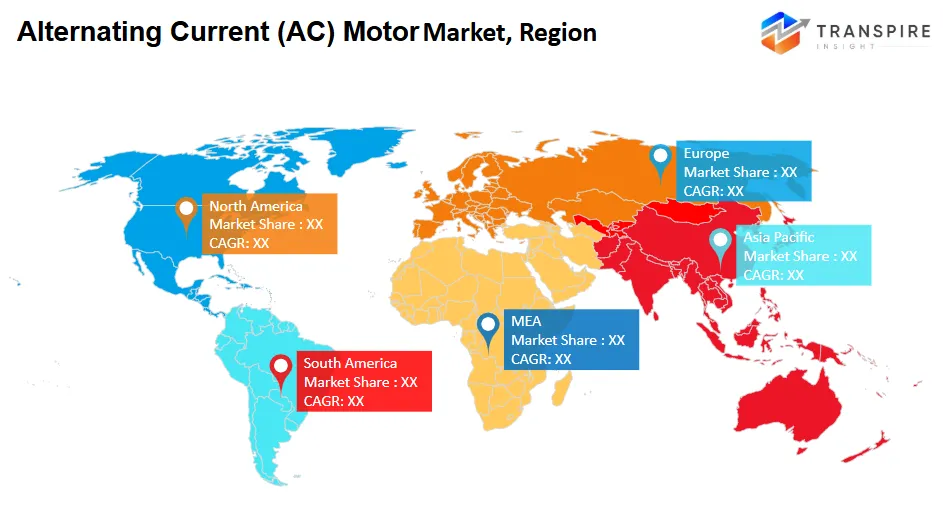
Asia Pacific accounts for 48.5% of the market share, driven by China's manufacturing, India's infrastructure projects, and Southeast Asia's electronics, automotive, and process industries, which combine the world's lowest-cost production bases with a rapidly growing domestic market for pumps, compressors, HVAC equipment, and factory automation. Rising government incentives for industrial upgrades, electrification programs, and energy-efficiency requirements are encouraging pump and other manufacturers to migrate to IE3-or-better motor platforms.
In March 2026, ABB announced an additional $75 million investment in India to expand its domestic manufacturing footprint and R&D capabilities across five key locations, including a $21 million allocation specifically dedicated to upgrading its Peenya facility in Bengaluru. https://new.abb.com/news/detail/133972/abb-invests-75-million-in-india-to-expand-manufacturing-and-rd-for-critical-segments
Europe accounts for 20.0%, versus 18.5% for North America, 7.0% for MEA, and 6.0% for Latin America. Europe's market is less volume-focused and more value-focused, with EU Ecodesign rules, carbon-neutrality policies, and Industry 4.0 investments strongly favouring IE4/IE5 motors, variable-speed drives, and connected monitoring. North America provides a stable replacement market, underpinned by automation, commercial HVAC, hazardous-duty oil-and-gas machinery, and by reshoring investment in manufacturing.
In April 2026, WEG entered into a strategic partnership with SpinDrive to integrate active magnetic bearings into their high-speed industrial motor systems. This collaborative development directly addresses the value-driven demands of modern manufacturing by producing completely oil-free, highly efficient drivetrain solutions that reduce friction losses and feature built-in digital monitoring capabilities. https://tracxn.com/d/acquisitions/acquisitions-by-weg/__r4LXXYKxiLuCdaW6wK7llOWHCurKVixAfGJhACYfOTU
The Middle East and Africa make up 7.0%, with a CAGR of around 6.5%. Latin America constitutes 6.0%. Demand from oil and gas sites, desalination, wastewater, and industrial diversification more strongly influences demand in the former area. Motor suppliers have opportunities from Saudi industrial development and Gulf infrastructure projects, although import dependency and project lead times restrict these. https://www.arabnews.pk/business/saudi-arabia-to-locally-produce-high-speed-engines-under-rolls-royce-deal-3002888
Who are the Key Players in the Alternating Current (AC) Motor Market, and how do they compete?
Competition focuses on efficiency, scale, deep engineering capacity, reach, and aftermarket support. ABB, Siemens, WEG, Nidec, and Regal Rexnord compete through wide product ranges, industrial relationships, and complete motor-drive solutions; innovations in IE5 and synchronous-reluctance technologies have set ABB apart, while Siemens' offerings are solid in motor and automation/digital control integration.
WEG strives for scale, application range, and expansion; Nidec leverages diversified motor experience and economical production; Regal Rexnord relies on industrial power transmission and application-specific dependability. TECO, Westinghouse, and Toshiba are highly competitive as a result of industrial engineering and applications experience, and an extensive customer base; Johnson Electric is focused on tight, application-specific motion; Mitsubishi Electric and Rockwell Automation provide digital intelligence and factory-automation integration; Schneider Electric for energy management and connected automation; Hitachi Industrial Equipment for industrial dependability; Bharat Bijlee and Kirloskar Electric have advantages in domestic manufacturing, custom engineering, and regional servicing; Wolong Electric has economies of scale and international presence. The leading competitors are expanding through local manufacturing, targeted distribution, digitization, and efficiency-optimised product design, rather than through traditional price competition.
Key Players are:
- Regal Rexnord
- TECO Westinghouse
- Toshiba
- Johnson Electric
- Mitsubishi Electric
- Rockwell Automation
- Schneider Electric
- Hitachi Industrial Equipment Systems
- Bharat Bijlee
- Kirloskar Electric
- Wolong Electric
Alternating Current (AC) Motor Market — Enhanced Competitive Benchmarking
|
Company |
Est. Revenue Share Range |
Key Offerings |
Strategic Positioning |
Geographic Strength |
Technology Focus |
|
ABB Ltd. |
Estimated 8–12% |
IEC/NEMA motors, Baldor-Reliance motors, IE4/IE5 motors, hazardous-duty motors |
scale leadership with premium efficiency and application-specific reliability |
Europe, North America, Asia Pacific |
IE4/IE5 efficiency, synchronous reluctance, VFD-compatible designs |
|
Innomotics GmbH |
Estimated 6–9% |
Low-voltage motors, high-voltage motors, explosion-protected motors, geared motors |
Industrial engineering leadership focused on high-power and mission-critical applications. |
Europe, Asia Pacific, North America |
High-voltage drive systems, converter operation, digital condition monitoring |
|
WEG S.A. |
Estimated 5–8% |
W22 motors, W51 HD motors, brake motors, explosion-proof motors |
Vertically integrated manufacturing with competitive pricing and broad industrial coverage |
Latin America, North America, Europe |
High-efficiency induction motors, variable-speed drives, integrated motor-drive solutions |
|
Nidec Corporation |
Estimated 5–8% |
Industrial AC motors, U.S. MOTORS products, geared motors, custom motor solutions |
Diversified motor specialist combining scale with application-specific customization |
Asia Pacific, North America, Europe |
High-efficiency motors, variable-speed operation, compact motor architectures |
|
Regal Rexnord Corporation |
Estimated 4–7% |
Marathon motors, Leeson motors, HVAC motors, industrial-duty motors |
Strong installed-base strategy emphasizing replacement demand and application reliability |
North America, Europe, Asia Pacific |
Inverter-duty motors, integrated power transmission, energy-efficient motor designs |
|
Wolong Electric Group |
Estimated 2–5% |
Industrial AC motors, high-voltage motors, specialized motors, industrial drive products |
Scale-oriented manufacturer expanding internationally through industrial applications. |
Asia Pacific, Europe, North America |
High-efficiency induction motors, large industrial motor systems, manufacturing optimization |
|
Toshiba Corporation |
Estimated 2–4% |
Industrial AC motors, high-voltage motors, premium efficiency motors, heavy-duty motor systems |
Premium engineering specialist serving demanding industrial and infrastructure applications |
Asia Pacific, North America, Europe |
High-power motor engineering, advanced insulation, efficiency and thermal management |
|
Mitsubishi Electric Corporation |
Estimated 2–4% |
AC servo motors, induction motors, industrial motors, motion-control motors |
Automation-led differentiation through precision motion and integrated control systems |
Asia Pacific, Europe, North America |
Servo control, precision motion, inverter-driven motors, industrial automation integration |
|
TECO Electric & Machinery Co., Ltd. |
Estimated 2–4% |
Low-voltage motors, medium-voltage motors, industrial AC motors, explosion-proof motors |
Regional manufacturing strength with competitive industrial pricing and customization |
Asia Pacific, North America, Europe |
High-efficiency induction motors, variable-frequency operation, motor-drive integration |
|
Yaskawa Electric Corporation |
Estimated 1–3% |
AC servo motors, induction motors, motion-control motors, motor-drive systems |
Precision motion-control specialist targeting advanced manufacturing and automation |
Asia Pacific, Europe, North America |
AC servo technology, regenerative drives, precision motion control, digital automation |
Recent Development News
- In August 2026, CG Power and Industrial Solutions launched its NEXORA IE3 and IE4 general-purpose motor series, featuring improved energy efficiency, reliability, and variable-frequency-drive compatibility. The launch strengthens the availability of energy-efficient induction motors for industrial applications while helping customers reduce energy consumption and lifecycle operating costs.https://www.industrialautomationindia.in/news/cg-nexora-ie3-ie4-general-purpose-motors
- In June 2026, Siemens Limited successfully closed the sale of its low-voltage motors and geared motors business to Innomotics India Pvt. Ltd. for a cash consideration of INR 2,200 crore. This divestment shifts the company's operational focus away from standard AC motor manufacturing toward core industrial digitalization, smart infrastructure, and automated mobility solutions.https://press.siemens.com/in/en/pressrelease/siemens-limited-successfully-closes-sale-low-voltage-motors-business-innomotics-india
- In October 2026, Nidec Motion & Energy entered into a strategic collaboration agreement with Ashok Leyland to co-develop custom commercial vehicle e-drive AC motors and propulsion systems. This partnership accelerates the domestic adoption and technological infrastructure of heavy electrified transport across the commercial electric vehicle value chain.https://acim.nidec.com/en/motors/News-And-Media/Press-Releases/Nidec-accelerates-Commercial-Vehicle-electrification-in-India
What Strategic Insights Define the Future of the Alternating Current (AC) Motor Market?
Technology and end-market shifts: The market is moving from motors to motor systems; efficiency compliance, variable-speed control, sensing and analytics are becoming a single, bundled offering. An important risk in this area relates to the reliance on the supply of rare-earth materials and electrical steel, which could increase costs and extend timescales for premium permanent-magnet synchronous programs. An important future opportunity exists in sectors such as desalination, cooling, water networks, mining and grid modernization, as well as infrastructure in the Middle East and Africa and the Asia Pacific. In these demanding applications, an end-user payback can be achieved through the use of IE4 and IE5 systems and long-term service agreements. Encouraging end-users to install retrofit-ready, sensor-compatible motor-drive packages and local manufacturing will help reduce import exposure and speed up implementation, while also providing ongoing monitoring, service, and efficiency benefits.
Key Segmentations are:
Motor Type
- Induction Motors
- Synchronous Motors
- Reluctance Motors
- Universal Motors
- Servo Motors
- Hysteresis Motors
- Other
Voltage
- Low Voltage
- Medium Voltage
- High Voltage
- Extra-Low Voltage
- Single-Phase
- Three-Phase
- Custom
Power Rating
- Below 1 HP
- 1–10 HP
- 10–50 HP
- 50–100 HP
- 100–500 HP
- 500–1000 HP
- Above 1000 HP
Application
- Pumps
- Fans
- Compressors
- Conveyors
- Machine Tools
- HVAC
- Industrial Automation
End User
- Manufacturing
- Oil & Gas
- Mining
- Power Generation
- Automotive
- Commercial Buildings
- Water & Wastewater
Efficiency
- IE1
- IE2
- IE3
- IE4
- IE5
- Premium Efficiency
- Ultra-Premium Efficiency
By Regional Analysis
North America
- US
- Canada
- Mexico
Europe
- Germany
- UK
- France
- Italy
- Spain
- Russia
- Rest of Europe
Asia Pacific
- China
- Japan
- India
- South Korea
- Australia
- Rest of Asia Pacific
South America
- Brazil
- Argentina
- Rest of South America
Middle East & Africa
- UAE
- Saudi Arabia
- Qatar
- South Africa
- Rest of the Middle East & Africa
Frequently Asked Questions
Find quick answers to common questions.
The alternating current (AC) motor market size was valued at USD 18.23 billion in 2025 and is poised to reach USD 23.75 billion by 2033, expanding at a 3.32% CAGR.
Key segments for the alternating current (AC) motor market are Motor Type (Induction Motors, Synchronous Motors, Reluctance Motors, Universal Motors, Servo Motors, Hysteresis Motors, Other); Voltage (Low Voltage, Medium Voltage, High Voltage, Extra-Low Voltage, Single-Phase, Three-Phase, Custom); Power Rating (Below 1 HP, 1–10 HP, 10–50 HP, 50–100 HP, 100–500 HP, 500–1000 HP, Above 1000 HP); Application (Pumps, Fans, Compressors, Conveyors, Machine Tools, HVAC, Industrial Automation); End User (Manufacturing, Oil & Gas, Mining, Power Generation, Automotive, Commercial Buildings, Water & Wastewater); Efficiency (IE1, IE2, IE3, IE4, IE5, Premium Efficiency, Ultra-Premium Efficiency)
Growth is primarily driven by industrial automation, energy-efficiency regulations, manufacturing expansion, increasing adoption of variable-frequency drives, infrastructure development, and demand for reliable, digitally monitored motor systems.
The alternating current (AC) motor market is led by major manufacturers including ABB, Siemens, WEG, Nidec, Regal Rexnord, TECO Westinghouse, Toshiba, Johnson Electric, Mitsubishi Electric, Rockwell Automation, Schneider Electric, Hitachi Industrial Equipment Systems, Bharat Bijlee, Kirloskar Electric, and Wolong Electric.
Asia Pacific dominates the AC motor market with a 48.5% share, supported by extensive manufacturing infrastructure, industrial automation, infrastructure development, expanding production capacity, and increasing investments in energy-efficient motor technologies.
Commercial opportunities include IE4/IE5 motor upgrades, AI-enabled predictive maintenance, variable-frequency drive integration, industrial automation, and infrastructure-led expansion across emerging economies.
- ABB
- Siemens
- WEG
- Nidec
- Regal Rexnord
- TECO Westinghouse
- Toshiba
- Johnson Electric
- Mitsubishi Electric
- Rockwell Automation
- Schneider Electric
- Hitachi Industrial Equipment Systems
- Bharat Bijlee
- Kirloskar Electric
- Wolong Electric
About the Authors

Mayur Shinde
I am Mayur Shinde, a Senior Research Analyst at Transpire Insight, specializing in the Automotive & Transportation and Information & Communication Technology (ICT) Industry. My work focuses on analyzing emerging market trends, technological advancements, competitive landscapes, and industry developments to deliver accurate, data-driven insights. I am passionate about transforming complex market information into clear, actionable content that helps businesses, professionals, and decision-makers stay informed and make confident strategic decisions.

Chakradhar Khansole
Chakradhar serves as the Research Director at Transpire Insight, bringing over 8 years of experience in technology, innovation, and strategic market intelligence. He specializes in transforming complex market data into actionable business insights that enable organizations to make informed, growth-oriented decisions. Recognized for his strategic vision and analytical expertise, Chakradhar leads high-impact research initiatives, delivering comprehensive market assessments, competitive intelligence, and forward-looking industry analysis.
Recently Published Reports
-
Apr 2026
3D Optical Profiler Market
3D Optical Profiler Market Size, Share & Analysis Report By Type (Desktop 3D Optical Profiler, and Portable 3D Optical Profiler), By Technology (Confocal Technology, and White Light Interference), By End-Use Industry (Manufacturing, Research Institutions, Automotive, Aerospace and Defense, Medical Devices, and Other), and Geography (North America, Europe, Asia-Pacific, Middle East and Africa, South and Central America), 2021 - 2031
-
Apr 2026
Depth Sensor Market
Depth Sensor Market Size, Share & Analysis Report By Type (Infrared Depth Sensors, Time-of-Flight (ToF) Sensors, Stereo Vision Sensors, Structured Light Sensors, Ultrasonic Depth Sensors), By Application (Automotive, Robotics, Gaming, Consumer Electronics, Industrial Automation, Healthcare, Security & Surveillance, Others), By End Users (Automotive Manufacturers, Consumer Electronics Companies, Healthcare Providers, Industrial Companies, Security Agencies, Gaming Companies, Robotics Companies, Others), and Geography (North America, Europe, Asia-Pacific, Middle East and Africa, South and Central America), 2021 – 2031
-
Apr 2026
Digital Manufacturing Market
Digital Manufacturing Market Size, Share & Analysis Report By Component (Hardware, Software, and Services), By Technology (Robotics, 3D Printing, Internet of Things (IoT), and Others), By Application (Automotive and Transportation, Aerospace and Defense, Consumer Electronics, Industrial Machinery, and Others), By Process Type (Computer-Based Designing, Computer-Based Simulation, Computer 3D Visualization, Analytics, and Others), and Geography (North America, Europe, Asia-Pacific, Middle East and Africa, South and Central America), 2021 – 2031
-
Apr 2026
Digital Visa Services Market
Digital Visa Services Market Size, Share & Analysis Report By Type (Individual Travelers, Group Travelers), By Application (Tourism, Business Travel, Others), and Geography (North America, Europe, Asia-Pacific, Middle East and Africa, South and Central America), 2021 – 2031